Hip Hop Hits Sung Wonderfully in Sign Language: Eminem’s “Lose Yourself,” Wiz Khalifa’s “Black and Yellow” & More
The first time I went to see David Sedaris read some of his hilarious essays live, I ended up laughing much more than I expected. By luck of seating, I found myself at the right of the stage, facing his sign language interpreter. She didn’t just quickly parse what he said. No, she also became a sort of double act with the author, throwing her whole body and facial expressions into making Sedaris’ prose sing. Especially when he came to some sexual idiom or turn of phrase, we all became aware of the audience’s gaze shifting rightward to see what his signer would do. (The wondrous Internet has not revealed her name–possibly one of our readers knows.)
That’s a preamble to say that the latest YouTube sensation above, Shelby Mitchusson, who signs her way through Eminem’s “Lose Yourself,” should come as no surprise to those who have encountered such lively interpretation, turning language for the deaf into a performance art. Mitchusson admits she’s still a beginner, but her 3 million views says she has made fans of the deaf and hearing alike. (And for once the YouTube comments don’t make you sad for humanity.)
But Mitchusson’s “hit” leads to a whole world of American Sign Language (ASL) stars once you jump down the YouTube rabbit hole. Just over a year ago, Jimmy Kimmel had on three ASL interpreters to compete in a rap battle to Wiz Khalifa’s “Black and Yellow” which you can see below.
One of them, the pink-haired Amber Galloway Gallego, had her own time in the viral video limelight back in 2013. Her spirited versions of Snoop Lion, Kendrick Lamar, and others during Lollapalooza earned her many Internet views, no doubt for her lascivious performance of rap and r’n’b’s smuttiest lyrics. She even received coverage in Rolling Stone, where the San Antonio, TX native tells stories of signing “Baby Got Back” at a barbecue at the beginning of her career. Her YouTube channel features her own versions of all the current pop hits (Taylor Swift, Carly Rae Jepsen) and classics (The Human League, Celine Dion).
The history of sign language is long and deep, with a rough guess at 137 recognized versions around the globe, according to Ethnologue. (But as deaf communities often develop their own dialects, it’s hard to tell.)
And the Internet, specifically YouTube–along with the beat-heavy genre of hip hop–has brought a subculture into the mainstream, something that years of advocacy by deaf groups couldn’t quite manage to do. Thanks again, Internet!
You can find some online ASL lessons here, or in our meta collection of Free Language Lessons.
Related content:
Learn 48 Languages Online for Free: Spanish, Chinese, English & More
Helen Keller & Annie Sullivan Appear Together in Moving 1930 Newsreel
Baba Brinkman: The Rap Guide to Evolution
Ted Mills is a freelance writer on the arts who currently hosts the FunkZone Podcast. You can also follow him on Twitter at @tedmills, read his other arts writing at tedmills.com and/or watch his films here.
Read More...The Well-Tempered Clavier: Download an Open Version of J.S. Bach’s Masterpiece
In 2012, the Japanese-German classical musician Kimiko Ishizaka made available to the world an open version of J.S. Bach’s Goldberg Variations performed on a Bösendorfer 290 Imperial piano in Berlin. Funded by a Kickstarter campaign, the recording was released under a Creative Commons Zero license, which essentially put the music straight into the public domain.
Yesterday we discovered, thanks to one of our readers, Ishizaka’s follow-up to The Open Goldberg Variations — The Open Well-Tempered Clavier, Book 1. Also Kickstarter-funded and released under a Creative Commons license, her new production puts 48 Preludes and Fugues into the commons. Explaining the importance of The Well-Tempered Clavier, Alexandre Prokoudine writes over at Libre Graphics World:
Among classical music connoisseurs, the Well-Tempered Clavier Book 1 (WTC, or “the 48” for short) is widely regarded as one of the most influential works by J.S. Bach. Here is why.
For a long time instruments used to be tuned in such intervals between notes that transposition (playing a melody in a key different from the originally intended one) usually produced a melody that was clearly out of tune. Finding the right intervals was an interesting mathematical problem to solve, and it was done in the 17th century by Andreas Werckmeister.
So while J.S. Bach didn’t invent well-tempered tuning, the 48 was his major, if not defining contribution to making it popular, as the 48 was pretty much The Music Theory Bible for generations of composers…
Historical value aside, the 48 is simply beautiful and elegantly sophisticated music (with score laid out in up to four voices, yet played by a single musician). If this is the first time you are listening to WTC, I officially envy you, because are about to discover something very special.
You can get the Open Well-Tempered Clavier as a free download here (please read the instructions on the page), or stream it above. You can also support the artist and purchase the download for a fee of your choice, or buy a CD version over on Amazon.
As for what you can expect from Kimiko Ishizaka next, look out for a recording of the Chopin Préludes on a Pleyel piano — the same piano Chopin played himself all those years ago.
Related Content:
Download the Complete Organ Works of J.S. Bach for Free
The Open Goldberg Variations: J.S. Bach’s Masterpiece Free to Download
Glenn Gould Explains the Genius of Johann Sebastian Bach (1962)
The Genius of J.S. Bach’s “Crab Canon” Visualized on a Möbius Strip
JS Bach’s The Well-Tempered Clavier Artistically Animated with Pulsing Neon Lights
Read More...The Absurd Philosophy of Albert Camus Presented in a Short Animated Film by Alain De Botton
What is the meaning of life? This may sound simplistic or naïve, especially in relation to much contemporary philosophy, which assumes the question is incoherent and reserves its focus for smaller and smaller slices of experience. And, of course, prior to the rise of secular modernity, the question was answered for us—and still is for a great many people—by religion. One either believed the answer, through coercion or otherwise, or kept quiet about it. But at least since Søren Kierkegaard, philosophers in the West have taken the question very seriously, and found all of the answers wanting. By the mid-twentieth century, there seemed to thinkers like Albert Camus to be no answer. Life has no meaning. It is inherently absurd and purposeless.
This Camus concluded in challenging essays like “The Myth of Sisyphus” and novels like L’Etranger, a book most of us know as The Stranger but which Alain de Botton, in his School of Life video above on Camus’ philosophy, translates as The Outsider. Reading this book, de Botton observes, “has long been an adolescent rite of passage” since many of its themes “are first tackled at seventeen or so.” Its protagonist, Meursault, an older, more nihilistic version of Holden Caulfield, illustrates Camus’ thesis through his steadfast refusal to identify with any meaning-making institutions or emotions, and through a casual, senseless murder. But while Meursault may see through the pretensions of his society, he has failed to see the world as it is.
Colin Wilson, another author many people read during intellectually formative years—who wrote an existentialist study also called The Outsider—describes Meursault’s indifference to life as a product of “his sense of unreality.” Only the looming prospect of death awakens him from what Meursault calls “a heavy grime of unreality.” Instead of despairing at life’s emptiness, Camus determined that true freedom required engaging fully with life, in the face of futility—with the ultimate prospect of death and the option of suicide always in view. Camus, says de Botton, “writes with exceptional intensity… as a guide for the reasons to live.” De Botton somewhat superficially praises Camus’ sexual prowess, fashion sense, and good looks as more than just “stylistic quirks,” but as markers of his psychological health.
But more than just a ladies man, Camus was a “great champion of the ordinary,” as well as a champion footballer and Nobel prize-winning literary star. He was also a fully committed journalist and political activist for much of his career, who stood by his individual principles even as other leftist intellectuals got swept up in the allure of Soviet communism under Stalin. In the documentary above, we learn important details of many of these qualities, as well of Camus’ troubled early life. Given his background of impoverishment and loss, it is indeed remarkable that Camus—much more so than other, more privileged philosophers—lived such a rich, fully engaged life.
In a rare television interview above, Camus answers questions about his theatrical adaptation of Dostoevsky’s The Possessed, another novel that confronts head on the question of life’s meaning. He speaks of the novel’s “nihilism,” now “the reality that we have to face.” Camus does not mention that Dostoyevsky, like the existentialist Kierkegaard, managed to salvage a kind of religious faith in the face of emptiness; the French philosopher and writer was convinced of the impossibility of such a thing. But whether one draws Dostoevsky or Camus’ conclusions, both would suggest that to live authentically, one must seriously grapple with the problem of meaninglessness and the reality of death.
Related Content:
Hear Albert Camus Deliver His Nobel Prize Acceptance Speech (1957)
Existential Philosophy of Kierkegaard, Sartre, Camus Explained with 8‑Bit Video Games
Josh Jones is a writer and musician based in Durham, NC. Follow him at @jdmagness
Read More...Mœbius Illustrates Paulo Coelho’s Inspirational Novel The Alchemist (1998)

When Paulo Coelho’s novel The Alchemist came out in English, the level of popularity it eventually attained seriously impressed me. Then I went to Latin America, where the Spanish version seemed to have won a vaster readership still. I haven’t yet gone to Brazil to gauge the book’s popularity on the streets of Coelho’s homeland since its first publication to relatively little interest, but it surely hasn’t gone unknown there. As many fans as The Alchemist has, though, the inspiration-and-destiny-inflected appeal of the text entirely escapes some readers, in whichever language they read it. Perhaps they’d prefer an edition illustrated by Mœbius?

Born Jean Giraud, Mœbius’ career guarantees him a permanent place as one of the most influential comic artists ever to live. Even apart from the achievements in the medium in which he became famous — his founding work on Heavy Metal, his creation of nontraditional western outlaw Blueberry — he did a good deal of work that brought his singularly imaginative aesthetic into other creative realms, such as concept art from Alejandro Jodorowky’s Dune and illustrations for Dante’s Paradiso. In some sense, it might have seemed natural for him to lend his hand to Coelho’s fantasy tale of an Andalusian shepherd boy on a treasure-hunting journey to Egypt.
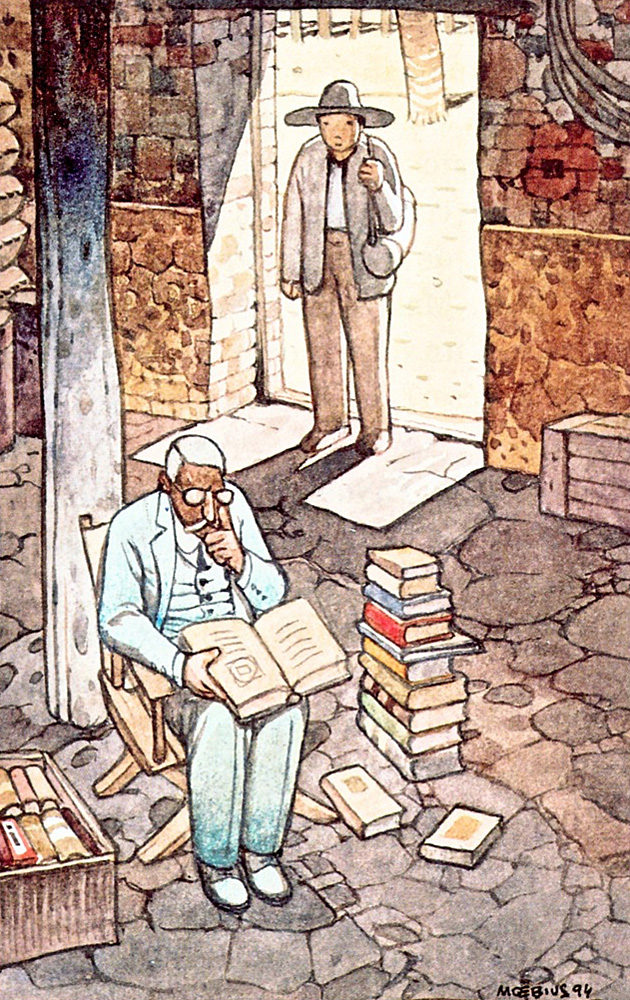
The Illustrated Alchemist: A Fable About Following Your Dream came out in 1998, and it included 35 Mœbius illustrations, four of which you see here. The artist’s signature style, which he usually used in the service of dark, complex fusions of past and present, might at first sound ill-suited for Coelho’s simple fable, but Mœbius adapts well to the material. Even if you put down the book unconvinced by Coelho’s arguments about following your dream, you might consider looking to Mœbius instead with our post on his tips for aspiring artists. Either way, The Illustrated Alchemist itself showcases a collaboration between two well-known creators who most definitely paid their dues.

Related content:
How Paulo Coelho Started Pirating His Own Books (And Where You Can Find Them)
Paulo Coelho on the Fear of Failure
The Inscrutable Imagination of the Late Comic Artist Mœbius
Mœbius’ Storyboards & Concept Art for Jodorowsky’s Dune
Mœbius Illustrates Dante’s Paradiso
Moebius Gives 18 Wisdom-Filled Tips to Aspiring Artists (1996)
Colin Marshall writes on cities, language, Asia, and men’s style. He’s at work on a book about Los Angeles, A Los Angeles Primer, and the video series The City in Cinema. Follow him on Twitter at @colinmarshall or on Facebook.
Read More...The Art of Collotype: See a Near Extinct Printing Technique, as Lovingly Practiced by a Japanese Master Craftsman
When I was a kid, I spent a lot of time at the Indianapolis Star, where my mother worked in what was then referred to as the “women’s pages.” She kept me busy returning the photos that accompanied marriage and engagement announcements, using the SASEs the young brides had supplied. After that, I’d hit the printing floor, where veteran workers sported square caps folded from the previous day’s edition, as that day’s issue clacked on tracks overhead. If I was lucky, someone would make me a gift of my name, set in hot type.
The Star still publishes — I shudder to report that its website seems to have renamed it IndyStar… — but cultural and digital advances have relegated all of the particulars mentioned above to the scrap pile.
They came rushing back with wild, Proustian urgency when Osamu Yamamoto, a master printer at Benrido Collotype Atelier in Kyoto, mentions the smell of the ink, in the short documentary above, how over the years, it has seeped into his skin, and become a part of his being.
Collotype, defined by the Getty Conservation Institute as “a screenless photomechanical process that allows high-quality prints from continuous-tone photographic negatives,” has been on the way out since the 70s. As master printer Yamamoto notes, it’s a low-efficiency, small batch operation, involving messy matrixes, hand-operated presses, and heavy iron machines that give off a sort of animal warmth when working.
Rather than pressmen’s caps, Benrido’s shirtless printers wear hachimaki, rubber aprons, and purple disposable gloves.
Filmmaker Fritz Schumann (whose film on the oldest hotel in Japan we previously featured before) evokes the workplace — one of two remaining collotype companies in the world — through small details like the plastic-wrapped digital Hamtaro clock and also by drawing viewers’ attention to the number of years logged by each employee. The art of collotype takes a long time to master and novices appear to be in short supply.
Should we conceive of this operation as a quaint relic, creeping along thanks to the whimsy of a few nostalgia buffs?
Surprisingly, no. The laborious collotype process remains the best way to duplicate precious artworks and historic documents. The way the ink interacts with reticulations in the gelatin surface atop results in subtleties that pixellated digital images cannot hope to achieve.
Visitors to the studio may support the enterprise by picking up a handful of collotype-printed postcards in the gift shop, but the office of the Japanese Emperor is the one who’s really keeping them in business, with orders to copy hundreds of delicate, centuries old scrolls, paintings and letters.
Like a circle in a circle…cultural preservation via cultural preservation! Perhaps the smell of the ink will prevail.
Related Content:
Hōshi: A Short Film on the 1300-Year-Old Hotel Run by the Same Family for 46 Generations
Mark Twain Wrote the First Book Ever Written With a Typewriter
- Ayun Halliday is an author, illustrator, and Chief Primatologist of the East Village Inky zine. Follow her @AyunHalliday
Read More...
Watch the Hardcore Original Ending to Kevin Smith’s 1994 Cult Hit Clerks
I’m not sure if it’s still the case today, in fact, I’m almost sure it isn’t, but in my day the ethos of an entire generation could be tidily summed up by reference to a handful of movies. Or at least that’s what we were led to believe, those of us who came of age in the early-to-mid 90s, when films like Richard Linklater’s Slacker (watch free online), Ben Stiller’s Reality Bites, and Kevin Smith’s Clerks achieved almost instant cult status as totems of middle class ennui—that of overeducated narcissists and directionless dreamers and cynics with serial romantic disasters and a gnawing sense of the dwindling returns on their heavy investment in cultural capital.
Of this ad hoc trilogy of 90s slackerdom, it’s Smith’s 1994 low-budget, black and white paean to the lives of low-wage convenience and video store clerks, their clueless customers, and a comic duo of stoned hangers-on that perhaps holds up best, and this is because the film’s comedy—ranging from gallows humor to gross-out slapstick to observational geekery—seems most grounded in the everyday experiences of real, absurdly bored, working stiffs everywhere. So it’s for the best that Smith decided not to finish the film with the original ending he shot, which you can see above. In it, the movie’s main character, Quick Stop clerk Dante Hicks, is killed in a robbery. The last image we see in this version’s harrowing dénouement is of his corpse, awkwardly wedged behind the Quick Stop counter.
It’s an ending that makes little sense tonally. Despite the movie’s detours into the macabre, it never gets serious enough to justify this kind of heaviness. As Mental Floss puts it, “the alternate ending to Kevin Smith’s breakthrough film turned a lighthearted vulgar comedy [see above] into a dark tragedy of Ingmar Bergman-ish proportions.” Actor Brian O’Halloran, who played Dante, thought as much. “I hated that ending,” Rolling Stone quotes him as saying, “I just thought it was too quick of a twist.” I guess it’s a good thing for Smith (and O’Halloran) that he finally agreed, since without the Clerks universe’s main character, there may have been no Clerks 2, for what it’s worth, though Jay and Silent Bob would certainly have gone on to their post-Clerks revenge.
Smith’s choice to keep it light also speaks to the spirit of the time—or the spirit of these filmed representations of the time, which are ultimately about a lack of resolution, a meta-lack of resolution, that becomes its own brand of tragicomedy. Clerks is loosely modeled on Dante’s vision of purgatory, but feels more like Samuel Beckett transposed to suburban New Jersey. The characters in Smith’s films forever live their lives in what post-hardcore band Fugazi so anthemically called the “waiting room”—the kind of place where, in the midst of a personal crisis, the most logical thing to do is debate the ethics of killing off independent contractors on Return of the Jedi’s Death Star.
The Clerks alternate ending appears on the 10th anniversary DVD of the film. You’ll probably agree the movie works much better without this fatally abrupt turn, but watching it gives us a glimpse of a world where death—always hovering on the edges of slackerdom—intrudes to break the spell of terminal inaction and emotional paralysis.
Related Content:
Watch Kevin Smith’s Clever First Film, Mae Day: The Crumbling of a Documentary (1992)
The Always-NSFW Kevin Smith and Jason Mewes Catch Up in Jay and Silent Bob Get Old Podcast
Hear Kevin Smith’s Three Tips For Aspiring Filmmakers (NSFW)
Watch Free Online: Richard Linklater’s Slacker, the Classic Gen‑X Indie Film
Josh Jones is a writer and musician based in Durham, NC. Follow him at @jdmagness
Read More...The 10 Favorite Films of Avant-Garde Surrealist Filmmaker Luis Buñuel (Including His Own Collaboration with Salvador Dalí)
You may remember that when we featured the favorite films of Federico Fellini, the 8 1/2 director’s top-ten list included… well, 8 1/2. But then, no filmmaker before Fellini or after him has had quite the same sensibility, so if Fellini made the kind of movies he himself wanted to watch — and I suspect he made only that kind of movie — then we might wonder why his list didn’t include even more of his own work. And maybe we should wonder the same about this list of favorites from Luis Buñuel, the Spanish surrealist who started doing for vivid, dreamlike, and grotesque European cinema in the 1920s what Fellini kept doing for it until the 1990s:
- Underworld (1927, Josef von Sternberg)
- The Gold Rush (1925, Charles Chaplin)
- The Bicycle Thief (1947, Vittorio De Sica)
- Battleship Potemkin (1925, Sergei Eisenstein)
- Portrait of Jennie (1948, William Dieterle)
- Cavalcade (1933, Frank Lloyd)
- White Shadows in the South Seas (1928, W.S. Van Dyle/Robert Flaherty)
- Dead of Night (1945, Alberto Cavalcanti/Charles Crichton/Basil Deardon/Robert Hamer)
- L’Age d’Or (1930, Luis Bunuel/Salvador Dali)
- I Am a Fugitive from a Chain Gang (1932, Mervyn LeRoy)
At the top of the post, you can watch Buñuel’s number-one pick, Josef von Sternberg’s silent proto-gangster picture Underworld. Just above, you’ll find his number-nine pick, and the one he had a hand in himself: L’Age d’Or, the 1930 societal satire on which he collaborated with the Spanish artist Salvador Dalí. It came as the follow-up to their 1929 silent short Un Chien Andalou, a work widely recognized as the foundation stone of surrealist cinema (see also our post on both films), and it came with much greater ambitions.
Neither Buñuel’s own directorial style nor the medium of cinema itself had quite found their form yet; those conditions produced a film that still retains many striking and even cutting qualities today, albeit not, perhaps, to the same degree that they caused contemporary right-wingers to toss ink at the screen and start brawls in the aisles. Watch the pre-1930 films on the list, like Battleship Potemkin and The Gold Rush, to understand what formed Buñuel’s cinematic sensibility; watch L’Age d’Or to understand why, when it comes to his own work, he prefers the early stuff.
Related Content:
Two Vintage Films by Salvador Dalí and Luis Buñuel: Un Chien Andalou and L’Age d’Or
Read Filmmaker Luis Buñuel’s Recipe for the Perfect Dry Martini, and Then See Him Make One
Federico Fellini’s List of His 10 Favorite Films … Includes One of His Own
Colin Marshall writes on cities, language, Asia, and men’s style. He’s at work on a book about Los Angeles, A Los Angeles Primer, and the video series The City in Cinema. Follow him on Twitter at @colinmarshall or on Facebook.
Read More...10 Writing Tips from Legendary Writing Teacher William Zinsser

Image used with permission by Mark Ostow/Yale Alumni Magazine
Author William Zinsser died at his Manhattan home on Tuesday, May 12, 2015. The 92-year-old left behind one of the classics of writing instruction manuals as his legacy, On Writing Well. Since its first printing in 1976, the book has sold 1.5 million copies, and Zinsser made sure to update the book often. He loved the revolution in writing that computers brought, calling it a miracle.
Never have so many Americans written so profusely and with so few inhibitions. Which means that it wasn’t a cognitive problem after all. It was a cultural problem, rooted in that old bugaboo of American education: fear.
Zinsser stressed simplicity and efficiency, but also style and enthusiasm. Here are 10 of his many tips for improving your writing.
1. Don’t make lazy word choices: “You’ll never make your mark as a writer unless you develop a respect for words and a curiosity about their shades of meaning that is almost obsessive. The English language is rich in strong and supple words. Take the time to root around and find the ones you want.”
2. On the other hand, avoid jargon and big words: “Clear thinking becomes clear writing; one can’t exist without the other. It’s impossible for a muddy thinker to write good English.”
3. Writing is hard work: “A clear sentence is no accident. Very few sentences come out right the first time, or even the third time. Remember this in moments of despair. If you find that writing is hard, it’s because it is hard.”
4. Write in the first person: “Writing is an intimate transaction between two people, conducted on paper, and it will go well to the extent that it retains its humanity.”
5. And the more you keep in first person and true to yourself, the sooner you will find your style: “Sell yourself, and your subject will exert its own appeal. Believe in your own identity and your own opinions. Writing is an act of ego, and you might as well admit it.
6. Don’t ask who your audience is…you are the audience: “You are writing primarily to please yourself, and if you go about it with enjoyment you will also entertain the readers who are worth writing for.”
7. Study the masters but also your contemporaries: “Writing is learned by imitation. If anyone asked me how I learned to write, I’d say I learned by reading the men and women who were doing the kind of writing I wanted to do and trying to figure out how they did it.”
8. Yes, the thesaurus is your friend: “The Thesaurus is to the writer what a rhyming dictionary is to the songwriter–a reminder of all the choices–and you should use it with gratitude. If, having found the scalawag and the scapegrace, you want to know how they differ, then go to the dictionary.”
9. Read everything you write out loud for rhythm and sound: “Good writers of prose must be part poet, always listening to what they write.”
10. And don’t ever believe you are going to write anything definitive: “Decide what corner of your subject you’re going to bite off, and be content to cover it well and stop.”
Zinsser follows his own advice, in that this book (pick up a copy here) is a joy to read, with a rollicking humor and an infectious enthusiasm. May he rest in peace!
Finally, as someone who can’t stand to hear the word ‘unique’ modified, Zinsser has this to say: “…being ‘rather unique’ is no more possible than being rather pregnant.’”
Related Content
David Ogilvy’s 1982 Memo “How to Write” Offers 10 Pieces of Timeless Advice
Writing Tips by Henry Miller, Elmore Leonard, Margaret Atwood, Neil Gaiman & George Orwell
Ted Mills is a freelance writer on the arts who currently hosts the FunkZone Podcast. You can also follow him on Twitter at @tedmills, read his other arts writing at tedmills.com and/or watch his films here.
Read More...An Animated John Coltrane Explains His True Reason for Being: “I Want to Be a Force for Real Good”
Last week, we posted an interview with the late, great Ray Bradbury that was brilliantly animated by the folks over at Blank on Blank. This week, they unveil a new piece featuring John Coltrane. You can watch it above.
Coltrane is, of course, one of the true giants of 20th century music. He first got attention playing with the Miles Davis Quintet in the mid-1950s on albums like Relaxin’, Cookin’ and Steamin’ before he released his seminal solo album Blue Train. But his career quickly faltered. He was hooked on heroin and Davis, a former junkie himself, fired him from the Quintet. When he cleaned himself up, Coltrane found he was a changed man. “In the year of 1957,” he writes in the liner notes for his masterpiece A Love Supreme, “I experienced, by the grace of God, a spiritual awakening, which was to lead me to a richer, fuller, more productive life.”
Throughout the 60s, Coltrane sought to express his rapidly evolving sense of spirituality through music that grew ever more complex and avant-garde. Late period Coltrane is a far cry from the moody grace of Blue Train; it’s a cascade of frenzied notes that can be as sublime as it is discordant and challenging.
The piece above is a recording by Pacifica Radio reporter Frank Kofsky who talked with Coltrane in November 1966, just eight months before he died at the age of 40 of liver cancer.
At one point in the piece, Kofsky asks him how much he practices. Trane was famous for the manic intensity with which he played. He once reportedly spent ten hours perfecting the sound of a single note. 12-hour practice sessions were the routine. In the interview, however, Coltrane is nonchalant. “I find that it’s only when something is trying to come through you know that I really practice and then it’s just, I don’t know how many hours, it’s just all day. “
Later in the video, when Coltrane discusses switching from a tenor sax to a soprano, you get a glimpse of how driven he was by his muse.
The sound of that soprano was actually so much closer to me in my ear. I didn’t want admit this damn thing because I said well the tenor’s my horn, this is my baby but the soprano, there’s still something there, just the voice of it that I can’t… It’s just really beautiful. I really like it.
But the most poignant moment comes at the end of video when he describes what kind of person he wants to be.
I mean I want to be a force for real good. In other words, I know that there are bad forces. I know that there are forces out here that bring suffering to others and misery to the world, but I want to be the opposite force. I want to be the force, which is truly for good.
For Jazz fans everywhere, there is no question that he was a force for good. And it was all embodied in his music.
Related Content:
John Coltrane Performs A Love Supreme and Other Classics in Antibes (July 1965)
John Coltrane’s Handwritten Outline for His Masterpiece A Love Supreme
Watch John Coltrane Turn His Handwritten Poem Into a Sublime Musical Passage on A Love Supreme
Jonathan Crow is a Los Angeles-based writer and filmmaker whose work has appeared in Yahoo!, The Hollywood Reporter, and other publications. You can follow him at @jonccrow. And check out his blog Veeptopus, featuring lots of pictures of badgers and even more pictures of vice presidents with octopuses on their heads. The Veeptopus store is here.
Read More...An Animated Louis CK on How the Colonists Came to America and Screwed It All Up (NSFW)
I suspect parents of school-aged children will find much to relate to in the Lord’s frustration with mankind, above, whether or not they’re prone to venting in comedian Louis CK’s patented NSFW language.
Who among us has not turned our back for a few moments, only to discover upon our return the house in shambles, the nutritious snack we set out passed over in favor of junk.
(“Just eat the shit on the floor! I left shit all over the floor! Fuckin’ corn and wheat and shit, grind it up and make some bread—what are you doing!?”)
It’s no wonder animators are drawn to CK. His distinctive voice and impeccable timing have earned him a starring role as a talking dog in a CGI feature to be released in 2016. Prior to striking it big with the series Louie, he was a frequent visitor on “Dr” Jonathan Katz’s couch. His over-the-top standup spiels provide the unauthorized flash animator with an embarrassment of riches.
Canadian film student John Roney, whose YouTube channel boasts spoofs of Game of Thrones and the Magic Schoolbus, keeps his visuals understated, mining CK’s 2011 performance at New York City’s Beacon Theater for the 2‑dimensional realm.
It could have been so much grosser.
Turn down the sound and Roney’s adaptation could be high quality children’s programming, the kind most of us godlike parents eventually accept as a necessary evil. Well, maybe not the part where those Aztec kids bowl Louis’ head down the pyramids (right above)…though they, like Roney’s other mildly observed human and animal characters, add to the funny. Here’s the original clip from the Beacon Theater show:
Related Content:
The Surreal Short Films of Louis C.K., 1993–1999
Louis CK Crashes Zach Galifianakis & Brad Pitt’s Very Awkward Interview
Jerry Seinfeld and Louis CK in Small Cars and Big Yachts, Getting Coffee
Ayun Halliday is an author, homeschooler, and Chief Primatologist of the East Village Inky zine. Follow her @AyunHalliday
Read More...Support Us
We're hoping to rely on loyal readers, rather than erratic ads. Please click the Donate button and support Open Culture. You can use Paypal, Venmo, Patreon, even Crypto! We thank you!

About Us

Open Culture scours the web for the best educational media. We find the free courses and audio books you need, the language lessons & educational videos you want, and plenty of enlightenment in between.
Advertise With Us

FREE UPDATES!
GET OUR DAILY EMAIL
Get the best cultural and educational resources on the web curated for you in a daily email. We never spam. Unsubscribe at any time.
FOLLOW ON SOCIAL MEDIA

Open Culture editor Dan Colman scours the web for the best educational media. He finds the free courses and audio books you need, the language lessons & movies you want, and plenty of enlightenment in between.
Advertise With Us

