7 Female Bass Players Who Helped Shape Modern Music: Kim Gordon, Tina Weymouth, Kim Deal & More
If you follow music news, you’ll have read of late more than a couple stories about two former members of two highly influential bands—Jackie Fox of the Runaways and Kim Gordon of Sonic Youth. Fox’s story of exploitation and sexual assault as a sixteen year-old rock star comes with all the usual public doubts about her credibility, and sadly represents the experience of so many women in the music business. Gordon’s numerous stories in her memoir Girl in a Band document her own struggles in punk and alt rock scenes that fostered hostility to women, in the band or no. The discussion of these two musicians’ personal narratives is compelling and necessary, but we should not lose sight of their significant contributions as musicians, playing perhaps the least appreciated instrument in the rock and roll arsenal—the bass.
Members of bands that routinely become the subject of petitions to the Rock and Roll Hall of Fame, Fox and Gordon represent just two of hundreds of women bass players, many thumping away in obscurity and no small number achieving success in indie, punk, metal, and jazz bands, as solo artists, or as sessions musicians. Gordon’s low end helped drive the sound of nineties alt-rock (see her with Sonic Youth at the top), and Fox’s basslines underscored seventies hard rock (with the Runaways above).
Before either of them picked up the instrument, another hugely influential bassist, Carol Kaye, played on thousands of hits as a member of L.A.’s top flight session musicians, the Wrecking Crew. A trained jazz guitarist, Kaye’s discography includes Nancy Sinatra’s “These Boots Were Made for Walking,” the Beach Boy’s “California Girls,” the Monkees “I’m a Believer,” Joe Cocker’s “Feelin’ Alright”… and that’s just a tiny sampling. (See Kaye give Kiss’s Gene Simmons a bass lesson, above, and don’t miss a lengthy interview with her here.)
Kaye could, and did, play almost anything; she is an exceptional—and exceptionally gracious—musician. And while few bass players can match her when it comes to musical range and ability, many share her talent for writing simple, yet unforgettable basslines that define genres and eras. Alongside Kim Gordon’s aggressively melodic bass playing in Sonic Youth, Kim Deal of the Pixies gave us massive 90s alt-rock hooks and, like Gordon, shared or took over vocal duties on some of the band’s biggest songs. (See them do “Gigantic” live in 1988 above.) Although they may not seem to have much in common, both Deal and Kaye mastered the art of simplicity, paring down what could have been overly busy basslines to only the most essential notes and rhythmic accents. (Deal discusses her approach in an interview here.)
Like Kim Deal’s playing in the Pixies, Tina Weymouth’s bass in Talking Heads worked as both a rhythmic anchor and a propulsive engine beneath the band’s angular guitars and synths. (See her awesome interplay above with the band and guest guitarist Adrian Belew during the Remain in Light tour in Rome.) Weymouth not only comprised one half of the funkiest art rock rhythm section in existence, but she wrote what is perhaps the funkiest bassline in rock history with her own project Tom Tom Club’s “Genius of Love.” It’s almost impossible to imagine what the 80s would have sounded like without Weymouth’s bass playing (though we could have lived without her dancing).
No list of classic female bass players will ever be complete—there’s always one more name to add, one more bass riff to savor, one more argument to be had over who is over- and underrated. But it should provoke no argument whatsoever to point toward Meshell Ndegeocello as not only one of the most talented bass players, but one of the most talented musicians period of her generation. See her and band above play “Dead End” live on KCRW. Unlike most of the players above (except perhaps Carol Kaye), Ndegeocello is a highly technical player, but also a very tasteful one. Much of her music flies under the radar, but most people will be familiar with her cover of Van Morrison’s “Wild Nights” with John Cougar Mellencamp and her neosoul hit “If That’s Your Boyfriend.”
Again, this is only the briefest, smallest sampling of excellent female bass players—in rock, jazz, soul, etc. An expanded list would include players like Melissa Auf der Maur, Esperanza Spalding, and many more names you may or may not have heard before. One you probably haven’t, but should, is the name Tal Wilkenfeld, an Australian prodigy who has played with Herbie Hancock, Chick Corea, the Allman Brothers, and Jeff Beck. (See her absolutely kill it in a performance with Beck above from 2007.) Like Carol Kaye many decades before her, Wilkenfeld made her name at a very young age, playing guitar in jazz clubs, and quickly became a highly in-demand player called—at age 21—“the future of bass.” Are there any other women players out there deserving of the title, or of inclusion in a bass playing Hall of Fame? Let us know in the comments, and include a link to your favorite live performance.
Related Content:
Meet Carol Kaye, the Unsung Bassist Behind Your Favorite 60s Hits
Four Female Punk Bands That Changed Women’s Role in Rock
Hear Isolated Tracks From Five Great Rock Bassists: McCartney, Sting, Deacon, Jones & Lee
The Story of the Bass: New Video Gives Us 500 Years of Music History in 8 Minutes
Josh Jones is a writer and musician based in Durham, NC. Follow him at @jdmagness
Read More...1,000,000 Minutes of Newsreel Footage by AP & British Movietone Released on YouTube
Both Faulkner and the physicists may be right: the passage of time is an illusion. And yet, for as long as we’ve been keeping score, it’s seemed that history really exists, in increasingly distant forms the further back we look. As Jonathan Crow wrote in a recent post on news service British Pathé’s release of 85,000 pieces of archival film on YouTube, seeing documentary evidence of just the last century “really makes the past feel like a foreign country—the weird hairstyles, the way a city street looked, the breathtakingly casual sexism and racism.” (Of course there’s more than enough reason to think future generations will say the same of us.) British Pathé’s archive seems exhaustive—until you see the latest digitized collection on YouTube from AP (Associated Press) and British Movietone, which spans from 1895 to the present and brings us thousands more past tragedies, triumphs, and hairstyles
This release of “more than 1 million minutes” of news, writes Variety, includes archival footage of “major world events such as the 1906 San Francisco earthquake, exclusive footage of the bombing of Pearl Harbor in 1941, the fall of the Berlin Wall and the 2001 terrorist attacks on the U.S.” And so much more, such as the newsreel above, which depicts Berlin in 1945, eventually getting around to documenting the Potsdam Conference (at 3:55), where Churchill, Stalin, and Truman created the 17th parallel in Vietnam, dictated the terms of the German occupation, and planned the coming Japanese surrender. No one at the time could have accurately foreseen the historical reverberations of these actions.
Another strange, even uncanny piece of film shows us the English football team giving the Nazi salute in 1938 at the commencement of a game against Germany. “That’s shocking now,” says Alwyn Lindsay, the director of AP’s international archive, “but it wasn’t at the time.” Films like these have become of much more interest since The Sun published photographs of the royal family—including a young Queen Elizabeth II and her uncle Prince (later King, then Duke) Edward VIII—giving Nazi salutes in 1933. Though it was not particularly controversial, and the children of course had little idea what it signified, it did turn out that Edward (seen here) was a would-be Nazi collaborator and remained an unapologetic sympathizer.
This huge video trove doesn’t just document the grim history of the Second World War, of course. As you can see in the AP’s introductory montage at the top of the post, there is “a world of history at your fingertips”—from triumphant video like Nelson Mandela’s release from prison, above, to the below film of “Crazy 60s Hats in Glorious Colour.” And more or less every other major world event, disaster, discovery, or widespread trend you might name from the last 120 or so years.
The archive splits into two YouTube channels: AP offers both historical and up-to-the-minute political, sports, celebrity, science, and “weird and wacky” videos (with “new content every day”). The British Movietone channel is solely historical, with much of its content coming from the 1960s (like those hats, and this video of the Beatles receiving their MBE’s, and other “Beatlemania scenes.”)
Movietone’s one nod to the present takes the form of “The Archivist Presents,” in which a historian offers quirky context on some bit of archival footage, like that above of the Kinks getting their hair curled. The completely unironic lounge music and casually sexist narration will make you both smile and wince, as do Ray Davies and company when they see their new hair. Most of the films in this million minutes of news footage (and counting) tend to elicit either or both of these two emotional reactions—joy (or amusement) or mild to intense horror, and watching them makes the past they show us feel paradoxically more strange and more immediate at once.
Related Content:
Free: British Pathé Puts Over 85,000 Historical Films on YouTube
700 Free Movies Online: Great Classics, Indies, Noir, Westerns, etc.
Josh Jones is a writer and musician based in Durham, NC. Follow him at @jdmagness.
Read More...How ABC Television Introduced Rap Music to America in 1981: It’s Painfully Awkward
Of all the various types of professional explainers out there, none may come across as more clueless than the television news reporter faced with a minority youth culture and trying to account for its existence—one he or she had previously been unaware of. Every description gets reduced to the broadest of judgements, easy stereotypes fill in for appreciation. The larger the media outlet, the more these tendencies seem to manifest; in fact a string of such sensualized reportage put together seems to constitute both the rise and the fall of a corporate news career.
All of the above should prepare you for what you are about to see in ABC’s 20/20 special “Rappin’ to the Beat” from 1981. Investigative reporter Steve Fox journeys into the world of rap music, a form—his condescending co-anchor tells us in a back-handed remark—“so compelling, you’ll never miss the fact there’s no melody.” “It’s a music that is all beat,” he says, “strong beat, and talk.” With the tone established, enter Fox to tell us that Blondie’s “Rapture” is the main reason rap caught on. It only gets worse. I suppose you could blame Debbie Harry, but she didn’t ask to be the first voice of rap we hear in a 20/20 special. That decision was the special purview of “Rappin’ to the Beat”’s producers.
But like all archival film and video of emerging creative movements, these clips redeem themselves with footage of the scene’s pioneers, including a performance from a 22-year-old Kurtis Blow and some early breakdancing—or, as one NYC Transit cop calls it, a riot. The second part, above, gives us some insightful commentary from NYC radio DJ Pablo Guzman, folklorist John Szwed (who wrote the definitive biography of Sun Ra), and syndicated rock columnist Lisa Robinson, who reminds us of how “very black and very urban” rap is, then goes on to say, “people hated rock and roll 15 years ago.”
It’s certainly true that 15 years or so after this clumsy attempt at capturing the moment, rap and hip-hop became ubiquitous—at a time when punk rock also hit the suburbs. Punk also had its 20/20 moment in the late 70s (above); it symbolized, the announcer tells us, “the dreadful possibility of riot which has always seemed to cling to rock and roll.” Metal got the Geraldo treatment in “Heavy Metal Moms”—the examples abound. Which of them is more banal, condescending, or just painfully awkward is impossible to say, but they make fascinating windows onto the media’s consistently weirded-out response to outsiders they can’t ignore. As a counterpoint, check out the way Fred Rogers welcomed to his show a 12-year-old breakdancer or a couple of experimental electronic musicians, making no effort to be cool, knowledgeable, or detached, only kind and curious. It’s just my opinion, but I always thought TV news needed more Mr. Rogers and less.… whatever the journalistic approach in “Rappin’ to the Beat” is supposed to be.
via Mental Floss
Related Content:
The “Amen Break”: The Most Famous 6‑Second Drum Loop & How It Spawned a Sampling Revolution
Mr. Rogers Takes Breakdancing Lessons from a 12-Year-Old (1985)
Josh Jones is a writer and musician based in Durham, NC. Follow him at @jdmagness.
Read More...Allen Ginsberg’s Top 10 Favorite Films
Before Netflix killed Blockbuster, Blockbuster killed the mom and pop video store. Maybe you had your favorite ma and pa shop, where under the surface of new releases you’d find the quirky, curated selections that reflected the mind of the owner.
When Allen Ginsberg lived in New York’s East Village, it was Kim’s Video, opened in 1987 by Yongman Kim. With so many artists frequenting its St. Marks Place location, Kim asked its more famous customers to share their lists of top ten favorite films. Ginsberg obliged. And you can now find his top 10 list online (in two parts: Part 1 — Part 2) thanks to The Allen Ginsberg Project.
Ginsberg’s oldest choice is Sergei Eisenstein’s 1925 Battleship Potemkin, which you can watch above. One must wonder if it was the very poetic editing that drew Ginsberg to the film, or something else, perhaps, maybe the film’s revolutionary nature?
Many of Ginsberg’s choices reflect his interest in poetic realism, the French film movement that combined stories of real folks with sometimes very impressionist camera work. Three of its most famous proponents, Julian Duvivier, Jean Renoir, and Marcel Carné appear on the Ginsberg list.
Julian Duvivier’s Pépé le Moko (1937) is set in that most wonderful location for the Beat poets, Tangiers, and inspired Graham Greene to write The Third Man. Marcel Carné’s classic Children of Paradise (1945) makes the list, as does his 1938 film noir Port of Shadows. Jean Renoir’s The Grand Illusion, which still tops many top 10 film lists today, is here too.
Another Frenchman, Jean Cocteau gets on the list twice, with two films from his Orphic trilogy, The Blood of a Poet (1930) and Orpheé (1950). The mix of the dreamlike and the erotic make a perfect choice for the poet.
Ginsberg saves space for Beat cinema, a lot of which is still not on DVD. Ron Rice’s The Flower Thief (1960) is often called one of the main films of the Beat Generation, a largely improvised, low budget film about the artists and writers of San Francisco. It sadly remains unavailable on DVD, and one wonders if the film was even available at Kim’s, as it doesn’t appear to be on VHS either.
More available are his final two choices, Robert Frank and Alfred Leslie’s Pull My Daisy (1959), which was named after (and executed in a style similar to) an Exquisite Corpse-style poem written by Ginsberg, Jack Kerouac, and Neil Cassady in the late ‘40s. Also largely improvised, the film involves bohemian party crashers who make life complicated for a man and wife trying to impress a respectable bishop who’s come for dinner.
Lastly, Ginsberg names Harry Smith’s visionary cut-up animation masterpiece Heaven and Earth Magic (1957 — 1962), which you can see above. Smith was not just a superb filmmaker, but a great influence on the Beats through his interest in psychedelics and mysticism, as well as the man behind the American Anthology of Folk Music on Folkways records. A great friend of Ginsberg, Harry Smith gets the final tip of the hat.
via The Allen Ginsberg Project
Related Content:
13 Lectures from Allen Ginsberg’s “History of Poetry” Course (1975)
The First Recording of Allen Ginsberg Reading “Howl” (1956)
Ted Mills is a freelance writer on the arts who currently hosts the FunkZone Podcast. You can also follow him on Twitter at @tedmills, read his other arts writing at tedmills.com and/or watch his films here.
Read More...How Django Reinhardt, After Losing Two Fingers, Developed An Innovative Style & Inspired Black Sabbath Guitarist Toni Iommi to Do the Same
Heavy Metal owes many debts, though it doesn’t always acknowledge them—debts to classical music, through guitarists like Yngwie Malmsteen, to the blues, through Led Zeppelin and Deep Purple, and to jazz, through a host of players, including Black Sabbath’s guitarist Tony Iommi. But while other players have picked up techniques from the jazz idiom like blast beats and sweep picking, Iommi found something else: the motivation to relearn to play the guitar after losing three of the fingertips on his right hand in an industrial accident, on his last day on the job, right before he was to embark on a European tour. He was only 17 years old. Iommi narrates the story himself above in “Fingers Bloody Fingers,” a powerful animated short by illustrator Paul Blow and animator Kee Koo.
After the gruesome accident, Iommi, “extremely depressed,” tragically resigned himself to never play the guitar again — that is, until his factory manager visited him in the hospital and told him the story of Django Reinhardt, the Belgian-Romani swing guitarist who lost two fingers in a terrible fire at age 18, himself just on the verge of stardom and highly sought after by the greatest bandleaders of the day. In the clip above from the French documentary Trois doigts de genie (Three Fingers of Genius), learn how Reinhardt overcame his disability to become one of the most famous guitarists of his day, and see why Iommi was so inspired by his story. “A lesser musician would have given up,” wrote Mike Springer in a previous post, “but Reinhardt overcame the limitation by inventing his own method of playing.” Iommi, of course, did the same, also along the way introducing a lighter gauge of string, which millions of rock guitarists now use.
Reinhardt toured and recorded with his own ensembles and with Duke Ellington and others. Unfortunately precious little footage of him exists, but you can see him above with violinist Stephane Grappelli in their Quintette du Hot Club and in a few other short clips in this post. Once you hear Django’s story of overcoming adversity, and once you hear him play, you’ll understand why he inspired Iommi to push through his own pain and limitations to become one of the most influential guitarists of his generation.
Related Content:
Django Reinhardt and the Inspiring Story Behind His Guitar Technique
Django Reinhardt Demonstrates His Guitar Genius in Rare Footage From the 1930s, 40s & 50s
Josh Jones is a writer and musician based in Durham, NC. Follow him at @jdmagness.
Read More...Neil Gaiman & Famous Friends Read Aloud the Entirety of Coraline (and The Graveyard Book Too)
One of the many pleasures of hearing a children’s author reading his or her own work is their overwhelming lack of vocal sentiment. When my children were young, I always opted for the horse’s mouth, over the more histrionic characterizations of a hired narrator, regardless of what sitcom or Broadway play he or she may have starred in. It might have taken author E.B. White 17 takes to lay down a track for Charlotte’s Web’s titular character’s death scene, but he eventually achieved the healthy remove that lets the listener—not the reader—wallow in the valley of deep emotions.
Neil Gaiman’s Coraline is not a weepie, like White’s best loved work. Instead, it revels in a sort of understated creepiness en route to the horrifically bizarre. It’s a tone his fellow literary celebs are blissfully well equipped to deliver, reading chapters aloud in honor of the book’s 10th anniversary. You can see them read all of the chapters here and also above and below.
Gaiman himself bookends the proceedings by claiming the first (above) and final chapter. Lucky that. One shudders to think of the myriad ways in which a narrator of cutesier sensibilities could have screwed up phrases like “oompah oompah” and “squidy brown toadstools” (thus blighting the entire book).
I conceive of these readings as a multiple narrator audiobook because the performers are reading, rather than attempting to act out the text in their hands, but really it’s more of a video storytime. Gaiman is definitely on point in front of the camera—his large brown eyes, prominent proboscis and stringy sternocleidomastoid muscles adding to the proceedings.
Sandwiched in between the master’s performances, you will find such luminaries as authors R.L. Stine, John Hodgman, and Daniel “Lemony Snicket” Handler, framed so that he has no head. Former child star Fairuza Balk would’ve made a gimcrack Coraline back in the day, but her rendition of the book’s penultimate chapter suggests that she’s even better suited to the role of Coraline’s “Other Mother,” or rather her disembodied hand. Bedlam, indeed.
Listen to the 10th Anniversary Celebration of the book in its entirety here.
Should that leave you wanting more, Harper Collins has compiled a stem to stern playlist of Gaiman reading 2008’s The Graveyard Book, culled from various videos of the author on tour. You can watch it above, or find it in our collection, 1,000 Free Audio Books: Download Great Books for Free.
Related Content:
Neil Gaiman’s Free Short Stories
Neil Gaiman Reads “The Man Who Forgot Ray Bradbury”
Where Do Great Ideas Come From? Neil Gaiman Explains
Ayun Halliday is an author, illustrator, and Chief Primatologist of the East Village Inky zine. Follow her @AyunHalliday
Read More...The Grateful Dead’s Final Farewell Concerts Now Streaming Online
It’s easy to write off the Grateful Dead—and I’ll admit I did for years—as aging “hippies stuck in the Summer of Love,” as a recent Wired article puts it. But this reputation belies a musical depth due in part, as we pointed out yesterday, to the band’s lyrical sophistication. But it isn’t only their lyricism, or their self-sustaining subculture, that has consistently won them generations of devoted followers born long after Jerry Garcia and company got their start at Ken Kesey’s Acid Test parties. “Long before it became necessary (or cool) to do so,” writes Wired, “the band embraced a DIY ethos in everything from manufacturing its own gear to publishing its own music distribution system. The Dead’s obsession with technology was almost inseparable from the band’s psychedelic ambition and artistic independence.”
Not only has the Dead fostered what is surely the most widespread bootleg industry in existence, but they also “pioneered rock concert broadcasts,” starting with a Carousel Ballroom show in 1968. Thanks to the spread of the Grateful Dead gospel through channels both official and unofficial, we have access to quality recordings of Jerry Garcia’s last show with the Grateful Dead twenty years ago, and to their last shows as a band, played just this past week in a two-city, 50th anniversary “Fare Thee Well” series of concerts in Santa Clara and at Chicago’s Soldier Field. The final shows are now largely available online thanks to the efforts of an enterprising “taper,” as the diligent amateur recording engineers who capture each Dead show are called.
At the top, hear “The Golden Road (To Unlimited Devotion)”—the first song on the band’s 1967 debut album—taped at the July 4th farewell gig. (Head over to NYCtaper’s site to hear/download the complete show.) And above, hear “Passenger” from the previous night. (Get the complete 7/3/2015 show here). The final July 5th show is sure to come online soon. Or you can find the shows on Archive.org here:
July 3
July 4
July 5
Opinions on these final gigs have varied widely, but no matter how uneven some of the performances, as always—scattered amidst the ramshackle jams—the Dead conjure trance states of interlocking rhythms and harmonies that make all the listening worthwhile. We may never get the chance to see them sprawl out live on stage again, but thanks to the stalwart taper community, nearly every moment of the Dead’s 50 year career in rock and roll—from the confusingly noodly to the truly sublime—has been preserved for the ages. Thousands of concerts can be found at The Internet Archive, one of the best sanctioned Grateful Dead bootleg archives on the web. Don’t miss it.
Related Content:
The Grateful Dead’s “Ripple” Played by Musicians Around the World
10,173 Free Grateful Dead Concert Recordings in the Internet Archive
The Acid Test Reels: Ken Kesey & The Grateful Dead’s Soundtrack for the 1960s Famous LSD Parties
Josh Jones is a writer and musician based in Durham, NC. Follow him at @jdmagness
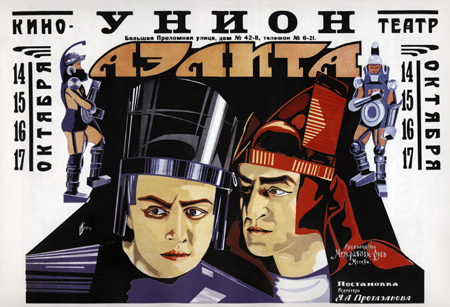
Read More...Watch the First Russian Science Fiction Film, Aelita: Queen of Mars (1924)
Despite the Soviet Union’s suppression of a great many writers and filmmakers, the communist state nonetheless produced some of the finest film and literature of the 20th century. We are lucky, for example, to have Mikhail Bulgakov’s The Master and Margarita, which was never published during the author’s lifetime and was for many years thereafter censored or relegated to samizdat versions. A similar fate almost befell the first Russian science fiction film, Aelita: Queen of Mars, a silent from 1924 that inspired such indispensable classics as Flash Gordon and Fritz Lang’s Metropolis. The film—which tops a Guardian list of “Seven Soviet sci-fi films everyone should see”—contributed to a rich cinematic vocabulary without which it would be hard to imagine the aesthetics of much science fiction in general.
Directed by Yakov Protazanov in the theatrical, futuristic constructivist style that Fritz Lang borrowed, Aelita tells the story of Los, an Earth engineer who builds a spaceship and travels to Mars to meet and fall in love with its queen.
Further plot developments make clear that Lang may owe something to the film’s story as well, involving a tyrannical Martian ruler, Aelita’s father, who ruthlessly exploits his planet’s proletariat. Allmovie describes Aelita as “the Marxist struggle reaches outer space” and indeed the film dramatizes an alien revolution very close to the one that took place back on Earth.
Part of the reason the film fell out of favor with the Soviet government in later decades—and irked critics at the time—is its ambivalence about revolutionary politics through its portrayal of Los as a disaffected intellectual. Alexei Tolstoy—author of the film’s source novel—had fewer reservations. The so-called “Comrade Count” won three Stalin prizes after his return from a brief European exile. Unlike the dissident critic Bulgakov, Tolstoy—a distant relative of both Leo Tolstoy and Ivan Turgenev—has been described by his enemies as cynical, opportunistic and, later, totally in thrall to Stalin. His friends probably described him as a loyal party man. (He is also credited with being the first to ascertain the Nazi’s use of gas vans.)
Aelita the film made a favorable impression on its first audiences (see an original poster above). One of the first full-length films about space travel, it enabled ordinary Russians to imagine what may have seemed to them like the near future of Soviet technology. And yet, writes Andrew Horton in a lengthy essay on Aelita, despite its reputation, the sci-fi classic is “neither science fiction nor a pro-revolutionary film.” Contemporary critics and filmmakers felt that Protazanov’s adaptation not only showed insufficient commitment to the revolution, but it also manifested “alleged continuity with the bourgeois cinema of the Tsarist age”—a serious charge in the age of socialist realism and disruptive cinematic experiments like those of Dziga Vertov.
In hindsight, however, Aelita turns out to have been a film before its time, and indeed a work of classic sci-fi, in its extremely imaginative use of technology, costuming, and set design. Without the fascination it has always held for film buffs, it might have disappeared, given its opposition to Party dogma: “The film praises domesticity and married life at a time when society was experimenting with the nature and meaning of relationships,” Horton writes, “It is a film that looks to rebuilding, consolidation, progress and the future and rejects revolution as an unachievable Utopian ideal open to hijack.” All of this context can seem a bit heavy, but we needn’t work too hard to untangle Aelita’s ideological strands. Simply enjoy the movie as an entertaining technical achievement from which we can draw a line to later sci-fi films like 1957’s Road to the Stars (above) and, from there, to modern masterpieces like Stanley Kubrick’s 2001.
Aelita will be added to our list of 101 Silent Films, a subset of our larger collection, 4,000+ Free Movies Online: Great Classics, Indies, Noir, Westerns, Documentaries & More.
via Ubuweb
Related Content:
Metropolis: Watch a Restored Version of Fritz Lang’s Masterpiece (1927)
Eight Free Films by Dziga Vertov, Creator of Soviet Avant-Garde Documentaries
Soviet Artists Envision a Communist Utopia in Outer Space
Josh Jones is a writer and musician based in Durham, NC. Follow him at @jdmagness
Read More...The Psychology of Messiness & Creativity: Research Shows How a Messy Desk and Creative Work Go Hand in Hand

You may have come into contact at some point with Tracey Emin’s My Bed, an art installation that reproduces her private space during a time when she spent four days as a shut-in in 1998, “heartbroken”: the bed’s unmade, the bedside strewn with cigarettes, moccasins, a bottle of booze, food, and “what appears to be a sixteen year old condom”…. If you were savvy enough to be Tracey Emin in 1998—and none of us were—you would have sold that messy room for over four million dollars last year at a Christie’s auction. I doubt another buyer of that caliber will come along for a knock-off, but this doesn’t mean the messes we make while slobbing around our own homes are without their own, intangible, value.
Those messes, in fact, may be seedbeds of creativity, confirming a cliché as persistent as the one about doctors’ handwriting, and perhaps as accurate. It seems a messy desk, room, or studio may genuinely be a mark of genius at work. Albert Einstein for example, writes Elite Daily, had a desk that “looked like a spiteful ex-girlfriend had a mission to destroy his workspace.” Einstein responded to criticism of his work habits by asking, “If a cluttered desk is a sign of a cluttered mind, then what are we to think of an empty desk?”
Mark Twain also had a messy desk, “perhaps even more cluttered than that of Albert Einstein.” To find out whether the messiness trait’s relation to creativity is simply an “urban legend” or not, Kathleen Vohs (a researcher at the University of Minnesota’s Carlson School of Management) and her colleagues conducted a series of experiments in both tidy and unruly spaces with 188 adults given tasks to choose from.
Vohs describes her findings in the New York Times, concluding that messiness and creativity are at least very strongly correlated, and that “while cleaning up certainly has its benefits, clean spaces might be too conventional to let inspiration flow.” But there are trade-offs. Read about them in Vohs’ paper—“Physical Order Produces Healthy Choices, Generosity, and Conventionality, Whereas Disorder Produces Creativity.” And just above, see Vohs’ co-author Joe Redden, Assistant Professor of Marketing at the University of Minnesota’s Carlson School of Management, discuss the team’s fascinating results. If conducting such an experiment on yourself, it might be best to do so in a space that’s all your own, though, like the rest of us, you’re too late to creatively turn the mess you make into lucrative conceptual art.
Related Content:
Why You Do Your Best Thinking In The Shower: Creativity & the “Incubation Period”
John Cleese’s Philosophy of Creativity: Creating Oases for Childlike Play
Josh Jones is a writer and musician based in Durham, NC. Follow him at @jdmagness
Read More...Christopher Lee Reads Edgar Allan Poe’s “The Raven,” and From “The Fall of the House of Usher”
Sir Christopher Lee died on Sunday at the age of 93, bringing to a close a long and distinguished acting career — though one fortunately not confined only to the heights of respectability. Lee could get schlocky with the best of them, elevating otherwise clunky, broad, or overly lurid genre films with his inimitable combination of stature, bearing, and (especially) voice, most notably as Hammer Horror’s go-to Count Dracula in the 1950s and 60s, as a James Bond villain in 1974, and as various sinister gray eminences in more recent Star Wars and Lord of the Rings movies.
But Lee made himself equally at home in projects involving the “better” classes of genre as well. His famous voice did supreme justice to the works of Edgar Allan Poe, the 19th-century writer whose work did so much to define modern horror literature.
At the top of the post, you can hear Lee give a reading of Poe’s well-known 1845 poem “The Raven”; just below, we have the trailer for Raúl García’s animated adaptation of Poe’s 1839 story “The Fall of the House of Usher,” over which Lee intones suitably ominous narration straight from the text.
If you’d like to hold your own tribute to the late Sir Lee, you’ll want to listen to all his Poe-related work, watch his performances in such films as the thoroughly cult-classic The Wicker Man and the founder-of-Pakistan biopic Jinnah (in which he played the title role, his personal favorite), and play aloud a selection from his stint as a heavy-metal Christmas vocalist. Most artists who began their careers in the 1940s got publicly categorized as “highbrow” or “lowbrow”; Lee’s career, with its many forays right up to the end into the conventional and unconventional, the straight-ahead and the bizarre, existed in a reality beyond brows — the one, in other words, that we all live in now.
Related Content:
Horror Legend Christopher Lee Presents a Heavy Metal Version of The Little Drummer Boy
Edgar Allan Poe’s “The Raven,” Read by Christopher Walken, Vincent Price, and Christopher Lee
Colin Marshall writes on cities, language, Asia, and men’s style. He’s at work on a book about Los Angeles, A Los Angeles Primer, and the video series The City in Cinema. Follow him on Twitter at @colinmarshall or on Facebook.
Read More...Support Us
We're hoping to rely on loyal readers, rather than erratic ads. Please click the Donate button and support Open Culture. You can use Paypal, Venmo, Patreon, even Crypto! We thank you!

About Us

Open Culture scours the web for the best educational media. We find the free courses and audio books you need, the language lessons & educational videos you want, and plenty of enlightenment in between.
Advertise With Us

FREE UPDATES!
GET OUR DAILY EMAIL
Get the best cultural and educational resources on the web curated for you in a daily email. We never spam. Unsubscribe at any time.
FOLLOW ON SOCIAL MEDIA

Open Culture editor Dan Colman scours the web for the best educational media. He finds the free courses and audio books you need, the language lessons & movies you want, and plenty of enlightenment in between.
Advertise With Us


