Harry Clarke’s 1926 Illustrations of Goethe’s Faust: Art That Inspired the Psychedelic 60s
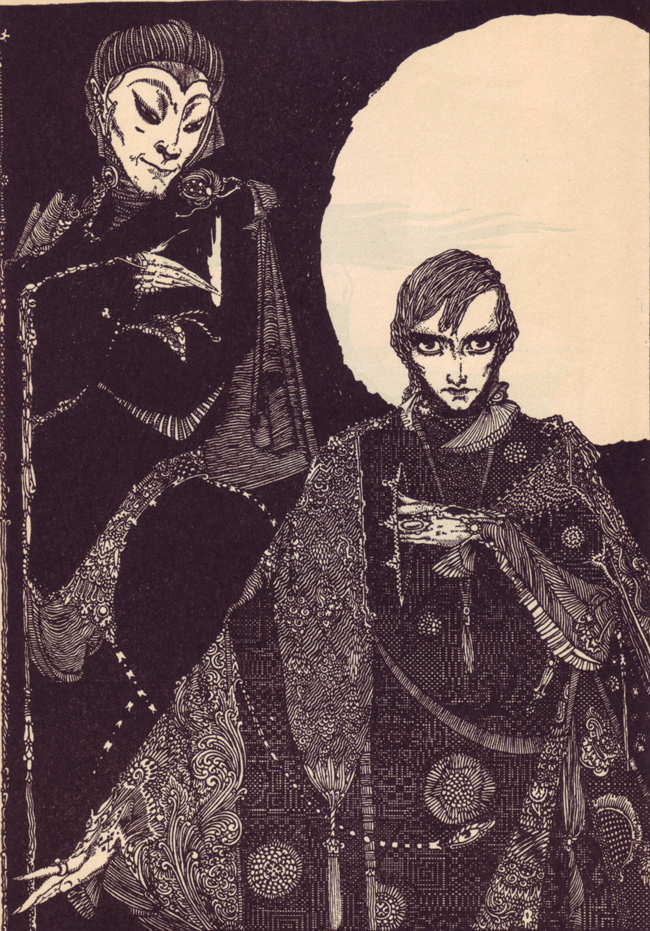
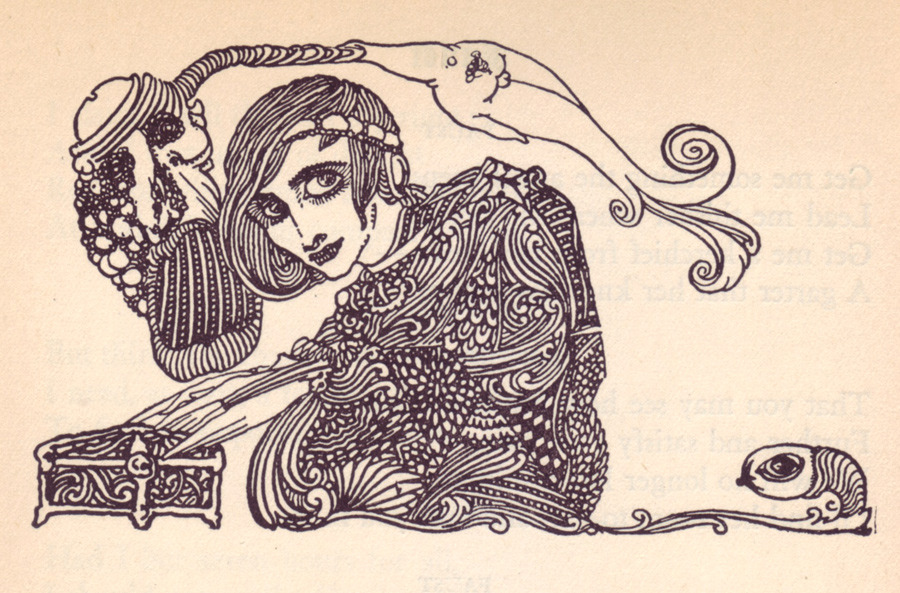
Evoking the playful grotesques of Shel Silverstein, the gothic gloom of Neil Gaiman’s Sandman comics, the occult beauty of the Rider-Waite tarot deck, and the hidden horrors of H.P. Lovecraft, Harry Clarke’s illustrations for a 1926 edition of Goethe’s Faust are said to have inspired the psychedelic imagery of the 60s. And one can easily see why Clarke’s disturbing yet elegant images would appeal to people seeking altered states of consciousness. Clarke, born in Dublin in 1889, came to prominence as an illustrator of imaginative literature—by Hans Christian Andersen, Edgar Allan Poe, and others—though he worked primarily as a designer, with his brother, of stained glass windows. Faust was the last book he illustrated, and the most fantastic.
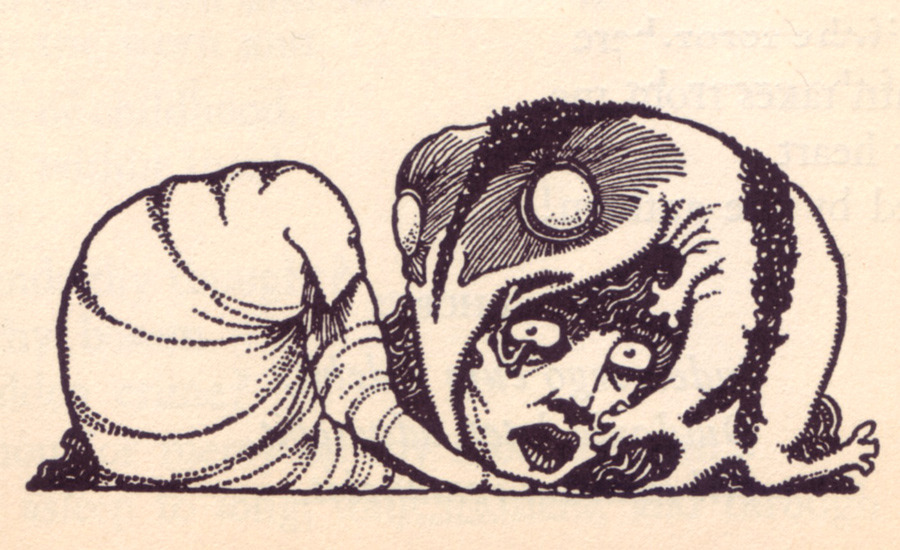
Clarke (1889 — 1931) drew his inspiration from the Art Nouveau movement that began in the previous century with artists like Aubrey Beardsley and Gustav Klimt. We see the influence of both in Clarke’s gaunt, elongated figures and his interest in unusual, organic patterns and ornamentation. We can also see—mentions an online Tulane University exhibit of his work—the influence of his own stained glass work, “through use of heavy lines in his black and white illustrations.” The blog Garden of Unearthly Delights notes that “initially Harraps, the publisher, did not like the drawings (Clarke recalled that they thought the work was ‘full of steaming horrors’), and many of the illustrations were finished under pressure.”
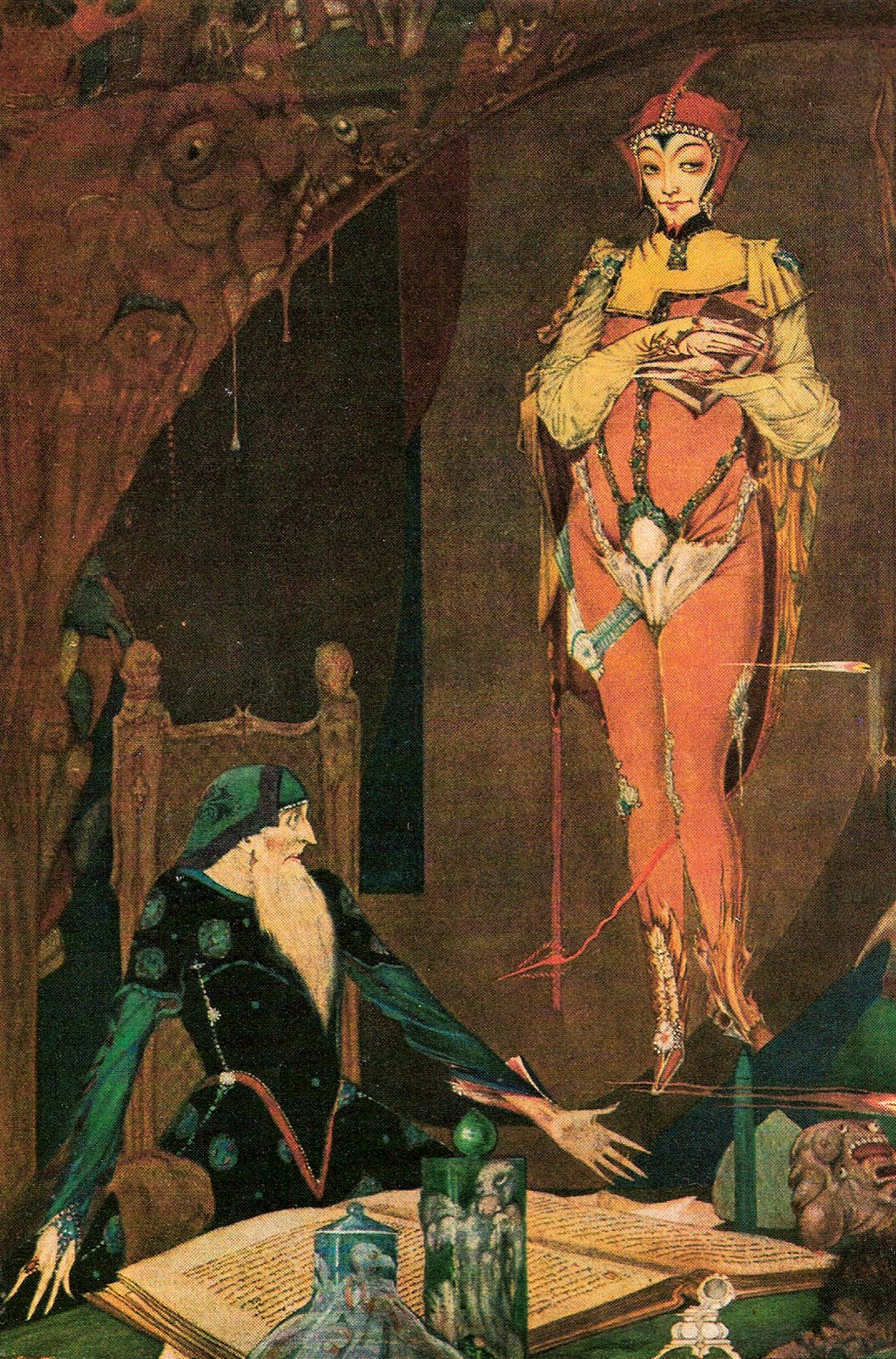
Despite the publisher’s reservations, reviews of the 2,000-copy limited edition were largely positive. Reviewers praised the drawings for their “distinctive charms” and “wealth of fantastic invention.” One critic for the Irish Statesman wrote, “Clarke’s fertility of invention is endless. It is shown in the multitude of designs less elaborate than the page plates, but no less intense.” The “page plates” referred to eight full-color, full-page illustrations like the painting of Faust and Mephistopheles above. Additionally, the book contains eight full-page ink wash illustrations, six full-page illustrations in black and white, and sixty-four smaller black and white vignettes.
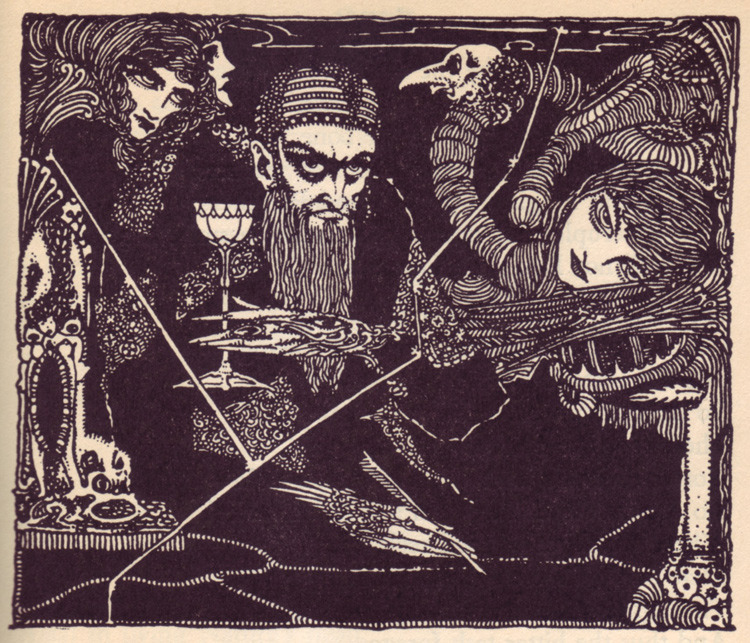
You can read the Clarke-illustrated poem online here, with the illustrations reproduced, albeit badly. (Also download the text in various formats at Project Gutenberg.) To see many more higher-quality digital scans like the ones featured here, visit 50 Watts and The Garden of Unearthly Delights, which also brings us more quotations from reviewers, including “a negative review of the drawings” that sums up what we might—and what those 60s revivalists surely did—find most appealing about Clarke’s illustrations. They present, wrote a critic in the magazine Artwork,
A dream world of half-created fantasies; the powerless fancies of senile visions; misshapen bodies with wormlike heads; staring eyes of octopuses and reptiles gaze like ponderous saurian of the lost world, while half-finished homunculi change like “plasma” in forms unbound by reason.
That last phrase, “unbound by reason,” could also apply to the weird, nightmarish pilgrimage of Goethe’s hero, and to the shaking off of old strictures that artists like Clarke, his fin de siècle predecessors, and his psychedelic successors strove to achieve.
Related Content:
Eugène Delacroix Illustrates Goethe’s Faust, “One of the Very Greatest of All Illustrated Books”
Gustave Doré’s Splendid Illustrations of Edgar Allan Poe’s “The Raven” (1884)
Alberto Martini’s Haunting Illustrations of Dante’s Divine Comedy (1901–1944)
Josh Jones is a writer and musician based in Durham, NC. Follow him at @jdmagness
Read More...A Wealth of Free Documentaries on All Things Japanese: From Bento Boxes to Tea Gardens, Ramen & Bullet Trains
“I used to be OBSESSED with Japanese culture,” wrote an uncommonly thoughtful Youtube commenter. “I miss that part of me. Trying to search for it again. That’s when I was the happiest.” Many of us westerners — or really, many of us non-Japanese — go through similar periods of affinity and avidity for all things Japanese. Some of us put it away with our childish things; some of us make Japanese culture a lifelong interest, or even the stuff of our professions. I myself got into Japan early, at some point found myself put off by the just slightly too obsessive Japanese pop-culture fan community in the West (though I admittedly read that comment below a music video with four million views), and later returned with a much more serious intent to understand.
But to understand what? The Japanese language, certainly, and Japanese film, Japanese cities, Japanese aesthetics, Japanese technology — all the fruits of the culture that stoke in the rest of the world both deep envy and, sometimes, faint suspicion. Why do they persist in using writing systems that, despite their considerable beauty, come with such aggravating difficulty? The comprehensive subway networks in metropolises like Tokyo and Osaka function day in and day out with astonishing reach and reliability, but why do their riders tolerate crowdedness even to the point of getting uncomplainingly crammed inside the cars by white-gloved attendants? And why, despite the Japanese love for elegant design and advanced consumer technology, do their web sites look so jumbled and confusing?
NHK World can put you on the road to understanding these and other questions with Japanology, their series of English-language documentaries exploring the things large and small, all surprising to the foreigner, that make up the fabric of Japanese life. BEGIN Japanology, their series for the Japan-intrigued but not necessarily Japan-experienced, has come to six seasons so far.
At the top of the post, you can see its episode on bento, those painstakingly prepared lunch boxes, simplified versions of which even those who know nothing of Japan have seen at grocery stores the world over. To learn more about bento’s place in Japanese culture, proceed on to the relevant episode of Japanology Plus, NHK’s series for the even more insatiably curious Japanophile. And couple with an episode on Ramen above.
Japanology Plus also dedicates one of its half-hour programs to the Shinkansen, commonly known as the “bullet train,” that quintessentially Japanese mode of transportation that, with its impeccable half-century record of speed, safety, and punctuality, has become the pride of the land. (I, for one, hold out hope that Obama will make The Onion’s “Ambitious Plan to Fly Americans to Japan to Use Their Trains” a reality.) But if you don’t feel quite ready yet to board a Shinkansen, much less learn about its inner workings, try the Begin Japanology Special Mini series, which offers five-minute distilled documentaries on such icons of Japan as tea gardens, hot springs, and Mount Fuji. Watching all these, I feel glad indeed that I’ve already got the tickets booked for my next flight over there. Do you have yours?
You can find Japanology added to our list of 200+ Free Documentaries, a subset of our collection 4,000+ Free Movies Online: Great Classics, Indies, Noir, Westerns, Documentaries & More
Related Content:
Discover Japan’s Earthquake Proof Underground Bike Storage System: The Future is Now
Watch a Japanese Craftsman Lovingly Bring a Tattered Old Book Back to Near Mint Condition
A Photographic Tour of Haruki Murakami’s Tokyo, Where Dream, Memory, and Reality Meet
Early Japanese Animations: The Origins of Anime (1917–1931)
Cookpad, the Largest Recipe Site in Japan, Launches New Site in English
Let’s Learn Japanese: Two Classic Video Series to Get You Started in the Language
Colin Marshall writes elsewhere on cities, language, Asia, and men’s style. He’s at work on a book about Los Angeles, A Los Angeles Primer, the video series The City in Cinema, and the crowdfunded journalism project Where Is the City of the Future? Follow him on Twitter at @colinmarshall or on Facebook.
Read More...30 Minutes of Harry Potter Sung in an Avant-Garde Fashion by UbuWeb’s Kenneth Goldsmith
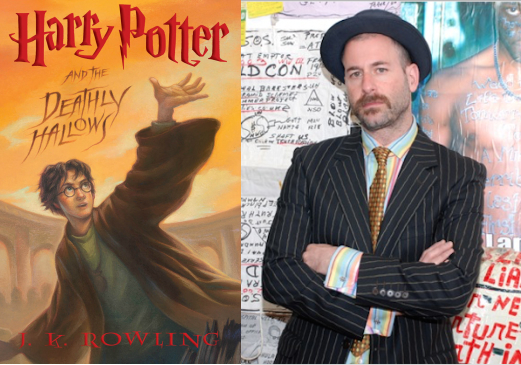
Last month, we featured poet, professor, and WFMU radio host Kenneth Goldsmith singing the theory of Theodor Adorno, Sigmund Freud, and Ludwig Wittgenstein — heavy reading, to be sure, but therein lay the appeal. How differently do we approach these formidable theoretical texts, Goldsmith’s project implicitly asks, if we receive them not just aurally rather than textually, but also in a light — not to say goofy — musical arrangement? But if it should drain you to think about questions like that, even as you absorb the thought of the likes of Adorno, Freud, and Wittgenstein, might we suggest Kenneth Goldsmith singing Harry Potter?
Perhaps the best-known modern exemplar of “light reading” we have, J.K. Rowling’s Harry Potter books present themselves as ripe for adaptation, most notably in the form of those eight big-budget films released between 2001 and 2011. On the other end of the spectrum, with evidently no budget at all, comes Goldsmith’s 30-minute adaptation, which you can hear just above, or along with his various other sung texts at Pennsound. Here he sings, with ever-shifting musical accompaniment and through some otherworldly voice processing, what sounds like the final novel in the Harry Potter series, Harry Potter and the Deathly Hallows.
“She tells a good story” — thus has every adult Harry Potter-reader I know explained the appeal of Rowling’s children’s novels even outside of the children’s demographic, especially as they awaited Deathly Hallows’ release in 2007. Having never dipped into the well myself, I couldn’t say for sure, but to my mind, if she tells a good enough story, that story will survive no matter the form into which you transpose it. The Potter faithful hold a variety of opinions about the degree of justice each movie does to their favorite novels, and even about the voice that reads them aloud in audiobook form, but what on Earth will they think of Goldsmith’s idiosyncratic rendition?
Update: Kenneth shot us an email a few minutes ago and filled out the backstory on this recording. Turns out the story is even more colorful than we first thought. He writes: “I was a DJ on WFMU from 1995–2010. In 2007, J.K. Rowling released the seventh and final Harry Potter and the Deathly Hallows. Prior to the book’s release the day I went on the air at WFMU, someone had leaked a copy to the internet, enraging Scholastic Books, who threatened anybody distributing it with a heavy lawsuit. I printed out and sang in my horrible voice the very last chapter of the book on the air, thereby spoiling the finale of the series for anyone listening. During my show, the station received an angry call from Scholastic Books. It appears that their whole office was listening to WFMU that afternoon. Nothing ever came of it.”
Related Content:
Download Two Harry Potter Audio Books for Free (and Get the Rest of the Series for Cheap)
Read Online J.K. Rowling’s New Harry Potter Story: The First Glimpse of Harry as an Adult
How J.K. Rowling Plotted Harry Potter with a Hand-Drawn Spreadsheet
Take Free Online Courses at Hogwarts: Charms, Potions, Defense Against the Dark Arts & More
The Quantum Physics of Harry Potter, Broken Down By a Physicist and a Magician
Harry Potter Prequel Now Online
Colin Marshall writes on cities, language, Asia, and men’s style. He’s at work on a book about Los Angeles, A Los Angeles Primer, and the video series The City in Cinema. Follow him on Twitter at @colinmarshall or on Facebook.
Read More...Stream 36 Recordings of Legendary Grateful Dead Concerts Free Online (aka Dick’s Picks)
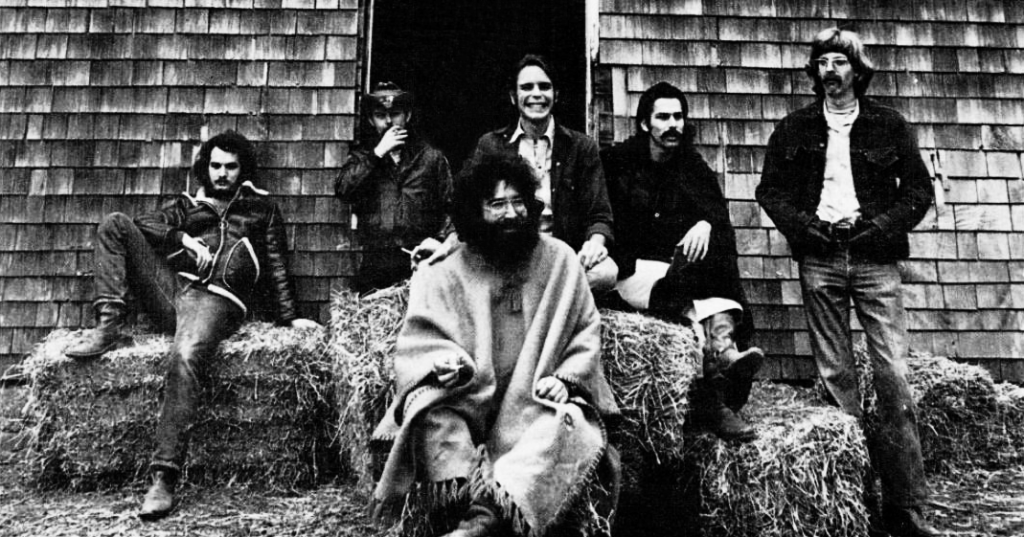
Image via Wikimedia Commons
There’s no shortage of Grateful Dead concerts freely available on the web. Indeed, head over to Archive.org and you’ll find hundreds of Dead shows, some going as far back as the 1960s. But when you start rummaging around, you’ll discover that some nights were magic, while many others fell far short. That’s why we can be thankful that Dick’s Picks came along. Named after the band’s tape archivist Dick Latvala, Dick’s Picks (released between 1993 and 2005) featured 36 volumes/albums of Grateful Dead concerts, all sourced from soundboard recordings captured on two-track master tapes. The recordings, as Tony Sclafani notes in The Grateful Dead FAQ, gave everyone a chance to “experience what going to a classic Dead show was like” — “to easily access recordings of legendary shows.”
Caught up in some Grateful Dead nostalgia myself, I quickly realized that all 36 volumes of Dick’s Picks are available on Spotify — at no cost. As much for my own musical edification as for yours, I’ve created a list below. (Some of you might have a beef with Spotify, or want to own your own copies, so I’ve included Amazon links too.) You can register for Spotify and download the free software here.
Dead fans will surely argue over which Dick’s Picks are the best. But, from what I’ve seen, Vol. 4 (above), Vol. 8, Vol. 10, and Vol. 12. offer great places to begin.
And although it doesn’t appear in the Dick’s Picks series, you can find on Archive.org what’s often considered one of the Dead’s finest live recordings — their May 8, 1977 concert in Barton Hall, at Cornell University.
Also, if you’re looking for a good introduction to the Dead’s musical career, listen to this recent episode of the Sound Opinions podcast, coming out of WBEZ in Chicago.
Enjoy.
- Vol. 1, 1993 : Tampa, 12/19/73 — Spotify — Amazon
- Vol. 2, 1995 : Columbus, 10/31/71 — Spotify — Amazon
- Vol. 3, 1995 : Pembroke Pines, 5/22/77 — Spotify — Amazon
- Vol. 4, 1996 : Fillmore East, 2/13–14/70 — Spotify — Amazon
- Vol. 5, 1996 : Oakland, 12/26/79 — Spotify — Amazon
- Vol. 6, 1996 : Hartford, 10/14/83 — Spotify — Amazon
- Vol. 7, 1997 : London, 9/9–11/74 — Spotify — Amazon
- Vol. 8, 1997 : Binghamton, 5/2/70 — Spotify — Amazon
- Vol. 9, 1997 : Madison Square Gardens, 9/16/90 — Spotify — Amazon
- Vol. 10, 1998 : Winterland, 12/29–30/77 — Spotify — Amazon
- Vol. 11, 1998 : Jersey City, 9/27/72 — Spotify — Amazon
- Vol. 12, 1998 : Providence & Boston, 6/26 & 28/74 — Spotify — Amazon
- Vol. 13, 1999 : Nassau Coliseum, 5/6/81 — Spotify — Amazon
- Vol. 14, 1999 : Boston, 11/30/73 & 12/2/73 — Spotify — Amazon
- Vol. 15, 1999 : Englishtown, 9/3/77 — Spotify — Amazon
- Vol. 16, 2000 : Fillmore Aud, 11/8/69 — Spotify — Amazon
- Vol. 17, 2000 : Boston, 9/25/91 — Spotify — Amazon
- Vol. 18, 2000 : Madison & Cedar Falls, 2/3 & 5/78 — Spotify — Amazon
- Vol. 19, 2000 : Oklahoma City, 10/19/73 — Spotify — Amazon
- Vol. 20, 2001 : Landover & Syracuse, 9/25 & 28/76 — Spotify — Amazon
- Vol. 21, 2001 : Richmond, 11/1/85 — Spotify — Amazon
- Vol. 22, 2001 : Lake Tahoe, 2/23 & 24/68 — Spotify — Amazon
- Vol. 23, 2001 : Baltimore, 9/17/72 — Spotify — Amazon
- Vol. 24, 2002 : Cow Palace, 3/23/74 — Spotify — Amazon
- Vol. 25, 2002 : New Haven & Springfield, 5/10–11/78 — Spotify — Amazon
- Vol. 26, 2002 : Chicago & Minneapolis, 4/26–27/69 — Spotify — Amazon
- Vol. 27, 2003 : Oakland, 12/16–17/92 — Spotify — Amazon
- Vol. 28, 2003 : Lincoln & Salt Lake City, 2/26 & 28/73 — Spotify — Amazon
- Vol. 29, 2003 : Atlanta & Lakeland, 5/19 & 21/77 — Spotify — Amazon
- Vol. 30, 2003 : Academy of Music, NYC, 3/25 & 28/72 — Spotify — Amazon
- Vol. 31, 2004 : Philadelphia & Jersey City, 8/4–6/74 — Spotify — Amazon
- Vol. 32, 2004 : Alpine Valley, East Troy , 8/7/82 — Spotify — Amazon
- Vol. 33, 2004 : Oakland, 10/9 & 10/76 — Spotify — Amazon
- Vol. 34, 2005 : Rochester, 11/5/77 — Spotify — Amazon
- Vol. 35, 2005 : San Diego, Chicago and Hollywood, August 1971 — Spotify — Amazon
- Vol. 36, 2005 : Philadelphia 9/21/72 — Spotify — Amazon
Related Content:
The Grateful Dead’s “Ripple” Played by Musicians Around the World
Bob Dylan and The Grateful Dead Rehearse Together in Summer 1987. Listen to 74 Tracks.
The Grateful Dead Play at the Egyptian Pyramids, in the Shadow of the Sphinx (1978)
Read More...Pres. Obama Releases a Free Playlist of 40 Songs for a Summer Day (Plus 6 Books on His Summer Reading List)

Like much of the rest of the country, President Obama is getting some downtime in August — in his case spending 16 days in Martha’s Vineyard. From that nice getaway spot, POTUS has launched on Spotify (download the free software here) two playlists of music — 20 songs for a hot summer day, and another 20 for a nice summer evening. You can play the songs below, and further down the page, find six books on his summer vacation reading list.
Daytime listening features songs from Bob Dylan, Bob Marley, Coldplay, Howlin’ Wolf, Aretha Franklin, Florence and the Machine, and The Rolling Stones. For nighttime, he’s serving up John Coltrane, Van Morrison, Joni Mitchell, Nina Simone and more. The man has taste. And for summer reading you can do worse than offer Jhumpa Lahiri, James Salter and Elizabeth Kolbert.
“The President’s Summer Playlist: Day”
“The President’s Summer Playlist: Night”
Obama’s Summer Reading List:
All That Is, by James Salter
All The Light We Cannot See, by Anthony Doerr
The Sixth Extinction, by Elizabeth Kolbert
The Lowland, by Jhumpa Lahiri
Between The World and Me, by Ta-Nehisi Coates
Washington: A Life, by Ron Chernow
If you would like to support the mission of Open Culture, consider making a donation to our site. It’s hard to rely 100% on ads, and your contributions will help us continue providing the best free cultural and educational materials to learners everywhere. You can contribute through PayPal, Patreon, and Venmo (@openculture). Thanks!
Read More...Isaac Asimov’s Foundation Trilogy: Hear a Radio Dramatization (1973)
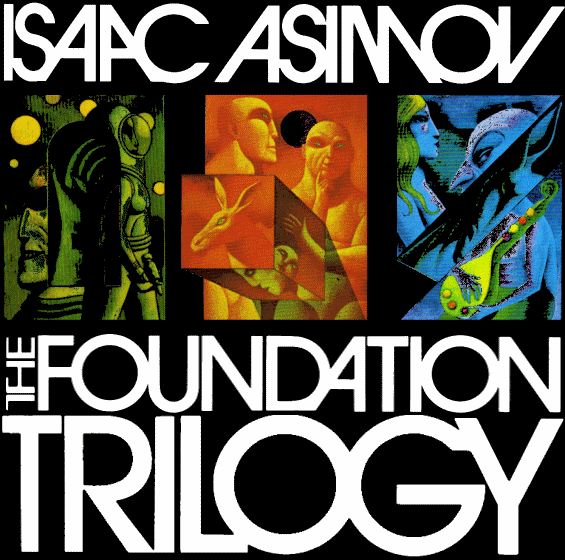
Last year Jonathan Nolan–screenwriter of Memento and Interstellar and not coincidentally director Christopher Nolan’s brother–announced that he would be developing Isaac Asimov’s legendary Foundation trilogy for HBO as a series. And we assume he’s still doing that, because there’s been nary a peep from the channel since. So far the Internet consensus has been a collective “well, that could be good!” instead of groans, which is a heartening thing these days.
For those who haven’t read the classic books, but would like to get the jump on ol’ Nolan, we submit this BBC Radio production from 1973, which is now available on Spotify below. (Download Spotify software here.) The recording also lives on Archive.org as well.
Right from the beginning we know we are in good hands, with the analog drones of the BBC Radiophonic Workshop ushering us into a stereo landscape filled with plummy British accents and atmospheric sound effects. It’s like the best ever episode of Doctor Who without a Tardis, corridors, or the enfeebled cries of a lost companion.
The Foundation Trilogy is heavily indebted to Edward Gibbon’s The History of the Decline and Fall of the Roman Empire, as well as a belief in the circular nature of history.
Asimov’s hero in the first book, Hari Seldon, using a science called psychohistory, can see the inevitable collapse of the Galactic Empire in which he lives and sets about trying to change it by setting up an opposition called the Foundation. The novels then jump decades ahead, checking in with this essential conflict, much like Gibbon’s work goes from emperor to emperor, marking the decline of empire and its inevitability. Free of aliens and shoot-em-ups, Foundation is very human despite its galactic scope.
Adapted by Patrick Tull and Mike Stott, the eight part radio series does a good job of presenting the novels as a character-driven drama, and while it is talky (it’s radio after all), it was Orson Scott Card who said of Foundation, it is “all talk, no action — but Asimov’s talk is action.”
It also influenced many future sci-fi writers. No doubt somewhere along the way Douglas Adams was listening to the radio play’s talking encyclopedia and thinking, hmm, what if this had jokes?
And once you get through the trilogy–maybe after an eight-hour flight?–there’s more Asimov radio plays for your listening pleasure on Spotify: Hostess, Pebble in the Sky, and Nightfall.
If you would like to support the mission of Open Culture, consider making a donation to our site. It’s hard to rely 100% on ads, and your contributions will help us continue providing the best free cultural and educational materials to learners everywhere. You can contribute through PayPal, Patreon, and Venmo (@openculture). Thanks!
Related Content:
Isaac Asimov’s Favorite Story “The Last Question” Read by Isaac Asimov— and by Leonard Nimoy
Two Documentaries Introduce Delia Derbyshire, the Pioneer in Electronic Music
1,000 Free Audio Books: Download Great Books for FreeTed Mills is a freelance writer on the arts who currently hosts the FunkZone Podcast. You can also follow him on Twitter at @tedmills, read his other arts writing at tedmills.com and/or watch his films here.
Read More...Read Pablo Picasso’s Poetry: Modernist Meditations on Making Art, World War, Dogs & More
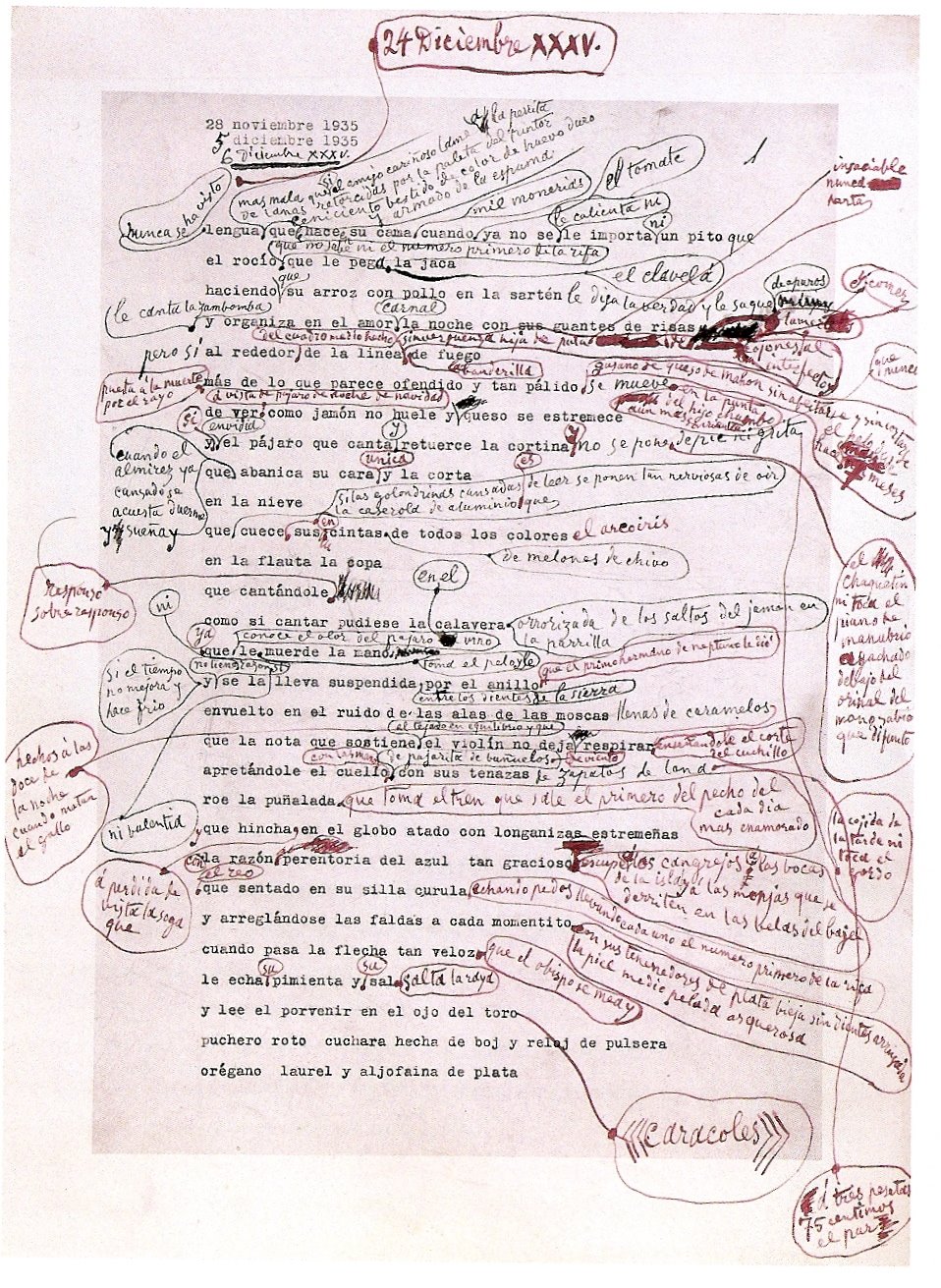
What makes Pablo Picasso such a representative 20th-century artist? Most of it has to do with his particular achievements, such as the visual ground he broke with his Cubist painting, sure, but some of it also has to do with the fact that his interests extended so far beyond painting. We think of creators who could create across various domains as “Renaissance men,” but conditions a few centuries on from the Renaissance enabled such artists to exert their will across an even wider range of forms. Picasso, for instance, worked in not just painting but sculpture, printmaking, ceramics, and letters.
That last even includes poetry, to which Picasso announced his commitment in 1935, at the age of 53. At that point, writes Dangerous Minds’ Paul Gallagher, “he began writing poems almost every day until the summer of 1959,” beginning “by daubing colors for words in a notebook before moving on to using words to sketch images,” ultimately producing hundreds of poems composed primarily of “stream of consciousness, unpunctuated word association with startling juxtaposition of images and at times an obsession with sex, death and excrement.”
If this sounds like your cup of tea, you can find plenty of Picasso poetry over at Ubuweb, which offers A Picasso Sampler: Excerpts from the Burial of the Count of Orgaz & Other Poems free for the viewing. “Picasso, like any poet of consequence, is a man fully into his time and into the terrors that his time presents,” writes the collection’s editor Jerome Rothenberg. His words reflect “the state of things between the two world wars — the first one still fresh in mind and the rumblings of the second starting up,” a time and place “where poetry becomes — for him as for us — the only language that makes sense.”
Before diving into that collection, you can also get a sense of Picasso’s poetry by having a look at some of his shorter poems collected at the site of artist Jef Borgeau, such as “the artist & his model”:
turn your back
but stay in view at the same time
(now look away,
anything else confuses)stand still without saying a word
you can’t see but this is how
i separate day from nightand the starless sky
from the empty heart
“dogs”:
dogs eat at the night
buried in the yard
they chase the moon in a pack
the white of their teeth
compared to starsthe windows close against them
iron bars in transparencylife closes against them
the morning will crush them to dust
with only the wind left
to stir them up
And “the morning of the world”:
i have a face cut from ice
a heart pierced in a thousand places
so to remember
always the same voice
the same gestures
and my laughter
heavy
as a wall
between you and methe ones who are most alive
seem the most stillbehind the milky way
a shadow dancesour gaze climbs toward the stars
Related Content:
Pablo Picasso’s Two Favorite Recipes: Eel Stew & Omelette Tortilla Niçoise
The Postcards That Picasso Illustrated and Sent to Jean Cocteau, Apollinaire & Gertrude Stein
Colin Marshall writes on cities, language, Asia, and men’s style. He’s at work on a book about Los Angeles, A Los Angeles Primer, and the video series The City in Cinema. Follow him on Twitter at @colinmarshall or on Facebook.
Read More...800 Free eBooks for iPad, Kindle & Other Devices
Download 800 free eBooks to your Kindle, iPad/iPhone, computer, smart phone or ereader. Collection includes great works of fiction, non-fiction and poetry, including works by Asimov, Jane Austen, Philip K. Dick, F. Scott Fitzgerald, Neil Gaiman, Tolstoy, Dostoevsky, Shakespeare, Ernest Hemingway, Virginia Woolf & James Joyce. Also please see our collection 1,000 Free Audio Books: Download Great Books for Free, where you can download more great books to your computer or mp3 player.
- Aeschylus - Prometheus Bound
- Aesop - Aesop’s Fables
- Andersen, Hans Christian - Andersen’s Fairy Tales
- Anderson, Sherwood — Winesburg, Ohio
- Anonymous - Beowulf
- Anonymous — Epic of Gilgamesh
- Anonymous - The Arabian Nights
- Aquinas, Thomas — Summa Theologiae
- Aristophanes — Lysistrata
- Aristophanes - The Birds
- Aristophanes - The Clouds
- Arnold, Matthew - Culture and Anarchy
- Aristotle — Collected Works
- Aristotle — Nicomachean Ethics
- Aristotle — Physics
- Aristotle - Politics
- Aristotle — The Categories
- Asimov, Isaac — “How People Get New Ideas”
- Asimov, Isaac — “Jokester”
- Asimov, Isaac — “Let’s Get Together”
- Asimov, Isaac - “Living Space”
- Asimov, Isaac — “Silly Asses”
- Asimov, Isaac - “Youth”
- Aurelius, Marcus - Meditations
- Austen, Jane - Emma
- Austen, Jane — Lady Susan
- Austen, Jane - Love and Friendship
- Austen, Jane - Mansfield Park
- Austen, Jane - Northanger Abbey
- Austen, Jane - Persuasion
- Austen, Jane - Pride & Prejudice
- Austen, Jane — Sense & Sensibility
- Ayer, Alfred — Language, Truth and Logic
- Bacon, Sir Francis — Novum Organum
- Balzac, Honoré de - Le Père Goriot
- Barthes, Roland — Incidents
- Basho, Matsuo — Various Poems
- Baudelaire, Charles - Les Fleurs du Mal (in French)
- Baudelaire, Charles - Flowers of Evil (in English)
- Baudelaire, Charles - The Generous Gambler
- Baudelaire, Charles - The Poem of Hashish (translated by Aleister Crowley)
- Barrie, JM- Peter Pan


- Baum, L. Frank - The Wizard of Oz (Vol 1)
- Baum, L. Frank - The Marvelous Land of Oz (Vol 2)
- Baum, L. Frank — Ozma of Oz (Vol 3)
- Baum L. Frank — Dorothy and the Wizard in Oz (Vol 4)
- Baum L. Frank — The Road to Oz (Vol 5)
- Baum, L. Frank — The Emerald City of Oz (Vol 6)
- Baum, L. Frank — The Patchwork Girl of Oz (Vol 7)
- Baum, L. Frank — Tik-Tok of Oz (Vol 8)
- Baum, L. Frank - The Scarecrow of Oz (Vol 9)
- Baum, L. Frank — Rinkitink in Oz (Vol 10)
- Baum L. Frank — The Lost Princess of Oz (Vol 11)
- Baum L. Frank — The Tin Woodman of Oz (Vol 12)
- Baum L. Frank — The Magic of Oz (Vol 13)
- Baum, L. Frank — Glinda of Oz (Vol 14)
- Benjamin, Walter — “The Work of Art in the Age of Mechanical Reproduction”
- Read Online in English — Read Online in German
- Bergerac, Cyrano de — Voyage to the Moon
- Berkeley, George — Three Dialogues between Hylas and Philonous
- Berlin, Isaiah - Concepts and Categories
- Read Online Now
- Berlin, Isaiah - The Arts in Russia Under Stalin
- Berryman, John - Card Trick
- Berryman, John — Modus Vivendi
- Berryman, John — The Right Time
- Berryman, John — Trouble With Telstar
- Berryman, John — Vigorish
- Blake, William — Songs of Innocence and of Experience
- Blake, William - Selected Poems
- Boethius — Consolation of Philosophy
- Bradbury, Ray — “The Jar”
- Bradbury, Ray — “The Last Night of the World”
- Bronte, Charlotte - Jane Eyre
- Bronte, Emily - Wuthering Heights
- Buchan, John - The Thirty Nine Steps
- Bukowski, Charles — His Last (Faxed) Poem
- Bukowski, Charles — Dostoevsky
- Burke, Edmund - Reflections on the Revolution in France
- Burke, Edmund - On the Sublime and Beautiful
- Burckhardt, Jacob- The Civilisation of the Renaissance in Italy
- Burroughs, Edgar Rice - A Princess of Mars
- Calvino, Italo — “The Daughters of the Moon”
- Calvino, Italo — “Why Read the Classics?”
- Carroll, Lewis - Alice’s Adventures in Wonderland
- Carroll, Lewis — Symbolic Logic
- Carroll, Lewis — The Game of Logic
- Carroll, Lewis - Through the Looking-Glass
- Carver, Raymond — “Beginners” (early draft of “What We Talk About When We Talk About Love”)
- Carver, Raymond - “Cathedral”
- Cervantes - Don Quixote
- Chandler, Raymond - “The Simple Art of Murder”
- Chaucer - Canterbury Tales
- Chekhov, Anton - Plays
- Chekhov, Anton — Short Stories
- Chekhov, Anton - The Kiss
- Chekhov, Anton - The Lady with the Dog
- Chekhov, Anton — The Chorus Girl and Other Stories (by Constance Garnett)
- Chekhov, Anton - Uncle Vanya
- Chomsky, Noam — Deterring Democracy
- Chomsky, Noam — Excerpts from Powers and Prospects: Reflections on Human Nature and the Social Order
- Chomsky, Noam — Keeping the Rabble in Line
- Chomsky, Noam — Necessary Illusions: Thought Control in Democratic Societies
- Chomsky, Noam — Rethinking Camelot: JFK, the Vietnam War, and U.S. Political Culture
- Chomsky, Noam — Secrets, Lies and Democracy
- Chomsky, Noam — The Prosperous Few and the Restless Many
- Chomsky, Noam — What Uncle Sam Really Wants
- Chopin, Kate - The Awakening
- Christie, Agatha - The Mysterious Affair at Styles
- Christie, Agatha - The Secret Adversary
- Cicero — Orations
- Clarke, Arthur C. — “Second Dawn”
- Clarke, Arthur C. — “The Deep Range”
- Clarke, Arthur C. — “The Nine Billion Names of God”
- Clarke, Arthur C. — “The Parasite”
- Clarke, Arthur C. — “The Star”
- Clarke, Arthur C. — “The Stroke of the Sun”
- Clarke, Arthur C. — “A Walk in the Dark”
- Coleridge, Samuel - Ancient Mariner and Select Poems
- Confucius — The Analects
- Confucius — The Great Learning
- Conrad, Joseph - Lord Jim
- Conrad, Joseph - Heart of Darkness
- Conrad, Joseph — Nostromo
- Conrad, Joseph - The Secret Agent
- Conrad, Joseph - Victory
- Crane, Stephen - The Red Badge of Courage
- Crowley, Aleister — Book of Law
- Crowley, Aleister — Household Gods
- Cummings E.E. — The Enormous Room
- da Vinci, Leonardo — A Treatise on Painting
- da Vinci, Leonardo — Anatomy Drawings
- Dante - The Divine Comedy
- Dante — The Divine Comedy (Digital Version from Columbia University)
- Dante — Intertextual Dante
- Darwin, Charles - On the Origin of Species
- Darwin, Charles — The Descent of Man
- Darwin, Charles — The Voyage of the Beagle
- Defoe, Daniel - Robinson Crusoe
- Denton, Bradley — Buddy Holly is Alive and Well on Ganymede (Background)
- Derrida, Jacques — “Structure, Sign, and Play in the Discourse of the Human Sciences”
- Descartes, Rene - Discourse on the Method
- Dewey, John - Democracy & Education
- Diaz, Junot — 7 Free Stories
- Dick, Philip K. — “Adjustment Team”
- Dick, Philip K. — “Beyond the Door”
- Dick, Philip K. — “Beyond Lies the Wub”
- Dick, Philip K. — “Breakfast at Twilight”
- Dick, Philip K. — “Exhibit Piece”
- Dick, Philip K. — “Foster You’re Dead”
- Dick, Philip K. — “Human Is”
- Dick, Philip K. — “James P. Crow”
- Dick, Philip K. — “Meddler”
- Dick, Philip K. — “Mr. Spaceship”
- Dick, Philip K. — “Piper in the Woods”
- Dick, Philip K. — “Progeny”
- Dick, Philip K. — “Prominent Author”
- Dick, Philip K. — “Sales Pitch”
- Dick, Philip K. — “Second Variety”
- Dick, Philip K. — “Shell Game”
- Dick, Philip K. — “Small Town”
- Dick, Philip K. — “Souvenir”
- Dick, Philip K. — “Survey Team”
- Dick, Philip K. — “The Crawlers”
- Dick, Philip K. — “The Crystal Crypt”
- Dick, Philip K. — “The Defenders”
- Dick, Philip K. — “The Eyes Have It”
- Dick, Philip K. — “The Golden Man”
- Dick, Philip K. — “The Gun”
- Dick, Philip K. — “The Hanging Stranger”
- Dick, Philip K. — “The Last of tbe Masters”
- Dick, Philip K. — “The Skull”
- Dick, Philip K. — “The Turning Wheel”
- Dick, Philip K. — “The Variable Man”
- Dick, Philip K. — “Tony and the Beetles”
- Dick, Philip K. — “Upon the Dull Earth”:
- Dick, Philip K. — “We Can Remember It For You Wholesale”
- iPad/iPhone
- Dickens, Charles - A Christmas Carol
- Dickens, Charles - A Tale of Two Cities
- Dickens, Charles - Bleak House
- Dickens, Charles - David Copperfield
- Dickens, Charles - Great Expectations
- Dickens, Charles - Hard Times
- Dickens, Charles — Little Dorrit
- Dickens, Charles - Mystery of Edwin Drood
- Dickens, Charles - Nicholas Nickleby
- Dickens, Charles - Oliver Twist
- Dickens, Charles - Our Mutual Friend
- Dickens, Charles — The Pickwick Papers
- Dickinson, Emily - Poems
- Didion, Joan — 12 Masterful Essays
- Dostoevsky, Fyodor - A Raw Youth (Translated by Constance Garnett)
- Dostoevsky, Fyodor - Brothers Karamazov
- Dostoevsky, Fyodor - Crime and Punishment
- Dostoevsky, Fyodor - Notes from the Underground
- Dostoevsky, Fyodor - Poor Folk
- Dostoevsky, Fyodor — The Double
- Dostoevsky, Fyodor — “The Dream of a Ridiculous Man”
- Dostoevsky, Fyodor - The Gambler
- Dostoevsky, Fyodor - The Idiot
- Dostoevsky, Fyodor - The Possessed
- Dostoevsky, Fyodor - White Nights and Other Stories
- Douglass, Frederick — Narrative of the Life of Frederick Douglass
- Doyle, Arthur Conan - The Adventures of Sherlock Holmes
- Doyle, Arthur Conan- The Complete Sherlock Holmes
- Doyle, Arthur Conan — The Hound of Baskerville
- Doyle, Arthur Conan - The Lost World
- Doyle, Arthur Conan - The Poison Belt
- Dreiser, Theodore - An American Tragedy
- Dreiser, Theodore - Sister Carrie
- Dumas, Alexandre - The Count of Monte Cristo
- Dumas, Alexandre - The Man in the Iron Mask
- Dumas, Alexandre - The Three Musketeers
- Durkheim, Emile — Le suicide: Étude de sociologie
- Eliot, Charles - The Harvard Classics (51 Volumes)
- Einstein, Albert — Relativity : The Special and General Theory
- Eisenstein, Sergei — Notes of a Film Director
- Eliot, George - Daniel Deronda
- Eliot, George - Middlemarch
- Eliot, George - Silas Marner
- Eliot, T.S. — Eeldrop and Appleplex
- Eliot, T.S. - Ezra Pound: His Metric and Poetry by T. S. Eliot
- Eliot, T.S. — Four Quartets
- Eliot, T.S. - Poems (Including “The Love Song of J. Alfred Prufrock”)
- Eliot, T.S. — The Hollow Men
- Eliot, T.S. — The Love Song of J. Alfred Prufrock
- Eliot, T.S. — The Sacred Wood
- Eliot, T.S. — “Tradition and the Individual Talent”
- Eliot, TS - The Waste Land
- Eisenstein, Sergei — Notes on a Film Director
- Emerson, Ralph Waldo — Essays
- Emerson, Ralph Waldo - The Complete Works
- Erasmus - The Praise of Folly
- Euripides - Medea
- Euripides — The Bacchae
- Faulkner, William - The Collected Stories of William Faulkner
- Faulkner, William — Early Prose and Poetry
- Feynman, Richard; Leighton, Robert; Sands, Matthew - The Feynman Lectures on Physics
- Volume 1: Read Online Now
- Volume 2: Read Online Now
- Volume 3: Read Online Now
- Fitzgerald, F. Scott — “Babylon Revisited”
- Fitzgerald, F. Scott — “Bernice Bobs Her Hair”
- Fitzgerald, F. Scott - Collected Stories
- Fitzgerald, F. Scott — All the Sad Young Men
- Fitzgerald, F. Scott - Flappers and Philosophers
- Fitzgerald, F. Scott - Tales of the Jazz Age
- Fitzgerald, F. Scott - Tender is the Night
- Fitzgerald, F. Scott - The Beautiful and Damned
- Fitzgerald, F. Scott - The Curious Case of Benjamin Button
- Fitzgerald, F. Scott - The Great Gatsby
- Fitzgerald, F. Scott - This Side of Paradise
- Flaubert, Gustave - Madame Bovary
- Flaubert, Gustave - Salammbo
- Flaubert, Gustave — Three Short Works
- Fontane, Theodor — Effi Briest
- Ford, Madox Ford - The Good Soldier
- Forster, E.M. — A Room with a View
- Forster, E.M. - Howards End
- Forster, E.M. - The Machine Stops
- Foucault, Michel - Die Ordnung des Diskurses
- Franklin, Benjamin - Autobiography
- Freud, Sigmund — A General Introduction to Psychoanalysis
- Freud, Sigmund - Beyond the Pleasure Principle
- Freud, Sigmund — Delusion and Dream
- Freud, Sigmund - Dream Psychology: Psychoanalysis for Beginners
- Freud, Sigmund - Leonardo da Vinci
- Freud, Sigmund - Interpretation of Dreams
- Freud, Sigmund - Moses And Monotheism
- Freud, Sigmund — Origin and Development of Psychoanalysis
- Freud Sigmund — Psychopathology of Everyday Life
- Freud, Sigmund - Reflections on War and Death
- Freud, Sigmund - Selected Papers on Hysteria and Other Psychoneuroses
- Freud, Sigmund - The History of the Psychoanalytic Movement
- Freud, Sigmund — Three Contributions to the Sexual Theory
- Freud, Sigmund — Totem and Taboo
- Freud, Sigmund — Wit and Its Relation to the Unconscious
- Frost, Robert - A Boy’s Will
- Frost, Robert — Miscellaneous Poems to 1920
- Frost, Robert — Mountain Interval
- Frost, Robert — North of Boston
- Frost, Robert — “The Road Not Taken
- Gaiman, Neil — “A Study in Emerald”
- Gaiman, Neil - “Bitter Grounds”
- Gaiman, Neil - “Cinnamon”
- Gaiman, Neil - “I Cthulhu”
- Gaiman, Neil - “The Case of the Four and Twenty Blackbirds”
- Gaiman, Neil - “The Day the Saucers Came”
- Gaiman, Neil — The Truth Is a Cave in the Black Mountains
- Garcia Marquez, Gabriel — The Autumn of the Patriarch
- Garcia Marquez, Gabriel — 10 Stories Online
- Gibbon, Edward - The History Of The Decline And Fall Of The Roman Empire
- Ginsberg, Allen — America
- Ginsberg, Allen — Homework
- Ginsberg, Allen — Howl
- Ginsberg, Allen, — America, Kaddish Part 1, A Supermarket in California, Sunflower Sutra
- Read Online Now
- Ginsberg, Allen — Taking a Walk through Leaves of Grass
- Goethe — Faust
- Goethe — Faust (Illustrated by Delacroix)
- Goethe — The Sorrows of Young Werther
- Goethe — Theory of Colors (background info)
- Gogol, Nikolai - The Dead Souls
- Gogol, Nikolai - The Nose
- Gogol, Nikolai — Taras Bulba
- Gramsci, Antonio — Selected Writings
- Grimm Brothers - Grimm’s Fairy Tales
- Harbou, Thea von — Metropolis
- Hardy, Thomas - Collected Stories
- Hawthorne, Nathaniel - The House of the Seven Gables
- Hawthorne, Nathaniel - The Scarlet Letter
- Hegel, GWF — Lectures on the History of Philosophy
- Hegel, GWF — Philosophy of Mind
- Hegel, GWF — Philosophy of Right
- Hegel, GWF — The Phenomenology of the Spirit
- Hemingway, Ernest - The First Forty Nine Stories (includes “The Snows of Kilimanjaro”)
- Hayek, Friedrich - The Use of Knowledge in Society
- Henley - Invictus
- Herodotus — The History of Herodotus V. 1 (Macaulay translation)
- Herodotus, The History of Herodotus V. 2 (Macaulay translation)
- Hesse, Hermann - Siddhartha
- Hobbes, Thomas - Leviathan
- Homer — The Iliad
- Homer — The Odyssey
- Hope, Anthony — The Prisoner of Zenda
- Hughes, Langston and Hurston, Zora Neale - The Mule Bone
- Hugo, Victor - Hunchback of Notre Dame
- Hugo, Victor - Les Miserables
- Hume, David - A Treatise of Human Nature
- Hume, David - Dialogues Concerning Natural Religion
- Hume, David - Enquiry into the Principles of Morals
- Hume, David ‑An Enquiry Concerning Human Understanding
- Hurston, Zora Neale - Poker!
- Hurston, Zora Neale - Three Plays (Lawing and Jawing; Forty Yards; Woofing)
- Huxley, Aldous - Brave New World
- Huxley, Aldous — Crome Yellow
- Huxley, Aldous — Mortal Coils
- Ibsen, Henrik - A Doll’s House
- Ibsen, Henrik — An Enemy of the People
- Ibsen, Henrik - Hedda Gabler
- Ibsen, Henrik - Peer Gynt
- Irving, Washington - The Legend of Sleepy Hollow
- James, Henry - The Ambassadors
- James, Henry — The American
- James, Henry - The Wings of the Dove
- James, Henry - Turn of the Screw
- James, William — Essay in Radical Empiricism
- James, William - Pragmatism
- James, William - Varieties of Religious Experience
- Joyce, James - A Portrait of the Artist as a Young Man
- Joyce, James - Chamber Music
- Joyce, James - Dubliners
- Joyce, James - Finnegans Wake
- Joyce, James - Ulysses
- Kafka, Franz - “A Hunger Artist”
- Kafka, Franz — “A Country Doctor”
- Kafka, Franz — Amerika (German Edition)
- Kafka, Franz — “A Report to an Academy”
- Kafka, Franz — “Before the Law”
- Kafka, Franz - “In the Penal Colony”
- Kafka, Franz — The Castle/Das Schloß (in German)
- Kafka, Franz — “The Great Wall of China”
- Kafka, Franz - The Metamorphosis
- Kafka, Franz — The Neighbour
- Kafka, Franz - The Trial
- Kant, Immanuel - Critique of Judgement
- Kant, Immanuel - Critique of Practical Reason
- Kant, Immanuel - Critique of Pure Reason
- Kant, Immanuel - Groundwork for the Metaphysics of Morals
- Kant, Immanuel - Perpetual Peace
- Kant, Immanuel - What is Enlightenment?
- Keats, John - The Poems of John Keats
- Keats, John — Poems, 1817
- Keats, John — Poetical Works
- Kenner, Hugh — Chuck Jones: A Flurry of Drawings
- Keynes, John Maynard - The Economic Consequences of the Peace
- Keynes, John Maynard - The General Theory of Employment, Interest and Money
- Kierkegaard, Søren - Fear and Trembling
- Kierkegaard, Søren — Philosophical Fragments
- Kierkegaard, Søren - Purity of Heart Is to Will One Thing
- Kierkegaard, Søren — The Sickness Unto Death
- Kierkegaard, Søren - Two Discourses on God and Man
- Kipling, Rudyard - Just So Stories for Little Children
- Kipling, Rudyard - Kim
- Kipling, Rudyard - The Jungle Book
- Lao-tzu — The Tao-te Ching
- Lawrence, D.H — Lady Chatterley’s Lover
- Lawrence, D.H. - Sons and Lovers
- Lawrence, D.H. — Women in Love
- Leibniz — Theodicy
- LeRoux, Gaston — Phantom of the Opera
- Lévi-Strauss, Claude - Tristes tropiques
- Lewis, C.S. — Spirits in Bondage: A Cycle of Lyrics
- Lewis, C.S. — The Abolition of Man
- Lewis, Sinclair — Arrowsmith
- Lewis, Sinclair - Babbitt
- Lewis, Sinclair — It Can’t Happen Here
- Locke, John — An Essay on Human Understanding
- Locke, John - Second Treatise on Government
- London, Jack - The Call of the Wild
- London, Jack - White Fang
- Lovecraft, HP - Collected Stories
- Lovecraft, HP — Supernatural Horror in Literature
- Lovecraft, HP — Free Complete, Works of H.P. Lovecraft
- Lucretius - On the Nature of the Things
- Machiavelli, Niccolò - The Prince
- Madison, Hamilton & Jay - The Federalist Papers
- Malthus, Thomas — An Essay on the Principle of Population
- Maimonides — Guide for the Perplexed
- Mann, Thomas — Death in Venice
- Marx and Engels - The Communist Manifesto
- Marx, Karl — The Works of Karl Marx (mostly in German)
- Marx, Karl — Das Kapital
- Marx, Karl - The Eighteenth Brumaire of Louis Bonaparte
- Mayakovsky, Vladimir — The Collected Poems of Vladimir Mayakovsky
- Mayakovsky, Vladimir - Whom Should I Be?
- Maupassant, Guy de - Original Short Stories
- McCrae, John — “In Flanders Fields”
- Melville, Herman - Billy Budd
- Melville, Herman - Moby Dick
- Melville, Herman — Pierre
- Mencken, H.L. — The American Language
- Mencken, H.L. — The Philosophy of Friedrich Nietzsche
- Mill, John Stuart- On Liberty
- Mill, John Stuart - Utilitarianism
- Miller, Henry — The Books in My Life
- Milton, John - Paradise Lost
- Milton, John — Paradise Regained
- Milton, John - The Poetical World
- Mirbeau, Octave — La 628-E8 (in French)
- Molière - Collected Works (in French)
- Read Online Now
- Molière - Le Bourgeois gentilhomme
- Molière - Tartuffe
- Montaigne — Essays
- Montesquieu - The Persian Letters
- Montesquieu - The Spirit of the Laws
- Montgomery, Lucy Maud — Anne of Green Gables
- More, Thomas - Utopia
- Morrison, Toni — “Sweetness”
- Muir, John — My First Summer in the Sierra
- Muir, John — The Mountains of California
- Muir, John — The Yosemite
- Muir, John — Travels in Alaska
- Munro, Alice — Collection of 18 Stories
- Murakami, Haruki — 6 Short Stories
- Murakami, Haruki — “On Seeing the 100% Perfect Girl One Beautiful April Morning”
- Nabokov, Vladimir - “Cloud, Castle, Lake”
- Nabokov, Vladimir — “Signs and Symbols”
- Nabokov, Vladimir — Lectures on Russian Literature
- Kindle Format (mobi) — Other Formats
- Nabokov, Vladimir — Lecture on The Metamorphosis
- Nabokov, Vladimir - “The Aurelian”
- Nabokov, Vladimir — “The Art of Translation”
- Newton, Isaac — Opticks
- Newton, Isaac — Principia
- Nietzsche, Friedrich - Beyond Good and Evil
- Nietzsche, Friedrich- Ecce Homo
- Nietzsche, Friedrich — Genealogy of Morals
- Nietzsche, Friedrich - Homer and Classical Philology
- Nietzsche, Friedrich - Human, All Too Human
- Nietzsche, Friedrich — On the Future of our Educational Institutions
- Nietzsche, Friedrich - Selected Letters
- Kindle + Read Online Now
- Nietzsche, Friedrich - The Anti Christ
- Nietzsche, Friedrich — The Birth of Tragedy
- Nietzsche, Friedrich - The Case Against Wagner
- Nietzsche, Friedrich — The Dawn of Day
- Nietzsche, Friedrich - The Gay Science
- Nietzsche, Friedrich - Thus Spake Zarathustra
- Nietzsche, Friedrich - Twilight of the Idols
- Norris, Frank — McTeague
- Northup, Solomon — Twelve Years a Slave
- O’Neill, Eugene - Anna Christie
- O’Neill, Eugene - Beyond the Horizon
- O’Neill, Eugene - The Hairy Ape
- O’Neill, Eugene - The Iceman Cometh
- Orwell, George — 50 Essays
- Orwell, George - 1984
- Orwell, George — A Clergyman’s Daughter
- Orwell, George - Animal Farm
- Orwell, George - Burmese Days
- Orwell, George - Down and Out in Paris and London
- Orwell, George - Homage to Catalonia
- Orwell, George - Politics and the English Language
- Orwell, George — Review of Mein Kampf
- Orwell, George — Review of Jean-Paul Sartre’s Portrait of the Antisemite
- Orwell, George - Looking Back on the Spanish war
- Orwell, George — New Words
- Orwell, George — Rudyard Kipling
- Orwell, George — The Lion and the Unicorn: Socialism and the English Genius
- Orwell, George — War Time Diaries (1938–1942)
- Ovid — Metamorphoses
- Paine, Thomas - Common Sense
- Paine, Thomas - Rights of Man
- Paine, Thomas — The Age of Reason
- Pascal, Blaise — The Pensées
- Pascal, Blaise — The Provincial Letters
- Perrault, Charles — Cinderella
- Planck, Max — Eight Lectures on Theoretical Physics
- Plath, Sylvia — A Lesson in Vengeance
- Plath, Sylvia - Ariel
- Plath, Sylvia — Blackberrying
- Plath, Sylvia — Daddy
- Plath, Sylvia — Dream with Clam-Diggers
- Plato — Collected Works
- Plato — Three Illustrated Dialogues by Plato: Euthyphro, Meno, Republic Book I
- Read Online Now
- Plato - Symposium
- Plato - The Apology, Phaedo, and Crito of Plato
- Plato - The Republic
- Plutarch - Lives
- Poe, Edgar Allan — The Works of Edgar Allan Poe — Volume 1
- Poe, Edgar Allan — The Works of Edgar Allan Poe — Volume 2
- Poe, Edgar Allan — The Works of Edgar Allan Poe — Volume 3
- Poe, Edgar Allan — The Works of Edgar Allan Poe — Volume 4
- Poe, Edgar Allan — The Works of Edgar Allan Poe — Volume 5
- Poe, Edgar Allan — Tales of Mystery and Imagination
- Poe, Edgar Allan - The Complete Poetical Works
- Poe, Edgar Allan - The Raven (Illustrated by Gustave Doré)
- Poe, Edgar Allan - The Narrative of Arthur Gordon Pym of Nantucket
- Popper, Karl — The Logic of Scientific Discovery
- Read Online Now
- Potter, Beatrix — The Tale of Peter Rabbit
- Pound, Ezra — Canto I
- Pound, Ezra — Canto XVI
- Pound, Ezra - Cathay
- Pound, Ezra — Personae
- Proust, Marcel - Swann’s Way
- Proust, Marcel - Within a Budding Grove
- Proust, Marcel - The Guermantes Way
- Proust, Marcel - Cities on the Plain
- Proust, Marcel - The Captive
- Proust, Marcel - The Sweet Cheat Gone
- Proust, Marcel - Time Regained
- Proust, Marcel — À la recherche du temps perdu
- Pushkin, Alexander — Eugene Onegin
- Rabelais — Gargantua and Pantagruel
- Racine, Jean — Andromaque
- Racine, Jean — Phaedre (English)
- Rand, Ayn - Anthem
- Reed, Lou — O Delmore how I miss you
- Reed, John - The Ten Days That Shook the World
- Richardson, Samuel — Clarissa
- Rilke, Rainer Maria — Duino Elegies
- Roth, Philip — “Epstein”
- Roth, Philip — “The Conversion of the Jews”
- Rousseau, Jean-Jacques — Emile
- Rousseau, Jean Jacques — Julie; ou, la Nouvelle Héloïse
- Rousseau, Jean-Jacques - The Confessions
- Rousseau, Jean-Jacques - The Social Contract & Discourses
- Rucker, Rudy — Postsingular
- Rucker, Rudy — The Hollow Earth
- Rucker, Rudy — The Ware Tetralogy (Background)
- Russell, Bertrand — Free Thought and Official Propaganda
- Russell, Bertrand - Introduction to Mathematical Philosophy
- Russell, Bertrand — Mysticism and Logic and Other Essays
- Russell, Bertrand - Political Ideals
- Russell, Bertrand — The Conquest of Happiness
- Kindle + Other Format — Read Online Now
- Russell, Bertrand - The Problems of Philosophy
- Russell, Bertrand - Western Philosophy
- Russell, Bertrand — Why I Am Not a Christian
- Ryle, Gilbert — The Concept of Mind
- Read Online Now
- Salinger, JD — Slight Rebellion Off Madison
- Santayana, George — Some Turns of Thought in Modern Philosophy: Five Essays
- Santayana, George — The Life of Reason
- Santayana, George — These Sense of Beauty
- Santayana, George — Three Philosophical Poets: Lucretius, Dante and Goethe
- Sartre, Jean-Paul - Existentialism Is a Humanism
- Sartre, Jean-Paul — Nausea
- Read Online Now (French version)
- Scott, Sir Walter - Ivanhoe
- Schopenhauer, Arthur - The World as Will and Representation
- Schopenhauer, Arthur — The Essays of Arthur Schopenhauer; On Human Nature
- iPad/iPhone — Kindle + Other Formats (find German version here)
- Schopenhauer, Arthur — Studies in Pessimism
- Seneca — The Tao of Seneca: Practical Letters from a Stoic Master (3 volumes)
- Seneca - On Benefits
- Sewell, Anna — Black Beauty
- Shackleton, Ernest - South: The Story of Shackleton’s Last Expedition
- Shakespeare, William — Complete Works in an HTML Edition by the Folger Shakespeare Library
- Shakespeare, William - The Complete Works
- Shakespeare, William - All’s Well Ends Well
- Shakespeare, William — Antony and Cleopatra
- Shakespeare, William — As You Like It
- Shakespeare, William - A Midsummer’s Night Dream
- Shakespeare, William — Coriolanus
- Shakespeare, William — Cymbeline
- Shakespeare, William - Hamlet
- Shakespeare, William — Henry IV (Part 1)
- Shakespeare, William — Henry IV (Part 2)
- Shakespeare, William — Henry V
- Shakespeare, William — Henry VI Part 1
- Shakespeare, William — Henry VI Part 2
- Shakespeare, William — Henry VI Part 3
- Shakespeare, William — Henry VIII
- Shakespeare, William - Julius Caesar
- Shakespeare, William — King John
- Shakespeare, William — King Lear
- Shakespeare, William — Love’s Labor’s Lost
- Shakespeare, William - Macbeth
- Shakespeare, William — Measure for Measure
- Shakespeare, William — Much Ado About Nothing
- Shakespeare, William - Othello
- Shakespeare, William — Pericles
- Shakespeare, William — Richard II
- Shakespeare, William — Richard III
- Shakespeare, William - Romeo & Juliet
- Shakespeare, William — The Comedy of Errors
- Shakespeare, William - The Merchant of Venice
- Shakespeare, William — The Merry Wives of Windsor
- Shakespeare, William - The Taming of the Shrew
- Shakespeare, William — The Tempest
- Shakespeare, William — The Two Noble Kinsmen
- Shakespeare, William — The Winter’s Tale
- Shakespeare, William — Timon of Athens
- Shakespeare, William — Titus Andronicus
- Shakespeare, William — Troilus and Cressida
- Shakespeare, William — Twelfth Night
- Shakespeare, William — Two Gentleman of Verona
- Shaw, George Bernard — Pygmalion
- Shelley, Mary - Frankenstein
- Shelley, Percy Bysshe — Complete Works
- Sinclair, Upton - The Jungle
- Smith, Adam - The Theory of Moral Sentiments
- Smith, Adam - The Wealth of Nations
- Sophocles - Antigone
- Sophocles - Oedipus Trilogy
- Spenser, Edmund - The Faerie Queene
- Spinoza — The Chief Works of Benedict de Spinoza, 2 vols.
- Spinoza — Ethics
- St. Augustine — Confessions
- Stein, Gertrude - Matisse Picasso and Gertrude Stein
- Stein, Gertrude - Tender Buttons
- Stein, Gertrude - Three Lives : stories of the Good Anna, Melanctha and the Gentle Lena
- Stein, Gertrude - The Autobiography of Alice B. Toklas
- Saint-Exupéry, Antoine de
- Stendhal — The Red and the Black
- French: Kindle + Other Formats
- English: Read Online Now
- Sterne, Laurence — The Life and Opinions of Tristram Shandy, Gentleman
- Stevenson, Robert Louis - Olalla
- Stevenson, Robert Louis - The Strange Case of Dr. Jekyll and Mr. Hyde
- Stevenson, Robert Louis - Treasure Island
- Stoker, Bram - Dracula
- Stoker, Bram — The Mystery of the Sea
- Stowe, Harriet Beecher - Uncle Tom’s Cabin
- Strunk Jr., William — The Elements of Style
- Suetonius - The Lives of the Twelve Caesars
- Sun Tzu - The Art of War
- Swift, Jonathan - A Tale of the Tub
- Swift, Jonathan - Gulliver’s Travels
- Thackeray, William Makepeace — Vanity Fair
- Thoreau, Henry David - Walden
- Thompson, Hunter S. — Collection of 10 Essays
- Thompson, Hunter S. — Fear and Loathing in Las Vegas
- Thucydides — The History of the Peloponnesian War
- Tocqueville, Alexis de - Democracy in America Vol 1.
- Tocqueville, Alexis de - Democracy in America Vol 2.
- Tolkien, J.R.R. — A Middle English Vocabulary
- Tolstoy, Leo — A Letter to a Hindu
- Tolstoy, Leo - Anna Karenina
- Tolstoy, Leo — Fables for Children
- Tolstoy, Leo - Master and Man
- Tolstoy, Leo — The Cossacks
- Tolstoy, Leo — The Death of Ivan Ilych
- Tolstoy, Leo — The Kingdom of God is Within You
- Tolstoy, Leo — The Kreutzer Sonata and Other Stories
- Tolstoy, Leo - The Pathways of Life (aka Wise Thoughts for Every Day)
- Tolstoy, Leo — Tolstoy on Shakespeare
- Tolstoy, Leo - War and Peace
- Tolstoy, Leo — What is Art?
- Tolstoy, Leo - What Men Live by and Other Tales
- Trollope, Anthony - The Life of Cicero
- Turgenev, Ivan Sergeevich - Fathers and Children
- Twain, Mark — On the Decay of the Art of Lying
- Twain, Mark - The Adventures of Huckleberry Finn
- Twain, Mark - The Adventures of Tom Sawyer
- Twain, Mark - The $30,000 Bequest
- Twain, Mark — The Prince and the Pauper
- U. Chicago — The Chicago Manual of Style, 16th Edition
- Untermeyer, Louis (editor) — Modern British Poetry
- Vasari, Giorgio — The Lives of the Artists
- Vasari, Giorgio — The Lives of the Most Excellent Painters, Sculptors, and Architects
- Vatsyayana - The Kama Sutra
- Veblen, Thorstein - The Theory of the Leisure Class
- Verne, Jules - 20,000 Leagues Under the Sea
- Verne, Jules - Around the World in 80 Days
- Verne, Jules - A Journey into the Center of the Earth
- Verne, Jules — The Mysterious Island
- Voltaire - Candide
- Voltaire — Micromégas
- Voltaire — Socrates
- Voltaire — The Philosophical Dictionary
- Voltaire — The Works of Voltaire
- Virgil - The Aeneid
- Vonnegut, Kurt — 2 B R O 2 B
- Vonnegut, Kurt - The Big Trip Up Yonder
- Vonnegut, Kurt - “The Drone”
- Wallace, David Foster - “9/11: The View From the Midwest”
- Wallace, David Foster - “All That”
- Wallace, David Foster - “An Interval”
- Wallace, David Foster - “Asset”
- Wallace, David Foster - “Backbone”
- Wallace, David Foster - “Brief Interviews with Hideous Men”
- Wallace, David Foster - “Consider the Lobster”
- Wallace, David Foster - “David Lynch Keeps His Head”
- Wallace, David Foster - “E Unibus Pluram: Television and U.S. Fiction”
- Wallace, David Foster - “Everything is Green”
- Wallace, David Foster - “Federer as Religious Experience”
- Wallace, David Foster - “Good People”
- Wallace, David Foster - “Host”
- Wallace, David Foster- “Incarnations of Burned Children”
- Wallace, David Foster - Little Expressionless Animals
- Wallace, David Foster - “Several Birds”
- Wallace, David Foster - “Shipping Out: On the (nearly lethal) comforts of aluxury cruise”
- Wallace, David Foster - “The String Theory”
- Wallace, David Foster - “Ticket to the Fair”
- Wallace, David Foster - “Wiggle Room”
- Weber, Max — Essays in Sociology
- Weber, Max — The Protestant Ethic and the Spirit of Capitalism
- Wells, H.G. — A Short History of the World
- Wells, H.G. — Experiment in Autobiography
- Wells, H.G. — The Invisible Man
- Wells, H.G.- The Island of Dr. Moreau
- Wells, H.G. - The Time Machine
- Wells, H.G. - The War of the Worlds
- Wells, H.G. — Twelve Stories and a Dream
- Wharton, Edith - The Age of Innocence
- Whitman, Walt — Complete Prose Works
- Whitman, Walt - Leaves of Grass
- Whitman, Walt — Song of Myself
- Wilde, Oscar - Picture of Dorian Gray
- Wilde, Oscar — The Happy Prince and Other Stories
- Wilde, Oscar - The Importance of Being Earnest
- Wilde, Oscar — The Complete Works
- Wilde, Oscar — Selected Poems
- William, Margery — The Velveteen Rabbit
- Wittgenstein, Ludwig — The Brown Book
- Wittgenstein, Ludwig - Notebooks, 1914–1916
- Wittgenstein, Ludwig — Notes on Logic
- Wittgenstein, Ludwig — Philosophical Investigations (German)
- Wittgenstein, Ludwig - Tractatus Logico-Philosophicus
- Wittgenstein, Ludwig - Tractatus Logico-Philosophicus (German-English Side by Side Edition)
- Wollstonecraft, Mary — A Vindication of the Rights of Women
- Woolf, Virginia - A Room of One’s Own
- Woolf, Virginia - Mrs Dalloway
- Woolf, Virginia - To the Lighthouse
What Beatboxing and Opera Singing Look Like Inside an MRI Machine
Beatboxing, the practice of producing drum machine-like beats (especially TR-808-like beats) with one’s voice, has long since made the transition from parlor trick to acknowledged musical art form. But we still have much to understand about it, as the recently-emerged first generation of beatboxing scholars knows full well. “A team of linguistics and engineering students at USC wanted to learn more about the mechanics behind the rhythms,” writes Los Angeles Times music critic Randall Roberts. “By using MRI technology, they recorded an unnamed local beatboxer working his magic, broke down the most commonly employed sounds by examining the movements of his mouth and then analyzed the data.”
This resulted in a paper called “Paralinguistic Mechanisms of Production in Human ‘Beatboxing’: A Real-Time Magnetic Resonance Imaging Study.” Roberts describes it as “predictably heavy with linguistic jargon, but even to a civilian, the results are illuminating,” especially the video the research team recorded, “which reveals how the human mouth can so convincingly create the pop of a snare drum.” At the top of the post, you can see this sort of thing for yourself: in this video “The Diva and the Emcee,” featured at the International Society for Magnetic Resonance in Medicine (ISMRM) Scientific Sessions in Seattle, we see how a beatboxer’s technique compares to that of an opera singer.
You can find out more at the site of the Speech Production and Articulation Knowledge group (SPAN), the USC team that performed this pioneering research into an important component of one of the pillars of hip hop. Keep their findings in mind next time you watch a beatboxing clip that goes viral (such as the Goldberg Variations one we featured back in 2012) for a richer listening experience. After all, it does no harm to the romance of the beatbox, to paraphrase Carl Sagan, to know a little bit about it.
Related Content:
Beatboxing Bach’s Goldberg Variations
All Hail the Beat: How the 1980 Roland TR-808 Drum Machine Changed Pop Music
Do Rappers Have a Bigger Vocabulary Than Shakespeare?: A Data Scientist Maps Out the Answer
Colin Marshall writes on cities, language, Asia, and men’s style. He’s at work on a book about Los Angeles, A Los Angeles Primer, and the video series The City in Cinema. Follow him on Twitter at @colinmarshall or on Facebook.
Read More...Orson Welles Reads From Moby-Dick: The Great American Director Takes on the Great American Novel
If you took a poll to determine in whose voice most readers would like to hear their audio books, I imagine Orson Welles would land pretty high on the list. And if you took a poll to determine which book most readers would rather approach in audio form than paper form, I imagine Herman Melville’s weighty but undeniably important (and still literarily fascinating) Moby-Dick would land pretty high on the list. Unfortunately for us, Welles never sat down to get the entirety of Moby-Dick on tape, but he did give the book a few readings on film, rounded up today for your enjoyment.
Most famously, Welles appeared in John Huston’s 1956 adaptation of the novel as Father Mapple, deliverer of the sermon on Jonah heard by the narrator Ishmael and his bunkmate Queequeg early on in the story, just before they sign on to the Pequod. Possessed of an interest of his own in Melville’s masterwork, Welles used his paycheck from the cameo to bring Moby-Dick to the stage. But he also wanted to do something cinematic with the material, as evidenced by the other two videos here: readings he shot in 1971, during production of The Other Side of the Wind. In them, he speaks the novel’s immortal opening line, “Call me Ishmael.”
Though he may sound even more compelling in Ishmael’s role than in Father Mapple’s, these clips do make you wonder what, or which character, stoked Welles’ fascination with Moby-Dick in the first place. Certainly we can draw obvious parallels between him and the Pequod’s Captain Ahab in terms of their tendency toward grand, all-consuming, impossible-seeming projects. Then again, Ahab labors under the idea that man can, with sufficient will, directly perceive all truths, while Welles made F for Fake, so perhaps he was a questioning, skeptical Ishmael after all. Whomever he identified with, this pillar of American cinema must have had big plans for this pillar of American literature — which, alas, we can now only struggle to perceive, just as Ahab and Ishmael struggle to perceive the form of the whale deep in the water.
Related Content:
How Ray Bradbury Wrote the Script for John Huston’s Moby Dick (1956)
A View From the Room Where Melville Wrote Moby Dick (Plus a Free Celebrity Reading of the Novel)
An Illustration of Every Page of Herman Melville’s Moby Dick
Orson Welles Reads Coleridge’s “The Rime of the Ancient Mariner” in a 1977 Experimental Film
Colin Marshall writes on cities, language, Asia, and men’s style. He’s at work on a book about Los Angeles, A Los Angeles Primer, and the video series The City in Cinema. Follow him on Twitter at @colinmarshall or on Facebook.
Read More...Support Us
We're hoping to rely on loyal readers, rather than erratic ads. Please click the Donate button and support Open Culture. You can use Paypal, Venmo, Patreon, even Crypto! We thank you!

About Us

Open Culture scours the web for the best educational media. We find the free courses and audio books you need, the language lessons & educational videos you want, and plenty of enlightenment in between.
Advertise With Us

FREE UPDATES!
GET OUR DAILY EMAIL
Get the best cultural and educational resources on the web curated for you in a daily email. We never spam. Unsubscribe at any time.
FOLLOW ON SOCIAL MEDIA

Open Culture editor Dan Colman scours the web for the best educational media. He finds the free courses and audio books you need, the language lessons & movies you want, and plenty of enlightenment in between.
Advertise With Us


