Lou Reed Reads Delmore Schwartz’s Famous Story “In Dreams Begin Responsibilities”
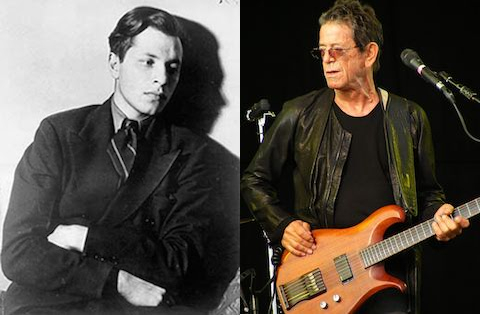
In a galloping vignette in Tablet, writer Lee Smith manages to evoke the essences of both sentimental tough guy Lou Reed and his literary mentor and hero, “Brooklyn Jewish Troubadour” Delmore Schwartz. Although Schwartz’s “poetry is his real legacy,” Smith writes, that rich body of work is often obscured by the fact that “his most famous work is a short story,” the much-anthologized “In Dreams Begin Responsibilities” (1935) It’s a story written in prose as lyrical as can be—with sentences one wants to pause and linger over, reading again and again, out loud if possible. It’s also a story in which we see “a direct line… between Schwartz and Reed,” whose song “Perfect Day” performs similar kind of magical cataloguing of urban impermanence. For Reed, onetime student of Schwartz at Syracuse University, “Delmore Schwartz is everything.”
Reed dedicated the last song, “European Son,” on the first Velvet Underground album to Schwartz, and wrote an eloquent forward to a reissue of Schwartz’s first collection of stories and poems, also titled In Dreams Begin Responsibilities. And just above, you can hear Reed himself read the story aloud, savoring those lyrical sentences in his Brooklyn deadpan. It’s easy to imagine Reed writing many of these sentences, such was Schwartz’s influence on him. They shared not only common origins, but also a common sensibility; in Reed’s songs we hear the echo of Schwartz’s voice, the satirical world-weariness and the lyricism and longing. In the biographical documentary Rock and Roll Heart, Reed says that Schwartz showed him how, “with the simplest language imaginable, and very short, you can accomplish the most astonishing heights.” Reading, and listening to Schwartz’s astonishing “In Dreams Begin Responsibilities” may help you understand just what he meant.
This reading has been added to our collection, 1,000 Free Audio Books: Download Great Books for Free.
Related Content:
Lou Reed Rewrites Edgar Allan Poe’s “The Raven.” See Readings by Reed and Willem Dafoe
Rock and Roll Heart, 1998 Documentary Retraces the Remarkable Career of Lou Reed
Teenage Lou Reed Sings Doo-Wop Music (1958–1962)
Josh Jones is a writer and musician based in Durham, NC. Follow him at @jdmagness
Read More...Blade Runner Spoofed in Three Japanese Commercials (and Generally Loved in Japan)
Blade Runner’s vision of a thoroughly Japanified Los Angeles in the year 2019 reflects the western economic anxieties of the early 1980s. And while that once far-flung year may not have come quite yet, Japan — given the bursting of its postwar financial bubble and the “lost decade” of the 1990s that followed — looks unlikely to own a fraction as much of the United States as Ridley Scott’s Philip K. Dick adaptation (and many other futuristic stories besides) assumed it eventually would. Still, the film’s cultural prophesy came true: even during its economic stagnation, Japan exercised more “soft power” than ever before, turning the world to the unique claims of its culture, from the refinement of its cuisine to the hyperactive exuberance of its music and animation to the matchless elegance of its traditional aesthetics.
Even as Blade Runner showed us how much Japanese style would one day influence, the style of the film had, for its part, an immediate influence on Japan. Though famously unappreciated by westerners on its initial release (“a waste of time,” said Siskel and Ebert), its proto-cyberpunk sensibility won the hearts of Japanese viewers, and Japanese creators, right away. The video at the top of the post collects three Japanese television commercials that both spoof and pay homage to Blade Runner: the first for the Honda Beat, a Japan-only roadster; the second (an astute parody of a particularly memorable scene) for Menicon contact lenses; and the third for mobile service provider J‑Phone.
But the movie’s effect on Japan didn’t stop at the advertising industry. The 1987 animated series Bubblegum Crisis, which follows the adventures of a cyborg-battling team in the “Mega Tokyo” of 2032, plays so much like a homegrown Blade Runner that a fan could create the second video above: an animated recreation of Blade Runner’s trailer, using all its original sound, with Bubblegum Crisis’ footage. The 1988 video game Snatcher stars the decidedly Harrison-Fordian Gillian Seed, a detective in pursuit of the titular killer androids in the “Neo Kobe” of 2044. You can still see much of what the film inspired, and what inspired in the film, in major Japanese cities today. Even Los Angeles has made strides here and there toward the Blade Runner future, though I regret to admit that we still await our tower-side geisha.
Related Content:
The Blade Runner Promotional Film
Colin Marshall hosts and produces Notebook on Cities and Culture and writes essays on cities, language, Asia, and men’s style. He’s at work on a book about Los Angeles, A Los Angeles Primer. Follow him on Twitter at @colinmarshall or on Facebook.
Read More...John Waters Narrates Offbeat Documentary on an Environmental Catastrophe, the Salton Sea
In 2004, John Waters narrated Plagues & Pleasures on the Salton Sea, a humorous documentary on the accidental lake created in the desert of Southern California. You can now find the film hosted on the YouTube channel of KQED, the public television outfit in San Francisco (where we’re getting heavy, heavy rains today). They lay the foundation for watching the film as follows:
Once known as the “California Riviera,” the Salton Sea is now considered one of America’s worst ecological disasters: a fetid, stagnant, salty lake, coughing up dead fish and birds by the thousands. Narrated by cult-movie legend John Waters, Plagues & Pleasures is an epic western tale of real estate ventures and failed boomtowns.
Find Plagues & Pleasures on the Salton Sea listed in our collection, 285 Free Documentaries Online.
If you would like to support the mission of Open Culture, consider making a donation to our site. It’s hard to rely 100% on ads, and your contributions will help us continue providing the best free cultural and educational materials to learners everywhere. You can contribute through PayPal, Patreon, and Venmo (@openculture). Thanks!
Related Content:
John Waters Makes Handmade Christmas Cards, Says the “Whole Purpose of Life is Christmas”
An Anti, Anti-Smoking Announcement from John Waters
John Waters: The Point of Contemporary Art
Global Warming: A Free Course from UChicago Explains Climate Change
Read More...Future Shock: Orson Welles Narrates a 1972 Film About the Perils of Technological Change
The beginning of the 1972 documentary Future Shock, directed by Alex Grasshof, shows Orson Welles, bearded and chomping on a cigar, standing on an airport people mover. He turns to the camera and delivers a monologue in his trademark silken baritone. “In the course of my work, which has taken me to just about every corner of the globe, I see many aspects of a phenomenon which I’m just beginning to understand. Our modern technologies have changed the degree of sophistication beyond our wildest dreams. But this technology has exacted a pretty heavy price. We live in an age of anxiety and time of stress. And with all our sophistication, we are in fact the victims of our own technological strengths –- we are the victims of shock… a future shock.”
The documentary itself is wonderfully dated. From its bizarre opening montage; to its soundtrack, which lurches from early electronic music to jazz funk; to some endearing video special effects, which, for whatever reason, mostly centers around Orson Welles’s head, the film feels thoroughly rooted in the Nixon administration. Yet many of the ideas discussed in the movie are, if anything, more relevant now than in the 1970s.
The term “future shock” was invented in Alvin Toffler’s hugely bestselling book of the same name to describe the constant, bewildering barrage of new technologies and all the resulting societal changes those technologies bring about. Anyone who has struggled to comprehend a new, baffling and supposedly essential social media platform, anyone who has been driven to paralysis over the number of choices on Netflix, anyone who found their livelihood decimated because of a hot new app knows what “future shock” is.
Toffler (along with his wife and uncredited co-writer Heidi Toffler) argued that we are in the midst of a massive structural change from an industrial society to a post-industrial one – a society that boggles the mind with an overload of information and an overload of consumer choices. “Change,” as they wrote, “is the only constant.”
Along the way, the Tofflers managed to predict the collapse of America’s manufacturing sector, along with things like Prozac, temp jobs, the internet and the meteoric rise and fall of insta-celebs (Alex from Target, we hardly knew you.) Other predictions – underwater cities, paper clothes and being able to choose your own skin color – haven’t yet come to pass. Still, they had a surprisingly good track record considering these predictions were written over four decades ago.
The video ends with a plea from not Welles, but Toffler himself, who is seen addressing college students.
If we can recognize that industrialism is not the only possible form of technological society, if we can begin to think more imaginatively about the future, then we can prevent future shock and we can use technology itself to build a decent, democratic and humane society. […] We can no longer allow technology just to come roaring down at us. We must begin to say “No” to certain kinds of technology and begin to control technological change, because we have now reached the point at which technology is so powerful and so rapid that it may destroy us, unless we control it. But what is the most important is we simply do not accept everything; that we begin to make critical decisions about what kind of world we want and what kind of technology we want.
Find other short films narrated by Welles in our collection, 4,000+ Free Movies Online: Great Classics, Indies, Noir, Westerns, Documentaries & More.
Related Content:
Isaac Asimov Predicts in 1964 What the World Will Look Like Today — in 2014
Arthur C. Clarke Predicts the Future in 1964 … And Kind of Nails It
Walter Cronkite Imagines the Home of the 21st Century … Back in 1967
The Internet Imagined in 1969
Marshall McLuhan Announces That The World is a Global Village
Jonathan Crow is a Los Angeles-based writer and filmmaker whose work has appeared in Yahoo!, The Hollywood Reporter, and other publications. You can follow him at @jonccrow. And check out his blog Veeptopus, featuring lots of pictures of badgers and even more pictures of vice presidents with octopuses on their heads. The Veeptopus store is here.
Read More...Hear Dave Grohl’s First Foo Fighters Demo Recordings, As Kurt Cobain Did in 1992
Like ‘em or lump ‘em, you should give ‘em credit—Dave Grohl’s Foo Fighters have kind of redefined the concept album with their latest, Sonic Highways, pushing a tired form in a refreshing direction. Rather than a self-contained narrative, the record opens itself up to tell the stories of rock ‘n’ roll itself or, as Allmusic puts it, “the classic rock that unites the U.S. from coast to coast.” Picking up where his celebratory film Sound City left off, Grohl ties in his newest release with a series of HBO documentaries that visit cities from New York, to Nashville, Austin, New Orleans, L.A., Washington, DC., and Seattle to tell their musical stories.
Of course, the musical history of that last metropolis cannot be narrated without reference to Grohl’s former band, and so, Consequence of Sound informs us, “Nirvana received heavy focus during the [Seattle Sonic Highways] episode as Dave Grohl recounted his time in the Rock and Roll Hall of Fame outfit. Among the biggest revelations was the time Kurt Cobain asked to hear solo recordings Grohl had been working on during Nirvana’s 1992 tour.”
“Kurt heard that, and kissed me on the face, as he was in a bath,” Grohl revealed. “He was so excited. He was like, ‘I heard you recorded some stuff with Barrett [Jones].’ I was like, ‘Yeah.’ He was like, ‘Let me hear it.’ I was too afraid to be in the same room as he listened to it.”
At the time, Grohl intended these early Foo Fighters recordings as an anonymous side project, but the demos garnered enough attention that he later [after Cobain’s death] formed a band and, well… we pretty much know the rest of that story, tragedy and all. But as for the demos, we can hear them too, just as Cobain did, possibly while in the bath, in ‘92. These early versions of songs like “Alone + Easy Target” (top), “Big Me” (above), and “Exhausted” (below)—all of which eventually made their way onto the first, eponymous 1995 Foo Fighters album—have been collected as an unofficial release called Nirvana: Dave’s Demotapes 1992–1993.
Grohl plays all the instruments on these recordings (hear more here), and wrote all the lyrics, though, as he tells us in an interview below, writing lyrics isn’t something he enjoys. He also discusses his admiration for Cobain’s natural writing ability, and reveals that the Nirvana frontman liked “Exhausted” and “Alone + Easy Target” so much he wanted to turn them into Nirvana songs. The opportunity was lost, but Cobain’s encouragement clearly had positive effect on the future Foo Fighter.
Becoming a rock frontman—and a current storyteller of rock history—may have been an evolutionary leap for Grohl, but drumming has been a constant before, during, and after the Nirvana phenomenon. As a denizen of the DC punk scene, Grohl lived part of the rock history of that city as well, playing with several hardcore bands, including Dain Bramage, the project that followed his first band, Mission Impossible. Music blog Antiquiet brings us that band’s 1986 demo recordings. They’re well worth a listen, showcasing a classic mid-80s DC sound, backed by what was even then some profoundly excellent drumming from Grohl. As Dain Bramage’s singer remarked, “After you’ve spent a couple years with Dave Grohl as your drummer it’s easy to feel like no other drummer exists.” The charismatic but humble Grohl writes some pretty decent songs too, even while working in the shadow of superfamous Kurt Cobain.
Related Content:
Nirvana Plays in a Radio Shack, the Day After Recording its First Demo Tape (1988)
The First Live Performance of Nirvana’s “Smells Like Teen Spirit” (1991)
Listen to The John Bonham Story, a Radio Show Hosted by Dave Grohl
Josh Jones is a writer and musician based in Durham, NC. Follow him at @jdmagness.
Read More...Pink Floyd’s The Wall: The Original Live Show & Behind-the-Scenes Footage of the 1980 Tour and 1982 Film
Opening with maximum fanfare and pomp, and closing with the sound of dive bombers, “In the Flesh?,” the first track on Pink Floyd’s magnum opus The Wall announces that the two-disc concept album will be big, bombastic, and important. All that it is, but it’s also somber, groovy, even sometimes delicate, harnessing the band’s full range of strengths—David Gilmour’s minimalist funk rhythms and soaring, complex blues leads, Nick Mason’s timpani-like drum fills and thumping disco beats, and Richard Wright’s moody keyboard soundscapes. Under it all, the propulsive throb of Roger Waters’ bass—and presiding over it his jaded, nostalgic vision of personal and social alienation.
Expertly blending personal narrative with trenchant, if at times not particularly subtle, social critique, Waters’ rock opera—and it is, primarily, his—debuted just over 35 years ago on November 30, 1979. The project grew out of a collection of demos Waters wrote and recorded on his own. He presented the almost-fully formed album (minus the few collaborations with Gilmour like “Comfortably Numb”) to the band and producer Bob Ezrin, who described it as “Roger’s own project and not a group effort.” That may be so in its composition, but the final recording is a glorious group effort indeed, showcasing each member’s particular musical personality, as well as those of a host of guest musicians. The legendary stage show drew together an even larger pool of talent, such as political cartoonist Gerald Scarfe, whose animations were projected on a giant cardboard wall that slowly came down over the course of the concert.
At the top of the page, see the band play the entirety of the album at Earl’s Court in London, and just above, watch a “lost” documentary compiled from behind-the-scenes footage of that show, the last of thirty the band performed on The Wall tour, which began in Los Angeles. We get interviews with the band and crew, Waters at sound check, and “the frenetic operation of the entire load-in process.” Architect Mark Fisher describes the planning and creation of the stage show—a year in the making—from the wall itself to the huge inflatable characters made from Scarfe’s animations. It’s a fascinating look at the very first show of its kind, a huge multimedia extravaganza that blew audiences away and raised the bar for every arena rock tour that followed.
The film version of The Wall, which debuted almost three years later in 1982, was also decidedly a collaborative affair. Just above, a documentary called “The Other Side of The Wall” introduces us to “four very different talents”: Waters, Scarfe, director Alan Parker, and star Bob Geldof. (Album producer Ezrin doesn’t get a mention, though he claims to have written the film’s script.) Giving us a look at “how the final brick in The Wall fell into place,” the short film begins with Waters’ inspiration for the concept album; he tells us in his own words how it grew from his frustrations with the stadium touring for Animals. Parker discusses his artistic intention to not make “a concept movie” (though the movie seems to be exactly that), and Scarfe talks about his designs for the album and film, which Parker describes as “weird” and “psychopathic.”
The final piece of behind-the-scenes making of The Wall we bring you is the BBC Radio interview, above, that Waters’ gave in 1979. He talks about the album’s genesis, and breaks down the meaning of each song at length. Waters’ relationship with The Wall defined the rest of his career after he left Pink Floyd in 1986. In fact, since 2010, he’s been touring his version of the stage show, and has produced a documentary of its revival. But long before the current incarnation of the enduringly classic album and live spectacle, he brought a revival of The Wall to Berlin in 1990 to commemorate the fall of that city’s literal wall eight months earlier. See the full concert video of that show below. Featuring an array of guest musicians, the show approximates the musical intensity of the original 1980 tour—but nothing, of course, can substitute for the incredible energy of the original four members of the band playing together. The vision may have been all Waters, but the execution of The Wall needed Pink Floyd for its success.
Related Content:
Hear Roger Waters’ Early, Work-in-Progress Recordings of Pink Floyd’s The Wall
Watch Documentaries on the Making of Pink Floyd’s Dark Side of the Moon and Wish You Were Here
Watch the Rare Reunions of Pink Floyd: Concerts from 2005, 2010 & 2011
Josh Jones is a writer and musician based in Durham, NC. Follow him at @jdmagness.
Read More...Watch Dragnet’s 1967 LSD Episode: #85 on TV Guide’s List of the Greatest Episodes of All Time
Jack Webb’s seminal cop show Dragnet, which first ran on television through most of the ’50s, was known for its gritty realism. In every episode, the show’s robotic, laconic lead, Detective Joe Friday, would navigate the seedy underworld and eventually get his man.
Though Dragnet rivaled only I Love Lucy in popularity, Webb pulled the plug on the series in 1959. But he couldn’t stay away. In January 1967, Webb launched a reboot of Dragnet. This time, Friday, quite possibly the squarest person on the planet, takes on youth culture. Case in point, the series’ inaugural show, which you can watch above, where Friday and his new partner Bill Gannon stumble upon that strange new societal scourge LSD. Incidentally, this is also the first episode of Dragnet to be shot in color. Make of that what you will.
When Friday and Gannon investigate a complaint about someone eating bark, they discover a teenager who painted his face Braveheart-style and is babbling about the pilot light at the center of the Earth. This is Blueboy AKA Benjamin Carver and clearly, he is tripping. He’s also selling lousy acid to Marcia Brady look-alikes.
The show is a fascinating time capsule on a number of levels. First, this episode was made while LSD was still legal. (Acid was banned California in October 1966. Not long, one imagines, after the episode was shot.) Friday and Gannon shake their heads in frustration over their legal impotence, especially later when they discover Blueboy dead from an overdose. Just in case you didn’t get the show’s moral (drugs = bad) Webb lards the episode with terrifying facts about the drug. “LSD is so potent that a single pound of the preparation can turn every person in Los Angeles county into a total psychotic. The population of the county – seven million people.”
Media critic Michele Hilmes argues, however, that the show might just be speaking out of both sides of its mouth. To an older generation, Dragnet is a cop show preaching law and order. To the younger generation, Webb’s heavy-handedness crosses the line into parodic camp.
Jack Webb so embodied the role of Joe Friday that he all but became the LAPD in the popular imagination. When Webb died in 1982, he was buried with full police honors and his badge number, 714, was officially retired from the force. It’s curious that a cop so unrelentingly smug would become the paragon of LA’s finest.
Thom Andersen memorably summed up the series in his seminal essay film Los Angeles Plays Itself. “Dragnet admirably expressed the contempt the LAPD had for the law-abiding civilians it was pledged ‘to protect and to serve.’ It protected us from ourselves, and it served us despite our best efforts to make the job more difficult. … Friday’s heavy-handed irony never lets up. None of the witnesses or suspects he questions penetrates his wall of condescension. Of course, Dragnet isn’t a documentary portrait of the LAPD, and its detectives weren’t really like Joe Friday. What’s scary is that he represented the department’s ideal.”
According to Andrew Graham’s Dragnet blog, TV Guide voted this episode #85 on its list of the greatest TV episodes of all time.
Related Content:
Artist Draws Nine Portraits on LSD During 1950s Research Experiment
Watch The Bicycle Trip: An Animation of The World’s First LSD Trip in 1943
Ken Kesey’s First LSD Trip Animated
Jonathan Crow is a Los Angeles-based writer and filmmaker whose work has appeared in Yahoo!, The Hollywood Reporter, and other publications. You can follow him at @jonccrow. And check out his blog Veeptopus, featuring lots of pictures of badgers and even more pictures of vice presidents with octopuses on their heads. The Veeptopus store is here.
Read More...George Orwell’s Final Warning: Don’t Let This Nightmare Situation Happen. It Depends on You!
More than 60 years after his death and the closely preceding publication of his best-known novel 1984, we look to George Orwell as a kind of prophet of the ills of corporatism, socialism, authoritarianism, totalitarianism — any powerful ‑ism, essentially, in which we can find nasty, freedom-destroying implications. The BBC documentary Orwell: A Life in Pictures, which we featured a few years back, makes a point of highlighting Orwell’s “warning” to what he saw as a fast corporatizing/socializing/authoriatarianizing/totalitarianizing world. In the film’s final dramatized scene above (watch the complete film here), the re-created Orwell himself makes the following ominous prediction:
Allowing for the book, after all, being a parody, something like 1984 could actually happen. This is the direction the world is going in at the present time. In our world, there will be no emotions except fear, rage, triumph, and self-abasement. The sex instinct will be eradicated. We shall abolish the orgasm. There will be no loyalty except loyalty to the Party. But always there will be the intoxication of power. Always, at every moment, there will be the thrill of victory, the sensation of trampling on an enemy who’s helpless. If you want a picture of the future, imagine a boot stamping on a human face, forever. The moral to be drawn from this dangerous nightmare situation is a simple one: don’t let it happen. It depends on you.
This fictionalized Orwell — much like the real Orwell — doesn’t mince words. But as with most unminced words, these mask a more complicated reality. Though Orwell fans may find each individual piece of this speech recognizable, especially the bit about the boot and the face, the man himself never spoke it — not in this form, anyway.
It mixes documented statements of Orwell’s with words from the text of 1984, and its dramatic closer [“Don’t let it happen. It depends on you!”] comes, as writes Barnes and Noble’s Steve King, from a post-publication press release directed by publisher Fredric Warburg toward readers who “had misinterpreted [Orwell’s] aim, taking the novel as a criticism of the current British Labour Party, or of contemporary socialism in general.” The quotation from the press release was “soon given the status of a last statement or deathbed appeal, given that Orwell was hospitalized at the time and dead six months later.”
You can read more at georgeorwellnovels.com, which provides a great deal of context on this press release, which runs, in full, as follows:
It has been suggested by some of the reviewers of Nineteen Eighty-Four that it is the author’s view that this, or something like this, is what will happen inside the next forty years in the Western world. This is not correct. I think that, allowing for the book being after all a parody, something like Nineteen Eighty-Four could happen. This is the direction in which the world is going at the present time, and the trend lies deep in the political, social and economic foundations of the contemporary world situation.
Specifically the danger lies in the structure imposed on Socialist and on Liberal capitalist communities by the necessity to prepare for total war with the U.S.S.R. and the new weapons, of which of course the atomic bomb is the most powerful and the most publicized. But danger lies also in the acceptance of a totalitarian outlook by intellectuals of all colours.
The moral to be drawn from this dangerous nightmare situation is a simple one: Don’t let it happen. It depends on you.
George Orwell assumes that if such societies as he describes in Nineteen Eighty-Four come into being there will be several super states. This is fully dealt with in the relevant chapters of Nineteen Eighty-Four. It is also discussed from a different angle by James Burnham in The Managerial Revolution. These super states will naturally be in opposition to each other or (a novel point) will pretend to be much more in opposition than in fact they are. Two of the principal super states will obviously be the Anglo-American world and Eurasia. If these two great blocks line up as mortal enemies it is obvious that the Anglo-Americans will not take the name of their opponents and will not dramatize themselves on the scene of history as Communists. Thus they will have to find a new name for themselves. The name suggested in Nineteen Eighty-Four is of course Ingsoc, but in practice a wide range of choices is open. In the U.S.A. the phrase “Americanism” or “hundred per cent Americanism” is suitable and the qualifying adjective is as totalitarian as anyone could wish.
If there is a failure of nerve and the Labour party breaks down in its attempt to deal with the hard problems with which it will be faced, tougher types than the present Labour leaders will inevitably take over, drawn probably from the ranks of the Left, but not sharing the Liberal aspirations of those now in power. Members of the present British government, from Mr. Attlee and Sir Stafford Cripps down to Aneurin Bevan will never willingly sell the pass to the enemy, and in general the older men, nurtured in a Liberal tradition, are safe, but the younger generation is suspect and the seeds of totalitarian thought are probably widespread among them. It is invidious to mention names, but everyone could without difficulty think for himself of prominent English and American personalities whom the cap would fit.
Readers can still find plenty to quibble with in Orwell, but surely that counts as a point toward his status as an enduringly fascinating writer. The lesson, however much we may misinterpret its delivery — and indeed, how much Orwell himself may sometimes seem to misdeliver it — holds steady: don’t let it happen. How not to let it happen, of course, remains a matter of active inquiry.
Related Content:
George Orwell Explains in a Revealing 1944 Letter Why He’d Write 1984
For 95 Minutes, the BBC Brings George Orwell to Life
The Only Known Footage of George Orwell (Circa 1921)
George Orwell and Douglas Adams Explain How to Make a Proper Cup of Tea
Colin Marshall hosts and produces Notebook on Cities and Culture and writes essays on cities, language, Asia, and men’s style. He’s at work on a book about Los Angeles, A Los Angeles Primer. Follow him on Twitter at @colinmarshall or on Facebook.
Read More...David Lynch Takes Aspiring Filmmakers Inside the Art & Craft of Making Indie Films
As a couple of generations of film students have shown us, you shouldn’t try to imitate David Lynch. You should, however, learn from David Lynch. At his best, the director of Eraserhead, Blue Velvet, and Mulholland Drive has managed, in the words of David Foster Wallace, to “single-handedly broker a new marriage between art and commerce in U.S. movies, opening formula-frozen Hollywood to some of the eccentricity and vigor of art film.” How has Lynch brought his enduringly strange and richly evocative visions to the screen, and to a surprising extent into the mainstream, without much apparent compromise?
You can get an idea of his method in Room to Dream: David Lynch and the Independent Filmmaker, the twenty-minute documentary above. Since Lynch hasn’t released a feature film since 2006’s Inland Empire — an especially uncompromising work, admittedly — some fans have wondered whether he’s put the movies, per se, behind him.
But Room to Dream shows the director in recent years, very much engaged in both the theory and process of filmmaking — or rather, his distinctive interpretations of the theory and process of filmmaking.
This touches on his childhood obsession with drawing weapons, his discovery of “moving paintings,” his endorsement of learning by doing, how he uses digital video, his enjoyment of 40-minute takes, why people fear the “very dark,” conveying meaning without explaining meaning (especially to actors), the process of “rehearsing-and-talking, rehearsing-and-talking,” how Avid (the short’s sponsor, as it would happen) facilitates the “heavy lifting” of editing his footage, how he finesses “happy accidents,” how he composes differently for different screens, and the way that “sometimes things take strange routes that end up being correct.” Take Lynch’s words to heart, and you, too, can enjoy his experience of crafting what he calls “sound and picture moving along in time” — with or without an Avid of your own.
Room to Dream will be added to our collection, 285 Free Documentaries Online.
Related Content:
Akira Kurosawa’s 80-Minute Master Class on Making “Beautiful Movies” (2000)
David Lynch Presents the History of Surrealist Film (1987)
10 Tips From Billy Wilder on How to Write a Good Screenplay
Tarkovsky’s Advice to Young Filmmakers: Sacrifice Yourself for Cinema
Filmmaking Advice from Quentin Tarantino and Sam Raimi (NSFW)
Colin Marshall hosts and produces Notebook on Cities and Culture and writes essays on cities, language, Asia, and men’s style. He’s at work on a book about Los Angeles, A Los Angeles Primer. Follow him on Twitter at @colinmarshall or on Facebook.
Read More...Wittgenstein Day-by-Day: Facebook Page Tracks the Philosopher’s Wartime Experience 100 Years Ago
Last week we told you about an ambitious video series — The Great War — that will document how World War I unfolded, week-by-week, over a four-year period, from 1914 to 1918. A new video will be released every Thursday, and it will reflect on what happened during the same week 100 years prior. When complete, there should be close to 300 videos in the series.
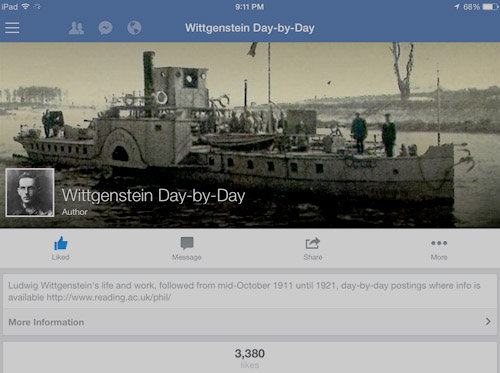
Today, we’re staying in the same time period, but getting even more micro. Wittgenstein Day-by-Day is a Facebook page that “tracks [Ludwig] Wittgenstein’s diary entries as they were written 100 years ago,” writes Levi Asher on his blog Literary Kicks. During World War I, Wittgenstein served on the frontlines in a howitzer regiment in Galicia and was decorated several times for his courage (more on that here). While fighting, he continued writing philosophy — texts that would be gathered in Notebooks, 1914–1916 – while also recording his experiences in his diaries. Today’s entry on Wittgenstein Day-by-Day reads:
Wednesday 18th November, 1914: In his private diary, LW reports hearing more thunder from the front-line, as well as machine-gun fire and heavy artillery fire. He records feeling pleased that their commander is again being replaced by their Lieutenant. He notes that he has done quite a lot of (philosophical) work, and is in a good mood. However, he also notes that in his work there has been at a standstill, as he needs a major incident to move forward (GT2, S.22).
Continuing his thought from yesterday, LW tells himself that it is all simply a matter of the existence of the logical place. ‘But what the devil is this “logical place”?’, he then asks himself (NB, p.31).
You can like and follow Wittgenstein Day-by-Day on Facebook. And, while you’re at it, do the same with Open Culture’s FB page here.
via Literary Kicks
Related Content:
Wittgenstein: Watch Derek Jarman’s Tribute to the Philosopher, Featuring Tilda Swinton (1993)
Bertrand Russell on His Student Ludwig Wittgenstein: Man of Genius or Merely an Eccentric?
Photography of Ludwig Wittgenstein Released by Archives at Cambridge
Download 110 Free Philosophy eBooks: From Aristotle to Nietzsche & Wittgenstein
Read More...Support Us
We're hoping to rely on loyal readers, rather than erratic ads. Please click the Donate button and support Open Culture. You can use Paypal, Venmo, Patreon, even Crypto! We thank you!

About Us

Open Culture scours the web for the best educational media. We find the free courses and audio books you need, the language lessons & educational videos you want, and plenty of enlightenment in between.
Advertise With Us

FREE UPDATES!
GET OUR DAILY EMAIL
Get the best cultural and educational resources on the web curated for you in a daily email. We never spam. Unsubscribe at any time.
FOLLOW ON SOCIAL MEDIA

Open Culture editor Dan Colman scours the web for the best educational media. He finds the free courses and audio books you need, the language lessons & movies you want, and plenty of enlightenment in between.
Advertise With Us