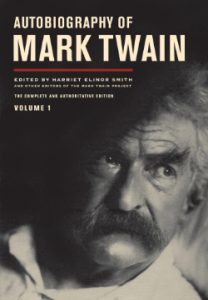
The Autobiography of Mark Twain (Vol. 1) hit the stands just yesterday, and already it stands atop the Amazon bestseller list, leapfrogging past Stieg Larsson, Bill Bryson, Jon Stewart, and even the latest, supposedly greatest American novelist, Jonathan Franzen. Although he died a century again, Twain has still got it.
The 766 page autobiography published by UC Press runs $18.99 in hardcover on Amazon, and the Kindle version a far cooler $9.99. You can read excerpts in PDF format here and here. Meanwhile you can also find free versions of Twain’s classics – Adventures of Huckleberry Finn and Tom Sawyer – in our collections of Free Audio Books and Free eBooks.
The Last Farm, a short Icelandic film directed by Rúnar Rúnarsson and starring Jón Sigurbjörnsson, is now being featured in the YouTube Screening Room. Nominated for an Academy Award for Live Action Short Film in 2006, the 20-minute production gets into some sobering yet inescapably universal issues – love, aging, family and death. And I’ll leave it at that. You can now find this film listed in our collection of Free Movies Online along with 200+ high quality cinematic works. Or you can purchase it on a DVD that brings together several Academy Award-nominated short films from 2005.
If you would like to support the mission of Open Culture, consider making a donation to our site. It’s hard to rely 100% on ads, and your contributions will help us continue providing the best free cultural and educational materials to learners everywhere. You can contribute through PayPal, Patreon, and Venmo (@openculture). Thanks!
The Internet has brought about a sea change in the way societies organize and operate. Few scholars anticipated the trend sooner, or articulated it with greater force and optimism, than Clay Shirky. In his 2008 book, Here Comes Everybody: The Power of Organizing without Organizations, Shirky described how new social structures were being created spontaneously as a result of the Web’s astounding ability to enable people to coordinate—instantly and across distances—not only with other individuals, but with the masses. Shirky’s new book, Cognitive Surplus: Creativity and Generosity in a Connected Age, develops his ideas further. He sees a revolution in the way people are beginning to pool their free time. “Cognitive Surplus,” he says, “is essentially answering the question, What is Wikipedia made of? What is Linux made of? What is YouTube made of? It is made of the coordinated contributions of the world’s connected citizenry.”
With the help of IBM researcher Martin Wattenberg, Shirky calculates that the cumulative effort invested in Wikipedia since its inception—“every edit made to every article, and every argument to those edits, for every language that Wikipedia exists in”—totals about 100 million hours of intellectual labor. Compare that to the 200 billion hours Americans spend every year watching television, writes Shirky. That’s about 2,000 Wikipedias’ worth of time expended every year, in one country.
Shirky claims that younger generations are transitioning from passive TV-watching to active online engagement, and therefore communal projects like Wikipedia are the wave of the future. His critics have countered that the evidence does not support his description of reality: Surveys indicate that the average amount of time people spend watching television has continued to rise since the arrival of the Internet—so if young people are spending more time online, they are likely spending less time actively engaged in the physical world around them.
But Shirky is undaunted. “One thing that makes the current age remarkable,” he writes, “is that we can now treat free time as a general social asset that can be harnessed for large, communally created projects, rather than as a set of individual minutes to be whiled away one person at a time.”
Shirky is currently spending time away from his post as a teacher in the Interactive Telecommunications Program at New York University to serve as a visiting fellow at Harvard University’s Berkman Center for Internet & Society. We met up with him there last week for a brief interview.
Open Culture: You’re well known as an optimist when it comes to technology’s effect on society. As a consequence, you’ve drawn a lot of criticism from the other side. Do you ever feel like a lightning rod for Luddites?
Clay Shirky: I’ve certainly become a lightning rod, which is relatively recent. I should say also, I’m not an optimist about technology full stop. I am an optimist about democratizing media. For instance, the effects of television seem to me to be far more complicated and far less positive than the effects of the printing press. Even though, or perhaps because, we spend more time watching television than we do with written material. But obviously one of the effects of the printing press was to democratize production, to increase dramatically the number of voices available for public discourse. Television, much less so. So I’m not a techno-optimist full stop. I am an optimist about democratizing media technologies. I have become a lightning rod in a way that I find a little bit disorienting, because I’ll sometimes read about myself and see opinions attributed to me that I haven’t actually expressed, but because they were expressed by other optimists we are kind of lumped together. My interpretation of this is that, for a long time the people who believed that this change in the media landscape was good simply weren’t taken seriously. The idea that this was going to lead to any kind of significant restructuring of any aspect of society was just seen as a kind of a fringe sensibility. I think with the collapse of the mainstream newspaper’s business model, there is now an example in which the Web is demonstrably transforming the intellectual and cultural landscape. And so I think that part of the reason for this lightning rod thing for me and for other people—for J.Z. (Jonathan Zittrain), for Yochai Benkler—is that there’s now a broad swath of society who doesn’t think about the effects of technology but nevertheless has come to believe that the web really does mean a restructuring. Some of the lightning rod stuff is essentially that conversation now spreading out to the general population. I think that this phase will probably last a year or two and then we’ll be on to some kind of post-lightning rod conversation.
Open Culture: Where do you think the conversation is headed?
Clay Shirky: Well, I think it’s headed around norms and assumptions. Our experience of print culture—that’s very much shaped by things like libraries and card catalogues, you know. How we interact with print. But libraries and card catalogs and bookstores and page numbers and chapter titles and all those kinds of things that we take for granted, those weren’t responses to print. Those were responses to the problems that print caused. And so what we see is that the culture that grew up around the printed word was in many cases a culture that was responsive to the difficulties of integrating print into society. And we now have this digital medium that allows for all kinds of new communicative possibilities, and I think the conversation runs to: What are the institutions and assumptions that we build around the Internet, partly to take advantage of its positive effects and partly to mitigate the difficulties it causes.
Open Culture: Is it too early to venture any suggestions in that regard?
Clay Shirky: No, of course not. When you’re venturing a suggestion, usually what you’re talking about is taking special cases and extrapolating. Two of them are that we’ve lost the ability to say which groups get to form and which don’t. In a world where forming a group was hard, society had a lot of controls. It was easy if you were a Methodist to find other Methodists. You’d go to the Methodist church at 9 o’clock on Sunday morning and you could find them easily enough. If you were an atheist it was very difficult to find other atheists. One of the startling effects of the so-called “New Atheist Movement” is not just that there are individual atheist voices in the public sphere, but that other atheists can now come out of the woodwork and interact with one another—on Richard Dawkins’s blog, on P.Z. Myers’s blog—and so it creates group-forming as a new possibility. So society is just going to see a lot more of those kinds of groups, that are not completely socially sanctioned, nevertheless form.
Open Culture: Do you see any ill effects from this? For example, as technology has progressed, people have increasingly shed their inherited affiliations, like family and neighbors, to forge these new bonds with like-minded people, often strangers. They share information and encouragement, which enhances their ability to act effectively. But this works just as well for pedophiles as it does for philanthropists, doesn’t it?
Clay Shirky: If you believe that human nature is exactly evenly divided between good and bad, and that prosocial norms are neutral with respect to outcome, then the Internet would be a completely neutral technology. If you believe that humans are basically bad, that prosocial norms are almost invariably used to create group-oriented negatives, then you would believe the Internet was bad. If you believe what I do, that prosocial norms tend towards positive and cooperative uses, then you would conclude that, on balance, heightened ability for groups to operate would lead to an improved society. So it’s not that the technology works better for philanthropists than pedophiles, it’s that society is more given to philanthropy as a generally embraced norm than pedophilia. And exposing yourself as a philanthropist creates none of the constraints that exposing yourself as a pedophile creates. So I think that, on balance, the effect is positive, even giving the coordination tools to groups that have negative goals—either specifically negative goals, as with terrorist groups, or groups which have norms which are so outside the mainstream, like pedophilia.
Open Culture: If we weaken our ancient social institutions, how will we hold the center together?
Clay Shirky: Many of the social institutions people are complaining about are, you know, a third of the nation watching Johnny Carson. It’s funny. When I grew up, all the handwringing about the media environment was, “Oh, we have this terrible homogenizing culture.” Now suddenly the thing we’re supposed to be worried about is, we have this terribly de-homogenizing culture. The arc of modernity—and I mean literally from the Protestant Reformation on—is the arc of cosmopolitanism. It is the arc of dismantling society and culture as a single, whole way of doing things—where everyone has one religion and everyone has one pattern of living—towards dramatically increased heterogeneity, of tolerance and participation. There’s no grand arrow of history where all of this stuff unfolds exactly the same way and exactly the same time. In this country, emancipation of African Americans happened on a different schedule with different results as emancipation of women’s ability to vote, own property and participate. What we’re seeing now, I think, is a progress towards greater freedom of consciousness and greater intellectual range, both inputs and outputs. People can find more things to read and watch across a wider range, and can say and do more things in response than we’ve had before. And that plainly does dismantle some of the previous solidarity goods in society. We don’t have a world where a quarter of the nation watches Johnny Carson. But we attach our allegiance to the system as a whole, which is to say, the idea of being part of a global network where people care for one another. One of the things that has happened in our lifetime is the incredible responsiveness to overseas disasters. There was an earthquake in Haiti, there was awful flooding in Pakistan, and the sense of “Someone needs to do something” is no longer conducted in the hallways of the U.N., but goes out as a direct appeal to the populace. So as a trade-off for the loss of this “solidarity, good-of-everybody-watching-the-same-TV-shows,” or what have you, the embrace is to a potentially larger loyalty, to the idea of a kind of global polity. And that’s in line with what’s been happening, very slowly but fairly steadily, since the Protestant Reformation.
Open Culture: What’s next for you? Are you working on a new project?
Clay Shirky: I got ten years of work out of the intuition that the Internet was getting more social, but I’m done with that now. I don’t have anybody to fight with anymore. That thesis is sort of broadly agreed to. The piece I’m working on now is specifically around journalism. My current formulation is that markets supply less accountability than democracies demand—that if you leave the presence of accountability to an entirely market-driven press corps, you get less coverage than democracies need to survive. And we’ve had all of these ways in the past of subsidizing that, right? So broadcast news had to be subsidized because the FCC said so when they handed out the licenses, and newspapers subsidized it because they had essentially enjoyed local monopolies but were relatively free of too much interference by advertisers. But a lot of those old subsidies are breaking. So the advertising subsidies that newspapers enjoyed, and the subsidies that were essentially required by the federal government of broadcast outlets, are all going away at the same time, and they’re all going away for the same reason, which is to say, none of those subsidies survive abundance. So the question I’m asking myself is—assuming this hypothesis is right—what are other ways that society can subsidize the kind of journalism that leads to accountability of elites, principally politicians but also business and religious elites? I don’t know the answer to that. There’s a lot of interesting experiments: ProPublica, Spot.us, GroundReport. But that’s the question I’m turning my attention to.
This article was contributed by Mike Springer, a journalist in Cambridge, Massachusetts.
The Astronomical Clock Tower, situated in Prague’s Old Town Square, just celebrated its 600th anniversary. And to help mark the occasion, artists projected visuals mappings onto the facade – ones that illuminated the history and symbolic significance of the tower for the crowd. These light shows are getting a little en vogue. Cambridge University recently punctuated its 800th anniversary celebration by turning its buildings into a canvas. And Ukraine marked its independence this year with a light show of its own.
A noteworthy mention: The World is Full of Interesting Things packs together 106 works from the “creative internet” into one Google slideshow. It’s a visual grab bag of images, videos, mashups, apps and other items that have captured the collective online imagination. The diverse collection is more easily experienced than explained. So start flipping through and see what we mean here.
This past Saturday, Vimeo held its first annual awards ceremony in New York City. Films by nine finalists were screened (see the list below) and then came the big moment: the announcement of the Best Video Award, which went to Eliot Rausch, director of “Last Minutes with ODEN.” As an organizer of the Vimeo festival explains, the documentary (watch above) is about “redemption and transformation.” It’s about how Jason Wood, an ex-convict and drug addict, grows personally, even spiritually, through his relationship with Oden, a three-legged dog now stricken with cancer. The documentary takes us poignantly through their last day together.
Dark Side of the Lens presents the art and inner voice of Irish surf photographer Mickey Smith. The six minute film lets you experience Smith’s aesthetics translated into beautiful practice. (“I wanna see waveriding documented the way I see it in my head, and the way I feel it in the sea.”) But then it rather poetically cracks open the personal philosophy of the artist:
I never set out to become anything in particular, only to live creatively and push the scope of my experience for adventure and for passion… The raw brutal cold coastlands for the right waveriders to challenge – this is where my heart beats hardest…
Most folk don’t even know who we are, and what we do or how we do it, let alone what they pay us for it. I never want to take this for granted so I try to keep motivation simple, real, and positive… If I only scrape a living, at least it’s a living where I’m scraping.… If there’s no future in it, this is a present worth remembering.
The aesthetic choices. The personal decisions. It’s all what’s happening behind the camera, the place no audience sees, the “dark side of the lens.” You can find the full transcript of Smith’s commentary after the jump…
A final note: Dark Side of the Lens was born out of a project called “Short Stories.” Established by Relentless Energy Drink, the UK-based project challenged filmmakers to create their own mini opus, to explore and celebrate “no half measures” in film. Find other shorts here.
If you would like to support the mission of Open Culture, consider making a donation to our site. It’s hard to rely 100% on ads, and your contributions will help us continue providing the best free cultural and educational materials to learners everywhere. You can contribute through PayPal, Patreon, and Venmo (@openculture). Thanks!
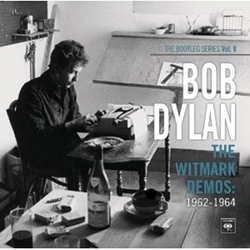
Next week, Bob Dylan will release The Witmark Demos: 1962–1964, a collection of 47 songs that the artist recorded for the M. Witmark & Sons publishing company, all before his 24th birthday. The young Dylan knocked out these tracks in a sparse 6x8 foot studio, accompanied only by his acoustic guitar, harmonica and piano. And, right now, you can stream 23 of these demos (for free) on NPR’s First Listen site. The lineup includes some of his finest early singles – Blowin’ In The Wind, A Hard Rain’s A‑Gonna Fall, Don’t Think Twice, It’s All Right, Girl From The North Country, Mr. Tambourine Man, The Times They Are A‑Changin’… You get the gist.
If you’re inclined to purchase the album, then you’ll want to consider this Amazon deal. Buy The Witmark Demos on CD or vinyl before 10/18/2010 and you will also get a live concert CD – Bob Dylan: In Concert, Brandeis University, 1963 – that has “never been heard, bootlegged or circulated in any way.” Not bad for $13.99. Find more details here.
We're hoping to rely on loyal readers, rather than erratic ads. Please click the Donate button and support Open Culture. You can use Paypal, Venmo, Patreon, even Crypto! We thank you!
Open Culture scours the web for the best educational media. We find the free courses and audio books you need, the language lessons & educational videos you want, and plenty of enlightenment in between.