The Teaching Company has posted online a free video lecture that focuses on what happens in our brain when we learn — something that should pique the interest of pretty much any reader here. (Just what happens with those synapses when you come here every day?) The lecture (watch here) comes from a larger course called Understanding the Brain and is presented by Jeanette Norden, a professor in Cell and Developmental Biology at Vanderbilt University.
Side Note: The Teaching Company is also offering free access to another lecture (this one in audio) that surveys the “Masterpieces of Classical Holiday Music,” including Bach’s Christmas Oratorio of 1734, Handel’s Messiah of 1741; and Tchaikovsky’s Nutcracker Suite of 1892. Listen or download here.
“Spain: Santiago de Compostela (Old Town); Old Town of Cáceres; Historic Walled Town of Cuenca; Old City of Salamanca; Old Town of Ávila with its Extra-Muros Churches; Old Town of Segovia and its Aqueduct; Historic City of Toledo France: Palace and Park of Versailles; Paris, Banks of the Seine Italy: Archaeological Areas of Pompei, Herculaneum and Torre Annunziata; Historic Centre of Siena; Historic Centre of Urbino; Historic Centre of San Gimignano Netherlands: Mill Network at Kinderdijk-Elshout Czech Republic: Holy Trinity Column in Olomouc; Historic Centre of Český Krumlov; Historic Centre of Prague United Kingdom: Stonehenge, Avebury and Associated Sites; Royal Botanic Gardens, Kew”
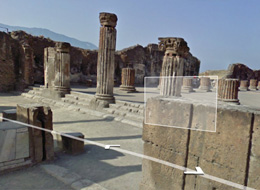
The story of Pompeii is well known. Back in 79 AD, Mount Vesuvius erupted and covered the neighboring Roman city with 60 feet of ash over the course of two days. The city was wiped out and then entombed for centuries, until archaeologists started unearthing the ruins in the 18th and 19th centuries, offering the modern world an amazing window into the finer details of ancient Roman life. (Just for the record, digging continues there today, and I even got to do some this past summer.) Today, Google is helping deepen the modern connection to the ancient world. Using Google Street view, you can tour Pompeii in 3D from the comfort of your own home. To begin walking through the ancient city, just click here.
Finally, to dig deeper into ancient history, I’d recommend looking through our previous post, Learning Ancient History for Free. This will point you to some of the best free courses available on the web.
The University of Michigan now offers a course designed to help students turn their iPhones into musical instruments. The video above shows footage from one of their practice sessions held in November. A final concert will be held on December 9. You can read more about this project here. Also see Stanford students playing the iPhone here.
What do natural magnetic fields look like? This extraordinary footage from NASA’s Space Sciences Laboratory (UC Berkeley) gives you a glimpse and reveals their “chaotic, ever-changing geometries.”
What if people behaved like banks? Or, more precisely, what if individuals holding “underwater” mortgages stopped following the social norms of ‘personal responsibility’ and ‘promise-keeping’ and instead acted like capitalist players in a free market? Most would dump their sinking mortgages and walk away. That’s the finding of Brent White, a law professor at the University of Arizona, who has published a new paper called “Underwater and Not Walking Away: Shame, Fear and the Social Management of the Housing Crisis.” (PDF) The bottom line is that homeowners and banks play by two different sets of rules. Main Street accepts the “emotional constraints … actively cultivated by the government, the financial industry,” and they hold the bag. Wall Street acts in its own self interest and gets a fresh start. The only thing they have in common these days are (you guessed it) guns.
Just for the record: I’m not advocating a position here, and I don’t hold an underwater mortgage…
Every now and then, we like to remind readers of the audio/video resources that Open Culture makes available to lifelong learners. These collections are all free, and can be downloaded to your computers and mp3 players. When you add it all together, you will find thousands of hours of free educational content here from quality sources. If you have a chance, please
Free Audio Books: This page contains a vast number of free audio books, including many classic works of fiction, non-fiction, and poetry. Jane Austen, Arthur Conan Doyle, F. Scott Fitzgerald, James Joyce, Kafka, Shakespeare, Orwell and much more. You can download them all straight to your computer or mp3 player, then listen any time. (On a related note, you might want to see our list of Life-Changing Books, according to our readers.)
Free Courses from Major Universities: This list brings together over 250 free courses from leading universities, including Stanford, Yale, MIT, UC Berkeley, Oxford and beyond. Theses full-fledged courses range across the humanities, social sciences, and sciences, including computer science. The page is a gold mine for lifelong learners.
Free eBooks: Here’s a new collection that features over 100 Free eBooks, most of them classics, that you can access on your PC, smart phone (including iPhone), and Kindle.
Ideas & Culture Programs/Podcasts: In this one collection, we have gathered together some of the most intellectually stimulating programs available via podcast. The programs will keep you thinking and culturally up-to-date, as will our collection of science podcasts. All can be downloaded straight to your mp3 player.
The Best Intelligent Video Sites: Where can you go to find intelligent video? We have listed 46 web sites that feature a steady stream of intelligent content: documentaries, lectures, educational programming and much more.
Smart YouTube Collections: It’s hard to separate the wheat from the chaff on YouTube. But we have done it. Here you will find upwards of 100 YouTube channels that regularly serve up smart video content.
Our YouTube Picks: Over the past few years, we have featured several hundred YouTube videos on Open Culture. And some of the best ones we have brought together in our own YouTube channel. You can subscribe to this collection and watch new videos as we add them.
Great Classic Movies: Our new movie collection features landmark films for the student of cinema. Here, you’ll find numerous Chaplin films from the silent era, 12 Alfred Hitchcock films, and many other great works from the 1920s, 30, 40s and 50s. You’ll even find some great contemporary films as well. Many of the great American directors are represented here.
Open Culture iPhone App: A little something special for iPhone users. When you download our free iPhone app, you can take with you, wherever you go, many of the items listed above. Free Audio Books, Free University Courses, Free Language Lessons, Music and Science Podcasts, etc. Give it a try and tell a friend. Note, that per Apple’s requirements, you will need access to Wi-Fi.
Werner Herzog, one of Germany’s finest living directors, has a new film out, The Bad Lieutenant (watch trailers here), which has a loose relationship with Abel Ferrara’s own Bad Lieutenant from 1992. The new film, starring Nicolas Cage and Eva Mendes, gets reviewed by A.O. Scott in the New York Times. And now a former Times film critic, Elvis Mitchell, sits down with Herzog and talks about his “anarchist” noir film set in New Orleans. The interview was aired by KCRW in LA and can be downloaded in several formats here, or streamed right below. And, film fans, don’t forget to check out our new collection of free movies online. (It now includes about 120 individual films, and lists 35 sites where you can watch free movies online.)
Last week, we waded into the best of TED debate. What’s the best TED Talk out there? It’s hard to say. Purely subjective. But we can say one thing. Jill Bolte Taylor’s “Stroke of Insight” talk reaches the top of many lists. What happens when a neuroanatomist experiences a massive stroke and feels all the brain functions she has studied (speech, movement, understanding, etc) suddenly start to slip away? And how do these losses fundamentally change who we are? You’ll find out in a crisp (and at times emotional) 18 minutes and 40 seconds. You can also read her book that elaborates on her life-altering experience. See My Stroke of Insight: A Brain Scientist’s Personal Journey.
This short animated film, When the Day Breaks, comes to us via The National Film Board of Canada, which appears on our list of places to watch free movies online. (Scroll to the bottom of the page.) In this film directed by Wendy Tilby and Amanda Forbis, “Ruby the pig seeks affirmation in the city around her after witnessing the accidental death of a stranger… and finds it in surprising places. With deft humour and finely rendered detail, When the Day Breaks illuminates the links that connect our urban lives, while evoking the promise and fragility of a new day.” Thanks Victoria for this nine minutes of goodness!
20 years ago, the dominoes fell in Eastern Europe. Not long after the Wall fell in Berlin, a non-violent revolution got underway in Czechoslovakia. The Velvet Revolution took just a matter of six weeks (November 17 — December 29, 1989) to unfold. It was fast and bloodless, and it put on the world stage Václav Havel — the playwright, turned anti-Soviet dissident, and soon democratic president of Czechoslovakia (and later the Czech Republic).
In 2006, Havel arrived in New York City, to spend 8 weeks at Columbia University. To mark the occasion, the university built a web site called Havel at Columbia that reconsidered Havel and the Velvet Revolution. Along with some intriguing historical footage, the site features video interviews with George H.W. Bush, David Remnick (the New Yorker editor and author of Lenin’s Tomb), Milos Forman (the great movie director of Czech heritage), Edward Albee (the playwright best known for Who’s Afraid of Virginia Woolf?), George Soros, and Lou Reed. Collectively, these conversations give you a very good feel for the man, the artist, and his historical contributions. You will also then find a conversation between Presidents Bill Clinton and Václav Havel, and a reading of Havel’s play, The Garden Party, directed by Israel Horvitz featuring Dustin Hoffman and Robert Klein. Podcasts of many of these wonderful events can be found on iTunes.
We're hoping to rely on loyal readers, rather than erratic ads. Please click the Donate button and support Open Culture. You can use Paypal, Venmo, Patreon, even Crypto! We thank you!
Open Culture scours the web for the best educational media. We find the free courses and audio books you need, the language lessons & educational videos you want, and plenty of enlightenment in between.
 The story of
  20 years ago, the dominoes fell in Eastern Europe. Not long after


