So, you want to be an architect. Where to begin? It seems like a very big aspiration. One theorist argues that modernist architecture has been “characterized by a thaumaturgic… ambition which would heal the ‘diseases’ of individuals and society.” As anyone who’s spent much time in a housing project, faceless office park, or strip mall might attest, more recent approaches can also have “the power of hurting.”
If you’re intent on wielding the power of architecture for good, you’ll need many years of study and apprenticeship. But whether you’re just getting your feet wet or have already waded into the field, you’ll likely gain quite a lot of understanding from “The Architectural Imagination,” a free online course from Harvard’s Graduate School of Design, in which you will “learn how to ‘read’ architecture as a cultural expression as well as a technical achievement.” The course, which begins on February 28th, is free, but for $99 students can also receive a certificate of completion.
“Architecture is one of the most complexly negotiated and globally recognized cultural practices,” notes the course introduction. Building design “involves all of the technical, aesthetic, political, and economic issues at play within a given society.” In addition to creating single-family dwellings, architects are tasked with designing harmonious spaces through which thousands of people might move on a daily basis.
Successful design requires more than an understanding of the necessary relationships between form and function. “In some ways,” the course trailer video above tells us, “it’s just what exceeds necessity that is architecture. And it’s the opening onto that excess that makes architecture a fundamentally human endeavor.”
Healing society? Grasping the big issues in arts, politics, and engineering? Designing for the “fundamentally human”? These are deep briefs indeed. A more lighthearted approach to the field—the tongue-in-cheek “I Am an Architect” rap above—suggests a couple simpler prerequisites for the aspiring architect: a lifelong passion for making things (with blocks, Legos, Jenga, etc.), and, of course, a pair of black plastic glasses. If you can relate, sign up for Harvard’s “The Architectural Imagination” and find many more edX Architecture courses here.
I don’t know if he’s been replaced as a major influence on young, restless (and almost exclusively male) aspiring writers, but once upon a time—if you weren’t into the romantic wanderlust of Kerouac but still considered yourself a fringe character—it might be to the hard-boiled shit-talking of wise old man Charles Bukowski that you turned. Upon first learning this, and being a busy college student, I decided to take a crash course and checked out a documentary.
I did not find myself charmed all at once. But one can fall in love with an author’s persona yet loathe them on the page. Bukowski’s crudeness and bad humor on film could not hide the deep wells of sadness in which he seemed to swim, as if—like some ancient cynic philosopher—he knew something profound and terrible and spared us the telling of it by posing as a drunken, half-mad street-corner raconteur. I had to go and read him.
In his idiom—that of an eloquent streetwise barfly—Bukowski can be every bit as passionate and profound as his hero Dostoevsky. His unforgettable mixing of comic seediness and casual abuse with a deeply tragic mourning over the human condition, while not to everyone’s taste, make his decades-long struggle out of penury and obscurity a feat worthy of the telling in his semi-autobiographical prose and poetry.
But does it make him a role model? For anyone but certain young, mostly male, aspiring writers maybe spending more time drinking than writing, that is?
A fair number of people seem to think so, and I leave it to you to decide, first by listening to the Bukowski poems read here, posted on YouTube with heavy, inspirational background music. Some are given new titles to sound more like self-help seminars—such as “Reinvent Your Life” at the top (originally “No Leaders, Please”). The video reading called “Go all the way,” second from top, changes the title of “Roll the Dice,” a classic picture of Bukowski’s uncompromising commitment to “going all the way,” even if it means “freezing on a park bench” and “losing girlfriends, wives, relatives, jobs and maybe your mind.”
Solidly middle-class parents might approve of the first poem’s sentiments, which could be wedged into a suitably vague, yet bold-sounding commencement speech or a job recruiter’s pep talk. But “Roll the Dice” simply goes too far. “It could mean jail, it could mean derision, mockery, isolation”? This won’t do at all. Hear another reading of “Roll the Dice” by inspirational rock star Bono further up, just after the more Bukowski-like Tom Waits reads “The Laughing Heart,” frequently referenced for its intensity of feeling. Like Thomas Hardy or Leonard Cohen, the bard of the barstools could look life straight in the eye, see all of its bleakness and violence, and still manage at times to catch a divine glimmer.
And for the many aspirants to whom Bukowski has appealed, we have, further up, “So, You Want to Be a Writer?” Before you hear, or read, this poem, be advised: these are not warm words of encouragement or helpful life-coaching in verse. It is the kind of raw talk no respectable writing teacher will give you, and maybe they’re right not to, who’s to say? Except a man who went all the way, froze on park benches, went to jail, lost girlfriends, wives, relatives, jobs and maybe his mind? Read an excerpt of Bukowski’s writing advice below, and just above, hear the author himself read “Friendly Advice to a Lot of Young Men,” which urges them to do virtually anything they like, “But don’t write poetry.”
don’t be like so many writers, don’t be like so many thousands of people who call themselves writers, don’t be dull and boring and pretentious, don’t be consumed with self- love. the libraries of the world have yawned themselves to sleep over your kind. don’t add to that. don’t do it. unless it comes out of your soul like a rocket, unless being still would drive you to madness or suicide or murder, don’t do it. unless the sun inside you is burning your gut, don’t do it.
The doctor breaks the news. You have terminal cancer, and you might have only a few months to live. How would you spend those final days? That’s a question that Eric Sun had to confront when doctors told him he had a glioblastoma, an aggressive form of brain cancer, in 2016. Only 32 years old, Sun had studied computer science and economics at Stanford, then went to work at Facebook in 2008. Everything was on track. Until it wasn’t. Then big decisions had to be made.
Last month, the New Yorkerpublished a poignant profile on Sun, documenting how, facing mortality, he found refuge–and maybe some kind of deeper meaning–in music. The related video above, “Finding Meaning in Music,” lets you see Sun returning to his lifelong passion–playing violin–and getting ready for his final performance. In the end, it’s art that nourishes the soul.
If you would like to support the mission of Open Culture, consider making a donation to our site. It’s hard to rely 100% on ads, and your contributions will help us continue providing the best free cultural and educational materials to learners everywhere. You can contribute through PayPal, Patreon, and Venmo (@openculture). Thanks!
45 years have passed since Brian Eno left Roxy Music to strike out on his own, launching a more or less unprecedented career spread across music popular and experimental as well as other forms of art entirely. It seems to have worked out for him: young stars like James Blake, Owen Pallett, and Seun Kuti continue to seek out the boundary-pushing creative oversight he previously brought as producer to acts like David Bowie and U2, and his own work as a “non-musician” (which began with him twisting knobs and pushing buttons almost at random with Roxy Music) continues apace, his latest album Reflection having come out just last year.
If you looked for Reflection at the record store, physical or digital, you might well find it filed under “ambient,” a genre Brian Eno often gets credited with, though never seems to claim credit for, inventing.
Whether or not he came up with that atmospheric, almost spatial form of music single-handedly — or its computer-composed cousin generative music, which you can experience with Reflection in app form — matters less than the intellectual framework he’s built, and that he continually dismantles and rebuilds, around it.
Though Eno has always insisted on the importance of deep feeling in music, perceiving a kind of sacredness in acts like singing and dancing, the creation of his own music has also involved no small amount of cogitation, the fruits of which you can hear in the 29-hour Spotify playlist above. (If you don’t have Spotify’s free software, you can download it here.) If you got into Eno through his ambient work, what you hear on much of this sonic journey through his discography might surprise you: the jaggedness of a “Sky Saw” from Another Green World, the cyberpunk beats of Nerve Net, or the nervy grooves on his collaborations with former Talking Heads David Byrne. All of it evidences that Eno never runs out of musical ideas, nor the fascination to execute them; no wonder Roxy Music leader Bryan Ferry, nearly half a century later, wants to collaborate with him again.
The playlist starts with Eno’s first album, 1974’s Here Come the Warm Jets, and then moves through the rest of his discography chronologically. It may not include every album Eno ever made. But it certainly seems to include every Eno album currently available on the streaming service.
Based in Seoul, Colin Marshall writes and broadcasts on cities and culture. His projects include the book The Stateless City: a Walk through 21st-Century Los Angeles and the video series The City in Cinema. Follow him on Twitter at @colinmarshall or on Facebook.
Tim Minchin isn’t much of a role model in the hair brushing department, but in every other way the prolific comedian/actor/writer/musician/director inspires.
He’s unabashedly enthusiastic about science, a lifelong learner who’s a strong believer in the power of exercise, travel, and thank you notes….
In 2013, his alma mater, the University of Western Australia, awarded him an Honorary Degree of Doctor of Letters and invited him to address the graduating class.
The speaker insisted up front that an “inflated sense of self importance” born of addressing large crowds was the only thing that positioned him to give such an address, then went on to share a funny 9‑point guide to life that stressed the importance of gratitude, education, intellectual rigor, and kindness toward others.
If you haven’t the time to watch the entire 12-minute speech, above, be sure to circle back later. His advice is hilarious, heartwarming, and memorable.
In extrapolating the essence of each of his nine “life lessons” below, we discovered many bonus lessons contained therein (one of which we include below.)
Tim Minchin’s 9 Rules To Live By
You don’t have to have a dream. Be micro-ambitious and see what happens as you pursue short-term goals…
Rather than chasing happiness for yourself, keep busy and aim to make someone else happy.
Remember that we are lucky to be here, and that most of us — especially those of us with a college education, or those actively seeking to educate themselves to a similar degree—will achieve a level of wealth that “most humans throughout history could not have dreamed of.”
Exercise. Among other things, it helps combat depression.
Identify your biases, prejudices, and privileges and do not exempt your own beliefs and opinions from intellectual rigor.
Be a teacher! Swell the ranks of this noble profession.
Define yourself by what you love, rather than what you despise, and lavish praise on the people and things that move you.
Respect those with less power than yourself, and be wary of those who do not.
Don’t be in a rush to succeed. It might come at a cost.
BONUS. Uphold the notion that art and science are not an either/or choice, but rather compliment each other. “If you need proof—Twain, Douglas Adams, Vonnegut, McEwan, Sagan and Shakespeare, Dickens for a start. …The arts and sciences need to work together to improve how knowledge is communicated. “
In a contrarian take on the legacy of John Coltrane on the 50th anniversary of his death last year, Zack Graham at GQ did not recommend Giant Steps nor A Love Supreme nor Blue Train nor My Favorite Things as the most important album in the artist’s career, but a record most casual jazz fans may never encounter, and which even the hardest-core Coltrane fans never heard in his lifetime. Recorded in the year of his death, Interstellar Space—a frenetic suite of free jazz duets with drummer Rashied Ali—didn’t appear until 1974. The album has since received widespread critical acclaim, and stands, Graham argues, as “Coltrane’s most influential record, its echoes still heard today in everything from electronic music to some of the world’s biggest hip hop acts.”
Graham makes a compelling case. It’s hardly an accessible album, but discerning listeners will nonetheless hear the sound of now in Ali’s stuttering, rapid fire beats and Coltrane’s modal bleats. Looking back, it can almost seem like he knew he was running out of time, and rushed to leave behind a blueprint for the music of the future.
“In his last months,” writes Stephen Davis at Rolling Stone, “Coltrane had changed everything about his music,” and, perhaps, everything about music in general, jazz and otherwise. His evolution as a musician and explorer of the mystical potentialities of artistic expression was so radical that from a certain point of view we are forced to work backward when approaching his catalog, as we might do with biographies of saints.
Should we pursue this line of thinking, however, we might have to grant that the posthumous Interstellar Space and its follow-up Stellar Regions—compiled from tapes Alice Coltrane discovered in 1994—are the result of Coltrane’s final musical apotheosis and thus can sound nigh-incomprehensible to most mere mortals. Interstellar Space “is a musicians’ album, for sure,” Graham admits, and an album for those fully open to the unknown: “the dissonance and enharmonic experimentation… is otherworldly.”
Working backward, we see Coltrane’s transfiguration into an avant-garde pioneer in 1966’s Ascension, an album that “still manages to confound as many listeners as it convinces,” Derek Taylor writes at All About Jazz. A Love Supreme is Coltrane’s gospel, a spiritual classic that draws everyone in with its message of transcendence and oneness. Earlier milestones My Favorite Things, Giant Steps, and Blue Train are each miraculous feats of musicianship that drew huge crowds of admirers and imitators, and then there are the years of apprenticeship, when the young Coltrane studied under masters like Miles Davis and Dizzy Gillespie, and practiced the dharma of Charlie Parker.
A narrative of Coltrane as a kind of musical messiah explains the literal veneration of his work by the Church of Saint John Coltrane, but it is only one convenient means of Coltrane appreciation. In truth, his oeuvre is too vast and varied in scope to neatly sum up in any fully satisfying way. We might just as well start at the beginning, when Coltrane was a mostly unknown, but very hip, sideman, playing with the greats throughout the fifties. “From his Bird-emulating beginnings to his flights into the unknown in his last years,” writes Fernando Ortiz, compiler of the “Complete” John Coltrane playlist above, “the standard of his music and his passion are always at the top or very close to it.”
Comprising over 700 tracks, “or four straight days of listening,” this playlist list is still “far from perfect,” Ortiz admits, “since it is subject to availability and to the non-systematic approach to data on Spotify, but it’s not that far this time.”
…no studio recording he made between 1955 and 1965 is missing (his previous years are well represented, starting with his 1946 recordings while in the Navy), which includes all his studio work as a leader during those years, as well as all his recordings as a sideman with Miles and Monk.
The weighting toward live recordings, “both from official and bootleg sources,” provides a very multifaceted view of the artist’s onstage development, and the inclusion of box sets like Heavyweight Champion: The Complete Atlantic Recordings offer panoramic surveys of his studio work. While we don’t get everything here, and some of the omissions are key, you will, if you spend quality time delving into this treasure house, understand why the name Coltrane conjures such intensity of awe, praise, and devotion.
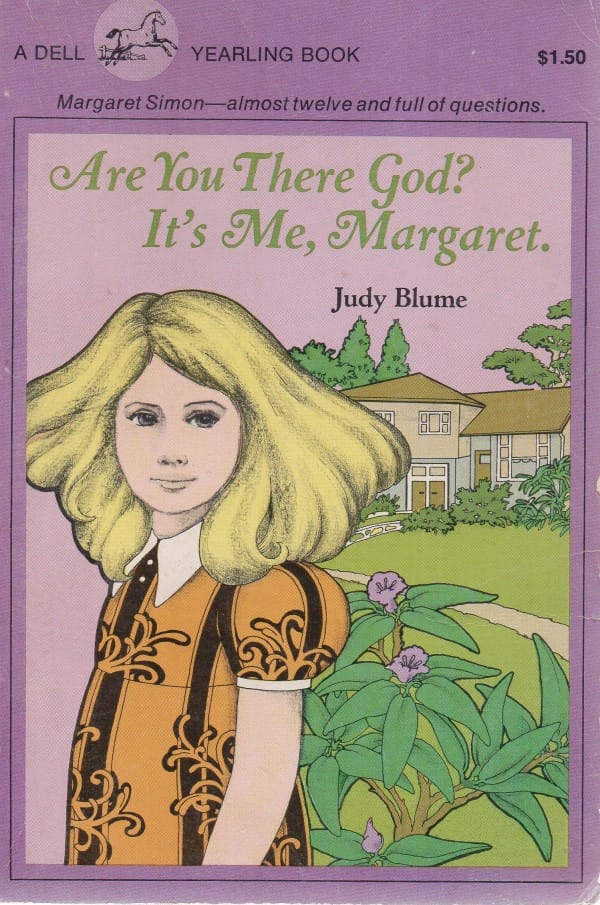
Art saves lives, and so does author Judy Blume. While some of her novels are intended for adult readers, and others for the elementary school set, her best known books are the ones that speak to the experience of being a teenage girl.
For many of us coming of age in the ‘70s and ‘80s, Blume was our best—sometimes only—source when it came to sex, menstruation, masturbation, and other topics too taboo to discuss. She answered the questions we were too shy to ask. Her characters’ interior monologues mirrored our own.
While her stories are not autobiographical, her compassion is born of experience.
Here she is on Are You There, God?It’s Me, Margaret, a tattered paperback copy of which made the rounds of my 6th grade class, like the precious contraband it was:
When I was in sixth grade, I longed to develop physically like my classmates. I tried doing exercises, resorted to stuffing my bra, and lied about getting my period. And like Margaret, I had a very personal relationship with God that had little to do with organized religion. God was my friend and confidant. But Margaret’s family is very different from mine, and her story grew from my imagination.
…in the early seventies I lived in suburban New Jersey with my husband and two children, who were both in elementary school. I could see their concern and fear each time a family in our neighborhood divorced. What do you say to your friends when you find out their parents are splitting up? If it could happen to them, could it happen to us?
At the time, my own marriage was in trouble but I wasn’t ready or able to admit it to myself, let alone anyone else. In the hope that it would get better I dedicated this book to my husband. But a few years later, we, too, divorced. It was hard on all of us, more painful than I could have imagined, but somehow we muddled through and it wasn’t the end of any of our worlds, though on some days it might have felt like it.
My daughter Randy asked for a story about two nice kids who have sex without either of them having to die. She had read several novels about teenagers in love. If they had sex the girl was always punished—an unplanned pregnancy, a hasty trip to a relative in another state, a grisly abortion (illegal in the U.S. until the 1970’s), sometimes even death. Lies. Secrets. At least one life ruined. Girls in these books had no sexual feelings and boys had no feelings other than sexual. Neither took responsibility for their actions. I wanted to present another kind of story—one in which two seniors in high school fall in love, decide together to have sex, and act responsibly.
The heartfelt lyrics of Amanda Palmer’s recent paean to Blume, who turned 80 this week, confirm that the singer-songwriter was among the legions of young girls for whom this author made a difference.
In her essay, “Why Judy Blume Matters,” Palmer recalls coming up with a list of influences to satisfy the sort of question a rising indie musician is frequently asked in interviews. It was a “carefully curated” assortment of rock and roll pedigree and obscurities, and she later realized, almost exclusively male.
This song, which name checks so many beloved characters, is a passionate attempt to correct this oversight:
Perhaps the biggest compliment you could give a writer ― or a writer of youth fiction ― is that they’re so indelible they vanish into memory, the way a dream slips away upon waking because it’s so deeply knitted into the fabric of your subconscious. The experiences of her teenage characters ― Deenie, Davey, Tony, Jill, Margaret ― are so thoroughly enmeshed with my own memories that the line between fact and fiction is deliciously thin. My memories of these characters, though I’d prefer to call them “people” ― of Deenie getting felt up in the dark locker room during the school dance; of Davey listlessly making and stirring a cup of tea that she has no intention of drinking; of Jill watching Linda, the fat girl in her class, being tormented by giggling bullies ― are all as vivid, if not more so, as my own memories…
Palmer’s husband, Neil Gaiman, puts in a cameo in the video’s final moments as one of many readers immersed in Blume’s oeuvre.
Readers, did a special book cover from your adolescence put in an appearance?
For more on Judy Blume’s approach to character and story, consider signing up for her $90 online Master Class.
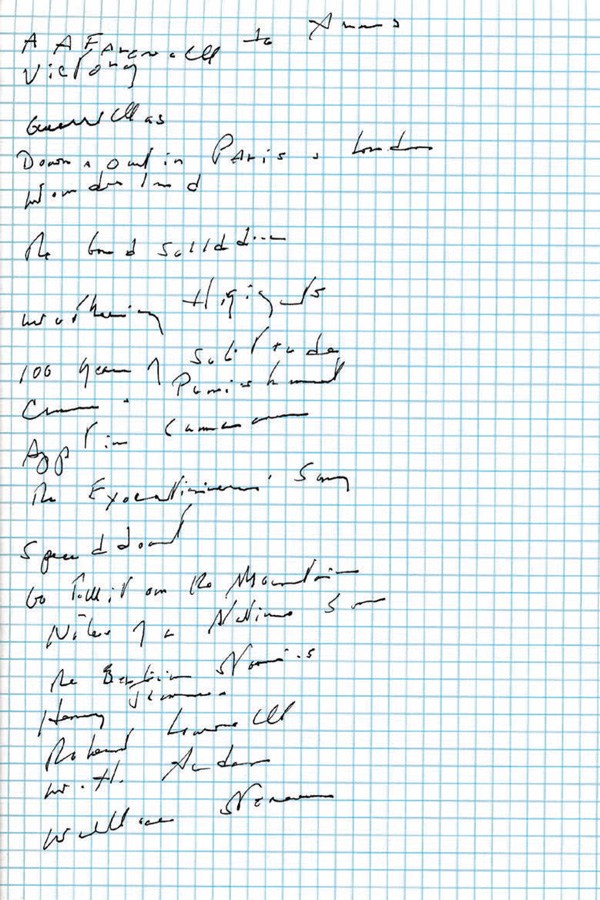
If you’ve read much Joan Didion, you’ve almost surely come across an observation or phrase that has changed the way you look at California, the media, or the culture of the late 20th century — or indeed, changed your life. But if life-changing writers have all had their own lives changed by the writers before them, which writers made Joan Didion the Joan Didion whose writing still exerts an influence today? Conveniently enough, the author of Play It as It Lays, Slouching Towards Bethlehem, and The White Album once drew up a list of the books that changed her life, and it surfaced on Instagram a few years ago:
In 1978, when Didion had already become a new-journalism icon, The Paris Review’s Linda Kuehl asked her whether any writer influenced her more than others. “I always say Hemingway,” she replied, “because he taught me how sentences worked. When I was fifteen or sixteen I would type out his stories to learn how the sentences worked. I taught myself to type at the same time.” TeachingA Farewell to Arms, her number-one most influential book, she “fell right back into those sentences. I mean they’re perfect sentences. Very direct sentences, smooth rivers, clear water over granite, no sinkholes.”
Didion’s list also includes other masters of the sentence, albeit most of them possessed of sensibilities quite distinct from Hemingway’s. Henry James, for instance: “He wrote perfect sentences, too, but very indirect, very complicated. Sentences with sinkholes. You could drown in them.” Consider them alongside the other writers among her favored nineteen, from novelists like Emily Brontë and Joyce Carol Oates to poets like Wallace Stevens and W.H. Auden to figures with one foot in literature and the other in journalism like George Orwell and Norman Mailer, and you’ve got a mix that no two aspiring writers could read and come out sounding exactly alike. No surprise that such a set of influences would produce a writer like Didion, so often imitated but, in her niche, never equaled.
Based in Seoul, Colin Marshall writes and broadcasts on cities and culture. His projects include the book The Stateless City: a Walk through 21st-Century Los Angeles and the video series The City in Cinema. Follow him on Twitter at @colinmarshall or on Facebook.
This gives new meaning to “skating on thin ice.” In Sweden, a filmmaker named Henrik Trygg likes to take his chances skating on pristine sheets of black ice, measuring only five centimeters/two inches thick. It’s a risk. A natural thrill. It’s also quite a sensory experience. Just listen to the “high-pitched, laser-like sounds,” of which sci-fi films could be made.
Watch Trygg’s film, “The Sound of Ice,” above. And, below, a version annotated in English by National Geographic.
If you would like to support the mission of Open Culture, consider making a donation to our site. It’s hard to rely 100% on ads, and your contributions will help us continue providing the best free cultural and educational materials to learners everywhere. You can contribute through PayPal, Patreon, and Venmo (@openculture). Thanks!
Don’t listen to people who tell you they’ve found the one true path to happiness — but do listen to people who seem seriously in search of it. One such person, Yale psychology and cognitive science professor Laurie Santos, teaches a whole course on the subject: Psych 157, also known as “Psychology and the Good Life.” And even though college students are living the best time of their lives — or so the culture keeps insisting to them — enough of them desire its insights to make it the most popular class at the university, with more than 1,180 students currently enrolled.
“The course focuses both on positive psychology — the characteristics that allow humans to flourish, according to Dr. Santos — and behavioral change, or how to live by those lessons in real life,” writes The New York Times’ David Shimer. “Students must take quizzes, complete a midterm exam and, as their final assessment, conduct what Dr. Santos calls a ‘Hack Yo’Self Project,’ a personal self-improvement project.” The body of knowledge underlying it all is hardly obvious: “Scientists didn’t realize this in the same way 10 or so years ago, that our intuitions about what will make us happy, like winning the lottery and getting a good grade — are totally wrong,” the article quotes Santos as saying.
So what, according to the up-to-date research of Santos and others, does make us happy? Now, you don’t need to go Yale to find out: you can simply take “The Science of Well-Being,” the new online version of Santos’ course, on Coursera. “The first half of the course reveals misconceptions we have about happiness and the annoying features of the mind that lead us to think the way we do,” says its description. “The second half of the course focuses on activities that have been proven to increase happiness along with strategies to build better habits.”
Now open for enrollment, “The Science of Well-Being” can be taken any time, and its number of students certainly won’t be limited by the capacity of Woolsey Hall. If you’d like to get a sense of the learning experience on offer, have a look at the course’s trailer above, in which Santos explains the origin and development of the course, which began in her own home and now, with a potentially worldwide audience, uses not just the latest science but a specially developed app to help its students develop the elements of their own good life. Will you finish the course perfectly happy? She doesn’t promise that, but nobody ever lost their way to happiness by knowing a bit about it.
Based in Seoul, Colin Marshall writes and broadcasts on cities and culture. His projects include the book The Stateless City: a Walk through 21st-Century Los Angeles and the video series The City in Cinema. Follow him on Twitter at @colinmarshall or on Facebook.
The idea of time travel is probably as old as the feeling of regret, but the desire to go back in time is not the same as the theoretical notion that it might actually be possible to do so. Where, the Nerdwriter wonders above, did this idea originate? And where did time travel narratives come from in general? Time travel, he argues, “as a device to tell stories, is a relatively recent phenomenon.” And time travel as a specific genre of literature is just a little over a hundred years old.
An important point of clarification: We find instances of time travel—or at least a kind of parallax—in many ancient texts, where some characters experience time differently in different realms and dimensions and can thus see the past or future in our world. In the Ramayana, a figure named Kakbhushubdi lives like the Watchers in the Marvel Comics’ universe—outside of time, observing millennia passing. (It is said he sees the same events happen over and over, with different outcomes each time.)
This is not strictly what we mean by time travel. Yet many ancient stories do show humans going back in time, or going to sleep and waking up in the future, through divine agency. In the Buddhist Pali texts, we learn that the Devas experience one hundred human years as a single day (an idea echoed in the Bible). In the Japanese legend of Urashima Taro, a man visits the palace of the Dragon God, and when he comes back 300 years have passed. But the Nerdwriter is talking about something different than these many narrative instances of time dilation (hundreds of years before Einstein elaborated the concept), though the same devices appear in modern time travel stories.
A significant distinction, the video suggests, lies in the very concept of time. Many ancient people believed that time was cyclical—hence the many variations on the same themes in Kakbhushubdi’s experience—or that time was malleable, subject to divine interruption and disruption. After Darwin’s Origin of Species and the rapid acceptance of evolution (if not natural selection), popular notions of time changed. The modern time travel genre begins with broadly Darwinian ideas as a central premise. In the popular imagination, evolution meant inevitable, linear progress, and thus was born a form of literature called the Utopian Romance.
One such novel, Edward Bellamy’s 1888 Looking Backward, has the distinction of being the third-largest bestseller of its time, after Uncle Tom’s Cabin and Ben Hur, with over one million copies sold. Why haven’t you heard of it before? Probably because the book envisions a character who falls asleep and wakes up in a socialist utopia 113 years in the future (the year 2000). It exerted significant influence on the many socialist movements of the time, and “Bellamy clubs” sprang up around the country, advocating for the nationalization of private property. Few Americans, at least, have learned about the widespread popularity of socialism in the U.S. during the late 19th century because… well, you tell me.
But Bellamy’s ideas are embedded in the genre, in work after work we are familiar with (take the parody version in Futurama). In the modern time travel novel, utopias “are no longer on a lost island or a different world, they were in the future.” This observation applies most readily to a more famous foundational text from 1895, H.G. Wells’ The Time Machine, which borrows from Swift’s Gulliver’s Travels, but sets the action not in a distant land but in the very distant future, the year 802701. Wells’ “subterranean workers, the Morlocks, and the decadent Eloi” who profit from their labor, notes the British Library, do not differ that much from humans of the past or the present—they have evolved technologically and physically, but are still subject to exploitation and violence.
Where Gulliver’s Travels can be read as a misanthropic undermining of notions of cultural superiority, Wells’ novel satirizes the idea that human evolution implies an improvement in human beneficence. The book set a pattern “for science-fiction to critique extreme developments of class.” In both Bellamy and Wells, time travel—whether achieved by science or a Rip Van Winkle sleep—presents an occasion for utopian or dystopian allegory. The time travel genre took on a new dimension after Einstein, when the science of relativity replaced Darwinian evolution as the central preoccupation, and paradoxes and rules became central concerns. This shift highlights another important feature of the modern time travel genre—its obsession with cause and effect, and therefore with the very nature and possibility of story itself.
We're hoping to rely on loyal readers, rather than erratic ads. Please click the Donate button and support Open Culture. You can use Paypal, Venmo, Patreon, even Crypto! We thank you!
Open Culture scours the web for the best educational media. We find the free courses and audio books you need, the language lessons & educational videos you want, and plenty of enlightenment in between.