Tom Lehrer earned a BA and MA in mathematics from Harvard during the late 1940s, then taught math courses at MIT, Harvard, Wellesley, and UC-Santa Cruz. Math was his vocation. But, all along, Lehrer nurtured an interest in music. And, by the mid 1950s, he became best known for his satirical songs that touched on sometimes political, sometimes academic themes.
Today we’re presenting one of his classics: “The Elements.” Recorded in 1959, the song features Lehrer reciting the names of the 102 chemical elements known at the time (we now have 115), and it’s all sung to the tune of Major-General’s Song from The Pirates of Penzance by Gilbert and Sullivan. You can hear a studio version below, and watch a nice live version taped in Copenhagen, Denmark, in September 1967.
Follow Open Culture on Facebook and Twitter and share intelligent media with your friends. Or better yet, sign up for our daily email and get a daily dose of Open Culture in your inbox. And if you want to make sure that our posts definitely appear in your Facebook newsfeed, just follow these simple steps.
Movies and music go way back — back, even, to the era of silent films, when music, provided by any performance outfit, from a full orchestra to a humble upright piano player, constituted the only accompanying sound of any kind. Often, kids who begin choosing music for themselves (at least this held for the kids of my generation) start with movie soundtracks, since they’ll usually have done at least a little filmgoing before they come to life as consumers of recorded sound. And modern soundtracks, so often composed in whole or in part of orchestral pieces, also offer a non-intimidating entrée into the wide world of classical music.
Movies and the City of Prague Orchestra also go way back. Founded in the 1940s as the Film Symphony Orchestra, in-house orchestra of Barrandov Film Studios, it eventually went its own way as the Czech Symphony Orchestra, and it has worked, post-Velvet Revolution, under the name we know it by today. We know that name because of the sheer amount of music the City of Prague Orchestra plays, doing 250 recording sessions every year for not just classical albums but a variety of other media as well, including television shows, video games, ringtones, and especially movies. Today we’ve rounded up a variety of albums on Spotify (whose free software you can download here) that collect the City of Prague Orchestra’s work with movie music, which spans scores they first laid down themselves to their interpretations of classic favorites.
First, in celebration of the recent continuation of the Star Wars saga with its new seventh film, the City of Prague Orchestra plays the music from the first six. But if you prefer a different sort of space odyssey, have a listen to the playlist just above featuring, the music from the films of Stanley Kubrick, who said that he didn’t need to commission new music for his pictures, since he could hardly do better than simply using the finest classical pieces already in existence — which, as anyone who’s seen 2001 knows, he could use suitably indeed. Below, you can hear the Orchestra take on selections from the work of Tim Burton and Martin Scorsese, auteurs well known for their visual inventiveness.
If you enjoy all of those, much more awaits your ears on Spotify from the City of Prague Orchestra’s cinematic catalogue, including playlists of music from the films of Steven Spielberg, whose big Hollywood visions depend on their scores for a good deal of their impact; of music from pictures starring iconic actors like John Wayne, Paul Newman, and Johnny Depp; of the pieces that have given the James Bond series their signature (sometimes so-uncool-it’s-cool) cool; and even of orchestral work from a swath of Italian film, including movies like La Dolce Vita, 8 1/2, and of course, Cinema Paradiso. If we find the cinema a paradise, after all, that owes as much to the music we’ve heard there as the visions we’ve seen there.
The man of a thousand haircuts, David Bowie has been the vanguard for creative reinvention for longer than many of his fans have been alive. As soon as he’s made us think he’s exhausted his imagination, he reappears with yet another album, another look, another theatrical tour. Except that last bit isn’t likely to happen again. We may have seen the end of Bowie the performer some time ago, according to such sources as longtime Bowie producer Tony Visconti (who worked with him on 2013’s The Next Day) and British concert promoter John Giddings.
“David is one of the best artists I’ve ever worked with,” said Giddings in October, ”but every time I see him now, before I even speak to him, he goes, ‘I’m not touring.’” Does this rule out the odd one-off appearance? Who knows. Nothing is for certain with Bowie. But it may well be that the performance above, a duet of “Changes” with Alicia Keys from 2006, represents the legendary shape shifter’s last gig. (And if so, we hope some better-quality video of it surfaces.)
Bowie appeared with Keys, Damian Marley, and comedian Wanda Sykes at New York’s Hammerstein Ballroom for a fundraiser and sang Station to Station’s “Wild is the Wind” and Lodger’s “Fantastic Voyage” in addition to “Changes,” all fitting notes to end on, if this is indeed the end of his live performing career. He had rarely taken the stage since his 2004 heart attack during the Reality tour, but, Rolling Stone points out, “that didn’t stop him from playing with Arcade Fire twice in 2005 and David Gilmour the following year.”
But that was ten years ago. During the recording of The Next Day, Visconti reported that Bowie insisted there would be no live shows, and there weren’t. Now, Bowie’s surprised us again with a new album, Blackstar, and a ten-minute video, above, that looks like all the paranoid dystopian visions in 90s albums like Outside, Earthling, and Heathen come terrifyingly true. I can imagine this most recent, perhaps final, entry in the Bowie canon would make for a hell of a stage show, but it looks like he will pass that torch to the younger artists who continue to inspire him as he ages gracefully. Blackstar will be released on January 8th, Bowie’s 69th birthday.
You decide you need some medical advice, so you take to the internet. Whoops! There’s your first mistake. Now you are bombarded with contradictory opinions from questionable sources and you begin to develop symptoms you never knew existed. It’s all downhill from there. So I’ll say this upfront: I have no medical qualifications authorizing me to dispense information about sleep disorders. The only advice I’d venture, should you have such a problem, is to go see a doctor. It might help, or not. I can certainly sympathize. I am a chronic insomniac.
The downside to this condition is obvious. I never get enough sleep. Whenever I consult the internet about this, I learn that it’s probably very dire and that I may lose my mind or die young(ish). The upside—which I learned to master after years of trying and failing to sleep like normal people—is that the nights are quiet and peaceful, and thus a fertile time creatively.
Medical issues aside, what do we know about sleep, insomnia, and creativity? Let us wade into the fray, with the proviso that we will likely reach few conclusions and may have to fall back on our own experience to guide us. In surveying this subject, I was pleased to have my experience validated by an article in Fast Company. Well, not pleased, exactly, as the author, Jane Porter, cites a study in Science that links a lack of sleep to Alzheimer’s and the accumulation of “potentially neurotoxic waste products.”
And yet, in praise of sleeplessness, Porter also recommends turning insomnia into a “productivity tool,” naming famous insomniacs like Margaret Thatcher, Bill Clinton, Charles Dickens, Marcel Proust, and Madonna (not all of whom I’d like to emulate). She then quotes psychologist Tomas Chamorro-Premuzic of University College London, who made the dubious-sounding claim in Psychology Today that “insomnia is to exceptional achievement what mental illness is to creativity.” Everything about this analogy sounds suspect to me.
But there are more substantive views on the matter. Another study, published in Creativity Research Journal, suggests insomnia may be a symptom of “notable creative potential,” though the authors only go as far as saying the two phenomenon are “associated.” The arrow of causality may point in either direction. Perhaps the most pragmatic view on the subject comes from Michael Perlis, psychology professor at the University of Pennsylvania, who says, “What is insomnia, but the gift of more time?”
Dennis Drabelle at The Washington Post, also an insomniac, refers to a recent study (as of 2007) from the University of Canterbury that suggests “insomnia and originality may go hand in hand.” He also points out that the notion of sleeplessness as productive, though “counterintuitive,” has plenty of precedent. Drabelle mentions many more famous cases, from W.C. Fields to Theodore Roosevelt to Franz Kafka. The list could go on and on.
Actor and musician Matt Berry tells The Guardian how, after years of tossing and turning, he finally harnessed his sleepless hours to write and record an album, Music for Insomniacs. “I knew that this was dead time,” says Berry, “and I could be doing something instead of sitting worrying about not being asleep.” Another musician, Dave Bayley of band Glass Animals, “owes his career in music to insomnia,” The Guardian writes, then notes a phenomenon sleep researchers call—with some skepticism—“creative insomnia.” Other musicians like Chris Martin, Moby, Tricky, and King Krule have all suffered the condition and turned it to good account.
The Guardian also notes that each of these poor souls has found “sleepless nights inspiring as well as tormenting.” Insomnia is not, in fact a gift or talent, but a painful condition that Porter and Drabelle both acknowledge can be associated with depression, addiction, and other serious medical conditions. One might make good use of the time—but perhaps only for a time. A site called Sleepdex—-which offers “resources for better sleep”—puts it this way:
Occasional insomnia appears to help some people produce new art and work, but is a detriment to others. It is perhaps true that more people find it a detriment than find it useful. Long-term insomnia and the accompanying sleep debt are almost surely negative for creativity.
This brings us to the subject of sleep—good, restful sleep—and its relationship to creativity. Sleepdex cites several research studies from Swiss and Italian universities, UC San Diego, and UC Davis. The general conclusion is that REM sleep—that period during which dreams “are the most narratively coherent of any during the night”—is also an important stimulus for creativity. There are the numerous anecdotes from artists like Salvador Dali, Paul McCartney, and countless others about famous works of art taking shape in dream states (Keith Richards says he heard the riff from “Satisfaction” in a dream).
And there are the experimental data, purportedly confirming that REM sleep enhances “creative problem solving.” European scientists have found that people were more likely to have creative insights after a long period of restful sleep, when the right brain gets a boost. Likewise, Tom Stafford at the BBC describes the “post-sleep, dreamlike mental state—known as sleep inertia or the hypnopompic state” that infuses our “waking, directed thoughts with a dusting of dreamworld magic.” It isn’t that insomniacs don’t experience this, of course, but we have less of it, as periods of REM sleep can be shorter and often interrupted by the need to scramble out of bed and get to work or get the kids to school not long after hitting the pillow.
Stafford points us toward a UC Berkeley study (apparently the University of California has some sort of monopoly on sleep research) “that helps illustrate the power of sleep to foster unusual connections, or ‘remote associates’ as psychologists call them.” Like nearly all of the scientific literature on sleep, this study expresses little doubt about the importance of sleep to memory function and problem solving. Big Think collects several more studies that confirm the findings.
On the whole, when it comes to the links between sleep—or sleeplessness—and creativity, the data and the stories point in different directions. This is hardly surprising given the slipperiness of that thing we call “creativity.” Like “love” it’s an abstract quality everyone wants and no one knows how to make in a laboratory. If it’s extra time you’re after—and very quiet time at that—I can’t recommend insomnia enough, though I wouldn’t recommend it at all as a voluntary exercise. If it’s the special creative insights only available in dream states, well, you’d best get lots of sleep. If you can, that is. Creative insomniacs—like those wandering in the confines of a dream world—know all too well they don’t have much choice in the matter.
From “eudicotyledon” on Reddit comes a holiday project you, too, can maybe try at home. He says: “My family made a gingerbread rendition of the Overlook Hotel from Kubrick’s “The Shining,” complete with a Rice Krispies treat maze and interior rooms depicting famous scenes.” You can flip through 29 images in the gallery above, showing the edible creation from different points of view. Then see a “making-of” gallery here. Enjoy.
The British Museum charges nothing for admission, of course, but now the internet has freed it in the geographical sense as well.
“The British Museum recently unveiled the results of its partnership with the Google Cultural Institute (GCI),” writes National Geographic’s Kristin Romney, “the world’s largest Google Street View of an interior space, covering nine floors and 85 permanent galleries of the museum.” Have a virtual walkthrough, and you’ll pass displays of about 80,000 notable objects; the highlights Romney names include the Lewis Chessmen and cat mummies, the Elgin Marbles, and even architectural features of the museum itself such as the “the yawning expanse of the museum’s Great Court, the largest public square in Europe, with early morning light filtering through the 3,312 glass roof panes.”
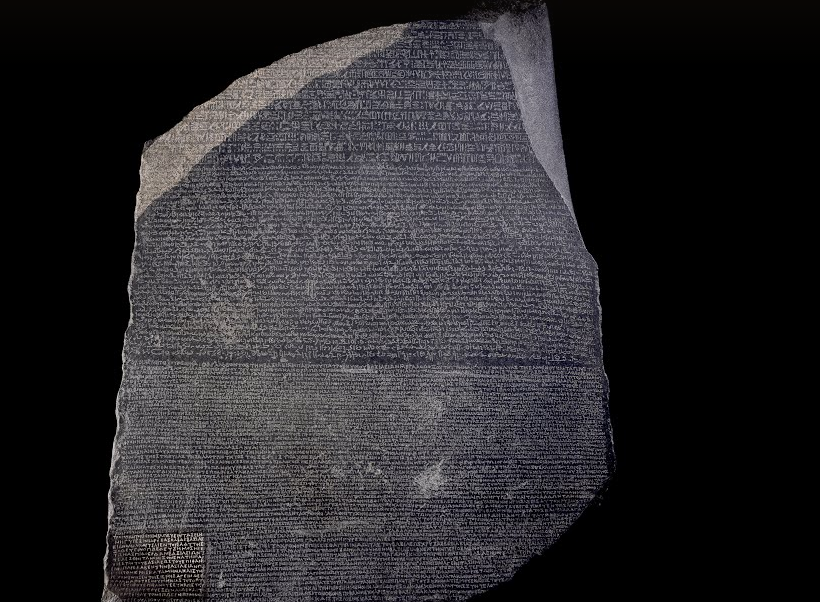
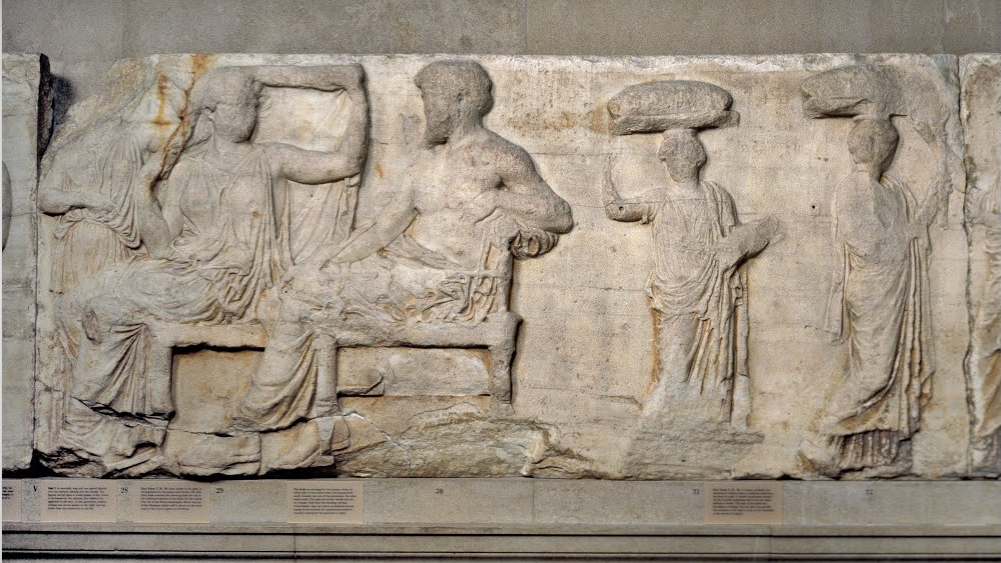
After you’ve enjoyed this Street View stroll, you’ll surely want to examine some of these items in greater depth. You can do just that at the virtual exhibits of the Google Cultural Institute’s British Museum collection, where you’ll find high-resolution images of and background information on 4,737 artifacts, the Rosetta Stone included. Or you can take a close look at a segment of the Elgin Marbles, a scene from the Parthenon showing “the sacred robe or peplos of Athena that was escorted to the Acropolis by the procession of the Great Panathenaic Festival, held in Athens every four years.” Not old enough for you? Then behold the Royal Game of Ur, an early board game of sorts discovered in the Royal Cemetery of the Mesopotamian city-state of Ur. And even further illumination of the ancient world awaits you beyond that, all thanks to this most modern sort of project. You can enter the collection here.
We all have some vision of what the good life should look like. Days filled with reading and strolls through museums, retirement to a tropical island, unlimited amounts of time for video games…. Whatever they may be, our concepts tend toward fantasy of the grass is greener variety. But what would it mean to live the good life in the here and now, in the life we’re given, with all its warts, routines, and daily obligations? Though the work of philosophers for the past hundred years or so may seem divorced from mundane concerns and desires, this was not always so. Thinkers like Plato, Aristotle, Immanuel Kant, and Friedrich Nietzsche once made the question of the good life central to their philosophy. In the videos here, University of New Orleans philosophy professor Chris Surprenant surveys these four philosophers’ views on that most consequential subject.
The view we’re likely most familiar with comes from Socrates (as imagined by Plato), who, while on trial for corrupting the youth, tells his inquisitors, “the unexamined life is not worth living.” Pithy enough for a Twitter bio, the statement itself may too often go unexamined. Socrates does not endorse a life of private self-reflection; he means that “an individual become a master of himself,” says Surprenant,”using his reason to reign in his passions, as well as doing what he can to help promote the stability of his community.” In typical ancient Greek fashion, Plato and his mentor Socrates define the good life in terms of reasonable restraint and civic duty.
The Platonic version of the good life comes in for a thorough drubbing at the hands of Friedrich Nietzsche, as do Aristotelian, Kantian, and Judeo-Christian ideals. Nietzsche’s declaration that “God is dead,” and in particular the Christian god, “allows us the possibility of living more meaningful and fulfilling lives,” Surprenant says. Nietzsche, who describes himself as an “amoralist,” uses the proposed death of god—a metaphor for the loss of religious and metaphysical authority governing human behavior—to stage what he calls a “revaluation of values.” His critique of conventional morality pits what he calls life-denying values of self-restraint, democracy, and compassion (“slave morality”) against life-affirming values.
For Nietzsche, life is best affirmed by a striving for individual excellence that he identified with an idealized aristocracy. But before we begin thinking that his definition of the good life might accord well with, say, Ayn Rand’s, we should attend to the thread of skepticism that runs throughout all his work. Despite his contempt for traditional morality, Nietzsche did not seek to replace it with universal prescriptions, but rather to undermine our confidence in all such notions of universality. As Surprenant points out, “Nietzsche is not looking for followers,” but rather attempting to “disrupt old conceptual schemes,” in order to encourage us to think for ourselves and, as much as it’s possible, embrace the hand we’re dealt in life.
For contrast and comparison, see Surprenant’s summaries of Aristotle and Kant’s views above and below. This series of animated videos comes to us from Wireless Philosophy (Wi-Phi for short), a project jointly created by Yale and MIT in 2013. We’ve previously featured video series on metaphysical problems like free will and the existence of god and logical problems like common cognitive biases. The series here on the good life should give you plenty to reflect on, and to study should you decide to take up the challenge and read some of the philosophical arguments about the good life for yourself, if only to refute them and come up with your own. But as the short videos here should make clear, thinking rigorously about the question will likely force us to seriously re-examine our comfortable illusions.
In the spirit of full disclosure, we should clarify that the true Poe fanboy is not the fictional Gomez Addams, but rather the first actor to bring the character to life, John Astin, of television fame.
His discoveries about human nature were so right, and so accurate, that it’s almost a wonder to read, or reread. There are continually discoveries, in the reading of Poe, about humankind.
Philip Brandes, reviewing a performance in the Los Angeles Times wrote:
Reciting “The Raven” in its entirety, Astin cannot afford to milk each line for atmosphere à la Vincent Price; it would take him most of the second act.
Instead, he races through the poem as an author would in recalling his own familiar words, gradually getting caught up in their power and finishing on a dramatic crescendo.
Alan Watts moved from his native London to New York in 1938, then eventually headed west, to San Francisco in the early 1950s. On the left coast, he started teaching at the Academy of Asian Studies, wrote his bestseller Way of Zen, and began delivering a long-running series of talks about eastern philosophy on KPFA radio in Berkeley. During these years, Watts became one of the foremost popularizers of Zen Buddhism, Hinduism, and Taoism, which made him something of a celebrity, especially when the 60s counterculture movement kicked into gear.
Now, 40 years and change after his death, you can find no shortage of vintage Watts’ media online (including this archive of streaming lectures). And today we’re featuring an episode from a TV series called Eastern Wisdom and Modern Life, which aired in San Francisco circa 1960. “The Silent Mind” runs 28 minutes, and it offered American viewers an introduction to the philosophy and practice of meditation, something still considered exotic at the time. History in the making. You’re watching it happen right here. Find more meditation and Alan Watts resources below.
If you would like to support the mission of Open Culture, consider making a donation to our site. It’s hard to rely 100% on ads, and your contributions will help us continue providing the best free cultural and educational materials to learners everywhere. You can contribute through PayPal, Patreon, and Venmo (@openculture). Thanks!
Having lost track of video gaming somewhere around the turn of the millennium, I admit that I have no idea which generation of Playstation you or a friend or family member may have joyfully unwrapped this Christmas morning. I only know that it probably didn’t come advertised with a commercial by David Lynch, so why not take a moment out of your Christmas day to revisit the Playstation — the Playstation 2, to be precise — that did? At the top of the post, we have Lynch’s characteristically surreal spot “Welcome to the Third Place,” featuring flames, a mysterious glowing woman, ominous footsteps, skewed perspectives, organic oddities, a talking duck (whose voice actor I challenge you to identify) — everything, in other words, that a Lynchian hopes for.
What goes on in this Third Place? Why, the sort of vivid, inexplicable sensory experiences not accessible in everyday life — unless, as the advertising logic goes, you choose to pass through the portal of the Playstation. But the man behind Twin Peaks and Blue Velvet has “been living in The Third Place for quite a few years,” says Playstation European marketing director David Patton in the making-of-video just below, shot by Luke Forsythe, who also worked on the commercial. “If there was one person that was gonna to understand what we needed to communicate, it was gonna be David Lynch.”
“I was 24 and it was easy to think having worked for so many impressive directors, that I wasn’t bullish or hard enough to be a director,” remembers Forsythe. “I was living with my parents watching films endlessly having to try and convince my mum that I was actually working. The next minute I’m in LA filming this. Meeting David Lynch, seeing how he worked so playfully and politely made me realise there are lots of ways to direct and be a director. It couldn’t have been better. 15 years later I’m still directing and still full of memories of this lovely man and the time spent seeing him make.”
“The resulting one-minute B&W trailer, shown in theaters in over a hundred countries except the U.S., ended up being classic David Lynch alright,” says fan site Welcome to Twin Peaks. “Except maybe for the 24 major visual effects in just 60 seconds.” Known as quite possibly the art-housiest household-name filmmaker alive, Lynch has shown more enthusiasm for making commercials than have many of his peers: “The money’s good,” he once said, “and the added bonus is that I get to use and learn about the latest technology.” And though he hasn’t made a movie in almost a decade, he hasn’t announced his retirement either. Maybe the U.S. campaign for the next Playstation — and wow, now that I look it up, it’ll be the Playstation 5 already — needs his services. Fifteen years have passed since “Welcome to the Third Place”; I’d say America’s ready.
Where have all the Fezziwigs gone? Those festive souls whose joyfully uncomplicated relationship to Christmas inspires generosity and the highest of spirits?
The factors leading to the seasonal malaise documented above are far less easy to identify than the singular complaint of the famous song Koresky borrows for the title of his video essay.
A simple reunion would have fixed Elvis’s Christmas blues.
Not so the characters played by Catherine Deneuve, Angelica Huston, and other lovely, aging actresses gazing mournfully in this mash up. Large families, sumptuous tables, and lavishly decorated homes are no match for their seasonal depression.
Perhaps they should try volunteering in a soup kitchen.
Or getting away from it all in the French Canadian asbestos mining town that provides the setting for Claude Jutra’s Mon oncle Antoine. (Nothing like a child-sized coffin and some realistically grimy, non-fake snow to make you count your blessings!)
A complete list of the films selected by Koresky for this misery-loves-company compilation is below. (Kudos to producer Casey Moore for his masterful editing.)
We're hoping to rely on loyal readers, rather than erratic ads. Please click the Donate button and support Open Culture. You can use Paypal, Venmo, Patreon, even Crypto! We thank you!
Open Culture scours the web for the best educational media. We find the free courses and audio books you need, the language lessons & educational videos you want, and plenty of enlightenment in between.