Maybe you knew about Marcel Duchamp’s passion for chess. But did you know about Marlon Brando’s passion for conga drums? Longtime fans may have first picked up on it in 1955, when the actor gave a microwave-link television tour of his Hollywood Hills home to Edward R. Murrow on Person to Person. Halfway through the segment (above), Brando gets into his history with the instrument, and even offers to “run downstairs and give you a lick or two” — and the always highly-prepared program had cameras in the conga room ready to capture this “impromptu” performance. While the interests actors keep on the side may tend to wane, Brando’s seems to have waxed, and later in life he even, writes Movieline’s Jen Yamato, “enlisted the help of Latin jazz percussionist Poncho Sanchez while developing a new tuning system for conga drums.” We can behold the extent and seriousness of Brando’s pursuit of conga perfection with a look at one of those patents, filed in 2002, for an automatic “drumhead tensioning device and method.”
As The Atlantic’s Rebecca Greenfield explains in a post on “Patents of the Rich and Famous,” “tightening a drum takes a lot of effort. Once the drum head loses its tension, there are typically six separate rods that need tightening. Far too many rods for Marlon. Brando explains that others have tried to develop mechanisms that would improve the drum tightening experience but none of them provided a simple or affordable solution.” Hence his motorized “simple and inexpensive drum tuning device that is also accurate and reliable and not subject to inadvertent adjustments.” And if you have no need for an automatic conga drum tuner, perhaps we can interest you in another of Brando’s achievements? “He had these shoes that you can wear in the pool, that would increase friction as you walk on the bottom of the pool to give you a better workout,” says patent attorney Kevin Costanza in an NPR story on Brando’s inventions. Or maybe you’d prefer to simply watch The Godfather again.
Sci-fi author B.C. Kowalski recently posted a short essay on why the advice to write every day is, for lack of a suitable euphemism, “bullshit.” Not that there’s anything wrong with it, Kowalski maintains. Only that it’s not the only way. It’s said Thackeray wrote every morning at dawn. Jack Kerouac wrote (and drank) in binges. Every writer finds some method in-between. The point is to “do what works for you” and to “experiment.” Kowalski might have added a third term: diversify. It’s worked for so many famous writers after all. James Joyce had his music, Sylvia Plath her art, Hemingway his machismo. Faulkner drew cartoons, as did his fellow Southern writer Flannery O’Connor, his equal, I’d say, in the art of the American grotesque. Through both writers ran a deep vein of pessimistic humor, oblique, but detectable, even in scenes of highest pathos.
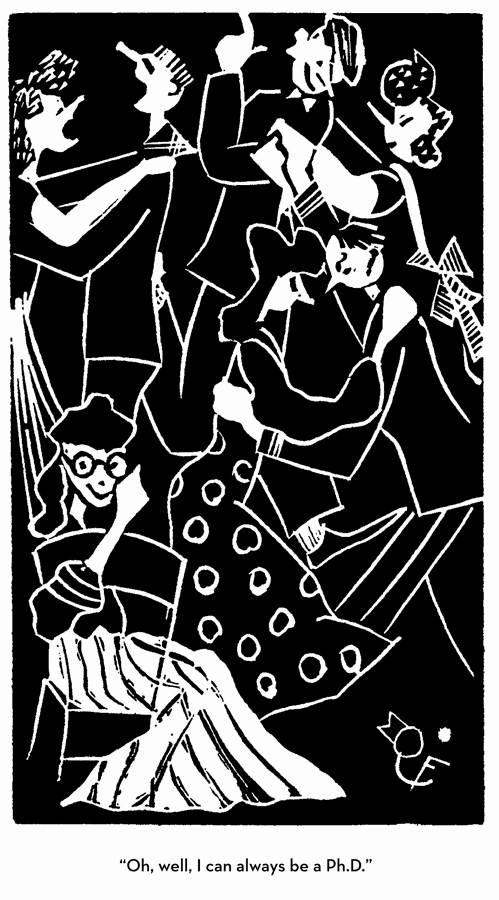
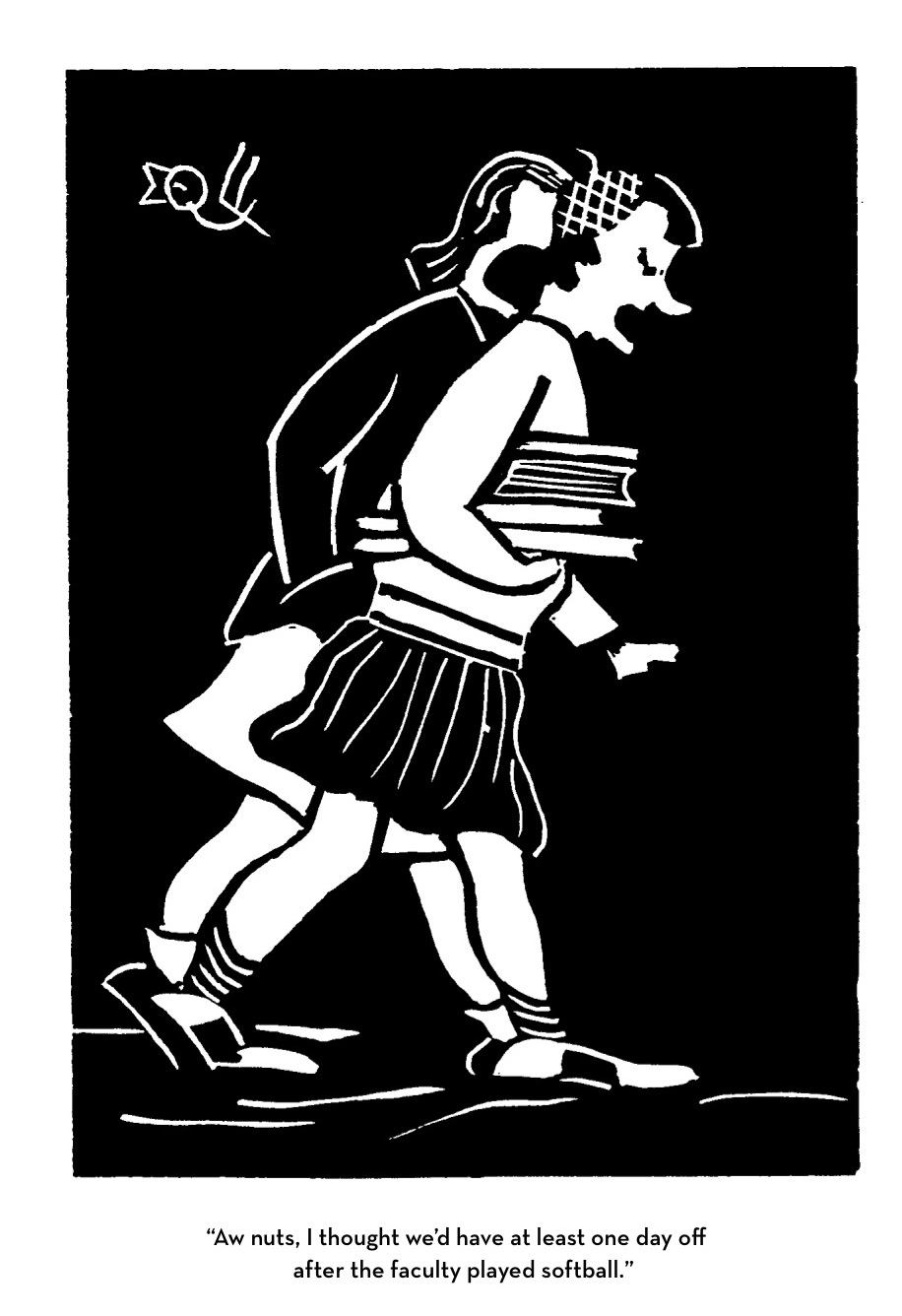
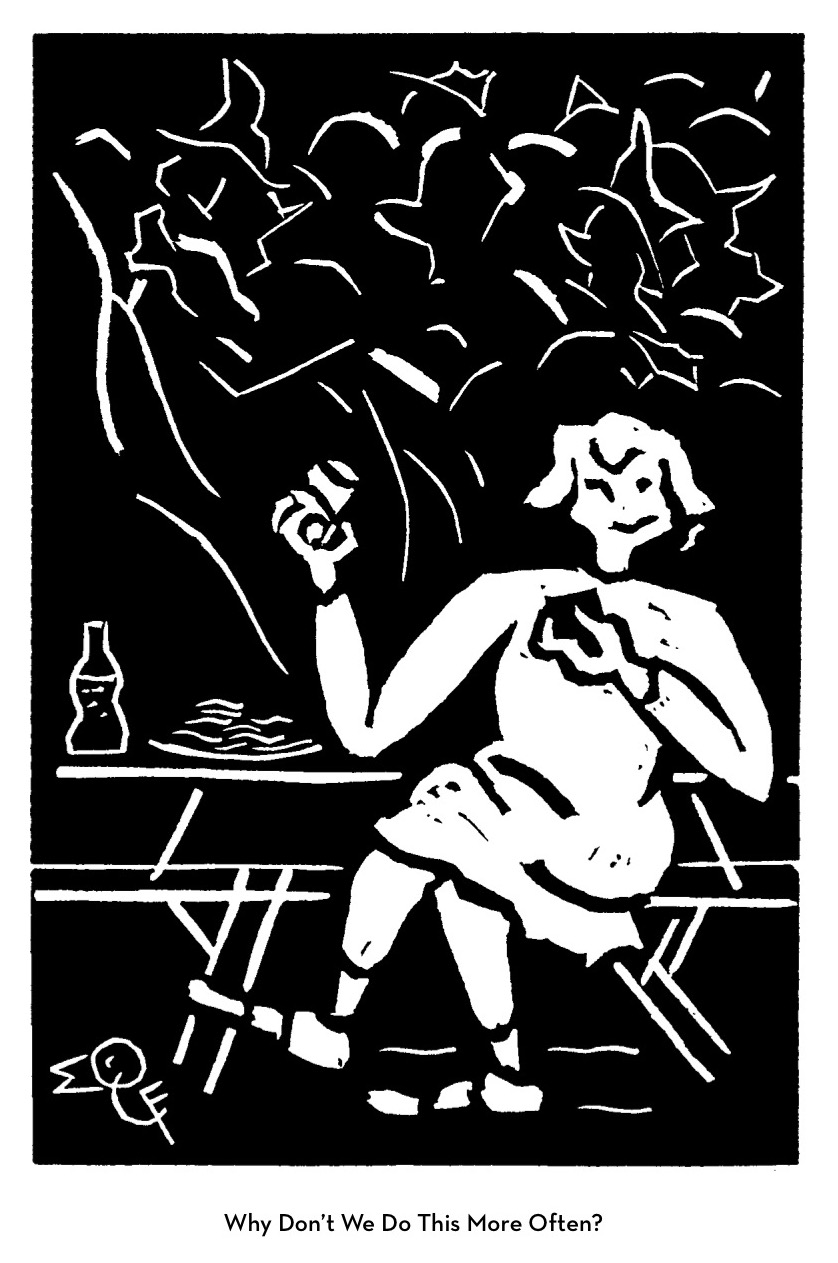
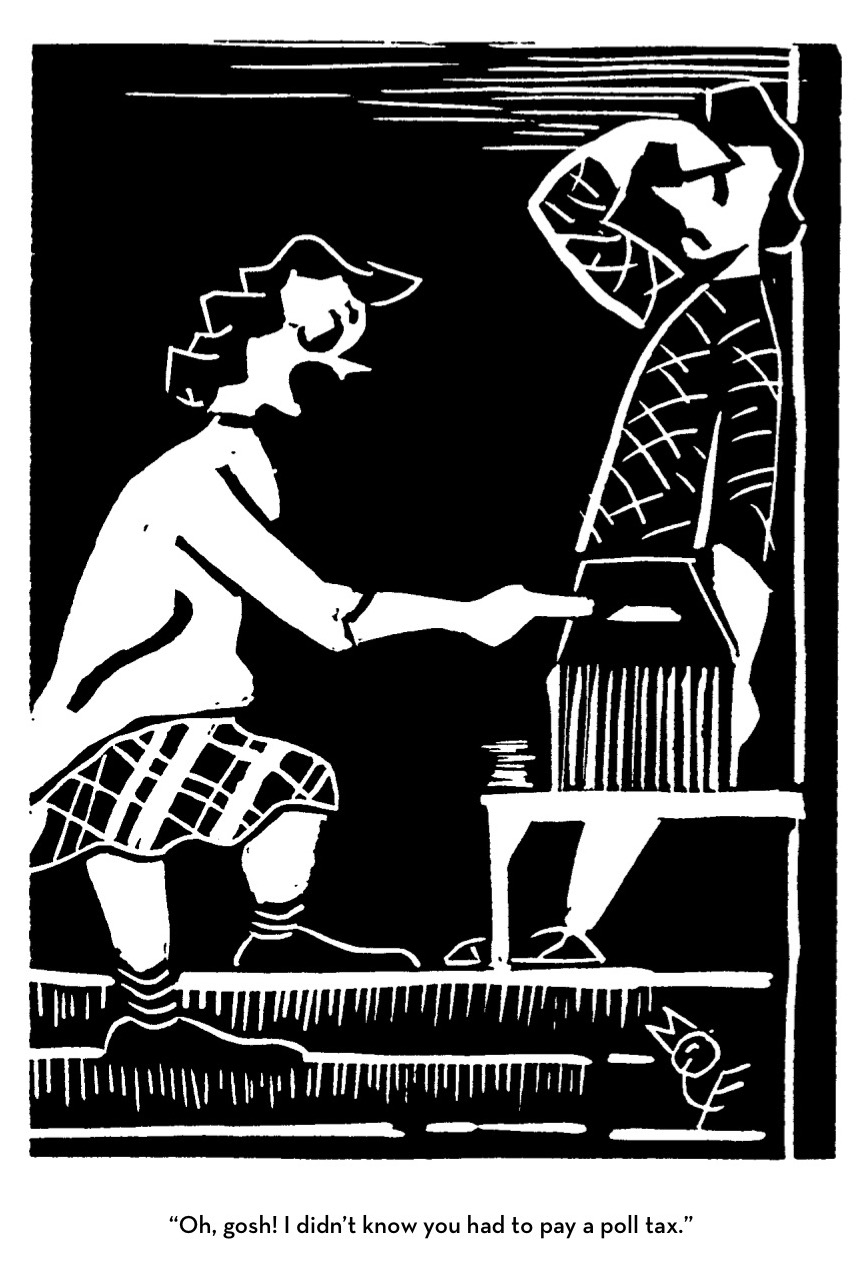
O’Connor’s visual work, writes Kelly Gerald in The Paris Review, was a “way of seeing she described as part of the ‘habit of art’”—a way to train her fiction writer’s eye. Her cartoons hew closely to her authorial voice: a lone sardonic observer, supremely confident in her assessments of human weakness. Perhaps a better comparison than Faulkner is with British poet and doodler Stevie Smith, whose bleak vision and razor-sharp wit similarly cut through mountains of… shall we say, bullshit. In both pen & ink and linoleum cuts, O’Connor set deadpan one-liners against images of pretension, conformity, and the banality of college life. In the cartoon at the top, she seems to mock the pursuit of credentials as a refuge for the socially disaffected. Above, a campaigner for a low-level office deploys bombastic pseudo-Leninist rhetoric, and in the cartoon below, a cranky character escapes a horde of identical WAVES.
O’Connor was an intensely visual writer with, Gerald writes, a “natural proclivity for capturing the humorous character of real people and concrete situations,” fully credible even at their most extreme (as in the increasingly horrific self-lacerations of Wise Blood’s Hazel Motes). She began drawing at five and produced small books and sketches as a child, eventually publishing cartoons in almost every issue of her high-school and college’s newspapers and yearbooks. Her alma mater Georgia College, then known as Georgia State College for Women, has published a book featuring her cartoons from her undergraduate years, 1942–45.
More recently, Gerald edited a collection called Flannery O’Connor: The Cartoons for Fantagraphics. In his introduction, artist Barry Moser describes in detail the technique of her linoleum cuts, calling them “coarse in technical terms.” And yet, “her rudimentary handling of the medium notwithstanding, O’Connor’s prints offer glimpses into the work of the writer she would become” with their “little O’Connor petards aimed at the walls of pretentiousness, academics, student politics, and student committees.” Had O’Connor continued making cartoons into her publishing years, she might have, like B.C. Kowalski, aimed one of those petards at those who dispense dogmatic, cookie-cutter writing advice as well.
Maybe you’re a diehard Game of Thrones fan. Maybe you’re not. Either way, you’ll marvel at this behind-the-scenes video. The short clip was put together by Mackevision, one of the VFX (visual effects) studios that worked on Season 4 of the HBO series. As one commenter on Metafilter noted, “The obvious stuff, such as castles in the background, is expected. As is adding in extra troops. But adding the fog, bits of vines and changing the color of the grass are the little touches that enliven a scene. Love they’re making mountains just pop in the background to illustrate the VFX work.” Another commenter noted, “It feels like a modern-day Python animation.” All I can say is that we’ll have more on that later today.
In 1963, the Pantone corporation began publishing a bi-yearly color guide, which divides and categorizes every color under the sun. The astonishingly ubiquitous guide is an essential tool for designers of every stripe, from a fashion guru figuring out what color to highlight in her fall line to the guy in charge of creating a color palette for the interior of a new Boeing-787.
Twice a year, Pantone, along with a shadowy cabal of colorists from around the world, meet in a European city and, with the secrecy of the Vatican choosing a new pope, they select the color of the season.
They are the reason why you painted your kitchen Wasabi Green a couple years ago and why, whether you want to or not, you’ll be wearing Radiant Orchid next year. Slate did a great write up about the whole confusing process a while back.
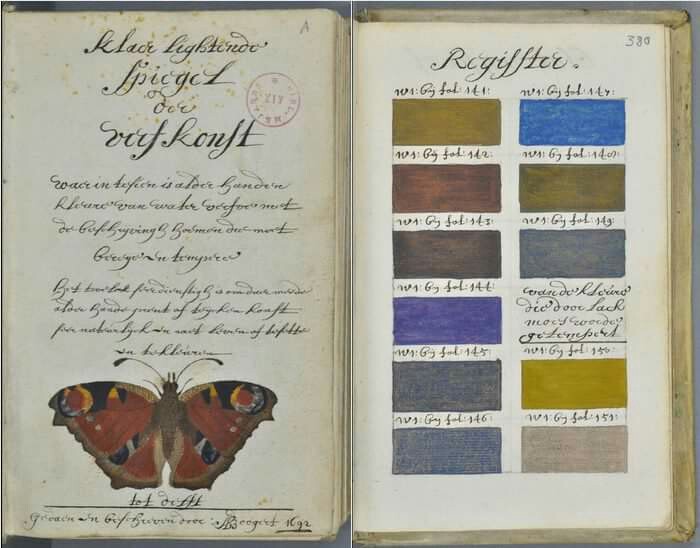
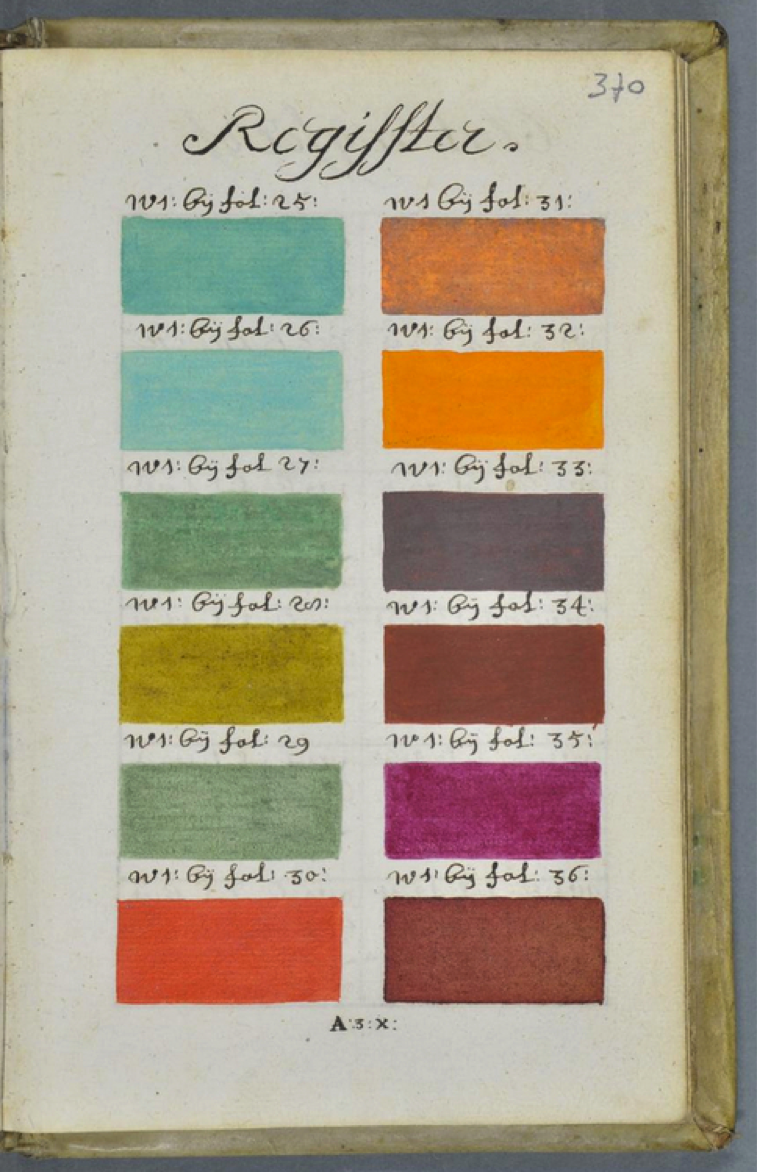
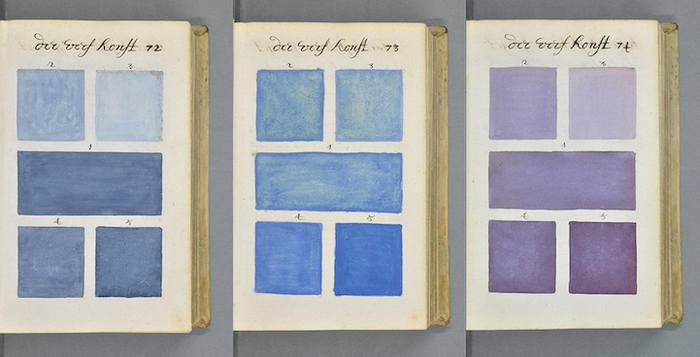
Over 250 years before the Color-Industrial Complex reared its head, a mysterious Dutch artist also detailed every color in the spectrum, only he did it all by hand. Known by the snicker-inducing name of A. Boogert, the author set out to demonstrate how to mix watercolor paint and how to manipulate the paint’s value by adding water. Yet he approached his task with a staggering level of detail and depth; the resulting book — Traité des couleurs servant à la peinture à l’eau — is over 700 pages. It’s about as thorough a color guide as one could imagine in a world without color printers.
The book was largely forgotten, gathering dust at the Bibliothèque Méjanes in Aix-en-Provence, France until Dutch art historian Erik Kwakkel, who translated the introduction, posted selections from the book on his blog. Herr Boogert apparently intended the book to be educational for aspiring artists. Unfortunately, only a few artists at the time ever got a chance to see the one-of-a-kind book.
Jonathan Crow is a Los Angeles-based writer and filmmaker whose work has appeared in Yahoo!, The Hollywood Reporter, and other publications. You can follow him at @jonccrow.
Quick fyi: Eric Ligman, a Microsoft Sales Excellence Manager, has gathered together a big list of free Microsoft ebooks and resource guides that will help you navigate through various Microsoft issues. Some of the texts are geared toward consumers; others toward IT professionals working with Microsoft products. A few handy titles include:
Roger Ebert seems to have resented star ratings, which he had to dish out atop each and every one of his hundreds upon hundreds of regular newspaper movie reviews. He also emphasized, every once in a while, his disdain for the “thumbs up” and “thumbs down” system that became his and Gene Siskel’s television trademark. And he could hardly ever abide that run-of-the-mill critic’s standby, the top-ten list. Filmgoers who never paid attention to Ebert’s career will likely, at this point, insist that the man never really liked anything, but those of us who read him for years, even decades, know the true depth and scope of his love for movies, a passion he even expressed, regularly, in list form. He did so for, as he put it, “the one single list of interest to me. Every 10 years, the ancient and venerable British film magazine, Sight & Sound, polls the world’s directors, movie critics, and assorted producers, cinematheque operators and festival directors, etc., to determine the Greatest Films of All Time.”
“Why do I value this poll more than others?” Ebert asks. “It has sentimental value. The first time I saw it in the magazine, I was much impressed by the names of the voters, and felt a thrill to think that I might someday be invited to join their numbers. I was teaching a film course in the University of Chicago’s Fine Arts Program, and taught classes of the top ten films in 1972, 1982 and 1992.” His dream came true, and when he wrote this reflection on sending in his list every decade, he did so a year nearly to the day before his death in 2013, making his entry in the 2012 Sight & Sound poll a kind of last top-ten testament:
Deciding that he must vote for “one new film” he hadn’t included on his 2002 list, Ebert narrowed it down to two candidates: The Tree of Life and Charlie Kaufman’s Synecdoche, New York. “Like the Herzog, the Kubrick and the Coppola, they are films of almost foolhardy ambition. Like many of the films on my list, they were directed by the artist who wrote them. Like several of them, they attempt no less than to tell the story of an entire life. [ … ] I could have chosen either film — I chose The Tree of Life because it’s more affirmative and hopeful. I realise that isn’t a defensible reason for choosing one film over the other, but it is my reason, and making this list is essentially impossible, anyway.” That didn’t stop his cinephilia from prevailing — not that much ever could.
Quick note: Earlier this year, J. K. Rowling began writing new stories about the 2014 Quidditch World Cup Finals for Pottermore, the website for all things Harry Potter. Today, she followed up with a story that takes the form of an article published in The Daily Prophet: “Dumbledore’s Army Reunites at Quidditch World Cup Final” by Rita Skeeter. Here, Rowling gives us the first glimpse of the adult Harry Potter.
About to turn 34, there are a couple of threads of silver in the famous Auror’s black hair, but he continues to wear the distinctive round glasses that some might say are better suited to a style-deficient twelve-year-old. The famous lightning scar has company: Potter is sporting a nasty cut over his right cheekbone. Requests for information as to its provenance merely produced the usual response from the Ministry of Magic: ‘We do not comment on the top secret work of the Auror department, as we have told you no less than 514 times, Ms. Skeeter.’ So what are they hiding? Is the Chosen One embroiled in fresh mysteries that will one day explode upon us all, plunging us into a new age of terror and mayhem?
What would Marcel Duchamp have thought of the age of 3D printing, had he foreseen it? I reckon that the inventor of the “readymade” work of art — i.e., a piece found in the real world and placed into an artistic context, as he famously/infamously did with a urinal for 1917’s Fountain — would endorse it as the logical extension of his own creative principles. But man, especially a man like Duchamp, does not live by recontextualized plumbing alone: he also painted, sculpted, and even carved. This last practice resulted, after some time in Buenos Aires the year after Fountain, in his very own one-of-a-kind Art Deco chess set. But now this unique item has turned readymade, so Boingboing reports via Kottke, as “freely downloadable 3D print-files on Thingiverse, where the community is actively remixing them” into versions “like this one, with self-supporting overhangs.”
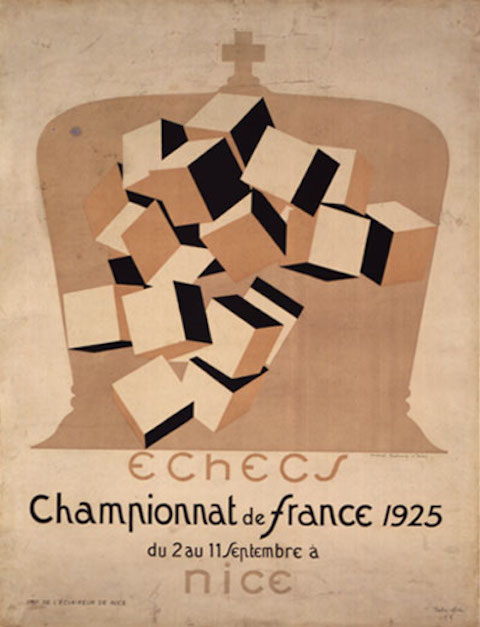
Duchamp himself, who appears in the video at the top of the post describing his passion for chess, surely would have enjoyed all this. After his time in Buenos Aires, he moved to Paris, then to America, and, in 1923, back to Paris again, by which time he’d dedicated himself almost fully to the game. Chess has obsessed many of humanity’s finest minds over centuries and centuries, and Duchamp seems to have shown little resistance to its intellectual and aesthetic pull. Still, just as he crossed chess and art when he crafted his Art Deco set (pictured above), he did it again in 1925, when he not only competed in the Third French Chess Championship (earning the title of grand master as a result) but also designed its striking poster below. The New York Times’ Holland Cotter, reviewing the Francis M. Naumann Fine Arts show “Marcel Duchamp: The Art of Chess,” writes that Duchamp ultimately found his two passions not just reconcilable but “complementary, an ideal intersection of brainpower and beauty. Chess was art; art was chess. Everything was about making the right moves.”
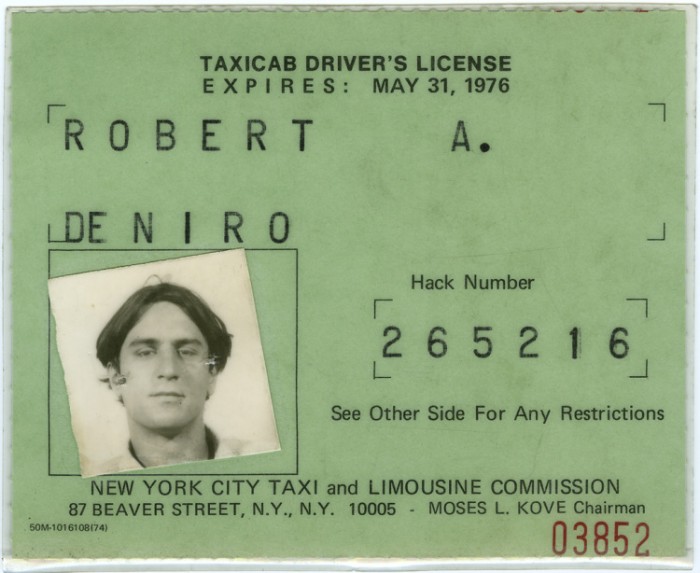
We all know that Robert De Niro has never cut corners when it comes to preparing for roles in films. Need him to gain 60 pounds to play the retired Jake LaMotta in Raging Bull? No problem. How about dropping down to a lean 4% body fat for Cape Fear? Consider it done. And while we’re at it, let’s pay a dentist $20k to grind the actor’s teeth down, you know, to achieve the menacing look of Max Cady. When it comes to Taxi Driver, the least a method actor can do is learn to drive a cab. Above, behold the hack license obtained by Bobby D. in 1976. As part of De Niro’s meticulous preparation for Taxi Driver, writes Andrew J. Rausch in The Films of Martin Scorsese and Robert De Niro, the actor spent some weekends as a cabbie. On one occasion, a passenger recognized him and asked him if he was Robert De Niro. The passenger, who also happened to be an actor, then quipped: “Well, that’s acting. One year the Oscar, the next you’re driving a cab!” (I’d really like to believe that story is true.) The license permanently resides at the Harry Ransom Center in Austin, Texas.
The best gospel recordings—by Aretha Franklin, The Staples Singers, The Carter Family, even Elvis—hum with a deep sincerity that can be truly moving, despite the unintentionally funny earnestness of ballads like “He Touched Me” (not to mention some of those album covers). You can add to the list of Southern gospel greats the name of Johnny Cash, who, like Elvis, got his start singing gospel and returned frequently to the hymns of his youth. Unlike the King, however, Cash also returned to the fold in the 1970s, partly influenced by his wife June Carter.
Cash would record a total of eight solo gospel albums with Columbia Records over his career, and a sort of old-time gospel greatest hits with The Million Dollar Quartet (Cash, Elvis, Jerry Lee Lewis, and Carl Perkins). He wrote a 1986 novelization of the life of the Apostle Paul called Man in White, and a song of the same name (below), and in 1990, the aging star recorded the entire New Testament, New King James Version. Hear the Gospel of Matthew above, and listen to it on Youtube. Running over 19 hours, the recording was repackaged in 2008 as a DVD called Chapter and Verse, with a slideshow and a CD of 14 of Cash’s gospel recordings.
Like his life and career, Cash’s religious journey was tumultuous, but once he’d kicked his addiction, he became something of a “staunch, conservative Bible thumper,” writing in the introduction to The Man in White, “Please understand that I believe the Bible, the whole Bible, to be the infallible, indisputable Word of God.” His theological views may have tempered over the years, but they remained staunchly Evangelical to the end of his life. That said, Cash “was a private man and preferred to keep his faith to himself,” once declaring, “If I’m with someone who doesn’t want to talk about it, I don’t talk about it. I don’t impose myself on anybody in any way, including religion.”
As in everything else Cash recorded, his conviction comes through in his reading above. While he didn’t preach, he did practice what he understood to be the values of his faith, standing up for the poor, imprisoned, and oppressed and against the power structures that constantly beat them down. Cash’s humility and commitment to principle have inspired millions of people who share his beliefs and millions who don’t. To learn more about this little-discussed side of the Man in Black, listen to the one-hour radio documentary below from Public Radio Exchange.
We're hoping to rely on loyal readers, rather than erratic ads. Please click the Donate button and support Open Culture. You can use Paypal, Venmo, Patreon, even Crypto! We thank you!
Open Culture scours the web for the best educational media. We find the free courses and audio books you need, the language lessons & educational videos you want, and plenty of enlightenment in between.