How can you change behavior for the better? It’s simple. Make it fun. The next thing you know, people will climb stairs instead of ride the escalator. And they’ll properly throw their trash away too (the subject of another engaging video)…
The Big Bang gave birth to our universe. But what will bring it to an absolute end? In 21 minutes, a mere mega blip of time, this episode of Cosmic Journeys offers an impressive visual account of this big enchilada question, taking you across trillions of years. The sun will die but make the earth uninhabitable well beforehand. A similar process of decay will play itself out across the universe and we will enter the “degenerate era.” Dark energy, dead stars, and black holes will reign supreme. But what will happen in the very, very end, when the cosmic clock strikes a number known as a “googol” or some time thereafter? A lot of that will get sorted out by the work physicists are now doing with the Large Hadron Collider, the giant particle accelerator located near Geneva, Switzerland. Give the video a little bit of time. The second half gives you the goods.
Hat tip to Wilter for sending this video our way.
Another great way to remember the great Lena Horne. This clip brings you back to 1958, when Horne appeared on What’s My Line, the longest-running game show in American television history. During its eighteen seasons, the show featured hundreds of celebrities, including some of America’s leading cultural figures. You can rewind the video tape and also check out appearances made by Salvador Dali, Alfred Hitchcock, Frank Lloyd Wright, Eleanor Roosevelt, Groucho Marx, Carl Sandburg, among others.
Sad to note the passing of Lena Horne, one of the first black talents to break the color barrier in Hollywood. Here we have her singing her signature song “Stormy Weather” in 1943. Thanks to @wesalwan, a regular contributor, for flagging this vintage piece.
The tech/internet billionaires of the 1990s were never known for their largesse. They built their massive yachts. They bought their sports teams. They didn’t give much back to the public domain, as the Rockefellers, Mellons and the Gettys once did (despite their many other flaws).
There are some exceptions, of course. Bill Gates finally found religion and got involved in philanthropy in a big way. Then, on a lesser scale, there’s Jay Walker, the founder of Priceline and Walker Digital. He plowed many of his millions into creating The Walker Library of Human Imagination. As Wired magazine has put it, the library is a kind of intellectual Disneyland, a 3600 square foot room that displays great works of human imagination in an imaginative setting. Artifacts on display include: a complete Bible handwritten on sheepskin from 1240 AD, the first illustrated medical book from 1499, a 1699 atlas containing the first maps that put the sun at the center of the universe, the napkin on which FDR sketched his plan to win WWII, and an original 1957 Russian Sputnik satellite. You can get a full list of cultural curiosities here, watch the recently produced video tour of the library above, and spend a few minutes watching Walker talk about his library at TED.
Conan O’Brien’s Silicon Valley tour winds up at Google as part of his “Legally Prohibited From Being Funny on Television Tour.” In this setting, you can really see his comic/improvisational talents come alive (more so than on late night TV). Give it a watch and tell me if you don’t get a good laugh…
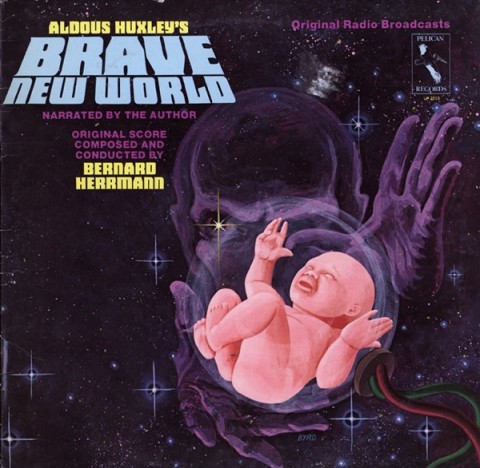
The CBS Radio Workshop was an “experimental dramatic radio anthology series” that aired between 1956 and 1957. And it premiered with a two-part adaptation of Aldous Huxley’s now classic 1932 novel, Brave New World. Huxley himself introduced and narrated the program, and now this classic radio drama has resurfaced online. You can listen to Part 1 and Part 2 below. The mp3s will be permanently housed in our collection of Free Audio Books.
As he grows older, Woody Allen increasingly finds himself positioned as the philosopher filmmaker. Fresh Air host Terry Gross asked him some heavy existential questions in an interview last year. (Listen here). And, more recently, we have Allen grappling with some big life questions in an interview conducted by Father Robert E. Lauder in the Catholic magazine, Commonweal. The conversation begins:
RL: When Ingmar Bergman died, you said even if you made a film as great as one of his, what would it matter? It doesn’t gain you salvation. So you had to ask yourself why do you continue to make films. Could you just say something about what you meant by “salvation”?
WA: Well, you know, you want some kind of relief from the agony and terror of human existence. Human existence is a brutal experience to me…it’s a brutal, meaningless experience—an agonizing, meaningless experience with some oases, delight, some charm and peace, but these are just small oases. Overall, it is a brutal, brutal, terrible experience, and so it’s what can you do to alleviate the agony of the human condition, the human predicament? That is what interests me the most. I continue to make the films because the problem obsesses me all the time and it’s consistently on my mind and I’m consistently trying to alleviate the problem, and I think by making films as frequently as I do I get a chance to vent the problems. There is some relief. I have said this before in a facetious way, but it is not so facetious: I am a whiner. I do get a certain amount of solace from whining.
William Carlos Williams – doctor by day, poet by night, and certainly one of America’s finest. In this 1954 audio clip, we hear Williams reading his own poetry at the storied 92nd Street Y in New York City. Poems include: “A Sort of a Song,” “The Maneuver,” “Seafarer,” “The Three Graces,” “Paterson, Episode 17,” “The Descent” and “Fish.” The reads are now added to the Poetry section of our Free Audio Books Collection.
Poetry lovers take note: People Reading Poems is a very new web site where users can come to hear recordings of people reading poems they love, and also to share their own favorite poems. It’s all completely free and easy to use. If you have a free moment, pay it a visit and help the site grow.
When you think Rome, you think the Colosseum. It’s one of the great structures of the Roman Empire, and it still dominates the landscape of the modern city. But how deep does your knowledge of the Colosseum actually go? Which emperor built the Amphitheatrum Flavium (as it was originally called)? For what purpose? And how, stylistically, was it originally built and decorated? All of this gets answered in an image-packed lecture by Yale professor Diana E.E. Kleiner, which forms part of her larger course on Roman Architecture. (Find it on YouTube, iTunes and Yale’s Open Course web site). I queued up the lecture at the 20 minute, when Kleiner starts talking about the Colosseum itself. But you can move back to the very beginning if you want to get some more political context.
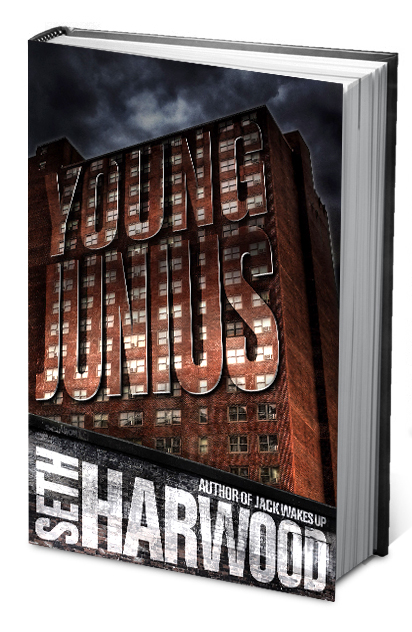
OC contributor Seth Harwood has something exciting going on over at his site today: he’s launching the pre-order sales of his new novel YOUNG JUNIUS, which is due out this fall. This is partly worth noting because Seth’s path to publication involves giving away his work for free as MP3 audiobooks. You can even listen to all of YOUNG JUNIUS before you make a buy. If you’re a fan of crime or mystery fiction, or you dig The Wire, you’ll love this book!
Now, Seth is partnering with independent publisher Tyrus Books to break new ground in publishing strategies. To read the full description of what he’s up to, go here. The brief version involves the pre-order of special, limited edition copies of the book that feature cloth binding, fan-created cover art, photos of the story’s locations, signed personalization and more. By offering these for a limited time via his site, he and Tyrus are able to print just the quantity sold and balance some of the cost (reduce the risk) of the book’s full print run–hardcover, paperback AND special edition.
If you’d like to read more about this or order a copy, head over to sethharwood.com. When you do, use the code OC to save $3 off the cover price of the book! Enjoy!!
Seth Harwood is a voracious reader, subversive publishing maven and crime novelist.
We're hoping to rely on loyal readers, rather than erratic ads. Please click the Donate button and support Open Culture. You can use Paypal, Venmo, Patreon, even Crypto! We thank you!
Open Culture scours the web for the best educational media. We find the free courses and audio books you need, the language lessons & educational videos you want, and plenty of enlightenment in between.