This week, Rebecca Onion’s always interesting blog on Slate features historical maps that illustrate the toll measles took on America before the advent of vaccines. The map above brings you back to 1890, when measles-related deaths were concentrated in the South and the Midwest. That year, according to the U.S. census, 8,666 people died from the disease. Fast forward to the period moving from 1912 to 1916, and you’ll find that there were 53,00 measles-related deaths in the US.
America continued to struggle with the disease, until 1962, when scientists mercifully invented a vaccine, and the rate of measles infections and deaths began to plummet. The authors of “Measles Elimination in the United States,” published in The Journal of Infectious Diseases (2004),note that “Since 1997, the reported annual incidence [of measles] has been <1 case/1 million population” — meaning that the disease had been pretty much eradicated in the US. But not elsewhere. The authors go on to warn, “Measles is the greatest vaccine-preventable killer of children in the world today and the eighth leading cause of death among persons of all ages worldwide.” It doesn’t take much to deduce that if we dismiss the science that has served us so well, we could see dreadfully colored maps all over again. Except this time the dark orange will likely be concentrated on the left coast.
A hundred years before Sigmund Freud used himself as a test subject for his experiments with cocaine, another scientist, Humphry Davy, English chemist and future president of the Royal Society, began “a very radical bout of self experimentation to determine the effects of” another drug—nitrous oxide, better known as “laughing gas.” Davy’s findings — Researches, Chemical and Philosophical Chiefly Concerning Nitrous Oxide, or Diphlogisticated Nitrous Air, And Its Respiration By Humphry Davy—published in 1800, come to us via ThePublic Domain Review, who describe the 1799 experiments thus:
With his assistant Dr. Kinglake, he would heat crystals of ammonium nitrate, collect the gas released in a green oiled-silk bag, pass it through water vapour to remove impurities and then inhale it through a mouthpiece. The effects were superb. Of these first experiments he described giddiness, flushed cheeks, intense pleasure, and “sublime emotion connected with highly vivid ideas.”
Though we don’t typically think of nitrous oxide as an addictive substance, like Freud’s experiments, Davy’s progressed rapidly from curiosity to recreation: “He began to take the gas outside of laboratory conditions, returning alone for solitary sessions in the dark, inhaling huge amounts, ‘occupied only by an ideal existence,’ and also after drinking in the evening.” Fortunately for us, however, also like Freud, Davy “continued to be meticulous in his scientific records throughout.” Eventually, the twenty-year-old Davy constructed an “air-tight breathing box.” Sealing himself inside, writes Mike Jay, Davy had Dr. Kinglake “release twenty quarts of nitrous oxide every five minutes for as long as he could retain consciousness.”
Also, like Freud’s use of cocaine, Davy’s research briefly led to a faddish recreational use of the drug, well into the early part of the nineteenth century, as you can see in the caricatures at the top and below, from 1830 and 1829, respectively. But despite what these humorous images suggest, “laughing gas” became known not only as a party drug, but also as a means of achieving heightened states of consciousness conducive to philosophical reflection and poetic creation (hence the “Philosophical” reference in the title of Davy’s research). During his own experiences “under the influence of the largest does of nitrous oxide anyone had ever taken,” Davy “’lost all connection with external things,’ and entered a self-enveloping realm of the senses,” writes Jay, finding himself “‘in a world of newly connected and modified ideas,’ where he could theorise without limits and make new discoveries at will.”
The appeal of this state to a scientist may be obvious, and to a poet even more so. Davy’s friend Robert Southey, the future Poet Laureate, became “as effusive” as Davy after taking the gas, exclaiming, “the atmosphere of the highest of all possible heavens must be composed of this gas.” In addition to Southey, Davy’s “freewheeling program of consciousness expansion… co-opted some of the most remarkable figures of his day”—including Samuel Taylor Coleridge, who is already well-known for finding some of his poetic inspiration under the influence of opium. Coleridge at the time had just published to great acclaim The Lyrical Ballads with William Wordsworth and had returned from a brief sojourn in Germany, where he had become heavily influenced by the German Idealist philosophy of Immanuel Kant and Friedrich Schelling.
Coleridge, who was “captivated by the young chemist” Davy, described his experience of taking nitrous oxide for the first time in very precise terms, avoiding the “extravagant metaphors” others tended to rely on. He recalled the sensations as resembling “that which I remember once to have experienced after returning from the snow into a warm room,” and, in a later trial, said he was “more violently acted upon” and that “towards the last I could not avoid, nor felt any wish to avoid, beating the ground with my feet; and after the mouthpiece was removed, I remained for a few seconds motionless, in great ecstacy.” Under the influence of both nitrous oxide and philosophical metaphysics, Coleridge had come to believe “the material world only an illusion projected by” the mind.
Davy, who fully endorsed this view, claiming “nothing exists but thoughts,” brought his “chaotic mélange of hedonism, heroism, poetry and philosophy” to heel in the “coherent and powerful” 580-page monograph above, which makes the case for laughing gas’s scientific and poetic worth. The report, writes Jay, combines “two mutually unintelligible languages—organic chemistry and subjective experience—to create a groundbreaking hybrid, a poetic science.” Like Freud’s use of cocaine or Timothy Leary’s experiments with LSD decades later, Davy’s experiments further demonstrate, perhaps, that the few times the sciences, philosophy, and poetry communicate with each other, it’s generally under the influence of mind-altering substances.
Where music goes, technologically speaking, audio books soon follow. We’ve had audio books on vinyl LP, on cassette tape, on CD, and on MP3, just like we’ve had music. Now that so many of us pull up our daily jams on Spotify, it shouldn’t come as a surprise that we can do a fair bit of our “reading” there as well. We’ve found a few lists that gather up the best audio book available on Spotify, including 21 classics and a collection of Shakespeare plays and sonnets at Gnarl’d, ten evergreen literary picks from Lifehacker, and a Spotify forum thread dedicated to subject.
Below, you’ll find Spotify links to more than 60 classic works of literature that, even if you struggled on getting them read in your English classes, you can now revisit in a perhaps much more lifestyle-compatible medium. If you find more audio books on Spotify, definitely let us know in the comments section below and we’ll add them to our list.
To listen to any of these, you will of course need Spotify’s software and account, both easy to come by: you just download and register.
The strict realist mold that dominated fiction and poetry for over a hundred years broke open in the late nineteenth century with symbolist French poets like Arthur Rimbaud, Stéphane Mallarmé, and Charles Baudelaire. The next few modernist decades made it impossible to ignore experimental literature, which trickled into the public consciousness through all variety of media. Popular songcraft, however, held out for a few more decades, and though styles proliferated, the standard ballad forms—straightforward narratives of love and loss—more or less dominated into the 1960s, with the exception of odd novelty records whose existence proved the rule.
Though neither ever abandoned the ballad, it’s significant that two of that decade’s most innovative pop songwriters, John Lennon and Bob Dylan, drew much of the inspiration for their more experimental songs from poetry—Lennon from an older nonsense tradition in English literature exemplified by Lewis Carroll, and Dylan from T.S. Eliot and other modernist poets.
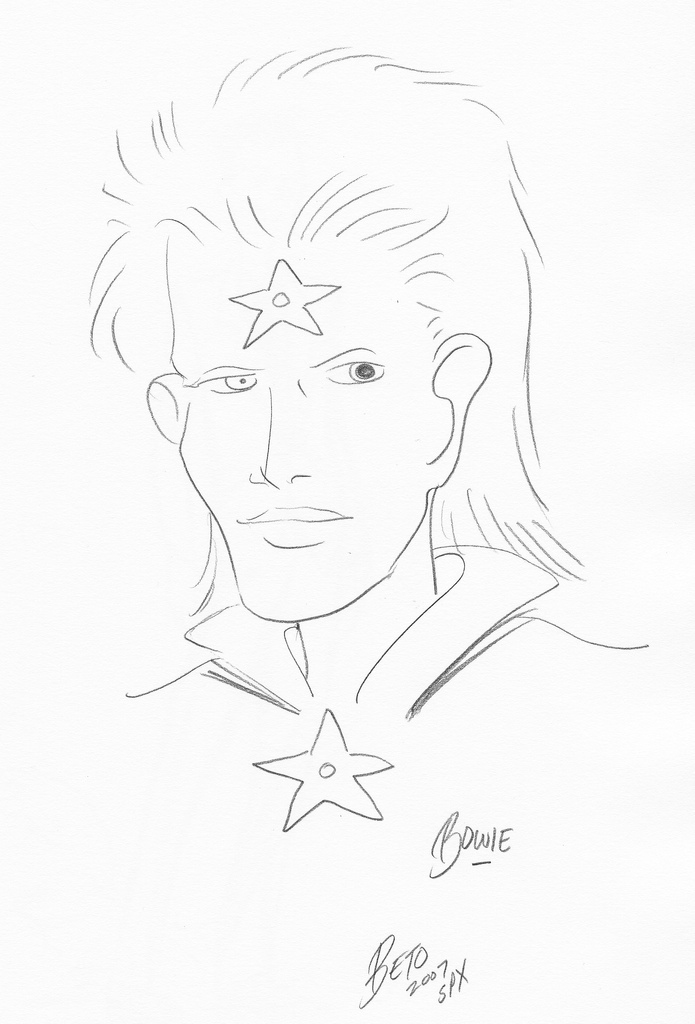
But another strain developed in the fifties and sixties—darker and weirder, though no less traceable to a literary source: William S. Burroughs’ surrealist cut-up technique, which he developed with artist Brion Gysin. Just above, you can hear Burroughs explain cut-up writing as a “montage technique” from painting applied to “words on a page.” Words and phrases are cut from newspapers and magazines and the fragments re-arranged at random. Burroughs and Gysin expanded the technique to audio recording and film, and these experiments inspired avant-garde electronic artists like Throbbing Gristle and Atari Teenage Riot, both of whom shared Burroughs’ desire to disrupt the social order with their audio experiments and neither of whom are household names. But Burroughs’ experiments with cut-up writing were also adopted by songwriters everyone knows well. In the clip at the top of the post, see David Bowie explain how he used the cut-up technique—“a kind of Western Tarot,” he calls it—both as a compositional tool and a means of finding inspiration.
In a 2008 interview, Bowie further explained his use of cut-ups: “You write down a paragraph or two describing different subjects, creating a kind of ‘story ingredients’ list, I suppose, and then cut the sentences into four or five-word sections, mix ‘em up and reconnect them.” The technique allows songwriters, he says, to “get some pretty interesting idea combinations,” even if they “have a craven need not to lose control.” Bowie almost single-handedly created the category of “art rock” with his application of avant-garde techniques to conventional song structures and rock ‘n’ roll attitudes.
Decades later, another hugely influential songwriter also made Burroughs’ technique mainstream. Kurt Cobain, who had the chance to meet and collaborate with Burroughs (above), used cut-ups to construct his lyrics—like Bowie, taking the bits of text from his own writing rather than from the mass media productions Burroughs and Gysin preferred. Pop music critic Jim Derogatis quotes Cobain as saying, “My lyrics are total cut-up. I take lines from different poems that I’ve written. I build on a theme if I can, but sometimes I can’t even come up with an idea of what the song is about.” Burroughs blog RealityStudio further documents the artistic influence of Burroughs and other writers on Cobain’s songwriting.
Though Bowie and Cobain are perhaps the two most prominent adopters of Burroughs’ technique, the Beat writer’s influence on pop music stretches back to the Beatles, who included him on the cover of Sgt. Peppers Lonely Hearts Club Band, and extends through the work of artists like Joy Division, Iggy Pop, and, notably, Radiohead’s Thom Yorke, who supposedly drew cut-up phrases from a hat to write the lyrics for the band’s groundbreaking album Kid A. And though Burroughs can seem like a sui generis force, wholly original, Language is a Virus notes that he himself “cited T.S. Eliot’s poem, The Waste Land (1922) and John Dos Passos’ U.S.A. Trilogy, which incorporated newspaper clippings, as early examples of the cut ups he popularized.” The technique can be traced even further back to founding Dadaist artist Tristan Tzara’s 1920 “To Make a Dadaist Poem.” Each case of Burroughs’ influence on both avant-garde and popular musicians demonstrates not only his well-deserved reputation as the father of the underground—from Beats to punks—but also the symbiotic relationship between musical and literary innovation.
William S. Burroughs is one of the most mythologized American authors of the 20th century. When you recall the details of his life, they read like the biography of a fictional character. He was an unabashed heroin addict yet he dressed like a dapper insurance salesman. He was openly, militantly gay at a time when homosexuality wasn’t even mentioned in polite society. He shot his wife, Joan Vollmer, in Mexico City while playing an ill-conceived game of William Tell and then spent years in Tangiers indulging in every possible vice while writing Naked Lunch, which happened to be one of the most controversial books of the century. And his writing influenced just about everyone you consider cool.
This week is the 101st birthday of Burroughs. To mark the occasion, This American Life aired a BBC documentary on Burroughs’s life. The show is narrated by Iggy Pop whose voice, in announcer mode, bears an uncanny resemblance to Sam Elliot. Pop relates how Burroughs influenced Kurt Cobain, punk rock and Bob Dylan, and how he himself lifted lyrics from Burroughs for his most popular song, and unlikely Carnival Cruise jingle, “Lust for Life.”
As Ira Glass notes, the documentary paints a clear picture of why he is such a revered figure – going into detail about his writing, his hugely influential “Cut Up” method, his obsession with cats – while never buying into his mystique. In fact, one of the most interesting parts of the doc is a damning appraisal of Burroughs’s cool junkie persona by author Will Self, who was himself an addict for a couple of decades. You can listen to the whole episode above.
If you would like to sign up for Open Culture’s free email newsletter, please find it here. It’s a great way to see our new posts, all bundled in one email, each day.
If you would like to support the mission of Open Culture, consider making a donation to our site. It’s hard to rely 100% on ads, and your contributions will help us continue providing the best free cultural and educational materials to learners everywhere. You can contribute through PayPal, Patreon, and Venmo (@openculture). Thanks!
Jonathan Crow is a Los Angeles-based writer and filmmaker whose work has appeared in Yahoo!, The Hollywood Reporter, and other publications. You can follow him at @jonccrow. And check out his blog Veeptopus, featuring lots of pictures of badgers and even more pictures of vice presidents with octopuses on their heads. The Veeptopus store is here.
We can probably all agree that it’s a little premature, but all the same, the BBC has barreled ahead with its list of “The 21st Century’s 12 greatest novels.” Topping the list of excellent, if not especially surprising, picks is The Brief Wondrous Life of Oscar Wao, Junot Díaz’s Pulitzer Prize-winning debut novel about, as he puts it in the interview above, “a closeted nerd writing about an absolutely out nerd, and using their shared mutual language to tell the story.” The book has connected with such a wide swath of readers for more than its appeal to fellow nerds, though that’s no small thing. A great many readers have seen their own lives reflected in Díaz’s characters—Dominican immigrants growing up in New Jersey—or have found their experiences illuminating. And even though Yunior and Oscar’s very male point of view might have alienated female readers in the hands of a lesser author, Díaz has the sensitivity and self-awareness to—as Joe Fassler argues in The Atlantic—write sexist characters, but not sexist books. As the author himself says above, “if it wasn’t for women readers, I wouldn’t have a career.”
Díaz’s ear for dialogue and idiom and his facility for constructing completely believable characters with completely distinctive voices are matched by his commitment to representing the experiences of people who still get routinely left out of the contemporary canon. Despite the attention given to such stellar non-white, non-male writers as Toni Morrison, Maxine Hong-Kingston, Arundhati Roy, and Jamaica Kincaid, most MFA programs, Diaz argued in a recent essay for The New Yorker, are still “too white,” reproducing “exactly the dominant culture’s blind spots and assumptions around race and racism (and sexism and heteronormativity, etc).” In his own MFA workshop experiences at Cornell, he found that “the default subject position of reading and writing—of Literature with a capital L—was white, straight and male.”
The problem is more than just personal, though he certainly found the experience personally alienating, and it isn’t a matter of redressing historical wrongs or enforcing an abstract PC notion of diversity. Instead, as Díaz told Salon, it’s a problem of accurately representing reality. “If race or gender (or any other important social force) are not part of your interpretive logic—if they’re not part of what you consider the real—then you’re leaving out most of what has made our world our world.” In his own role at a professor at MIT, teaching undergraduate writing courses for the Comparative Media Studies/Writing Department, Díaz is very thoughtful about his approach, emphasizing, “it’s not the books you teach, but how you teach them.” In addition to novels by authors like Haitian-born Edwidge Danticat and Zimbabwean author NoViolet Bulawayo, he has his students read “classic Gothic texts which are themselves not very diverse by our standards,” but, he says, “the critical lens I deploy helps my students understand how issues of race, gender, coloniality etc. are never far.”
Salon tracked down the syllabi and reading lists for two of Díaz’s MIT courses, “World-Building” and “Advanced Fiction.” We do find one classic Gothic text—Bram Stoker’s Dracula—and also much of what we might expect from the self-confessed nerd, including work from such well-regarded comic writers as Frank Miller and Alan Moore and classic sci-fi from Tarzan creator Edgar Rice Burroughs. In addition to these white, male writers, we have fiction from African-American sci-fi authors Octavia Butler and N.K. Jemisin. Díaz’s “Advanced Fiction” list is even more wide-ranging, inclusive of writers from Chile, Zimbabwe, China, and Haiti, as well as the U.S. See both lists below.
World-Building:
Description: “This class concerns the design and analysis of imaginary (or constructed) worlds for narrative media such as roleplaying games, films, comics, videogames and literary texts. … The class’ primary goal is to help participants create better imaginary worlds – ultimately all our efforts should serve that higher purpose.”
Prerequisites: “You will need to have seen Star Wars (episode four: A New Hope) and read The Lord of the Rings by JRR Tolkien.”
Reading List:
“A Princess of Mars” by ER Burroughs
“Dracula” by Bram Stoker
“Batman: The Dark Knight Returns” by Frank Miller
“Sunshine” by Robin McKinley
“V for Vendetta” by Alan Moore
“The Hunger Games” by Suzanne Collins
“The Hundred Thousand Kingdoms” by NK Jemisin
“Lilith’s Brood” by Octavia Butler
“Perdido Street Station” by China Miéville
“Snow Crash” by Neal Stephenson (Recommended)
Some things to consider always when taking on a new world: What are its primary features—spatial, cultural, biological, fantastic, cosmological? What is the world’s ethos (the guiding beliefs or ideals that characterize the world)? What are the precise strategies that are used by its creator to convey the world to us and us to the world? How are our characters connected to the world? And how are we the viewer or reader or player connected to the world?
Advanced Fiction
Description: “An advanced workshop on the writing and critiquing of prose.”
Reading List:
“Clara” by Roberto Bolaño
“Hitting Budapest” by NoViolet Bulawayo
“Whites” by Julie Otsuka
“Ghosts” by Edwidge Danticat
“My Good Man” by Eric Gansworth
“Gold Boy, Emerald Girl” by Yiyun Li
“Bounty” by George Saunders
Let’s say you spend a considerable amount of money for a painting by a noted artist. Or maybe you get it for a steal. Either way, the painting hangs prominently in your home, where it is admired by guests and brings you pleasure every time you look at it, which is often. Years later, you accidentally discover that your painting is not the work of the artist whose signature graces the lower right hand corner of the canvas, but rather a heretofore anonymous forger. How do you react?
Do you laugh and say, “When I think of all the happiness that living with this beautiful image has brought me over the years, I feel I have gotten my money’s worth many times over. I don’t care who painted it!”
Or do you look as though you’ve just realized that evil exists in the world, which is how Hitler’s right hand man, Hermann Göring, reputedly looked when, as a prisoner at Nuremberg, he was informed that his beloved Vermeer, ”Christ with the Woman Taken in Adultery” (below), was actually the work of the Dutch dealer who had sold it to him.
Göring’s reaction may have been the most human thing about him. According to Yale psychologist Paul Bloom, the pleasure we take in the things we love is deeply informed by their perceived origins. Forget monetary value. Forget bragging rights. We need to believe that our painting was not just painted by Vermeer, but handled by him, breathed upon him. If only that Vermeer of mine could talk…I bet it could settle once and for all the exact nature of his relationship with that little serving girl. Remember? The one with the pearl earring?
But that’s the sort of provenance we crave. The kind that comes with a story we can sink our teeth into.
The story must also fit the circumstances, as Bloom makes plain in his wonderfully entertaining TED talk on the Origins of Pleasure.
Unknowingly hopping in the sack with a blood relative or eating rat meat are intriguing narratives, provided they happen to someone else. Knowledge of such stories could deepen your connection to a particular piece of art.
(Can’t you feel the sexual anguish oozing out of my Vermeer? Did you know he had to choose between buying brushes and buying food?)
Not the sort of origin story you’d want to find at the bottom of your own personal soup bowl, however.
And when it comes to drink, we will willingly believe in the superior flavor of anything poured under the auspices of an acclaimed label. Scientific evidence confirms this.
(On a related note, I once hung on to a bottle after drinking the luxury vodka it once contained, thinking I’d refill it with a cheap liquor hack I had read about. The experiment ended when my husband complained that the water in our Brita pitcher tasted funny.)
Speaking of romantic partners, it turns out that beauty truly is not so much in the eye, but the brain of the beholder. And it’s probably not a bad idea to make sure you’ve got the facts regarding a potential lover’s age, gender, and bloodlines. Caveat emptor, as anyone who’s ever seen the Crying Game will attest.
Werner Herzog is the wild man of cinema. His movies are stark and elemental and ecstatic and are usually about a crazed dreamer who struggles to achieve an impossible task in the face of a chaotic, indifferent universe. Think Aguirre, Wrath of God, about a conquistador who goes crazy while adrift along an Amazonian river. Think Stroszek, about a German grifter who goes mental in the forbidding landscape of Wisconsin while struggling to find the American dream. That film famously, inexplicably, ends with shots of a dancing chicken.
The ecstatic truths seen in his movies are reflected in the man himself. At the age of 14, Herzog struck out from his native Germany for Albania and then Sudan. In 1972, he once walked from Munich to Paris to visit an ailing friend. In 1977, he shot footage at the lip of a volcano at the brink of eruption. He’s a filmmaker who seems to go out of his way to choose locations that are remote and difficult — Antarctica, the Sahara and the Amazonian rain forest — and his shoots always seem to be bedeviled by intrigue and catastrophe. His first feature was nearly derailed because of a coup d’état. While shooting Fata Morgana in Cameroon, he was mistaken for a wanted criminal and thrown in jail. Once during a TV interview in the hills of Los Angeles, he was shot by a random crazy person. Watch it here.
“A BBC television crew came to see me in Laurel Canyon,” as he recounted for The New Yorker. “They wanted to interview me for the British première of ‘Grizzly Man.’ I didn’t want them to film right outside my house, so we went up to Skyline Drive. In the middle of the interview, I was shot with a rifle by someone standing on his balcony. I seem to attract the clinically insane.”
Instead of stopping the interview, running for protection and perhaps going to the hospital, Herzog just continued with the interview saying simply, “It was not a significant bullet. I am not afraid.”
Herzog’s improbable penchant for disaster, his collaboration with the brilliant, but batshit crazy, Klaus Kinski, and of course, his singular, uncompromising work have turned him into almost a mythic figure in some circles. But it’s these mad, macho declarations like those above that have really fed the cult of Herzog.
Recently, some unknown genius turned some of Herzog’s more extreme quotations into inspirational posters. Lines like “Civilization is like a thin layer of ice upon a deep ocean of chaos and darkness” are placed along side a shot of a glass of white wine and a sunset.
So gaze upon them. Absorb the pearls of wisdom. Find cold comfort in their bleak, nihilist pronouncements. They make fine additions to any cubicle.
Jonathan Crow is a Los Angeles-based writer and filmmaker whose work has appeared in Yahoo!, The Hollywood Reporter, and other publications. You can follow him at @jonccrow. And check out his blog Veeptopus, featuring lots of pictures of badgers and even more pictures of vice presidents with octopuses on their heads. The Veeptopus store is here.
Given his celebrity status in the realms of both music and visual art, I don’t know that we can really call anything Brian Eno does obscure. But at one point, he did call his own efforts obscure — or at least those efforts required to establish and run the label Obscure Records, which he did between 1975 and 1978. In that short period, Obscure Records managed to put out ten albums, from Gavin Bryars’ The Sinking of the Titanic (catalog no. 1) to Michael Nyman’s Decay Music (no. 6) to Harold Budd’s Pavilion of Dreams (no. 10), all of which we might broadly categorize as “contemporary classical music,” with a strong bent toward new compositional techniques and what we’d now call ambient textures.
“The label provided a venue for experimental music,” says Ubuweb’s Obscure Records page, “and its association with Eno gave increased public exposure to its composers and musicians.” There, you freely can listen to all ten Obscure releases — which, I suppose, effectively makes them obscure no more — although they don’t include the famously detailed original liner notes “analyzing the compositions and providing a biography of the composer.”
Though he mostly acted as producer on Obscure recordings, Eno also used the label to put out his seminal 1975 solo album Discreet Music (no. 3), which contains a composition made using the then unheard-of technique of running several tape loops simultaneously and letting the sound recorded on them run gradually out of sync. Obscure’s fifth release, Jan Steele and John Cage’s 1976 Voices and Instruments, features “The Wonderful Widow Of Eighteen Springs,” previously featured here on Open Culture as interpreted by Joey Ramone.
This may seem colorful enough for any label’s lifetime, but Eno did have an eleventh Obscure record planned. It ultimately made more sense, however, to found an entirely new operation to put out this work, a certain Music for Airports. It came out as the flagship release from Eno’s Ambient Records — and the rest, my friends, is popular-experimental music history.
With the naked eye, it’s nearly impossible to see what happens inside a DSLR camera when the shutter activates. But all of that changes when you use a high speed camera — the Phantom Flex — to slow things down to 10,000fps. Above, you can see The Slow Mo Guys do their thing. It’s fun to watch, and you’ll probably learn a few things about how a camera works.
If you would like to sign up for Open Culture’s free email newsletter, please find it here. It’s a great way to see our new posts, all bundled in one email, each day.
If you would like to support the mission of Open Culture, consider making a donation to our site. It’s hard to rely 100% on ads, and your contributions will help us continue providing the best free cultural and educational materials to learners everywhere. You can contribute through PayPal, Patreon, and Venmo (@openculture). Thanks!
If I close my eyes on hallucinogens, I get a vision of great scaly dragons in outer space, they’re winding slowly and eating their own tails. Sometimes my skin and all the room seem sparkling with scales, and it’s all made out of serpent stuff. And as if the whole illusion of life were made of reptile dream.
He also mentioned that drugs made him barf. That alone seems a persuasive reason to stop taking them.
Despite his strong desire to continue his pursuit of ever higher levels of consciousness, the cons were beginning to outweigh the pros.
It took nearly a year for the Paris Review to publish the interview. So long that the subject felt the need to revise his earlier statements, via the typewritten letter above.
His post-interview psychedelic excursions appear to have transpired in the sort of benign universe typically imagined by a preschooler with a big box of crayons: “tiny jeweled violet flowers,” “giant green waves,” a “great yellow sun.” Otherwise known as Big Sur on acid.
I wonder if Johnson ever found out he had a rabidly anti-war Beat Poet (and “masses of green bulb-headed Kelp vegetable-snake undersea beings”) praying for his recovery.
Apparently it worked.
The complete June 1965 interview can be read in the Paris Review’s archives. Those who’ve grown unaccustomed to reading courier font as executed by a midcentury manual typewriter will find the complete text of Ginsberg’s letter below.
June 2, 1966
To readers of Paris Review:
Re LSD, Psylocibin [sic], etc., Paris Review #37 p. 46: “So I couldn’t go any further. I may later on occasion, if I feel more reassurance.”
Between occasion of interview with Thomas Clark June ’65 and publication May ’66 more reassurance came. I tried small doses of LSD twice in secluded tree and ocean cliff haven at Big Sur. No monster vibration, no snake universe hallucinations. Many tiny jeweled violet flowers along the path of a living brook that looked like Blake’s illustration for a canal in grassy Eden: huge Pacific watery shore, Orlovsky dancing naked like Shiva long-haired before giant green waves, titanic cliffs that Wordsworth mentioned in his own Sublime, great yellow sun veiled with mist hanging over the planet’s oceanic horizon. No harm. President Johnson that day went into the Valley of Shadow operating room because of his gall bladder & Berkley’s Vietnam Day Committee was preparing anxious manifestoes for our march toward Oakland police and Hell’s Angels. Realizing that more vile words from me would send out physical vibrations into the atmosphere that might curse poor Johnson’s flesh and further unbalance his soul, I knelt on the sand surrounded by masses of green bulb-headed Kelp vegetable-snake undersea beings washed up by last night’s tempest, and prayed for the President’s tranquil health. Since there has been so much legislative mis-comprehension of the LSD boon I regret that my unedited ambivalence in Thomas Clark’s tape transcript interview was published wanting this footnote.
We're hoping to rely on loyal readers, rather than erratic ads. Please click the Donate button and support Open Culture. You can use Paypal, Venmo, Patreon, even Crypto! We thank you!
Open Culture scours the web for the best educational media. We find the free courses and audio books you need, the language lessons & educational videos you want, and plenty of enlightenment in between.