570 millions years of evolution. That’s a lot of ground to cover. And it could be like watching paint dry. But not when it flies by in 60 seconds, with a groovy soundtrack by I‑Konic. First come the arthropods. Next some friendly fish, all followed by land plants, flying insects, amphibians, and reptiles. Way down the line, at the very end, the first humans arrive on the scene. But don’t blink, you might miss it.
George Harrison had a beloved guitar named Lucy. B.B. King has one named Lucille. Curious, that.
Above, in a new animated video by Blank on Blank, B.B. explains the story behind the naming of his legendary guitar, and then answers the big question: Do you really need to endure hard times to play the blues? No spoilers here.
The audio was recorded in September, 1985 by Warner Bros. A&R manager Joe Smith. While writing a book on the music industry, Smith taped interviews with legendary figures like Dave Brubeck, Lou Reed, Paul McCartney, Joan Baez, Herbie Hancock, David Bowie, George Harrison, Yoko Ono, James Brown, Bo Diddley, Jerry Garcia, Christine McVie, Mick Jagger, Linda Ronstadt and more. Each interview runs 30–60 good minutes. They’re fascinating to listen to, and you can find them on iTunes and the web.
If you would like to support the mission of Open Culture, consider making a donation to our site. It’s hard to rely 100% on ads, and your contributions will help us continue providing the best free cultural and educational materials to learners everywhere. You can contribute through PayPal, Patreon, and Venmo (@openculture). Thanks!
Giving Gus Van Sant’s Drugstore Cowboy a re-watch a couple of weeks ago, I found I especially enjoyed William S. Burroughs’ appearance toward the end as — what else? — an aged but wise drug user in whose benevolent presence Matt Dillon’s protagonist comes to life-changing conclusions. That picture represented a break into the mainstream, or close to it, for Van Sant, a director previously known for Mala Noche, a stark black-and-white take on street hustlers on Portland’s Skid Row.
But Burroughs’ presence, among other things, allowedDrugstore Cowboy to keep a certain raw edge. If you really want to see Burroughs’ in a context of cinematic rawness, though, have a look at these home movies. We’ve pulled them out of the internet’s attic as a celebration of the Naked Lunch author’s 101st birthday. Only lightly and tastefully edited, these VHS gems (part one, part two) candidly depict Burroughs at home in Lawrence, Kansas in 1996, just a year before his death.
They also find him in the company of such notable friends as Patti Smith, Steve Buscemi, and Allen Ginsberg, smoking, drinking, and — in Smith’s case — busting out the guitar. Cats, as promised, roam through the frame. You might not call Burroughs himself, made somewhat less exuberant by time, the life of the party, but he does seem to have radiated a kind of askew animating spirit until the end. It certainly kept him surrounded by countercultural luminaries, all of them surely still as keen as that young pharmacy-robber to learn from him.
If you warbled “02134” without hesitation, you probably grew up watching a beloved children’s television show of the 70s.
It turns out Zoom wasn’t the only cool program WGBH hatched in 1972. On March 13, just a couple of months after Zoom’s debut, the station aired Between Time and Timbuktu, a 90-minute special inspired by the work of Kurt Vonnegut.
Vonnegut also wrote the introduction to the published script, a paperback quickie enhanced by production stills and photos taken by Vonnegut’s wife, Jill Krementz. It was as good a forum as any for him to announce his retirement from film, which he cited as a medium “too clanking and real” for his comfort.
The show itself is likely to cause nostalgia for television’s freewheeling, Monty Python era.
Though 1972 wasn’t an entirely silly period, if you’ll recall. The Vietnam War was raging, with Walter Cronkite holding down the CBS Evening News desk.
Between Time and Timbuktu capitalizes on the veteran broadcaster’s ubiquity by casting comedian Ray Goulding of Bob and Ray fame, as an appropriately grave Walter Gesundheit. Bob joined him at the news desk as a fictitious former astronaut. Vonnegut was appreciative of their efforts, stating that American comedians had probably done more to shape his thinking than any other writer.
Also look for William Hickey, who played Prizzi’s Honor’s genial, aged mafia don, in the lead role of Stony Stevenson—now there’s a period character name! If you’ll remember, Stony is also the first civilian in space, at least according to the Sirens of Titan.
If you’ve spent any time at all on a college campus, you’ve heard Bob Marley and the Wailer’s 1984 compilation album Legend wafting from dorm rooms and frat house windows. The longest charting album in the history of Billboard magazine, it contains all of the band’s top 40 hits and more or less stands as every young American’s introduction to the iconic Jamaican singer, if not to reggae music itself. Before Legend, there was Eric Clapton’s cover of Marley’s 1973 single “I Shot the Sheriff.” Clapton’s version hit number one on the Billboard Hot 100 in ’74—his only number one hit in the U.S.—and introduced American audiences to Marley’s fiery politics, if not always to Marley himself. On what would have been Marley’s 70th birthday, we bring you some early footage of the man and his band.
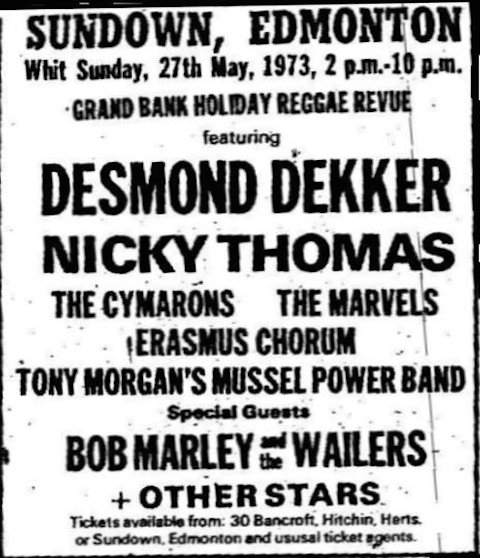
While many Americans may been rather late to the Bob Marley party, and to reggae, the English have long had a fascination with West Indian music. Ska pioneers like Desmond Dekker drew huge crowds in the UK while remaining much less popular stateside (though Dekker had a number one hit in the U.S. in 1969). But even some Brits didn’t quite know what to do with Marley when he and the Wailers hit English shores in the spring of 1973. Playing the Sundown Theater in the London suburb of Edmonton in support of Dekker and a host of other acts (top), Marley, writes Dangerous Minds, “was still somewhat of an enigma and the Wailers were sonically much more adventurous than some of the other acts on the bill that day…. According to reports at the time, most of the audience at this Wailers gig didn’t ‘get’ the group.”
Nevertheless, that ’73 tour changed the band’s fortunes forever. After three albums, a previous UK tour, and several attempts to break into the pop charts, the Wailer’s fourth record, major label-debut Catch a Fire, finally made them international stars, if not yet every American college freshman’s favorite band. Just above, hear an FM broadcast of another date from the UK leg of the Catch a Firetour (see the Youtube page for the full setlist). After Britain, the band played a run of shows at Paul’s Mall in Boston, then four nights at New York’s Max’s Kansas City. Just a few months later, they hit major cities all over the U.S. before returning to England in November in support of Burnin’, and the song Clapton made famous.
While we tend to associate Marley with peace, love, and patchouli—an impression furthered by Legend, which leans rather heavily on the love songs—these early albums are fierce and militant, and do not hold back from explicit calls for violent revolution and condemnation of historical oppression. It’s a somewhat neglected side of Marley’s legend, but in these concerts, we see just how multifaceted a songwriter and performer he was. Charismatic and vibrant, and flanked by the talented Peter Tosh, Marley exudes star power. Today on his 70th birthday, it’s still as good a time as any to celebrate his life and remember his strident yet soulful calls for love and justice.
Never has the work of so popular a filmmaker felt so distant from the mainstream than in the case of Stanley Kubrick. Just thinking of the man who directed movies like 2001: A Space Odyssey, The Shining,Full Metal Jacket, and Eyes Wide Shut in the same cultural context as a rom-coms and explosion-intensive blockbusters gets one chuckling. But Robert Ryang took it to the next level when he cut together the trailer above, which converts The Shining, one of the most haunting psychological horror pictures ever made, into Shining, a garden-variety feel-good dramedy.
Ryang, then a young editor, pulled off this astonishing conversion as his winning submission for an Association of Independent Creative Editors contest, which asked for new trailers for existing films that put them into different genres. The Shining trailer’s success has spawned many imitators, including quite a few based on Kubrick’s work alone. Just above, we have 2001 turned into an entirely different kind of science-fiction movie — the kind that try to overwhelm us with their sheer intensity summer after tiring summer.
This trailer produces another lighthearted Kubrick, this time out of perhaps Kubrick’s most dark-hearted piece, the unrelenting Vietnam picture Full Metal Jacket. Here it plays a lot more like Stripes without the satirical edge. Below, Kubrick’s family-unfriendly Christmas film Eyes Wide Shut becomes a family-friendly Christmas film. Ultimately, though, it speaks to the quality of the original movies that, try as they might to convert them into the blandest of standard Hollywood fare, these trailers still can’t fully conceal the presence of something cinematically intriguing indeed. I know I’d still buy a ticket.
The medieval travelogue presents present-day writers and artists with an abundance of material. Writing in an age when the boundaries between fiction and non- were not so sharply drawn, early explorers and sailors had little compunction about embellishing their tales with exaggerations and outright lies. Travelers circulated stories of giants and monsters and credulous readers back home swallowed them whole. Well, sometimes. In the case of the most famed medieval traveler, Marco Polo, scholars have debated whether Il Milione—one of the titles of a narrative based on his accounts—refers to a family nickname or to Polo’s reputation for telling “a million lies.” But whether Polo told the truth or not hardly mattered to Italo Calvino, who found in the explorer’s colorful tales just the inspiration he needed for his 1972 novel Invisible Cities.
More a series of vignettes than a narrative, the book consists of chapter after chapter of Polo describing for Kublai Khan the various cities he encountered on his travels, each one more fantastic and magical than the last. “Kublai Khan does not necessarily believe everything Marco Polo says,” Calvino tells us in his introduction, “but the emperor of the Tartars does continue listening to the young Venetian with greater attention and curiosity than he shows any other messenger or explorer of his.” As readers, we too listen with rapt attention to curious stories of cities like Olinda, which “grows in concentric circles, like tree trunks which each year add one more ring” and Eusapia, where “the inhabitants have constructed an identical copy of their city, underground,” so that the dead can “continue their former activities.”
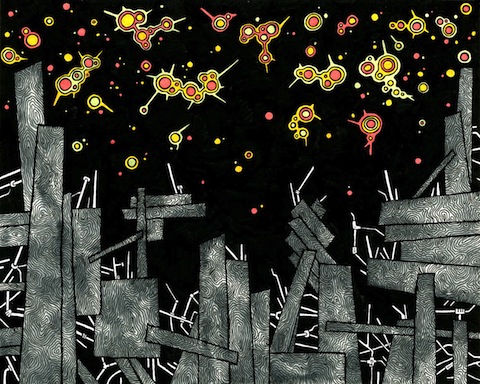
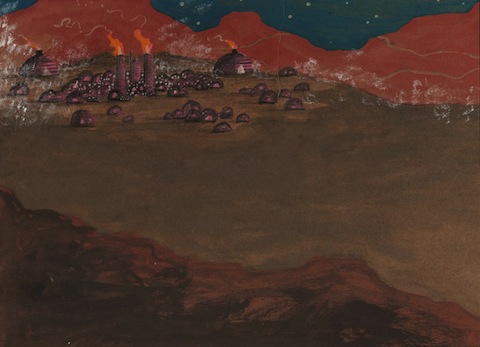
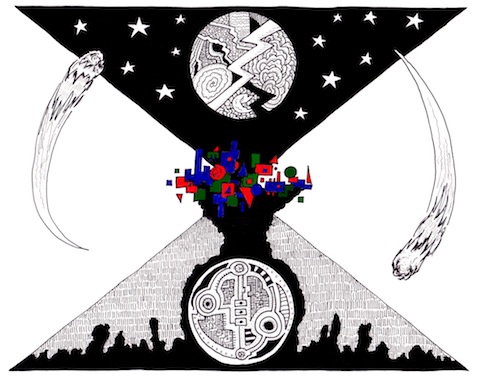
Playing on the bizarre nature of travelers’ tales and the imaginative excesses of exotic romances, Calvino’s novel abounds in delightful architectural absurdities and puzzling allegories, almost demanding to be illuminated like a medieval manuscript. Deciding to meet the challenge, artists Matt Kish, Leighton Connor, Joe Kuth began illustrating Invisible Cities in April of 2014. Their tumblr, Seeing Calvino, updates every Wednesday with a new interpretation of the novel’s many strange cities. At the top of the post, see “Thekla,” the “city forever under construction,” by Kish. Below it, Kuth’s imagining of “Irene,” the “name for a city in the distance, and if you approach it, it changes.” And just above, Connor’s interpretation of “Beersheba,” in which it is believed that “suspended in the heavens, there exists another Beersheba … They also believe, these inhabitants, that another Beersheba exists underground.”
Seeing Calvino isn’t Kish’s first foray into literary illustration. Previously, he undertook an illustration of every page of Melville’s Moby Dick, an impressive effort we featured last week. (Above, see another of his Invisible Cities pieces, “Adelma.”) Of the new, collaborative Calvino project, Kish tells us, “the episodic structure really appealed to us and we thought it was the perfect kind of thing to build a tumblr around and share with people.”
Invisible Cities has been fascinating to create… each of us brings a very different approach to the work. Joe’s Cities tend to be far more literal, realistic and representational, which I find kind of staggering because that is so difficult to do with Calvino. My illustrations are far more abstract and conceptual, trying to show in symbolic ways the ideas behind each chapter. Leighton falls somewhere between us on that spectrum, and his work has elements of realism and abstraction. None of us even talked about this before we started, we simply began independently (after settling on a rotation) and watched each other’s work evolve.
The three artists of Seeing Calvino have to date painted 45 of the 56 cities in Calvino’s novel. Kish has also illustrated Joseph Conrad’s Heart of Darkness, and his blog features many other graphic interpretations of literary and cinematic works. The Moby Dick project saw publication as a book in 2011. We can only hope that Calvino’s publisher sees the value of an Invisible Cities edition incorporating Kish, Kuth, and Connor’s illustrations.
Attention sulky art school students! Next time you’re stocking up on pre-smashed TVs, baby doll parts, riot cop stencils and mannequins, be sure to say hello to Shepard Fairey.
Fairey’s real, but the store, a brightly lit emporium catering to those seeking to make subversive statements with their art, is the invention of Fred Armisen and Carrie Brownstein’s Portlandia. (The full episode aired last week on IFC.)
Meanwhile, Fairey wins laughs by leaving the comedy to the comedians. Though I wouldn’t be surprised to learn that Shocking Art Supply employee Shepard F is an admirer of Henry Rollins. You can read all sorts of things into a performance that deadpan.
The segment was filmed in a Portland store where Fairey remembered purchasing art supplies a few years back. As he notes on his website:
I’m no actor, but this part, along with maybe “jaded art student” or “jaded skate shop employee,” are the closest I’ll ever get to method acting.
- Ayun Halliday is an author whose last sting in Portland involved making final edits to the Zinester’s Guide to NYC in a broken down vintage camper infested with flying ants. Follow her @AyunHalliday
This week, Rebecca Onion’s always interesting blog on Slate features historical maps that illustrate the toll measles took on America before the advent of vaccines. The map above brings you back to 1890, when measles-related deaths were concentrated in the South and the Midwest. That year, according to the U.S. census, 8,666 people died from the disease. Fast forward to the period moving from 1912 to 1916, and you’ll find that there were 53,00 measles-related deaths in the US.
America continued to struggle with the disease, until 1962, when scientists mercifully invented a vaccine, and the rate of measles infections and deaths began to plummet. The authors of “Measles Elimination in the United States,” published in The Journal of Infectious Diseases (2004),note that “Since 1997, the reported annual incidence [of measles] has been <1 case/1 million population” — meaning that the disease had been pretty much eradicated in the US. But not elsewhere. The authors go on to warn, “Measles is the greatest vaccine-preventable killer of children in the world today and the eighth leading cause of death among persons of all ages worldwide.” It doesn’t take much to deduce that if we dismiss the science that has served us so well, we could see dreadfully colored maps all over again. Except this time the dark orange will likely be concentrated on the left coast.
A hundred years before Sigmund Freud used himself as a test subject for his experiments with cocaine, another scientist, Humphry Davy, English chemist and future president of the Royal Society, began “a very radical bout of self experimentation to determine the effects of” another drug—nitrous oxide, better known as “laughing gas.” Davy’s findings — Researches, Chemical and Philosophical Chiefly Concerning Nitrous Oxide, or Diphlogisticated Nitrous Air, And Its Respiration By Humphry Davy—published in 1800, come to us via ThePublic Domain Review, who describe the 1799 experiments thus:
With his assistant Dr. Kinglake, he would heat crystals of ammonium nitrate, collect the gas released in a green oiled-silk bag, pass it through water vapour to remove impurities and then inhale it through a mouthpiece. The effects were superb. Of these first experiments he described giddiness, flushed cheeks, intense pleasure, and “sublime emotion connected with highly vivid ideas.”
Though we don’t typically think of nitrous oxide as an addictive substance, like Freud’s experiments, Davy’s progressed rapidly from curiosity to recreation: “He began to take the gas outside of laboratory conditions, returning alone for solitary sessions in the dark, inhaling huge amounts, ‘occupied only by an ideal existence,’ and also after drinking in the evening.” Fortunately for us, however, also like Freud, Davy “continued to be meticulous in his scientific records throughout.” Eventually, the twenty-year-old Davy constructed an “air-tight breathing box.” Sealing himself inside, writes Mike Jay, Davy had Dr. Kinglake “release twenty quarts of nitrous oxide every five minutes for as long as he could retain consciousness.”
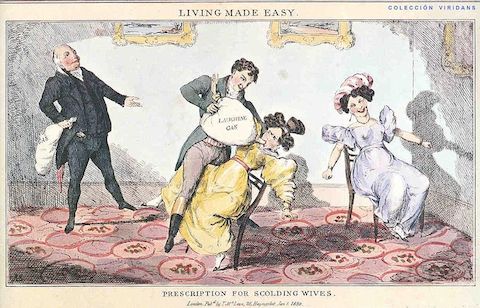
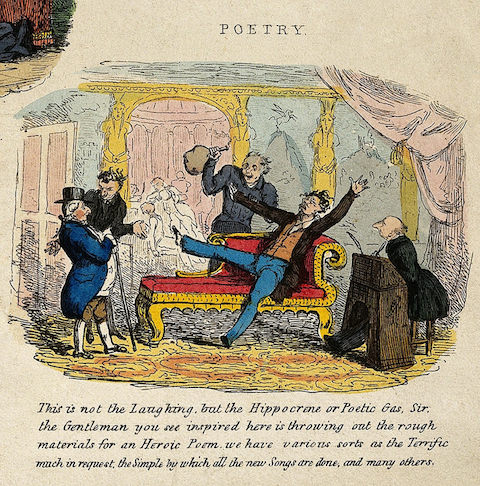
Also, like Freud’s use of cocaine, Davy’s research briefly led to a faddish recreational use of the drug, well into the early part of the nineteenth century, as you can see in the caricatures at the top and below, from 1830 and 1829, respectively. But despite what these humorous images suggest, “laughing gas” became known not only as a party drug, but also as a means of achieving heightened states of consciousness conducive to philosophical reflection and poetic creation (hence the “Philosophical” reference in the title of Davy’s research). During his own experiences “under the influence of the largest does of nitrous oxide anyone had ever taken,” Davy “’lost all connection with external things,’ and entered a self-enveloping realm of the senses,” writes Jay, finding himself “‘in a world of newly connected and modified ideas,’ where he could theorise without limits and make new discoveries at will.”
The appeal of this state to a scientist may be obvious, and to a poet even more so. Davy’s friend Robert Southey, the future Poet Laureate, became “as effusive” as Davy after taking the gas, exclaiming, “the atmosphere of the highest of all possible heavens must be composed of this gas.” In addition to Southey, Davy’s “freewheeling program of consciousness expansion… co-opted some of the most remarkable figures of his day”—including Samuel Taylor Coleridge, who is already well-known for finding some of his poetic inspiration under the influence of opium. Coleridge at the time had just published to great acclaim The Lyrical Ballads with William Wordsworth and had returned from a brief sojourn in Germany, where he had become heavily influenced by the German Idealist philosophy of Immanuel Kant and Friedrich Schelling.
Coleridge, who was “captivated by the young chemist” Davy, described his experience of taking nitrous oxide for the first time in very precise terms, avoiding the “extravagant metaphors” others tended to rely on. He recalled the sensations as resembling “that which I remember once to have experienced after returning from the snow into a warm room,” and, in a later trial, said he was “more violently acted upon” and that “towards the last I could not avoid, nor felt any wish to avoid, beating the ground with my feet; and after the mouthpiece was removed, I remained for a few seconds motionless, in great ecstacy.” Under the influence of both nitrous oxide and philosophical metaphysics, Coleridge had come to believe “the material world only an illusion projected by” the mind.
Davy, who fully endorsed this view, claiming “nothing exists but thoughts,” brought his “chaotic mélange of hedonism, heroism, poetry and philosophy” to heel in the “coherent and powerful” 580-page monograph above, which makes the case for laughing gas’s scientific and poetic worth. The report, writes Jay, combines “two mutually unintelligible languages—organic chemistry and subjective experience—to create a groundbreaking hybrid, a poetic science.” Like Freud’s use of cocaine or Timothy Leary’s experiments with LSD decades later, Davy’s experiments further demonstrate, perhaps, that the few times the sciences, philosophy, and poetry communicate with each other, it’s generally under the influence of mind-altering substances.
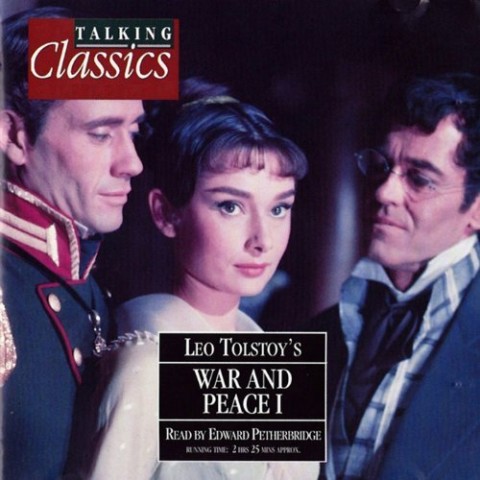
Where music goes, technologically speaking, audio books soon follow. We’ve had audio books on vinyl LP, on cassette tape, on CD, and on MP3, just like we’ve had music. Now that so many of us pull up our daily jams on Spotify, it shouldn’t come as a surprise that we can do a fair bit of our “reading” there as well. We’ve found a few lists that gather up the best audio book available on Spotify, including 21 classics and a collection of Shakespeare plays and sonnets at Gnarl’d, ten evergreen literary picks from Lifehacker, and a Spotify forum thread dedicated to subject.
Below, you’ll find Spotify links to more than 60 classic works of literature that, even if you struggled on getting them read in your English classes, you can now revisit in a perhaps much more lifestyle-compatible medium. If you find more audio books on Spotify, definitely let us know in the comments section below and we’ll add them to our list.
To listen to any of these, you will of course need Spotify’s software and account, both easy to come by: you just download and register.
We're hoping to rely on loyal readers, rather than erratic ads. Please click the Donate button and support Open Culture. You can use Paypal, Venmo, Patreon, even Crypto! We thank you!
Open Culture scours the web for the best educational media. We find the free courses and audio books you need, the language lessons & educational videos you want, and plenty of enlightenment in between.