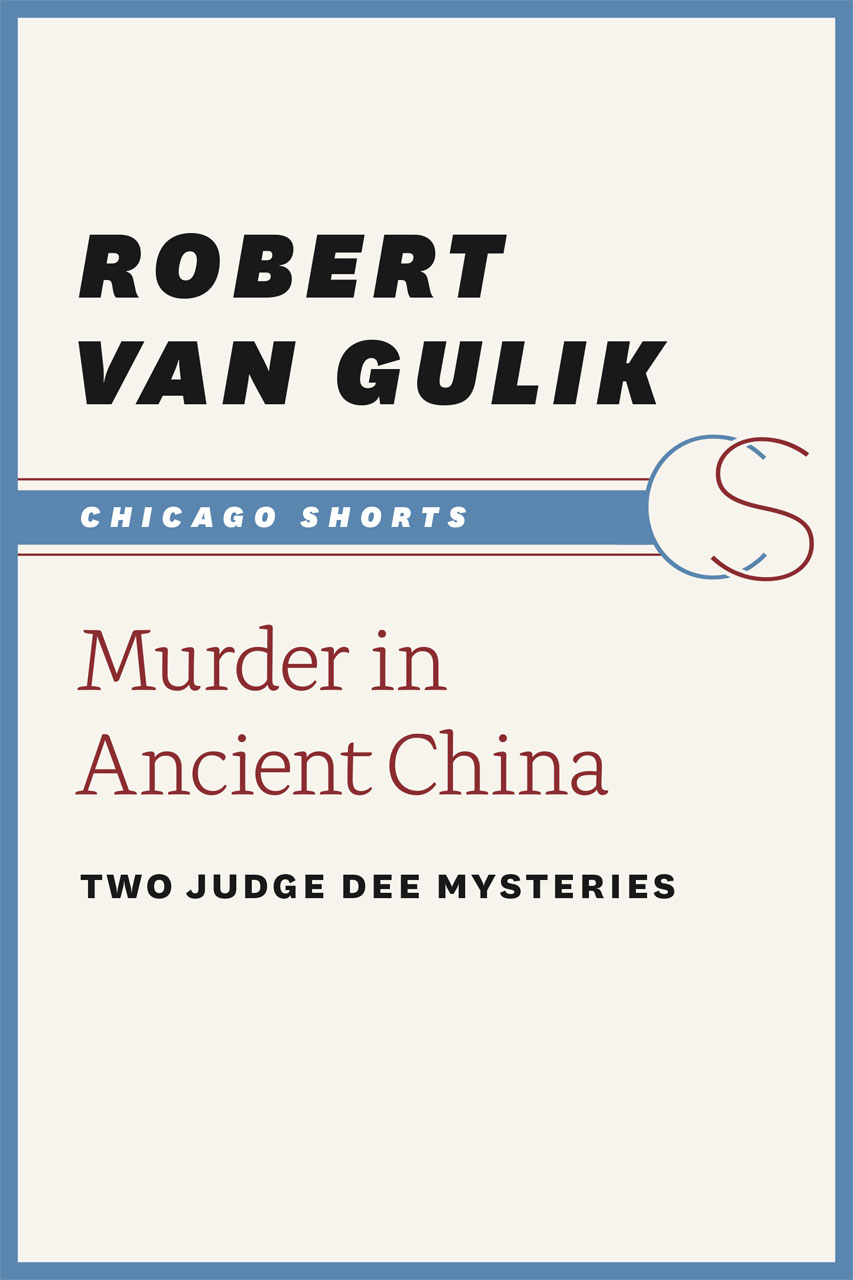
Here’s a little tip. Every month the University of Chicago Press lets you download a free ebook. If you go to this page, you can put your name on an email list and they’ll let you know when a new book is available. The current free book (for January 2014) is Murder in Ancient China by Robert Van Gulik. According to the press, the book is “available on our website DRM-free in your choice of an EPUB file (for most e‑reading devices, phones, and computers), as well as in a PRC file (for the Kindle). Or, you can get Murder in Ancient China free thoughout January at leading e‑book retailers, including in the Amazon Kindle store, at Apple iBooks, and at GooglePlay.”
The delay also affords those of us who live here ample time to stockpile the offending substance for future homemade musical instruments.
If you’re fretting over a relative lack of instrument building experience, relax.Three minutes is more than enough time for John Bertles, composer, arts educator and founder of Bash the Trash, to show you how you can make beautiful music from (mostly) scavenged materials. (Entirely scavenged, should you luck into a supply of giant rubber bands. I presume you have access to the more advanced version’s paper clips and leftover chopsticks. That alone justifies your soon-to-be Styro-free Panda Express delivery habit.)
If you’ve been building rubber band guitars since nursery school, Bertles’ video lesson still merits a listen, to hear how the sort of sounds practiced fingers are able to coax from these humble materials.
PS: Lest we get hung up on technicalities: Styrofoam is a trademarked polystyrene product of Dow Chemical. To quote Bertles, who has genuine claims on giving it a meaningful second life, “great material for building musical instruments…terrible for the earth.”
I’ve always had the impression of John Lennon as an aloof figure, and I’ve sometimes had difficulty reconciling the give peace a chance persona with the angry young man and his acid tongue. Motorhead’s Lemmy once called him “the asshole of the band,” saying, “if you read his books, he’s not the peace-loving nice guy that you heard about.” That may be partly true (his first wife Cynthia might agree), but it needn’t negate his ideals nor his activism and charity. Lennon was complicated, and probably not an easy person to get close to. On the other hand, he may be the most self-revealing of all the Beatles (literally). Perhaps—as Lennon says in voice-over narration above—his life, like his experimental 8mm films, was “self-edited.”
Though not shot by Lennon himself (and not technically “home movies” as the YouTube uploader describes them), the candid films above and below show a relaxed and playful Lennon at his 31st birthday party on October 9, 1971, goofing off with Yoko and several other well-known figures (the same day, an exhibition of Lennon and Ono’s art opened in Syracuse). Allen Ginsberg, Ringo Starr, and Phil Spector bob in and out of the shaky frame below.
Above, Miles Davis hangs out with the couple and plays basketball with Lennon. Keener eyes than mine may spot other legendary celebrities. Avant-garde filmmaker and onetime Warhol cameraman Jonas Mekas shot the footage, calling it “Happy Birthday to John.” Mekas describes the audio track as “a series of improvised songs, sung by John, Ringo, Yoko Ono, and their friends—not a clean studio recording, but as a birthday singing, free and happy.” In a 2002 interview, he conveyed his impressions of Lennon:
John was very open and curious, a very quick sort of person, who caught on immediately. He did a lot of 8mm filming himself. At the beginning of Happy Birthday John, you will hear him talking about what he was trying to do.
The above video brings together two things that few people of my generation can resist. The first hardly needs an introduction: at the risk of angering Coen Brothers fans with the comparison, their 1998 cult hit The Big Lebowski has generated at least as many endlessly quotable lines as Caddyshack did almost 20 years earlier, and it appeals to a similar contingent of slacker wiseasses. The movie gave Jeff Bridges—son of Lloyd, brother of Beau, and certainly a star in his own right before he played The Dude—the kind of cachet most actors only dream of. I’m not saying he wouldn’t have won his 2009 best actor Oscar for Crazy Heart without Lebowski, but I’m not saying that he would have either. And then, of course, there was the renewed interest in the “sport” of bowling, Hollywood weirdo and self-identified gun nut John Milius (who inspired John Goodman’s character), and the creamy vodka cocktail.
The second thing: the 8‑bit video games that, believe it or not, represented a revolution in home gaming, and gave us the first Nintendo and Sega systems and games that, true confession, used to keep me up all night, like the various versions of Megaman (which you can play online here). The games now have legendary status and their definitively colorful, blocky aesthetic has been—or was at least a few years ago—the ultimate in geek nostalgia chic, along with a new wave of “chiptune” music made with, or inspired by, the 8‑bit chips of the games of our youth. So what, I ask, could be more fun than bringing Lebowski and 8‑bit gaming together for a 3‑minute bowling game? Very little. As C‑Net describes the video above, it’s “an experience we only wish we’d had back in the 90’s.” Made by CineFix, who have previously animated Pulp Fiction, The Hunger Games, Blade Runner and a string of other hits as 8‑bit shorts, the 8‑Bit Cinema Big Lebowski isn’t actually playable, but it should be. Regardless, it’s as fun to watch as you might imagine a mash-up of the Coen Brothers and Super Mario World would be. Get your nostalgia on.
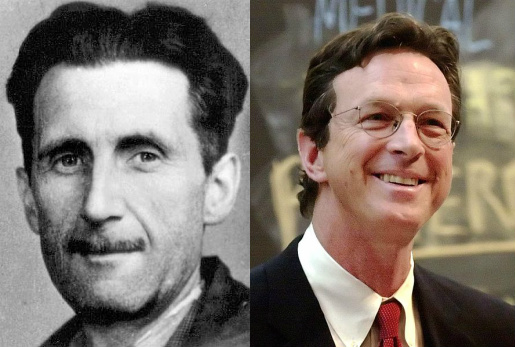
In his 2002 memoir, Travels, Michael Crichton took his readers back several decades, to the early 1960s when, as a Harvard student, he tried an interesting little experiment in his English class. He recalled:
I had gone to college planning to become a writer, but early on a scientific tendency appeared. In the English department at Harvard, my writing style was severely criticized and I was receiving grades of C or C+ on my papers. At eighteen, I was vain about my writing and felt it was Harvard, and not I, that was in error, so I decided to make an experiment. The next assignment was a paper on Gulliver’s Travels, and I remembered an essay by George Orwell that might fit. With some hesitation, I retyped Orwell’s essay and submitted it as my own. I hesitated because if I were caught for plagiarism I would be expelled; but I was pretty sure that my instructor was not only wrong about writing styles, but poorly read as well. In any case, George Orwell got a B- at Harvard, which convinced me that the English department was too difficult for me.
I decided to study anthropology instead. But I doubted my desire to continue as a graduate student in anthropology, so I began taking premed courses, just in case.
Most likely Crichton submitted Orwell’s essay 1946 essay, “Politics vs. Literature: An Examination of Gulliver’s Travels.” He eventually went to Harvard Medical School but kept writing on the side. Perhaps getting a grade just a shade below Orwell’s B- gave Crichton some bizarre confirmation that he could one day make it as a writer.
Follow Open Culture on Facebook and Twitter and share intelligent media with your friends. Or better yet, sign up for our daily email and get a daily dose of Open Culture in your inbox. And if you want to make sure that our posts definitely appear in your Facebook newsfeed, just follow these simple steps.
Looking for free, professionally-read audio books from Audible.com, including works by Crichton and Orwell? Here’s a great, no-strings-attached deal. If you start a 30 day free trial with Audible.com, you can download two free audio books of your choice. Get more details on the offer here.
Carl Sagan had his first religious experience at the age of five. Unsurprisingly, it was rooted in science. Sagan, then living in Brooklyn, had started pestering everyone around him about what stars were, and had grown frustrated by his inability to get a straight answer. Like the resourceful five-year-old that he was, the young Sagan took matters into his own hands and proceeded to the library:
“I went to the librarian and asked for a book about stars … And the answer was stunning. It was that the Sun was a star but really close. The stars were suns, but so far away they were just little points of light … The scale of the universe suddenly opened up to me. It was a kind of religious experience. There was a magnificence to it, a grandeur, a scale which has never left me. Never ever left me.”
This sense of universal wonder would eventually lead Sagan to become a well-known astronomer and cosmologist, as well as one of the 20th century’s most beloved science educators. Although he passed away in 1996, aged 62, Sagan’s legacy remains alive and well. This March, a reboot of his famed 1980 PBS show, Comos: A Personal Voyage, will appear on Fox, with the equally great science popularizer Neil DeGrasse Tyson taking Sagan’s role as host. Meanwhile, last November saw the opening of the Carl Sagan and Ann Druyan Archive at the Library of Congress.
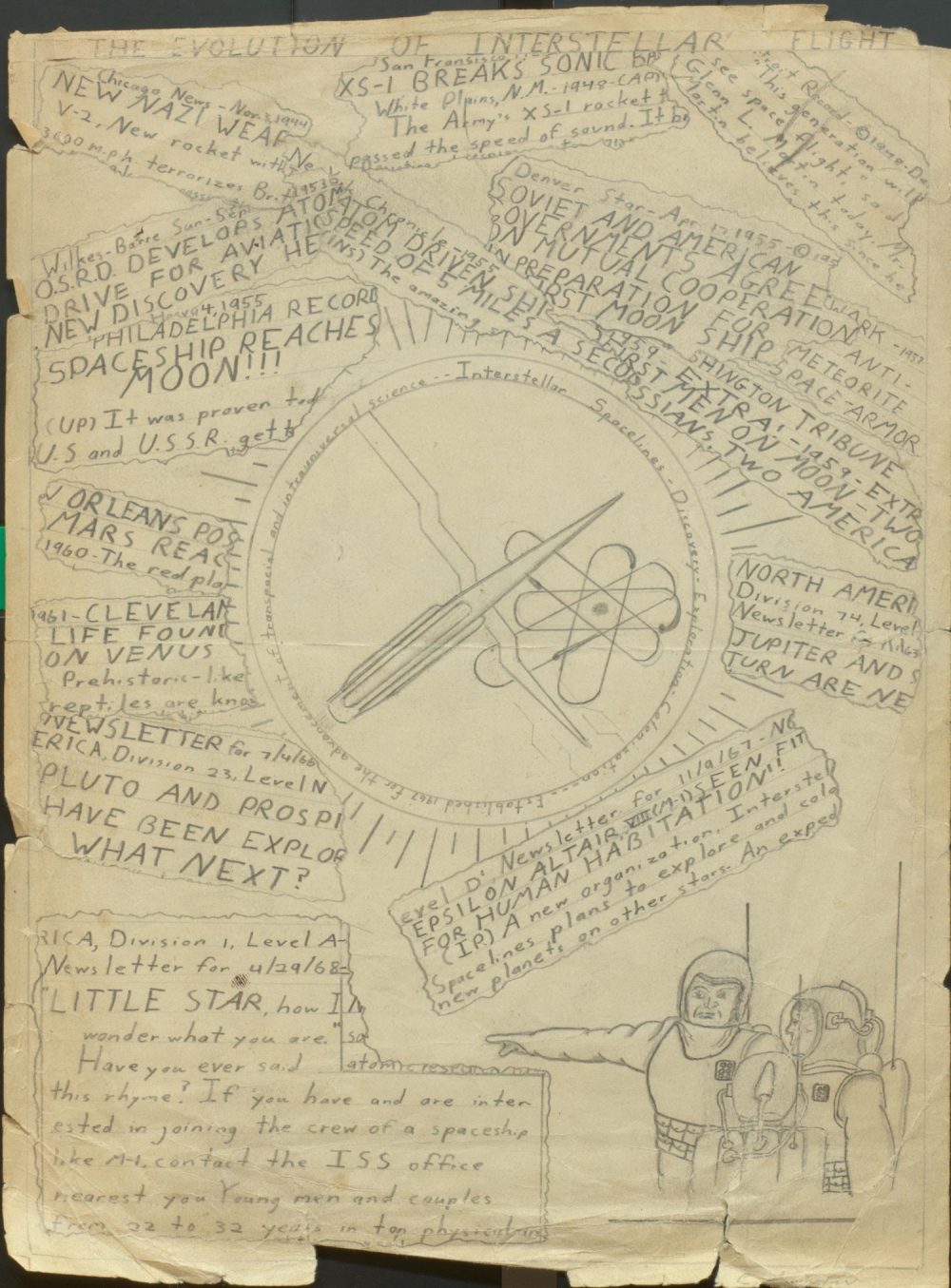
Among the papers in the archive was this sketch, titled “The Evolution of Interstellar Flight,” which Sagan drew between the ages of 10 and 13. In the center of the drawing Sagan pencilled the logo of Interstellar Spacelines, which, Sagan imagined, was “Established [in] 1967 for the advancement of transpacial and intrauniversal science.” Its motto? “Discovery –Exploration – Colonization.” Surrounding the logo, Sagan drew assorted newspaper clippings that he imagined could herald the key technological advancements in the space race. Impressively drawn astronauts in the corner aside, I most enjoyed the faux-clipping that read “LIFE FOUND ON VENUS: Prehistoric-like reptiles are…” Good luck containing your sense of wonder on seeing that.
Visionary director David Lynch has created some of the most terrifying, surreal images in cinema, from a dancing dream dwarf in Twin Peaks to that severed ear in a field in Blue Velvet. So he might seem like an unlikely choice to direct a series of commercials for Clear Blue Easy One Minute home pregnancy tests, but that’s exactly what he did in 1997.
The moody, black and white ad shows a nervous-looking woman waiting for the results of the test. In those agonizing moments, the face of her watch reads ‘yes’ and ‘no’ instead of numbers – reflecting her anxiety.
While this commercial might seem tame for Lynch, it is thematically similar to his other work. His early masterpiece Eraserheadis a bizzaro fever dream about the abject terror of parenthood.
“The client was a little nervous that the spot would be eerie and scary,” David Cohen, executive producer of the ad, said to Entertainment Weekly’s A.J. Jacob. “But on the set, Lynch was constantly making sure the client was happy.”
In fact, Lynch has had a whole second career as a commercial director, making ads for Nissan, PlayStation and one incredibly freaky PSA about the evils of littering. He also directed a surprisingly literary series of commercials for Calvin Klein using text penned by such luminaries as F. Scott Fitzgerald and D.H. Lawrence. We’ll post something about those next week.
Jonathan Crow is a Los Angeles-based writer and filmmaker whose work has appeared in Yahoo!, The Hollywood Reporter, and other publications. You can follow him at @jonccrow.
Allen Ginsberg died on April 5, 1997. Less than a week before, after the long terminally ill poet had made parting phone calls to nearly everyone in his address book, he wrote the poem above, “Things I’ll Not Do (Nostalgias).” He once called all his work extended biography, and we might call this particular work a piece of biography extended into speculation, comprising all the places (Tibet, Morocco, Los Angeles), people (composer Philip Glass, noted Tangier expat Paul Bowles, his own relatives), and things (attending concerts, teaching students, smoking various substances) he knew he would never experience again, or indeed for the first time — items left over, in short, from what we might now call Ginsberg’s bucket list. The transcript runs as follows:
Never go to Bulgaria, had a booklet & invitation
Same Albania, invited last year, privately by Lottery scammers or
recovering alcoholics,
Or enlightened poets of the antique land of Hades Gates
Nor visit Lhasa live in Hilton or Ngawang Gelek’s household & weary
ascend Potala
Nor ever return to Kashi “oldest continuously habited city in the world”
bathe in Ganges & sit again at Manikarnika ghat with Peter,
visit Lord Jagganath again in Puri, never back to Bibhum take
notes tales of Khaki B Baba
Or hear music festivals in Madras with Philip
Or enter to have Chai with older Sunil & Young coffeeshop poets,
Tie my head on a block in the Chinatown opium den, pass by Moslem
Hotel, its rooftop Tinsmith Street Choudui Chowh Nimtallah
Burning ground nor smoke ganja on the Hooghly
Nor the alleyways of Achmed’s Fez, nevermore drink mint tea at Soco
Chico, visit Paul B. in Tangiers
Or see the Sphinx in Desert at Sunrise or sunset, morn & dusk in the
desert
Ancient sollapsed Beirut, sad bombed Babylon & Ur of old, Syria’s
grim mysteries all Araby & Saudi Deserts, Yemen’s sprightly
folk,
Old opium tribal Afghanistan, Tibet — Templed Beluchistan
See Shangha again, nor cares of Dunhuang
Nor climb E. 12th Street’s stairway 3 flights again,
Nor go to literary Argentina, accompany Glass to Sao Paolo & live a
month in a flat Rio’s beaches and favella boys, Bahia’s great
Carnival
Nor more daydream of Bali, too far Adelaide’s festival to get new scent
sticks
Not see the new slums of Jakarta, mysterious Borneo forests & painted
men and women
Nor mor Sunset Boulevard, Melrose Avenue, Oz on Ocean Way
Old cousin Danny Leegant, memories of Aunt Edith in Santa Monica
No mor sweet summers with lovers, teaching Blake at naropa,
Mind Writing Slogans, new modern American Poetics, Williams
Kerouac Reznikoff Rakosi Corso Creely Orlovsky
Any visits to B’nai Israel graves of Buda, Aunt Rose, Harry Meltzer and
Aunt Clara, Father Louis
Not myself except in an urn of ashes
March 30, 1997, A.M.
Allen Ginsberg
As much of a final statement as it sounds like, “Things I’ll Not Do (Nostalgias)” remains, in a way, a work in progress, given the manuscript’s semi-decipherable hand. “Although many of his poems’ first drafts looked like this,” say the caretakers of AllenGinsberg.org, “if anything was unclear, we could just ask. That, obviously, wasn’t an option after April 5 that year.” Ten of Ginsberg’s associates passed the paper around, Google- and Wikipedialessly trying to piece together all of his characteristically far-flung references. The Caves of Dunhuang “went incorrectly transcribed for the first edition as ‘cares of Dunhuang’, since none of us were aware these were caves,” and “when we got to the ‘antique lands of Hades Necromanteion,” we couldn’t find a single reference to it anywhere, and in the end simply stated ‘Hades Gates.’ That’s how it’s published today — still. Till the next edition that is.”
In 1914, T.S. Eliot moved from his birth country, the United States, to England at the age of 25 and soon thereafter established himself as one of the most influential poets of this generation, writing some of the best known poems of the 20th century including The Love Song of J. Alfred Prufrock (1915), The Waste Land (1922) and The Hollow Men (1925).
Yet Eliot considered his Four Quartets cycle to be his finest. Published individually over the course of six years, the series consists of four poems – Burnt Norton (1936), East Coker (1940), The Dry Salvages (1941) and Little Gidding (1942) – that are profound mediations on time, the cosmos and the divine.
Eliot discussed the cycle with the Paris Review in 1959. “I’d like to feel that they get better as they go on. The second is better than the first, the third is better than the second, and the fourth is the best of all. At any rate, that’s the way I flatter myself.”
The BBC has produced an audio version of Eliot’s Four Quartets with none other than Oscar-winning actor Jeremy Irons serving as a reader. The video above is a clip of that reading, taken from Burnt Norton.
You can read along to Iron’s leonine narration:
Footfalls echo in the memory Down the passage which we did not take Towards the door we never opened Into the rose-garden. My words echo Thus, in your mind. But to what purpose Disturbing the dust on a bowl of rose-leaves I do not know. Other echoes Inhabit the garden. Shall we follow? Quick, said the bird, find them, find them, Round the corner. Through the first gate, Into our first world, shall we follow The deception of the thrush? Into our first world. There they were, dignified, invisible, Moving without pressure, over the dead leaves, In the autumn heat, through the vibrant air, And the bird called, in response to The unheard music hidden in the shrubbery, And the unseen eyebeam crossed, for the roses Had the look of flowers that are looked at. There they were as our guests, accepted and accepting. So we moved, and they, in a formal pattern, Along the empty alley, into the box circle, To look down into the drained pool. Dry the pool, dry concrete, brown edged, And the pool was filled with water out of sunlight, And the lotos rose, quietly, quietly, The surface glittered out of heart of light, And they were behind us, reflected in the pool. Then a cloud passed, and the pool was empty. Go, said the bird, for the leaves were full of children, Hidden excitedly, containing laughter. Go, go, go, said the bird: human kind Cannot bear very much reality.
The complete cycle read by Irons is on the BBC website for a limited time. (If you want to skip the program’s lengthy introduction, start at the 7:45 marker.)
And if you want to hear the Four Quartets read by T.S. Eliot himself, check out the video below. More readings can be found in our collection of Free Audio Books.
Jonathan Crow is a Los Angeles-based writer and filmmaker whose work has appeared in Yahoo!, The Hollywood Reporter, and other publications. You can follow him at @jonccrow.
Nelson Mandela, who passed away late last year, spent more than a quarter of his life in prisons. For the first twenty years, beginning with his 1962 incarceration in Johannesburg’s Marshall Square Prison when Mandela was 44 years old, there was little hope of clemency from the apartheid regime. By the 1980s, however, international pressure was bearing down on the reigning National Party. Multinational banks stopped investing in South Africa, and several of them, alongside British PM Margaret Thatcher, demanded that Mandela be released. Internally, the country’s tensions were becoming difficult to control, and the regime attempted to enforce order by declaring a state of emergency. The crackdown resulted in further anti-government attacks by the anti-apartheid African National Congress. Eventually, the pressure proved insurmountable, and the 72 year old Mandela was released from Victor Verster prison in 1990.
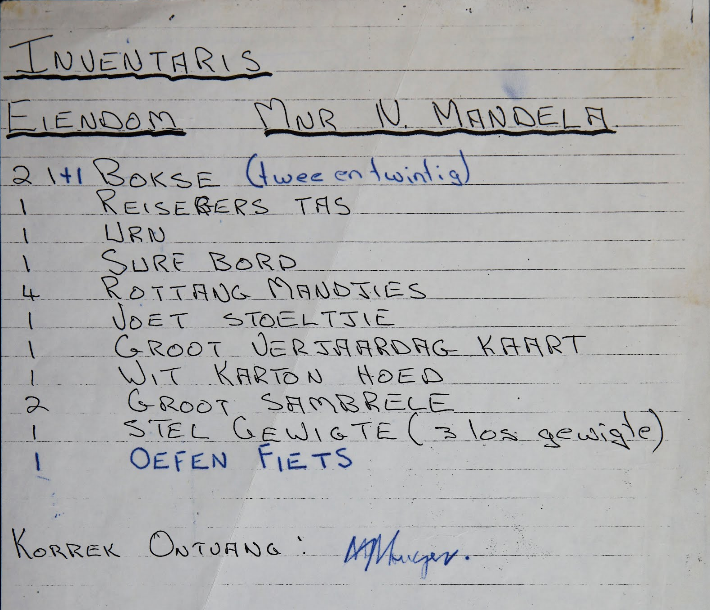
Upon walking out of Victor Verster, Mandela received the personal property he had relinquished during his time in jail. Above is a photograph of the handwritten list of his personal effects. (Click the image to read it in a larger format.) Our resident Afrikaans expert (i.e., Google Translate) provides an English translation below:
Inventory
Property Mr. Mandela
21 +1 boxes
1 Reisegers* Bag
1 Urn
1 Surf Board
4 Rattan Baskets
1 footstool
1 Large Birthday Card
1 White Cardboard Hat
2 Big Umbrellas
1 Set Weights
1 Exercise Bike
Correct Ontavang:* [illegible]
Urns and rattan baskets are all well and good, but I was most impressed that the great anti-apartheid leader counted an exercise bike and a set of weights among his possessions. Don’t even get me started on the surfboard. Then again, Mandela took his fitness more seriously than most during his lifetime, as he noted in his autobiography:
“I enjoyed the discipline and solitariness of long-distance running, which allowed me to escape from the hurly-burly of school life.”
“On Monday through Thursday, I would do stationary running in my cell in the morning for up to forty-five minutes. I would also perform one hundred fingertip push-ups, two hundred sit-ups, fifty deep knee-bends, and various other calisthenics.”
“Exercise was unusual for African men of my age and generation… I know that some of my younger comrades looked at me and said to themselves, ‘if that old man can do it, why can’t I?’ They too began to exercise.”
“I attended the gym for one and a half hours each evening from Monday through Thursday… We did an hour of exercise, some combination of roadwork, skipping rope, calisthenics, or shadow boxing, followed by fifteen minutes of body work, some weight lifting, and then sparring.”
And if you can help us figure out what “Reisegers bag” and “Correct Ontavang” mean and write the translation in the comment section, we’d appreciate it!
Ilia Blinderman is a Montreal-based culture and science writer. Follow him at @iliablinderman.
A few weeks ago, we featured George Orwell’s 1944 letter revealing the ideas that would lead him to write his still widely read, and even more widely assigned, novel/anti-authoritarian statement 1984. The book would come out five years later, in 1949, suggesting that Orwell worked at a pretty good clip to turn out a book of such high stature. Alas, he never lived to see it attain its current place in the culture, and barely even to see its publication. It turns out Orwell had to work faster than you may expect; beset by poor health in various manifestations, he had to finish off the novel’s manuscript, which he had then tentatively titled The Last Man in Europe, before his conditions finished him off. “I am not pleased with the book but I am not absolutely dissatisfied,” he wrote his agent of the rough draft. “I think it is a good idea but the execution would have been better if I had not written it under the influence of TB.”
That typically gray but hardy Blairian observation (as in Eric Arthur Blair, Orwell’s given name, taking into account that “Orwellian” has, owing to 1984, a meaning of its own) comes from Robert McCrum, writing in The Guardian of the author’s struggle to complete the book by the end of 1948. “It was a desperate race against time. Orwell’s health was deteriorating, the manuscript needed retyping, and the December deadline was looming.” Feeling beyond help, he “followed his ex-public schoolboy’s instincts: he would go it alone. [ … ] Sustained by endless roll-ups, pots of coffee, strong tea and the warmth of his paraffin heater, with gales buffeting [his borrowed house on a remote Scottish island] night and day, he struggled on. By 30 November 1948 it was virtually done.” On June 8th, the book appeared in England’s bookstores, met by acclaim from Winston Churchill himself on down. Orwell died on January 21, 1950, 64 years ago this past Monday.
Above, we’ve included images of 1984’s manuscript from GeorgeOrwellNovels.com (click on each for a larger version), and you can learn more about it at The Fiction Desk. Do consider giving a read — or, better yet, a re-read — to Orwell’s 1946 essay “Why I Write,” from which McCrum quotes to illuminate the writer’s drive to complete this harrowing final work: “Writing a book is a horrible, exhausting struggle, like a long bout of some painful illness. One would never undertake such a thing if one were not driven by some demon whom one can neither resist or understand.”
We're hoping to rely on loyal readers, rather than erratic ads. Please click the Donate button and support Open Culture. You can use Paypal, Venmo, Patreon, even Crypto! We thank you!
Open Culture scours the web for the best educational media. We find the free courses and audio books you need, the language lessons & educational videos you want, and plenty of enlightenment in between.