The site specific opera Invisible Cities is up and running at LA’s historic Union Station. Location aside, something in this original work demands that I subject it to the New York Magazine Approval Matrix I carry around in my mind. It’s a snarky, quadfurcated rating system for the latest trends and happenings.
The phrase “based on an Italo Calvino novel” should guarantee it a spot in the Highbrow range.
Opera purists might consider the fact that ticket holders must rely on wireless headphones to get the full sound mix as reason enough to send this innovative work to the Despicable end of a “deliberately oversimplified guide to who falls where on our taste hierarchies.” A philistine myself, I think matching wandering singers to an invisible live orchestra (they’re sequestered in a nearby room) sounds Brilliant. It’s as if a silent disco and a flash mob mated, giving birth to a baby with impervious street cred and an incredible set of pipes. Here, have a listen…
Unlike the typical Improv Everywhere lark, the audience here is in on this gag. Though innocent passersby may wonder why various individuals are mooning around the terminal singing, Invisible Cities is a ticketed performance. Indeed, its popularity is such that the producers have needed to add extra free shows. Approval Matrix suggests it’s time to hop a train to LA.
Ayun Halliday dreams that her opera-hating 13-year-old son will one day consent to attend another free dress rehearsal at the Met, so that she can chaperone. Follow her @AyunHalliday
Yes, Halloween is behind us, and some people may desire a break from the Lou Reed tributes in order to mourn him silently. Fair enough. But indulge us once more, because Reed’s best music and the dark imaginative work of Edgar Allan Poe are always relevant, and when they come together, it’s reason to celebrate. And come together they did ten years ago with the recording of Reed’s concept album The Raven, a selection of musical and dramatic pieces put together by Reed. The album notably features actors such as Willem Dafoe, Steve Buscemi, Elizabeth Ashley, and Amanda Plummer and guest artists like David Bowie, Kate and Anna McGarrigle, and Ornette Coleman.
The collaboration, if you can call it such, between Reed and Poe makes perfect sense. As Mark Deming at Allmusic writes, “it’s no wonder why Lou Reed regards Poe as a kindred spirit.” Reed said as much in the liner notes: “I have reread and rewritten Poe to ask the same questions again. Who am I? Why am I drawn to do what I should not? … Why do we love what we cannot have? Why do we have a passion for exactly the wrong thing?” Despite its collection of seemingly mismatched parts, Reed’s The Raven worked, Deming writes, and Reed hadn’t “sounded this committed and engaged” in “over a decade” (Pitchfork had a decidedly different take on the album).
The Raven was originally a commissioned work for a stage production called POEtry, an adaptation of Poe’s work by Robert Wilson (who had previously worked with Tom Waits on The Black Rider). The title recording of Reed’s adapted “The Raven” (top) is actually read by a creepy-voiced Willem Dafoe. Ten years later, we have Reed himself reading his version of “The Raven” (above) at Cannes just this past June. He looks and sounds rather frail, but he’s mentally in top form. He breaks into his own reading to point out the fact that his version of the poem uses Poe’s “exact rhythm.” “If you don’t believe me,” he says, “you can check it line-by-line.” And so you can. Read Reed’s “The Raven” against Poe’s original. Of his modernization, Reed said:
The language is difficult, because there are a lot of arcane words that probably no one knew that they meant, even at the time – architectural terms and whatnot. So I spent a lot of time with the dictionary, to make it more contemporary, easy to read. Or easier, I should say.
The Reed/Poe/Robert Wilson collaboration also produced a 2011 book, also called The Raven and illustrated by artist Lorenzo Mattotti.
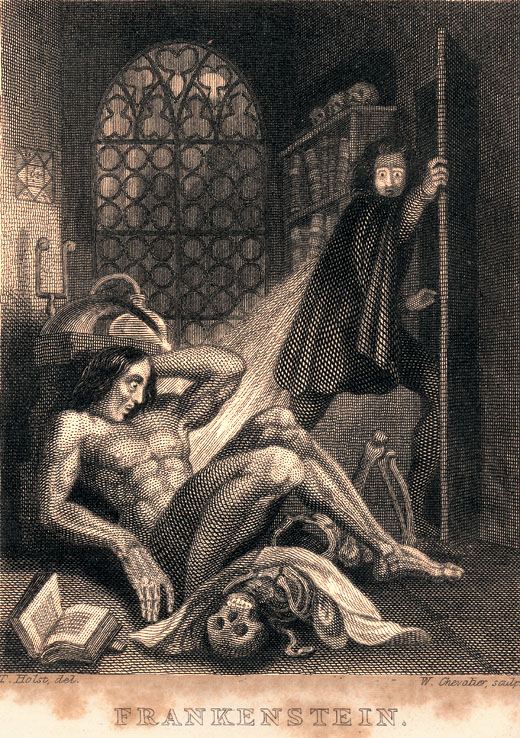
The story behind the writing of Frankenstein is famous. In 1816, Mary Shelley and Percy Bysshe Shelley, summering near Lake Geneva in Switzerland, were challenged by Lord Byron to take part in a competition to write a frightening tale. Mary, only 18 years old, later had a waking dream of sorts where she imagined the premise of her book:
When I placed my head on my pillow, I did not sleep, nor could I be said to think. My imagination, unbidden, possessed and guided me, gifting the successive images that arose in my mind with a vividness far beyond the usual bounds of reverie. I saw — with shut eyes, but acute mental vision, — I saw the pale student of unhallowed arts kneeling beside the thing he had put together. I saw the hideous phantasm of a man stretched out, and then, on the working of some powerful engine, show signs of life, and stir with an uneasy, half vital motion.
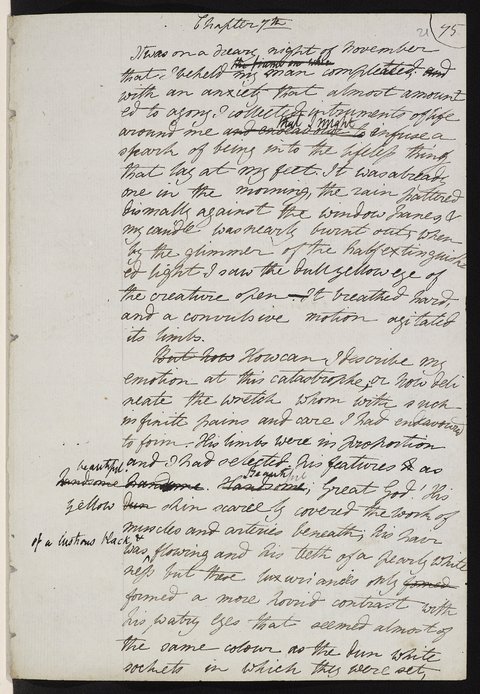
This became the kernel of Frankenstein; or, The Modern Prometheus, the novel first published in London in 1818, with only 500 copies put in circulation. In writing Frankenstein, Shelley used a series of notebooks that “can now be viewed in high quality, resizable page images.” Each hand-written page comes accompanied by a typed transcript. Find them all here.
Down the line, the Shelley-Godwin Archive “will provide the digitized manuscripts of Percy Bysshe Shelley, Mary Wollstonecraft Shelley, William Godwin, and Mary Wollstonecraft, bringing together online for the first time ever the widely dispersed handwritten legacy of this uniquely gifted family of writers.” So stay tuned for more.
Note: The Archive recommends using recent versions of Google’s Chrome browser or the latest version of Safari or Mozilla Firefox when viewing the manuscripts.
Six students from De Montfort University have created a stellar 3D representation of 17th century London, as it existed before The Great Fire of 1666. The three-minute video provides a realistic animation of Tudor London, and particularly a section called Pudding Lane where the fire started. As Londonist notes, “Although most of the buildings are conjectural, the students used a realistic street pattern [taken from historical maps] and even included the hanging signs of genuine inns and businesses” mentioned in diaries from the period.
Commenting on the video, one judge from the esteemed British Library had this to say:
Some of these vistas would not look at all out of place as special effects in a Hollywood studio production. The haze effect lying over the city is brilliant, and great attention has been given to key features of London Bridge, the wooden structure of Queenshithe on the river, even the glittering window casements. I’m really pleased that the Pudding Lane team was able to repurpose some of the maps from the British Library’s amazing map collection – a storehouse of virtual worlds – in such a considered way.
Follow Open Culture on Facebook and Twitter and share intelligent media with your friends. Or better yet, sign up for our daily email and get a daily dose of Open Culture in your inbox. And if you want to make sure that our posts definitely appear in your Facebook newsfeed, just follow these simple steps.
Back in college, I took a fall-quarter introductory music course. We happened to have class on Halloween (an event quite seriously taken around the University of California, Santa Barbara, in case you didn’t know), and the professor held an especially memorable lecture that day. He had us study “Der Erlkönig,” music by Franz Schubert, words by none other than Johann Wolfgang von Goethe. While I will not claim that this tale of the haunting of a moribund child, even with its driving score, genuinely frightened me, I will say that it put the fear into me in a more existential way, a blow which only a simple story can land effectively.
“Who rides, so late, through night and wind?” asks Goethe’s poem, translated from the German. “It is the father with his child. He has the boy well in his arm. He holds him safely, he keeps him warm.” The man feels concern for his ailing son, but the boy has troubles of his own: “Father, do you not see the Erlking?” The father explains his son’s vision of this menacingly regal figure away as the fog, as the wind, as the trees. But the child insists: “My father, my father, he’s grabbing me now! The Erlking has done me harm!” By the time their horse reaches home, indeed, the Erlking — or some obscure agent of mortality — has him. Hear this fable sung, and watch it vividly animated with sand on glass (no doubt a painstaking process) by Ben Zelkowicz above. Halloween itself may have just passed, but “Der Erlkönig” remains timelessly haunting.
We’ll add “Der Erlkönig” to the Animation section of our collection of Free Movies Online.
There was lots of money to be made at the end of the 19th century and Dudley Docker made his share of it. He was what they called a “baron of industry” at a time when manufacturing was exploding in Britain. Docker made his fortune in paint, motorcycles, arms manufacturing, railways, and banking. He was an industrial booster, acting as one of the three major financiers behind Ernest Shackleton’s Trans-Antarctic Expedition. In 1916, he founded a major association of British industry to promote business interests.
A charming result of that work is a recently digitized film made in 1925 to demonstrate the work inside Oxford University Press. For book arts lovers, this is a fascinating peek into the early days of mechanized printing.
Above we watch a worker use a mould to make lead type, hundreds of them, by pouring the molten lead in at the top, making a quick upward motion and releasing the quickly dried type. A separate team of workers then sets up monotype composing machines, and we watch as men demonstrate their use.
The film follows the process of printing a run of Oxford English Dictionaries. Books were bound by gender-divided teams: A room of women labored in the “girls” bindery section while men bound books in their own separate room. We see the sewing, cutting and the fascinating process of gilding the page edges.
In our digital age, the old analog processes take on a new, deeper significance. This film presents a terrific 18-minute tutorial on one of the greatest achievements of the modern age: printing mass quantities of bound books.
With the possible exception of Beyonce as Etta James in Cadillac Records, no onscreen portrayal of a female jazz singer tops Diana Ross as Billie Holiday in Lady Sings the Blues. She is so mesmerizing, in fact, that it’s easy to forget, if you haven’t seen the movie recently, that Ross is flanked by two other excellent performers in Billy Dee Williams as Louis McKay, a composite stand-in for Holiday’s three husbands, and Richard Pryor as the “Piano Man,” Ross’s accompanist. It was a role that “propelled him into stardom” and kept Pryor out in front of an audience as a movie actor. Watch a clip from the film below, with Ross’s Holiday and Pryor’s surly Piano Man together at 3:39.
Odd as it seems that a dramatic role would be Pryor’s breakout performance, unexpected still perhaps is the video at the top of Pryor singing the blues himself. None of his raunchy or self-deprecating wit here, just a genuine, heartfelt rendition of Jimmy Cox’s 1924 “Nobody Knows You When You’re Down and Out.” According to eOne Music’s Eric Alper, Pryor not only started performing comedy after he moved to New York City in 1963, he also sang, opening for such soon-to-be-greats as Nina Simone and Bob Dylan. Pryor in fact got his start on the club circuit as a drummer, so “he was familiar with the scene.” Movies.com recounts a poignant story from Simone’s autobiography about Pryor’s intense stage fright before one of these early gigs:
He shook like he had malaria, he was so nervous. I couldn’t bear to watch him shiver so I put my arms around him there in the dark and rocked him like a baby until he calmed down. The next night was the same, and the next, and I rocked him each time.
As a singer, Pryor doesn’t channel and focus his anxiety so much as he slowly masters it, appearing a little stiff at first but eventually knocking it out with a surprisingly good performance that well deserves a listen. The provenance of the clip isn’t exactly clear, and some intro material marks it as part of a documentary, maybe. Please weigh in if you know or suspect the film clip’s source.
Ah, the ancient art of rhetoric. There’s no escaping it. Variously defined as “the art of argumentation and discourse” or, by Aristotle in his fragmented treatise, as “the means of persuasion [that] could be found in the matter itself; and then stylistic arrangement,” rhetoric is complicated. Aristotle’s definition further breaks down into three distinct types, and he illustrates each with literary examples. And if you’ve ever picked up a rhetorical guide—ancient, medieval, or modern—you’ll be familiar with the lists of hundreds of unpronounceable Greek or Latin terms, each one corresponding to some quirky figure of speech.
Well, as usual, the internet provides us with an easier way in the form of the video above of 10 figures of speech “as illustrated by Monty Python’s Flying Circus,” one of the most literate of popular artifacts to ever appear on television. There’s “paradiastole,” the fancy term for euphemism, demonstrated by John Cleese’s overly decorous newscaster. There’s “epanorthosis,” or “immediate and emphatic self-correction, often following a slip of the tongue,” which Eric Idle overdoes in splendid fashion. Every possible poetic figure or grammatical tic seems to have been named and catalogued by those philosophically resourceful Greeks and Romans. And it’s likely that the Pythons have utilized them all. I await a follow-up video in lieu of reading any more rhetorical textbooks.
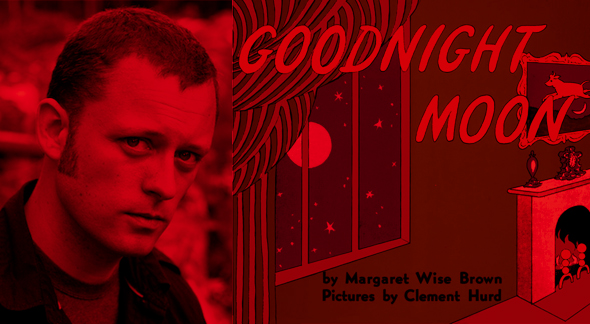
Is this wrong? Benjamin Percy (author of the werewolf thriller Red Moon) takes the sweet children’s bedtime story, Goodnight Moonby Margaret Wise Brown, and turns it into a story that will keep kids (and maybe adults) awake for days on end — perhaps leaving parents no choice but to have the real Werner Herzog read Go the F**k to Sleep. This recording comes courtesy ofGraywolf Press, and don’t forget to look under your bed.
American movie stars have long found work across the pacific in Japanese television commercials: Nicolas Cage, Paul Newman, Dennis Hopper, Harrison Ford, Jodie Foster — the list goes on. If their spots aired stateside, we’d probably buy what they sell too, but celebrities in their image-protective league have thus far shown a reluctance to endorse products in their own country. Japan’s ad industry hasn’t only sought the participation of America’s big-name actors, though; it’s also gone after the directors. At the top, you’ll see one featuring a filmmaker never afraid of exposure: Pulp Fiction auteur Quentin Tarantino taking a turn in local costume (and alongside a talking dog) in a commercial for Japanese cell phone service provider Softbank. Just below, we have Orson Welles, he of Citizen Kane and British frozen-peas narration alike, in a spot for G&G Whisky.
“I direct films and act in them,” Welles says by way of introduction. “What we’re always trying for is perfection, but of course, that’s only a hope. But with G&G, you can rely on it.” It may put you in the mind of Sofia Coppola’s Lost in Translation, wherein Bill Murray’s character famously turns up in Japan to shoot a whisky commercial of his own. Makers of that beverage have shown quite an interest in the imprimatur of cinema’s luminaries, Eastern as well as Western.
We’ve previously featured a Suntory commercial including not just The Gofather and Apocalypse Now director Francis Ford Coppola, but Akira Kurosawa, the maker of Rashomon and Seven Samurai, known in his homeland as “the Emperor.” It makes you wonder: do we in America know our directors well enough that they could sell us things? Then again, the Japanese did enjoy all those old Woody Allen Seibu spots when most of them still hadn’t a clue about the beloved filmmaker’s identity.
I am of the rather uncontroversial opinion that any marriage is what any two people make of it themselves. I’m also of the opinion that no matter how many people may publicly disagree with that idea, in private, people make their own rules. Nonetheless, the less outspoken among us often respond to moralists and scolds in our lives with the live-and-let live attitude expressed by a character in E.M. Forster’s Where Angels Fear to Tread: “Let Philip say what he likes, and he will let us do what we like.”
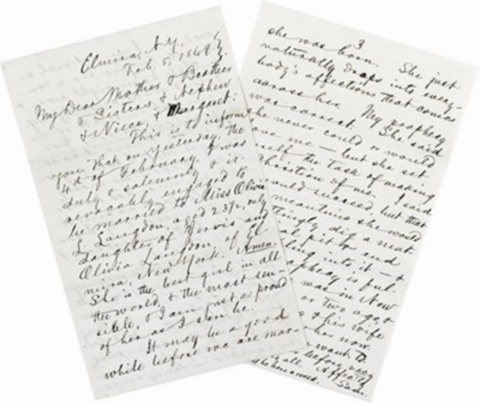
Such passive-aggressive arrangements can be alienating, an opinion Mark Twain seemed to hold when he announced to his family the upcoming nuptials to his future wife of 34 years, Olivia Langdon. In a display of what Booktryst calls “the sort of sentiment deeply appreciated by a prospective spouse,” Twain wrote his family in 1869 to tell them the news, and he tried to win them over. His announcement is a “gushing, self-deprecating declaration of intent.” One, moreover, that presumes his audience’s contrariness. The then 34-year-old Twain anticipates and addresses what seems his family’s primary objection to his marriage in general: he details his financial plans and expresses his intention to proceed “unaided.”
Twain then mounts his best persuasive case to sway his readers—Mother & Brother & Sisters & Nephew & Niece, & Margaret—in Langdon’s favor. He says that everyone who knows her “naturally” loves her. He also goes so far as to say that Langdon “set herself the task of making a Christian of me” and that “she would succeed.” Anyone who knows Twain’s attitudes toward religion, and Christianity in particular, may see some hyperbole, or even disingenuousness, here, but perhaps it’s a sincere expression of how far he was willing to go for the woman who stood by his side as he lost his fortune and hers in scheme after failed get-rich-quick scheme. As Booktryst nicely puts it, “Aside from pen & paper, the only investment that ever paid off for him was his effort to win the heart of Olivia Langdon.”
This is to inform you that on yesterday, the 4th of February, I was duly & solemnly & irrevocably engaged to be married to Miss Olivia L. Langdon, of Elmira, New York. Amen. She is the best girl in all the world, & the most sensible, & I am just as proud of her as I can be.
It may be a good while before we are married, for I am not rich enough to give her a comfortable home right away, & I don’t want anybody’s help. I can get an eighth of the Cleveland Herald for $25,000, & have it so arranged that I can pay for it as I earn the money with my unaided hands. I shall look around a little more, & if I can do no better elsewhere, I shall take it.
I am not worrying about whether you will love my future wife or not—if you know her twenty-four hours & then don’t love her, you will accomplish what nobody else has ever succeeded in doing since she was born. She just naturally drops into everybody’s affections that comes across her. My prophecy was correct. She said she never could or would love me—but she set herself the task of making a Christian of me. I said she would succeed, but that in the meantime she would unwittingly dig a matrimonial pit & end up tumbling into it—& lo! the prophecy is fulfilled. She was in New York a day or two ago, & George Wiley & his wife Clara know her now. Pump them, if you want to. You shall see her before very long.
We're hoping to rely on loyal readers, rather than erratic ads. Please click the Donate button and support Open Culture. You can use Paypal, Venmo, Patreon, even Crypto! We thank you!
Open Culture scours the web for the best educational media. We find the free courses and audio books you need, the language lessons & educational videos you want, and plenty of enlightenment in between.