Maintaining the balance of power among European states has always been a fraught affair, but it was especially so in the years when mercantilism made fragile alliances during the religious wars of the 17th century. This was a time when merchants made excellent diplomats, not only because they traveled extensively and learned foreign tongues and customs, but because they spoke the universal language of trade.
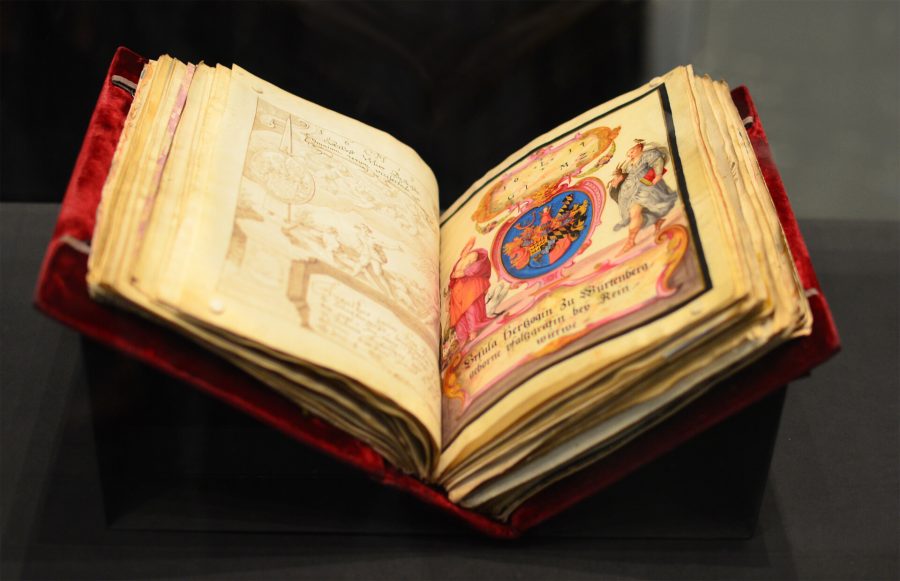
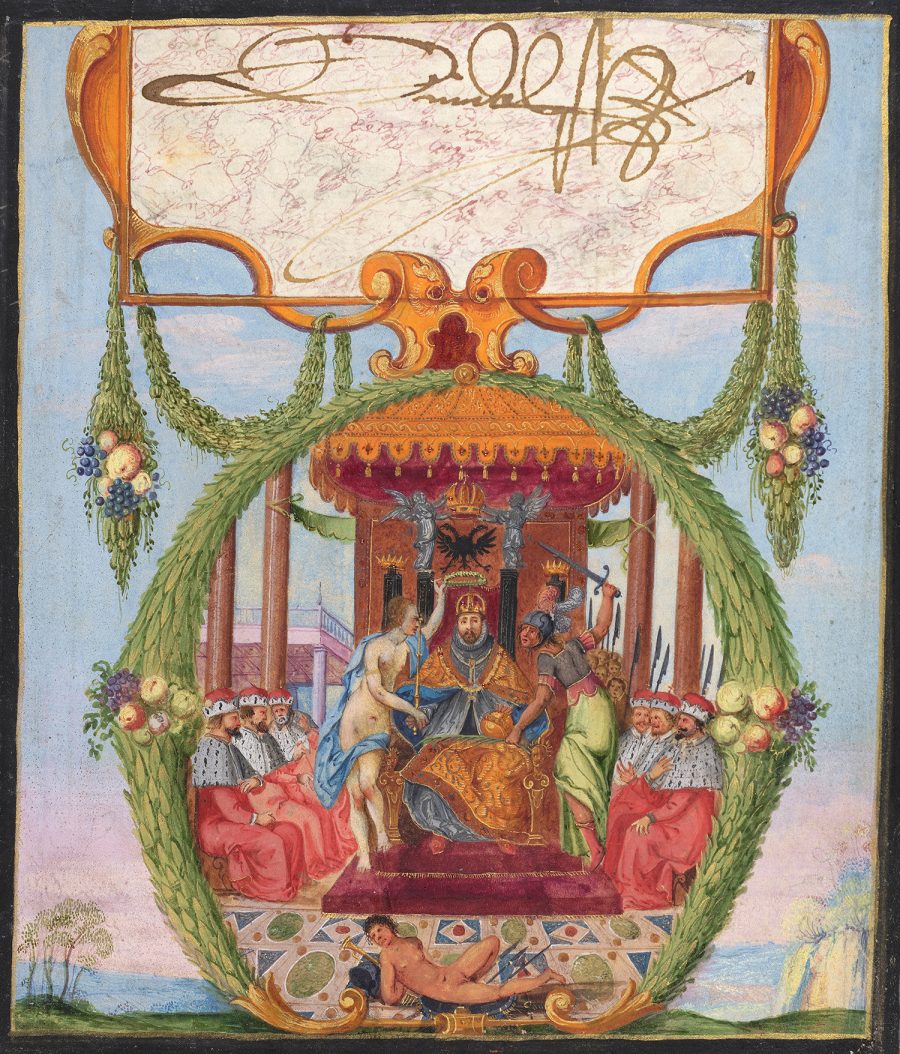
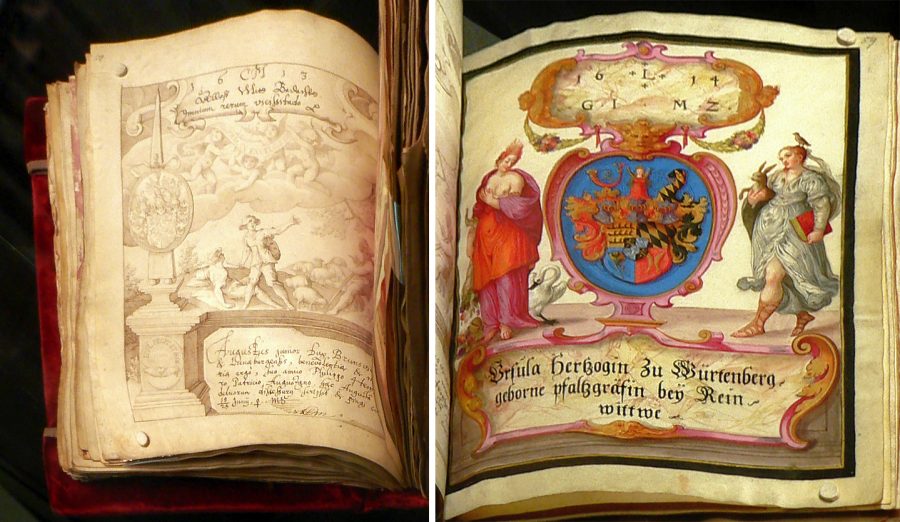
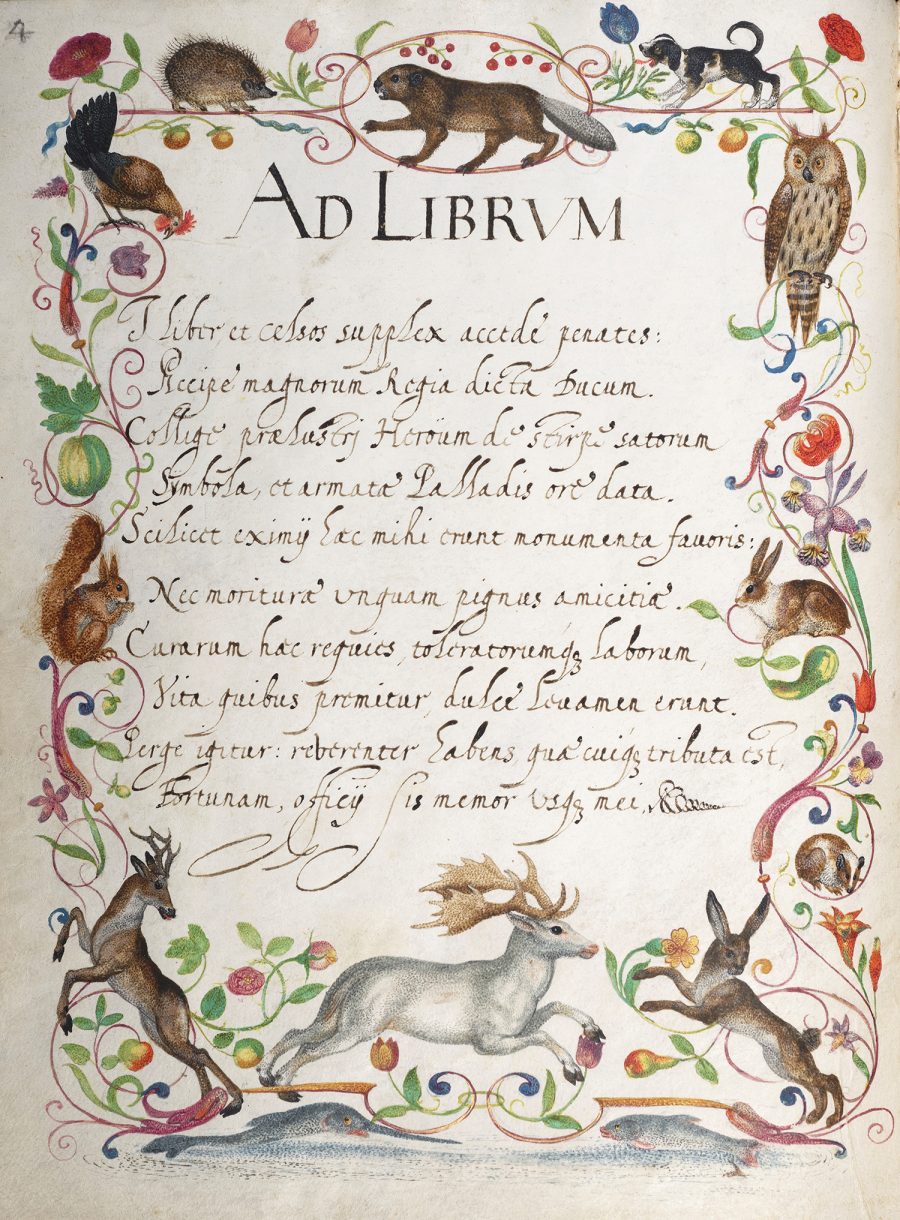
German merchant and diplomat Philipp Hainhofer from Augsburg was such a figure, traveling from court to court to meet with Europe’s renowned dignitaries. As he did so, he would ask them to sign his album amicorum, or “friendship book,” also called a stammbuch. Each signer would then “commission an artist to create a painting accompanying their signatures,” Alison Flood writes at The Guardian.
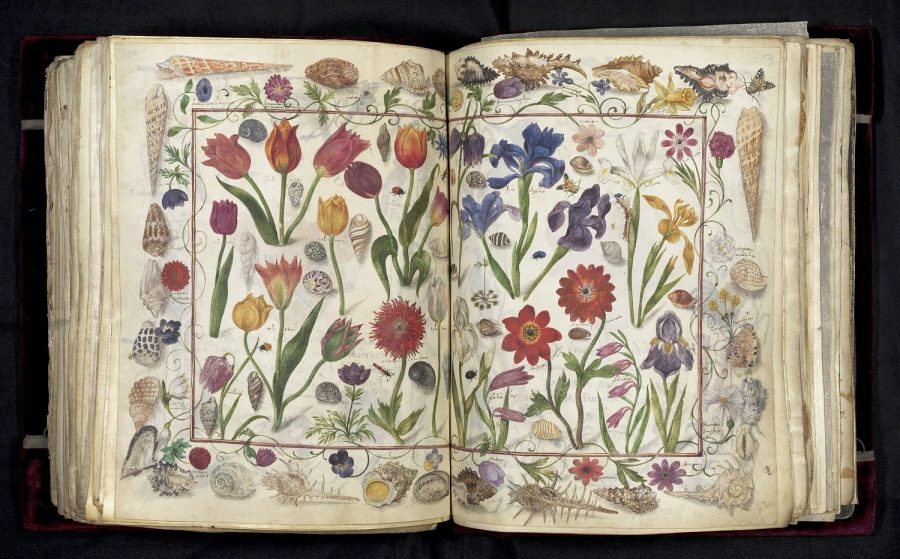
“There are around 100 drawings” in his autograph book, known as the Große Stammbuch, “which took more than 50 years to compile.” After Hainhofer’s death in 1647, his friend August the Younger—who helped collect the hundreds of thousand of books in the Herzog August Bibliothek—tried to acquire the book but failed. Now it has finally landed in the huge library, one of the world’s oldest, almost 400 years later, after a purchase at a private auction this week.
Friendship books were commonly used at the time to record the names of family and friends. Students used them as yearbooks, and Hainhofer began his collection of signatures as a college student. He gradually gained a select clientele as his career advanced. Signatories, the History Blog points out, “include Holy Roman Emperor Rudolf II, another HRE Matthias, Christian IV of Denmark and Norway, Cosimo II de’Medici, Grand Duke of Tuscany…” and many others.
Hainhofer’s Große Stammbuch is, as you can see, a beautiful work of art—or almost 100 collected works of art—in its own right. “The elaborateness of the illustrations directly corresponds to the signatory’s status and rank in society,” as Grace Ebert notes at Colossal. It is also a fascinating record of Early Modern European politics, trade, and diplomacy, a fine art all its own.
Can you remember when you last visited a museum? Even if you didn’t much care for them before the time of the coronavirus, you’re probably beginning to miss them right about now. At least the internet technology that has kept our communication open and our entertainment flowing — and, regrettably for some, kept our work meetings regular — has also made it possible to experience art institutions through our screens. Here on Open Culture we’ve previously featured many such online art spaces, digital gallery experiences, and virtual museum tours, and today we’ve rounded up some of the best for you.
Most everyone who had a trip to France scheduled for this spring or summer will have canceled it. But thanks to these three high-definition, first-person videos, you can still tour the Louvre, Liberty Leading the People, the Venus de Milo, the Mona Lisa, and even I.M. Pei’s rooftop pyramid and all. Perhaps you’d planned to spend part of 2020 traveling Europe more widely, in which case you’d almost certainly have gone to Italy and seen Forence’s Uffizi Gallery as well. Luckily, that most famous collection of Renaissance art has gone digital with a complete “street view” tour as well as an archive of 3D sculpture scans.
Of course, no art-oriented trip to Italy would be well spent only in galleries and museums: it would also have to include St. Peter’s Basilica, the Sistine Chapel, and other sacred spaces of the Vatican, in whose virtual versions you can now spend as long as you like. And while some tourists in Europe face time or money constraints too tight to allow visits to smaller countries like the Netherlands, internet travel is subject to no such limitations. So go ahead and take a seven-part tour of the Van Gogh Museum in 4K, or have a look at Rembrandt’s The Night Watch down to every last brushstroke.
The ongoing pandemic having put a temporary stop to not just most travel to Europe but most international travel of any kind, hopeful travelers to and within North America have also been forced to change their plans. If this describes you, consider taking a virtual tour of the Smithsonian National Museum of Natural History, Frank Lloyd Wright’s studio Taliesin, or the Frida Kahlo Museum in Mexico City. But while you’re online, why not mount an even more ambitious worldwide art journey: to the Hermitage in Russia, the Ghibli Museum in Japan, and street art (as well as stolen art) from all over? It’s a big world of art out there — something we can’t let ourselves forget before we can see it in person again.
Based in Seoul, Colin Marshall writes and broadcasts on cities, language, and culture. His projects include the book The Stateless City: a Walk through 21st-Century Los Angeles and the video series The City in Cinema. Follow him on Twitter at @colinmarshall, on Facebook, or on Instagram.
The burial rites of ancient and exotic peoples can seem outlandish to us, but there’s nothing particularly normal about the funeral traditions in the United States and the UK, where corpses are sent off to professional undertakers and made to look alive before they’re sealed in boxes and buried or turned into piles of ash.
Andrea DenHoed at The New Yorker refers to the practice of Tibetan Buddhist sky burials, in which “bodies are ritually dissected and left in the open to be consumed by vultures” and of the Torajans of Indonesia, who “have a ritual called Ma’Nene, in which bodies are disinterred, dressed in new clothes, and carried in a parade around the village.” These rites seem almost to mock our western fears of death.
Innovations on the funeral displace us further from the body. DenHoed writes, in 2016, of the then-relatively rare experience of attending a funeral over Skype, now commonplace by virtue of bleak necessity. It’s hard to say if high-tech mourning rituals like turning human remains into playable vinyl records brings us closer to accepting dead bodies, but they certainly bring us closer to an ancestral prehistoric past when at least some Bronze Age Britons turned the bones of their dead into musical instruments.
What’s that now? Through radiocarbon-dating, the researchers, in other words, were able to determine that ancient people who lived between 2500–600 BC “were keeping and curating body parts, bones and cremated remains” of people they knew well, sometimes exhuming and ritually re-burying the remains in their homes, or just keeping them around for a couple generations.
“It’s indicative of a broader mindset where the line between the living and the dead was more blurred than it is today,” Booth tells The Guardian. “There wasn’t a mindset that human remains go in the ground and you forget about them. They were always present among the living.” This is hardly strange. The incredible amount of loss people will feel after COVID-19 will likely bring a proliferation of such rituals.
The find making headlines is a human thigh bone “that had been carved into a whistle” Josh Davis writes at the British Natural History Museum, and buried with another adult male. “When dated, it revealed that the thigh bone came from a person who probably lived around the same date as the man that it was buried with, meaning it is likely that it was someone that they knew in life, or were fairly close to.”
There doesn’t seem to be any suggestion that this was a common or widespread practice, but it’s not that dissimilar to wearing the remains of the dead as jewelry. “The Romans did it,” notes Glenn McDonald at National Geographic, “The Persians did it. The Maya did it.” And the Victorians, also, wore the remains of their dead, 4,000 years after their ancient ancestors. “The technologies change,” says McDonald, “but the basic human experience” of death, loss, and mourning remains the same.
There are so many origin stories of punk that no single history can count as definitive. But there’s also no disputing its roots in the New York poetry scene from which Patti Smith emerged in the 1960s and 70s. She learned from Allen Ginsberg and William S. Burroughs, and Gregory Corso and Sam Shepherd inspired the poetry/rock hybrid that would become the music of Horses.
Corso, who called himself a “punk debauche” in his 1960 poem “1959,” lived up to the label. He would heckle poets “during their listless performances,” writes Kembrew McLeod in Downtown Pop Underground, “yelling, ‘Shit! Shit! No blood! Get a transfusion!’ Sitting at Corso’s side,” during poetry readings hosted by the Poetry Project at St. Mark’s Church, “Smith made a mental note not to be boring.”
She followed her friend Sam Shepard’s advice to add music to her first public reading and called guitar player Lenny Kaye to accompany her. “It was primarily a solo poetry reading,” McLeod writes, “with occasional guitar accompaniment.” The 1971 appearance, which you can hear in the recording above, set the tone for almost all of her subsequent performances for the next several decades.
“We did ‘Mack the Knife,” Kaye recalls, “because it was Bertolt Brecht’s birthday, and then I came back for the last three musical pieces. I hesitate to call them ‘songs,’ but in a sense they were the essence of what we would pursue.” Oddly, that year also marked the first usage of “punk” to describe a style of music, though it was applied to the garage rock of ? and the Mysterians, not to Smith and Kaye’s music. She herself has said she didn’t consider what they were doing to be “punk” at all.
This doesn’t much matter. It was attitude and the energy Smith translated from St. Marks to the CBGBs scene that secures her “Godmother” status. She was impressed, as she says above, by Jim Morrison and Jimi Hendrix. She was also impressed by a 1971 essay written by Andrew Wylie, who published her first book after her St. Mark’s reading. “Living as we were in an extremely violent, fragile time,” Smith’s Unauthorized Biographyrecounts, “[Wylie] was drawn to short, almost amputated works.” He concluded that “just to be alive in such times was an act of violence.”
Punk poetry, or whatever we want to call it, was born in a church on St. Mark’s Place in New York City in 1971. From then on, whatever other strains came together to make punk rock, Smith’s channeling of Corso, Shepard, Burroughs, Morrison, etc., backed by Kaye’s steady guitar work, has resonated through the music into the present.
Who among us hasn’t wished to be as efficient as a computer? While computers seem to do everything at once, we either flit or plod from task to task, often getting sidetracked or even lost. At this point most have relinquished the dream of true “multitasking,” which turns out to lie not only beyond the reach of humans but, technically speaking, beyond the reach of computers as well. “Done right, computers move so fluidly between their various responsibilities, they give the illusion of doing everything simultaneously,” says the narrator of the animated TED-Ed lesson above. But in reality, even they do one thing at a time; what, then, can we humans learn from how they’re programmed to prioritize and switch between their many tasks?
A computer operating system has an element called a “scheduler,” which “tells the CPU how long to work on each task before switching.” Schedulers work quite well these days, but “even computers get overwhelmed sometimes.” This used to happen to the open-source operating system Linux, which “would rank every single one of its tasks in order of importance, and sometimes spent more time ranking tasks than doing them. The programmers’ counterintuitive solution was to replace this full ranking with a limited number of priority ‘buckets,’ ” replacing a precise priority ordering with a broader low-medium-high kind of grouping. This turned out to be a great improvement: “The system was less precise about what to do next, but more than made up for it by spending more time making progress.”
The lesson for those of us who habitually list and prioritize our tasks is obvious: “All the time you spend prioritizing your work is time you aren’t spending doing it,” and “giving up on doing things in the perfect order may be the key to getting them done.” In the case of e‑mail, bane of many a 21st-century existence, “Insisting on always doing the very most important thing first could lead to a meltdown. Waking up to an inbox three times fuller than normal could take nine times longer to clear.
You’d be better off replying in chronological order, or even at random.” Robert Pirsig memorably articulated this in Zen and the Art of Motorcycle Maintenance, whose main character offers advice to his son frustrated by the task of writing a letter home from their road trip:
I tell him getting stuck is the commonest trouble of all. Usually, I say, your mind gets stuck when you’re trying to do too many things at once. What you have to do is try not to force words to come. That just gets you more stuck. What you have to do now is separate out the things and do them one at a time. You’re trying to think of what to say and what to say first at the same time and that’s too hard. So separate them out. Just make a list of all the things you want to say in any old order. Then later we’ll figure out the right order.
We don’t write many letters home these days, of course, and even e‑mail may no longer pose the direst threat to our time management. More of us blame our lack of productivity on the interruptions of instant messaging in all its forms, from texting to social media, another problem with an equivalent in computing. That a computer can be interrupted by any number of the processes it runs necessitated the development of a procedure called “interrupt coalescing,” according to which, “rather than dealing with things as they come up,” the system “groups these interruptions together based on how long they can afford to wait.” Even if we can’t eliminate interruptions in our lives, we can group them: “If no notification or e‑mail requires a response more urgently than once an hour, say, then that’s exactly how often you should check them — no more.”
Based in Seoul, Colin Marshall writes and broadcasts on cities, language, and culture. His projects include the book The Stateless City: a Walk through 21st-Century Los Angeles and the video series The City in Cinema. Follow him on Twitter at @colinmarshall, on Facebook, or on Instagram.
But in terms of sheer on-camera charisma, the Ballets Russes dancer and choreographer definitely steals the collective show, above, currently on exhibit as part of the Museum of Modern Art’s Private Lives Public Spaces, an exhibit exploring home movies as an art form.
Massine’s unbridled al fresco hip-twirling, prancing, and side kicks (preceded by a slow-motion run at 1:55) exist in stark contrast with Matisse’s stiff discomfort in the same setting (11:11) One need not be a skilled lipreader to guess the tone of the commentary Mrs. Chapman’s 16mm camera was not equipped to capture.
Stein (12:00), whose forceful personality was the stuff of legend, appears relaxed at the summer home she and Toklas shared in Bilignin, but also happy to position their standard poodle, Basket, as the center of attention.
Georges Braque (14:50), the introverted Father of Cubism, clings gratefully to his palette as he stands before a large canvas in his studio, and appears just as wary in another clip at 20:10.
The Surrealist Dali (21:50), as extroverted as Braque was retiring, takes a different approach to his palette, engaging with it as a sort of comic prop. Ditto his wife-to-be, Gala, and a painted porcelain bust he once accessorized with an inkwell, a baguette, and a zoetrope strip.
Dali serves up some serious Tik-Tok vibes, but we have a hunch Colette’s struggles with her friend, pianist Misia Sert’s semi-tame monkey (4:35), would rack up more likes.
As the curators of the MoMA exhibition note:
Chapman Films is immensely popular in the Film Study Center for the rare and intimate glimpses of their lives it provides, from a time when the famous were not readily accessible. Yes, there were gossip columns, fan magazines, and juicy exposés in the 1930s and ‘40s, but many notable figures carefully curated their public personas. We know these figures through their paintings, music, or words, not their faces, so to see them at all—let alone in real life, doing everyday things—is remarkable.
Also charming is the freshness of their interactions with Chapman’s camera—many of her subjects were celebrities, but their fame was in no way tethered to the ubiquity of smart phones. Hard to go viral in 16mm, decades before YouTube.
Though dancing, as Massine, and his close second Serge Lifar (8:50) make plain, is an excellent way to hold our attention.
“Like most people who make it in the art world, I bought a yacht to cruise the Med,” Banksy wrote on Instagram when introducing the Louise Michel, a vessel tasked with a somewhat different mission than an arriviste party boat: picking up refugees from countries like Libya and Turkey lost at sea. Anyone who’s followed Banksy’s art career knows he possesses a well-developed instinct for catching and keeping public attention, and it has hardly deserted him in this venture. Why sponsor a refugee rescue boat, after all, when you can sponsor a bright pink feminist refugee rescue boat, emblazoned with a piece of original art?
Despite having been named for the 19th-century feminist anarchist Louise Michel, the motor yacht’s operations encompass an even wider variety of causes: The Guardian’s Lorenzo Tondo and Maurice Stierl quote “Lea Reisner, a nurse and head of mission for the first rescue operation,” saying that the project is also “meant to bring together a variety of struggles for social justice, including for women’s and LGBTIQ rights, racial equality, migrants’ rights, environmentalism and animal rights.” This multidirectional activism would seem to suit the artistic sensibility of Banksy, whose work strikes out in as many critical directions as both his admirers and detractors can interpret.
The Louise Michel, as Tondo and Stierl reported last Thursday, “set off in secrecy on 18 August from the Spanish seaport of Burriana, near Valencia, and is now in the central Mediterranean where on Thursday it rescued 89 people in distress, including 14 women and four children.” After picking up the first group of refugees, reports the Washington Post’s Miriam Berger, “it then encountered a ship traveling from North Africa to Europe with 130 people aboard and some bodies of people who had died during the journey,” and as a result “quickly became overcrowded and could not properly steer, its Twitter posts said.” All this happened “at sea around 55 miles southeast of Lampedusa, an Italian island off the North African coast that has become a migration transit point.”
Hours later two other vessels, one operated by the Italian coast guard and one by a German nongovernmental organization, came to take on passengers. Though hardly smooth sailing, the Louise Michel’s first rescue mission proceeded more favorably than some: “A vessel named the Talia, which rescued 52 people almost two months ago, wasn’t allowed into the port for 5 days,” says Dazed. “Now, a boat named the Etienne is in the longest record stand-off between authorities and rescuers ever, having spent three weeks at sea being denied disembarkation in Malta.” Banksy publicized the Louise Michel, which he sponsors without involvement in its operations, only after it had set sail. But for anyone with an interest in showing the world the dire circumstances of refugees today, the highly visible boat’s highly visible difficulties certainly aren’t bad publicity.
Based in Seoul, Colin Marshall writes and broadcasts on cities, language, and culture. His projects include the book The Stateless City: a Walk through 21st-Century Los Angeles and the video series The City in Cinema. Follow him on Twitter at @colinmarshall, on Facebook, or on Instagram.
Trauma is repetition, and the United States seems to inflict and suffer from the same deep wounds, repeatedly, unable to stop, like one of the ancient Biblical curses of which Bob Dylan was so fond. The Dylan of the early 1960s adopted the voice of a prophet, in various registers, to tell stories of judgment and generational curses, symbolic and historical, that have beset the country from its beginnings.
The verses of “Blowin’ in the Wind,” from 1963’s The Freewheelin’ Bob Dylan, enact this repetition, both traumatic and hypnotic. In its dual refrains—“how many times…?” and “the answer is blowin’ in the wind” (ephemeral, impossible to grasp)—the song cycles between earnest Lamentations and the acute, world-weary resignation of Ecclesiastes. “This ambiguity is one reason for the song’s broad appeal,” as Peter Dreier writes at Dissent.
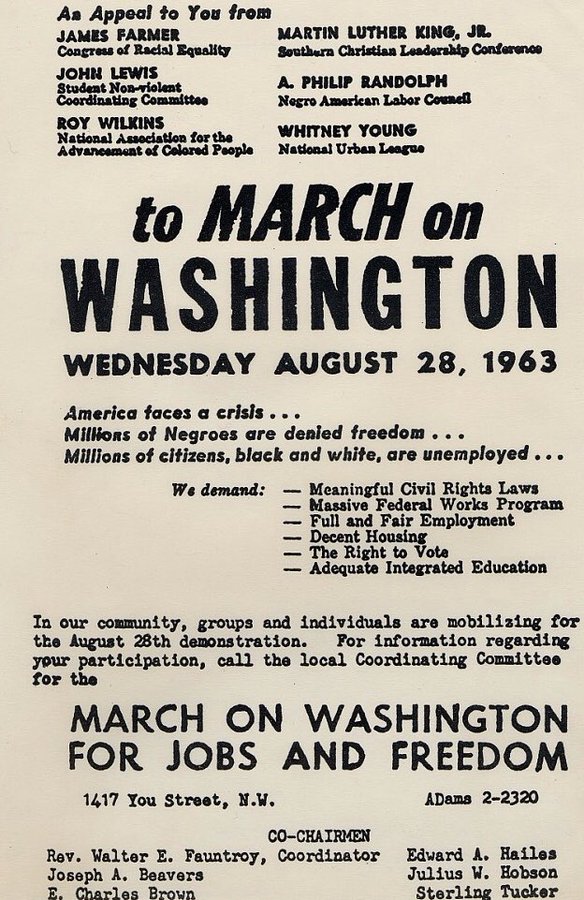
Just three months after its release, when Dylan performed at the March on Washington for Jobs and Freedom on August 28, 1963, “Blowin’ in the Wind” had become a massive civil rights anthem. But he had already ceded the song to Peter, Paul & Mary, who played their version that day. Dylan ignored his sophomore album entirely to play songs from the upcoming The Times They Are a‑Changing—songs that stand out for their indictments of the U.S. in some very specific terms.
Dylan played three songs from the new album: “When the Ship Comes In” with Joan Baez, “Only a Pawn in Their Game,” and “With God on Our Side.” (He also played the popular folk song “Keep Your Eyes on the Prize.”) In contrast to his vaguely allusive popular anthems, “Only a Pawn in Their Game”—about the murder of Medgar Evers—isn’t coy about the culprits and their crimes. We might say the song offers an astute analysis of institutional racism, white supremacy, and stochastic terrorism.
A bullet from the back of a bush
Took Medgar Evers’ blood
A finger fired the trigger to his name
A handle hid out in the dark
A hand set the spark
Two eyes took the aim
Behind a man’s brain
But he can’t be blamed
He’s only a pawn in their game
A South politician preaches to the poor white man
“You got more than the blacks, don’t complain
You’re better than them, you been born with white skin, ” they explain
And the Negro’s name
Is used, it is plain
For the politician’s gain
As he rises to fame
And the poor white remains
On the caboose of the train
But it ain’t him to blame
He’s only a pawn in their game
The deputy sheriffs, the soldiers, the governors get paid
And the marshals and cops get the same
But the poor white man’s used in the hands of them all like a tool
He’s taught in his school
From the start by the rule
That the laws are with him
To protect his white skin
To keep up his hate
So he never thinks straight
‘Bout the shape that he’s in
But it ain’t him to blame
He’s only a pawn in their game
From the poverty shacks, he looks from the cracks to the tracks
And the hoofbeats pound in his brain
And he’s taught how to walk in a pack
Shoot in the back
With his fist in a clinch
To hang and to lynch
To hide ‘neath the hood
To kill with no pain
Like a dog on a chain
He ain’t got no name
But it ain’t him to blame
He’s only a pawn in their game
Today, Medgar Evers was buried from the bullet he caught
They lowered him down as a king
But when the shadowy sun sets on the one
That fired the gun
He’ll see by his grave
On the stone that remains
Carved next to his name
His epitaph plain
Only a pawn in their game
These lyrics have far too much relevance to current events, and they’re indicative of the changing tone of Dylan’s muse. His refrains drip with irony. The killer of Medgar Evers “can’t be blamed”—an evasion of responsibility that becomes a powerful force all its own.
Dylan revisits the themes of generational trauma and murder in “With God on Our Side” (hear him sing it with Baez at Newport, above). The song is a sharp satire of his historical education, with its inevitable repetitions of war and slaughter. Here, Dylan presents the exponentially gross, existentially dreadful, consequences of a national abdication of blame for historical violence.
Oh my name it ain’t nothin’
My age it means less
The country I come from
Is called the Midwest
I was taught and brought up there
The laws to abide
And that land that I live in
Has God on its side
Oh, the history books tell it
They tell it so well
The cavalries charged
The Indians fell
The cavalries charged
The Indians died
Oh, the country was young
With God on its side
The Spanish-American
War had its day
And the Civil War, too
Was soon laid away
And the names of the heroes
I was made to memorize
With guns in their hands
And God on their side
The First World War, boys
It came and it went
The reason for fighting
I never did get
But I learned to accept it
Accept it with pride
For you don’t count the dead
When God’s on your side
The Second World War
Came to an end
We forgave the Germans
And then we were friends
Though they murdered six million
In the ovens they fried
The Germans now, too
Have God on their side
I’ve learned to hate the Russians
All through my whole life
If another war comes
It’s them we must fight
To hate them and fear them
To run and to hide
And accept it all bravely
With God on my side
But now we got weapons
Of chemical dust
If fire them, we’re forced to
Then fire, them we must
One push of the button
And a shot the world wide
And you never ask questions
When God’s on your side
Through many a dark hour
I’ve been thinkin’ about this
That Jesus Christ was
Betrayed by a kiss
But I can’t think for you
You’ll have to decide
Whether Judas Iscariot
Had God on his side.
So now as I’m leavin’
I’m weary as Hell
The confusion I’m feelin’
Ain’t no tongue can tell
The words fill my head
And fall to the floor
That if God’s on our side
He’ll stop the next war
Dylan’s race/class analysis in “Only a Pawn in the Game” and his succinct People’s History of Christian Nationalism in “With God on Our Side” stand out as interesting choices for the March for several reasons. For one thing, it’s as though he had written these songs expressly to take the political, economic, and religious mechanisms and mythologies of racism apart. This was radical speech in an event that was policed by its organizers to tone down inflammatory rhetoric for the cameras.
23-year-old John Lewis, for example, was forced to temper his speech, in which he meant to say, “We will march through the South, through the heart of Dixie, the way Sherman did. We shall pursue our own scorched earth policy and burn Jim Crow to the ground — nonviolently.… the revolution is at hand, and we must free ourselves of the chains of political and economic slavery.” As a popular white artist, rather than a potentially seditious Black organizer, Dylan had far more license and could “use his privilege,” as they say, to describe the systems of political and economic oppression Lewis had wanted to name.
Dylan’s performance was one of a handful of memorable musical appearances. Most of the singers made a far bigger impression, like Mahalia Jackson, Marian Anderson, and Baez herself, whose “We Shall Overcome” created a legendary moment of harmony. No one sang along to Dylan’s new songs—they wouldn’t have known the words. But Dylan was never careless. He chose these words for the moment, hoping to have some impact in the only way he could.
The 1963 March’s purpose has been overshadowed by a few passages in Martin Luther King, Jr.‘s powerful “I Have a Dream” speech, co-opted by everyone and reduced to meme-able quotes. But the protest “remains one of the most successful mobilizations ever created by the American Left,” historian William P. Jones writes. “Organized by a coalition of trade unionists, civil rights activists, and feminists–most of them African American and nearly all of them socialists.”
Dylan sang stories of how the country got to where it was, through a history of violence still playing out before the marchers’ eyes. Whatever political tensions there were among the various organizers and speakers did not distract them from pushing through the 1964 Civil Rights Act and the Fair Employment Practices clause banning discrimination on the basis of race, religion, national origin, or sex—protections that have been broadened since that time, and also challenged, threatened, and stripped away.
Fifty-seven years later, as the RNC convention ends and another March on Washington happens, we might reflect on Dylan’s small but prescient contributions in 1963, in which he aptly characterized the traumatic repetitions we’re still convulsively experiencing over half a century later.
When did you last hear live music? Granted, this isn’t an ideal time to ask, what with the ongoing pandemic still canceling concerts the world over. But even before, no matter how enthusiastic a show-goer you considered yourself, your life of music consumption almost certainly leaned toward the recorded variety. This is just as John Philip Sousa feared. In 1906, when recorded music itself was still more or less a novelty, the composer of “The Stars and Stripes Forever” published an essay in Appleton’s Magazine prophesying a world in which, thanks to “the multiplication of the various music-reproducing machines,” humanity has lost its ability, feel, and appreciation for the art itself.
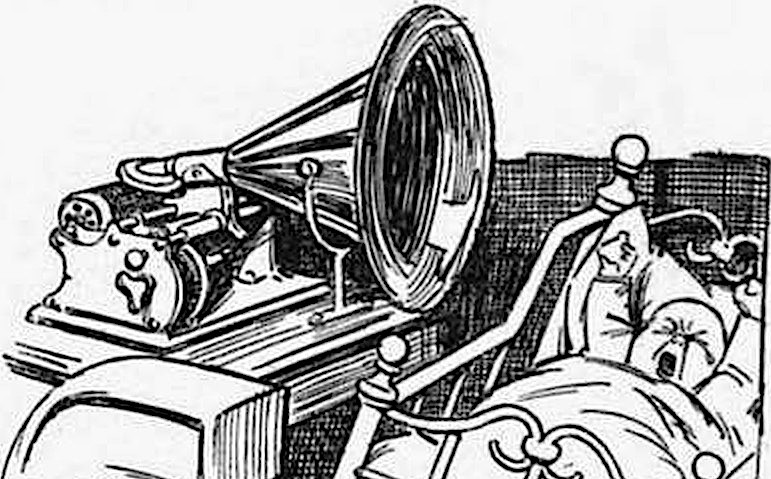
“Heretofore, the whole course of music, from its first day to this, has been along the line of making it the expression of soul states,” writes Sousa. “Now, in this the twentieth century, come these talking and playing machines, and offer again to reduce the expression of music to a mathematical system of megaphones, wheels, cogs, disks, cylinders,” all “as like real art as the marble statue of Eve is like her beautiful, living, breathing daughters.” With music in such easy reach, who will bother learning to perform it themselves? “What of the national throat? Will it not weaken? What of the national chest? Will it not shrink? When a mother can turn on the phonograph with the same ease that she applies to the electric light, will she croon her baby to slumber with sweet lullabys, or will the infant be put to sleep by machinery?”
In 1906 a famous composer warned recorded music would end lullabies and turn kids in human phonographs “without soul or expression”
The grandiloquence of Sousa’s writing, which you can hear performed in the clip from the Pessimists ArchivePodcastabove, encourages us to enjoy a knowing chuckle, but some of his points may give us pause. He foresees the decline of “domestic music,” and indeed, how many households do we know whose members all share in the making of music, or for that matter the listening? “Before you dismiss Sousa as a nutty old codger,” writes New Yorker music critic Alex Ross, “you might ponder how much has changed in the past hundred years.” With more music at our command than ever before, music itself “has become a radically virtual medium, an art without a face. In the future, Sousa’s ghost might say, reproduction will replace production entirely. Zombified listeners will shuffle through the archives of the past, and new music will consist of rearrangements of the old.”
The aesthetic half of Sousa’s argument has its descendants today in narratives of rock’s ruination by computers, diagnoses of popular culture’s addiction to its own past, and “DRUM MACHINES HAVE NO SOUL” stickers. The commercial half will also sound familiar: “The composer of the most popular waltz or march of the year must see it seized, reproduced at will on wax cylinder, brass disk, or strip of perforated paper, multiplied indefinitely, and sold at large profit all over the country, without a penny of remuneration to himself for the use of this original product of his brain,” Sousa writes. 114 years later, the relative entitlement of composers, lyricists, and performers (not to mention labels, distributors, and other business entities) to profits from recordings remains a hotly debated matter, due in no small part to the rise of streaming music services like Spotify. That probably wouldn’t surprise Sousa — nor would the longing, felt by increasingly many of us, to experience live music once again.
Based in Seoul, Colin Marshall writes and broadcasts on cities, language, and culture. His projects include the book The Stateless City: a Walk through 21st-Century Los Angeles and the video series The City in Cinema. Follow him on Twitter at @colinmarshall, on Facebook, or on Instagram.
The art of drawing is not the art of observing forms and objects alone, it is not mere mimicry of these objects; it is the art of knowing how far and wherein, and with what just limitations, those forms and objects can be reproduced in a picture, or in a decorative work. — Eugène Grasset, 1896
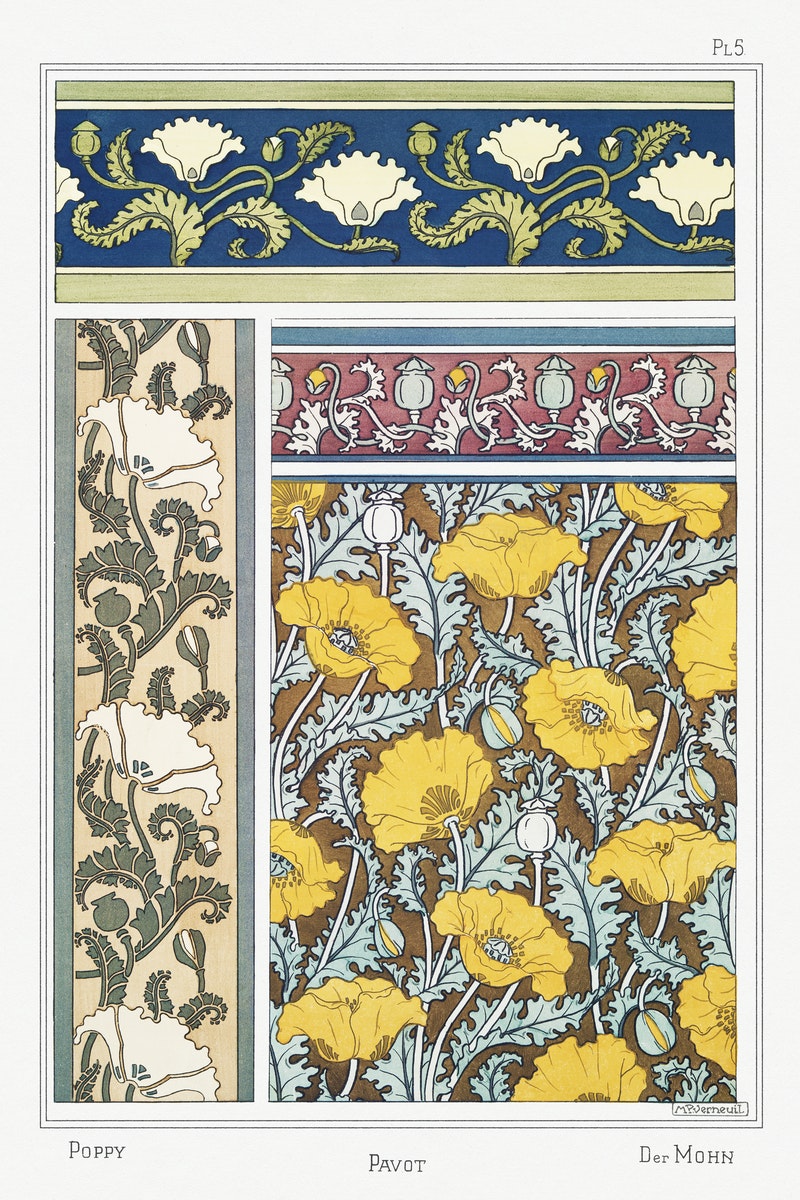
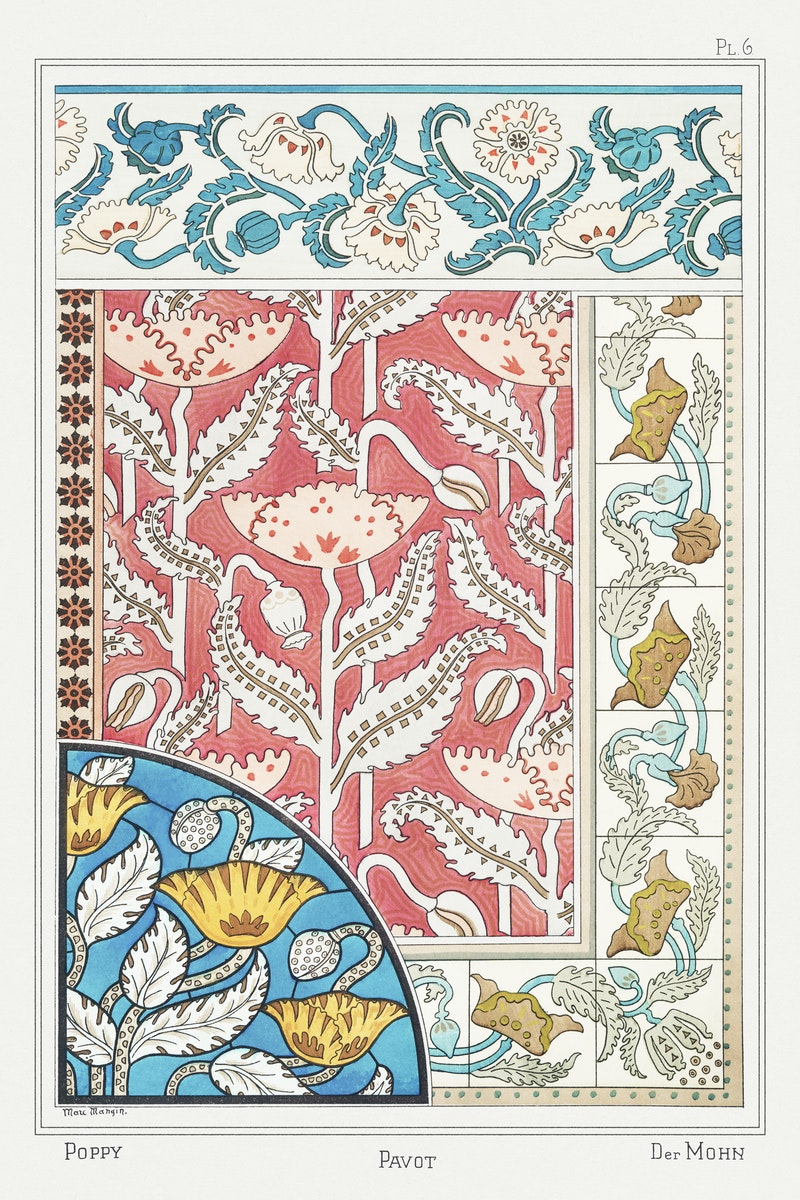
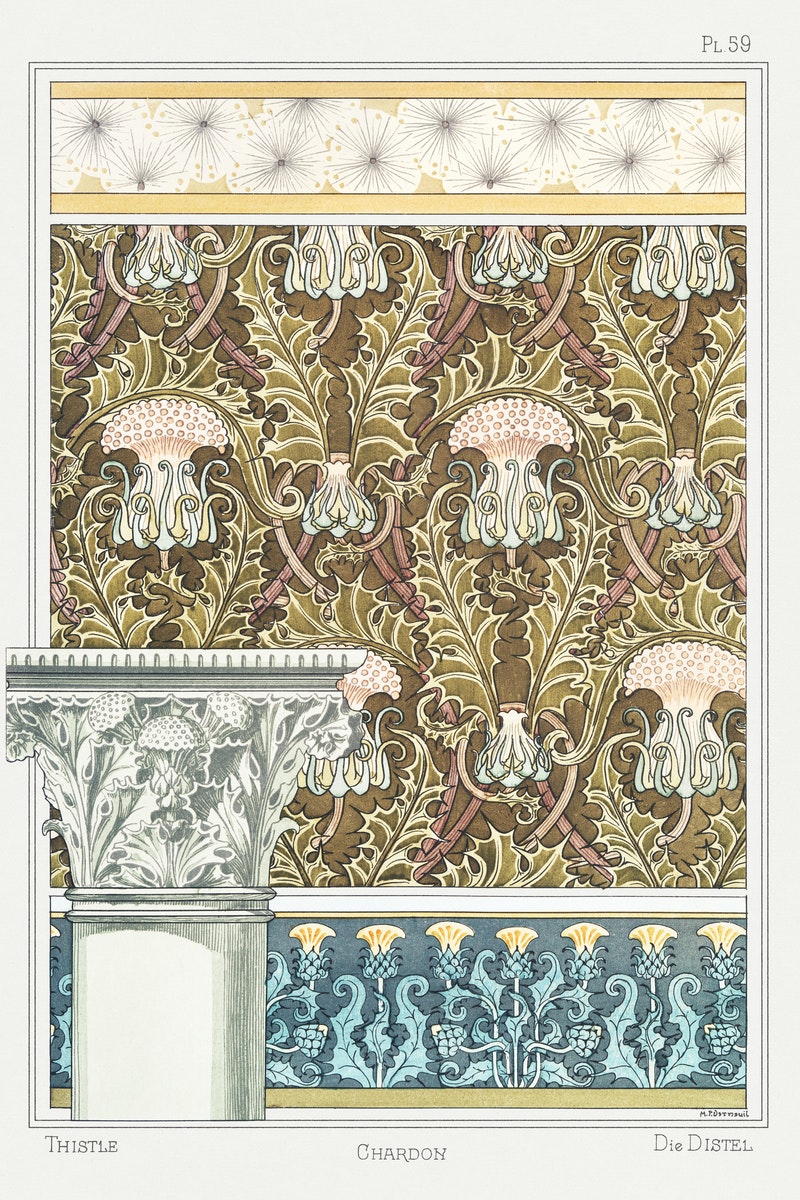
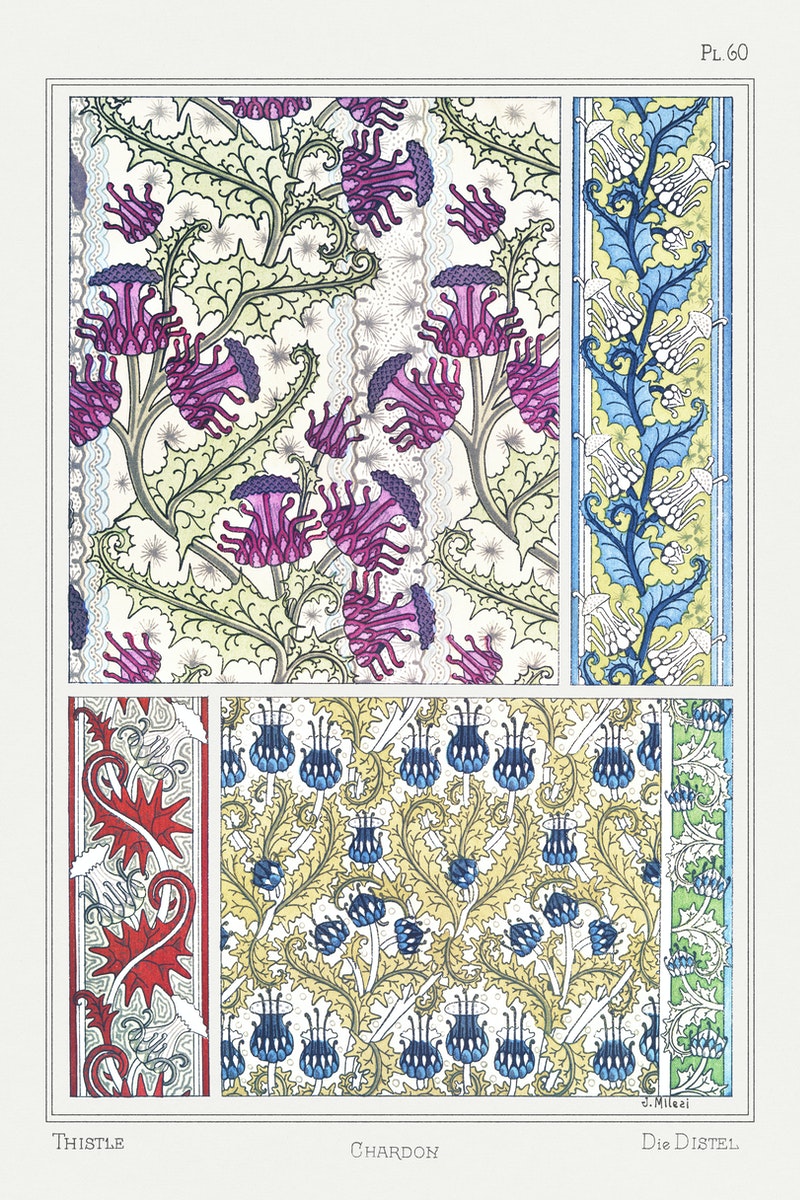
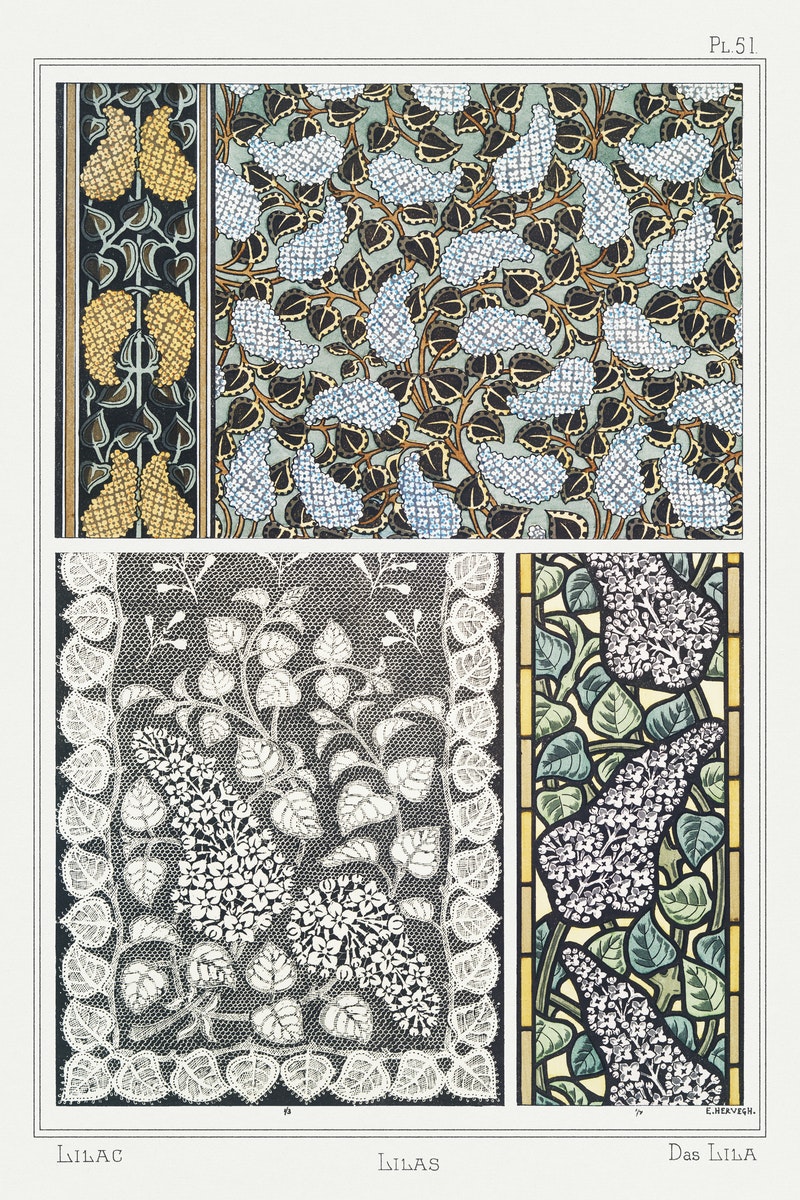
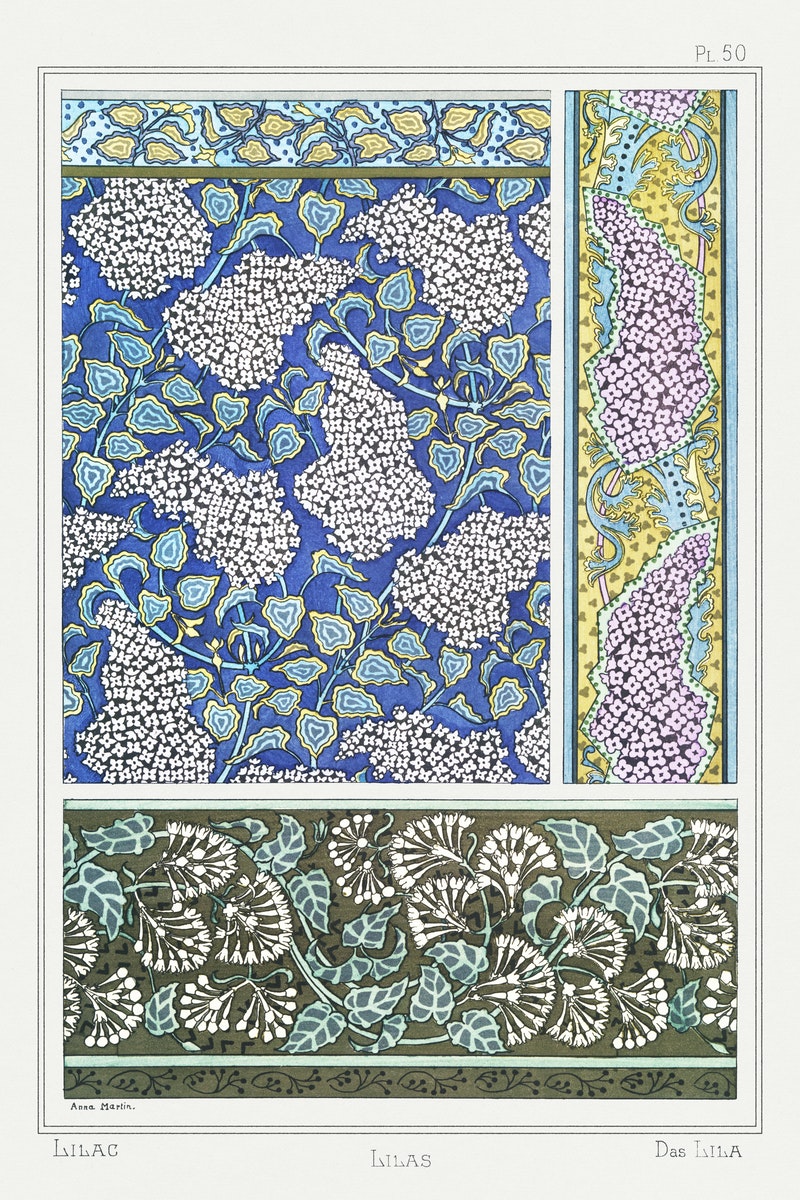
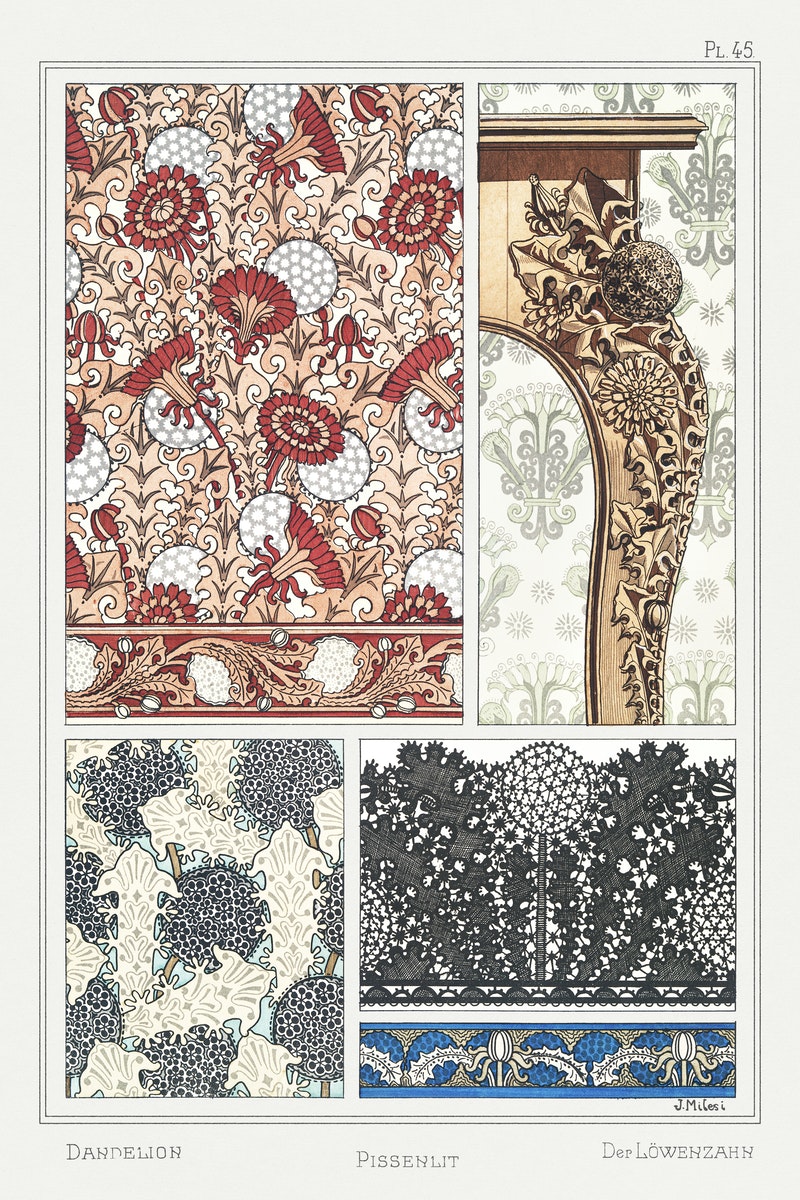
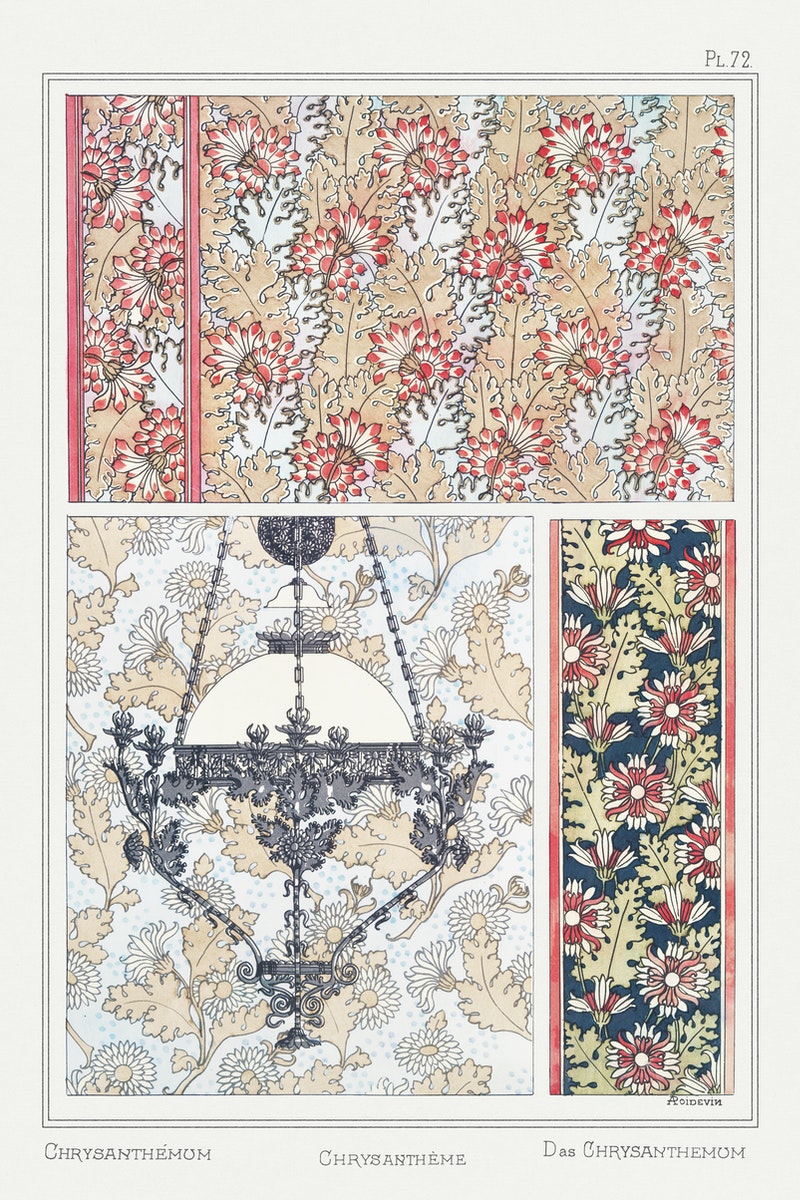
Twenty-four flowering plants were selected for consideration, from humble specimens like dandelions and thistle to such Art Nouveau heavy hitters as poppies and irises.
Each flower is represented by a realistic botanical study, with two additional color plates in which its form is flattened out and mined for its decorative, stylistic elements.
The plates were rendered by Grasset’s students at the École Guérin, young artists whom he had “forbidden to condescend to the art of base and servile imitation”:
The art of drawing is not the art of observing forms and objects alone, it is not mere mimicry of these objects; it is the art of knowing how far and wherein, and with what just limitations, those forms and objects can be reproduced in a picture, or in a decorative work.
He also expected students to hone their powers of observation through intense study of the organic structures that would provide their inspiration, becoming intimately acquainted with the character of petal, leaf, and stem:
Beautiful lines are the foundation of all beauty. In a work of art, whatever it be, apparent or hidden symmetry is the visible or secret cause of the pleasure we feel. Everything that is created must have some repetition in its parts to be understood, retained in the memory, and perceived as a whole
When it came to adorning household implements such as vases and plates, Grasset insisted that decorative elements exist in harmony with their hosts, sniping that any artist who would distort form with ill considered flourishes should make a bas-relief instead.
Thusly do chrysanthemum stems provide logical-looking ballast for a chandelier, and a dandelion’s curved leaves hug the contours of a table leg.
Grasset’s best known student, Maurice Pillard Verneuil, whose career spanned Art Nouveau to Art Deco, absorbed and articulated the master’s teachings:
It is no longer the nature (artists) see that they represent, that they transcribe, but the nature that they aspire to see; nature more perfect and more beautiful and of which they have the interior vision.
Ask an American film student to name the masterpieces of Russian cinema, and you will get a selection of Tarkovsky (Solaris, Stalker, The Mirror) and a soupcon of Eisenstein. And no doubt those are true, reverential classics. But what do Russians consider their best-loved films? That’s a completely different matter.
This list from the Russian Film Hub presents 20 films rated by Kinopoisk, the country’s version of imdb.com–movies that hold a special place in their hearts, ones that have affected the culture, the ones that people can quote by heart. There’s not one Tarkovsky here at all.
Better yet, all these films are available to watch on the Russian Film Hub site, and with English subtitles. (Most are YouTube embeds from the MosFilm channel, but not all).
Now, there are a few films on the list that art house fans will recognize. The Cranes Are Flying won the Palme d’Or at Cannes in 1958, one of the highest accolades a Russian film had received in the post-war period. Mikhail Kalatozov’s film is set before and after World War II, and lead actress Tatyana Samoylova’s Veronika is as iconic a role as Ingrid Bergman in Casablanca, guarantee to make an audience weep at the end. (The film is available to screen to American viewers, as you can watch in on Criterion Channel and HBO Max.)
Similarly Grigory Chukhrai’s Ballad of a Soldier is a well-loved war drama, directed by a man who had fought in World War II himself. Despite a series of problems during production, it has gone on to be internationally recognized. (It too is only available to American viewers through Criterion.)
However, the rest of these titles will be new to a vast majority of non-Russians. The top three on the list and number seven are by Leonid Gaidai, Russia’s best known comedy director, similar to a Blake Edwards or a Harold Ramis. Gaidai’s plots usually center around conmen and mistaken identity, and the number one film in the list–Ivan Vasilyevich Changes His Profession, from 1973, is a time travel caper where an apartment manager and a bungling burglar are transported back to the 16th century, while Tsar Ivan the Terrible is brought into 1973. It gets compared to Monty Python, Napoleon Dynamite, and Hanna-Barbera cartoons on Letterboxd, and while the word play might not make it through the translation, it is considered hilarious regardless. (All four of Gaidai’s films were huge box office hits.)
Also of note is Welcome, or No Trespassing, a wacky kids’ camp comedy (think Wes Anderson’s Moonlight Kingdom) in which the young’uns get one over on their adult captors. Director Elem Klimov would go on, 20 yeas later, to direct Come and See, one of the most harrowing and brutal anti-war films out there.
Not every film is from the height of the Cold War, either. Brother, from 1997, is a gangster film set in the mean streets of St. Petersburg, and is considered one of the most popular post-Soviet Russian films.
And finally, the list has room for an adaptation of Sherlock Holmes that, according to reviewers on Letterboxd, rivals that of Jeremy Brett and Basil Rathbone.
Ted Mills is a freelance writer on the arts who currently hosts the Notes from the Shed podcast and is the producer of KCRW’s Curious Coast. You can also follow him on Twitter at @tedmills, and/or watch his films here.
We're hoping to rely on loyal readers, rather than erratic ads. Please click the Donate button and support Open Culture. You can use Paypal, Venmo, Patreon, even Crypto! We thank you!
Open Culture scours the web for the best educational media. We find the free courses and audio books you need, the language lessons & educational videos you want, and plenty of enlightenment in between.