Chef turned restaurateur Alain Ducasse has rather a lot to say on the subject of chocolate.
On the website of Le Manufacture, the small-batch chocolate factory he founded in a former Renault Garage, he waxes poetic, sharing wide-eyed childhood memories of the “terribly sensual and bewitching substance.”
He’s a bit more mercenary in the pages of the The Wall Street Journal and Harvard Business Review, noting that the chocolate operation grew out of his desire to control the process from cacao beans to dessert plates in his numerous fine dining establishments.
His involvement in the day-to-day operations is likely ceremonial, but in a chocolate making stint early in his career, he found the “olfactory universe” pleasurable and “intoxicating to the point of being disturbing.”
Take that, Hersheys!
His fondness for vintage machinery and traditional methods opens the door to some serious cacao porn, above, starring former executive pastry chef Nicolas Berger.
The word “meticulous” comes up more than once in the voiceover narration. Hopefully, Saturday Night Live will take note. Tasked by Epicurious to identify a guilty pleasure on the order of chocolate or wine, Ducasse named BLT sandwiches, but he musters the requisite, parody-worthy romanticism for director Simon Pénochet:
Beyond gourmandise, we are seeking truth, a quest which is more primal than original.
Most of us Open Culture writers and readers surely grew up thinking of the local public library as an endless source of fascinating things. But the New York Public Library’s collections take that to a whole other level, and, so far, they’ve spent the age of the internet taking it to a level beyond that, digitizing ever more of their fascinating things and making them freely available for all of our perusal (and even for use in our own work). Just in the past couple of years, we’ve featured their release of 20,000 high-resolution maps, 17,000 restaurant menus, and lots of theater ephemera.
This week, The New York Public Library (NYPL) announced not only that their digital collection now contains over 180,000 items, but that they’ve made it possible, “no permission required, no hoops to jump through,” to download and use high-resolution images of all of them.
You’ll find on their site “more prominent download links and filters highlighting restriction-free content,” and, if you have techier interests, “updates to the Digital Collections API enabling bulk use and analysis, as well as data exports and utilities posted to NYPL’s GitHub account.” You might also consider applying for the NYPL’s Remix Residency program, designed to foster “transformative and creative uses of digital collections and data, and the public domain assets in particular.”
These selections make the NYPL’s digital collection seem strongly America-focused, and to an extent it is, but apart from hosting a rich repository of the history, art, and letters of the United States, it also contains such fascinating international materials as medieval European illuminated manuscripts; 16th-century handscrolls illustrating The Tale of Genji, the first novel; and 19th-century cyanotypes of British algae by botanist and photographer Anna Atkins, the first person to publish a book illustrated with photos. You can start your own browsing on the NYPL Digital Collections front page, and if you do, you’ll soon find that something else we knew about the library growing up — what good places they make in which to get lost — holds even truer on the internet.
Bruce Lee’s TV acting career began in 1966, when he landed a part in The Green Hornet. (Watch his thrilling audition here). But it took another five years before he gave his first–and, it turns out, only television interview in English. For 25 minutes in December 1971, the martial arts star sat down with Pierre Berton, a Canadian journalist, in Hong Kong. And their conversation covered a fair amount of ground – Lee’s success starring in Mandarin films .… despite only speaking Cantonese; his difficulty developing a career in a country still hostile toward China; and his work training other Hollywood stars in the martial arts.
Taped in 1971, the interview aired only once, then went missing, and wasn’t found until 1994, when it finally aired again as a TV special called ”Bruce Lee: The Lost Interview’.’ First featured on Open Culture in 2011, the recording is now considered his only surviving on-camera interview and/or his only meaningful interview conducted in English. A somewhat restored version can be viewed on Vimeo here.
Follow Open Culture on Facebook and Twitter and share intelligent media with your friends. Or better yet, sign up for our daily email and get a daily dose of Open Culture in your inbox. And if you want to make sure that our posts definitely appear in your Facebook newsfeed, just follow these simple steps.
The Simpsons have mocked or referenced literature over its 27 (!!) seasons, usually through a book Lisa was reading, or with guest appearances (e.g., Michael Chabon & Jonathan Franzen, Maya Angelou and Amy Tan). And it has referenced Edgar Allan Poe in both title (“The Tell-Tale Head” from the first season) and in passing (in “Lisa’s Rival” from 1994, the title character builds a diorama based on the same Poe tale.)
But on the first ever “Treehouse of Horror” from 1990–the Simpsons’ recurring Halloween episode–they adapted Poe’s “The Raven” more faithfully than any bit of lit found in any other episode. The poem, read by James Earl Jones, remains intact, more or less, but with Dan Castellaneta’s Homer Simpson providing the unnamed narrator’s voice. Marge makes an appearance as the long departed Lenore, with hair so tall it needs an extra canvas to contain it in portrait. Maggie and Lisa are the censer-swinging seraphim, and Bart is the annoying raven that drives Homer insane.
Castellaneta does a great job delivering Poe’s verse with conviction and humor, while keeping the character true to both Homer and Poe. It’s a balancing act harder than it sounds.
Suffice it to say that this foray into Poe was good enough for several teachers guides (including this one from The New York Times) to suggest using the video in class. (We’d love to hear about this if you were a teacher or student who experienced this.) And it’s the first and only time that Poe got co-writing credit on a Simpsons episode.
Ted Mills is a freelance writer on the arts who currently hosts the artist interview-based FunkZone Podcast. You can also follow him on Twitter at @tedmills, read his other arts writing at tedmills.com and/or watch his films here.
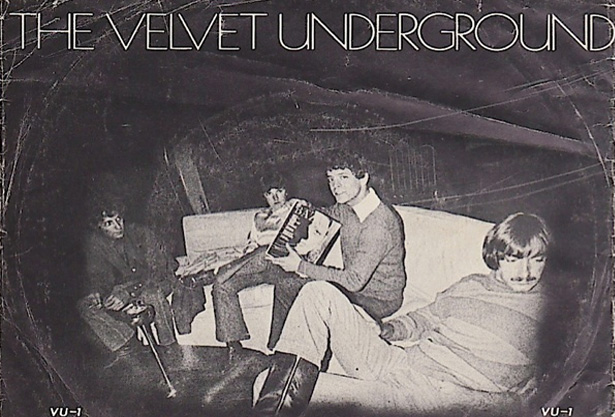
“Not everyone ‘digs’ underground movies, but those who do can ‘dig’ ’em here.” Now imagine those words spoken in the archetypal so-square-it’s-cool consummate midcentury newscaster voice — or actually watch them enunciated in just that manner out on the steps of New York’s The Bridge, “one of several small theaters around the country where ‘underground’ films are shown.” The report, which aired on CBS Evening News with Walter Cronkite on December 31st, 1965, introduced to mainstream Americans such avant-garde filmmakers as Jonas Mekas, Stan Brakhage, and Andy Warhol — as well as a certain band called the Velvet Underground.
This six-minute segment spends some time with Piero Heliczer, filmmaker, poet, and “once the Jackie Coogan of Italy.” As Dangerous Minds’ Martin Schneider writes, “When CBS came a‑callin’ to do its story, Heliczer was shooting a 12-minute short called Dirt, featuring the Velvet Underground, and that was the scene Heliczer happened to be shooting that day. (For some reason none of the fellows in the band are wearing a shirt.)” Schneider also quotes Velvet Underground founding member Sterling Morrison, who credits playing in Heliczer’s “happenings” with showing him the possibilities of experimental music: “The path ahead became suddenly clear — I could work on music that was different from ordinary rock & roll since Piero had given us a context to perform.”
I can only imagine how the viewers of fifty years and one week ago must have reacted to hearing these cutting-edge filmmakers discussing “the narrative aspect and the poetic aspect” of cinema, let alone seeing clips of their works themselves, right down to a representative twenty seconds of Andy Warhol’sSleep. It even includes a clip from Brakhage’s Two: Creeley/McClurewhich must have made more than a few of them wonder if their set had suddenly gone on the blink. But even the most staid of CBS’s audience must have come away with a novel idea or two worth thinking about, such as Brakhage’s stated aim of making movies “for viewing in a living room, rather than in a theater.” That, perhaps, they could dig.
If you would like to sign up for Open Culture’s free email newsletter, please find it here. It’s a great way to see our new posts, all bundled in one email, each day.
If you would like to support the mission of Open Culture, consider making a donation to our site. It’s hard to rely 100% on ads, and your contributions will help us continue providing the best free cultural and educational materials to learners everywhere. You can contribute through PayPal, Patreon, and Venmo (@openculture). Thanks!
Before the New Year, we brought you footage of Russian polymathic inventor Léon Theremin demonstrating the strange instrument that bears his surname, and we noted that the Theremin was the first electronic instrument. This is not strictly true, though it is the first electronic instrument to be mass produced and widely used in original composition and performance. But like biological evolution, the history of musical instrument development is littered with dead ends, anomalies, and forgotten ancestors (such as the octobass). One such obscure oddity, the Telharmonium, appeared almost 20 years before the Theremin, and it was patented by its American inventor, Thaddeus Cahill, even earlier, in 1897. (See some of the many diagrams from the original patent below.)
Cahill, a lawyer who had previously invented devices for pianos and typewriters, created the Telharmonium—also called the Dynamaphone—to broadcast music over the telephone, making it a precursor not to the Theremin but to the later scourge of telephone hold music. “In a large way,” writes Jay Williston at Synthmuseum.com, “Cahill invented what we know of today as ‘Muzak.’” He built the first prototype Telharmonium, the Mark I, in 1901. It weighed seven tons. The final incarnation of the instrument, the Mark III, took 50 people to build at the cost of $200,000 and was “60 feet long, weighed almost 200 tons and incorporated over 2000 electric switches…. Music was usually played by two people (4 hands) and consisted of mostly classical works by Bach, Chopin, Greig, Rossini and others.” The workings of the gargantuan machine resemble the boiler room of an industrial facility. (See several photographs here.)
Needless to say, this was a highly impractical instrument. Nevertheless, Cahill not only found willing investors for the enormous contraption, but he also staged successful demonstrations in Baltimore, then—after disassembling and moving the thing by train—in New York. By 1905, his New England Electric Music Company “made a deal with the New York Telephone Company to lay special lines so that he could transmit the signals from the Telharmonium throughout the city.” Cahill used the term “synthesizing” in his patent, which some say makes the Telharmonium the first synthesizer, though its operation was as much mechanical as electronic, using a complicated series of gears and cylinders to replicate the musical range of a piano. (See the operation explained in the video at the top.) “Raised bumps on cylinders helped create musical contour notes,” writes Popular Mechanics, “not unlike a music box, with the size of the cylinder determining the pitch.”
The huge, very loud Telharmonium Mark III ended up in the basement of the Metropolitan Opera House for a time as Cahill worked on his scheme for pumping music through the telephone lines. But this plan did not come off smoothly. “The problem was,” Popular Mechanics points out,” all cables leak off radio waves. Sending a gigantic, amplified signal on turn-of-the-20th-century phone lines was bound to cause trouble.” The Telharmonium created interference on other phone lines and even interrupted Naval radio transmissions. “Rumor has it,” the Douglas Anderson School of the Arts writes, “that a New York businessman, infuriated by the constant network interference, broke into the building where the Telharmonium was housed and destroyed it, throwing pieces of the machinery into the Hudson river below.”
The story seems unlikely, but it serves as a symbol for the instrument’s collapse. Cahill’s company folded in 1908, though the final Telharmonium supposedly remained operational until 1916. No recordings of the instrument have survived, and Thaddeus Cahill’s brother Arthur eventually sold the last prototype off for scrap in 1950 after failing to find a buyer. The entire rationale for the instrument had been supplanted by radio broadcasting. The Telharmonium may have failed to catch on, but it still had a significant impact. Its unique design inspired another important electronic instrument, the Hammond organ. And its very existence gave musical futurists a vision. The Douglas Anderson School writes:
Despite its final demise, the Telharmonium triggered the birth of electronic music—The Italian Composer and intellectual Ferruccio Busoni inspired by the machine at the height of its popularity was moved to write his “Sketch of a New Aesthetic of Music” (1907) which in turn became the clarion call and inspiration for the new generation of electronic composers such as Edgard Varèse and Luigi Russolo.
The instrument also made quite an impression on another American inventor, Mark Twain, who enthusiastically demonstrated it through the telephone during a New Year’s gathering at his home, after giving a speech about his own not inconsiderable status as an innovator and early adopter of new technologies. “Unfortunately for Thaddeus Cahill,” writes William Weir at The Hartford Courant, “Twain’s support wasn’t enough to make a success of the Telharmonium.” Learn more about the instrument’s history from this book.
One of the things I miss about living in a city with a subway system is the myriad thoughtful design elements that go into managing a perpetual flow of tourists and commuters. New York’s subway map presents us with an iconic tangle of interlocking tributaries resembling diagrams of a circulatory system. The NYC system’s ingeniously simple graphic presentation of lettered and numbered trains, encircled in their corresponding colors, can be read by most anyone with a rudimentary grasp on the English alphabet—from a new language learner to a small child. The Washington, DC subway system, though a much more prosaic affair overall, whisks riders through impressively cavernous, catacomb-like stations, with brutalist tile and concrete honeycombs that seem to go on forever. The squiggly lines of its color-coded map likewise promise ease of use and legibility.
And then there are the hours of reading time granted by a subway commute, a leisure I’ve relinquished now that I rely on car and bike. So you can imagine my envious delight in learning about Brazil’s Ticket Books, which are exactly what they sound like—books that work as subway tickets, designed with the minimalist care that major transit systems do so well. And what’s more, they’re free: “To celebrate World Book Day last April 23rd,” writes “future-forward online resource” PSFK, “[Brazillian publisher] L&PM gave away 10,000 books for free at subway stations across São Paulo. Each book came with ten free trips.” Riders could then recharge them and use the books again or pass them on to others to encourage more reading, an important public service given that Brazilians only read two books per year on average.
With subway map-inspired covers designed by firm Agência Africa, the books include The Great Gatsby, The Art of War, Hamlet, Murder Alley by Agatha Christie, Hundred Love Sonnets by Pablo Neruda, and more (including comic collections from Charles Schulz and Garfield’s Jim Davis). Watch an explainer video at the top of the post and see some lovely images of the book covers above. The campaign won three trophies at the Cannes Lions Festival in the categories “Promo,” “Outdoor,” and “Design,” and has proved so popular that publisher L&PM has expanded the project to other Brazilian cities, giving me yet more reason to visit Brazil. And if Ticket Books makes its way to a subway-enabled city near me, I may consider moving.
From director, designer, and animator Elliot Lim comes an animated tribute to his “favorite show of all time,” HBO’s The Wire – a sentiment that he shares with Pres. Obama, countless critics, and many casual TV viewers. As much as the episodes themselves, fans fondly remember The Wire’s opening credits, which functioned, Andrew Dignan once wrote, as short films that “distill each season’s themes, goals, and motifs.” The opening credits are what get the animated treatment in Lim’s video. Whether his video distills a particular set of themes, goals and motifs, I’m not yet sure. I’ll need to watch it a few more times and report back soon.
Follow Open Culture on Facebook and Twitter and share intelligent media with your friends. Or better yet, sign up for our daily email and get a daily dose of Open Culture in your inbox. And if you want to make sure that our posts definitely appear in your Facebook newsfeed, just follow these simple steps.
Who really killed John F. Kennedy? Did America really land on the moon? What really brought down the Twin Towers? Few modern phenomena possess the sheer fascination quotient of conspiracy theories. If you believe in them, you’ll of course dig into them obsessively, and if you don’t believe in them, you surely feel a great curiosity about why other people do. Science writer and Skeptic magazine Editor in Chief Michael Shermer falls, needless to say, into the second group; so far into it that examining conspiracy theories and those who subscribe to them has become one of his best-known professional pursuits since at least 1997, the year of his straightforwardly titled book Why People Believe Weird Things.
On the 50th anniversary of JFK’s assassination, Shermer wrote an article in the Los AngelesTimes about the reasons that event has drawn so many avid conspiracy theorists over the past half-decade. First: their cognitive dissonance resulting from the two seemingly incompatible ideas, that of JFK “as one of the most powerful people on Earth” and JFK “killed by Lee Harvey Oswald, a lone loser, a nobody.” Second: their participation in a monological belief system, “a unitary, closed-off worldview in which beliefs come together in a mutually supportive network.” Third: their confirmation bias, or “the tendency to look for and find confirming evidence for what you already believe” — the umbrella man, the grassy knoll — “and to ignore disconfirming evidence.”
These factors all come into play with the other major American conspiracy theories as well. In the podcast clip at the top of the post, you can hear physicist Michio Kaku trying to set straight a moon landing conspiracy theorist. They argue that man has never set foot on the moon, but that the government instead hoodwinked us into believing it with an elaborate audiovisual production (directed, some theorists insist, by none other than Stanley Kubrick, who supposedly “confessed” in fake interview footage that recently made the internet rounds). Should you require further argument to the contrary, have a look at S.G. Collins’ Moon Hoax Not just above.
No higher-profile set of conspiracy-theory movement has come out of recent history than the 9/11 Truthers, who may differ on the details, but who all gather under the umbrella of believing that the events of that day happened not because of the actions of a conspiracy of foreign terrorists, but because of a conspiracy within the United States government itself. In the Q&A footage above (originally uploaded, in fact, by a believer), one such theorist stands up and asks linguist and activist Noam Chomsky to join in on the movement, pointing to a cover-up of the manner in which 7 World Trade Center collapsed — a big “smoking gun” of the larger conspiracy, in their eyes.
This prompts Chomsky to offer an explanation of how scientists and engineers actually go looking for the truth. Have they eliminated entirely their cognitive dissonance, monological belief systems, and confirmation biases? No human could ever do that perfectly — indeed, to be human is to be subject to all these distorting conditions and more — but the larger enterprise of science, at its best, frees us little by little from those very shackles. What a shame to voluntarily clap oneself back into them.
After a long hiatus, the RSA (The Royal Society for the Encouragement of Arts, Manufactures and Commerce) has returned with another one of the whiteboard animated-lectures they pioneered five years ago.
The animated reboot (above) brings to life the thoughts of another Stanford psychology professor, Carol S. Dweck. The author of Mindset: The New Psychology of Success(a book that appeared on Bill Gates’s Best of 2015 list), Dweck has looked closely at how our beliefs/mindsets strongly influence the paths we take in life. And, in this clip, she talks about how well-meaning parents, despite their best intentions, might be creating the wrong mindsets in their kids, paving the way for problems down the road. You can watch the complete, unanimated lecture here.
If you would like to sign up for Open Culture’s free email newsletter, please find it here. It’s a great way to see our new posts, all bundled in one email, each day.
If you would like to support the mission of Open Culture, consider making a donation to our site. It’s hard to rely 100% on ads, and your contributions will help us continue providing the best free cultural and educational materials to learners everywhere. You can contribute through PayPal, Patreon, and Venmo (@openculture). Thanks!
Astrophysicist Neil deGrasse Tyson, the most prominent public defender of science education and funding, frequently comes in for some good-natured ribbing for his genial pedantry, ascension to Carl Sagan’s unofficial spokesmanship, and downgrading of the beloved Pluto from planet status. But he takes it all in stride. As another science communicator, Phil Plate the “Bad Astronomer,” has written, “The man is brilliant, charming, a pillar of science education, and a glutton for punishment. But I think he secretly revels in it.” If you follow Tyson’s Twitter account and watch him engage with cranks, or if you’ve seen him in any of the hundreds of public debates and panels he attends, it seems he more than revels in it; he’s totally in his element, so to speak, publicly modeling the mix of confidence, humility, and curiosity that drives science forward.
In the video above, Tyson dares to try and fill the shoes of another great communicator—and no, I don’t mean Ronald Reagan, but the president whose most famous speech Charles Sumner called “a monumental act.” And though Abraham Lincoln was not nearly as comfortable in front of an audience as Tyson is, Lincoln’s Gettysburg Address set the bar for how to get a point across with the maximum amount of eloquence and minimum of redundancy and rambling. Can Tyson deliver the goods like Lincoln did with only 272 words to work with? Is the attempt to “reply” to the “Gettysburg Address” an act of hubris or the ultimate tribute? Decide for yourself as you listen to Tyson’s April, 2015 acceptance speech at the National Academy of Science for the Public Welfare Medal, the Academy’s “most prestigious award.”
Tyson’s speech has been enhanced with a dramatic animation and sound effects for a technological impact Lincoln never could have achieved, though by most accounts he didn’t need it. Not a solemn occasion like Gettysburg, the awards ceremony nonetheless called for at least a little pomp, as well as some history. Tyson points out that “during the bloody year of his Gettysburg Address, President Lincoln chartered the National Academy of Sciences.” For more of that story, see the short video above, where you’ll learn, among other things, that Lincoln was the first and only American president to hold a patent on a scientific invention.
We're hoping to rely on loyal readers, rather than erratic ads. Please click the Donate button and support Open Culture. You can use Paypal, Venmo, Patreon, even Crypto! We thank you!
Open Culture scours the web for the best educational media. We find the free courses and audio books you need, the language lessons & educational videos you want, and plenty of enlightenment in between.