If you would like to support the mission of Open Culture, consider making a donation to our site. It’s hard to rely 100% on ads, and your contributions will help us continue providing the best free cultural and educational materials to learners everywhere. You can contribute through PayPal, Patreon, and Venmo (@openculture). Thanks!
Heavy Metal owes many debts, though it doesn’t always acknowledge them—debts to classical music, through guitarists like Yngwie Malmsteen, to the blues, through Led Zeppelin and Deep Purple, and to jazz, through a host of players, including Black Sabbath’s guitarist Tony Iommi. But while other players have picked up techniques from the jazz idiom like blast beats and sweep picking, Iommi found something else: the motivation to relearn to play the guitar after losing three of the fingertips on his right hand in an industrial accident, on his last day on the job, right before he was to embark on a European tour. He was only 17 years old. Iommi narrates the story himself above in “Fingers Bloody Fingers,” a powerful animated short by illustrator Paul Blow and animator Kee Koo.
After the gruesome accident, Iommi, “extremely depressed,” tragically resigned himself to never play the guitar again — that is, until his factory manager visited him in the hospital and told him the story of Django Reinhardt, the Belgian-Romani swing guitarist who lost two fingers in a terrible fire at age 18, himself just on the verge of stardom and highly sought after by the greatest bandleaders of the day. In the clip above from the French documentary Trois doigts de genie (Three Fingers of Genius), learn how Reinhardt overcame his disability to become one of the most famous guitarists of his day, and see why Iommi was so inspired by his story. “A lesser musician would have given up,” wrote Mike Springer in a previous post, “but Reinhardt overcame the limitation by inventing his own method of playing.” Iommi, of course, did the same, also along the way introducing a lighter gauge of string, which millions of rock guitarists now use.
Reinhardt toured and recorded with his own ensembles and with Duke Ellington and others. Unfortunately precious little footage of him exists, but you can see him above with violinist Stephane Grappelli in their Quintette du Hot Club and in a few other short clips in this post. Once you hear Django’s story of overcoming adversity, and once you hear him play, you’ll understand why he inspired Iommi to push through his own pain and limitations to become one of the most influential guitarists of his generation.
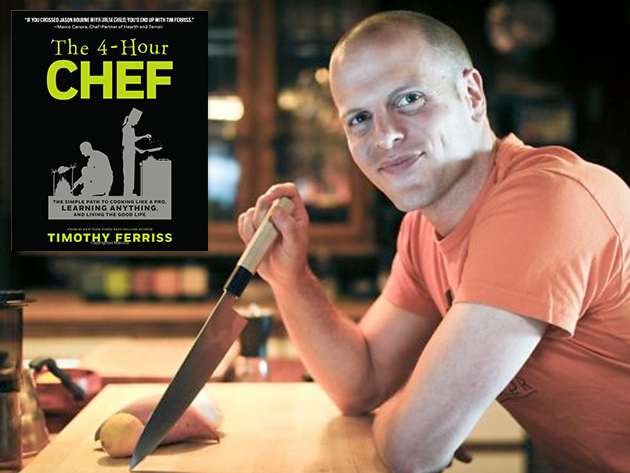
You’ll train inside the kitchen for everything outside the kitchen. Featuring tips and tricks from chess prodigies, world-renowned chefs, pro athletes, master sommeliers, super models, and everyone in between, this “cookbook for people who don’t buy cookbooks” is a guide to mastering cooking and life.
The 4‑Hour Chef is a five-stop journey through the art and science of learning:
1. META-LEARNING. Before you learn to cook, you must learn to learn. META charts the path to doubling your learning potential.
2. THE DOMESTIC. DOM is where you learn the building blocks of cooking. These are the ABCs (techniques) that can take you from Dr, Seuss to Shakespeare.
3. THE WILD. Becoming a master student requires self-sufficiency in all things. WILD teaches you to hunt, forage, and survive.
4. THE SCIENTIST. SCI is the mad scientist and modernist painter wrapped into one. This is where you rediscover whimsy and wonder.
5. THE PROFESSIONAL. Swaraj, a term usually associated with Mahatma Gandhi, can be translated as “self-rule.” In PRO, we’ll look at how the best in the world become the best in the world, and how you can chart your own path far beyond this book.
Or explore the Free Trial Programs offered by Audible.com and Audiobooks.com, both of which give you the chance to download an audiobook for free while trying out their programs.
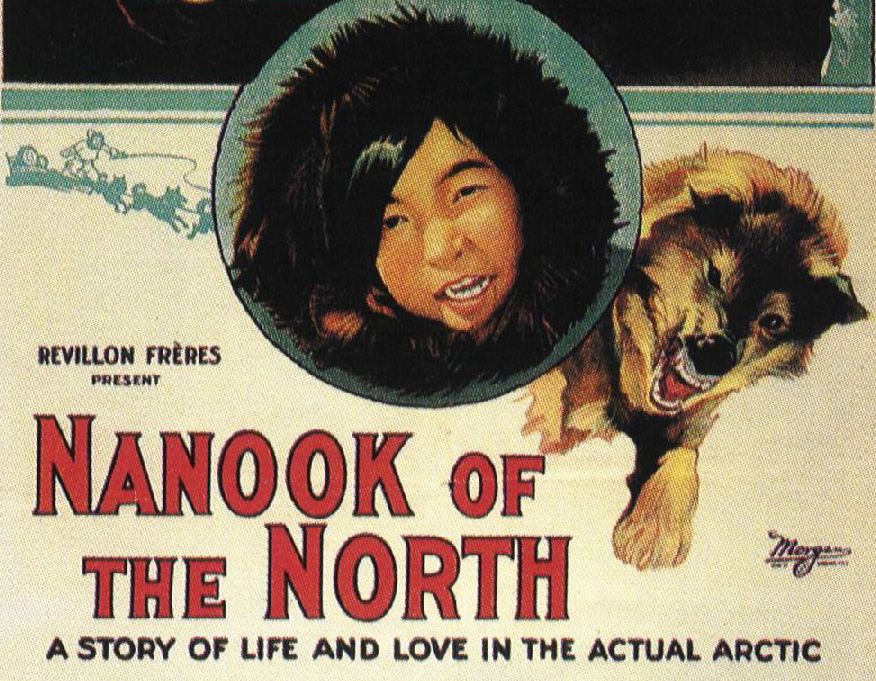
A rudimentary difference between fiction narratives and documentary film is supposed to be that one is created out of the imagination, and the other is a recorded document of real events. Yet if we go right back to the very first feature length documentary, Robert J. Flaherty’s Nanook of the North, we see that the line between fact and fiction was just as wobbly then as now.
A popular success when it was released in 1922, Nanook brought its heroic title character to an audience who knew nothing about the Native tribes of the north. The film shows a way of life that was disappearing as Flaherty, originally an explorer and prospector, began to document it. We see the hardy Inuit Nanook hunting with spears, pulling up to a trading station in a kayak and trading with the white owner. We see his wife and kids, the family building an igloo and bedding down for the night. The film emphasizes as much his self-reliance as it does Nanook’s naivety. And it fully cemented the idea of the Eskimo in popular culture. Nanook became a name as synonymous with the Inuit as Pierre is to the French. Frank Zappa even wrote a song suite about Nanook.
Flaherty was not trained in film, and learned what he could quickly about photography when he decided to shoot footage up north while working for the Canadian Pacific Railway. He accidentally destroyed all of his original footage when he dropped a cigarette on the flammable nitrite film and set about raising money for a reshoot. Without precedent, Flaherty rethought his doc into what we now recognize as classic form: Instead of trying to capture the culture, he chose one man as his main character, an entry into an unknown world.
And in those reshoots we find the line between fiction and fact blurred. Nanook’s real name was Allakariallak, and though he was a hunter, he and his tribe had long ditched the spear for the much more effective gun. Flaherty wanted to represent Inuit life before the European influence, and Allakariallak played along, not just hunting with his spear, but pretending at the trade outpost not to recognize a gramophone.
The scenes inside the igloo were staged for good reason: the camera was too big and the lighting needed would have melted the walls. So Allakariallak and the crew built a cutaway igloo where the family could pretend to bed down for the night. (Oh, and the two women we see were actually Flaherty’s common law wives.)
Flaherty’s legacy was in combining ethnography, travelogue, and showing how people live and work, none of which had been done before in film. Flaherty continued to make documentaries into 1950, including Man of Aran (about life on the Irish isle of the same name) and Tabu, a Polynesian island tale directed by F.W. Murnau, best known for Nosferatu. But none had the impact of this film. When the Library of Congress first started listing films in 1989 for preservation, specifying ones that were “culturally, historically, or aesthetically significant,” Nanook was in the first selection of 25.
The idea of building a living habitat in order to control the action still happens in nature documentaries, and humans readily playing a version of themselves to tell a certain kind of narrative is the basis of all reality TV. Flaherty bent boring truth to get to a different, “essential” truth. Is it better that we believe that Nanook died out on the ice, a victim of the harsh reality of survival on the ice, or to know that he actually died at home from tuberculosis? The qualities that caused controversy upon Nanook’s release aren’t the opposite of documentary, they *are* documentary.
Ted Mills is a freelance writer on the arts who currently hosts the FunkZone Podcast. You can also follow him on Twitter at @tedmills, read his other arts writing at tedmills.com and/or watch his films here.
Yesterday we ran a list of 93 films beloved by Stanley Kubrick, which includes two by Andrei Tarkovsky: 1972’s Solaris and 1986’s The Sacrifice. You expect one auteur to appreciate the work of another — “game recognize game,” to use the modern parlance — but the selection of Solaris makes special sense. Just four years before it, Kubrick had, of course, made his own psychologically and visually-intense cinematic voyage out from Earth into the great beyond, 2001: A Space Odyssey.
The appreciation, alas, wasn’t mutual. “Tarkovsky supposedly made Solaris in an attempt to one-up Kubrick after he had seen 2001 (which he referred to as cold and sterile),” writes Joshua Warren at criterion.com. “Interestingly enough, Kubrick apparently really liked Solaris and I’m sure he found it amusing that it was marketed as ‘the Russian answer to 2001.’ ” Jonathan Crow recently quoted Tarkovsky as saying: “2001: A Space Odyssey is phony on many points, even for specialists. For a true work of art, the fake must be eliminated.”
That pronouncement comes from a 1970, pre-Solaris interview with Tarkovsky by Naum Abramov. The Russian auteur indicts what he sees as 2001’s lack of emotional truth due to its excessive technological invention, effectively declaring that, in his own foray into the realm of science-fiction, “everything would be as it should. That means to create psychologically, not an exotic but a real, everyday environment that would be conveyed to the viewer through the perception of the film’s characters. That’s why a detailed ‘examination’ of the technological processes of the future transforms the emotional foundation of a film, as a work of art, into a lifeless schema with only pretensions to truth.”
Critic Philip Lopate writes that “the media played up the cold-war angle of the Soviet director’s determination to make an ‘anti-2001,’ and certainly Tarkovsky used more intensely individual characters and a more passionate human drama at the center than Kubrick.” And the films do have similarities, from their “leisurely, languid” narratives to their “widescreen mise-en-scène approach that draws on superior art direction” to their “air of mystery that invites countless explanations.” But Lopate argues that the themes of Solaris resemble those of 2001 less than those of Hitchcock’s Vertigo: “the inability of the male to protect the female, the multiple disguises or ‘resurrections’ of the loved one, the inevitability of repeating past mistakes.”
As a lover of both Kubrick and Tarkovsky’s work, I can hardly take sides. Maybe I just need to watch both 2001 and Solaris yet again, one after another, in order to better compare them. (Find Tarkovsky’s films free online here.) And maybe I need to throw Vertigo into the evening as well. Now that’s what I call a triple feature.
Special Collections, University of Vermont Libraries
No matter how much of a political junkie you are, you must surely have had enough of the spectacle that is the 2016 campaign for the presidency. At current count, we are faced with an astounding 15 candidates for the Republican nomination, one of whom is doing his best to revive the ugliest nativism of the 19th century. On the other side of our binary party system, we have only One. Or so it would seem if you were to pay attention to much of the media coverage, which only rarely mentions the handful of other Democratic contenders and mostly ignores the rising tide of support for Bernie Sanders.
The Senator from Vermont has unabashedly referred to himself, throughout his long political career, as a democratic socialist or, on occasion, simply a “socialist”—a word that strikes fear into the heart of many an American, and resonates widely with another portion of the electorate. Debates over what this means rage on. George Will calls Sanders’ socialism a “charade.” Thor Benson in the New Republicaccuses him of playing “loose with the terminology.” The history and current state of “socialism” is so long and complex that no one definition seems to suit. Its political baggage in American discourse, however, is undeniable.
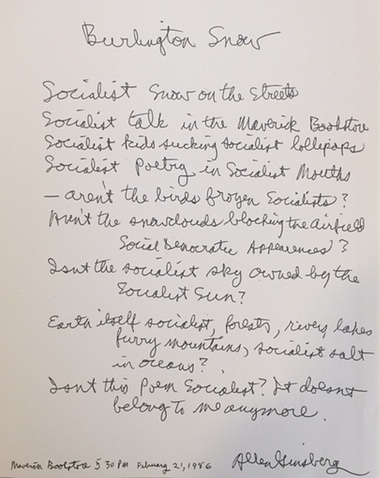
This was just as true in 1986, when Allen Ginsberg wrote a poem in praise of Sanders, then mayor of Burlington, Vermont. Ginsberg playfully draws on the loose associations we have with the word, hammering it home with tongue-in-cheek repetition, then turning reflective.
Socialist snow on the streets Socialist talk in the Maverick bookstore Socialist kids sucking socialist lollipops Socialist poetry in socialist mouths —aren’t the birds frozen socialists? Aren’t the snowclouds blocking the airfield Social Democratic Appearances? Isn’t the socialist sky owned by the socialist sun? Earth itself socialist, forests, rivers, lakes furry mountains, socialist salt in oceans? Isn’t this poem socialist? It doesn’t belong to me anymore.
Calling it “Burlington Snow,” Ginsberg composed the poem—equal parts goofy and sincere—on a visit to the city, one of many pilgrimages made by left-wing writers and artists after Sanders’ string of attempted foreign policy interventions. You can read all about the optimistic socialist—or democratic socialist, or whatever—in Paul Lewis’ Guardian portrait.
When you think of traditional Japanese art, you might think of a sumi‑e ink painting that evokes a copse of bamboo with a few masterful lines. A haiku that captures the fragility of beauty in the length of a tweet. A garden that somehow conveys the transcendence of all things by elegantly framing the wind in the trees.
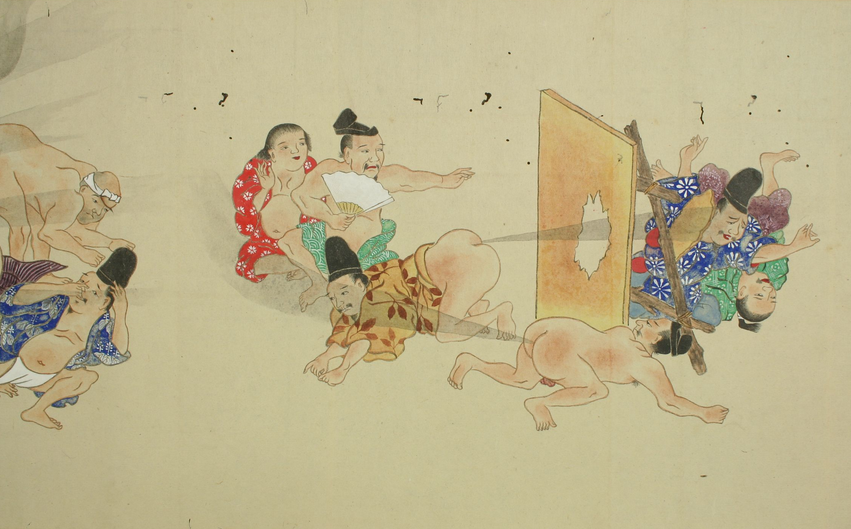
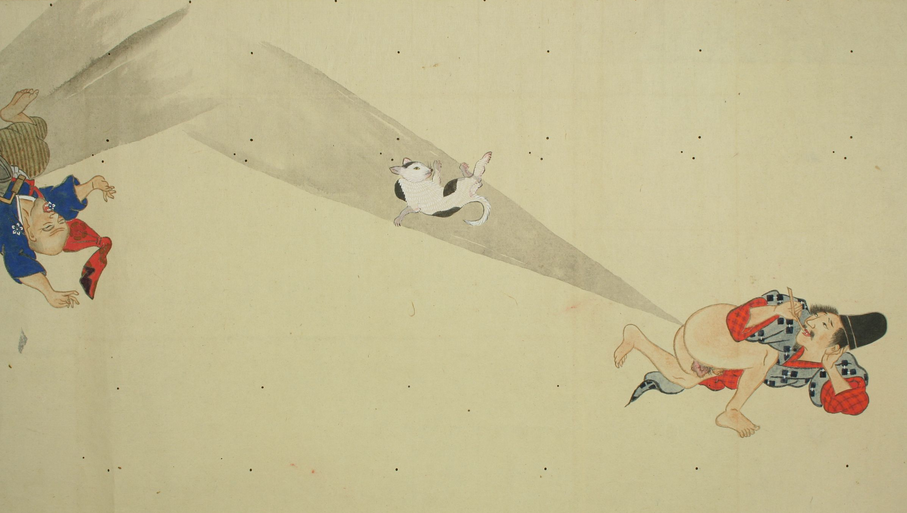
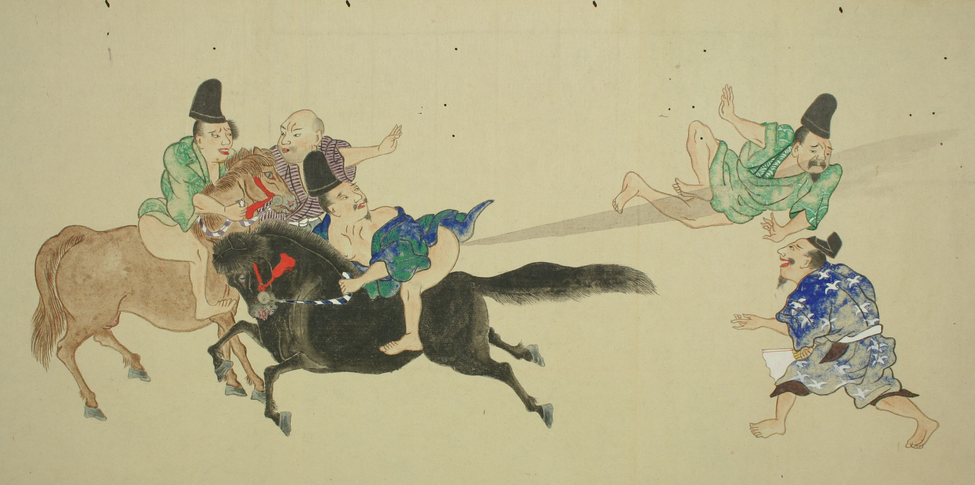
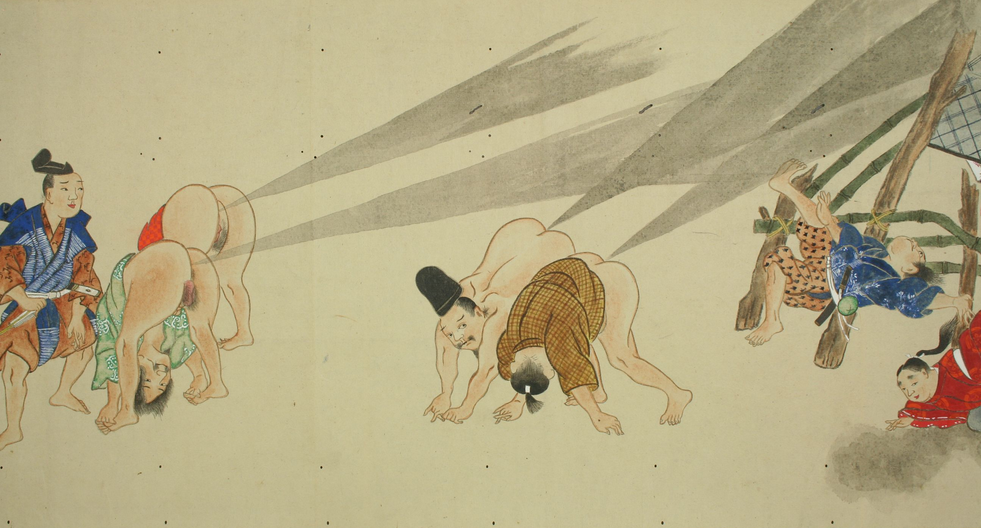
While the He-Gassen scroll from roughly the 1840s has little of the Zen-like restraint of the above examples, it definitely shows the wind in the trees. He-Gassen (屁合戦) literally translates into “fart battle” and it shows various men and women with their rears in the air, breaking hurricane-strength wind — blasts so powerful that they can launch cats into the air, blow through walls, knock over buildings and generally send victims reeling. The scroll is easily one of the most remarkable, and hilarious, pieces of art I’ve seen in a long while.
The whole thing might look like an extended sketch from Terreace and Phillip, those gassy Canadian TV stars from South Park, but some argue that He-Gassen might have a political dimension. During the Edo period (1603–1867), flatulence was used as a way to mock westerners. Japan was closed off from the outside world and they were feeling more and more pressure from the West until finally American gun boats led by Commodore Matthew Perry forced the country open in 1853. What better way to thwart these Western interlopers than with a cavalcade of industrial strength gas?
Jonathan Crow is a Los Angeles-based writer and filmmaker whose work has appeared in Yahoo!, The Hollywood Reporter, and other publications. You can follow him at @jonccrow. And check out his blog Veeptopus, featuring lots of pictures of vice presidents with octopuses on their heads. The Veeptopus store is here.
Separated by only seven years, Dylan Thomas and W.H. Auden had what might be called a friendly rivalry—at least, that is, from Thomas’ point of view. The hard-drinking Welsh poet once wished Auden a happy seventieth birthday—on his thirtieth. It’s a typical comment, writes biographer Walford Davies, expressed “with the attractive brio of a younger brother.” Thomas wrote of his admiration for “the mature, religious, and logical fighter,” but deprecated “the boy bushranger” in the older, more reserved Auden.
Whether we take these appraisals as gentle ribbing or—as another Thomas biographer Andrew Lycett writes—“disdain,” it does not seem that Thomas felt such antipathy for Auden’s poetry. One would think the contrary listening to him read Auden’s “As I Walked Out One Evening,” above. Thomas, Lycett tells us, “approved of Auden’s propensity for radical cultural change” but disapproved of the way his “political tub thumping got in the way of his poetry.”
Thomas uses his sonorous voice in a theatrical way that well-suits Auden’s stately verse. That voice became a regular feature for several years on the BBC for whom Thomas recorded broadcast after broadcast of readings and radio plays in the late 1940s. As we’ve detailed in a previous post, he made many recordings of his own work as well, including of his most well known poem, “Do Not Go Gentle into that Good Night,” which he reads in somber, measured tones. Above, in a reading of Auden’s “September 1, 1939,” Thomas takes a strained, almost affected, tone, perhaps evincing some aversion to the “political tub-thumping” in Auden’s poem. His breathing is labored, and he was, in all likelihood, drunk. He usually was, and he did suffer from a breathing condition. Thomas sadly drank himself to death, while Auden, who didn’t quite see seventy, lived on twenty more years, and recorded his own readings of “As I Went Walking” and “September 1, 1939.”
Both the latter Auden poem and the one Thomas reads above, “Song of the Master and Boatswain,” begin in bars: the speaker in “September 1” sits “in one of the dives / on Fifty-Second Street.” “Song of the Master and the Boatswain” opens “At Dirty Dick’s and Sloppy Joe’s” where “we drank our liquor straight.” Aside from these settings neither has anything at all in common. “Master and Boatswain” is almost bawdy, but ends on a cynical note. Written days after the event and dense with philosophical and classical allusions, “September 1” laments Germany’s invasion of Poland, the effective beginning of what would become World War II. Thomas was a more anarchic, less restrained poet, and Auden, the more educated, and disciplined, of the two. But it can certainly be said that they shared a similar sensibility in a taste for the tragic.
I freely admit it—like a great many people these days, I have a social media addiction. My drug of choice, Twitter, can seem like a particularly schizoid means of acquiring and sharing information (or knee-jerk opinion, rumor, innuendo, nonsense, etc.) and a particularly accelerated form of distractibility that never, ever sleeps. Given the profound degree of over-stimulation such outlets provide, we might be justified in thinking we owe our short attention spans to 21st century technological advances. Not necessarily, says Michigan State University professor Natalie Phillips—who studies 18th and 19th century English literature from the perspective of a 21st century cognitive theorist, and who cautions against “adopting a kind of historical nostalgia, or assuming those of the 18th century were less distracted than we are today.”
Early modern writers were just as aware of—and as concerned about—the problem of inattention as contemporary critics, Phillips argues, “amidst the print-overload of 18th-century England.” We might refer, for example, to Alexander Pope’s epic satire “The Dunciad,” a hilariously apocalyptic jeremiad against the proliferation of careless reading and writing in the new media environment of his day. (A world “drowning in print, where everything was ephemeral, of the moment.”)
Phillips focuses on the work of Jane Austen, whom, she believes, “was drawing on the contemporary theories of cognition in her time” to construct distractible characters like Pride and Prejudice’s Elizabeth Bennett. Taking her cues from Austen and other Enlightenment-era writers, as well as her own inattentive nature, Phillips uses contemporary neuroscience to inform her research, including the use of brain imaging technology and computer programs that track eye movements.
In collaboration with Stanford’s Center for Cognitive and Biological Imaging (CNI), Phillips devised an experiment in 2012 in which she asked literary PhD candidates—chosen, writes Stanford News, “because Phillips felt they could easily alternate between close reading and pleasure reading”—to read a full chapter from Austen’s Mansfield Park, projected onto a mirror inside an MRI scanner. At times, the subjects were instructed to read the text casually, at others, to read closely and analytically. Afterwards, they were asked to write an essay on the passages they read with attention. As you’ll hear Phillips describe in the short NPR piece above, the neuroscientists she worked with told her to expect only the subtlest of differences between the two types of reading. The data showed otherwise. Phillips describes her surprise at seeing “how much the whole brain, global activations across a number of different regions, seems to be transforming and shifting between the pleasure and the close reading.” As CNI neuroscientist Bob Dougherty describes it, “a simple request to the participants to change their literary attention can have such a big impact on the pattern of activity during reading,” with close reading stimulating many more areas of the brain than the casual variety. What are we to make of these still inconclusive results? As with many such projects in the emerging interdisciplinary field of “literary neuroscience,” Phillips’ goal is in part to demonstrate the continued relevance of the humanities in the age of STEM. Thus, she theorizes, the practice and teaching of close reading “could serve—quite literally—as a kind of cognitive training, teaching us to modulate our concentration and use new brain regions as we move flexibly between modes of focus.”
The study also provides us with a fascinating picture—quite literally—of the ways in which the imaginative experience of reading takes place in our bodies as well as our minds. Close, sustained, and attentive reading, Phillips found, activates parts of the brain responsible for movement and touch, “as though,” writes NPR, “readers were physically placing themselves within the story as they analyzed it.” Phillips’ study offers a scientific look at a mysterious experience serious readers know well—“how the right patterns of ink on a page,” says Dougherty, “can create vivid mental imagery and instill powerful emotions.” As with the so-called “hard problem of consciousness,” we may not understand exactly how this happens anytime soon, but we can observe that the experience of close reading is a rewarding one for our entire brain, not just the parts that love Jane Austen. While not everyone needs convincing that “literary study provides a truly valuable exercise of people’s brains,” Phillips’ research may prove exactly that.
Most cinephiles want to watch not just their favorite directors’ films, but their favorite directors’ favorite films. And how many cinephiles’ lists of favorite directors fail to include Stanley Kubrick? In 2013, we featured the only top-ten list the director of 2001: A Space Odyssey and A Clockwork Orange ever wrote, for Cinema magazine in 1963, which runs as follows:
I Vitelloni (Fellini, 1953)
Wild Strawberries (Bergman, 1957)
Citizen Kane (Welles, 1941)
The Treasure of the Sierra Madre (Huston, 1948)
City Lights (Chaplin, 1931)
Henry V (Olivier, 1944)
La notte (Antonioni, 1961)
The Bank Dick (Fields, 1940)
Roxie Hart (Wellman, 1942)
Hell’s Angels (Hughes, 1930)
But fans eager to find out more of what shaped the cinematic taste of this auteur of all auteurs do have a few more resources to turn to. At criterion.com, Joshua Warren has compiled, “from interviews with Kubrick’s family, friends and colleagues, an interview [Kubrick] did in 1957 for Cahiers du cinéma as well as an interview in 1963 for Cinema magazine and the ‘Master list’ by the BFI,” an annotated list of Kubrick’s favorite films.
And at the BFI’s site, Nick Wrigley (“with the help of Kubrick’s right-hand man, Jan Harlan”) has another set of such lists. Their combined selections, organized by director, run as follows. Note that one film on the extended list, Fritz Lang’s 1927 masterpiece Metropolis, can be viewed above.
Annie Hall (Woody Allen, 1977)
Husbands and Wives (Woody Allen, 1992)
Manhattan (Woody Allen, 1979)
Radio Days (Woody Allen, 1987)
McCabe & Mrs. Miller (Robert Altman, 1971)
If… (Lindsay Anderson, 1968)
Boogie Nights (Paul Thomas Anderson, 1998)
La notte (Michelangelo Antonioni, 1961)
Harold and Maude (Hal Ashby, 1971)
Pelle the Conqueror (Bille August, 1987)
Babette’s Feast (Gabriel Axel, 1987)
Casque d’Or (Jacques Becker, 1952)
Édouard et Caroline (Jacques Becker, 1951)
Cries and Whispers (Ingmar Bergman, 1972)
Smiles of a Summer Night (Ingmar Bergman, 1955)
Wild Strawberries (Ingmar Bergman, 1972)
Deliverance (John Boorman, 1972)
Henry V (Kenneth Branagh, 1989)
Modern Romance (Albert Brooks, 1981)
Children of Paradise (Marcel Carné, 1945)
City Lights (Charles Chaplin, 1931)
The Bank Dick (Edward Cline, 1940)
Beauty and the Beast (Jean Cocteau, 1946)
Apocalypse Now (Francis Ford Coppola, 1979)
The Godfather (Francis Ford Coppola, 1972)
The Silence of the Lambs (Jonathan Demme, 1991)
Alexander Nevsky (Sergei Eisenstein, 1938)
The Spirit of the Beehive (Victor Erice, 1973)
La strada (Federico Fellini, 1954)
I vitelloni (Federico Fellini, 1953)
La Kermesse Héroïque (Jacques Feyder, 1935)
Tora! Tora! Tora! (Richard Fleischer, 1970)
The Fireman’s Ball (Miloš Forman, 1967)
One Flew Over the Cuckoo’s Nest (Milos Forman, 1975)
Cabaret (Bob Fosse, 1972)
The Exorcist (William Friedkin, 1973)
Get Carter (Mike Hodges, 1971)
The Terminal Man (Mike Hodges, 1974)
The Texas Chainsaw Massacre (Tobe Hooper, 1974)
Hell’s Angels (Howard Hughes, 1930)
The Treasure of Sierra Madre (John Huston, 1947)
Dekalog (Krzysztof Kieslowski, 1990)
Rashomon (Akira Kurosawa, 1950)
Seven Samurai (Akira Kurosawa, 1954)
Throne of Blood (Akira Kurosawa, 1957)
Metropolis (Fritz Lang, 1927)
An American Werewolf in London (John Landis, 1981)
Abigail’s Party (Mike Leigh, 1977)
La bonne année (Claude Lelouch, 1973)
Once Upon a Time in the West (Sergio Leone, 1968)
Very Nice, Very Nice (Arthur Lipsett, 1961)
American Graffiti (George Lucas, 1973)
Dog Day Afternoon (Sidney Lumet, 1975)
Eraserhead (David Lynch, 1976)
House of Games (David Mamet, 1987)
The Red Squirrel (Julio Medem, 1993)
Bob le flambeur (Jean-Pierre Melville, 1956)
Closely Watched Trains (Jiří Menzel, 1966)
Pacific 231 (Jean Mitry, 1949)
Roger & Me (Michael Moore, 1989)
Henry V (Laurence Olivier, 1944)
The Earrings of Madame de… (Max Ophuls, 1953)
Le plaisir (Max Ophuls, 1951)
La ronde (Max Ophuls, 1950)
Rosemary’s Baby (Roman Polanski, 1968)
The Battle of Algiers (Gillo Pontecorvo, 1966)
Heimat (Edgar Reitz, 1984)
Blood Wedding (Carlos Saura, 1981)
Cría Cuervos (Carlos Saura, 1975)
Peppermint Frappé (Carlos Saura, 1967)
Alien (Ridley Scott, 1977)
The Anderson Platoon (Pierre Schoendoerffer, 1967)
White Men Can’t Jump (Ron Shelton, 1992)
Miss Julie (Alf Sjöberg, 1951)
The Phantom Carriage (Victor Sjöström, 1921)
The Vanishing (George Sluizer, 1988)
Close Encounters of the Third Kind (Steven Spielberg, 1977)
E.T. the Extra-terrestrial (Steven Spielberg, 1982)
Mary Poppins (Robert Stevenson, 1964)
Platoon (Oliver Stone, 1986)
Pulp Fiction (Quentin Tarantino, 1994)
The Sacrifice (Andrei Tarkovsky, 1986)
Solaris (Andrei Tarkovsky, 1972)
The Emigrants (Jan Troell, 1970)
The Blue Angel (Josef von Sternberg, 1930)
Danton (Andrzej Wajda, 1984)
Girl Friends (Claudia Weill, 1978)
The Cars that Ate Paris (Peter Weir, 1974)
Picnic at Hanging Rock (Peter Weir, 1975)
Citizen Kane (Orson Welles, 1941)
Roxie Hart (William Wellman, 1942)
Ådalen 31 (Bo Widerberg, 1969)
The Siege of Manchester (Herbert Wise, 1965)
As you might expect from a filmmaker who entered a different genre with every picture, this list of all the movies he went on record as admiring includes all different kinds of movies. We expect to find respected films by his colleagues in respected auteurhood like Woody Allen, Ingmar Bergman, Andrei Tarkovsky, and Max Ophuls (who, said Kubrick, “possessed every possible quality”). But perhaps more surprisingly, the list also includes thrillers like The Terminal Man, exercises in horror like The Texas Chainsaw Massacre, and grotesque comedies like The Cars That Ate Paris. But think about those movies for a moment, and you realize that, like Kubrick’s own work, they all transcend their supposed genres. As for what he saw in White Men Can’t Jump — well, I suppose we’ve all got to take some secrets to the grave.
Back in 2010, Hayao Miyazaki’s company Studio Ghibli produced a commercial for the massive food conglomerate Nissin Seifun. The spot centers on a rotund cat named Konyara who bats lazily at a red butterfly – Nissin’s logo. Konyara is rendered in simple thick, black lines that recall Japanese sumi‑e painting.
Miyazaki reportedly didn’t have much to do directly with the piece but his influence is all over it. The commercial was produced by Miyazaki’s long time collaborator Toshio Suzuki and animated by Katsuya Kondo, who did the character design for perhaps Miyazaki’s most cat-centric movie Kiki’s Delivery Service.
Another Miyazaki collaborator, pop legend Akiko Yano, did the music. More to the point, Konyara looks like some of Miyazaki’s most enduring characters from Totoro to Ponyo to the Kodama from Princess Mononoke. Adorable, elegant and vital.
The commercial was so successful that Nissin commissioned two more. The second one aired in 2012 and featured a sleepy Konyara struggling to grab 40 winks while her offspring, named Ko-Konyara (trans: Little Konyara), insists on cuddling. The calligraphy on the side reads “Always together.”
The most recent Ghibli/Nissin commercial came out a few months ago. Konyara’s brood has expanded to three – the two new cats named Kuroneko and Buchi. All three tumble into the frame as Konyara presents them with a fish while text appears reading, “I’m hungry.” When the little black kitten, who looks a lot like a soot sprite from Totoro, runs off with dinner, Konyara gives a resigned sigh. It’s an expression that anyone who has spent long periods with very young children will recognize.
Jonathan Crow is a Los Angeles-based writer and filmmaker whose work has appeared in Yahoo!, The Hollywood Reporter, and other publications. You can follow him at @jonccrow. And check out his blog Veeptopus, featuring lots of pictures of vice presidents with octopuses on their heads. The Veeptopus store is here.
We're hoping to rely on loyal readers, rather than erratic ads. Please click the Donate button and support Open Culture. You can use Paypal, Venmo, Patreon, even Crypto! We thank you!
Open Culture scours the web for the best educational media. We find the free courses and audio books you need, the language lessons & educational videos you want, and plenty of enlightenment in between.