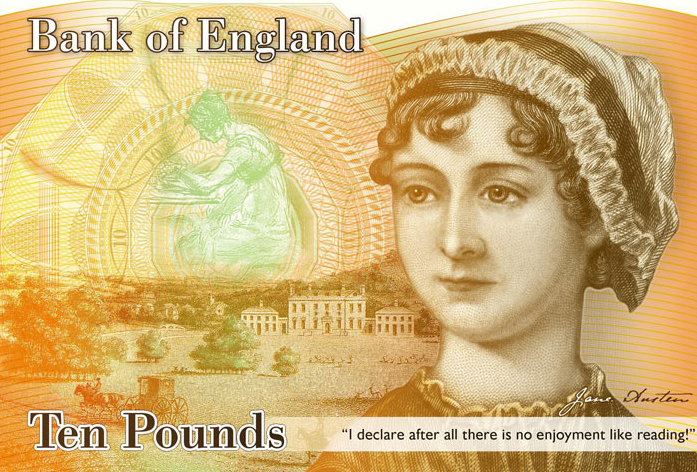
Earlier this year, the Royal Mail released a stamp collection commemorating Jane Austen’s six novels. Now, word has leaked out that, probably starting in 2017, the author of Pride and Prejudice will appear on the £10 note. Said Mark Carney, the new governor of the Bank of England, “Jane Austen certainly merits a place in the select group of historical figures to appear on our banknotes. Her novels have an enduring and universal appeal and she is recognised as one of the greatest writers in English literature.” Only three women have appeared on English banknotes since they started portraying historical figures in 1970. Austen will be the fourth. The Guardian has more on this good story here.
The history of philosophy tends to get mightily abbreviated. The few philosophy professors I know don’t have much truck with generalist “history of ideas”-type projects, and the discipline itself encourages, nay, requires, intensive specialization. Add to this glib comments like Alfred North Whitehead’s on philosophy as a “series of footnotes to Plato,” and the eminent position of the erratic and comparatively philosophically-unschooled autodidact Wittgenstein, and you have, in modern philosophy, a sad neglect of the genealogy of thought.
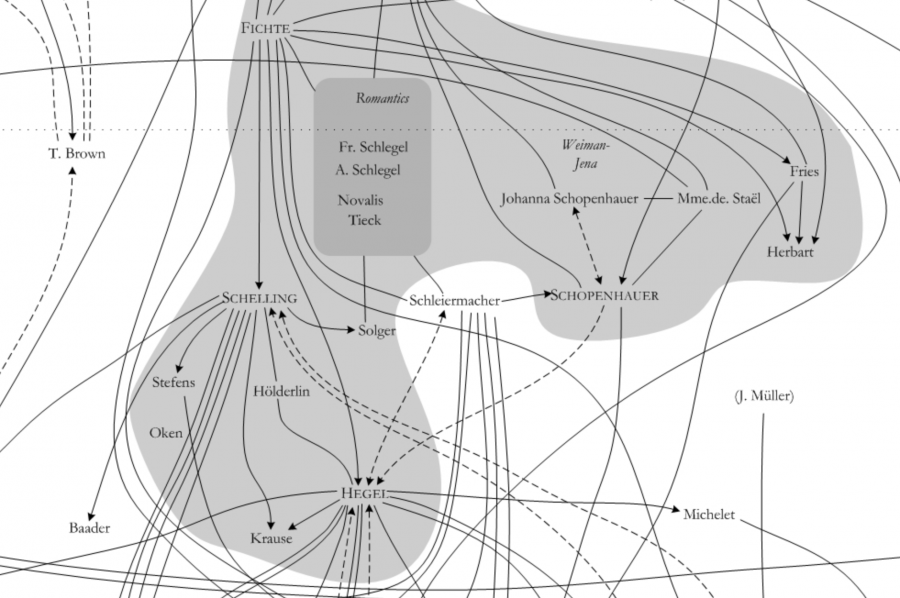
But take heart, you who, like me, incline toward minor figures and obscure relationships. Ohio State professor of philosophy Kevin Scharp is a Linnaean taxonomist of thought, compiling charts, “Information Boxes,” and hand-drawn diagrams of the “Sociology of Philosophy,” like that above, which covers Western philosophy from 600 B.C.E. to 600 C.E. and shows the myriad complex connections between hundreds of individual philosophers and schools of thought (such as Stoicism, Skepticism, Neo-Platonism, etc.). The second massive diagram covers 600 C.E. to about 1935. Each one is about 4 feet wide and 44 feet tall, with the text at 12-pont font. Both diagrams are based on Sociology of Philosophies by Randall Collins.
Note: to see the diagrams in detail, you will need to click the links above, and then click again on the images that appear on the new web page.
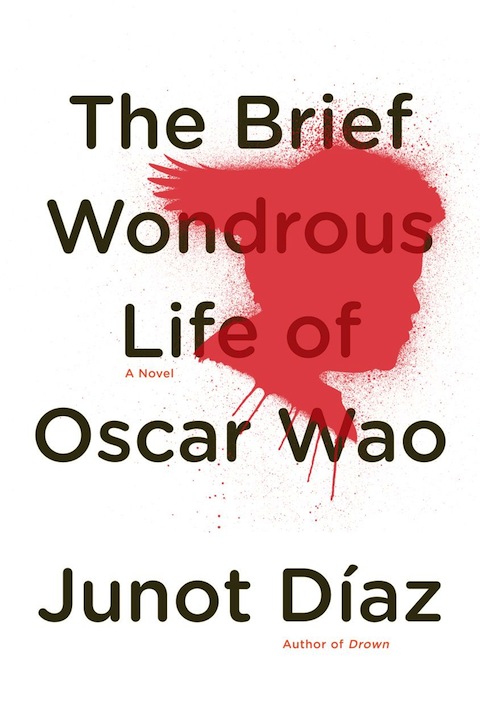
Junot Díaz’s breakout 2007 novel The Brief Wondrous Life of Oscar Wao is a brilliant illustration of “misprision,” the act of misreading or misunderstanding that, in Harold Bloom’s estimation, precipitates new literary creation. In Díaz’s novel, the experiences of a young immigrant—a sci-fi nerd and gamer interacting with culture high and low—brings forth a vibrant, playful polyglot born from misunderstanding and desire.
So far, this reading is the standard fare of critical appraisals of the book. Now, however, we have it on authority—from the author himself, who has provided his own annotations for an excerpt of Oscar Wao via “Poetry Genius,” a section of the popular site “Rap Genius,” that allows authors to annotate their own work. The portion of the novel Díaz chooses to annotate is packed with allusions to science fiction classics, including Frank Herbert’s Dune, Planet of the Apes, and, of course, Star Wars. In the selection below on Star Wars’ fictional planet Tatooine, Díaz makes a humorous and insightful comment on nerd culture, race and nationality, and the yearning every fanboy or girl has to see him or herself in the works they love.
Depending on your fanboy orientation either the first or second most famous desert planet in nerdom. Again when I saw those landscapes in Star Wars I felt surge of kinship. Shit, on first viewing I also thought my man’s name was Juan Kenobi. But that’s what happens when you’re an immigrant kid of color in a culture that erases your community completely. You start inventing filiations.
As publisher Melville House’s blog notes, Díaz’s annotation often reads like a “line-by-line author talk.” Per usual, the author is as comfortable in an off-the-cuff vernacular as he is in an erudite literary-critical voice, as when he cites David Foster Wallace, Jorge Luis Borges, Patrick Chamoiseau, and William Vollmann as inspirations. The Poetry Genius site also includes the fascinating interview with Díaz above. Fans of Díaz and the novel won’t want to miss it.
Here’s a fascinating glimpse of the very first Bloomsday celebration, filmed in Dublin in 1954.
The footage shows the great Irish comedic writer Brian O’Nolan, better known by his pen name Flann O’Brien, appearing very drunk as he sets off with two other renowned post-war Irish writers, Patrick Kavanagh and Anthony Cronin, and a cousin of James Joyce, a dentist named Tom Joyce, on a pilgrimage to visit the sites in James Joyce’s epic novel Ulysses.
The footage was taken by John Ryan, an artist, publisher and pub owner who organized the event. The idea was to retrace the steps of Leopold Bloom and other characters from the novel, but as Peter Costello and Peter van de Kamp explain in this humerous passage from their book, Flann O’Brien: An Illustrated Biography, things began to go awry right from the start:
The date was 16 June, 1954, and though it was only mid-morning, Brian O’Nolan was already drunk.
This day was the fiftieth anniversary of Mr. Leopold Bloom’s wanderings through Dublin, which James Joyce had immortalised in Ulysses.
To mark this occasion a small group of Dublin literati had gathered at the Sandycove home of Michael Scott, a well-known architect, just below the Martello tower in which the opening scene of Joyce’s novel is set. They planned to travel round the city through the day, visiting in turn the scenes of the novel, ending at night in what had once been the brothel quarter of the city, the area which Joyce had called Nighttown.
Sadly, no-one expected O’Nolan to be sober. By reputation, if not by sight, everyone in Dublin knew Brian O’Nolan, otherwise Myles na Gopaleen, the writer of the Cruiskeen Lawn column in the Irish Times. A few knew that under the name of Flann O’Brien, he had written in his youth a now nearly forgotten novel, At Swim-Two-Birds. Seeing him about the city, many must have wondered how a man with such extreme drinking habits, even for the city of Dublin, could have sustained a career as a writer.
As was his custom, he had been drinking that morning in the pubs around the Cattle Market, where customers, supposedly about their lawful business, would be served from 7:30 in the morning. Now retired from the Civil Service, on grounds of “ill-health”, he was earning his living as a free-lance journalist, writing not only for the Irish Times, but for other papers and magazines under several pen-names. He needed to write for money as his pension was a tiny one. But this left little time for more creative work. In fact, O’Nolan no longer felt the urge to write other novels.
The rest of the party, that first Bloomsday, was made up of the poet Patrick Kavanagh, the young critic Anthony Cronin, a dentist named Tom Joyce, who as Joyce’s cousin represented the family interest, and John Ryan, the painter and businessman who owned and edited the literary magazine Envoy. The idea of the Bloomsday celebration had been Ryan’s, growing naturally out of a special Joyce issue of his magazine, for which O’Nolan had been guest editor.
Ryan had engaged two horse drawn cabs, of the old fashioned kind, which in Ulysses Mr. Bloom and his friends drive to poor Paddy Dignam’s funeral. The party were assigned roles from the novel. Cronin stood in for Stephen Dedalus, O’Nolan for his father, Simon Dedalus, John Ryan for the journalist Martin Cunningham, and A.J. Leventhal, the Registrar of Trinity College, being Jewish, was recruited to fill (unkown to himself according to John Ryan) the role of Leopold Bloom.
Kavanagh and O’Nolan began the day by deciding they must climb up to the Martello tower itself, which stood on a granite shoulder behind the house. As Cronin recalls, Kavanagh hoisted himself up the steep slope above O’Nolan, who snarled in anger and laid hold of his ankle. Kavanagh roared, and lashed out with his foot. Fearful that O’Nolan would be kicked in the face by the poet’s enormous farmer’s boot, the others hastened to rescue and restrain the rivals.
With some difficulty O’Nolan was stuffed into one of the cabs by Cronin and the others. Then they were off, along the seafront of Dublin Bay, and into the city.
In pubs along the way an enormous amount of alcohol was consumed, so much so that on Sandymount Strand they had to relieve themselves as Stephen Dedalus does in Ulysses. Tom Joyce and Cronin sang the sentimental songs of Tom Moore which Joyce had loved, such as Silent, O Moyle. They stopped in Irishtown to listen to the running of the Ascot Gold Cup on a radio in a betting shop, but eventually they arrived in Duke Street in the city centre, and the Bailey, which John Ryan then ran as a literary pub.
They went no further. Once there, another drink seemed more attractive than a long tour of Joycean slums, and the siren call of the long vanished pleasures of Nighttown.
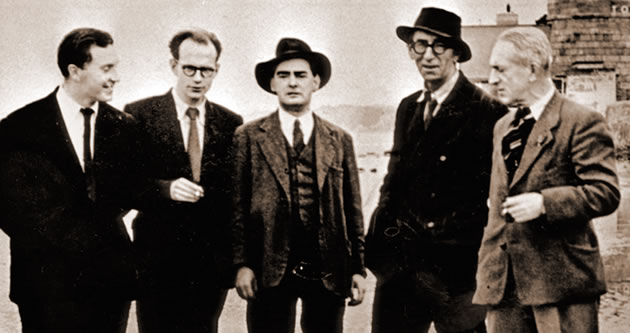
Celebrants of the first Bloomsday pause for a photo in Sandymount, Dublin on the morning of June 16, 1954. From left are John Ryan, Anthony Cronin, Brian O’Nolan (a.k.a. Flann O’Brien), Patrick Kavanagh and Tom Joyce, cousin of James Joyce.
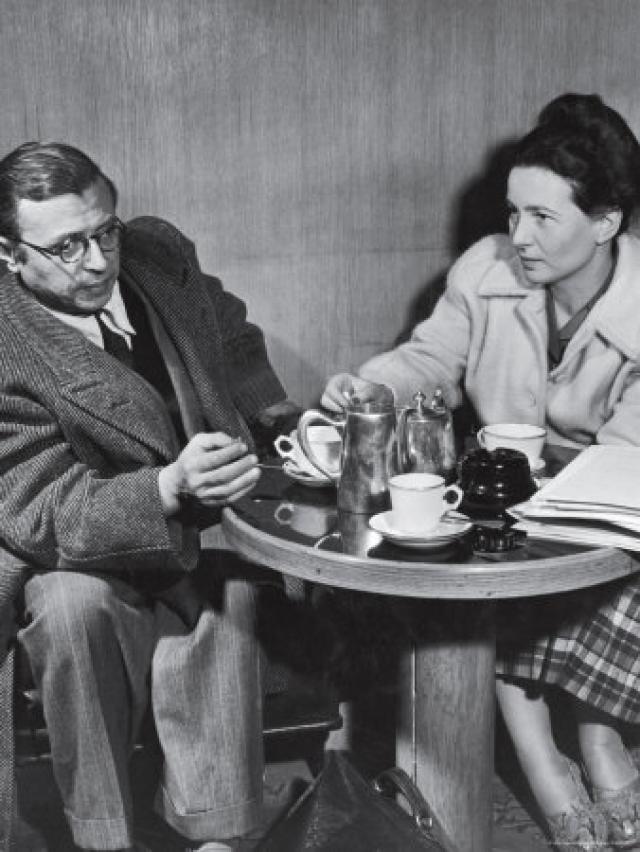
In 1987, Marty Smith published a spoof called The Jean-Paul Sartre Cookbook in a Portland, Oregon alternative newspaper called the Free Agent. Later, in 1993, it was republished in the Utne Reader. And it starts with this premise:
We have been lucky to discover several previously lost diaries of French philosopher Jean-Paul Sartre stuck in between the cushions of our office sofa. These diaries reveal a young Sartre obsessed not with the void, but with food. Apparently Sartre, before discovering philosophy, had hoped to write “a cookbook that will put to rest all notions of flavor forever.” The diaries are excerpted here for your perusal.
Now for a couple of my favorite entries:
October 3
Spoke with Camus today about my cookbook. Though he has never actually eaten, he gave me much encouragement. I rushed home immediately to begin work. How excited I am! I have begun my formula for a Denver omelet.
October 6
I have realized that the traditional omelet form (eggs and cheese) is bourgeois. Today I tried making one out of a cigarette, some coffee, and four tiny stones. I fed it to Malraux, who puked. I am encouraged, but my journey is still long.
November 23
Ran into some opposition at the restaurant. Some of the patrons complained that my breakfast special (a page out of Remembrance of Things Past and a blowtorch with which to set it on fire) did not satisfy their hunger. As if their hunger was of any consequence! “But we’re starving,” they say. So what? They’re going to die eventually anyway. They make me want to puke. I have quit the job. It is stupid for Jean-Paul Sartre to sling hash. I have enough money to continue my work for a little while.
November 26
Today I made a Black Forest cake out of five pounds of cherries and a live beaver, challenging the very definition of the word “cake.” I was very pleased. Malraux said he admired it greatly, but could not stay for dessert. Still, I feel that this may be my most profound achievement yet, and have resolved to enter it in the Betty Crocker Bake-Off.
The School of Open is offering its second round of free, facilitated, online courses. Through August 4, you can sign up for 7 courses on open science, collaborative workshop design, open educational resources, copyright for educators, Wikipedia, CC licenses, and more. Courses will start after the first week of August and run for 3 to 7 weeks, depending on the course topic and organizer. All courses will offer badges for recognition of skills and/or course completion as part of P2PU’s badges pilot. Here’s a list of the upcoming courses, all of which have been added to our comprehensive list of MOOCs.
Literary theorist and scholar Walter Benjamin was part of a small but incredibly significant cohort of German-Jewish intellectuals who fled the Nazis in the thirties. The group included thinkers like Theodor Adorno, Max Horkheimer, Hannah Arendt, Herbert Marcuse, and Bertolt Brecht. Of all of the names above, only Benjamin succumbed, committing suicide by morphine overdose in 1940 at a Catalonian hotel, when it became clear that the Spanish, with whom he had sought refuge, were going to turn him back over to Germany.
Of all of the thinkers above, most of whom are fairly well-known by U.S. students of the liberal arts, it can (and should) be argued that Benjamin was the most influential, even if he rarely appears on a syllabus, excepting one well-known essay, “The Work of Art in the Age of Mechanical Reproducibility,” a staple of film and media theory classes. All of the thinkers listed above adored Benjamin, and all of them figuratively sat at his feet. And while Benjamin—often by reference to the aforementioned essay—gets pegged as a Marxist thinker, he was also something else; he was a mystic and a sage, the critical equivalent, perhaps, of Kafka.
The 1993 experimental film above—One Way Street: Fragments for Walter Benjamin—is part documentary, part low-budget cable-access editing exercise. The film provides an introduction to Benjamin’s life and thought through interviews with scholars, re-enactments of Benjamin’s last days, and montages centered around his many aphoristic expressions. One Way Street opens with an epigram from Benjamin’s pupil Brecht, from the latter’s poem “On the Suicide of the Refugee W.B.,” in which Brecht eulogizes his mentor’s prophetic strain: “the future lies in darkness and the forces of right / Are weak. All this was plain to you.” Indeed, it is this mystical aspect of Benjamin that defies his strict categorization as a dogmatic Marxist materialist. Through the considerable influence of his friend Gershom Scholem, Benjamin acquired a deep interest in Kabbalistic thought, including a messianic streak that colored so much of his writing.
In reference to this Jewish mysticism, Anson Rabinbach, editor of New German Critique summarizes Benjamin’s thought above:
The world is… dispersed in fragments, and in these fragments, the fragments of the world that God has now turned his back on, reside certain presences, which attest to the former existence of their divine character. You cannot actively go about to discover these divine presences, but they can be revealed.
According to Rabinbach, Benjamin’s method was, similar to Freud’s, an attempt to “unlock” these “emanations” by “juxtaposing things that don’t quite necessarily appear to be related to each other… And this is the Kabbalistic sense, that you cannot go directly at the task, because the disclosure of the emanation is blocked.” Benjamin’s fragmentary “method” produced prodigious results—hundreds upon hundreds of pages of essays, and a frustratingly unfinished book published as The Arcades Project.
His thought is so diverse that one commenter in the film above—Michael Jennings, author of Benjamin study Dialectical Images—says that “the way that Benjamin is used most in this country, is to dip in and take a quotation out of context, in support of any argument one could think of, and I used to take umbrage at this, until I realized that this was precisely Benjamin’s own practice.” In this way, Benjamin occupies a similar place in the humanities as Russian literary theorist Mikhail Bakhtin. Where he is famous, he is famous for creating whole conceptual fields one can invoke by uttering a single word or phrase.
One of the most potent words in the Benjamin lexicon is the French term flâneur. The flâneur is a “stroller, idler, walker,” a “well-dressed man, strolling leisurely through the Parisian arcades of the nineteenth century—a shopper with no intention to buy, an intellectual parasite of the arcade” (as Benjamin website “The Arcades Project Project” defines it). The flâneur is an individual of privilege and a progenitor of the male gaze: “Traditionally the traits that mark the flâneur are wealth, education, and idleness. He strolls to pass the time that his wealth affords him, treating the people who pass and the objects he sees as texts for his own pleasure.” The flâneur is not simply a passive observer; he is instead a kind of lazy urban predator, and also a dandy and proto-hipster. Perhaps the most sinister representation of this character (in a different urban context) is the creepy Svidrigailov in Dostoevsky’s Crime and Punishment.
In the 1998 film above, Flâneur III: Benjamin’s Shadow, Danish director Torben Skjodt Jensen and writer Urf Peter Hallberg collaborate on an impressionistic black-and-white meditation on Paris, overlaid with Hallberg’s ruminations and quotations from Benjamin. Benjamin’s fascination with nineteenth-century Paris drove his massive, unfinished Arcades Project, an excavation of the inner workings of modernity. Where One Way Street is marked by a very dated 90’s aesthetic (which may look chic now that the decade’s back in fashion), the above film is both classical and modernist, a testament to the beauties and contradictions of Paris. I think in this respect, it is a more fitting tribute to the critical and contradictory aesthetic theory of Walter Benjamin.
F. Scott Fitzgerald was right. The rich really are different from you or me. They’re more likely to behave unethically.
That’s the finding of a group of studies by researchers at the University of California, Berkeley. The research shows that people of higher socioeconomic status are more likely to break traffic laws, lie in negotiations, take valued goods from others, and cheat to increase chances of winning a prize. The resulting paper, “Higher Social Class Predicts Increased Unethical Behavior,” [PDF] was published last year in the Proceedings of the National Academy of Sciences.
Perhaps most surprising, as this story by PBS NewsHour economics reporter Paul Solman shows, is that the tendency for unethical behavior appears not only in people who are actually rich, but in those who are manipulated into feeling that they are rich. As UC Berkeley social psychologist Paul Piff says, the results are statistical in nature but the trend is clear. “While having money doesn’t necessarily make anybody anything,” Piff told New Yorkmagazine,“the rich are way more likely to exhibit characteristics that we would stereotypically associate with, say, assholes.”
The good folks at Book Riot conducted a survey of 828 readers, hoping to find out what books they’ve faked reading. The top five books (all available in our Free eBooks and Free Audio Books collections) may not come as a surprise:
Pride and Prejudice by Jane Austen
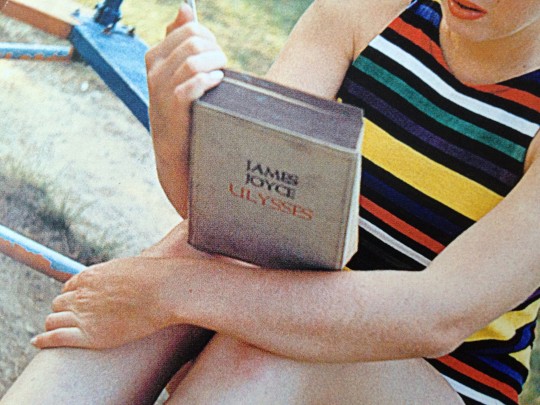
Ulysses by James Joyce
Moby-Dick by Herman Melville
War and Peace by Leo Tolstoy
The Bible
Nor will the remaining 15 astound you (give or take a couple). But we’ll let you head over to Book Riot for the complete list. Wait! Stop! Before you leave, let us know what books you’ve fudged before. It’s anonymous and all in good fun. Look forward to your confessions.
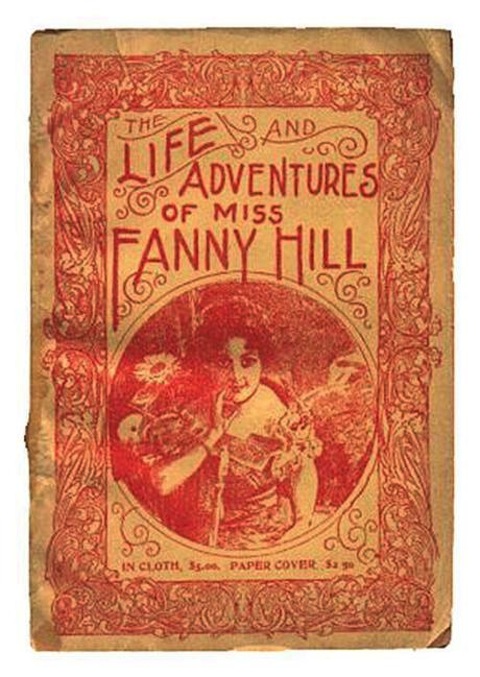
In a recent interview with literary historian Loren Glass about the achievements of taboo-busting publisher Grove Press, I wondered whether anyone growing up today could conceive of a book causing a public scandal, let alone a trial that reaches the Supreme Court. Grove had the highest-profile of its several legal skirmishes after publishing Henry Miller’s Tropic of Cancer in 1961. Two years later, G.P. Putnam Sons would drop their own literary bombshell in the form of Memoirs of a Woman of Pleasure, better known by the name of the protagonist there referenced, Fanny Hill, who, orphaned at fifteen, throws herself into a career in “profit by pleasing.” Originally written in 1748 by John Cleland, a former British East India Company employee locked up in debtors’ prison, the book broke new ground by offering almost nothing but a string of elaborately crafted (and, technically, “vulgar” language-free) sex scenes.
“A partial list of the book’s adventures includes an orgy, sex between women, masturbation, masochism, cross-dressing, and a detailed sodomy scene that is one of only two known explicit depictions of male same-sex ardor in the language before the end of the 19th century,” writes the Boston Globe’s Ruth Graham in an article on the 50th anniversary of the Fanny Hill-vindicating verdict. “The book still has the capacity to shock. As [assistant attorney general William I.] Cowin noted in front of the Supreme Court, after the first 10 pages of the novel, ‘all but 32 have sexual themes.’ But Fanny Hill would not have survived so long if it were merely scandalous in 18th-century terms: It remains revolutionary today because, as English critic Peter Quennell wrote in the introduction to the 1963 edition, “It treats of pleasure as the aim and end of existence.” You can find out just what this means by downloading the book free from Project Gutenberg or iTunes, or listening to a free audio version here. Whether these text-only editions count as worksafe all depends, of course, on the size of your screen and the literacy of your co-workers. You can see bawdy illustrations that appeared in historical editions here. Note that they are very definitively NSFW.
The story of Oskar Schindler, savior of thousands of Polish Jews, produced an epic novel, Schindler’s Ark, which in turn produced Steven Spielberg’s epic Schindler’s List. Like that of Anne Frank, Schindler’s story contains actions both unimaginably courageous and relatably human, and so his drama moves us past the stupefyingly brutal machinery of the Nazi death camps and into the lives of the real people under threat and those who helped them. But when we step out of the memoirs and fictionalizations and back into the dry history of documents, memos, and orders, the inhuman bureaucratic cast of Nazi efficiency returns, even in the case of Oskar Schindler.
Take the actual list (page one above). A featureless business ledger, the list is indistinguishable from the many concentration camp registers and death records Schindler’s fellow Nazis kept assiduously as they went about the business of eradicating a whole population. We know, of course, that Schindler played the part of a party believer to save lives instead of take them, but it’s still quite eerie to look over this faceless list of names and contemplate how close these men and women came to the horrors of the camps that took so many of their neighbors, friends, and relatives.
The list above is now on sale through an Ebay auction, starting bid 3 million dollars. It is certified authentic as the actual list typed up by Shindler’s accountant Itzhak Stern (played by Ben Kingsley in the film). The auction page provides the following information:
Itzhak Stern typed up the 14 page list on onion skin paper. Up for auction is not a copy of that list, but the actual one. It was sold by Itzhak Stern’s nephew to the current owner. It is dated in pencil on the first page, April 18, 1945. The auction will also include a copy of the affidavit from Stern’s nephew, recounting more details and provenance on The List. There’s a complete history of the composition of the list in David Crowe’s brilliant bio, Oskar Schindler: The Untold Account of His Life, Wartime Activities, and the True Story Behind the List.
We're hoping to rely on loyal readers, rather than erratic ads. Please click the Donate button and support Open Culture. You can use Paypal, Venmo, Patreon, even Crypto! We thank you!
Open Culture scours the web for the best educational media. We find the free courses and audio books you need, the language lessons & educational videos you want, and plenty of enlightenment in between.






%203.1%20%20(part%201).jpg)
%203.1%20%20(part%202).jpg)