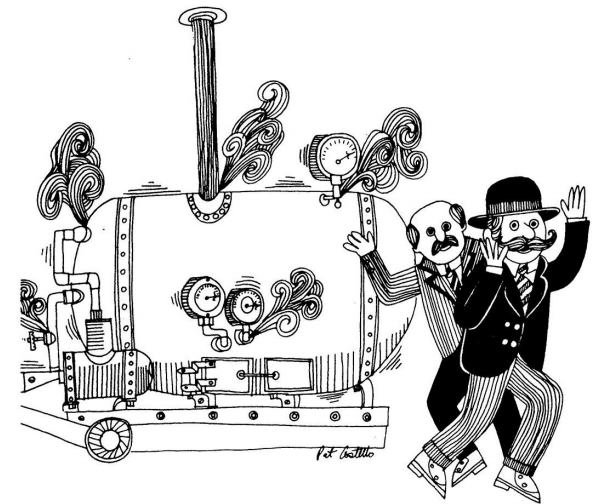
I see hints of blueprints, tile work, leaded-glass windows, William Blake, Paul Klee, Saul Steinberg, Al Hirschfeld, Edward Gorey, my mother’s wasp waist, cats and dogs. I see my father, at age four, forty, and eighty-four, doodling his heart out.
His daughter, Nanette, notes that he was drawn by the human face—his own and those of others.
Portraits include one of his best-known fictional characters, the unsuccessful science fiction author Kilgore Trout. It’s a revelation, especially to those of us who imagined Trout as something closer to veteran character actor Seymour Cassel.
In addition to his humorous doodles, Vonnegut was known to chisel out a sculpture or two on the kitchen counter.
He had a one-man show of his felt tip drawings in Greenwich Village in 1980 (“not because my pictures were any good but because people had heard of me”).
The son and grandson of architects, Vonnegut preferred to think of himself less as an artist than as a “picture designer.” Working on a novel was a “nightmare,” but drawing was pure pleasure.
Perfection was not the goal. Vonnegut realized a sympathetic community would spring up around an artist struggling within his limitations, and acted accordingly.
To that end, he recommended that people practice art “no matter how badly because it’s known to make a soul grow.”
“There’s only a couple of people I’ve felt genuinely frightened taking photos in front of live because the person is out of control,” says Manchester-based rock photographer Kevin Cummins. The first was Joy Division’s Ian Curtis, “and Iggy Pop was another.” Iggy’s onstage mania rivals any lead singer, living or dead. The intimidating Henry Rollins tells a story about his one and only attempt to upstage his idol. He describes Iggy as “two guys. There’s Jim (Jim Osterberg)—‘Hey, my name’s Jim, good to meet you, man, how are you?’ And then there’s Iggy Pop,” Rollins says, and does an impression of a seething madman. “Jim is cool. Iggy is like this terrifying monster of rock and roll.”
You’ve probably heard the stories of those early Stooges gigs. Smearing himself with peanut butter, cutting himself open with broken glass and leaping into the audience long before stage-diving was something people did. We’ve also heard a lot more from Jim these days: shirtless, but “lucid, intelligent,” and displaying excellent recall in his interview with Marc Maron in the comedian’s garage; mostly clothed, bespectacled, and professorial in his delivery of the BBC’s 2014 John Peel Lecture.
In interviews and on his radio show, including a recent two-hour Bowie tribute, he is witty, gregarious, and sometimes wistful. But Iggy’s still pretty terrifying onstage even into his elder-statesman-hood. Witness the stage plan drawn up in 2006 by Jos Grain, production manager for the 21st-century touring version of Iggy and The Stooges.
we like to keep it as clear as possible, especially at the front.
This means all cables for the downstage wedges etc must be run off the front in the pit, not accross the front of the stage.
My insurance doesn’t cover me for allowing rockstars to fall off the front of the stage.
No lighting or monitor cables, no power cables, no toy robots, no television evangelists, no television cameramen, no substances related to the manufacture of creosote, no plastic seahorses, no bailiwicks, no crepescules, no kooks and especially NO CAMERAMEN.
This way Iggy can run around in his customary manner like a crazed running around-type-thing and we can all relax in a haze of self-satisfied panic. [all sic]
Grain’s rider—a hilarious write-up prone to profane fugue states full of jarring non-sequiturs and riotous asides—pushes the genre as far as it can go. “If there was a Grammy for ‘best contract rider,’ writes Brian Mackay at the Springfield, Illinois State Journal-Register, “Iggy and the Stooges would retire the category.” A note about a guitar rack suddenly swerves into the following reverie:
Horse v Panda? I think the panda might just win it if he managed to get on the horse’s back and sink his teeth and claws into its neck. Without getting kicked in the bollocks, of course. Two hooves in a Panda’s gonads would probably bring victory to the horse, though I doubt it would celebrate much. Horses arent big champagne drinkers.
And fucking Grand Prix drivers just squirt it all over each other.
The requests get ridiculously specific, but it’s still more or less standard rock star stuff (nothing on the order of Van Halen’s “no brown M&M’s”) …or is it…? When we get down to the requirements for Iggy’s dressing room, Grain asks for:
Somebody dressed as Bob Hope doing fantastic Bob Hope impersonations and telling all those hilarious Bob Hope jokes about golf and Hollywood and Bing Crosby. Oh God, I wish I’d been alive in those days, so that Bob Hope could have come and entertained me in some World War 2 hell-hole before I went off and got shot. What joy they must have experienced…
OR
Seven dwarves, dressed up as those dwarves out of that marvelous Walt Disney film about the woman who goes to sleep for a hundred years after biting a poisoned dwarf, or maybe after pricking her finger on a rather sharp apple… or something. What was the name of that film? Was it Cinderella? Taller people are acceptable, of course. It’s attitude, more than height, that’s important here. Don’t forget the pointy hats!
As for the band’s needs, other references to pandas come up. The bass player needs three Marshall VBA Bass Amplifiers. “Please make sure they’re good ones,” Grain writes, “or we’ll all end up as wormlike web-based life forms in the bass player’s online literary diahorrea. Honestly. He’s like a sort of internet Pepys or Boswell, except without the gout and the syphilis. For all I know.” The Stooges’ bass player, by the way, is punk legend Mike Watt, whose tour diaries really are a species of literary genius.
Sometimes when I get down about the state of rock and roll, I remember that Iggy Pop is still alive and running around shirtless onstage like a lunatic at 71. And I remember this rider exists. Read the whole thing here.
For all of the justified ire directed at certain online retailers for their anti-competitive practices, tax evasion, labor exploitation, and so on, one fact often goes unremarked upon since it seems to fall outside the usual narratives. The explosion of online retail gave purchasing power to people locked out of certain markets because of income or geography or disability, etc. Moreover, it gave people outside of traditional market demographics the opportunity to experiment with new interests in judgment-free zones.
These changes have allowed a generation of musicians access to instruments they would never have been willing or able to find in the past. For example, Fender guitars has discovered that women now account for 50 percent of all “beginner and aspirational players,” notes Rolling Stone. “The instrument-maker is adjusting its marketing focus accordingly… around a massive new audience that it’d previously been ignoring.” Walking into a music store and feeling like you’ve been ignored by the big companies may not make for an encouraging experience. But the ability to buy gear online without a hassle may be one significant reason why so many more women have taken up the instrument.
Which brings us to Sears. Yes, it’s a roundabout way to get there, but bear with me. You’ve surely heard the news by now, the venerable retail giant has gone bankrupt after 132 years in business—a casualty of predatory capitalism or bad business practices or the inevitably changing times or what-have-you. A number of eulogies have described the company’s early “catalogue shopping system” as “the Amazon of its day,” as Lila MacLellan points out at Quartz. The comparison surely fits. During its heyday, people all over the country, in the most far-flung rural areas, could order almost anything, even a house.
But a number of stories, including MacLellan’s, have also described Sears, Roebuck & Company as a great equalizer of its day for the way it busted the Jim Crow barriers black shoppers once faced. Cornell University history professor Louis Hyman has posted a thread on hisTwitter and given an interview on Jezebel describing the democratizing power of the Sears Catalog in the late 19th century for black Americans, most of whom lived in rural areas (as did most Americans generally) and had to suffer discrimination from white shopkeepers, who charged inflated prices, denied sales and credit, forced black customers to wait at the back of long lines, and so on.
Hyman talks about this specific history in the video lecture above (starting at 6:24). The viciousness of segregation didn’t stop at the store. As he says, local postmasters would often refuse to sell stamps or money orders to black customers. The Sears Catalog, then, included specific instructions for giving cash directly to mail carriers. Storekeepers burned the catalogs, but still rural customers were able to get their hands on them and order what they needed, pay cash, and receive it without difficulty. A new world opened up for people previously shut out of many consumer markets, and this included, writes Chris Kjorness at Reason, turn-of-the-century musicians.
The Sears guitar, says Michael Roberts, who teaches the history of the blues at DePaul University, “was inexpensive enough that the blues artists were able to save up the money they made as sharecroppers to make that purchase.” As Kjorness puts it, “There was no Delta blues before there were cheap, readily available steel-string guitars. And those guitars, which transformed American culture, were brought to the boondocks by Sears, Roebuck & Co.”
The first Sears, Roebuck catalog was published in 1888. It would go on to transform America. Farmers were no longer subject to the variable quality and arbitrary pricing of local general stores. The catalog brought things like washing machines and the latest fashions to the most far-flung outposts. Guitars first appeared in the catalog in 1894 for $4.50 (around $112 in today’s money). By 1908 Sears was offering a guitar, outfitted for steel strings, for $1.89 ($45 today), making it the cheapest harmony-generating instrument available.
Quality improved, prices went down, and bluesmen could get their instruments by mail. Most of the big names we associate with the Delta blues bought a guitar from the Sears Catalog. Guitars became such a popular item that Sears introduced their own brand, under the existing Silvertone line, in the 1930s. Later budget guitars and amplifiers sold through Sears included Danelectro, Valco, Harmony, Kay, and Teisco (all of whom, at one time or another, made Silvertones).
These brands are now known to musicians as classic roots and garage rock instruments played by the likes of Jack White, but their histories all come together with Sears (you may hear them lumped together sometimes as “the Sears guitars”). The company first supplied bluesmen and country pickers with acoustic guitars, but “once the sound of the electric guitar became that of American music,” Whet Moser writes at Chicago Magazine, “teens in garages all over started picking up axes, and Sears was there to supply them.”
Through their business deal with Nathan Daniel, they manufactured the “amp-in-case” line of Danelectro Masonite guitars, sold in stores and catalogs. These funky 50s instruments, designed for maximum cost-cutting, incorporated surplus lipstick tubes as housing for their pickups. They made such a distinctive jangly sound, thanks to the way Daniel wired them, that it became a hallmark of 50s and 60s garage rock. Often sold under the Silvertone name as well, Danelectro guitars were cheap, but well designed. (Jimmy Page has had a particular fondness for the Danelectro 59).
While the product history of Sears electric guitars is incredibly complicated, with brand names, designs, and product lines shifting from year to year, it’s enough to say that without their budget guitars and amps, many of the struggling musicians who innovated the blues and rock and roll would have been unable to afford their instruments. The story of Sears writ large can be told as the story of a market “disruptor” raising standards of living for millions of rural and urban Americans. The company’s innovative marketing and distribution schemes were also totally central to the history of American popular music.
How did it all begin? Is there a god? Can we predict the future? Is there other intelligent life in the universe? For decades, many of us turned to Stephen Hawking for answers to those questions, or at least supremely intelligent suggestions as to where the answers might lie. But the celebrated astrophysicist’s death earlier this year — after an astonishingly long life and career, given the challenges he faced — took that option away. It turns out, though, that we haven’t actually heard the last of him: his last book, Brief Answers to the Big Questions (whose trailer you can watch just above), came out just this week.
“The book is quintessential Hawking,” writes physics professor Marcelo Gleiser at NPR. “He starts by addressing the questions in physics and cosmology that he dedicated his intellectual life to answer, using easy-to-follow arguments and drawing from everyday images and thought experiments.” Hawking’s answers to the big questions figure into his view of not just the world but all existence: he believes, writes Gleiser, “that humanity’s evolutionary mission is to spread through the galaxy as a sort of cosmic gardener, sowing life along the way. He believes, even if not without worry, that we will develop a positive relationship with intelligent machines and that, together, we will redesign the current fate of the world and of our species.”
In parallel with his career as a public figure and writer of popular explanatory books, which began with 1988’s A Brief History of Time, Hawking performed scientific research on black holes. The Guardian’s science editor Ian Sample describes it as a “career-long effort to understand what happens to information when objects fall into black holes,” capped off by a posthumously published paper titled “Black Hole Entropy and Soft Hair.” “Toss an object into a black hole and the black hole’s temperature ought to change,” writes Sample. “So too will a property called entropy, a measure of an object’s internal disorder, which rises the hotter it gets.” In the paper Hawking and his collaborators show that “a black hole’s entropy may be recorded by photons that surround the black hole’s event horizon, the point at which light cannot escape the intense gravitational pull. They call this sheen of photons ‘soft hair’.”
If that sounds tricky to understand, all of us who have appreciated Hawking’s writing know that we can at least go back to his books to get a grip on black holes and the questions about them that get scientists most curious. Much remains for future astrophysicists to work on about that “information paradox,” to do with where, exactly, everything that seemingly gets sucked into a black hole actually goes. “We don’t know that Hawking entropy accounts for everything you could possibly throw at a black hole, so this is really a step along the way,” Hawking’s collaborator Malcolm J. Perry tells Sample. “We think it’s a pretty good step, but there is a lot more work to be done.” As Hawking surely knew, the big questions — in physics or any other realm of existence — never quite get fully answered.
Based in Seoul, Colin Marshall writes and broadcasts on cities, language, and culture. His projects include the book The Stateless City: a Walk through 21st-Century Los Angeles and the video series The City in Cinema. Follow him on Twitter at @colinmarshall or on Facebook.
If you are a fan of “American Horror Story” you might remember a character in Season Three (“Coven”) played by Danny Huston, brother of actress Anjelica, son of director John. He was called The Axeman, and if you were not particularly steeped in New Orleans lore or serial killer history, that particular reference might have flown right past.
But denizens of the city know him full well, because of his brutal killing methods, his weapon of choice, his random attacks…and his love of jazz. Oh, and the fact that he was never caught.
Let’s talk about that jazz, though. At the time of his attacks, between 1918 and 1919, jazz was in its infancy and rapidly evolving in this southern port city, which was newly unsegregated in the years after the Civil War. It was a mix of African-Americans, Jews, Creole, whites, and everybody else, and jazz was the sound of a young generation ready to party. (Needless to say, older generations hated this music.)
At first the killer was not known as the Axeman, but a mysterious intruder who had chiseled open front doors, hacked owners (and their wives) to death with his axe, and disappeared, leaving behind his signature weapon (which, it turned out, usually belonged to the home owner). The newspapers at the time reported on every lurid detail and sent the city into a state of fear during the summer of 1918.
They have never caught me and they never will. They have never seen me, for I am invisible, even as the ether that surrounds your earth. I am not a human being, but a spirit and a demon from the hottest hell. I am what you Orleanians and your foolish police call the Axeman.
When I see fit, I shall come and claim other victims. I alone know whom they shall be. I shall leave no clue except my bloody axe, besmeared with blood and brains of he whom I have sent below to keep me company.
If you wish you may tell the police to be careful not to rile me. Of course, I am a reasonable spirit. I take no offense at the way they have conducted their investigations in the past. In fact, they have been so utterly stupid as to not only amuse me, but His Satanic Majesty, Francis Josef, etc. But tell them to beware. Let them not try to discover what I am, for it were better that they were never born than to incur the wrath of the Axeman. I don’t think there is any need of such a warning, for I feel sure the police will always dodge me, as they have in the past. They are wise and know how to keep away from all harm.
Undoubtedly, you Orleanians think of me as a most horrible murderer, which I am, but I could be much worse if I wanted to. If I wished, I could pay a visit to your city every night. At will I could slay thousands of your best citizens (and the worst), for I am in close relationship with the Angel of Death.
Now, to be exact, at 12:15 (earthly time) on next Tuesday night, I am going to pass over New Orleans. In my infinite mercy, I am going to make a little proposition to you people. Here it is: I am very fond of jazz music, and I swear by all the devils in the nether regions that every person shall be spared in whose home a jazz band is in full swing at the time I have just mentioned. If everyone has a jazz band going, well, then, so much the better for you people. One thing is certain and that is that some of your people who do not jazz it out on that specific Tuesday night (if there be any) will get the axe.
Well, as I am cold and crave the warmth of my native Tartarus, and it is about time I leave your earthly home, I will cease my discourse. Hoping that thou wilt publish this, that it may go well with thee, I have been, am and will be the worst spirit that ever existed either in fact or realm of fancy.
–The Axeman
Did you note the part in bold (our emphasis)? Readers in 1919 certainly did.
That Tuesday, the musical city was even more lively than usual. If you had a record player, it played all night and loudly. If you had a piano, you were banging away at the keys. And if you had a jazz club nearby, it was standing room only. It might have been the biggest night of jazz in history. And indeed, nobody got the chop that evening.
The Axeman struck four more times that year, with only one victim succumbing to his wounds. And after that The Axeman disappeared. With no fingerprints, suspects, or descriptions of the killer, the case was never solved.
Historians haven’t done well in uncovering his identity either, but one thing they agree on: the killer probably didn’t write the letter.
Ted Mills is a freelance writer on the arts who currently hosts the artist interview-based FunkZone Podcast and is the producer of KCRW’s Curious Coast. You can also follow him on Twitter at @tedmills, read his other arts writing at tedmills.com and/or watch his films here.
In a study released last year, Katja Grace at Oxford’s Future of Humanity Institute “surveyed the world’s leading researchers in artificial intelligence by asking them when they think intelligent machines will better humans in a wide range of tasks.” After interviewing 1,634 experts, they found that they “believe there is a 50% chance of AI outperforming humans in all tasks in 45 years and of automating all human jobs in 120 years.” That includes everything from driving trucks, running cash registers, to performing surgery, and writing New York Times bestsellers. These sobering predictions have prompted academics, like Northeastern University president Joseph Aoun, to write books along the lines of Robot-Proof: Higher Education in the Age of Artificial Intelligence which asks the question, How can universities “educate the next generation of college students to invent, to create, and to discover—filling needs that even the most sophisticated robot cannot”? It’s a good question. But a challenging one too. Because it assumes we understand what robots can, and cannot, do. Case in point, Boston Dynamics released a video this week of its SpotMini robot dancing to Bruno Mars’s “Uptown Funk.” It can moonwalk. It can twerk. Did the dance departments see that coming? Doubt it.
If you would like to sign up for Open Culture’s free email newsletter, please find it here. It’s a great way to see our new posts, all bundled in one email, each day.
If you would like to support the mission of Open Culture, consider making a donation to our site. It’s hard to rely 100% on ads, and your contributions will help us continue providing the best free cultural and educational materials to learners everywhere. You can contribute through PayPal, Patreon, and Venmo (@openculture). Thanks!
As an English major undergrad in the 90s, I had a keen side interest in reading philosophy of all kinds. But I had little sense of what I should be reading. I browsed the library shelves, picking out what caught my attention. Not a bad way to make unusual discoveries, but if you want to get a focused, not to mention current, view of a particular field, you need to have a knowledgeable guide.
Back in those days, the internet was, as they say, in its infancy. How much better I would have fared if something like Five Books had existed! The site’s general idea, as it trumpets on its homepage, is to recommend “the best books on everything.” Argue amongst yourselves about whether any one resource can deliver on that promise, but let’s keep our focus on the excellent space of their Philosophy section, curated by freelance philosopher-at-large Nigel Warburton.
You may know Dr. Warburton from his many forays in public philosophy. Whether it’s the Philosophy Bites podcast, or its spin-offs Free Speech Bites and Ethics Bites, or his work on the BBC’s animated history of ideas series, or any one of his books, he has a rare knack for bringing the obscure and often difficult concepts of academic philosophy to light with both conversational good humor and intellectual rigor. Most of that work takes place in dialogue, the original form of classical philosophy.
What about the best books on Ethics for Artificial Intelligence? It’s a far more pressing question than it was when Arthur C. Clarke published 2001: A Space Odyssey, which happens to be one of the books on Oxford academic Paula Boddington’s list. In his interview with Boddington, Warburton asks for, and receives, a clarification of the phrase “ethics for artificial intelligence.” In her choice of books, Boddington recommends those below. You may not find some of them shelved in philosophy sections, but when it comes to our sci-fi present, it seems, we may need to expand our categories of thought.
There are dozens more enlightening interviews and lists of five best books—on Nietzsche, Marx, and Hegel, on Existentialism, Stoicism, Consciousness, Chinese Philosophy…. Too many to directly quote here. There are lists from Warburton himself, on the best philosophy books from 2017, and best introductions to philosophy. The whole experience is a little like visiting, virtually, a couple dozen or so highly-regarded philosophers in every field, listening in on an informative chat, and getting a booklist from every one. You’ve still got to find and buy the books yourself (and read and talk about them), but this kind of guidance from living philosophers currently working in the field has never before been so widely and freely available outside of academia.
If you think of Texas filmmakers, Richard Linklater surely comes to mind right away. Despite the success and acclaim he has steadily garnered over the past three decades, the director of Slacker, Dazed and Confused, Boyhood, and the Before trilogy remains resolutely based in Austin, and even continues to set many of his movies in his home state. If you think of Texas politicians, can you possibly keep Ted Cruz from coming to mind? The state’s junior senator has remained a fixture on the highest-profile American political scene since at least his candidacy in the Republican presidential primaries of 2016. Linklater and Cruz’s fan bases might not overlap much, and given Texas’ famously enormous size, the men themselves may never have run into each other before. But now, in the form of political advertisements, their worlds have collided.
Since his rise to prominence, Cruz has suffered something of an image problem. (“Cruz may be unique among politicians anywhere in that every mention of his name is always accompanied by remarks on his loathesomeness,” as essayist Eliot Weinberger puts it.) His campaign in the run-up to the 2018 midterm elections has attempted to correct that problem with the slogan “Tough as Texas,” but not every Texan has accepted its portrayal of the candidate as a macho, no-nonsense son of the Lone Star State.
Certainly Linklater seems to have had trouble swallowing it, seeing as he’s directed a couple of video ads for the unambiguously named political action committee Fire Ted Cruz. Both feature actor Sonny Carl Davis, seemingly staying in the character he played in Bernie, one of Linklater’s most thoroughly Texan pictures. In them he airs the kind of criticisms of Cruz one might imagine coming from the mouth of the straight-talking and somewhat ornery Texas everyman.
In Linklater’s first anti-Cruz spot, Davis questions whether someone who so publicly allies himself with a president who insulted him so viciously during the last election has truly demonstrated a Texas-grade toughness (not that he puts it quite that way). The second moves on to a territory even more suited to fightin’ words: cheeseburgers. It seems that Cruz recently called his election rival Beto O’Rourke a “Triple Meat Whataburger liberal who is out of touch with Texas values.” But to the mind of Davis’ character, such a tone-deaf insult to as beloved a Texas institution as Whataburger — especially from a man who has also praised the “little burgers” of White Castle — cannot stand. Can the power of such ridicule, harnessed to the power of cinema, unseat a senator? We’ll have to wait until November to find out, but if I were Cruz, I wouldn’t exactly be looking forward to what Linklater comes up with next.
Based in Seoul, Colin Marshall writes and broadcasts on cities, language, and culture. His projects include the book The Stateless City: a Walk through 21st-Century Los Angeles and the video series The City in Cinema. Follow him on Twitter at @colinmarshall or on Facebook.
“The looming student loan default crisis is worse than we thought,” writes Professor of Economics Judith Scott-Clayton at Brookings. I’ll leave it to you to parse the report, but to sum up… it looks bad. Subprime mortgage crisis bad. Maybe… there’s another way? Working models of fully subsidized higher ed systems in other countries—like fully subsidized healthcare systems—strongly suggest as much. Some high-end programs in the U.S., like NYU’s newly free medical school, have taken an early lead, hoping to solve the problem of doctor shortages.
But there’s an earlier, humbler, more progressive model of free college in the States, Kentucky’s little-known Berea College, founded in 1855 by an abolitionist Presbyterian minister John Gregg Fee as the first integrated, co-educational college in the American South. “It has not charged students tuition since 1892,” Adam Harris reports at The Atlantic. “Every student on campus works, and its labor program is like work-study on steroids. The work includes everyday tasks such as janitorial services, but older students are often assigned jobs aligned to their volunteer programs.”
Rather than working to pay off tuition, “students receive a physical check for their labor that can go toward housing and living expenses.” Nearly half of the school’s graduates leave with no debt, with the remaining carrying an average of less than $7,000 from room and board expenses. Compare that to a national average of $37,172 in loan debt per student for the class of 2016. How does Berea do it? It funds tuition with its large endowment of 1.2 billion dollars.
Through a perverse historical irony, as Harris describes, the same racist hatred that ran Berea’s founder out of town in 1859, and forced the school to segregate in 1904, made certain that its funding model would sustain it far into its (re)integrated future. After Kentucky’s passage of the so-called “Day Law,” barring black students from attending, money began to pour in.
The prospect of educating poor white people from Appalachia for no tuition was something that the community could get behind. And nearly 100 years ago, on October 20, 1920, the board made sure that the college would be able to do so for a long time. According to Jeff Amburgey, the school’s chief financial officer, “The board essentially said, for Berea to sustain its funding model,” any unrestricted bequests—essentially money that someone leaves the institution after they have passed away, that is not tagged for a specific purpose—could not be spent right away. Instead, he says, the money was expected to be treated as part of the endowment, and only the return on that investment could be spent.
Berea could not, as some other schools do, spend millions on football stadiums instead of investing in its students. In the 50s, the school reintegrated, but the process was very slow, as it was everywhere in the country. “The community was gone,” says Berea history professor Alicestyne Turley, referring to the Reconstruction-era community that had a student body mix of 50–50 black and white students.
The school had to relearn its founding principles, as expressed in its founder’s chosen motto, from the Book of Acts: “God has made of one blood all peoples of the earth.” Now most of the enrollees, low-income white and black students mostly from Appalachia, qualify for Pell grants. 10 percent of the budget comes from charitable gifts. But the school pays the bulk of the tuition, $39,400 per student, from its endowment.
Is this sustainable? Time will tell. Though a 1937 promotional film, above, from the college’s segregated past decries “the false glitter of easy prosperity,” its current president tells Harris “we’re not the kind of institution that holds the world of finance in disdain. We are dependent on it.” A stock market crash could bankrupt Berea, and no bailouts would be forthcoming. But for now, the college thrives, with very impressive ranking numbers in the U.S. News Best Colleges report (it comes in a #4 in Best Undergraduate Teaching and #3 in Most Innovative Schools).
The school hosts bell hooks as a professor in residence and boasts as an alumnus Carter G. Woodson, the “father of black history,” with a center named for him whose mission is “to assert the kinship of all people and provide interracial education with a particular emphasis on understanding and equality among blacks and whites as a foundation for building community among all peoples of the earth.”
Maybe if there were a way to, say, fund Berea, and colleges and universities nationwide, through some kind of, say, taxation on, say, the most profitable companies on the planet, or some such… just imagine.…
Technology has come so far that we consider it no great achievement when a device the size of a single paper book can contain hundreds, even thousands, of different texts. But 21st-century humanity didn’t come up with the idea of putting multiple books in one, nor did we first bring that idea into being — not by a long shot. Medieval book historian Erik Kwakkel points, for example, to the “dos-à-dos” (back to back) binding of the 16th and 17th centuries, which made for books “like Siamese twins in that they present two different entities joined at their backs: each part has one board for itself, while a third is shared between the two,” so “reading the one text you can flip the ‘book’ to consult the other.”
Not long thereafter, Kwakkel posted an artifact that blows the dos-à-dos out of the water: a 16th-century book that contains no fewer than six different books in a single binding. “They are all devotional texts printed in Germany during the 1550s and 1570s (including Martin Luther, Der kleine Catechismus) and each one is closed with its own tiny clasp,” he writes.
“While it may have been difficult to keep track of a particular text’s location, a book you can open in six different ways is quite the display of craftsmanship.” You can admire it — and try to figure it out — from a variety of different angles at the Flickr account of the National Library of Sweden, where it currently resides in the archives of the Royal Library.
Four or five centuries ago, a book like this would no doubt have impressed its beholders as much as or even more than the most advanced piece of handheld consumer electronics impresses us today. But when the internet discovered Kwakkel’s post, it became clear that this six-in-one devotional captivates us in much the same way as a brand-new, never-before-seen digital device. “With a literacy rate hovering around an estimated 5 to 10 percent of the population during the Middle Ages, only a select few of society’s upper echelons and religious castes had use for books,” Andrew Tarantola reminds us. “So who would have use for a sextuplet of stories bound by a single, multi-hinged cover like this? Some seriously busy scholar.” And he writes that not on a site for enthusiasts of old books, Medieval history, or religious scholarship, but at the temple of tech worship known as Gizmodo.
Based in Seoul, Colin Marshall writes and broadcasts on cities, language, and culture. His projects include the book The Stateless City: a Walk through 21st-Century Los Angeles and the video series The City in Cinema. Follow him on Twitter at @colinmarshall or on Facebook.
Public domain fans, pull your noses out of those musty old books on Project Gutenberg, but keep your eyes glued to the screen!
The Library of Congress just cut the ribbon on the National Screening Room, an online trove of cinematic goodies, free for the streaming.
Given that the collection spans more than 100 years of cinema history, from 1890–1999, not all of the featured films are in the public domain, but most are, and those are free to download as well as watch.
Archivist Mike Mashon, who heads the Library’s Moving Image Section, identifies the project’s goal as providing the public with a “broad range of historical and cultural audio-visual materials that will enrich education, scholarship and lifelong learning.”
Can’t argue with that. Those seeking to become better versed in the art of consensual kissing whilst mustachioed will find several valuable takeaways in the above clip.
Personal experience, however, compels me to expand upon Mashon’s stated goal: artists, theatermakers, filmmakers—use those downloadable public domain films in your creative projects! (Properly attributed, of course.)
You can educate yourself about a particular clip’s rights and the general ins and outs of motion picture copyrights by scrolling past the clip’s call number to click on “Rights & Access.”
The Library does emphasize that rights assessment is the individual’s responsibility. Few artists conceive of this as the fun part, but do it, or risk the sort of creative heartbreak animator Nina Paley set herself up for when integrating inadequately checked out vintage recordings into her feature-length Sita Sings the Blues, having “decided (she) was just going to use this music, and let the chips fall where they may.”
It’s adorable to the point of irresistible, but alas “for educational purposes only,” a designation that applies to all the Gershwin home movies.
(Watch em, anyway! You never know when you may be called upon to throw an opulent 1940’s‑style toddler party. Forewarned is forearmed! Instagram’s gonna LOVE you.)
Copyright-wise, a good way to hedge your bets is to look for material filmed before 1922, like The Newlyweds, DW Griffith’s meet-cute silent short, starring America’s Sweetheart, Mary Pickford. Look to the leading ladies of that era, if you want to find some worthy tales (and footage) to shoehorn into your #metoo documentary.
Sounds like you’ve got a lot of research ahead of you, friend. But wait, there’s more!
I could watch that horse dive all day! And so could the audience of that 8‑hour puppet opera I may wind up writing one of these days. It’s set in Coney Island….
Readers, have a rummage and report back. What’s your favorite find in the National Screening Room? Any plans for future use, real or imaginary? Let us know.
If you’re not immediately inspired, don’t despair. Just check back. New content will be uploaded monthly. There are also plans afoot to create educator lesson plans on historical and social topics documented in the collection. Teachers, imagine what your students might create with this classroom tool.…
We're hoping to rely on loyal readers, rather than erratic ads. Please click the Donate button and support Open Culture. You can use Paypal, Venmo, Patreon, even Crypto! We thank you!
Open Culture scours the web for the best educational media. We find the free courses and audio books you need, the language lessons & educational videos you want, and plenty of enlightenment in between.