If you read Open Culture, you probably love watching movies. I’d wager, however, that you don’t love watching action movies. I don’t mean that you operate at an intellectual level far above any such paltry entertainments; I mean that the craft of action filmmaking has itself declined. You’ve surely felt that today’s big-budget spectacles of chase, fight, and explosion — Transformers, the Jason Bourne films, last few Bonds, the latest Batman trilogy — don’t thrill you as did those of decades past — Hard Boiled, Raiders of the Lost Ark, The Wild Bunch, Die Hard — but perhaps you can’t pin down quite why. Have action movies changed, you may wonder, or have I? German-born, UCLA-based film scholar Matthias Stork argues for the former, breaking down the corruption of modern action filmmaking in his video essay Chaos Cinema. “Throughout the first century of moviemaking, the default style of commercial cinema was classical,” he begins. “It was meticulous and patient. In theory, at least, every composition and camera move had a meaning, a purpose, and movies did not cut without good reason.”
No longer. Where action filmmakers once “prided themselves on keeping the viewer well-oriented” in time and space, they now throw disparate images together haphazardly, enslaved to “rapid editing, close framings, bipolar lens lengths, and promiscuous camera movement,” trading “visual intelligibility for sensory overload,” leaving it to the soundtrack to provide a semblance of continuity. Stork examines the qualities and effects of this new style of “chaos cinema” in three parts. The first covers the visual disintegration of action sequences themselves; the second covers the deficiency’s penetration even into scenes of dialogue and music and the emergence of the “shaky-cam”; the third summarizes and engages responses to the first two parts. Whether or not mainstream commercial filmmaking will ever cure itself and return to convincing, coherent action rather than the impressionistic “general idea of action,” we now have a fascinating diagnosis of the disease. (For further discussion of Chaos Cinema, consider listening to Stork’s appearance on Battleship Pretension, a favorite film podcast of mine.)
They make an unlikely duo—the onetime lead singer of the hardest-partying rock band in the world and the soft-voiced contemporary bluegrass singer and fiddler. And yet somehow, the pairing of Robert Plant and Alison Krauss makes perfect sense, if not on paper then certainly on the stage and in the studio. They’ve been collaborating for years and won five Grammies for their 2007 album Raising Sand, which appeared on some of the most prominent critical best-of lists that year. And Plant has gone on record saying that his work with Krauss permanently altered his musical direction and helped him reconnect with his own English country music background.
Both Krauss and Plant get to explore several American roots avenues in Raising Sand, an album of songs by such luminaries as Sam Philips, the Everly Brothers, Townes Van Zandt, and Doc Watson. But in the videos above, the pair—backed by a country band—mosey through two old Led Zeppelin songs renowned for their thunderous loudness and sweeping guitars. “Black Dog” (original here) begins with Jimmy Page’s unmistakable intro riff picked out on a banjo while Plant goofs around and attempts a two-step. It feels like we’re in for a novelty act, but when the two start singing harmonies, the strength of their musical bond is immediately apparent, even in what some might consider a butchering of an iconic tune. Krauss takes the lead vocal in “When the Levee Breaks” (original here) while Plant hangs back and strums a guitar. She turns the song into straight country, and mostly sells it, save the band’s thin, uninspired instrumental breakdowns and guitar solos that only vaguely recall the original. All-in-all it’s an interesting experiment in genre transposition, though I think we’re lucky to have been spared an album of Plant and Krauss re-inventing classic Zeppelin as contemporary Americana.
Do Milton Friedman and John Kenneth Galbraith debate in that great economics department in the sky? Both men died in 2006, after remarkably long and distinguished careers as two of the most widely read economists of the 20th century, yet I can only with great difficulty imagine them ever agreeing. Friedman, founder of the free market-oriented University of Chicago “school” of economics, scrutinized the world’s economies and found that a only minimum of government intervention makes for a maximum of freedom. The Canadian-born Galbraith, who served on Harvard’s faculty as well as under four U.S. Presidents, saw things differently, believing in the necessity of a strong state to ensure stability, efficiency, and equality. Both spent a great deal of time and energy communicating directly with the public, not just with popular books and commentaries on economic issues of the day, but with television programs too. You can watch Galbraith’s The Age ofUncertainty, which first aired on the BBC in 1977, above. Friedman’s “response” Free to Choose, broadcast on PBS in 1980, appears below.
The fifteen-episode Age of Uncertainty and the ten-episode Free to Choose both come down to the teachings of their star economists; you might think of them as extended lectures, with quite different conclusions, on the causes and effects of capitalism. But both expand upon this base of content with rich imagery, from a variety of creative visualizations (up to and including historical dramatization) of Galbraith’s words to Friedman’s travels far and wide, from his money-driven birthplace of New York City to the “haven for people who sought to make the most of their own abilities” of Hong Kong in search of real examples of the free market in action. The styles of dress may look dated, but the production value holds up, and the economic issues discussed have only grown more relevant with time. Whether you believe the government should keep a helping hand on the economy or keep its grubby mitts off it, both series have a wealth, as it were, of entertainment and education in store for you. As bitterly as Galbraithian statists and Friedmanite libertarians may argue, surely they can agree on the enjoyability of quality television.
The 1994 documentary above, Einstein’s Brain, is a curious artifact about an even stranger relic, the brain of the great physicist, extracted from his body hours after he died in 1955. The brain was dissected, then embarked on a convoluted misadventure, in several pieces, across the North American continent. Before Einstein’s Brain tells this story, it introduces us to our guide, Japanese scholar Kenji Sugimoto, who immediately emerges as an eccentric figure, wobbling in and out of view, mumbling awed phrases in Japanese. We encounter him in a darkened cathedral, staring up at a backlit stained-glass clerestory, praying, perhaps, though if he’s praying to anyone, it’s probably Albert Einstein. His first words in heavily accented English express a deep reverence for Einstein alone. “I love Albert Einstein,” he says, with religious conviction, gazing at a stained-glass window portrait of the scientist.
Sugimoto’s devotion perfectly illustrates what a Physics World article described as the cultural elevation of Einstein to the status of a “secular saint.” Sugimoto’s zeal, and the rather implausible events that follow this opening, have prompted many people to question the authenticity of his film and to accuse him of perpetrating a hoax. Some of those critics may mistake Sugimoto’s social awkwardness and wide-eyed enthusiasm for credulousness and unprofessionalism, but it is worth noting that he is experienced and credentialed as a professor in mathematics and science history at the Kinki University in Japan and, according to a title card, he “spent thirty years documenting Einstein’s life and person.”
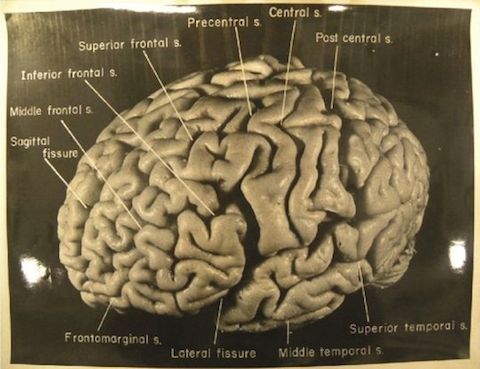
For a full evaluation, see a poorly proofread but very well-sourced article at “bad science blog” Depleted Cranium that tells the complete story of Einstein’s brain, and supports Sugimoto’s tale by reference to several accounts. Of the documentary, we’re told that “based on all available data, the basic premise and the events shown in the documentary are indeed true.” In the film, Sugimoto travels across the U.S. in search of Dr. Thomas Harvey, the man who originally removed Einstein’s brain at Princeton. (See one of the original pathology photos, with added labels, of the brain above). Depleted Cranium continues to set the scene as follows:
Eventually, Sugimoto tracks down Thomas Harvey at his home in Kansas. When he requests to see the brain, Harvey brings out two glass jars containing the pieces. At this point, Sugimoto makes a shocking request: he asks Harvey if he could have a small piece of the brain to keep as a personal memento. Harvey says “I don’t see any reason why not” and proceeds to retrieve a carving knife and a cutting board from his kitchen. He cuts a small section from a sample he identifies as being part of Einstein’s brain stem and cerebellum and gives it to Sugimoto in a small container. In the final scene, Sugimoto celebrates by taking his piece of the brain to a local kereoke [sic] bar and singing a favorite Japanese song.
The notion that the bulk of Einstein’s brain would have ended up in a closet in Kansas seems strange enough. And as for Harvey: the pathologist shopped the brain around for decades—if not for profit, then for notoriety—even driving across the country with journalist Michael Paterniti in 1997 to deliver a large portion of the brain to Dr. Sandra Witelson of McMaster University in Ontario. Paterniti documented the road trip in his book Driving Mr. Albert, which appears to corroborate much of Sugimoto’s narrative, though the trip may itself have been a publicity stunt.
In addition to the brain, Einstein’s eyes were also removed, without authorization, by his ophthalmologist, who kept them in a safety deposit box (where they presumably remain). The entire story of Einstein’s remains is gruesomely outlandish, though one might consider it a modern celebrity example of the centuries-old practice of body snatching. If some or all of this intrigues you, you’ll appreciate Sugimoto’s documentary. Unfortunately, the video upload is rough. It was recorded from Swedish television, has Swedish subtitles, and is generally pretty low-res. However, as a title card at the opening tells us, “due to the extremely limited availability of this documentary, this will have to suffice until a copy of higher quality rises to the surface.”
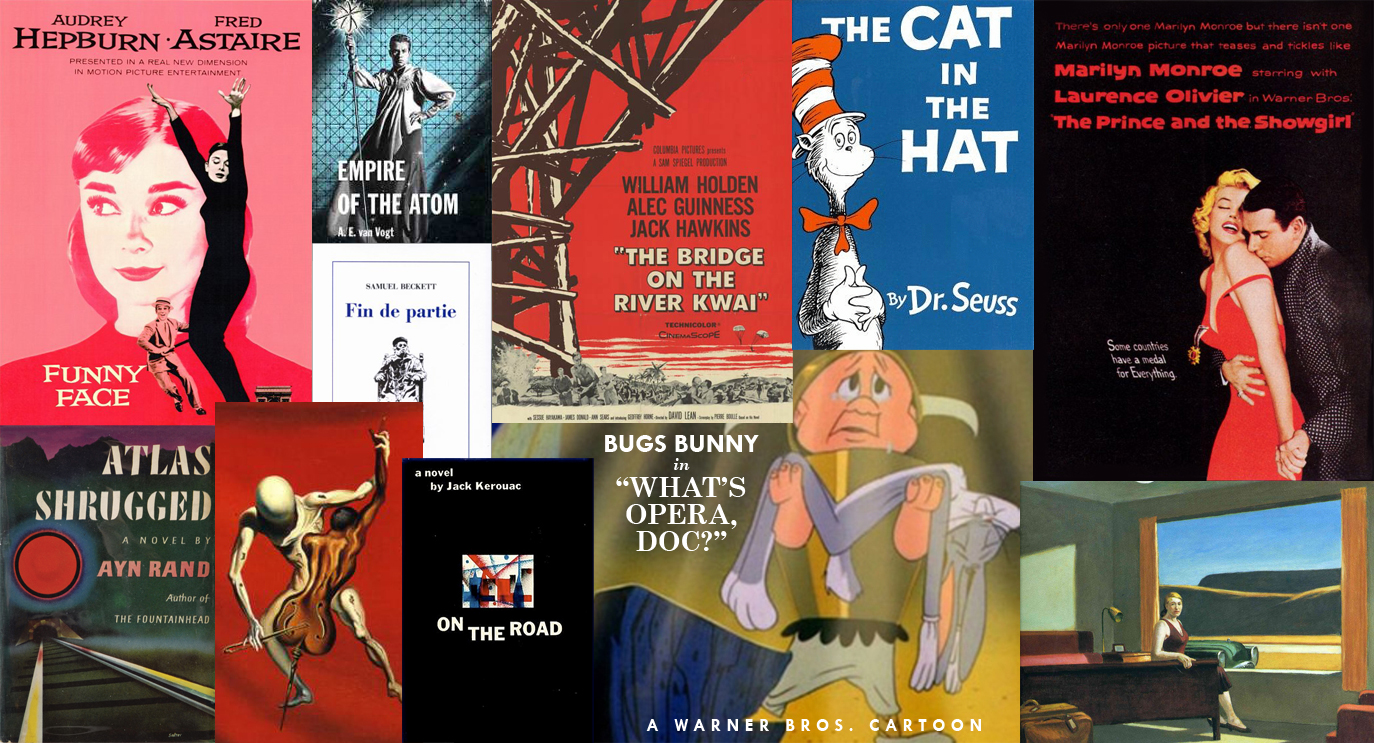
Every year, Duke University’s Center for the Study of the Public Domain highlights major works that would have entered the public domain had the copyright law that prevailed until 1978 still remained in effect today. That law (established in 1909) allowed works to remain under copyright for a maximum of 56 years — which means that 2014 would have welcomed into the public domain works first published in 1957. Some highlights (from the longer list) include:
Books
Jack Kerouac, On the Road
Ayn Rand, Atlas Shrugged
Dr. Seuss, How the Grinch Stole Christmas and The Cat in the Hat
Studs Terkel, Giants of Jazz
Ian Fleming, From Russia, with Love
Movies
12 Angry Men (Henry Fonda, Lee J. Cobb, Jack Klugman, Ed Begley, and more)
A Farewell to Arms (Rock Hudson and Jennifer Jones)
Jailhouse Rock (Elvis Presley)
The Seventh Seal (written and directed by Ingmar Bergman and starring Max von Sydow and Bengt Ekerot)
Funny Face (Audrey Hepburn and Fred Astaire)
Gunfight at the O.K. Corral (Burt Lancaster and Kirk Douglas)
Music
“That’ll Be the Day” and “Peggy Sue” (Buddy Holly, Jerry Allison, and Norman Petty)
“Great Balls of Fire” (Otis Blackwell and Jack Hammer)
“Wake Up, Little Susie” (Felice and Boudleaux Bryant)
Elvis Presley’s hits: “All Shook Up” (Otis Blackwell and Elvis Presley) and “Jailhouse Rock” (Jerry Leiber and Mike Stoller)
The musical “West Side Story” (music by Leonard Bernstein, lyrics by Stephen Sondheim, and book by Arthur Laurents)
Art
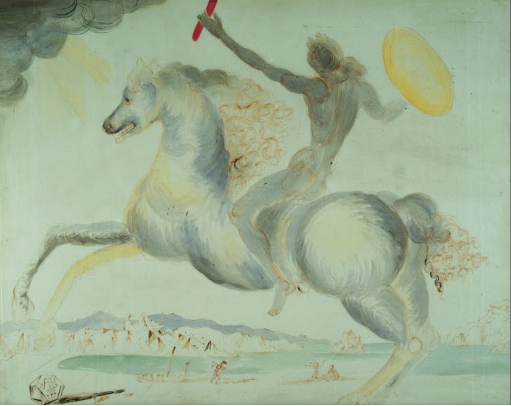
Dali’s “Celestial Ride” and “Music: the Red Orchestra”
Edward Hopper’s “Western Motel”
Picasso’s “Las Meninas” set of paintings
Under the current copyright regime, you’ll have to wait another 39 years — until 2053 — before these works hit the commons.
Note: If you’re wondering how many works of art entered the public domain in 2014, the answer is simple: 0. As the Duke site notes, “Not a single published work” is entering the public domain in 2014. “In fact, in the United States, no publication will enter the public domain until 2019.”
There are myriad New Year’s Eve customs worldwide. In Japan, toshikoshi soba noodles are eaten to bring in the coming year. In North America, finding someone to share a New Year’s Eve kiss with as the clock winds down has become a boon to the romantically-challenged. In Germany, however, a different tradition has taken form: every year on December 31st, TV networks broadcast an 18-minute-long black and white two-hander comedy skit.
In 1963, Germany’s Norddeutscher Rundfunk television station recorded a sketch entitled Dinner For One, performed by the British comics Freddie Frinton and May Warden. The duo depicted an aging butler serving his aristocratic mistress, Miss Sophie, dinner on the occasion of her 90th birthday.
Although four additional spots have been set at the table, the nonagenarian’s friends have long since passed away, and the butler is forced to take their places in drinking copious amounts of alcohol while toasting Miss Sophie’s health. Hilarity, as it is wont to do in such cases, ensues.
Since its initial recording, the clip has become a New Year’s Eve staple in Germany. Although Dinner For One has never been broadcast in the U. S. or Canada, the clip has spread throughout Europe to Norway, Finland, Estonia, Lithuania, Austria, Switzerland, and beyond the continent’s shores, to South Africa and Australia. In Sweden, a bowdlerized 11-minute version of the clip has been produced, where, for decency’s sake, much of the butler’s boozing was excised alongside its attendant comedic effect. In Denmark, after the national television network failed to broadcast the sketch in 1985, an avalanche of viewer complaints has guaranteed its subsequent yearly appearance. Although the category is now defunct, the clip held the Guinness World Record for Most Frequently Repeated TV Program. As for why the video’s garnered so much attention? No one’s really sure. The Wall Street Journal’s Todd Buell posits that the sketch’s easy to understand English combined with a German longing for security and simplicity may have led to its iconic status. To me, however, it seems that the finely tuned physical comedy translates readily beyond any linguistic boundaries, and simply hit the right note at the right time.
Above, you can view the original 18-minute comedic opus and celebrate New Year’s day in the same way that much of Europe brought in 2014 (don’t mind the German introduction — the video is in English). In future years, you can always find Dinner for One in our collection 4,000+ Free Movies Online: Great Classics, Indies, Noir, Westerns, Documentaries & More.
From all of us at Open Culture to you, have a happy new year!
In 2013, we published 1300+ posts on a wide range of cultural subjects. Looking back through our logs we were able to identify the 15 posts that resonated most widely with our readers. We hope you enjoy this recap, and share some of the items with friends. And we look forward to seeing you in 2014. Happy New Year to you all.
The British Library Puts 1,000,000 Images into the Public Domain, Making Them Free to Reuse & Remix: Some of the world’s great libraries are also opening access to our cultural heritage. Take for example the British Library, which announced this month that it has released over a million images onto Flickr Commons for anyone to use, remix and repurpose. Culled from the pages of 17th, 18th and 19th century books, the images include a dizzying array of “maps, geological diagrams, beautiful illustrations, comical satire, illuminated and decorative letters, colorful illustrations, landscapes, wall-paintings” and more.
The Genius of J.S. Bach’s “Crab Canon” Visualized on a Möbius Strip: Bach wrote his “Crab Canon” in such a way that it could be played backwards as well as forwards. But prepare yourself for the mind-blowing coup de grâce when mathematical image-maker Jos Ley lays the piece out on a Möbius strip.
Pink Floyd’s David Gilmour Sings Shakespeare’s Sonnet 18: In the early 2000s, Pink Floyd guitarist and singer David Gilmour recorded a musical interpretation of William Shakespeare’s “Sonnet 18″ at his home studio aboard the historic, 90-foot houseboat the Astoria. This video of Gilmour singing the sonnet was released as an extra on the 2002 DVD David Gilmour in Concert, and it’s pretty sublime.
Learn to Code with Harvard’s Intro to Computer Science Course And Other Free Tech Classes: These days, it could never hurt to make sure you have some good tech chops. Many of you understand that, and that’s why you jumped on Harvard’s free, introductory computer science course. Taught by David Malan, the introductory course covers “abstraction, algorithms, encapsulation, data structures, databases, memory management, security, software development, virtualization, and websites. Languages include C, PHP, and JavaScript plus SQL, CSS, and HTML.” You can always find the course listed in the Computer Science section of our collection of 800 Free Courses Online.
Michelangelo’s Illustrated 16th-Century Grocery List: Very few of Michelangelo’s papers survive today, but we do oddly have the grocery lists that he had his servant bring to the food market. “Because the servant he was sending to market was illiterate,” writes the Oregonian‘s Steve Duin, “Michelangelo illustrated the shopping lists — a herring, tortelli, two fennel soups, four anchovies and ‘a small quarter of a rough wine’ — with rushed … caricatures in pen and ink.” It’s a unique historical item, certainly worth checking out.
Prize-Winning Animation Lets You Fly Through 17th Century London: Six students from De Montfort University created a stellar 3D representation of 17th century London, as it existed before The Great Fire of 1666. The three-minute video provides a realistic animation of Tudor London, and particularly a section called Pudding Lane where the fire started. Grab a small handful of popcorn, and sit back and enjoy.
Hermann Rorschach’s Original Rorschach Test: What Do You See?: In honor of Hermann Rorschach’s birthday in November, we highlighted the original images used in his famous psychology test back in 1921. And we invited you to say what you saw in these images. The answers were often amusing, sometimes perplexing.
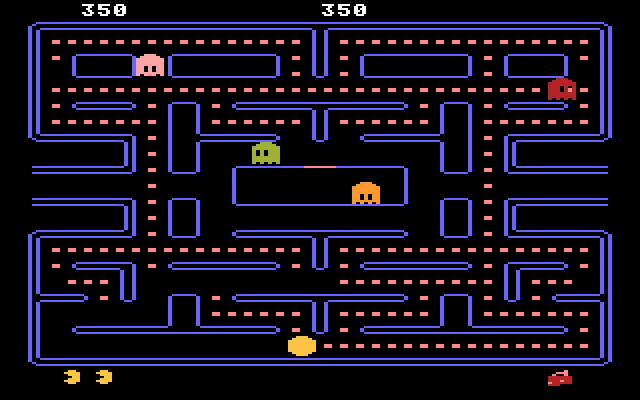
While I was growing up in the 1990s, my parents’ refusal to purchase gaming consoles gave me no choice but to navigate the age of Nintendo 64 with a doddering, nearly decade-old PC. As my friends were enthralled by the then-dazzling graphics of Mario 64, I was using my lumbering mastodon of a 486/66 mhz computer as a way to re-experience some of the best console games of years past. Having downloaded programs that turned my computer into a keyboard-controlled Atari, Nintendo, Super Nintendo, or Sega Genesis, and having sought out the websites that hosted the game files, I was mollified by playing Pac Man (1980), Castlevania (1986), and Asteroids (1979), amongst dozens of others.
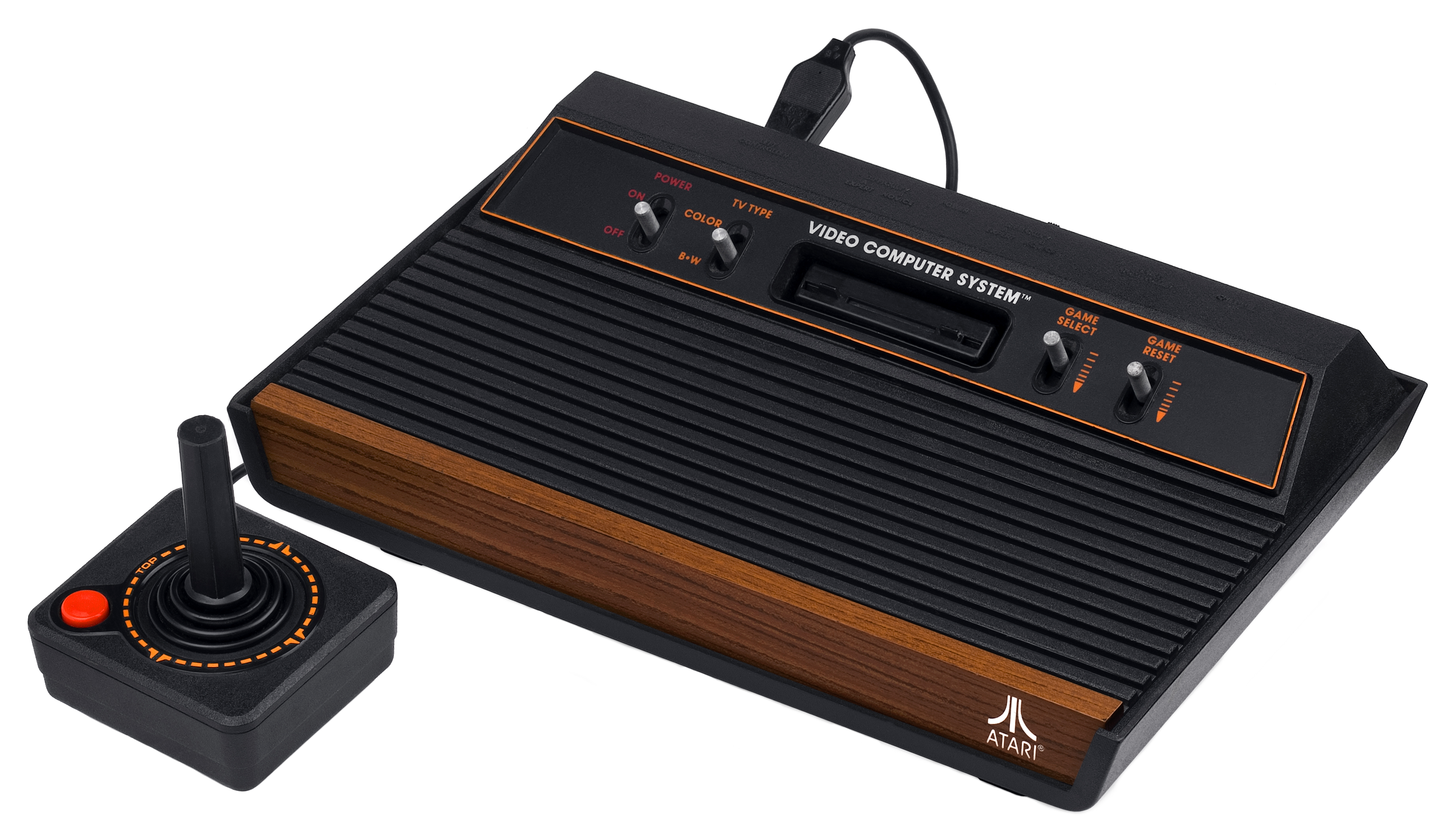
Earlier this year, the Internet Archive set aflame the hearts of nostalgic gamers everywhere by opening the Historical Software Collection, making classics such as Karateka(1984) and Akalabeth (1980) freely available and removing the need to download any additional software components. On Boxing Day, the generous souls at the Internet Archive announced a follow-up: the Console Living Room. For those wishing to relive the joys of early consoles, sourcing classic titles and downloading emulation programs to turn your computer into a virtual console is no longer necessary. Using nothing more than their browser (Firefox is recommended), users can enjoy the full (albeit temporarily soundless) experience of ‘70s and ‘80s classics and rarities on the Atari 2600, Atari 7800 ProSystem, ColecoVision, Magnavox Odyssey², and Astrocade consoles. Quick sessions of Donkey Kong(1981), Asteroids(1987), and Mario Bros.(1988) have never been easier.
In its art preservationist wing, the Cultural Institute, Google houses an enormous digital collection of artwork spanning centuries and continents in what it calls the Art Project. Google’s collection, writes Drue Kataoka at Wired, is part of a “big deal […] it signals a broader, emerging ‘open content’ art movement.” “Besides the Getty,” Kataoka notes, this movement to digitize fine art collections includes efforts by “Los Angeles’ LACMA… as well as D.C.’s National Gallery of Art, the Dallas Museum of Art, Baltimore’s Walters Art Museum, and the Yale University Art Gallery. And Google. Yes, Google.” Google is working hard to defuse this “yes, Google” reaction, posting frequent updates to its collection, already a magnificent phenomenon: “Imagine seeing an image of the Fall of the Rebel Angels by Pieter Breuegel the Elder,” writes Kataoka, “or Vincent van Gogh’s Irises, in high resolution.” Now, you can, thanks to Google’s astonishingly vast digital archive.
In the Art Project, you can stroll on over to Portugal’s Museu do Caramulo, for example, which Google describes as “an unusual museum in a small town” off the beaten path. There, you can see this macabre 1947 Picasso still life or this 1954 Salvador Dali portrait of a Roman horseman in Iberia (above). Then head over to the other side of the world, where the Adachi Museum of Art in Japan contains 165,000 square meters of Japanese garden: “The Dry Landscape Garden, The White Gravel and Pine Garden, the Moss Garden, and The Pond Garden.” It also features gorgeous paintings like Yokoyama Taikan’s 1931 Autumn Leaves and Hishida Shunso’s adorable 1906 Cat and Plum Blossoms. Dozens of smaller collections like these sit comfortably alongside such extensive and well-known collections as New York’s MoMA and Metropolitan Museum of Art and Florence’s Uffizi. See a tiny sampler of the Art Project in the video teaser above.
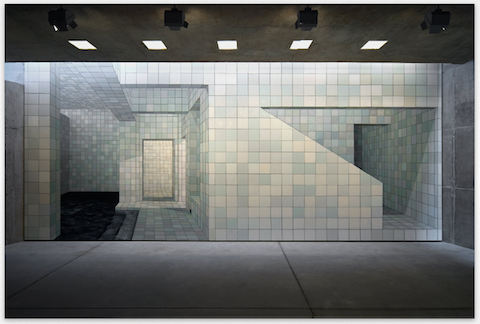
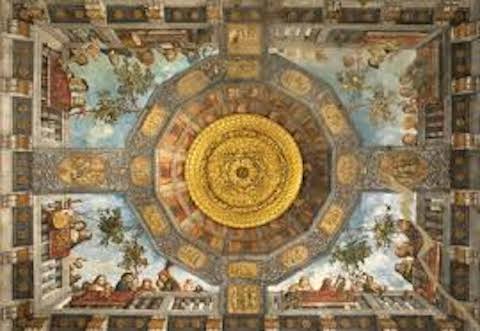
Google’s collection has greatly expanded since its comparatively modest 2011 roll-out. The company signed partnership agreements with 151 institutions in 2012 and the Art Project has grown since then to include over 57,000 digital representations of famous and not-so-famous works of art. Most recently, it has added work to the online collections of 34 different partner institutions. Google’s announcement on its official blog takes a themed approach, presenting versions of several trompe l’oeil(“fool the eye”) works that have just joined the Art Project. Trompe l’oeil is a gimmick as old as antiquity, and Google gives us several examples, beginning with the stylish, understated Brazilian train station mural right above by Adriana Varejao. Below, see the ceiling of Italy’s National Archaeological Museum of Ferrara, a much more classical (or Baroque) approach to trompe l’oeil that displays some typical elements of the period, including elaborate geometric designs, lots of gold, and well-dressed figures staring down at viewers or floating off into the heavens. See more trompe l’oeil works on Google’s blog, and access their full digital collection here.
Censorship, as most serious filmgoers know, shaped the sensibility of all the pictures we know from the “Golden Age” of Hollywood. It did so in the form of 1930’s “Motion Picture Production Code (also known as the Hays Code),” which “set up a small jury to review films for content,” at first “still without teeth and largely mocked by industry insiders.” But that changed in a big way when “the American Bishops of the Roman Catholic Church organized The Legion of Decency and, in 1934, with the support of Protestant and Jewish Organizations, began calling for boycotts of films deemed unacceptable. [ … ] The Hollywood studios, still reeling from the losses of 1933 due in large part to the delayed effects of the Great Depression, were forced to act.” That summary comes from “The History of Hollywood Censorship and the Ratings System,” a brief but in-depth lesson produced by Filmmaker IQ. Its video version appears at the top. Below, you can watch 1941’s The Outlaw, the bust size of whose star Jane Russell had the censors demanding “37 specific reshoots.”
The complete story of censorship and ratings in Hollywood involves such elements of American history and culture as not just the Great Depression and the Roman Catholic Church, but the 1919 World Series Gambling scandal, the Chicago’s Women’s Municipal League, mighty systems of production, the sport of boxing, Howard Hughes, and of course, the almighty dollar. Eventually, filmmakers began to simply defy the Hays Code; you can watch Otto Preminger’s famous example of just that, the 1953 comedy The Moon is Blue (possessed, censors said, of “an unacceptably light attitude towards seduction, illicit sex, chastity, and virginity”). In 1968, the weakened Code’s replacement arrived: the Motion Picture Association of America’s Ratings system and its still-familiar G, PG, R, and X (PG-13 was introduced in 1984; NC-17 replaced X in 1990). Quaint as these measures may now seem, the lesson tells us that controversy has remained. “Some may say that films were sexier and scarier under the censorship of the production code – for nothing that can be seen is as tantalizing and horrifying as what the imagination and anticipation can conjure. But given the choice between freedom and censorship, freedom is the only sustainable option.”
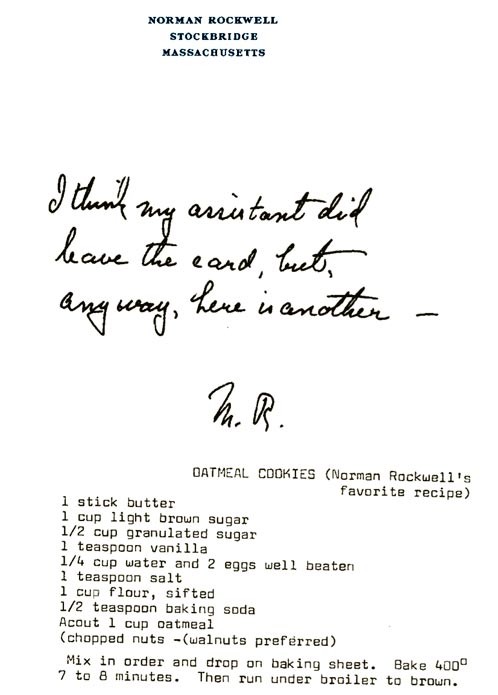
Norman Rockwell, prolific painter and illustrator of 20th century Americana, often worked so single-mindedly that he missed his meals. In 1943, Rockwell exhausted himself to such a degree that, while completing the Franklin Delano Roosevelt-inspired series of paintings entitled Four Freedoms, he lost 15 pounds over the course of seven months. This drop in weight is, perhaps, all the more shocking when given some context: Rockwell was far from being a corpulent man. In fact, when the then 23-year-old artist attempted to enlist as a serviceman in the U. S. Navy during World War I, he was judged to be eight pounds underweight, standing at six feet and tipping the scales at 140 pounds. Rockwell, however, was not to be deterred by something so trivial as his bodily composition. He gorged himself on bananas and doughnuts when he came home that evening. The next day, Navy recruiters dully welcomed the sufficiently bloated Rockwell to the fold.
We're hoping to rely on loyal readers, rather than erratic ads. Please click the Donate button and support Open Culture. You can use Paypal, Venmo, Patreon, even Crypto! We thank you!
Open Culture scours the web for the best educational media. We find the free courses and audio books you need, the language lessons & educational videos you want, and plenty of enlightenment in between.