Readers often ask us, “What’s the best way to make sure that I don’t miss any of your posts?” The answer, right now, is pretty clear: Sign up for our daily email. Each day, you will receive an email that tidily wraps up everything we’ve featured on the site over a 24 hour period. Faithfully it will appear in your inbox each day. The other great option is our trusty RSS feed: http://feeds.feedburner.com/OpenCulture
You can always follow us on Twitter (or Google Plus), where we highlight our daily posts, plus many other cultural curiosities found on the web. The only downside is that a river of material flows through Twitter, so you’ll have to keep a pretty close eye on things to spot our posts.
Finally there’s Facebook, but you can almost forget about that. Although nearly a quarter million people have liked our Facebook page, Facebook has historically shown our posts to a fraction of that audience (something they’re candid about). And because of a new algorithm change, the fraction is getting substantially smaller. The unfortunate bottom line is that you can’t rely on Facebook to give you what you want. But you can rely on our daily email and our feed. They’re 100% guaranteed. Now back to our regularly scheduled program.
Fellow riders failing to observe proper commuter etiquette ranks high on the pet peeves list of habitual subway users worldwide. While passengers playing music loud enough for other commuters to hear would be inconceivable in Osaka, Japan, most straphangers wouldn’t bat an eye at iPods blasting in New York. Meanwhile, New Yorkers have their own spin on subway etiquette. Gothamist, a New York City blog, frequently posts photographic violations of the unspoken riders’ code of conduct; documented gaffes include bringing a Christmas tree on the subway and carrying a surfboard the wrong way.
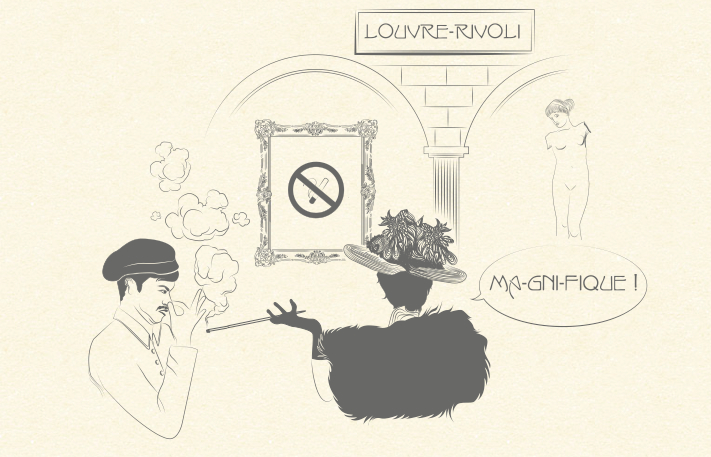
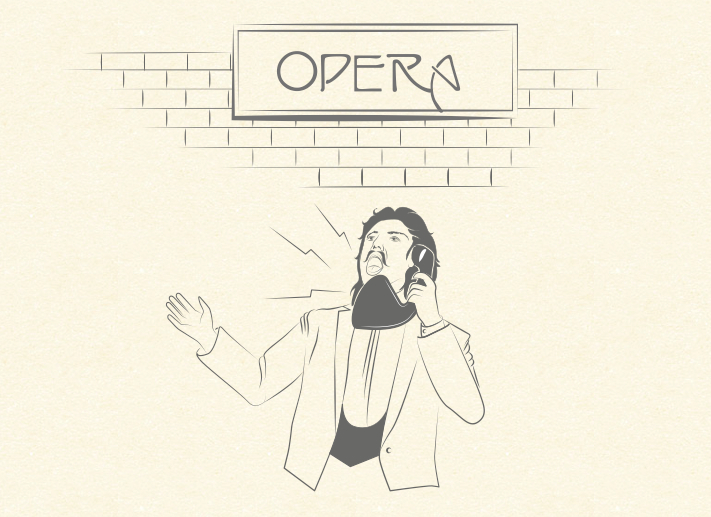
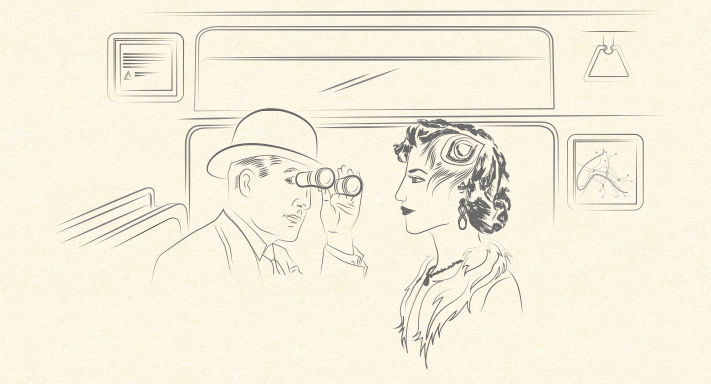
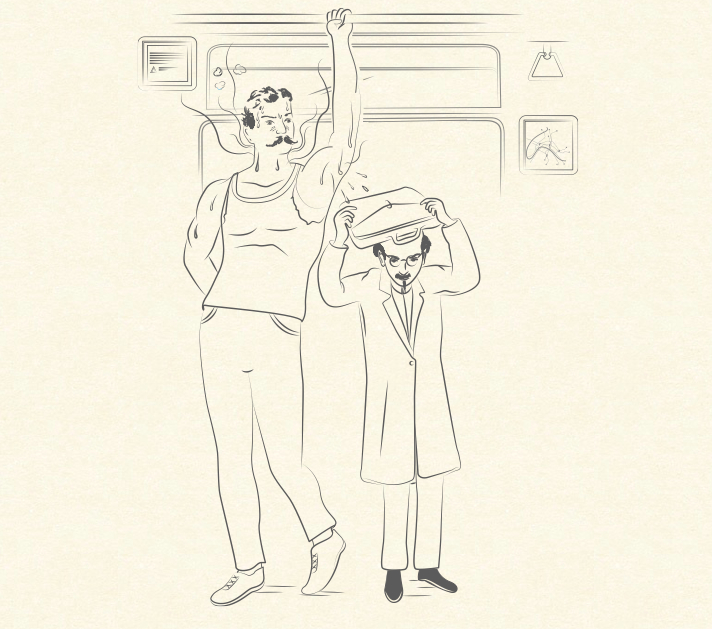
To prevent such faux pas from ruining the subway-riding experiences of Parisian commuters, France’s public transport operator (the RATP) has decided to nip such gauche behavior in the bud by issuing a short illustrated manual on subway manners. The Savoir Vivre Guide For The Modern Traveller, available here, is a quaint 1950s-style primer that provides much-needed pointers for hapless foreigners and rural French visitors alike. Its 12 guidelines, five of which are illustrated here, are a distillation of some 2000 tips that the RATP received in its crowdsourced etiquette campaign. For the sake of your reading pleasure and travelling know-how, we’ve included a number of the illustrations and tips below:
“Those No Smoking signs aren’t contemporary art — they mean no smoking”
(C’est comprendre que l’énorme cigarette barrée sur le quai n’est pas une œuvre d’art contemporain, mais une interdiction de fumer)
“Be considerate when using your cellphone”
(French readers will enjoy the pun: C’est ne pas faire de son portable un insupportable)
“Don’t be a creep and stare at people”
(C’est ne pas fixer une passagère avec insistance, quand bien même elle aurait les yeux revolver)
“On hot days, make like the emperor penguin — keep your arms low, and hold on to the bottom of the pole.”
(C’est les jours de grosse chaleur, tel le manchot empereur, bien garder les bras le long du corps et prendre sa meilleure prise en bas du poteau, pas tout en haut)
While Terkel is famous for interviewing everyday people for his oral histories of the Depression, work, and World War II, and his radio show featured its fair share of students, domestic workers, and veterans, this particular archive is full of big names: Actress and comedian Lily Tomlin. Literary theorist Edward Said. Actor and activist Sidney Poitier.
Currently, there are about twenty audio files available, and the archive promises more to come, pending digitization and the clearing of rights. (Let’s hope they hurry up! Some of the placeholder entries for not-yet-available interviews—Buckminster Fuller, Margaret Mead, Arthur C. Clarke—are most tantalizing.)
The one downside to this archive is that you can’t download the interviews—a potential drawback for addicted podcast fans. However, if you have a smartphone and a good data connection, it’s simple enough to listen to the files straight from your phone’s Chrome browser.
Above you can listen to Terkel interview a young Bob Dylan in 1963. The remaining parts of the interview can be found here. Note: The Dylan interview isn’t actually in the Pop Up archive. But it is another one of Terkel’s legendary interviews. So we wanted to add it to the mix.
Rebecca Onion is a writer and academic living in Philadelphia. She runs Slate.com’s history blog, The Vault. Follow her on Twitter: @rebeccaonion.
The Odyssey, one of Homer’s two great epics, narrates Odysseus’ long, strange trip home after the Trojan war. During their ten-year journey, Odysseus and his men had to overcome divine and natural forces, from battering storms and winds to difficult encounters with the Cyclops Polyphemus, the cannibalistic Laestrygones, the witch-goddess Circe and the rest. And they took a most circuitous route, bouncing all over the Mediterranean, moving first down to Crete and Tunisia. Next over to Sicily, then off toward Spain, and back to Greece again.
If you’re looking for an easy way to visualize all of the twists and turns in The Odyssey, then we’d recommend spending some time with the interactive map hosted on the University of Pennsylvania’s website. The map breaks down Odysseus’ voyage into 14 key scenes and locates them on a modern map.
Meanwhile, if you’re interested in the whole concept of ancient travel, I’d suggest revisiting one of our previous posts: Play Caesar: Travel Ancient Rome with Stanford’s Interactive Map. It tells you all about ORBIS, a geospatial network model, that lets you simulate journeys in Ancient Roman. You pick the points of origin and destination for a trip, and ORBIS will reconstruct the duration and financial cost of making the ancient journey. Pretty cool stuff.
If you would like to support the mission of Open Culture, consider making a donation to our site. It’s hard to rely 100% on ads, and your contributions will help us continue providing the best free cultural and educational materials to learners everywhere. You can contribute through PayPal, Patreon, and Venmo (@openculture). Thanks!
Why? Because “Alexander kept pushing forward. He didn’t want to have to go home and be dominated by his mother.” The same impulse drove Tyson to box his way out of Brownsville, Brooklyn. That’s all covered in his autobiography.
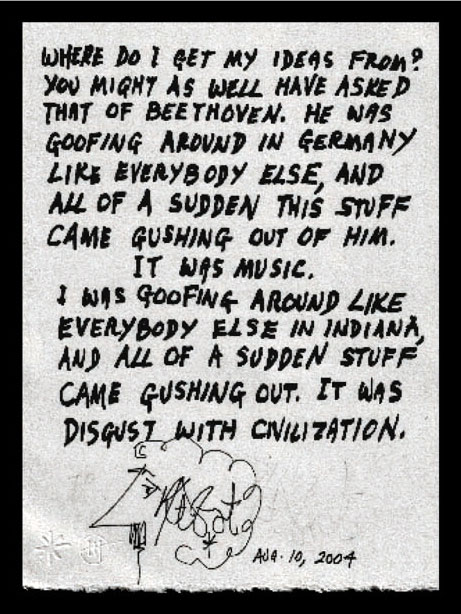
This past week, we referred you back to Neil Gaiman’s essay where he tried to explain the almost unexplainable: the source(s) of his great ideas. The sci-fi/fantasy writer had always struggled to put his finger on those sources, and he could never really find an origin in one particular spring. But, it turns out that Kurt Vonnegut never had that problem. On Twitter, one of our followers (@Iygia_Maria) flagged for us an illustrated quote by Vonnegut. He writes:
Where do I get my ideas from? You might as well have asked that of Beethoven. He was goofing around in Germany like everybody else, and all of a sudden this stuff came gushing out of him. It was music. I was goofing around like everybody else in Indiana, and all of a sudden stuff came gushing out. It was disgust with civilization. (Backwards City Review, 2004.)
We have released over a million images onto Flickr Commons for anyone to use, remix and repurpose. These images were taken from the pages of 17th, 18th and 19th century books digitised by Microsoft who then generously gifted the scanned images to us, allowing us to release them back into the Public Domain. The images themselves cover a startling mix of subjects: There are maps, geological diagrams, beautiful illustrations, comical satire, illuminated and decorative letters, colourful illustrations, landscapes, wall-paintings and so much more that even we are not aware of.
The librarians behind the project freely admit that they don’t exactly have a great handle on the images in the collection. They know what books the images come from. (For example, the image above comes from Historia de las Indias de Nueva-España y islas de Tierra Firme, 1867.) But they don’t know much about the particulars of each visual. And so they’re turning to crowdsourcing for answers. In fairly short order, the Library plans to release tools that will let willing participants gather information and deepen our understanding of everything in the Flickr Commons collection.
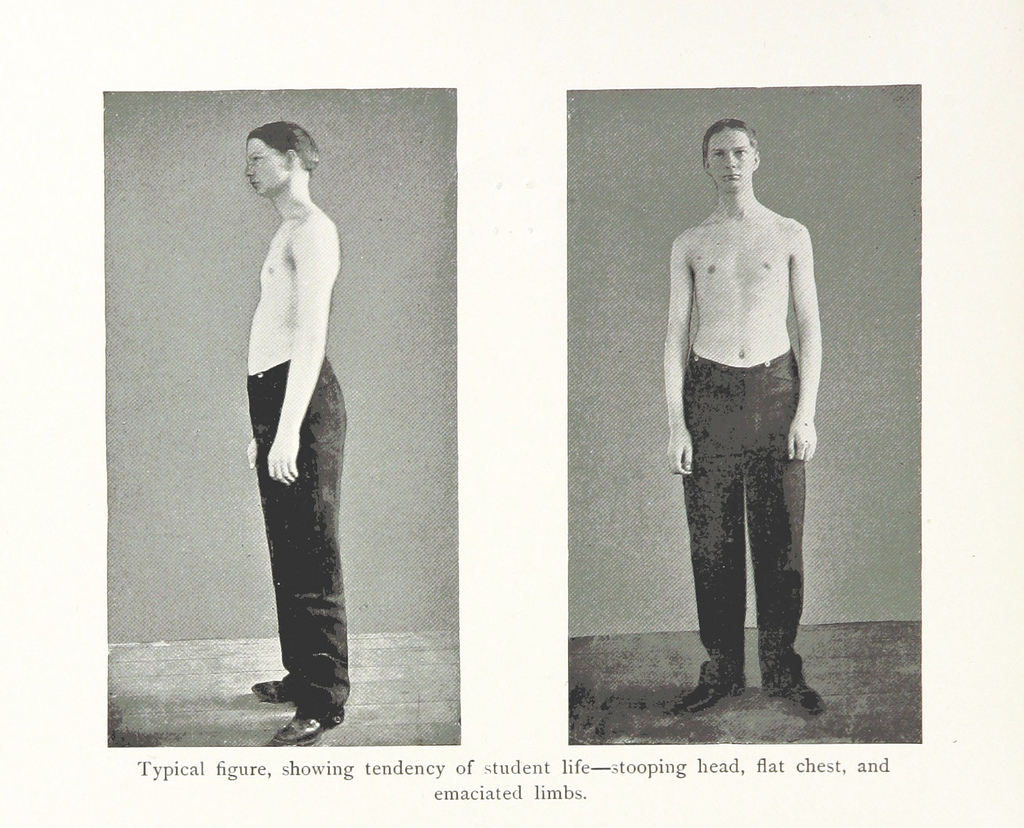
You can jump into the entire collection here, or view a set of highlights here. The latter happens to include a curious image. (See below.) It’s from an 1894 book called The United States of America. A study of the American Commonwealth, its natural resources, people, industries, manufactures, commerce, and its work in literature, science, education and self-government. And the picture features, according to the text, a “Typical figure, showing tendency of student life–stooping head, flat chest, and emaciated limbs.” It’s hard to know what to say about that.
To learn more about this British Library initiative, read this other Open Culture post which takes a deeper dive into the image collection.
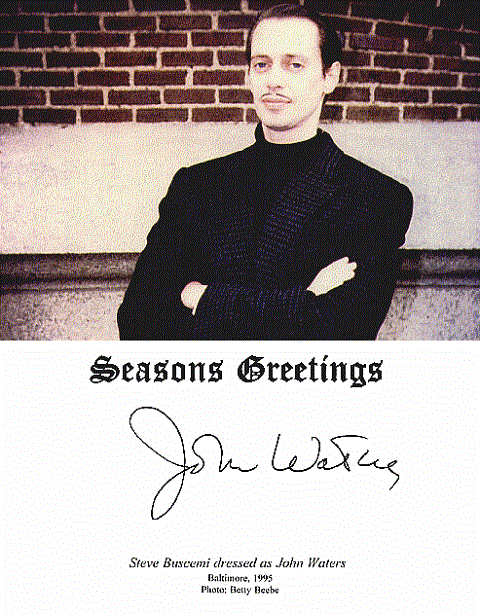
Awkward as it feels to receive Christmas cards from people we don’t really know, who among us would turn one down from the one and only John Waters? Then again, the director of such landmarks in deliberately taste-free cinema as Pink Flamingos and Female Trouble would presumably delight in injecting a little aesthetic discomfort into our holiday routines. Waters, according to a New York Times Q&A about his taking on the road “A John Waters Christmas,” his “staged monologue about all things merry and dark,” has made and sent out his own inimitable Christmas cards for almost fifty years. “I started doing it in high school in 1964,” he explains. “I send out over 2,000 cards by now. Basically, I’m channeling Pia Zadora, who used to send out the best pricey holiday-related object to help spread her name and make it last all year.” His 2006 card above bears a genuine mugshot from the police department of Waters’ beloved Baltimore; other images have included a dramatic 1940s scene of Christmas ruined by a criminal Santa, indie-film acting icon Steve Buscemi made up convincingly as Waters, and Elizabeth Taylor shaven-headed after brain surgery. One year, he even attached a tree ornament containing a dead cockroach.
“Being a traditionalist, I’m a rabid sucker for Christmas,” Waters explains in his essay “Why I Love Christmas.” “November 1 kicks off the jubilee of consumerism, and I’m so riddled with the holidays season that the mere mention of a stocking stuffer sexually arouses me.” Preholiday activities he considers “the foreplay of Christmas,” and naturally, “Christmas cards are your first duty and you must send one (with a personal, handwritten message) to every single person you ever met, no matter how briefly.” And of course, “you must make your own cards by hand. ‘I don’t have time’ you may whine, but since the whole purpose of life is Christmas, you’d better make time, buster.” Waters has also assembled his very own Christmas album, featuring a variety of holiday songs performed by Tiny Tim, Stormy Weather, and even Alvin and the Chipmunks. The selection below, “First Snowfall” by the Coctails, uses the classically kitschy singing saw as a lead:
You may well hear it again if you happen to attend Waters’ own annual Christmas party in Baltimore, a tradition he’s kept up for nearly as long as he’s sent out the cards. “Everyone comes, from the mayor to Pat Sajak to a judge and a well-known criminal I helped get out of jail,” as he describes it to the Times.” There’s a bar on every floor of the house and a buffet table where you’ll see the guy that played the singing anus in Pink Flamingos standing next to the governor.” Forget the cards; I need an invitation.
Michael Shainblum released a new timelapse film this week called “Into the Atmosphere,” which is his visual tribute to California’s beautiful deserts, mountains and coastlines. Even if you’ve seen your fair share of timelapse films before, as I’m sure many of you have, you might be interested in this other newly-released film called “The Art of The Timelapse.” Produced by The Creators Project, the short film gives you a glimpse of what goes into making a timelapse — the requisite gear, the favorable lighting conditions, the ideal landscape, and more. Shainblum is your guide. You can find an archive of his films here.
If you’d like to dig deeper into the art of making timelapse films, we’d recommend checking out The Basics of Time Lapse Photography with Vincent Laforet, a four-part video series, on Canon’s education web site. The first episode appears below.
At least since that 17th century architect of the scientific revolution, Sir Francis Bacon (who was mostly right), people have been making predictions about the technologies and social advancements of the future. And since Bacon, scientists and futuristic writers have been especially in demand during times of great change and uncertainty, such as at the turn of the last century. In 1900, civil engineer John Elfreth Watkins, Jr. in Ladies’ Home Journal claimed to have surveyed “the most learned and conservative minds in America… the wisest and most careful men in our greatest institutions of science and learning.”
Specifying advances likely to occur 100 years thence, “before the dawn of 2001,” Watkins culled 28 predictions about such things as travel and the transmission of information over great distances, biological and genetic mutations, and the domestic comforts of the average consumer. Several of the predictions are very Baconian indeed—as per the strange list at the end of Bacon’s science fiction fragment New Atlantis, a text obsessed with altering the appearance of the natural world for no particular reason other than that it could be done. Watkins’ list includes such predictions as “Peas as Large as Beets,” “Black, Blue, and Green Roses,” and “Strawberries as Large as Apples.” Some are Baconian in more sinister ways, and these are also a bit more accurate. Take the below, for example:
There will be No Wild Animals except in menageries. Rats and mice will have been exterminated. The horse will have become practically extinct. A few of high breed will be kept by the rich for racing, hunting and exercise. The automobile will have driven out the horse. Cattle and sheep will have no horns. They will be unable to run faster than the fattened hog of to-day. A century ago the wild hog could outrun a horse. Food animals will be bred to expend practically all of their life energy in producing meat, milk, wool and other by-products. Horns, bones, muscles and lungs will have been neglected.
I would defer to ecologists and meat industry watchdogs to confirm my intuitions, but it does seem that some of this, excepting the extermination of vermin and horns, has come to pass or is very likely in regard to several species. Another prediction, this one about our own species, is laughably optimistic:
Everybody will Walk Ten Miles. Gymnastics will begin in the nursery, where toys and games will be designed to strengthen the muscles. Exercise will be compulsory in the schools. Every school, college and community will have a complete gymnasium. All cities will have public gymnasiums. A man or woman unable to walk ten miles at a stretch will be regarded as a weakling.
We’re much closer to the future of Pixar’s Wall‑E than anything resembling this scenario (unless you live in the world of Crossfit). Another prediction is both dead on and dead wrong at once. Claiming that there will be “from 350,000,000 to 500,000,000 people in the Americas and its possessions by the lapse of another century” did in fact turn out to be almost uncannily accurate—current estimates are somewhere around 300,000,000. The “possessions” alluded to, however, display the attitude of blithe Monroe doctrine expansionism that held the nation in its sway at the turn of the century. The prediction goes on to say that most of the “South and Central American republics would be voted into the Union by their own people.” A few more of Watkins’ predictions, some prescient, some preposterous:
Telephones Around the World. Wireless telephone and telegraph circuits will span the world.
Store Purchases by Tube. Pneumatic tubes instead of store wagons, will deliver packages and bundles.
Hot and Cold Air from Spigots. Rising early to build the furnace fire will be a task of the olden times.
Ready-Cooked Meals will be Bought from establishments similar to our bakeries of to-day [see the above Wall‑E reference]
There will be No C, X, or Q in our every-day alphabet. They will be abandoned because unnecessary.
Aeriel War-Ships and Forts on Wheels. Giant guns will shoot twenty-five miles or more, and will hurl anywhere within such a radius shells exploding and destroying whole cities.
How Children will be Taught. A university education will be free to every man and woman.
Ah, if only that last one had come true! To read all of Watkins predictions in detail, click on the image above for a larger, readable, version of the full article.
As an arts major who doodled my way through every required science course in high school and college, I am deeply gratified by filmmaker Michel Gondry’s approach to documenting the ideas of Noam Chomsky. Having filmed about three hours worth of interviews with the activist, philosopher, and father of modern linguistics in a sterile MIT conference room, Gondry headed back to his charmingly analog Brooklyn digs to spend three years animating the conversations. It’s nice to see a filmmaker of his stature using books to jerry-rig his camera set up. At one point, he huddles on the floor, puzzling over some sequential drawings on 3‑hole punch paper. Seems like the kind of thing most people in his field would tackle with an iPad and an assistant.
Gondry may have felt intellectually dwarfed by his subject, but there’s a kind of genius afoot in his work too. Describing the stop-motion technique he used for Is the Man Who Is Tall Happy?, he told Amy Goodman of Democracy Now, “I have a lightbox, and I put paper on it, and I animate with Sharpies, color Sharpies. And I have a 16-millimeter camera that is set up on a tripod and looks down, and I take a picture. I do a drawing and take a picture.”
A pretty apt summation—watch him in action above—but the curiosity and humanity so evident in such features as Eternal Sunshine of the Spotless Mindand The Science of Sleep is a magical ingredient here, too. He attributes biological properties to his Sharpie markers, and takes a break from some of Chomsky’s more complex thoughts to ask about his feelings when his wife passed away. He doesn’t seem to mind that he might seem a bit of a schoolboy in comparison, one whose talents lie beyond this particular professor’s scope.
As Chomsky himself remarks in the trailer, below, “Learning comes from asking why do things work like that, why not some other way?”
Is the Man Who Is Tall Happy? is available on iTunes.
Ayun Halliday puts her lifelong penchant for doodling to good use in her award-winning, handwritten, illustrated zine, The East Village Inky. Follow her @AyunHalliday
We're hoping to rely on loyal readers, rather than erratic ads. Please click the Donate button and support Open Culture. You can use Paypal, Venmo, Patreon, even Crypto! We thank you!
Open Culture scours the web for the best educational media. We find the free courses and audio books you need, the language lessons & educational videos you want, and plenty of enlightenment in between.
 Readers often ask us, “What’s the best way to make sure that I don’t miss any of your posts?” The answer, right now, is pretty clear: Sign up for our daily email. Each day, you will receive an email that tidily wraps up everything we’ve featured on the site over a 24 hour period. Faithfully it will appear in your inbox each day. The other great option is our trusty RSS feed: http://feeds.feedburner.com/OpenCulture