One day we’ll maybe have a LinkedIn page. For now, you can follow us on Facebook, Twitter and Google Plus and share intelligent media with your friends! They’ll thank you for it.
Here’s something to lighten your day a little: Monty Python’s John Cleese as Sherlock Holmes in the 1977 British television film The Strange Case of the End of Civilization as We Know It.
As the title suggests, it’s a very silly film. Cleese plays Arthur Sherlock Holmes, grandson of the famous detective. His sidekick, Dr. Watson, is similarly descended from a familiar character in the Arthur Conan Doyle stories. Together they set out to foil a diabolical plot by their nemesis, a descendent of Professor Moriarty. The modern-day Holmes has some of the same mannerisms as his famous grandfather, but is decidedly less clever and likes to keep his calabash pipe filled with exotic varieties of cannabis.
Cleese co-wrote the script with Jack Hobbs and the film’s director, Joseph McGrath, who is best known for directing the Peter Sellers movies Casino Royale and The Magic Christian. It was produced for London Weekend Television by Humphrey Barclay, who is generally credited with bringing together much of what eventually became the Monty Python cast, including American animator Terry Gilliam, in the subversive late-1960s children’s show Do Not Adjust Your Set. Cleese’s wife at the time, Connie Booth, who was also collaborating with him on the TV series Fawlty Towers, plays the detective’s landlady Mrs. Hudson. And Arthur Lowe is very funny as the dim-witted Dr. Watson.
The Strange Case of the End of Civilization as We Know It is a low-budget affair — extremely goofy — and not for everyone. But if you’re a fan of classic British TV comedy and you love outlandish gags, you should get a kick out of it. The funniest parts begin after the 13-minute mark, when Cleese arrives onscreen.
Note: Elmore Leonard, the crime writer who gave us Get Shorty, Freaky Deaky, and Glitz, died at his home in Bloomfield Village, Michigan. He was 87. If you never had a chance to read Leonard, you can start with “Ice Man,” a 2012 story that appeared in The Atlantic. It’s free online. You can also get a feel for his writing by revisiting a post written here by Mike Springer last year. It gives an overview of Leonard’s tips for aspiring writers. And, in so doing, it provides valuable insight into how Leonard approached his craft. Elmore Leonard’s Ultimate Guide for Would-Be Writers is reprinted in full below.
“If it sounds like writing,” says Elmore Leonard, “I rewrite it.”
Leonard’s writing sounds the way people talk. It rings true. In novels like Get Shorty, Rum Punch and Out of Sight, Leonard has established himself as a master stylist, and while his characters may be lowlifes, his books are received and admired in the highest circles. In 1998 Martin Amis recalled visiting Saul Bellow and seeing Leonard’s books on the old man’s shelves. “Bellow and I agreed,” said Amis, “that for an absolutely reliable and unstinting infusion of narrative pleasure in a prose miraculously purged of all false qualities, there was no one quite like Elmore Leonard.”
In 2006 Leonard appeared on BBC Two’s The Culture Show to talk about the craft of writing and give some advice to aspiring authors. In the program, shown above, Leonard talks about his deep appreciation of Ernest Hemingway’s work in general, and about his particular debt to the 1970 crime novel The Friends of Eddie Coyle, by George V. Higgins. While explaining his approach, Leonard jots down three tips:
“You have to listen to your characters.”
“Don’t worry about what your mother thinks of your language.”
“Try to get a rhythm.”
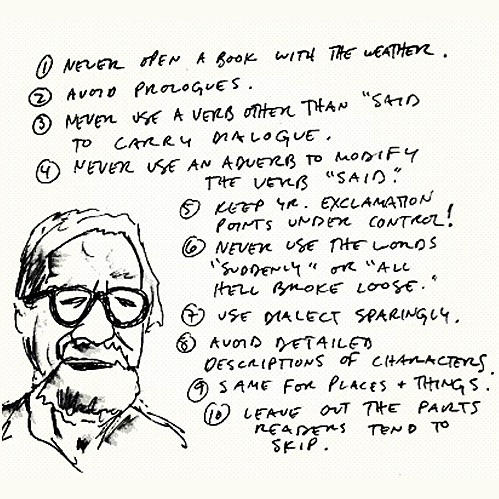
“I always refer to style as sound,” says Leonard. “The sound of the writing.” Some of Leonard’s suggestions appeared in a 2001 New York Times article that became the basis of his 2007 book, Elmore Leonard’s 10 Rules of Writing. Here are those rules in outline form:
You can read more from Leonard on his rules in the 2001 Times article. And you can read his new short story, “Ice Man,” in The Atlantic.
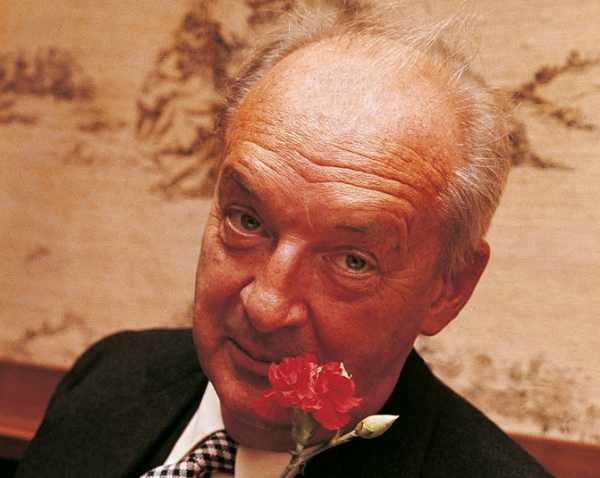
There may be no more a despicable yet ridiculous narrator in twentieth century fiction than the sleazy, condescending Humbert Humbert. And there may be no better name in twentieth century fiction than Dolores Haze, Humbert’s 12-year-old stepdaughter and love interest, whom he calls, among other things, his “nymphette,” Lolita.
Vladimir Nabokov’s tragicomic 1955 novel Lolitastill has the power to shock, disgust, and elicit wry laughter from readers, with its satirical take on decadent old Europe and wisecracking young America. True to its mid-century U.S. setting and sensationalistic subject matter, the novel is packed not only with Humbert’s obsessively creepy description and layers of literary allusion, but also with plenty of pulpy action, if we are to believe in the events Humbert narrates.
In the novel’s penultimate chapter, Humbert tracks down Clare Quilty, another predatory older man who takes advantage of Lolita. Humbert confronts, then kills Quilty (or so it seems). In the final chapter, Humbert also dies, and we learn that the novel is in fact his memoir, willed only to be published after he and Lolita have died. In the audio clip at the top, hear Vladimir Nabokov himself read from the climactic chapter in which Humbert faces Quilty down, and directly above, see the author read those first unforgettable lines: “Lolita, light of my life, fire of my loins. My sin, my soul. Lo-lee-ta.”
Find more recordings of Nabokov reading his work here.
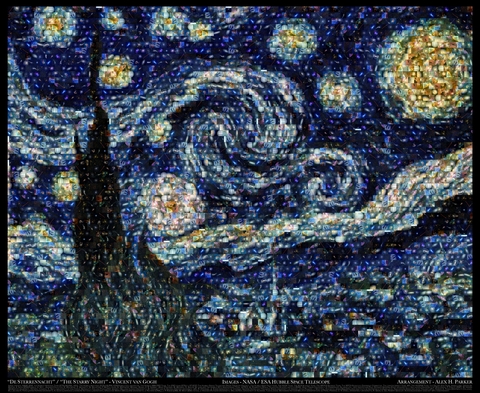
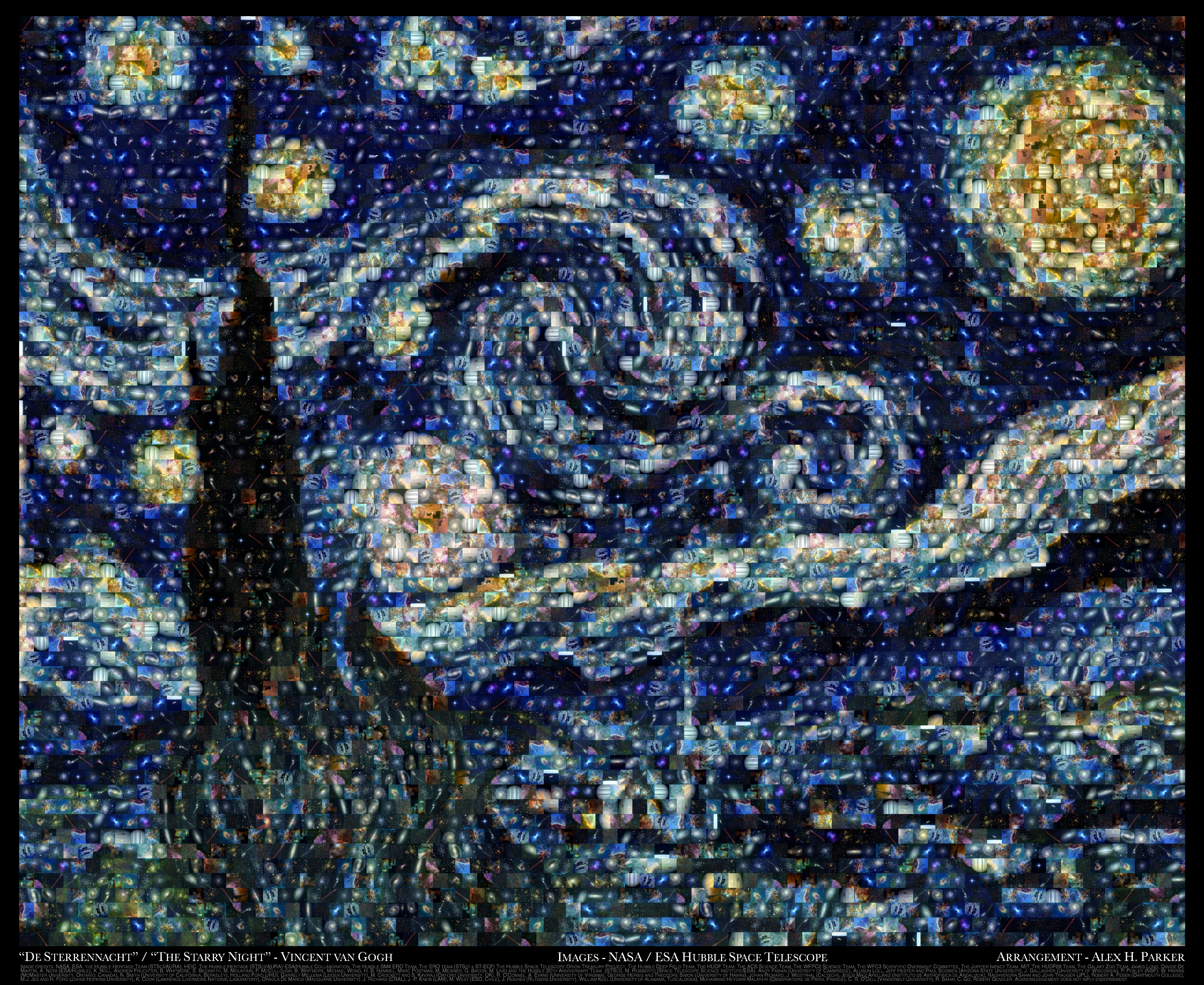
Last week, I traveled to New York City to gaze into The Starry Night. Obviously I’m not talking about the skies above Manhattan, not when my hotel was based in Times Square. No, I’m talking about Vincent van Gogh’s post-impressionist masterpiece that hangs in the MoMA on 53rd Street. Although van Gogh seemingly felt ambivalent about his 1889 painting, many now consider it one of the most important works of art produced in the 19th century. And like any other great painting, it has become a fetishized object, sometimes in ways that we can find endearing. Take this little project for example. Last year, Alex Parker, a post-doctoral fellow at the Harvard-Smithsonian Center for Astrophysics, created a mosaic of Starry Night using 100 Hubble photos. He downloaded the photos from the European Space Agency’s website, popped them into a free digital art software package called AndreaMosaic and, voila, produced the image above. You can — and should — view it in a larger, high-res format here.
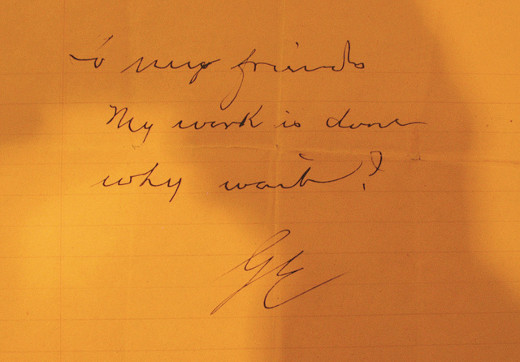
In 1932 George Eastman, the 77 year old entrepreneur who established the Eastman Kodak Company, popularized the use of roll film, and brought photography to the mainstream, found himself in declining health. Suffering from lumbar spinal stenosis, a narrowing of the spinal canal that can lead to considerable back pain and difficulty walking, Eastman was depressed and increasingly disabled. On March 14th, he committed suicide by firing a single gunshot through his heart. An act as brief, and to the point, as the note he left behind. It read:
To my friends
My work is done
Why wait?
GE
If you would like to support the mission of Open Culture, consider making a donation to our site. It’s hard to rely 100% on ads, and your contributions will help us continue providing the best free cultural and educational materials to learners everywhere. You can contribute through PayPal, Patreon, and Venmo (@openculture). Thanks!
“Bohemian Rhapsody” by Queen is one of the most audacious pop songs ever made. Part ballad, part opera, part heavy metal orgasm, the song has six distinct sections and took over a month to record. At just under six minutes, “Bohemian Rhapsody” was considered too long for pop radio. “The record company, in their infinite ignorance, of course immediately suggested that we cut it down,” said Queen drummer Roger Taylor, who stood by his bandmates and refused to let the song be cut. “It really was hit or miss. It was either going to be massive or it was going to be nothing.”
“Bohemian Rhapsody,” of course, went on to become one of the most popular songs in music history. It spent nine weeks at number one in the UK following its release in the fall of 1975, and went back to number one after the death of singer Freddie Mercury in 1991. In America the song peaked at number nine in 1976 and re-entered the charts at number two in 1992, when it was featured in the movie Wayne’s World. Last year, an ITV poll in Great Britain listed “Bohemian Rhapsody” as “The Nation’s Favorite Number One” song in 60 years of music.
Above, in the 3‑part mini documentary Inside the Rhapsody, Queen takes you inside the making of the song. And, along the way, guitarist Brian May goes back to the mixing board to explain the complexity of layers that went into realizing Mercury’s vision for the song. The original 24-track analogue recording system was far too limited, so the band used the ping-pong technique to “bounce” literally hundreds of overdubs into the mix. May explains how the operatic vocal layers were inspired by the “cascading strings” effect made famous by Annunzio Paolo Mantovani, a technique May first tried out in 1974 with the guitar solo on “Killer Queen.”
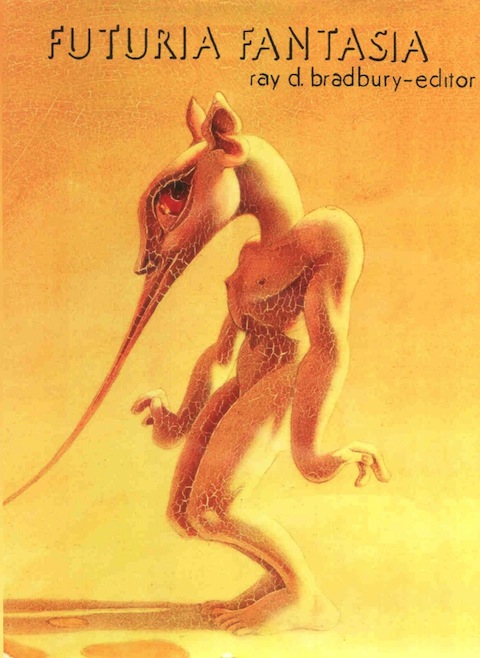
Budding science-fiction authors today know that, to get their start, they should probably go online and publish themselves. But even before the advent of the modern internet, many writers eager to tell speculative tales of humanity’s future struggle with technology, knowledge, and its own nature showed a similar self-starting bent. They made especially advantageous use of photocopiers and staplers in the seventies and eighties, the decades commonly considered the heyday of those low-circulation publications known as zines. But long before before that, the format already incubated serious science-fiction talent. Take Futuria Fantasia, which published four issues between 1939 and 1940. Its editor? A certain Ray Bradbury, before Fahrenheit 451, before The Martian Chronicles — before everything.
“Released in 1939 shortly after Bradbury graduated from high school,” says Zinewiki’s entry on the magazine, “Futuria Fantasia was published with the help of [sci-fi promoter] Forrest J. Ackerman, who lent Bradbury $90.00 for the fanzine.” The first issue, available free from Project Gutenberg, includes Bradbury’s story “Let’s Get Technatal” (written under the pseudonym “Ron Reynolds”) and poem “Thought and Space.”
The second issue includes an article he wrote under “Guy Amory” and his story “The Pendulum.” The third includes a Bradbury editorial, the fourth another editorial and the pseudonymous stories “The Piper” and “The Flight of the Good Ship Clarissa.” “I hope you like this brain-child, spawned from the womb of a year long inanimation,” the ambitious young Bradbury writes in his introduction to the summer 1939 issue. “This is only the first issue of FuFa … if it succeeds there will be more, better issues coming up.” Three more would, indeed, emerge, but surely even such a predictive mind as Bradbury’s couldn’t imagine what his career really held in store.
You can hear all ten stories from the Spring 1940 edition of Futuria Fantasia in the playlist below. It includes “Gorgono and Slith” by Ray Bradbury:
Billed and sold as the ninth and final studio album by The Doors, An American Prayer tends to divide Jim Morrison fans. On the one hand, it’s a captivating document of the late singer reading his free-associative poetry: dark, weirdly beautiful psychedelic lyrical fugues. On the other hand, it’s only a “Doors album” in that the three remaining members convened in 1978 to record original music over the deceased Morrison’s solo readings. While the resulting product is both a haunting tribute and an immersive late-night listen, many have felt that the band’s rendering did violence to the departed singer’s original intentions. (Listen to and download it here for free.)
An American Prayer’s readings were recorded unaccompanied in March 1969 and December 1970. In 1971, Morrison joined his long-time lover Pamela Courson in Paris. That same year, Jim Morrison died, under some rather mysterious circumstances, at the age of 27.
Before his death, however, he made what is said to be his final studio recording, a poetry reading/performance with a couple of unknown Parisian street musicians. Although Doors keyboardist Ray Manzarek allegedly dismissed this recording as “drunken gibberish,” Doors fans have circulated it since 1994—combined with a 37-minute poetry reading from 1968—as a bootleg called The Lost Paris Tapes.
While it’s true that An American Prayer is a powerful and haunting album, it’s also true that The Lost Paris Tapes represents the unadorned, unedited Morrison, in full control of how his voice sounds, and without his famous band. I cannot help you find a copy of The Lost Paris Tapes, but many of the tracks are on Youtube, such as “Orange County Suite” (top), an affecting piece written for Pamela Courson. Other excerpts from the bootleg, such as “Hitler Poem” (above) show Morrison in a very strange mood indeed, and show off his unsetting sense of humor. While the work on The Lost Paris Tapes ranges in quality, all of it preserves the seductive voice and cryptic imagination that Jim Morrison never lost, even as he began to slip away into alcoholism.
Librarians are breaking the mold lately and flirting with the world of hip hop and punk. Courtesy of The New York Public Library Tumblr, we have Chicago librarians paying homage to The Beastie Boys’s 1994 video, “Sabotage,” directed by Spike Jonze. Of course, the original 1994 video paid comedic tribute to TV crime shows of the 1970s, shows like Hawaii Five‑O and Starsky and Hutch. So what we have above is a tribute to a tribute.
The way people read on the internet has encouraged the provision of “tips,” especially presented as short sentences collected in lists. While we here at Open Culture seldom ride that current, we make exceptions for lists of tips by authors best known for their long-form textual achievements. Richard Ford (The Sportswriter books), Jonathan Franzen (The Corrections and Freedom), and Anne Enright (The Portable Virgin, The Gathering) here offer ten suggestions each to guide your own writing habits. Though presumably learned in the process of writing novels, many of these lessons apply just as well to other forms. I, for example, write mostly essays, but still find great value in Franzen’s instruction to treat the reader as a friend, Enright’s point that description conveys opinion, and Ford’s injunction not to write reviews (or at least, as I read it, not reviews as so narrowly defined).
Some of these tips have to do with technique: Ford advises against drinking while writing, Franzen advises against using “then” as a conjunction, and Enright advises you simply to keep putting words on the page. Others have more to do with maintaining a certain temperament: “Don’t have arguments with your wife in the morning, or late at night,” says Ford; “You have to love before you can be relentless,” says Franzen; “Have fun,” says Enright. And as any successful writer knows, you can’t pull it off at all without a strong dose of practicality, as exemplified by Enright’s “Try to be accurate about stuff,” Franzen’s doubt that “anyone with an internet connection at his workplace is writing good fiction,” and Ford’s “Don’t have children.” Can we draw out an overarching guideline? Avoid distraction, perhaps. But you really have to read these authors’ lists in full, like you would their novels, to grasp them. The lists below originally appeared in The Guardian, along with tips from various other esteemed writers.
Richard Ford
1 Marry somebody you love and who thinks you being a writer’s a good idea.
5 Don’t have arguments with your wife in the morning, or late at night.
6 Don’t drink and write at the same time.
7 Don’t write letters to the editor. (No one cares.)
8 Don’t wish ill on your colleagues.
9 Try to think of others’ good luck as encouragement to yourself.
10 Don’t take any shit if you can possibly help it.
Jonathan Franzen
1 The reader is a friend, not an adversary, not a spectator.
2 Fiction that isn’t an author’s personal adventure into the frightening or the unknown isn’t worth writing for anything but money.
3 Never use the word “then” as a conjunction – we have “and” for this purpose. Substituting “then” is the lazy or tone-deaf writer’s non-solution to the problem of too many “ands” on the page.
4 Write in the third person unless a really distinctive first-person voice offers itself irresistibly.
5 When information becomes free and universally accessible, voluminous research for a novel is devalued along with it.
6 The most purely autobiographical fiction requires pure invention. Nobody ever wrote a more autobiographical story than “The Metamorphosis”.
7 You see more sitting still than chasing after.
8 It’s doubtful that anyone with an internet connection at his workplace is writing good fiction.
9 Interesting verbs are seldom very interesting.
10 You have to love before you can be relentless.
Anne Enright
1 The first 12 years are the worst.
2 The way to write a book is to actually write a book. A pen is useful, typing is also good. Keep putting words on the page.
3 Only bad writers think that their work is really good.
4 Description is hard. Remember that all description is an opinion about the world. Find a place to stand.
5 Write whatever way you like. Fiction is made of words on a page; reality is made of something else. It doesn’t matter how “real” your story is, or how “made up”: what matters is its necessity.
6 Try to be accurate about stuff.
7 Imagine that you are dying. If you had a terminal disease would you finish this book? Why not? The thing that annoys this 10-weeks-to-live self is the thing that is wrong with the book. So change it. Stop arguing with yourself. Change it. See? Easy. And no one had to die.
8 You can also do all that with whiskey.
9 Have fun.
10 Remember, if you sit at your desk for 15 or 20 years, every day, not counting weekends, it changes you. It just does. It may not improve your temper, but it fixes something else. It makes you more free.
We're hoping to rely on loyal readers, rather than erratic ads. Please click the Donate button and support Open Culture. You can use Paypal, Venmo, Patreon, even Crypto! We thank you!
Open Culture scours the web for the best educational media. We find the free courses and audio books you need, the language lessons & educational videos you want, and plenty of enlightenment in between.