In 1952, John Cage composed his most controversial piece, 4′33,″ a four-and-a-half minute reflection on the sound of silence. Now fast forward eight years. It’s February, 1960, and we find the composer teaching his famous Experimental Composition courses at The New School in NYC, and paying a visit to the CBS game show “I’ve Got a Secret.” The TV show offered Cage something of a teachable moment, a chance to introduce the broader public to his brand of avant-garde music. Cage’s piece is called Water Walk (1959), and it’s all performed with unconventional instruments, save a grand piano. A water pitcher, iron pipe, goose call, bathtub, rubber duckie, and five unplugged radios — they all make the music. And the audience doesn’t quite know how to react, except with nervous laughter. It wasn’t particularly courteous. But, as one scholar has noted, it’s equally remarkable that prime time TV gave ten minutes of uninterrupted airtime to avant-garde music. You take the good with the bad.
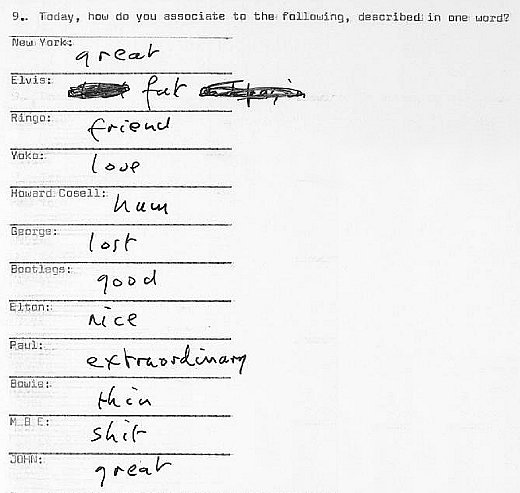
In 1976 a youthful fan named Stuart sent John Lennon a six-page list of questions. The former Beatle responded with answers, along with a child-like drawing of a lamb standing on a cloud, saying, “Hi Stuart.”
Stuart wanted to know a few things, like what sort of album Lennon was working on. “Until it’s been on tape,” Lennon replied, “I never know what it will be.” He also wondered if the famous musician was writing anything, like perhaps an autobiography. “Yes, I have been writing, but not an autobiography. I’ve noticed that people tend to DIE after writing their life story.”
The young fan included a list of words and names, along with the question: How would you characterize the following figures in one word?
John: “Great”
Paul: “Extraordinary”
George: “Lost”
Ringo: “Friend”
Elvis: “Fat”
Yoko: “Love”
Howard Cosell: “Hum”
Lennon signed off with, “It was a pleasure, hope ya dig it/John Lennon.”
“Civilization begins with distillation,” William Faulkner once said, and like many of the great writers of the 20th century — Ernest Hemingway, F. Scott Fitzgerald, James Joyce — the bard of Oxford, Mississippi certainly had a fondness for alcohol.
Unlike many of the others, though, Faulkner liked to drink while he was writing. In 1937 his French translator, Maurice Edgar Coindreau, was trying to decipher one of Faulkner’s idiosyncratically baroque sentences. He showed the passage to the writer, who puzzled over it for a moment and then broke out laughing. “I have absolutely no idea of what I meant,” Faulkner told Coindreau. “You see, I usually write at night. I always keep my whiskey within reach; so many ideas that I can’t remember in the morning pop into my head.”
Every now and then Faulkner would embark on a drunken binge. His publisher, Bennett Cerf, recalled:
The maddening thing about Bill Faulkner was that he’d go off on one of those benders, which were sometimes deliberate, and when he came out of it, he’d come walking into the office clear-eyed, ready for action, as though he hadn’t had a drink in six months. But during those bouts he didn’t know what he was doing. He was helpless. His capacity wasn’t very great; it didn’t take too much to send him off. Occasionally, at a good dinner, with the fine wines and brandy he loved, he would miscalculate. Other times I think he pretended to be drunk to avoid doing something he didn’t want to do.
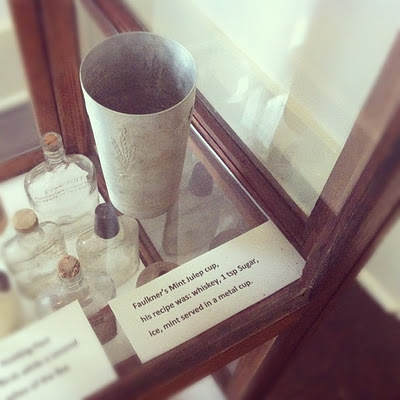
Wine and brandy were not Faulkner’s favorite spirits. He loved whiskey. His favorite cocktail was the mint julep. Faulkner would make one by mixing whiskey–preferably bourbon–with one teaspoon of sugar, a sprig or two of crushed mint, and ice. He liked to drink his mint julep in a frosty metal cup. (See image above.) The word “julep” first appeared in the late 14th century to describe a syrupy drink used to wash down medicine. Faulkner believed in the medicinal efficacy of alcohol. Lillian Ross once visited the author when he was ailing, and quoted him as saying, “Isn’t anythin’ Ah got whiskey won’t cure.”
On a cold winter night, Faulkner’s medicine of choice was the hot toddy. His niece, Dean Faulkner Wells, described the recipe and ritual for hot toddies favored by her uncle (whom she called “Pappy”) in The Great American Writers’ Cookbook, quoted last week by Maud Newton:
Pappy alone decided when a Hot Toddy was needed, and he administered it to his patient with the best bedside manner of a country doctor.
He prepared it in the kitchen in the following way: Take one heavy glass tumbler. Fill approximately half full with Heaven Hill bourbon (the Jack Daniel’s was reserved for Pappy’s ailments). Add one tablespoon of sugar. Squeeze 1/2 lemon and drop into glass. Stir until sugar dissolves. Fill glass with boiling water. Serve with potholder to protect patient’s hands from the hot glass.
Pappy always made a small ceremony out of serving his Hot Toddy, bringing it upstairs on a silver tray and admonishing his patient to drink it quickly, before it cooled off. It never failed.
In this video created by the Guardian, writer and award-winning documentary filmmaker Errol Morris talks about the nature of truth, art, and propaganda in photography. He draws examples from the photographs of Abu Ghraib and the Crimean War, both cited in his book Believing is Seeing, and he asks the viewer to consider a most fundamental question: how does a photograph relate to the physical world? Unlike a verbal or written statement, a photograph cannot be true or false. It simply is.
Then comes another argument worth considering — the idea that all photographs are posed. By way of example, Morris cites an instance where a photographer (in this case Roger Fenton) omits an elephant standing outside the frame. And it leads Morris to suggest that we shouldn’t take photos at face value. Rather we should do our due diligence to find out whether there isn’t always a metaphorical elephant looming beyond the frame. As Morris states, a photograph decontextualizes everything. It reveals to us a two dimensional reality that’s “been torn out of the fabric of the world.”
This video is part of the Guardian’s “Comment is Free” series, in which the world’s top thinkers, newsmakers, and people with stories to tell are interviewed. For more meditations on photography, give some time to Errol Morris’ speech at the Harvard Bookstore. Find the transcript here.
Eugene Buchko is a blogger and photographer living in Atlanta, GA. He maintains a photoblog, Erudite Expressions, and writes about what he reads on his reading blog.
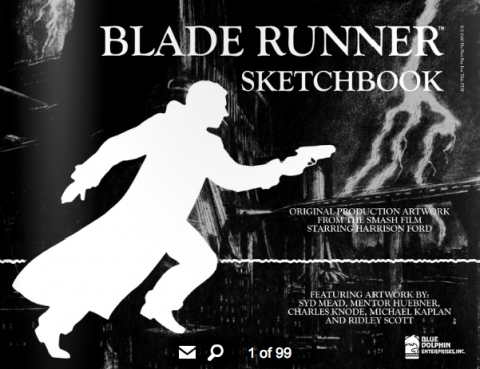
Coinciding with the release of Blade Runner in 1982, David Scroggy published the Blade Runner Sketchbook, a book with 100+ production drawings and artwork for Ridley Scott’s classic sci-fi film. The sketchbook features visual work by Scott himself, artist Mentor Huebner, and costume designer Charles Knode, but most notably a slew of drawings by artist, futurist, and illustrator Syd Mead.
As Comics Alliance notes, this sketchbook has been out of print for years and scant few paper copies remain available for purchase. So digital versions have filled the void online, and now comes this: a version that lets you revel in the Blade Runner artwork in full-screen mode. Enter the sketchbook by clicking the image above or below. (The book itself is hosted at Isuu.com). Once you get there, click the images and they’ll fill your screen.
Enjoy, and while you’re at it, don’t miss some related items:
Let’s do the time warp today and revisit the Not-S0-Golden Age of American Television. The year was 1978. Star Wars fever still gripped America, and the Variety Show TV format wouldn’t say die. So, producing The Star Wars Holiday Special was a no-brainer. The two-hour show takes you inside the domestic world of Chewbacca and his family — his father Itchy, his wife Malla, and his son Lumpy — and features guest appearances by Jefferson Starship, Harvey Korman and Bea Arthur, plus a little stock footage of Alec Guinness. As for the production quality and special effects? They’re all textbook kitsch.
You’ve heard enough to know that this wasn’t the finest hour for the Star Wars franchise. One critic called it the “the worst two hours of television ever.” And, when he’s willing to acknowledge the existence of the TV special, George Lucas readily admits that turning Star Wars into a variety show “wasn’t the smartest thing to do.” But because the show only aired once in its entirety, the holiday special has gained something of a cult status and circulates “underground” on the web. Vanity Fair has more on this misadventure in television programming here. H/T goes to Dangerous Minds.
Like the children in his books, Maurice Sendak, at age 83, is doing the best he can to navigate a frightening and bewildering world. “We all have to find our way,” Sendak says in this revealing little film from the Tate museums. “If I could find my way through picture-making and book illustration, or whatever you want to call it, I’d be okay.”
In books like In the Night Kitchen, Where the Wild Things Are and Outside, Over There, Sendak has explored the wonders–and terrors–of childhood. “No one,” wrote Dave Eggers recently in Vanity Fair, “has been more uncompromising, more idiosyncratic, and more in touch with the unhinged and chiaroscuro subconscious of a child.”
Sendak’s own childhood in Brooklyn, New York, was a time of emotional trauma. His parents were Polish immigrants who had trouble adjusting to life in America. On the day of Sendak’s barmitzvah, his father learned that his entire family had been killed in the Holocaust. He remembered the sadness of looking through family scrapbooks. “The shock of thinking I would never know them was terrible,” Sendak told the Guardian earlier this year. “Who were they?”
This early sense of the precariousness of life carried over into his work. As the playwright Tony Kushner wrote of Sendak in 2003:
Maurice, among the best of the best, shocks deeply, touching on the mortal, the insupportably sad or unjust, even on the carnal, on the primal rather than the merely primitive. He pitches children, including aged children, out of the familiar and into mystery, and then into understanding, wisdom even. He pitches children through fantasy into human adulthood, that rare, hard-won and, let’s face it, tragic condition.
Orson Welles. A brilliant director. A talented actor. And not a bad narrator of animated films. We know one thing. The whole is often greater than the sum of the parts. So, today, we’re serving up three animated films narrated by Welles, plus some classic radio broadcasts.
We start with an animated version of Plato’s Cave Allegory from 1973. The allegory is the most well known part of The Republic (Download – Kindle), and Welles reads the famous lines delivered by Socrates. Perfect casting. This is hardly the first animation of the cave allegory. Partially Examined Life has a roundup of 20 animations, but we’re always partial to this brilliant version done with claymation.
In 1962, Orson Welles directed The Trial, a film based on Franz Kafka’s last and arguably best-known novel. The film begins auspiciously with Welles narrating an animated version of “Before the Law,” a parable from The Trial. And then the dramatic film unfolds. Later in his life, Welles told the BBC, “Say what you will, but The Trial is the best film I have ever made. I have never been so happy as when I made that film.”
The backstory behind this short animated film, Freedom River, deserves a little mention. According to Joseph Cavella, a writer for the film:
For several years, Bosustow Productions had asked Orson Welles, then living in Paris, to narrate one of their films. He never responded. When I finished the Freedom River script, we sent it to him together with a portable reel to reel tape recorder and a sizable check and crossed our fingers. He was either desperate for money or (I would rather believe) something in it touched him because two weeks later we got the reel back with the narration word for word and we were on our way.
Filmed 40 years ago, Freedom River offers some strong commentary on America, some of which will still resonate today.
Finally, if you can’t get enough of Orson’s voice, don’t miss The Mercury Theatre on the Air, Welles’ radio program that brought theatrical productions to the American airwaves from 1938 to 1941. You can still find the broadcasts online, including the legendary War of the Worlds program from 1938 (listen), and dramatized versions of Dickens’ A Christmas Carol (listen) and Around the World in 80 Days (click the first item in playlist).
The short films mentioned above appear in our collection of Free Movies Online, where you will also find some longer films by Welles.
Last year, Richard Vezina created a popular video tribute to Stanley Kubrick (A Stanley Kubrick Odyssey). Now he returns with David Lynch in Four Movements. Accompanied by musical pieces from Angelo Badalamenti & David Lynch, each movement revolves around a distinctive theme or visual trend in Lynch’s works. Here’s how the 20 minute video unfolds:
First Movement: Melancholy and Sadness — Questions In A World Of Blue
Second Movement: Action, Violence, and Sex — The Pink Room
Third Movement: Dreams and Nightmares — Into The Night
Fourth Movement: Love and Hope — Mysteries of Love
Shoppers on Grafton Street in Dublin were treated to a rare street performance on Christmas Eve by some of Ireland’s most illustrious pop musicians. U2 frontman Bono, oscar-winning singer/songwriter Glen Hansard, Liam O’ Maonlai of Hothouse Flowers, Mundy, and Declan O’Rourke gathered on the famous shopping street to spread holiday cheer and raise money for the homeless.
It was the third straight year of Christmas Eve busking for Bono and Hansard. A large group of fans showed up in anticipation, having been tipped off the day before by Hansard. “Busking with some friends tomorrow on Grafton St.,” he wrote on Twitter. “Come and throw a coin in the box for Simon Community and the Peter McVerry trust.” The crowd grew so big that the police moved the performance to the gate of St. Stephen’s Green, at the end of the street.
The group performed a rousing, sing-along version of the Mic Christopher song “Heyday” (above), and some holiday favorites, including the 1960s hit “Christmas (Baby Please Come Home),” which can be seen on YouTube here and here.
When Steve Jobs became the majority investor in Pixar in January 1986, the company looked nothing like it does today. Back then, Pixar was mainly a technology play. It sold expensive Image Computers to government agencies and medical institutions along with rendering software. That strategy didn’t pay off particularly well. The company hemorrhaged cash; layoffs ensued; and things were generally looking bleak for the young company.
Pixar’s fortunes changed, however, when it tapped into the talents of a young animator named John Lasseter. During Pixar’s early days, Steve Jobs and co-founder Ed Catmull asked Lasseter to develop a short animated film to help show off the capabilities of Pixar’s hardware and software. He came up with Luxo Jr. (above), which turned two lovable lamps into movie stars. The short film won first prize at SIGGRAPH, the annual computer graphics conference held in 1986. Later Luxo Jr. was nominated for an Academy Award.
In 1988, Pixar was still hanging on by a thread. But Jobs continued to nurture Lasseter’s work and directed precious resources towards another short film. When giving Lasseter funds ($300,000), Jobs said to the animator, “All I ask of you, John, is to make it great.” And that he did. The result, Tin Toy (above), won the ’88 Academy Award for animated short film, the first computer-generated film to win the award.
Tin Toy caught Disney’s attention, and they began to pursue Lasseter. But Lasseter stayed loyal to Pixar, and before too long, Pixar and Disney decided to partner on the production of Toy Story, which netted a profit of $330 million. Pixar dumped its hardware/software business and focused on making animated films from then on, before Disney eventually purchased Pixar for $7.4 billion in 2006.
If you’re looking for a little more animation, don’t miss The Adventures of André and Wally B., the 1984 short film made by Lasseter at the Graphics Group, the unit within LucasFilm that was eventually spun into Pixar. Also here we have the First 3D Digital Film, which happened to be created by Ed Catmull (1970). He co-founded Pixar and is now president of Walt Disney Animation Studios and Pixar Animation Studios.
We're hoping to rely on loyal readers, rather than erratic ads. Please click the Donate button and support Open Culture. You can use Paypal, Venmo, Patreon, even Crypto! We thank you!
Open Culture scours the web for the best educational media. We find the free courses and audio books you need, the language lessons & educational videos you want, and plenty of enlightenment in between.