In case you’ve ever wondered .…
Australia’s Electronic Canvas
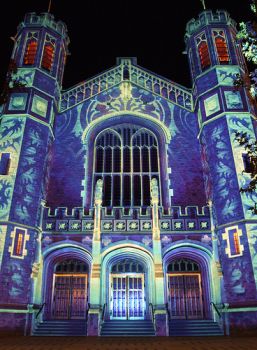
We wanted to post a quick photo from the lighting show at the Adelaide Festival of Arts. During the festival, artists project lights on the city’s architectural monuments, turning the buildings into electronic canvases. We’ve posted one photo below. For more good ones, see here. Thanks Carol for sharing these!

David Sedaris Delivers a Pizza
Apparently not the real deal, but a pretty good impersonation nonetheless…

The State of the Digital Commons & Open Source Education
I wanted to flag for you a three part series on the “digital commons” and the preservation of open source education. Produced by Tom Hanson at OpenEducation.net, you can find the three articles below. Also, to get more content along these lines, head on over to OER Blogs, a good aggregator of open education resource blogs.
- The Digital Commons – Left Unregulated, Are We Destined for Tragedy?
- An Interview with Ahrash Bissell of the Creative Commons
- The Open Digital Commons — A Truly Endless Array of Success Stories
Listening to Famous Poets Reading Their Own Work
Today, we have a guest feature by Don from Classic Poetry Aloud (iTunes — Feed — Web Site), a place where you can find a great lineup of poetry podcasts. We welcome other guest contributors. So, if you’re interested, just email us. Take it away (and thanks) Don…
The internet has given poetry new scope and a new freshness. It’s almost like the ‘70s, when punk fanzine readers were famously told ‘Here are three chords, now form a band’. Today, the injunction could be: ‘Here are three web sites, now perform some poetry’.
And the emphasis would very much be on performance, with readings taking place on blogs (individually) and at poetry slams (collectively).
But an interest in poetry readings is not confined to new work. My own daily poetry podcast, Classic Poetry Aloud, is dedicated to anything in the English language that is out of copyright, and attracts listeners on every continent.
While podcasts such as Classic Poetry Aloud (see a November Open Culture posting for a listing of poetry podcasts) feature a range of poets, the internet also offers a wealth of recordings of celebrated authors reading from their own work.
The BBC has a wonderful series of such recordings at Poetry Out Loud. My favourites include: Men and their Boring Arguments by contemporary British poet Wendy Cope, and an excerpt from Tennyson’s celebrated Charge of the Light Brigade, originally recorded in 1890 on a wax cylinder by Edison. In addition, the BBC has a series of interviews with poets discussing their work.
The Academy of American Poets’ listening booth offers more than 150 original readings. As well as the rolling tones of Dylan Thomas reading Do not go Gentle into that Good Night, there is Robert Frost’s The Road not Taken, and Gwendolyn Brooks’ We Real Cool – complete with an illuminating, humorous, wry introduction. This is an unashamed show stopper reading of a poem that runs to just 24 words.
Indeed, one of the joys of listening to poets reading from their own work is often the comments and insights that they offer. T.S. Eliot does this in introducing The Journey of the Magi, one of three of his poems to feature on the Poetry Archive. On this site, there are over 200 poems that feature some form of introduction by the poet.
The Poetry Archive is an ambitious project set up by British poet laureate Andrew Motion to capture poetry readings. The range here is so vast that it is impossible to say how many poems are featured on the site, but it makes for an invaluable resource, with poems accessible by theme as well as by form.
Among British poets is former laureate John Betjeman, apparently unable to remember the title of the poem he is best remembered for – A Subaltern’s Love Song – and he jokes with his audience before launching into a characteristically brisk and warm rendition. Not all of the Poetry Archive comes from the UK, though, and Allen Ginsberg reads three poems, including A Supermarket in California.
Author Andrew Keen has claimed that the internet is ‘killing culture’. That’s a good, alliterative tag line to sell books, but the growing popularity of poetry on the net shows that it’s also far from the truth.
Richard Feynman Plays the Bongos
When he wasn’t busy hashing out the theory of quantum electrodynamics, Nobel Prize winning physicist Richard Feynman was hitting the bongos and singing praises to orange juice. Watch him go. And find more vintage Feynman resources below.
If you would like to sign up for Open Culture’s free email newsletter, please find it here. It’s a great way to see our new posts, all bundled in one email, each day.
If you would like to support the mission of Open Culture, consider making a donation to our site. It’s hard to rely 100% on ads, and your contributions will help us continue providing the best free cultural and educational materials to learners everywhere. You can contribute through PayPal, Patreon, and Venmo (@openculture). Thanks!
Related Content:
Learn How Richard Feynman Cracked the Safes with Atomic Secrets at Los Alamos
Cat Shenanigans

Win the Pulitzer Center Contest
The Pulitzer Center on Crisis Reporting (which we recently featured in 10 Signs of Intelligent Life at YouTube) is sponsoring the Global Issues/Citizen Voices Contest. Final winners will be chosen by the Pulitzer Center and will receive a Pulitzer Center Citizen Journalist Award. You can get involved. The deadline is March 12. Get details here.
Bach, Beethoven, Mozart, Wagner, Some Yo-Yo Ma and More: Free Classical Music Podcasts
 With the recent 250th anniversary of Mozart’s birth, there has been no shortage of podcasts dedicated to Mozart’s masterpieces. First, Radio Sweden (iTunes — Feed — Web Site) reissued a digital archive of Mozart recordings by the Royal Swedish Opera from the 1940s and 1950s. And, along very similar lines, Danmarks Radio (Feed — Web Site) issued podcasts of nine Mozart symphonies recorded by the Danish Radio Symphony Orchestra. (You’ll find here symphonies numbers 15, 17, 23, 34, 35, 36, 39, 40, and 41. Since the web site is in Danish, we’d recommend accessing these high quality MP3’s through the rss feed listed above.) Lastly, we should mention here that, as part of last year’s festivities, The International Mozart Foundation published online for the first time the entirety of of Mozart’s musical scores.
Along with Mozart, you can find plenty of Beethoven. We have highlighted here before, but it’s worth noting again, Deutsche Welle’s podcast collection called Beethovenfest (iTunes — Feed — Web Site). You’ll want to give it a look, and also see the podcast collection put together by the Boston Symphony Orchestra Conservatory (iTunes — Feed — Web Site). This educational series offers an extensive overview and recordings of Beethoven’s work, as well as that of Arnold Schoenberg. You can also catch more Beethoven (as well as a little Mozart and Bach) with the podcast series called The Concert (iTunes — Feed — Web Site), which features recordings from the Isabella Stewart Gardner Museum in Boston.
Speaking of Bach, you may want to give some time to these two podcasts: Bach Podcast from Magnatune.com (iTunes — Feed — Web Site) and Bach Festival of Philadelphia (Feed — Web Site).
Let’s now leave you with a few other good finds: Wagner Operas Podcast (iTunes — Feed — Web Site) lets you listen in on recordings from the annual Bayreuth Festival, plus more. An Intimate Tour Through the Music of Yo-Yo Ma (iTunes — Feed — Web Site) offers essentially what the title says. Finally, we’d recommend Classical Performance (iTunes Feed Web Site), which consists of classical music performances from WGBH’s Studio One in Boston; The New York Philaharmonic Podcast (iTunes — Feed — Web Site) which introduces you to the music and performers featured in the concerts of the New York Philharmonic; and From the Top. Live from Carnegie Hall Video Podcast (iTunes — Feed — Web Site), a podcast that showcases the top-notch skills and compelling stories of America’s best young classical musicians.

Eat, Pray, Love @ Google
Elizabeth Gilbert’s Eat, Pray, Love has been on the New York Times bestseller list for 57 weeks. If you haven’t read it yet, then you may want to spend some time with Gilbert’s talk at Google. While her talk and reading didn’t completely strike a chord with me, it may well with you. So here you go (and, yes, we’ve added the video to our YouTube Playlist):

Support Us
We're hoping to rely on loyal readers, rather than erratic ads. Please click the Donate button and support Open Culture. You can use Paypal, Venmo, Patreon, even Crypto! We thank you!

Receive our Daily Email
About Us

Open Culture scours the web for the best educational media. We find the free courses and audio books you need, the language lessons & educational videos you want, and plenty of enlightenment in between.
Advertise With Us

