Variety is reporting tonight that Harry Dean Stanton has died in Los Angeles, at the age of 91. He’s best remembered, of course, for his roles in David Lynch’s Twin Peaks, HBO’s Big Love, Alex Cox’s Repo Man, and Wim Wender’s Paris, Texas. Over a 60 year career, Stanton made appearances in 116 films, 77 TV shows, and several music videos. He also lent his voice to an Alien video game and recorded poems by Charles Bukowski. Above and below, hear him read “Bluebird” and “Torched Out.” Both recordings come from the 2003 documentary, Bukowski: Born Into This. Back in 2012, Stanton headlined an L.A. tribute to the Los Angeles poet.
If you would like to support the mission of Open Culture, consider making a donation to our site. It’s hard to rely 100% on ads, and your contributions will help us continue providing the best free cultural and educational materials to learners everywhere. You can contribute through PayPal, Patreon, and Venmo (@openculture). Thanks!
This comic lays out 2000 years of musical history. … Again and again there have been attempts to police music; to restrict borrowing and cultural cross-fertilization. But music builds on itself. To those who think that mash-ups and sampling started with YouTube or the DJ’s turntables, it might be shocking to find that musicians have been borrowing – extensively borrowing – from each other since music began. Then why try to stop that process? The reasons varied. Philosophy, religion, politics, race – again and again, race – and law. And because music affects us so deeply, those struggles were passionate ones. They still are.
The history in this book runs from Plato to Blurred Lines and beyond. You will read about the Holy Roman Empire’s attempts to standardize religious music using the first great musical technology (notation) and the inevitable backfire of that attempt. You will read about troubadours and church composers, swapping tunes (and remarkably profane lyrics), changing both religion and music in the process. You will see diatribes against jazz for corrupting musical culture, against rock and roll for breaching the color-line. You will learn about the lawsuits that, surprisingly, shaped rap. You will read the story of some of music’s iconoclasts – from Handel and Beethoven to Robert Johnson, Chuck Berry, Little Richard, Ray Charles, the British Invasion and Public Enemy.
To understand this history fully, one has to roam wider still – into musical technologies from notation to the sample deck, aesthetics, the incentive systems that got musicians paid, and law’s 250 year struggle to assimilate music, without destroying it in the process. Would jazz, soul or rock and roll be legal if they were reinvented today? We are not sure. Which as you will read, is profoundly worrying because today, more than ever, we need the arts.
All of this makes up our story. It is assuredly not the only history of music. But it is definitely a part – and a fascinating part – of that history…
If you would like to support the mission of Open Culture, consider making a donation to our site. It’s hard to rely 100% on ads, and your contributions will help us continue providing the best free cultural and educational materials to learners everywhere. You can contribute through PayPal, Patreon, and Venmo (@openculture). Thanks!
Many painters today concentrate on producing abstract work — and a fair few of those have only ever produced abstract work. But look not so very far back in human history, and you’ll find that to paint meant to paint representatively, to replicate on canvas the likenesses of the actual people, places, and things out there in the world. Humanity, of course didn’t evolve with its representational art skills pre-installed: though some cave paintings do recognizably depict men and beasts, many strike us today as what we would call abstract, or at least abstracted. So which modern artists can lay claim to having rediscovered abstraction first?
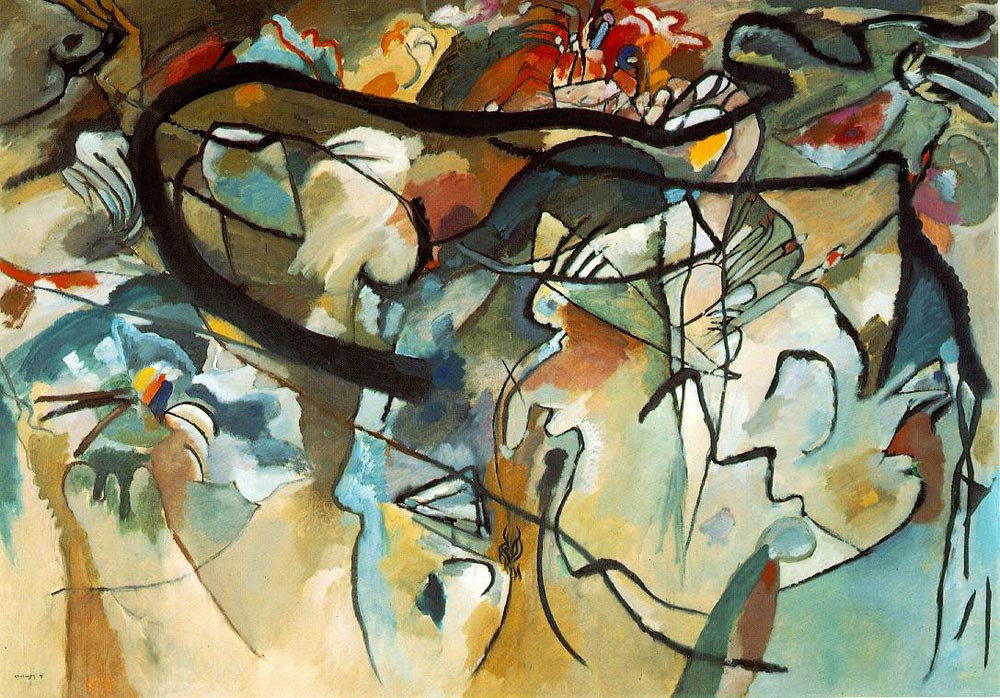
Kandinsky, Composition V, 1911
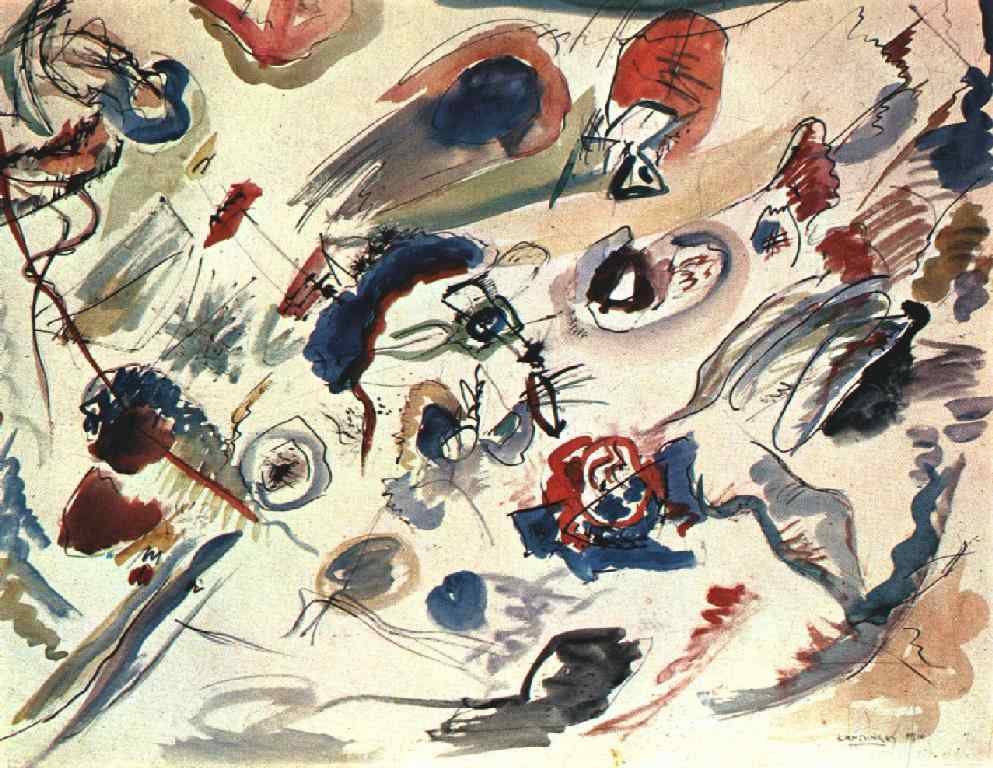
If you’ve studied any art history, you might well name the early 20th-century Russian painter Wassily Kandinsky (whose first abstract watercolor from 1910 appears at the top of the post). But “while Kandinsky is today hailed as the father of abstract painting,” writes Artsy’s Abigail Cain, “he was by no means the only player in the development of non-representational painting,” though “his work Komposition V did, admittedly, jumpstart public interest in abstract painting.”
First exhibited in Munich in December 1911, “this monumental work was just barely representational” and also “the first such work to be put on display,” inspiring the art world not just to take abstraction seriously but to see it as the future.
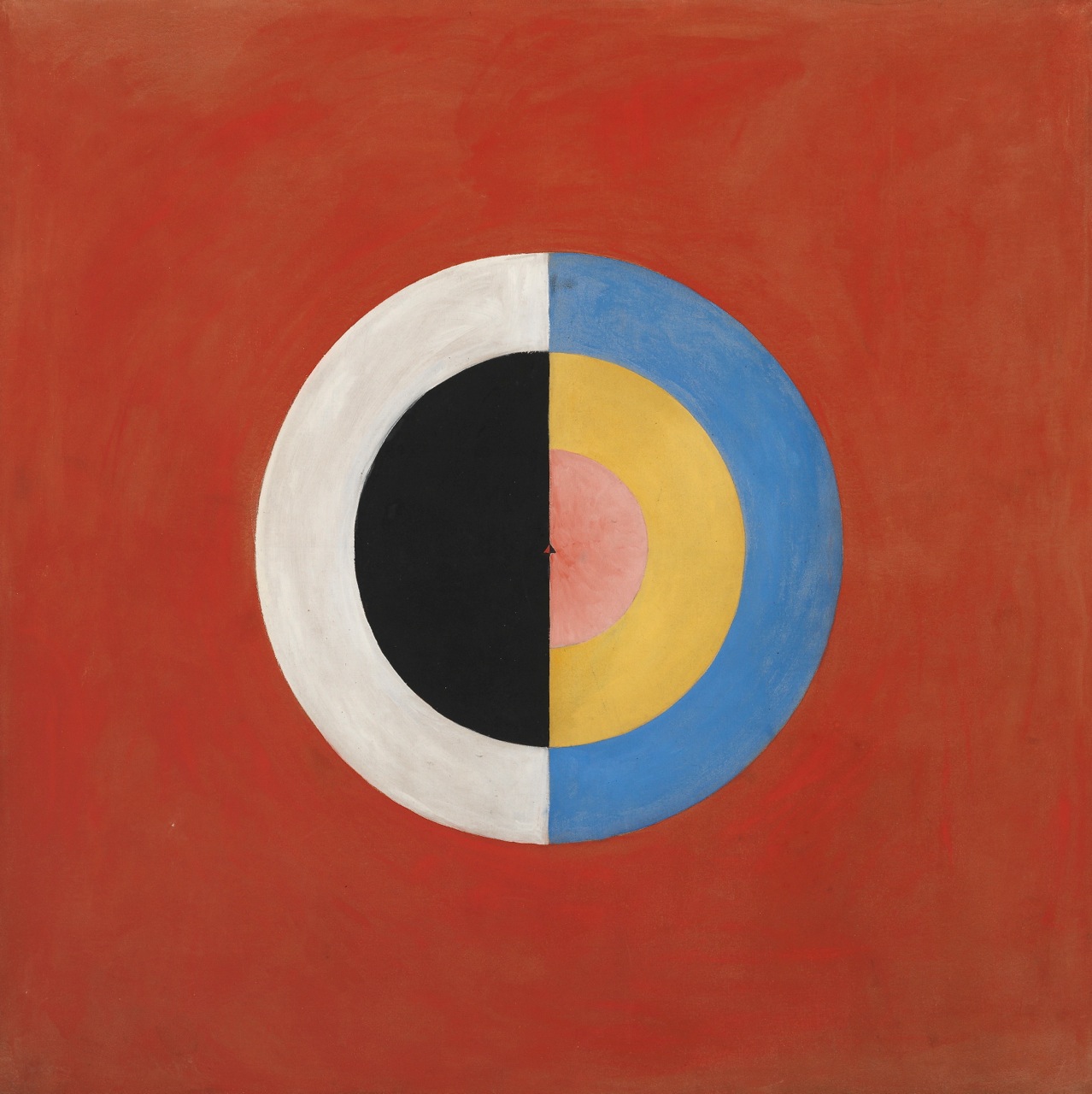
Hilma af Klint, Svanen, 1915
Kandinsky, inspired by Goethe’s Theory of Colors, had already given the subject of abstraction no small amount of thought. He’d first written a manifesto defining abstract art a few years earlier, titling it On the Spiritual in Art, a title that would have resonated with Hilma af Klint, a painter who might have actually gone abstract first. “Af Klint, who was born in Stockholm, showed an early interest in nature, mathematics and art, and she began studying at the Royal Swedish Academy of Fine Arts in 1882,” writes the New York Times’ Natalia Rachlin. She made her name as a landscape and portrait painter after graduation, but at the same time “also continued a more private pursuit: she had begun showing an interest in the occult and attending séances as early as 1879, at the age of 17.”
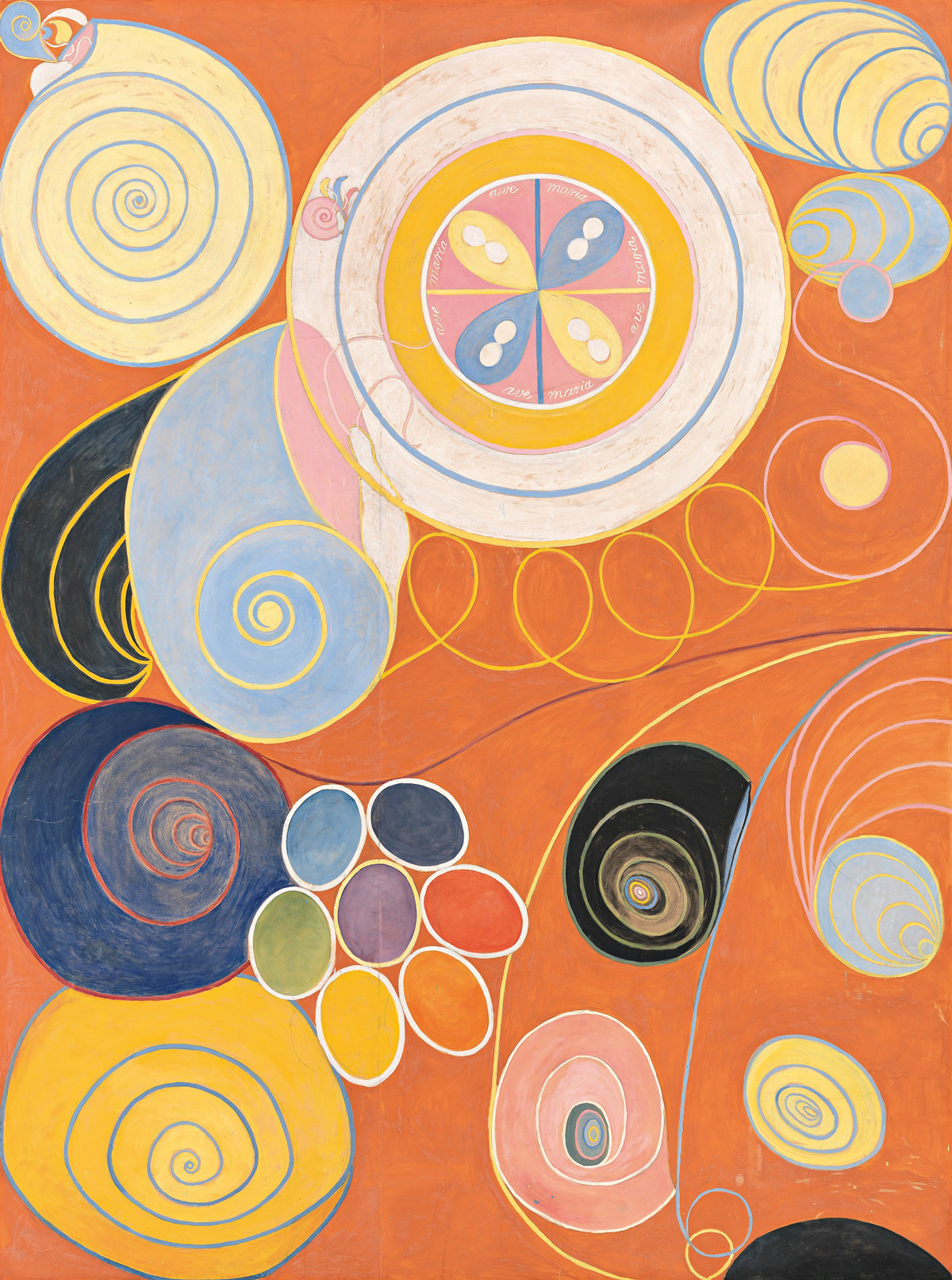
Hilma af Klint, ‘Staggering’: The Ten Largest, Youth, 1907.
Af Klint’s “curiosity about the spiritual realm soon developed into a lifelong interest in spiritism, theosophy and anthroposophy,” and during one séance she heard a spirit tell her to “make paintings that would represent the immortal aspects of man. This proved to be the turning point in af Klint’s work: from the naturalistic to the abstract, from portrayals of physical reality to conveying the invisible.” She went on to produce the 193 abstract Paintings for the Temple. The exhibitions of her representational work continued, but she kept the rest private, and in her will “even asked that her abstract paintings not be shown in public until at least twenty years after her death, noting that audiences were not yet capable of understanding her work.”
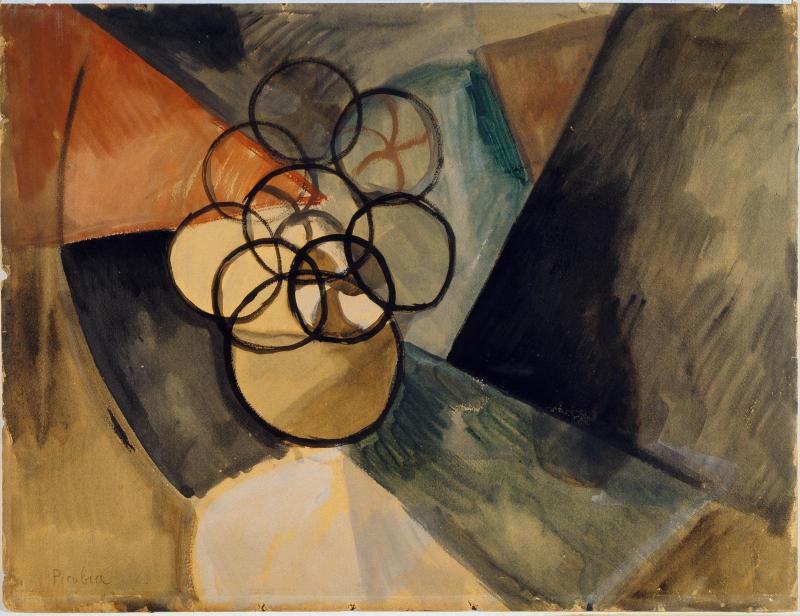
Francis Picabia, Caoutchouc, 1909.
Both Kandinsky and Af Klint look like plausible candidates for the first abstract painter — it just depends on how you define the beginning of abstraction — but they’re hardly the only ones. Cain also brings up the Czech-born, Paris-based artist František Kupka, or his colleague in the French avant-garde Francis Picabia, whose 1909 watercolor Caoutchouc (Rubber), pictured just above, came before Kandinsky had painted an abstract image or even completed any writing on the subject. Still, some objectors note that “the work still retains some semblance of form, reminiscent of a bouquet of flowers.” These questions of purity, innovation, and especially originality do get complicated. As Clive James once said, “It’s very hard to be totally inventive, so I’m not terribly interested in originality. Vitality is all I care about” — a quality that all these works exude still today.
If you would like to support the mission of Open Culture, consider making a donation to our site. It’s hard to rely 100% on ads, and your contributions will help us continue providing the best free cultural and educational materials to learners everywhere. You can contribute through PayPal, Patreon, and Venmo (@openculture). Thanks!
The worlds of the Velvet Underground and Lawrence Welk are pretty far apart. On the one side, you have a gritty New York band city writing lyrics about shooting up heroin. On the other, a bandleader whose “champagne music” charmed TV viewers across Middle America for 27 straight years. And yet. And yet.
In this 2007 YouTube classic, director/producer Darren Hacker found a way to cross the chasm, mashing up VU’s 1968 song “Sister Ray” with footage from the Lawrence Welk Show. As he explained to Dangerous Minds, “I rigged up 2 ancient VCRs and a CD player across my living room floor, layed down on my stomach, cued everything up and then manually activated all 3 devices at precise intervals, live…in real time. One take, no edits…” Everything lined up, just like that.
Enjoy “Lawrence Welk Meets Velvet Underground” and imagine a moment when, circa 1968, VU went mainstream on the milquetoast Lawrence Welk Show.
Last year we featured the Wintergatan Music Machine, a lovingly handcrafted in wood automated instrument created by artist/musician Martin Mollin. Over 2,000 marbles travel through a complex series of gears, cranks, and tubes, eventually striking notes on a xylophone and creating beats on two closely mic’d pads to make bass and snare drum sounds. There’s more layers to follow in the video, and it’s all been programed by Mollin.
Even before digital they made fantastic, programmable music instruments. In bell towers and church towers that play a melody they always have a programming wheel exactly like the one that is on the marble machine.
Which leads to today’s video, where Mollin gets to improvise on the machine that inspired him to make his own: a 500-year-old carillon. This carillon uses a programmable wheel (or “repinnable musical drum” as it is officially called), which allowed melodies to be played on church bells.
Those patterns are set on the drum by a series of movable stops, but this carillon also has a second set of keys that are arranged like a piano, and must be played with a fist. Mollin has a go, and improvises a melody near the end.
Mollin also hosts “Music Machine Mondays” on his YouTube channel, where he explores more of the museum’s collection of automata, like this insane Self-Playing Orchestra with 17 Instruments (above). If you are into some pre-transistor coolness, before steam or punk was even a thing, do check it out.
Ted Mills is a freelance writer on the arts who currently hosts the FunkZone Podcast. You can also follow him on Twitter at @tedmills, read his other arts writing at tedmills.com and/or watch his films here.
Art Nouveau, Art Deco… these are terms we associate not only with a particular period in history—the turn of the 20th century and the ensuing jazz-age of the 20s—but also with particular locales: Paris, New York, L.A., London, Vienna, or the Jugendstil of Weimar Munich. We probably do not think of Rio de Janeiro. This may be due to biases about the privileged location of culture, such that most people in Europe and North America, even those with an arts education, know very little about art from “the colonies.”
But it is also the case that Brazil had its own modern art movement, one that strove for a distinctly Brazilian sensibility even as it remained in dialogue with Europe and the U.S. The movement announced itself in 1922, the centennial of the South American nation’s independence from Portugal.
In celebration, artists from São Paulo held the Semana de Arte Moderna, seven days in which, the BBC writes, they “constructed, deconstructed, performed, sculpted, gave lectures, read poetry and created some of the most avant-garde works ever seen in Brazil.”
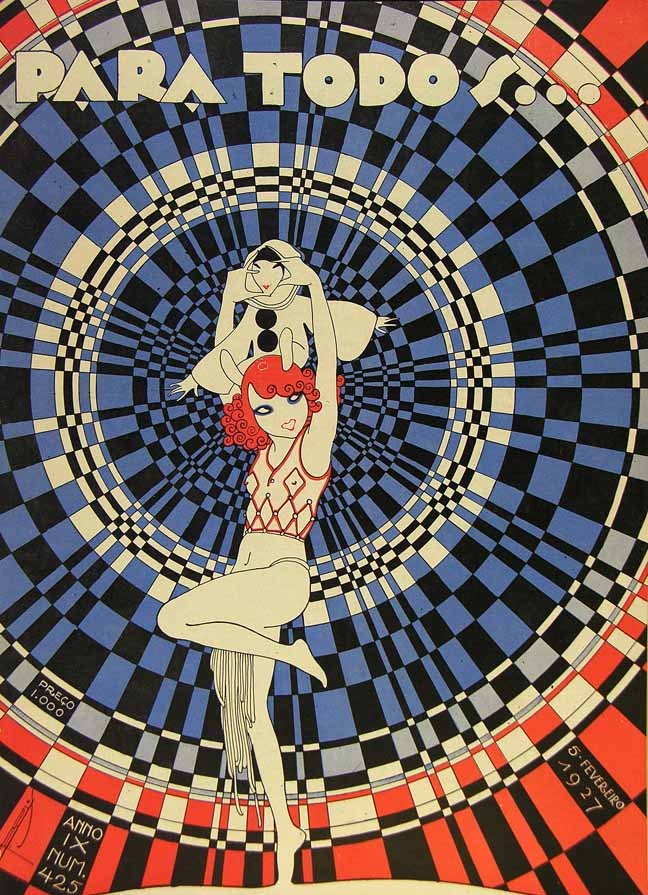
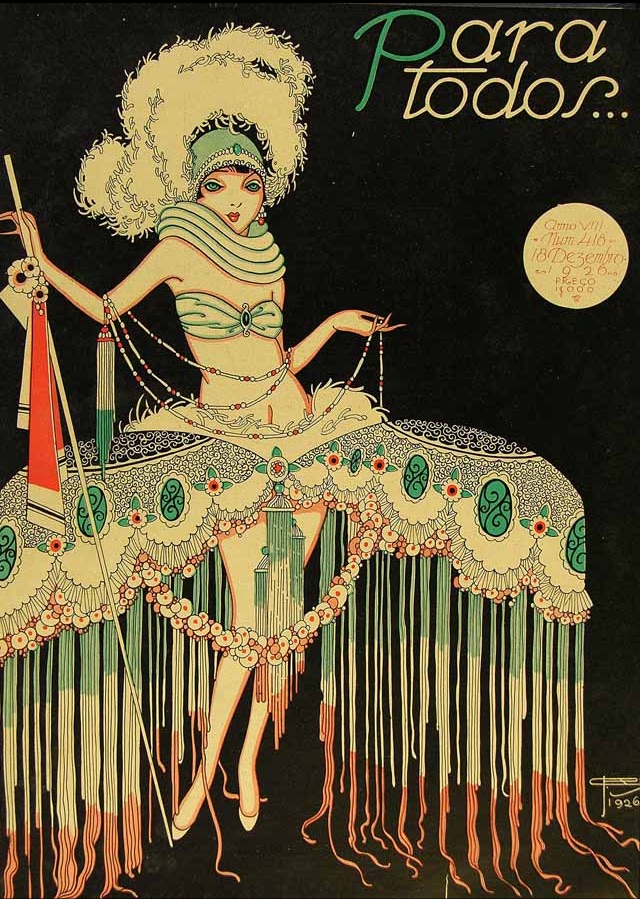
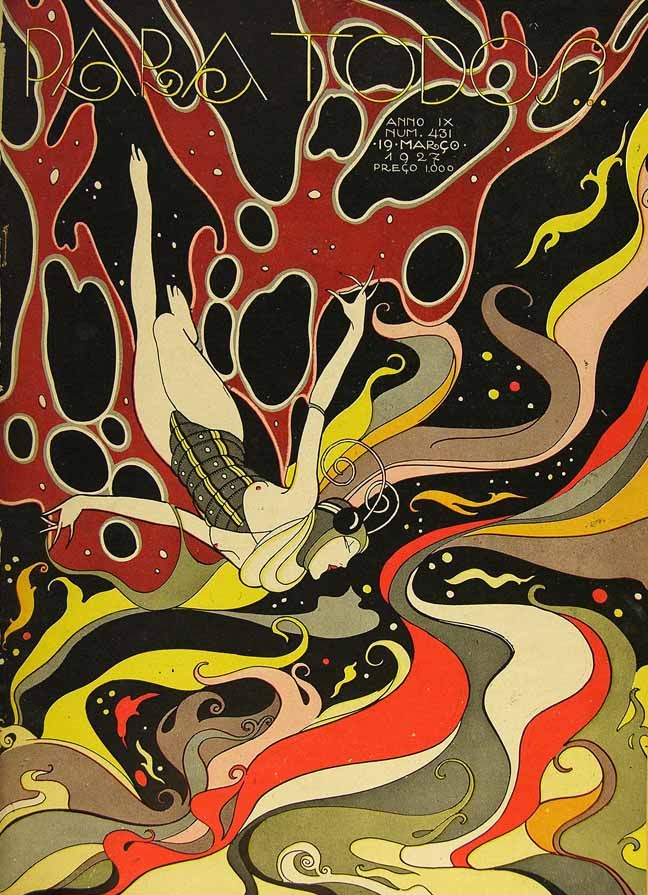
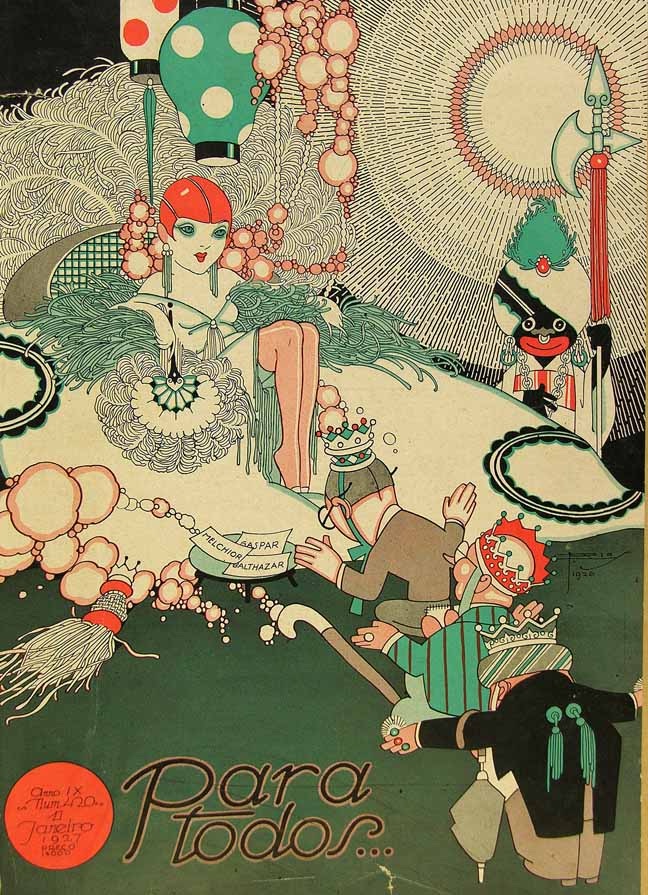
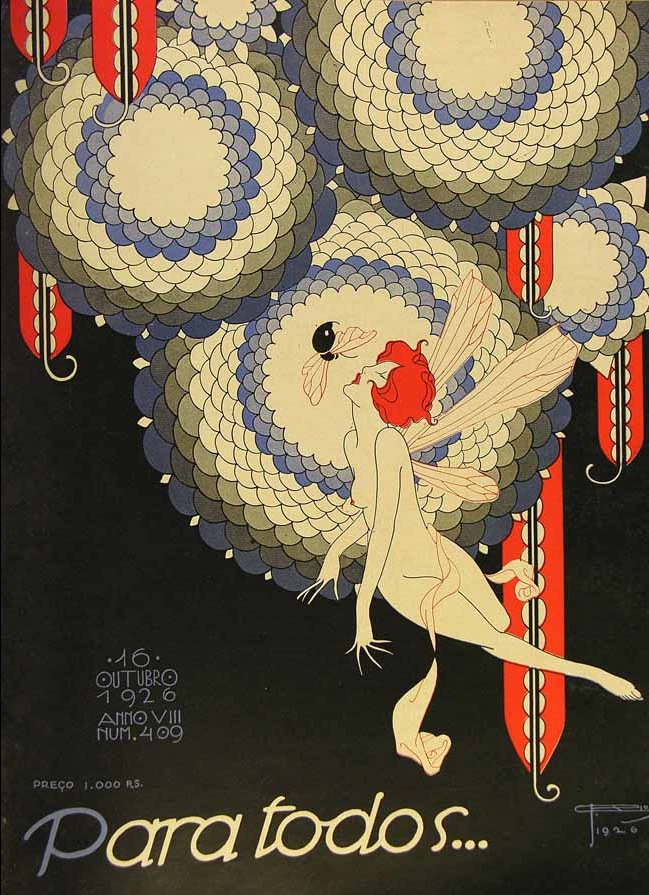
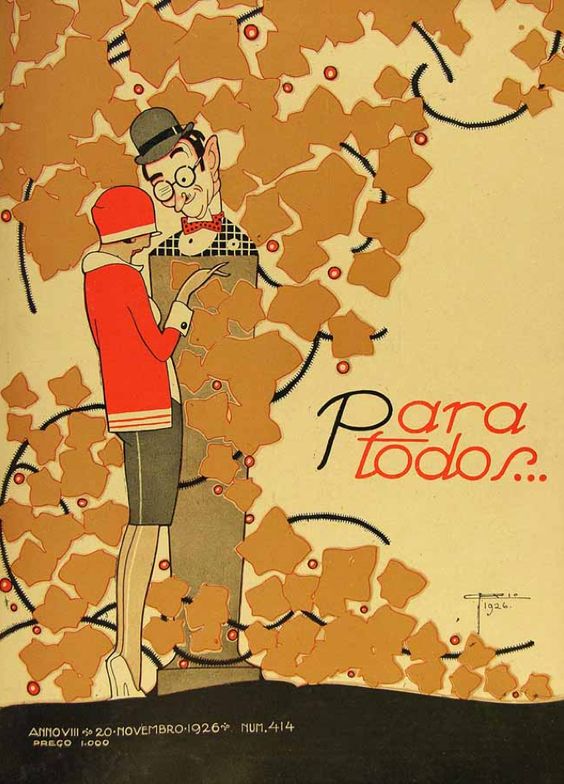
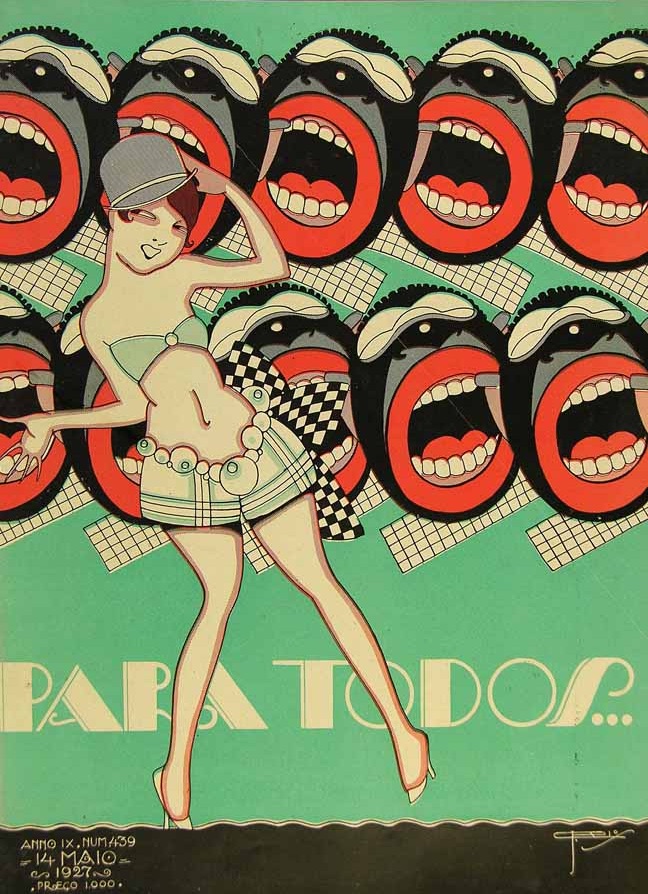
1922 also happened to be the year that a Rio de Janeiro-born artist, illustrator, and graphic designer who went by the name J. Carlos (José Carlos de Brito e Cunha) took over the direction of the magazine Para Todos. Founded in 1918, the magazine began as a film rag, and its covers faithfully featured photo spreads of movie stars. But in 1926, Carlos, who had already proven himself a “major talent in Brazilian Art Deco graphic design,” writes Messy Nessy, began drawing his own cover illustrations, and he continued to do so for the next four years, as well as drawing thousands of cartoons and writing vaudeville plays and samba lyrics.
His work clearly draws from Euro-American sources, including several unfortunate racial caricatures. But it also introduces some uniquely Brazilian elements, or uniquely Carlos-ian elements, that seem almost proto-psychedelic (we might imagine a jazz-age Os Mutantes accompanying these trippy designs). J. Carlos was a prolific artist who “collaborated in design and illustration in all the major publications of Brazil from the 1920s until the 1950s.” In all, it’s estimated that he left behind over 100,000 illustrations. So devoted was Carlos to the art and culture of his native city that he apparently turned down an invitation by Walt Disney to work in Hollywood.
Print magazine describes Carlos’ work as “a cross between Aubrey Beardsley and John Held Jr.,” and while there is no shortage of the willowy, doll-like flappers, elongated, elfin figures, and intricate, spidery patterns we would expect from this derivation, Carlos is also doing something very different from either of those artists—or really from anyone working in the Northern Hemisphere. He has since become a heroic figure for Brazilian artists and scholars, inspiring an extensive web project, a visual thesis on Issuu, and two recent documentary films (all in Portuguese), which you can find here.
In 2009, Carlos received a posthumous honor that probably would have thrilled him in life, a tribute song by the Académicos da Rocinha samba club. Listen to it here and find several more of Carlos’ Para Todos covers at Messy Nessy, Print, and the Brazilian blog Os caminhos do Journalismo.
Was Frank Zappa a musical genius? A modernist, avant-garde composer who just happened to work in an idiomatic pastiche of jazz, classical, progressive rock and juvenile shock tactics? The question can be a deeply divisive one. Zappa tends to inspire either intense devotion or intense dislike. But whatever one’s opinion of the man or his music, it’s safe to say that when he wasn’t working alone, Zappa worked in the company of some incredibly talented musicians. And he attracted, as John Rockwell wrote in 1984 at The New York Times, “a tiny following among classical avant-gardists.”
That year, one of his more genteel fans, Pierre Boulez—former music director of the New York Philharmonic and “widely regarded,” notes Rockwell, “as one of the great composers of the [20th] century”—decided to conduct a suite of Zappa songs. Zappa hoped the resulting album, The Perfect Stranger, would help him realize his ambition of having his music taken seriously in classical circles. (“A brief collaboration in 1970 with Zubin Mehta,” writes April Peavey at PRI, “went nowhere.”)
Boulez conducts his own ensemble for three tracks on the album, “The Perfect Stranger,” “Naval Aviation in Art?” and “Dupree’s Paradise.” The remaining four songs are performed by “The Barking Pumpkin Digital Gratification Consort,” a Zappaism for the Synclavier, Zappa’s favorite electronic instrument. For all the high seriousness the collaboration implies, Zappa couldn’t help inserting his surreally sardonic sense of humor; always “a compulsive musical comedian,” wrote Rockwell, he wears here “the defensive mask of irony, again.”
Each of the songs has an accompanying scenario. “The Perfect Stranger” imagines that “a door-to-door salesman, accompanied by his faithful gypsy-mutant industrial vacuum cleaner, cavorts licentiously with a slovenly housewife.” In “Love Story,” Zappa wants us to picture “an elderly Republican couple attempting sex while breakdancing.” Many people have had trouble getting past the sophomoric posturing and seeing Zappa’s music as serious art. He often seemed intent on alienating exactly such people.
But perhaps Zappa did not need the pedigree Boulez lent to his work. When listening, for example, to the Mothers of Invention play Zappa’s original arrangement of “Dupree’s Paradise” (top), one has to admit, he created brilliantly complex, rhythmically exciting music and, in the final analysis, represented “a particularly appealing type of quintessentially American composer—genuinely defiant of established categories and divisions that others routinely accept.” Listen to the Boulez/Zappa collaboration The Perfect Stranger in the Spotify playlist above, or access it directly on Spotify here.
In an odd twist of history, two of the wisest and weirdest children’s writers of their generation also happened to have both been fighter pilots during World War II. Antoine de Saint-Exupéry, author of The Little Prince, flew reconnaissance missions for the French Air Force before the 1940 armistice with Nazi Germany. Roald Dahl, author of—among many others—Charlie and the Chocolate Factory, James and the Giant Peach, and The BFG, flew with the Royal Air Force. Both wrote about their flying exploits and both writers, it so happened, were once shot down over Libya, which also happens to be the title of Dahl’s first published story, written for grown-ups and published in the Saturday Evening Post in 1946.
There are maybe other uncanny similarities, but one thing Saint-Exupéry never turned his hand to is television. Dahl, on the other hand, had the opportunity to host two TV shows during his lifetime: Way Out in 1961 and Tales of the Unexpected, which aired from 1979 to 1988 and featured several episodes based on Dahl’s own stories. Although he has become renowned for his high-concept kid’s books, at the time of Dahl’s entrée onto the tube, he had mainly achieved fame as a writer of macabre tales published in the New Yorker as well as a script written for Alfred Hitchcock Presents called “Lamb to the Slaughter.”
Dahl seems a natural fit for the medium, not only as a writer but as a presenter, with his dry wit and suave personality. But his first show, Way Out—eight episodes of which you can now watch on YouTube—came about entirely by accident, or rather, as the serendipitous result of another program’s spectacular failure. This is no exaggeration. Jackie Gleason, perhaps the most famous comedian of his day, had decided in 1961 to attempt a celebrity game show on CBS called You’re in the Picture. The show was such a bomb that it only aired once, and the following week, Gleason appeared on a bare stage for half an hour, the authors of a Filmfax Magazine article write, and “apologized to the American public for the insult to their intelligence that had been perpetrated the week before.”
This went on for several more weeks, then Gleason invited celebrity friends on for impromptu interviews and “when things started getting desperate,” had a chimp on as a guest star. One CBS network head at the time remembered the show later as the greatest disaster of his decades-long career in television. Enter producer David Susskind, “a man who could deliver a program quickly and under pressure,” and a great fan of Roald Dahl. Cooking up the idea of “an eerie, chilling creepy drama,” Susskind says, with “a nether world sense to it,” he approached Dahl with an offer to replace Gleason’s travesty with adaptations of his stories and the opportunity to host.
Only one of Dahl’s stories made it into the show, the first episode “William & Mary” (above), about a man planning to become a brain in a jar. But the show was an instant hit with critics, especially Dahl’s brief, darkly humorous opening and closing monologues. One critic described him as “a thin Alfred Hitchcock, an East Coast Rod Serling.” And like Serling’s show, Way Out—which was spelled in a title card after the first episode with an inexplicable single apostrophe as ’Way Out—trafficked in sci-fi and psychological horror. But the two shows were not in competition. Twilight Zone and Way Out both aired on the same network, CBS, and the time slot of Gleason’s failed show happened to directly precede The Twilight Zone, just then ending its second season. Dahl’s show was billed as a “companion program” to Serling’s.
Sadly for all the praise showered upon ’Way Out, it did not attract a large enough audience to get renewed for a second season, and it would be another 18 years before Dahl returned to television. But even had he never returned, or never even made his first program, Dahl’s significant contribution to TV history would be secure. His first children’s book, The Gremlins, originally written in 1943 for a failed Disney project, inspired what is perhaps the most well-known Twilight Zone episode of them all, the William Shatner-starring “Nightmare at 20,000 Feet,” which involves a certain terrifying shock on an airplane and was so effective, it was remade for Twilight Zone, the film. The episode adapted a story by Richard Matheson, but it was Dahl who first came up with the idea.
Back in 2010, we began featuring a series of videos from filmmaker Kirby Ferguson. Called Everything is a Remix, the four-part video series explored the idea that (to quote from one of my earlier posts) “great art doesn’t come out of nowhere. Artists inevitably borrow from one another, drawing on past ideas and conventions, and then turn these materials into something beautiful and new.” That applies to musicians, filmmakers, technologists, and really anyone in a creative space.
If you would like to watch the original series in its totality, I would refer you to the video below. Above, you can now watch a new Kirby Ferguson video that delves into the concept of Fair Use–a concept defined by the Stanford Copyright and Fair Use website essentially as “any copying of copyrighted material done for a limited and ‘transformative’ purpose, such as to comment upon, criticize, or parody a copyrighted work.” They go on to say: “Such uses can be done without permission from the copyright owner. In other words, fair use is a defense against a claim of copyright infringement. If your use qualifies as a fair use, then it would not be considered an infringement.”
Needless to say, fair use is an important concept if you’re making your own videos on Youtube, or if you’re a teacher using media in the classroom.
By the end of his short video, if you’re still not clear what Ferguson means by Fair Use, you’re in luck. He’s giving you the opportunity to submit questions to be answered by “a real live lawyer in a follow up video.” He also includes extra resources at the end of the segment.
If you would like to support the mission of Open Culture, consider making a donation to our site. It’s hard to rely 100% on ads, and your contributions will help us continue providing the best free cultural and educational materials to learners everywhere. You can contribute through PayPal, Patreon, and Venmo (@openculture). Thanks!
Few filmmakers have ever figured out how to make a motion picture about an already larger-than-life personality, and personalities haven’t come much larger in recent history than Freddie Mercury’s. Talk of a movie about the Queen frontman, who died in 1991, has gone on for years: Dexter Fletcher came up as a potential director, and for the role of Mercury both Ben Wishaw and Sacha Baron Cohen have at different times been attached. But now the film has entered production, having found a director in Bryan Singer, he of the X‑Men franchise, and a star in Rami Malek, best known as the lead in the television series Mr. Robot.
But can Malek — or indeed anyone currently living — convince as Mercury? The first piece of evidence has surfaced in the form of the clip at the top of the post, shot on set as the cast recreates Queen’s 1985 comeback performance at Live Aid. The band “seemed to intuit right from the start the importance of the day, though they were very nervous backstage.
But once onstage they completely own it, even more so Freddie Mercury who rises to the occasion as a front man and as a singer, giving one of his best performances,” writes Ted Mills of the real concert video, which we featured just this past May here on Open Culture. The show opens by going straight into“Bohemian Rhapsody,” Queen’s signature eight-minute rock opera, which gives the new movie its working title.
Even going by just a minute and a half of footage, shot shakily, in low resolution, and at a distance, it must be said that Malek does look to make an uncanny Mercury, right down to that distinctive jog onto the stage at Wembley Stadium. In the Late Show with Stephen Colbert clip just above, Malek talks about his experience watching the surviving members of Queen watch his performance as Mercury for the first time — and at the iconic Abbey Road Studios, no less. “How did they take you?” Colbert asks. “They took me,” Malek responds, leaving us to wait until December of next year to judge for ourselves how he brings their beloved lead singer back to life — and whether, by whatever combination of training and technological wizardry, the film gets it right down to that one-of-a-kind voice.
We're hoping to rely on loyal readers, rather than erratic ads. Please click the Donate button and support Open Culture. You can use Paypal, Venmo, Patreon, even Crypto! We thank you!
Open Culture scours the web for the best educational media. We find the free courses and audio books you need, the language lessons & educational videos you want, and plenty of enlightenment in between.