“Over half a century, Mary Leakey labored under the hot African sun, scratching in the dirt for clues to early human physical and cultural evolution. Scientists in her field said she set the standards for documentation and excavation in paleolithic archeology. They spoke of hers as a life of enviable achievement.” That’s how The New York Times started its 1996 obituary for Mary Leakey, “matriarch of the famous fossil-hunting family in Africa whose own reputation in paleoanthropology soared with discoveries of bones, stone tools and the footprints of early human ancestors.”
Above, you can watch the Times’ newly-released cutout animation, celebrating her life and paleoanthropology work in eastern Africa. The endearing seven-minute film covers her discovery of Proconsul africanusin 1948, Zinjanthropus boiseiin 1959, Homo habilis in 1960, and the trail of early human footprints found at Laetoli in the mid-1970s. The film also features something you’ll likely never see elsewhere — people throwing elephant dung frisbees! Enjoy.
If you’ve been wondering how the Serial podcast would follow up on its remarkable first season, the suspense is over. This morning, Season 2 is getting underway. Episode 1 is now online, ready for download.
A year ago, we got intimately familiar with the 1999 murder of Hae Min Lee and the trial of Adnan Syed. Now, host Sarah Koenig will take us deeper into the world of Sgt. Bowe Bergdahl, the soldier held captive by the Taliban for five years, who is now facing desertion charges by the US Army.
Follow Open Culture on Facebook and Twitter and share intelligent media with your friends. Or better yet, sign up for our daily email and get a daily dose of Open Culture in your inbox. And if you want to make sure that our posts definitely appear in your Facebook newsfeed, just follow these simple steps.
In May we featured color footage of a bombed-out Berlin a month after Germany’s defeat in the Second World War. Today we have footage of Tokyo, the other Axis power’s capital city, shot in that aftermath era, albeit in black-and-white — but at such a high level of clarity and with such smoothness that it feels as if it could have come from a historical movie made today. These clips, assembled into a sort of music video by the record producer and DJ Boogie Belgique, take us for a ride down a shopping street in the Shinbashi district, past market stalls in Shibuya, alongside the river, and even into areas meant exclusively for the occupying American forces.
Given that, and given the obviously high technology used to capture the footage itself, the occupying American forces more than likely shot this film themselves. But when did they do it? Clearly, Tokyo has had time to build itself back up after the immense destruction of the war, but how much time exactly? The Japan-watchers at Rocket News 24 have put their heads together to answer that question. “Japan was occupied from 1945 to 1952, so it was most likely around that time,” writes that site’s Scott Wilson.
He goes on to enumerate the visual clues that help pin down the year, including one poster for “Hatsu Imai, the first woman elected to the Japanese House of Representatives in 1946” and another for Miracle on 34th Street, originally released in November 1948. The consensus, in any case, seems to call this the Tokyo of the late 1940s, the city that Yasujirō Ozu, one of Japan’s most beloved auteurs, used as a setting in films like The Record of a Tenement Gentleman, A Hen in the Wind, and Late Spring.
But Ozu never included any visible traces of the American occupation, much less the clear presence we see in this documentary clip, in large part due to the demands of the American censors. They frowned on any direct reference to the United States, to the point that they almost cut out of Late Spring the admiring reference to Gary Cooper, to whom the main character’s matchmaking aunt compares the suitor she’s chosen for her. That main character, named Noriko, went on to appear in Ozu’s Early Summer in 1951 and Tokyo Story in 1953 — not as the exact same person each time, but always played by Setsuko Hara, rest her sweet soul, as the archetypal young-ish woman in postwar Tokyo. How many real-life Norikos of Shinbashi or Shibuya, I wonder, turned their heads to watch the American camera crew pass by?
Over the years the recommendation robots of Amazon and other online services seem to be usurping the role of the librarian. I do not know if this is ultimately good or bad—we may see in the future artificially intelligent librarians emerge from the web, personal literary assistants with impeccable taste and sensitivity. But at present, I find something lacking in online curation cultivated by algorithms. (I have a similar nostalgia for the bygone video store clerk.) Yes, customers who bought this book also bought others I might like, but what, tell me, would a genuine reader recommend?
A reader, say, like that arch reader Jorge Luis Borges, “one of the most well read men in history,” writes Grant Munroe at The Rumpus. Part of the thrill of discovering Borges resides in discovering all of the books he loved, both real and imaginary. The author always points to his sources. Borges, after all, “presented the genius of Pierre Menard, author of the Quixote [a story about writing as scrupulously faithful rewriting] by first carefully enumerating each book found in Menard’s personal library.” Borges himself, some readers may know, wrote the bulk of the short stories for which he’s known while working at a library in Buenos Aires, a job he described in his 1970 essay “Autobiographical Notes” as “nine solid years of unhappiness.”
Although he disliked the bureaucratic boredom of library work, Borges was better suited than perhaps anyone for a curatorial role. Given this reputation, Borges was asked more than once to select his favorite novels and stories for published anthologies. One such multi-volume project, titled Personal Library, saw Borges selecting 74 titles for an Argentine publisher between 1985 and his death in 1988. In another, Borges chose “a list of authors,” Monroe writes, “whose works were selected to fill 33 volumes in The Library of Babel, a 1979 Spanish language anthology of fantastic literature edited by Borges, named after his earlier story by the same name.”
Monroe tracked down all of the titles Borges chose for the eclectic anthology, “a fun, brilliant, polyglot collection” that includes a great many of the author’s perennial favorites, many of which you’ll recognize from their mentions in his fiction and essays. Below, we reproduce Monroe’s reconstruction of the 33 Library of Babel volumes, with links to those works available free online. Unfortunately, many of these stories are not available in translation. Others, such as those of Leon Bloy, have just become available in English since Monroe’s 2009 article. Thanks to his diligence, we can enjoy having Jorge Luis Borges as our personal librarian.
The Library of Babel
(Note: The titles of all stories currently without a proper translation into English have been left in their original language.)
(Also note: All stories marked with [c] are still protected by US copyright law. Only residents of the UK and Australia can legally click on the hyperlink provided.)
“August 26, 1983″
“The Rose of Peracelsus”
“Blue Tigers”
“Shakespeare’s Memory”
An Interview with Borges, with Maria Esther Vasquez
A Chronology of J.L. Borges’ Life, from Siruela Magazine
The Ruler and Labyrinth: An Approximation of J.L Borges’ Bibliography, by Fernandez Ferrer
“La Taie d’Argent”
“Les Captifs de Longjumeau”
“Une Idée Médiocre”
“Une Martyre”
“La Plus Belle Trouvaille de Caïn”
“On n’est pas Parfait”
“La Religion de M. Pleur”
“Terrible Châtiment d’un Dentiste”
“La Tisane”
“Tout Ce Que Tu Voudras!”
“La Dernière Cuite”
“Le Vieux de la Maison”
“Il Giorno Non Restituito”
“Due Immagini in una Vasca”
“Lo Specchio che Fugge”
“Storia Completamente Assurda”
“Il Mendicante di Anime”
“Una Morte Mentale”
“Non Voglio Più Essere Ciò che Sono”
“Chi Sei?”
“Il Suicida Sostituto”
“L’ultima Visita del Gentiluomo Malato”
(Used copies of the 1985 Oxford U. Press translation of Cruel Tales (the collection in which these stories are published) are available online.)
“L’Aventure de Tsé-i-la”
“Le Convive des Dernières Fêtes”
“A Torture By Hope” [trans. 1891]
“La Reine Ysabeau”
“Sombre Récit Conteur Plus Sombre”
“L’Enjeu”
“Véra”
“The Buddhist Priest of Ch’ang-Ch’ing”
“In the Infernal Regions”
“The Magic Mirror”
“A Supernatural Wife”
“Examination for the Post of Guardian Angel”
“The Man Who Was Changed into a Crow”
“The Tiger Guest”
“Judge Lu”
“The Painted Skin”
“The Stream of Cash”
“The Invisible Priest”
“The Magic Path”
“The Wolf Dream”
“Dreaming Honors”
“The Tiger of Chao-Ch’ëng”
“Taking Revenge”
(While I’ve provided links to online translations, they’re somewhat suspect; probably better to check the Complete Short Stories.)
“The Hunger Artist”
“First Sorrow” [or “The Trapeze Artist”]
“The Vulture”
“A Common Confusion”
“Jackals and Arabs”
“The Great Wall of China”
“The City Coat of Arms”
“A Report to the Academy”
“Eleven Sons”
“Prometheus”
(A new translation of Lugones’ stories, published by The Library of Latin America, is available at Powell’s.)
“The Pillar of Salt”
“Grandmother Julieta”
“The Horses of Abdera”
“An Inexplicable Phenomenon”
“Francesca”
“Rain of Fire: An Account of the Immolation of Gomorra”
(All the copyrighted stories are from Kipling’s Debits and Credits. They should be available in any thorough collection of his short fiction.)
“The Story-Teller”
“The Lumber Room”
“Gabriel-Ernest”
“Tobermory”
“The Background” [translated as “El Marco” (or “The Frame”)]
“The Unrest Cure”
“The Interlopers”
“Quail Seed”
“The Peace of Mowsle Barton”
“The Open Window”
“The Reticence of Lady Anne”
“Sredni Vashtar”
We’ve seen some pretty creative things done on a Möbius strip – like watching a Bach canon get played forwards, then back. But how about this? Above, watch Andy Marmery show a superconductor levitating on a Möbius strip made with over 2,000 magnets. The magic is in the superconducting material, Yttrium barium copper oxide, which lets the superconductor whiz along, seemingly floating both above and below the track. This video comes from a video series called “Tales from the Prep Room,” created by The Royal Institution, “a 200 year old charity based in London dedicated to connecting people with the world of science through events, education, and [its] Christmas Lectures.”
Follow Open Culture on Facebook and Twitter and share intelligent media with your friends. Or better yet, sign up for our daily email and get a daily dose of Open Culture in your inbox. And if you want to make sure that our posts definitely appear in your Facebook newsfeed, just follow these simple steps.
Jean Giraud, better known as Mœbius, may have passed away in 2012, but he gave his many fans glimpses into his unparalleled artistic imagination right up until the end. In 2010 and 2012, the Fondation Cartier pour l’Art Contemporain put on Mœbius-Transe-Forme, the first major exhibition in Paris devoted to his work, and one that, at Mœbius’ request, explored “the theme of metamorphosis, a leitmotif that runs throughout his comics, drawings, and film projects” and that presented his work in a variety of ways that even some of his most avid readers, used to experiencing his work only on the page, would never have seen before.
One such way took the form of The Dancing Line, a series of videos which capture Mœbius drawing live on a graphic tablet, offering an artist’s-eye-view into how he transformed a blank digital canvas into a window on the world he spent his career creating. Here we have three selections from the series: at the top we have Mœbius filling in the details on the face of Malvina from The Airtight Garage.
Just above, he draws the title character from his even better known comic series Blueberry, the unconventional Western he created with Jean-Michel Charlier. Below, you can watch the creation of a piece called “Inside Mœbius” — not a self-portrait, exactly, but a portrait of the sort of artist that exists in Mœbius’ world drawing a portrait of Mœbius himself.
“Staying alive for an artist means to always be in an unknown part of himself, to be out of himself,” Mœbius told the Los Angeles Times in 2011. “The exhibition in Paris, the theme was transformation. Art is the big door but real life is a lot of small doors that you must pass through to create something new. You don’t always need to go far.” Nobody, artist or otherwise, stays alive forever, but Mœbius knew how, in the time he had, to stay as alive as possible by constantly seeking out those unknown parts. The Dancing Line videos show us how he felt his way through that terra incognita, pointing the way with the expansive body of work he left behind toward all those small doors we, too, must pass through to create something new of our own.
Last Tuesday, December 1st, marked the 60th anniversary of Rosa Parks’ refusal to relinquish her seat at the front of a Montgomery, Alabama bus, and as some people pointed out, the story many of us were told as children about Parks’ act of civil disobedience was fabricated. Parks was not a humble, elderly seamstress worn out from a long day of work, a myth author Herbert Kohl summarizes as “Rosa Parks the Tired.” She was a well-connected activist and NAACP leader who had already initiated actions to integrate local libraries. Of her grossly oversimplified biography, Parks remarked in her memoirs, “I was not tired physically, or no more tired than I usually was at the end of a working day. I was not old, although some people have an image of me as being old then. I was forty-two. No, the only tired I was, was tired of giving in.”
Nor was Parks the first to brave arrest for refusing to give up a seat at the front of the bus. That same year, 15-year-old Claudette Colvin refused to give in, and seven months later, so did 18-year-old Mary Louise Smith. Neither of their arrests, however, had the power to spark the Montgomery Bus Boycott, the action that brought national attention to the civil rights movement and to Martin Luther King, Jr.’s leadership role. King would later recall that “Mrs. Parks was ideal for the role assigned to her by history” because “her character was impeccable and her dedication deep-rooted.” King’s repeated emphasis on “character” throughout his direction of the boycott and beyond often seems an awful lot like what is today disparaged, with good reason, as “respectability politics”—the notion that only those who conform to conservative, middle-class norms of dress and behavior deserve to be treated with dignity and to have their civil rights respected.
But this was not necessarily his point. His embrace of nonviolent resistance was in part a strategic means of presenting the Jim Crow power structure with an implacable united front that could not be moved to react in ways that might seem to justify violence in the eyes of a largely unsympathetic public—to make it clear beyond any doubt who was the aggressor. And the violence and repression directed at the boycotters was significant. They were attacked while walking to work; King’s and civil rights leader E.D. Nixon’s houses were both firebombed; and King, Parks, and 87 others were indicted for their participation in the boycott.
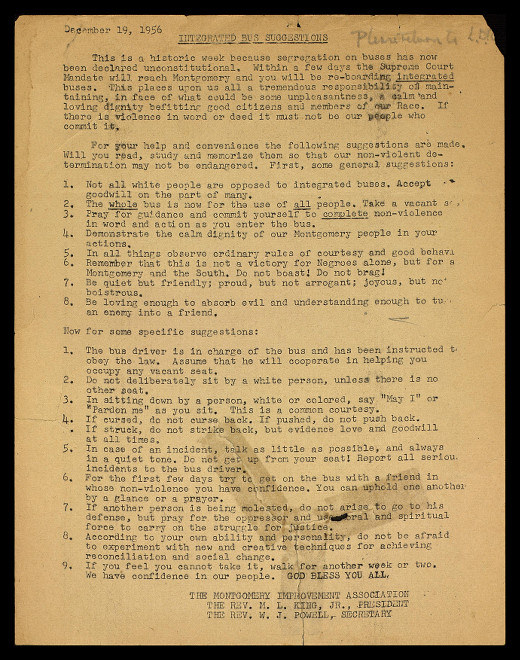
Nor did the boycott’s success in 1956 put an end to the attacks. As a site commemorating this history summarizes, “After the boycott came to a close, snipers shot into buses in black communities, at one point hitting a young black woman, Rosa Jordan, in the legs.” And on one single night in 1957, “four black churches and two homes were bombed.” These acts were on the extreme end of a daily series of aggressive confrontations and humiliations black riders faced as they boarded the newly-integrated Montgomery buses. To help those riders navigate this environment, King prepared the list of guidelines above on the week before the buses integrated. You can read a full transcript of the list below, thanks to Lists of Note, who include it in their recent book-length collection.
King makes his agenda clear in the introductory paragraph: “If there is violence in word or deed it must not be our people who commit it.” Some of these directives encourage great passivity in the face of often extreme hostility. It is very difficult for me to imagine responding in such ways to insults or physical attacks. And yet, the boycotters had already daily, and calmly, faced death and severe injury. As white Lutheran minister Robert Graetz—whose home was also bombed—remembered later, “Dr. King used to talk about the reality that some of us were going to die and that if any of us were afraid to die we really shouldn’t be there.”
INTEGRATED BUS SUGGESTIONS
This is a historic week because segregation on buses has now been declared unconstitutional. Within a few days the Supreme Court Mandate will reach Montgomery and you will be re-boarding integrated buses. This places upon us all a tremendous responsibility of maintaining, in face of what could be some unpleasantness, a calm and loving dignity befitting good citizens and members of our Race. If there is violence in word or deed it must not be our people who commit it.
For your help and convenience the following suggestions are made. Will you read, study and memorize them so that our non-violent determination may not be endangered. First, some general suggestions:
1 Not all white people are opposed to integrated buses. Accept goodwill on the part of many.
2 The whole bus is now for the use of all Take a vacant seat.
3 Pray for guidance and commit yourself to complete non-violence in word and action as you enter the bus.
4 Demonstrate the calm dignity of our Montgomery people in your actions.
5 In all things observe ordinary rules of courtesy and good behavior.
6 Remember that this is not a victory for Negroes alone, but for all Montgomery and the South. Do not boast! Do not brag!
7 Be quiet but friendly; proud, but not arrogant; joyous, but not boisterous.
8 Be loving enough to absorb evil and understanding enough to turn an enemy into a friend.
Now for some specific suggestions:
1 The bus driver is in charge of the bus and has been instructed to obey the law. Assume that he will cooperate in helping you occupy any vacant seat.
2 Do not deliberately sit by a white person, unless there is no other seat.
3 In sitting down by a person, white or colored, say “May I” or “Pardon me” as you sit. This is a common courtesy.
4 If cursed, do not curse back. If pushed, do not push back. If struck, do not strike back, but evidence love and goodwill at all times.
5 In case of an incident, talk as little as possible, and always in a quiet tone. Do not get up from your seat! Report all serious incidents to the bus driver.
6 For the first few days try to get on the bus with a friend in whose non-violence you have confidence. You can uphold one another by a glance or a prayer.
7 If another person is being molested, do not arise to go to his defense, but pray for the oppressor and use moral and spiritual force to carry on the struggle for justice.
8 According to your own ability and personality, do not be afraid to experiment with new and creative techniques for achieving reconciliation and social change.
If you feel you cannot take it, walk for another week or two. We have confidence in our people. GOD BLESS YOU ALL.
We’ve long been able to read books online. More recently, the internet has also become a favored distribution system for movies, and certainly we’ve all heard more than enough about the effects of downloading and streaming on the music industry. No new technology can quite substitute, yet, for a visit to the museum, but as we’ve often posted about here, many of the museums themselves have gone ahead and made their paintings, sculptures, and other artifacts viewable in great detail online. At this point, will the experience of any art form at all remain unavailable to us on the internet?
Not long ago, I would have named any of the performing arts, but the brains at the Google Cultural Institute have now got around to those most living of all forms as well. The New York Times’ Michael Cooper writes of our newfound ability, through a series of 360-degree videos, to “stand, virtually, on the stage of the Palais Garnier, among the dancers of the Paris Opera Ballet,” ” journey to Stratford-upon-Avon, where you can try to keep up with a frenetic Alex Hassell of the Royal Shakespeare Company as Henry V, exhorting his troops to go ‘once more unto the breach,’ ” or “go onstage at Carnegie Hall, where the video places you smack in the middle of the Philadelphia Orchestra as it plays a rousing ‘In the Hall of the Mountain King.’ ”
These come as part of a virtual exhibition involving “an innovative assemblage of performing arts groups” that went live earlier this month at the Google Cultural Institute’s site. The organizations, now more than 60 in total, include not just the Paris Opera, the Royal Shakespeare Company, and Carnegie Hall, but the Berlin Philharmonic, the Vienna State Opera, the American Ballet Theater, the American Museum of Magic, the Brooklyn Academy of Music, the Country Music Hall of Fame, the John F. Kennedy Center for the Performing Arts, the Metropolitan Opera, and the Rome Opera. You can find the performances neatly divided into categories: Music, Opera, Theatre, Dance, and Performance Art.
Google’s blog describes some of the technology behind all this, including the 360-degree performance recordings, the “indoor Street View imagery” of the grand venues where many of the performances happen, and the “ultra-high resolution Gigapixel” images available for your scrutiny. When you play the video above of the Philadelphia Orchestra, you can click and drag to view the performance from every possible angle from your vantage right there in the midst of the musicians. I can’t imagine what the Google Cultural Institute will come up with next, but surely it won’t be long before we can see things from the Black Swan’s point of view.
The BBC is getting ready to air a documentary, Secrets of the Mona Lisa, which will delve into the research of French scientist Pascal Cotte. Using an innovative imaging technique, Cotte has managed to probe the paint layers beneath the surface of da Vinci’s sixteenth-century masterpiece. And, lo and behold, he’s found hidden paintings, including what he believes is an original, “real” portrait of Lisa del Giocondo (the subject of da Vinci’s painting).
The host of the documentary, art historian Andrew Graham-Dixon, announced, “I have no doubt that this is definitely one of the stories of the century.” Other art historians are not getting carried away. Martin Kemp, Emeritus Professor of the History of Art at the University of Oxford, said in an interview: “They [Cotte’s images] are ingenious in showing what Leonardo may have been thinking about. But the idea that there is that picture as it were hiding underneath the surface is untenable. I do not think there are these discrete stages which represent different portraits. I see it as more or less a continuous process of evolution. I am absolutely convinced that the Mona Lisa is Lisa.” Or, put differently, there are not different portraits on da Vinci’s canvas, just stages of the same portrait that now hangs in the Louvre today.
Should we have any doubt about the malleability of George Orwell’s dystopian 1948 novel 1984, we need look no further than its most recent, very loose incarnation in a coming film titled Equals, which Variety’s Peter Debruge writes “should resonate most with the arthouse-going segment of the ‘Twilight’ fanbase.” That’s not a description that fills me with hope for a film project that might have brought us a worthy update of Orwell’s classic, as relevant as ever in a world full of high-tech surveillance states, technologically-enabled post-factualism, and choose-your-own creeping totalitarian political scenarios. These are concerns that deserve, nay beg, for a mature cinematic treatment, and a sophisticated new film adaptation of 1984 might be just the thing we need to grasp the moment. Instead, we may have to settle for glossy, Orwell-esque teen romance.
On the other hand, we might consider what should presumably be a sophisticated treatment of the novel in a recent adaptation that premiered in 2005 at London’s Royal Opera house. Composed by New York Philharmonic conductor Lorin Maazel, with a libretto by poet and critic J.D. McClatchy and Tony-award winning writer Thomas Meehan, the 1984 opera would seem to offer much more than an entertaining diversion. The work is Maazel’s first production, and he told the BBC, “I found that once I got into the material I was very inspired, very motivated, by the breadth of the story, by the challenge of making this extraordinary novel come alive in a different frame and context.”
As Maazel points out, and as the coming Equals movie exploits, the novel’s plot does indeed turn on a romance, among other potentially theatrical elements. Maazel says he “found within [it] the true stuff of opera—doomed love affair, political intrigue—very much like Don Carlos, or Fidelio, or Tosca.” How successful were Maazel and his writers at translating the dark political plotting of the novel to the brightly-lit stage of the Royal Opera? Well, you’ll notice that the “Press Articles” section of the opera’s website is tellingly thin, perhaps because the critics were not kind to the production, many calling it a vanity project, given that Maazel had financed it himself (with a company called Big Brother Productions). Nonetheless, the New York Times praised the libretto as “an effective treatment of George Orwell’s complex and iconic novel” that honors Orwell’s “themes and characters,” though they found the music in general much less compelling.
Widespread critical disparagement did not seem to impact ticket sales, however; the performance nearly sold out for three nights in a row. Opera houses everywhere, struggling as they are to attract new audiences and patrons, may yet consider reviving the work for its popularity. In the meanwhile, curious fans of opera, the novel, or both, can purchase a DVD of the production and see several clips here. At the top of the post, hear the overture and below it, see the love duet of Winston (Simon Keenlyside) and Julia (Nancy Gustafson). Further down, hear audio of the hymn “All Hail Oceana,” and just above, see the production’s finale. Speakers of Italian may find this brief television segment on the production of interest as well. While neither Maazel’s ambitious opera nor the upcoming, very loose commercial film adaptation seem to offer the contemporary 1984 we need, I for one hold out hope for a treatment that can effectively crystalize our fraught political present and Orwell’s disturbingly imagined future.
Flannery O’Connor’s surgical satire has the ability to strip away the pretensions of not only those characters we are already predisposed to dislike, but also those with whom we may sympathize—that is, educated people with broadly humanist views who think they see right through the self-important prejudices and provincialism of people like Mrs. Hopewell in “Good Country People” or Mrs. Chestny in “Everything that Rises Must Converge.” Both stories dramatize generational tensions in the form of mother/child pairs at odds. In the former, superficial, condescending Mrs. Hopewell and her daughter Joy—a miserable, graduate-educated amputee who prefers to call herself Hulga—battle over their conflicting moral philosophies, only to both be taken in by a devious bumpkin posing as a Bible salesman.
In the latter story—also the title of O’Connor’s most widely read collection, published posthumously in 1965—a mother and son pair present us with two kinds of intolerance. Mrs. Chestny is an overt bigot whose self-importance depends on her sense of herself as a descendent of a proud, if decayed, Southern aristocracy. Julian, her unemployed son, a despairing recent college-grad with designs of becoming a writer but with no real prospects, thinks himself above his mother’s ugly racism and desires nothing more than that she learn her lesson: “The old world is gone,” he says, “You aren’t who you think you are.” When she finally gets her comeuppance at the end of the story (on the way, comically, to a “reducing class”) it may have come, to Julian’s dismay, at the cost of her life. Though we are inclined to sympathize at first with the bitterly ironic son, as the story progresses, the narrator reveals his motivations as hardly more elevated than his mother’s hate and fear.
These are not characters we fall in love with, but we never forget them either. Through them we come to see that none of us is who we think we are, that the human capacity for self-deception is boundless. This is the lesson common to each of O’Connor’s stories, one she offers anew with wit and variety each time, and each time through a kind of revelation. Her stories draw us into points of view that reveal themselves—through sudden epiphanies and gradual unfoldings—to be inadequate, deluded, profoundly limited. And though O’Connor’s Southern Catholic pessimism has astonishingly universal reach, the regional grounding of her stories and novels present us with particularly American versions of the petty meanness and conceit common to the human species.
In “Revelation,” another story from Everything Rises Must Converge—read above by Studs Terkel—O’Connor lays bare some particularly American race and class biases in the character of Mrs. Turpin, another older Southern lady whose prejudices are more vicious and spiteful than both Mrs. Hopewell and Mrs. Chestny put together. The story achieves a subtle examination of some very unsubtle attitudes, and the reading by Terkel, in his Chicago-accented radio voice, does it justice indeed. Terkel read the story on his radio show, The Studs Terkel Program, in 1965, the year of its publication and a little over a year after O’Connor’s death. See a complete transcript of the broadcast at the Terkel show’s Pop Up Archive. The audio above has been kindly enhanced for us by sound designer Berrak Nil.
As an added treat, hear “Everything that Rises Must Converge” read above by Academy Award-winning actress Estelle Parsons, who became known in her later years for playing an overbearing mother like the story’s Mrs. Chestny in the TV sitcom Roseanne. Despite the quaintness of O’Connor’s characterizations, we are not far at all from the world she depicted, given the stubborn persistence of human bigotry, selfishness, and blind self-regard. For more classic O’Connor, hear the sharp-tongued writer, who died too soon of complications from her lupus at age 39, read her story “A Good Man is Hard to Find” here.
We're hoping to rely on loyal readers, rather than erratic ads. Please click the Donate button and support Open Culture. You can use Paypal, Venmo, Patreon, even Crypto! We thank you!
Open Culture scours the web for the best educational media. We find the free courses and audio books you need, the language lessons & educational videos you want, and plenty of enlightenment in between.