If you’re near Pasadena, California, stop by the Flower Pepper Gallery and see Facade, the new exhibition featuring the work of visual artist Randy Hage. For decades now, Hage has been fascinated by the beauty of aging structures in New York City. This led him, beginning in the late 1990s, to start photographing aging storefronts in the city, “with their hand painted signs, layers of architecture, wonderful patinas and intriguing history.” Later, he decided to preserve their memory in miniaturized, hyper-realistic sculptures (like the ones now on display in Pasadena through November 18th). In the video above, see just how perfectly Hage manages to recreate New York storefronts in miniature. Here’s another famous-but-now-defunct facade you might recognize:
Follow Open Culture on Facebook and Twitter and share intelligent media with your friends. Or better yet, sign up for our daily email and get a daily dose of Open Culture in your inbox. And if you want to make sure that our posts definitely appear in your Facebook newsfeed, just follow these simple steps.
If you would like to support the mission of Open Culture, consider making a donation to our site. It’s hard to rely 100% on ads, and your contributions will help us continue providing the best free cultural and educational materials to learners everywhere. You can contribute through PayPal, Patreon, and Venmo (@openculture). Thanks!
In modern times, we don’t regard female musicians as in and of themselves unusual. Our rosters of favorite rockers, pop-stars, solo singer-songwriters, and what have you might well feature as many women as men — or, depending on the subgenre, many more women than men. But those of us who listen to a great deal of classical music might feel a tad sheepish about how much more heavily male our playlists slant, at least in terms of the composers. For a variety of historical and cultural reasons, the classical canon can feel like a man’s world indeed.
But it doesn’t have to! The Spotify playlist above, “1200 Years of Women Composers: From Hildegard To Higdon,” reveals that women started shaping what we now know as classical music far longer ago than most of us realize. (If you don’t have Spotify’s free software, download it here.) The playlist, which contains over 900 pieces and will take you days to listen to, begins in medieval times with the Byzantine abbess, poet, composer, and hymnographer Kassia (shown above) and ends with female composers from around the world not only living but (especially by the standards of those who write orchestral music) still young, like Misato Mochizuki, Helena Tulve, and Lera Auerbach.
This comes arranged by Spotify Classical Playlists, whose site describes how the playlist offers not just an anthology of women composers, but also “a brief history of western classical music. It’s really fascinating to hear music constantly reinventing itself from the monophonic and deeply spiritual medieval chant of Hildegard [of Bingen] all the way into Higdon’s lush and ultra-modern percussion concerto.” And before you begin this epic listen, bear in mind the quote from Faust that appears there: “Das Ewig Weibliche Zieht ins hinan” — “The eternal feminine leads us upwards.”
Creative Commons image by Osama Shukir Muhammed Amin
When one enters the world of The Epic of Gilgamesh, the oldest epic poem we know of, one enters a world lost to time. Though its strange gods and customs would have seemed perfectly natural to its inhabitants, the culture of Gilgamesh has so far receded from historical memory that there’s little left with which we might identify. Scholars believe Gilgamesh the demi-god mythological character may have descended from legends (such as a 126-year reign and superhuman strength) told about a historical 5th king of Uruk. Buried under the fantastic stories lies some documentary impulse. On the other hand, Gilgamesh—like all mythology—exists outside of time. Gilgamesh and Enkidu always kill the Bull of Heaven, again and again forever. That, perhaps, is the secret Gilgamesh discovers at the end of his long journey, the secret of Keats’ Grecian Urn: eternal life resides only in works of art.
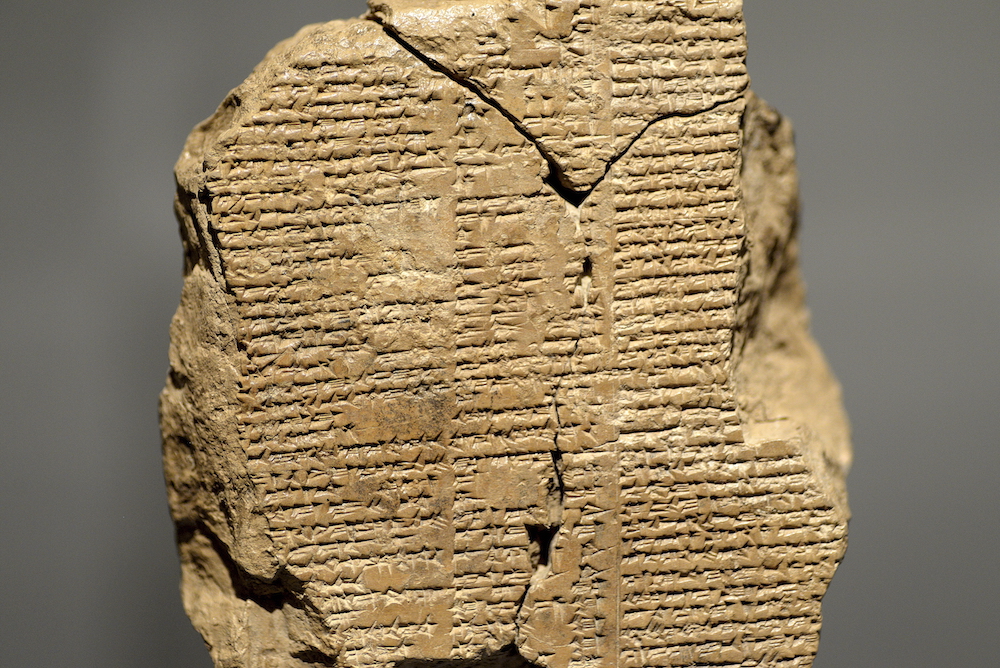
And perhaps the only way to approach some common understanding of myths as both products of their age and as archetypes in realms of pure thought comes through a deep immersion in their historical languages. In the case of Gilgamesh, that means learning the extraordinarily long-lived Akkadian, a Mesopotamian language that dates from about 2,800 BCE to around 100 CE. In order to do so, archeologists and Assyriologists had to decipher fragments of cuneiform stone tablets like those on which Gilgamesh was discovered. The task proved exceptionally difficult, such that when George Smith announced his translation of the epic’s so-called “Flood Tablet” in 1872, it had lain “undisturbed in the [British] Museum for nearly 20 years,” writes The Telegraph, since “there were so few people in the world able to read ancient cuneiform.”
Cuneiform is not a language, but an alphabet. The script’s wedge-shaped letters (cuneus is Latin for wedge) are formed by impressing a cut reed into soft clay. It was used by speakers of several Near Eastern languages including Sumerian, Akkadian, Urartian and Hittite; depending on the language and date of a given script, its alphabet could consist of many hundreds of letters. If this weren’t challenging enough, cuneiform employs no punctuation (no sentences or paragraphs), it does not separate words, there aren’t any vowels and most tablets are fragmented and eroded.
Nonetheless, Smith, an entirely self-educated scholar, broke the code, and when he discovered the fragment containing a flood narrative that predated the Biblical account by at least 1,000 years, he reportedly “became so animated that, mute with excitement, he began to tear his clothes off.” That story may also be legend, but it is one that captures the passionately obsessive character of George Smith. Thanks to his efforts, those of many other 19th century academics, treasure hunters, and tomb raiders, and modern scholars toiling away at the University of London, we can now hear Gilgamesh read not only in Old Akkadian (the original language), but also later Babylonian dialects, the languages used to record the Code of Hammurabiand a later, more fragmented version of the Gilgamesh epic.
The University of London’s Department of the Languages and Cultures of the Ancient Near East hosts on its website several readings in different scholars’ voices of Gilgamesh, The Epic of Anzu, the Codex Hammurabi and other Babylonian texts. Above, you can hear Karl Hecker read the first 163 lines of Tablet XI of the Standard Akkadian Gilgamesh. These lines tell the story of Utnapishtim, the mythical and literary precursor to the Biblical Noah. So important was the discovery of this flood story that it “challenged literary and biblical scholarship and would help to redefine beliefs about the age of the Earth,” writes The Telegraph. When George Smith made his announcement in 1872, “even the Prime Minister, William Gladstone, was in attendance.” Unfortunately, things did not end well for Smith, but because of his efforts, we can come as close as possible to the sound of Gilgamesh’s world, one that may remind us of a great many modern languages, but that uniquely preserves ancient history and ageless myth.
The University of London site also includes translations and transliterations of the cuneiform writing, from Professor Andrew George’s 2003 The Babylonian Gilgamesh Epic: Introduction, Critical Edition and Cuneiform Texts. Furthermore, there are answers to Frequently Asked Questions, many of which you may yourself be asking, such as “What are Babylonian and Assyrian?”; “Given they are dead, how can one tell how Babylonian and Assyrian were pronounced?”; “Did Babylonian and Assyrian poetry have rhyme and metre, like English poetry?”; and—for those with a desire to enter further into the ancient world of Gilgamesh and other Akkadian, Babylonian, and Assyrian semi-mythical figures—“What if I actually want to learn Babylonian and Assyrian?”
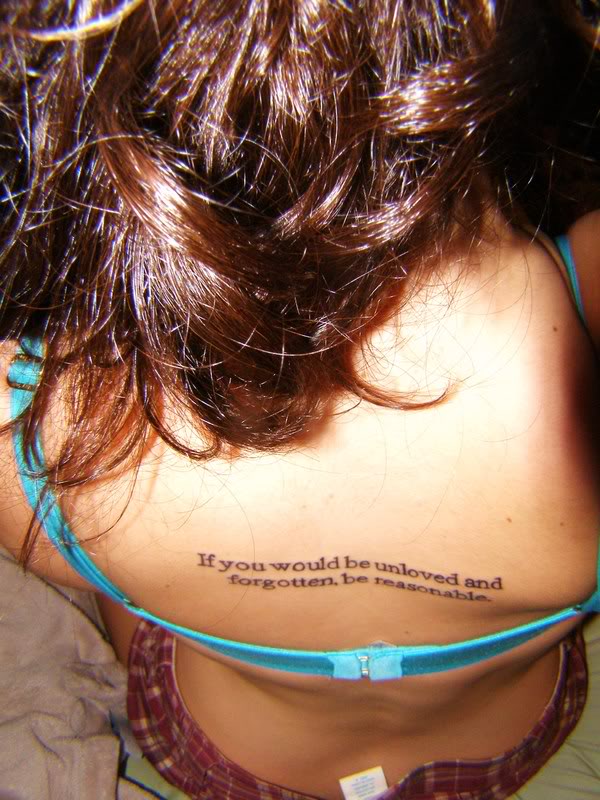
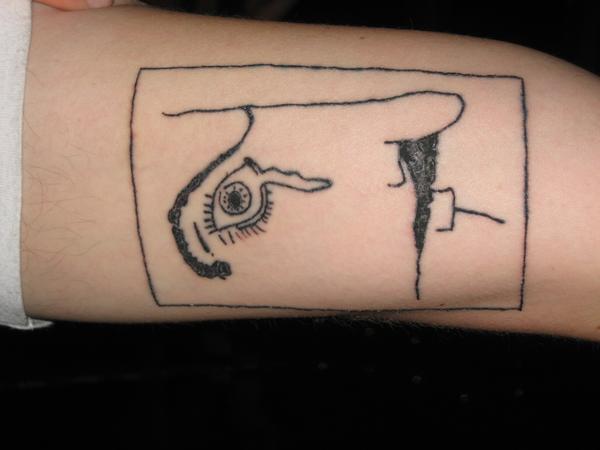
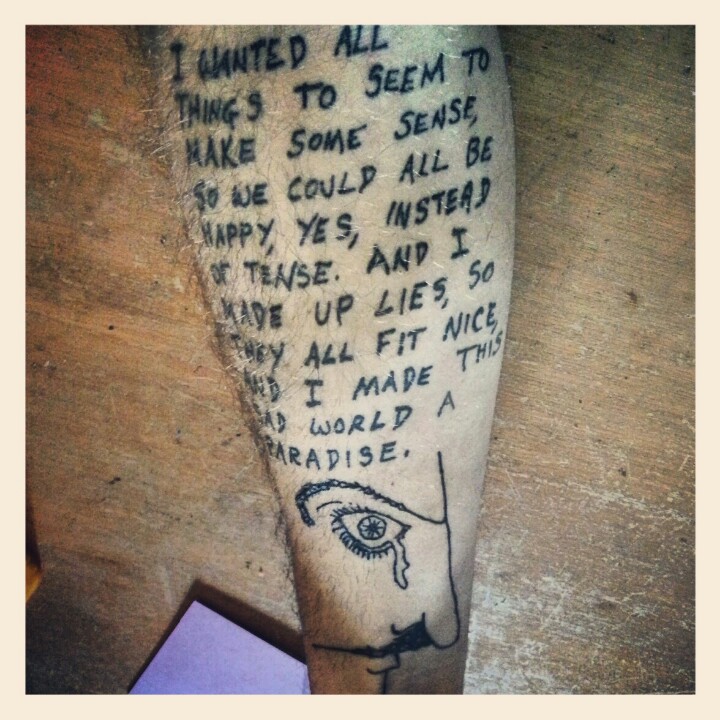
It’s not surprising. Vonnegut’s humor and concision make him one of the most quotable authors of all time, perfectly suited to the task.
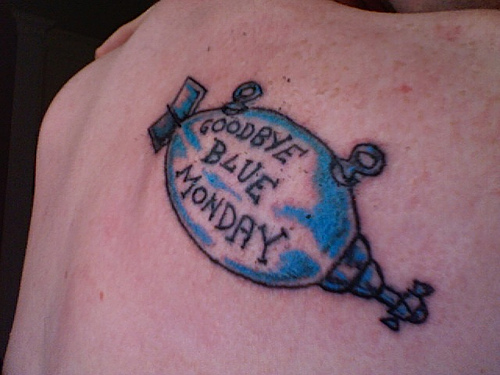
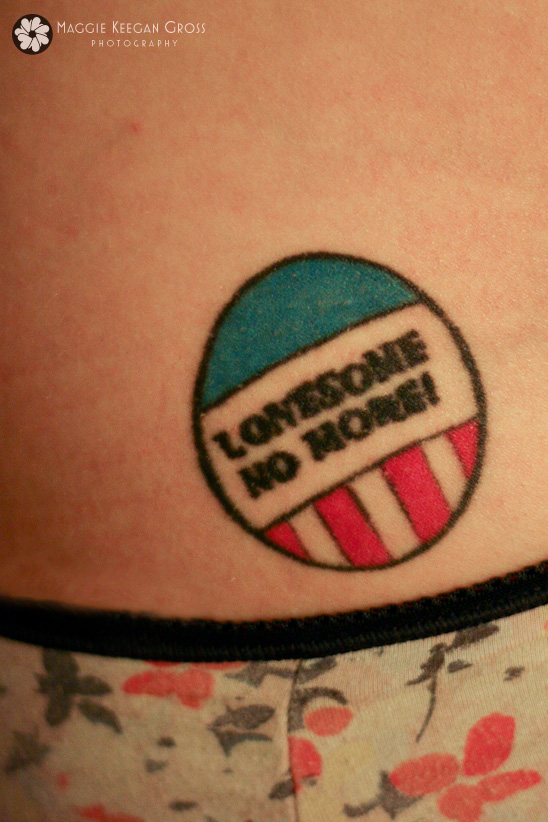
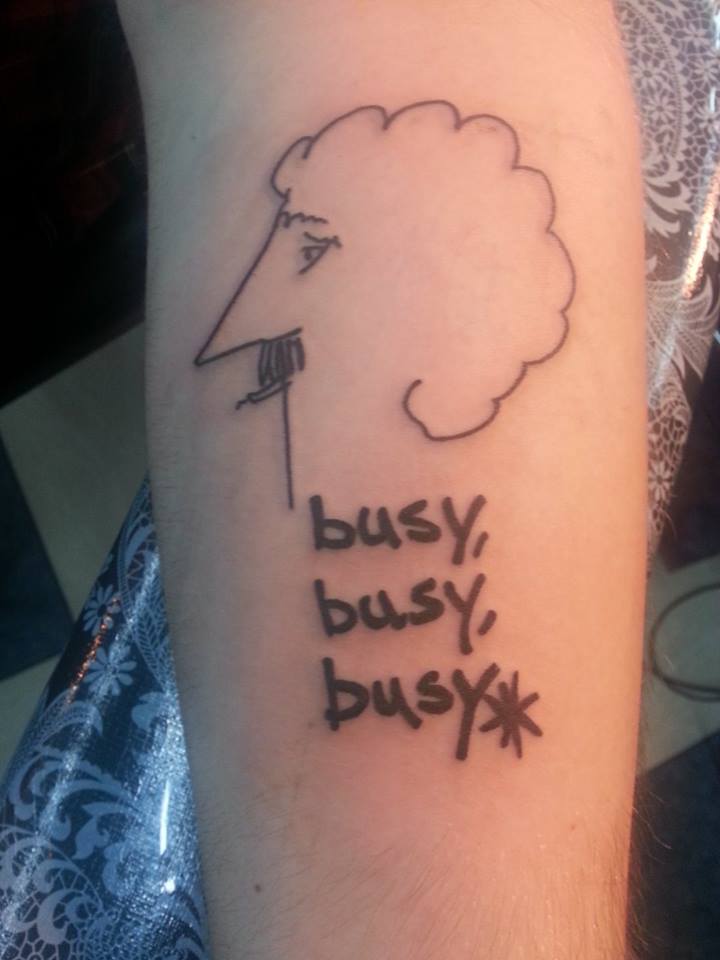
Repetition is the price Vonnegut tattoo enthusiasts must pay for such enduring popularity.
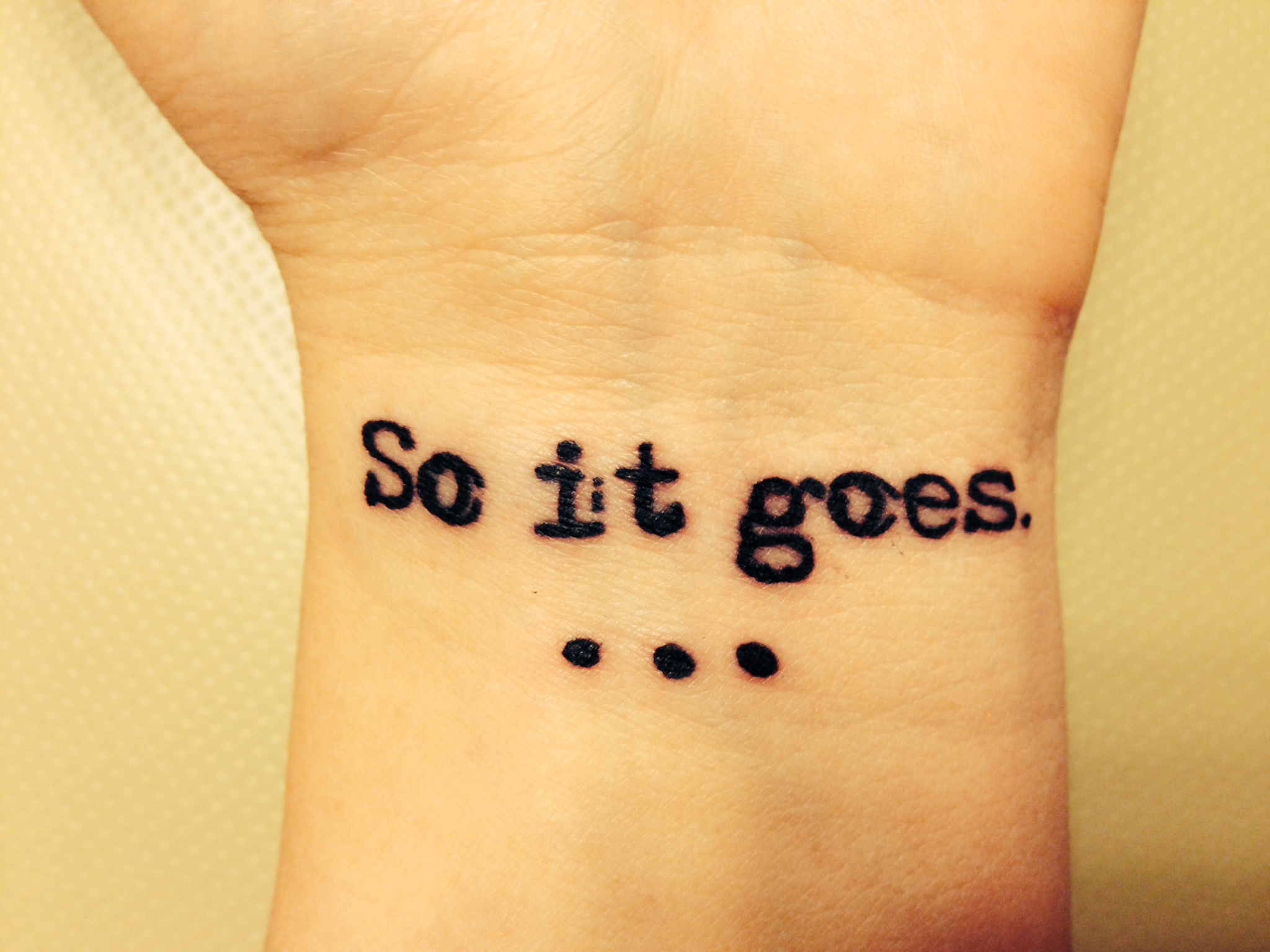
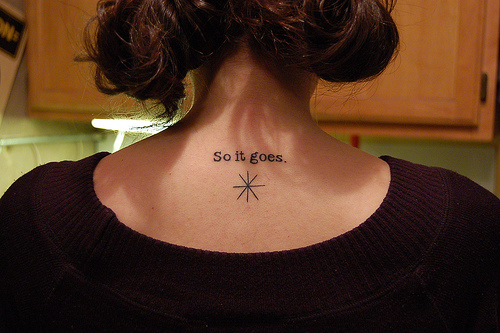
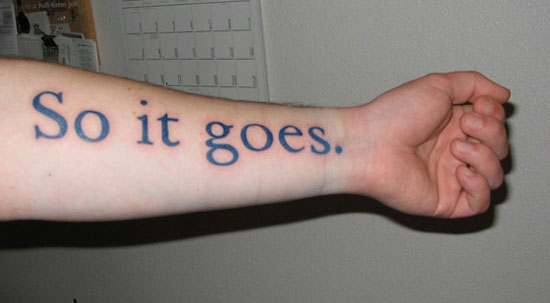
The phrase “so it goes” occurs 106 times in Slaughterhouse-Five, a figure dwarfed many times over by the number of hides upon which it is permanently inked. Recurrence is so frequent that the literary tattoo blog, Contrariwise, recently hosted a round of So It Goes Saturdays. So it goes.
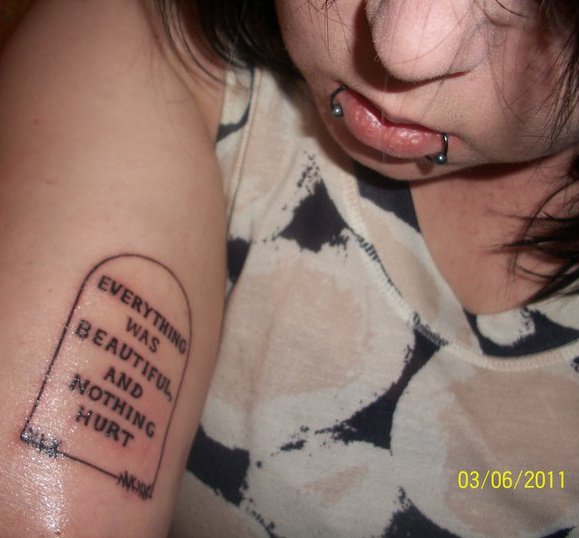
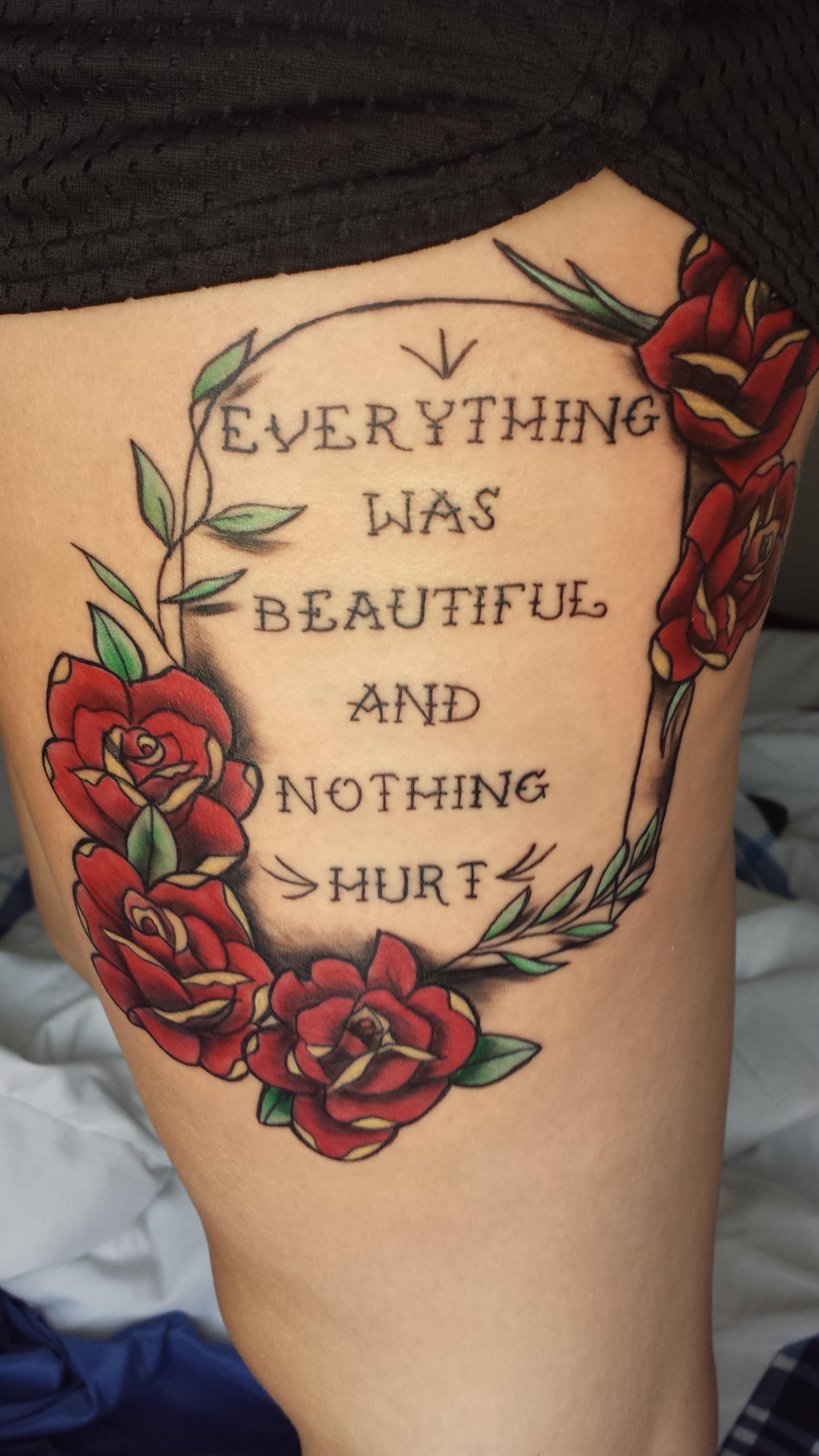
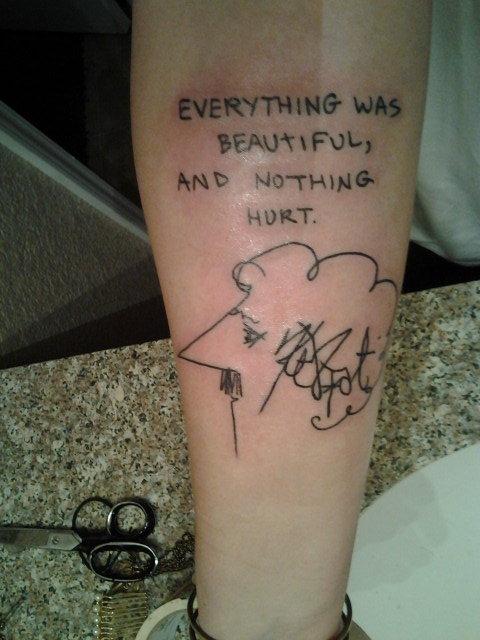
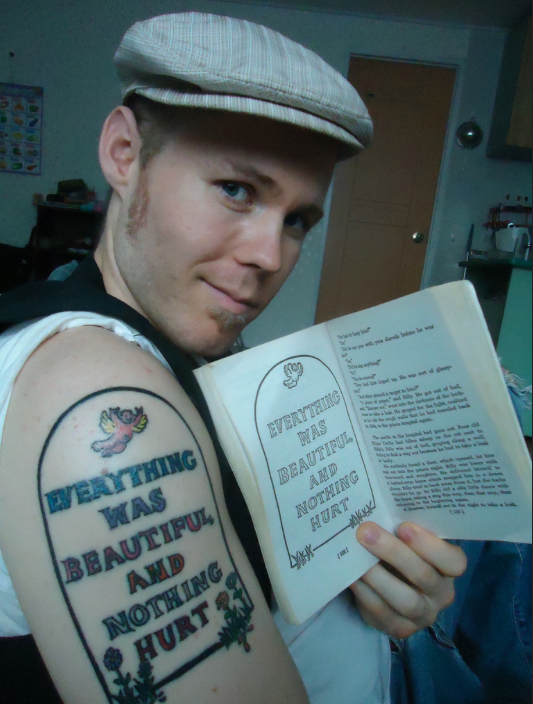
The second runner up, also from Slaughterhouse-Five, is the painfully ironic “Everything was Beautiful and Nothing Hurt.”
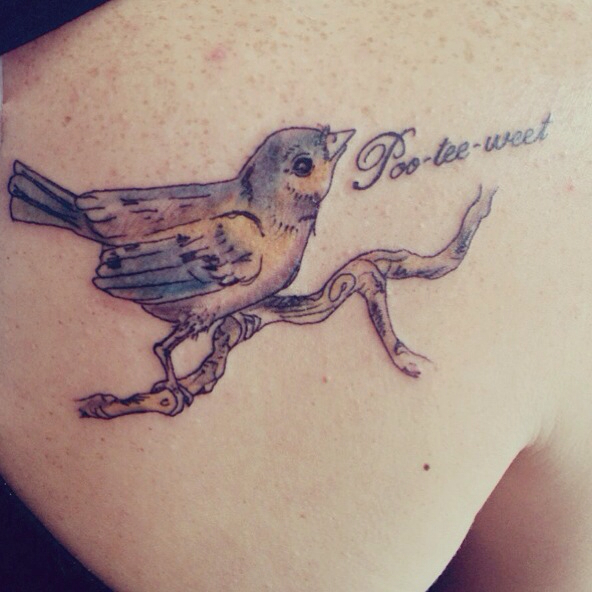
Those who’d rather put a bird on it than present an accessible sentiment to the uninitiated can opt for “poo-tee-weet,” the catchphrase of a bird who’s a witness to war. Certain to confound the folks staring at your triceps in the grocery line.
Slaughterhouse Five is not Vonnegut’s only tattoo-friendly novel, of course.
Ayun Halliday is an author, illustrator, and Chief Primatologist of the East Village Inky zine. Her play, Fawnbook, opens in New York City later this month. Follow her @AyunHalliday
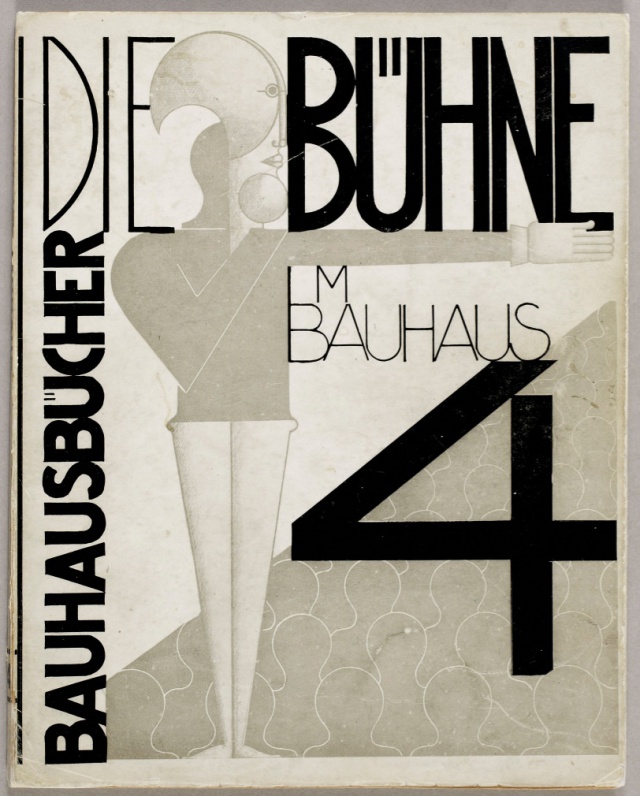
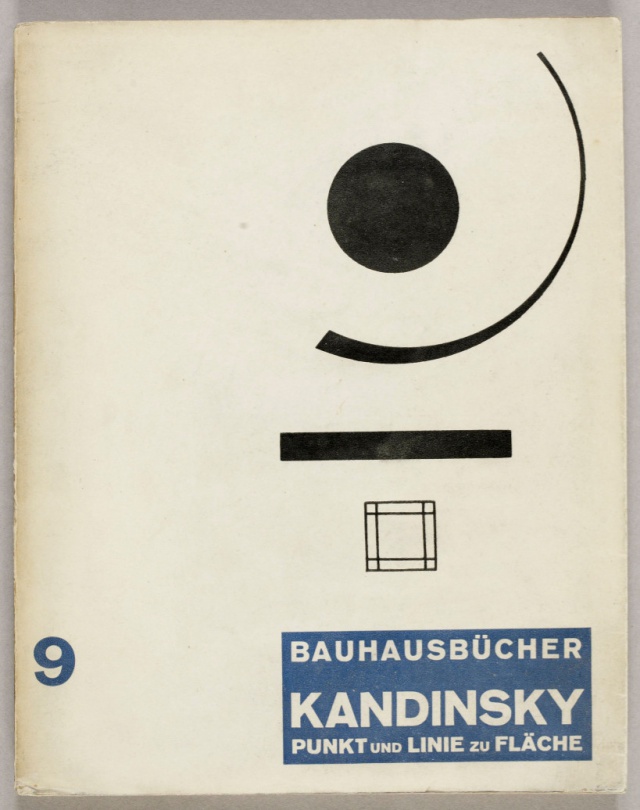
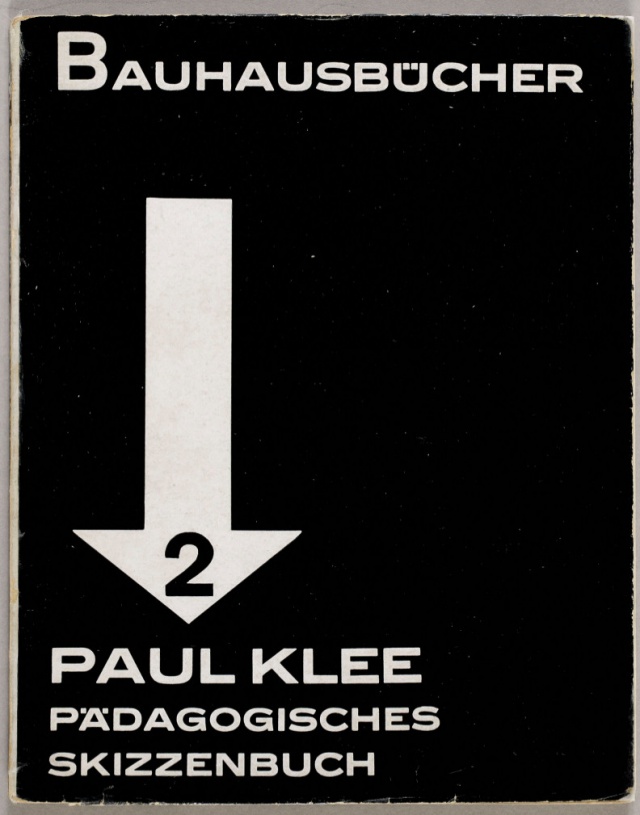
In 1919, German architect Walter Gropius founded Bauhaus, the most influential art school of the 20th century. Bauhaus defined modernist design and radically changed our relationship with everyday objects. Gropius wrote in his manifesto Programm des Staatlichen Bauhauses Weimar that “There is no essential difference between the artist and the artisan.” His new school, which featured faculty that included the likes of Paul Klee, László Moholy-Nagy, Josef Albers and Wassily Kandinsky, did indeed erase the centuries-old line between applied arts and fine arts.
Bauhaus architecture sandblasted away the ornate flourishes common with early 20th century buildings, favoring instead the clean, sleek lines of industrial factories. Designer Marcel Breuer reimagined the common chair by stripping it down to its most elemental form. Herbert Bayer reinvented and modernized graphic design by focusing on visual clarity. Gunta Stölzl, Marianne Brandt and Christian Dell radically remade such diverse objects as fabrics and tea kettles.
13. Albert Gleizes, Kubismus, Munich: Albert Langen, 1928.
14. László Moholy-Nagy, Von Material zur Architektur, Munich: Albert Langen, 1929, 241 pp; facsimile repr., Mainz and Berlin: Florian Kupferberg, 1968.
The New Vision: From Material to Architecture, trans. Daphne M. Hoffman, New York: Breuer Warren and Putnam, 1930; exp.rev.ed. as The New Vision and Abstract of an Artist, New York: George Wittenborn, 1947, 92 pp. (in English)
And here are some key Bauhaus journals:
bauhaus 1 (1926). 5 pages, 42 cm. Download (23 MB).
bauhaus: zeitschrift für bau und gestaltung 2:1 (Feb 1928). Download (17 MB).
bauhaus: zeitschrift für gestaltung 3:1 (Jan 1929). Download (17 MB).
bauhaus: zeitschrift für gestaltung 3:2 (Apr-Jun 1929). Download (15 MB).
bauhaus: zeitschrift für gestaltung 3:3 (Jul-Sep 1929). Download (16 MB).
bauhaus: zeitschrift für gestaltung 2 (Jul 1931). Download (15 MB).
Jonathan Crow is a Los Angeles-based writer and filmmaker whose work has appeared in Yahoo!, The Hollywood Reporter, and other publications. You can follow him at @jonccrow. And check out his blog Veeptopus, featuring lots of pictures of vice presidents with octopuses on their heads. The Veeptopus store is here.
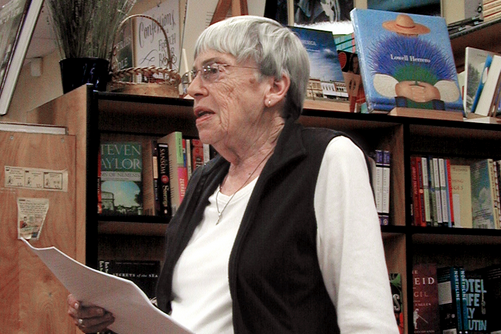
Mind Webs, a 1970’s radio series created by WHA Radio in Wisconsin, featured dramatized readings of classic sci fi stories by the likes of Arthur C. Clarke, Ray Bradbury and Philip K. Dick. You can learn more about the series, and access a complete set of recordings here. Below, we’ve highlighted for you a dramatization of an Ursula K. Le Guin story, “The End.” It’s rare to encounter an audio recording of a Le Guin story online, so we hope you enjoy. “The End” is now added to our collection: 1,000 Free Audio Books: Download Great Books for Free. And if you’re looking to immerse yourself in Le Guin’s fiction, give her groundbreaking novel The Left Hand of Darknessa try. It won the Hugo and Nebula Awards (the top award for fantasy/sci-fi novels) in 1969.
Looking for free, professionally-read audio books from Audible.com? Here’s a great, no-strings-attached deal. If you start a 30 day free trial with Audible.com, you can download two free audio books of your choice. Get more details on the offer here.
And note this: Audiobooks.com also has a free trial offer where you can download a free audiobook. Details.
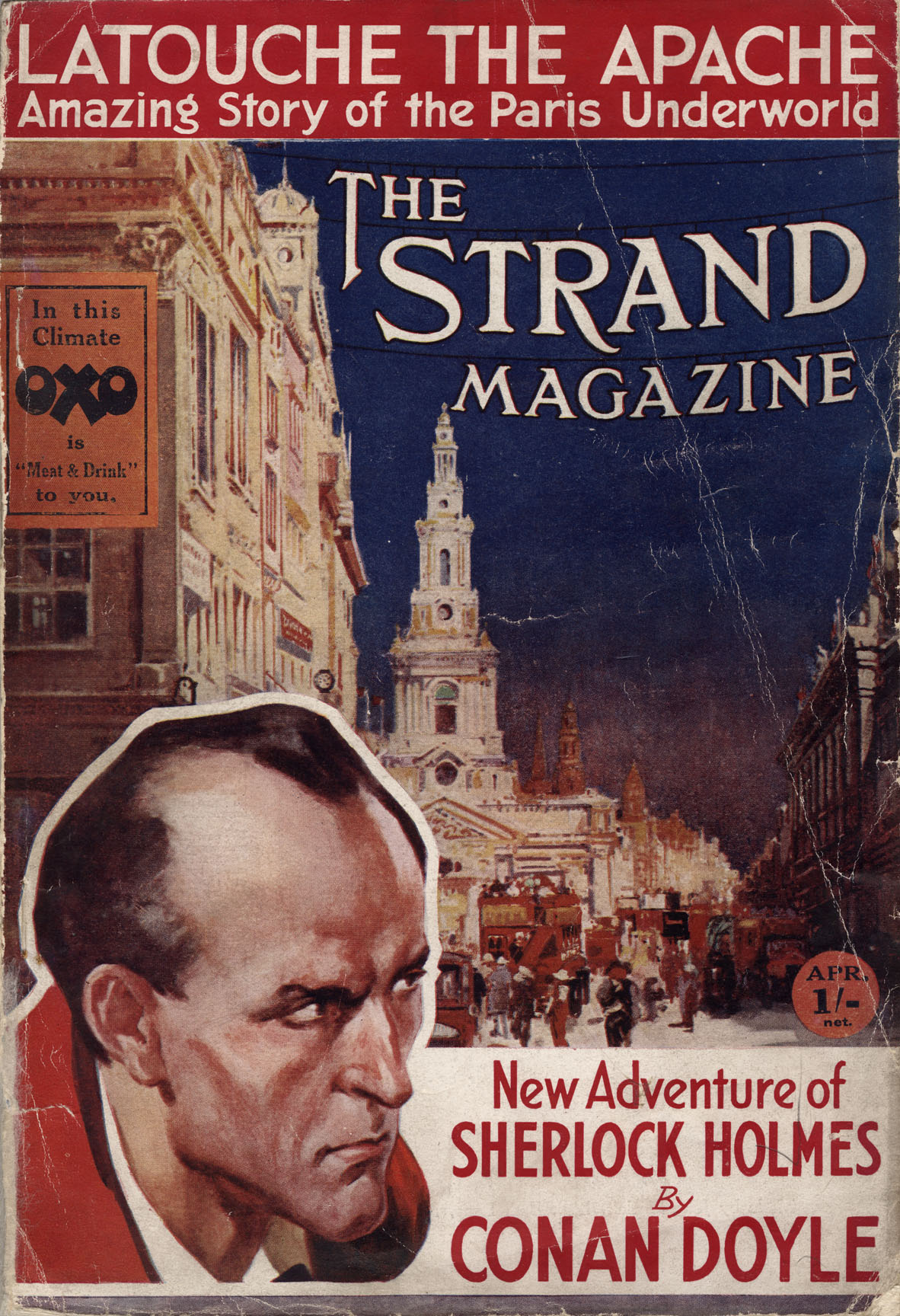
Sherlock Holmes has become such a cultural fixture since he first appeared in print that all of us have surely, at one time or another, considered reading through the London detective’s complete case files. But where to start? One can always begin at the beginning with that first print appearance, Sir Arthur Conan Doyle’s 1887 novel A Study in Scarlet. But how best to progress through the Sherlock Holmes canon, a body of 56 short stories and four novels (and that number counting only the material written by Conan Doyle himself), some more essential than others?
You might consider reading the adventures of Sherlock Holmes according to the preferences of Sherlock Holmes’ creator. We know these preferences because of a 1927 competition in The Strand Magazine, where the character’s popularity first blew up, which asked readers to name the twelve best Sherlock Holmes stories. They asked Conan Doyle the same question, and the list he came up with runs as follows:
“The Final Problem” (“we could hardly leave out the story which deals with the only foe who ever really extended Holmes, and which deceived the public (and Watson) into the erroneous inference of his death”)
“A Scandal in Bohemia” (since, as the first short story in the series, “it opened the path for the others,” and “it has more female interest than is usual”)
“The Musgrave Ritual” (for its inclusion of “a historical touch which gives it a little added distinction” and “a memory from Holmes’ early life”)
“The Reigate Squires” (in which “on the whole, Holmes himself shows perhaps the most ingenuity”)
He later added seven more favorites, including some he’d written after The Strand’s contest took place:
“When this competition was first mooted I went into it in a most light-hearted way,” wrote Conan Doyle, “thinking that it would be the easiest thing in the world to pick out the twelve best of the Holmes stories. In practice I found that I had engaged myself in a serious task.” And those who call themselves Sherlock Holmes enthusiasts know that, though they may have begun reading the stories with an equally light heart, they soon found themselves going deeper and deeper into Holmes’ world in a much more serious way than they’d expected. Starting with Conan Doyle’s selections may set you down the very same path; when you finally come out the other side, feel free to name your own top twelve stories in the comments below.
Before the internet became our primary source of information and entertainment—before it became for many companies a primary revenue stream—it promised to revolutionize education. We would see a democratic spread of knowledge, old hierarchies would crumble, ancient divisions would cease to matter in the new primordial cyber-soup where anyone with entry-level consumer hardware and the patience to learn basic HTML could create a platform and a community. And even as that imagined utopia became just another economy, with its own winners and losers, large—and free—educational projects still seemed perfectly feasible.
These days, that potential hasn’t exactly evaporated, but we’ve had an increasing number of reasons—the threatened status of net neutrality prominent among them—to curb our enthusiasm. Yet as we remind you daily here at Open Culture, free educational resources still abound online, even if the online world isn’t as radical as some radicals had hoped. Frequently, those resources reside in online libraries like the Internet Archive, who store some of the best educational material from pre-internet times—such as theNBC University Theater, a program that comes from another transitional time for another form of mass media: radio.
Before payola and television took over in the fifties, radio also showed great potential for democratizing education. In 1942, at the height of the Golden Age of Radio, NBC “reinaugurated” a previous concept for what it called the NBC University of the Air. “Throughout the mid-1940s,” writes the Digital Deli, an online museum of golden age radio, “NBC produced some twenty-five productions specifically designed to both educate and entertain. Indeed, many of those programs were incorporated into the curricula of high schools, colleges and universities throughout the U.S. and Canada.”
After 1948, the program was retooled as NBC University Theater, then simply NBC Theater. “Irrespective of the title change,” however, the program “continued to maintain the same high standards and continued to expand the number of colleges offering college credit for listening to and studying the programs’s offerings.” Digital Deli has the full details of this proto-MOOC’s curriculum. It consists of listening to adaptations of “great American stories,” great “world” stories–from Voltaire, Swift, and others–and adaptations of modern American and British fiction and “Great Works of World Literature.”
In short, the NBC University Theater adaptations might substitute for a college-level literary education for those unable to attend a college or university. In the playlist above, you can hear every episode from the show’s final run from 1948 to 1951. We begin with an adaptation of Sinclair Lewis’s Main Street and end with Thomas Hardy’s “The Withered Arm.” In-between hear classic radio drama adaptations of everything from Austen to Faulkner and Hemingway to Ibsen. There are 110 episodes in total.
Each episode features commentary from distinguished authors and critics, including Robert Penn Warren, E.M. Forster, and Katherine Anne Porter. “Apart from the obvious academic value” of the series, writes Digital Deli, “it’s clear that considerable thought—and daring—went into the selections as well.” Despite the tremendous increase in college attendance through the G.I. Bill, this was a period of “rising hostility towards academics, purely intellectual pursuits, and the free exchange of philosophies in general.”
The ensuing decade of the fifties might be characterized culturally, writes Digital Deli, as an “intellectual vacuum”—anti-intellectual attitudes swept the country, fueled by Cold War political repression. And radio became primarily a means of entertainment and advertising, competing with television for an audience. Quality radio dramas continued—most notably of excellent science fiction. But never again would an educational program of NBC University Theater’s scope, ambition, and radical potential appear on U.S. radio waves.
The border-obsessed map animator known as Emperor Tigerstar views war from a distance. The Emperor leaves such details as journal entries, letters home, and tales of valor and cowardice for other history buffs.
His niche is meticulously clocking the defeat and triumph in terms of shifting territories, by year, by fortnight, and, in the case of World War Iand World War II, by day.
The Blue and the Gray are here represented by blue and red, with the mustard-colored disputed border states picking sides before the first minute is out. (The Union’s Naval Blockade is in formation within seconds.)
Legend:
Maroon = Confederate States of America and territories
Red = Areas occupied by Confederate forces
Pink = Gains for that Day
Dark Blue = United States of America and territories
Blue = Areas occupied by Union forces.
Light blue = Gains for that day
Yellow = Border states / disputed areas.
The magnitude is moving, especially when paired with ground-level observations, be they fictional, historical or eyewitness.
Even the place-names on the map, which now were merely quaint, would take on the sound of crackling flame and distant thunder, the Biblical, Indian and Anglo-Saxon names of hamlets and creeks and crossroads, for the most part unimportant in themselves until the day when the armies came together, as often by accident as on purpose, to give the scattered names a permanence and settle what manner of life future generations were to lead.
Ayun Halliday is an author, illustrator, and Chief Primatologist of the East Village Inky zine. Her play, Fawnbook, opens in New York City later this fall. Follow her @AyunHalliday
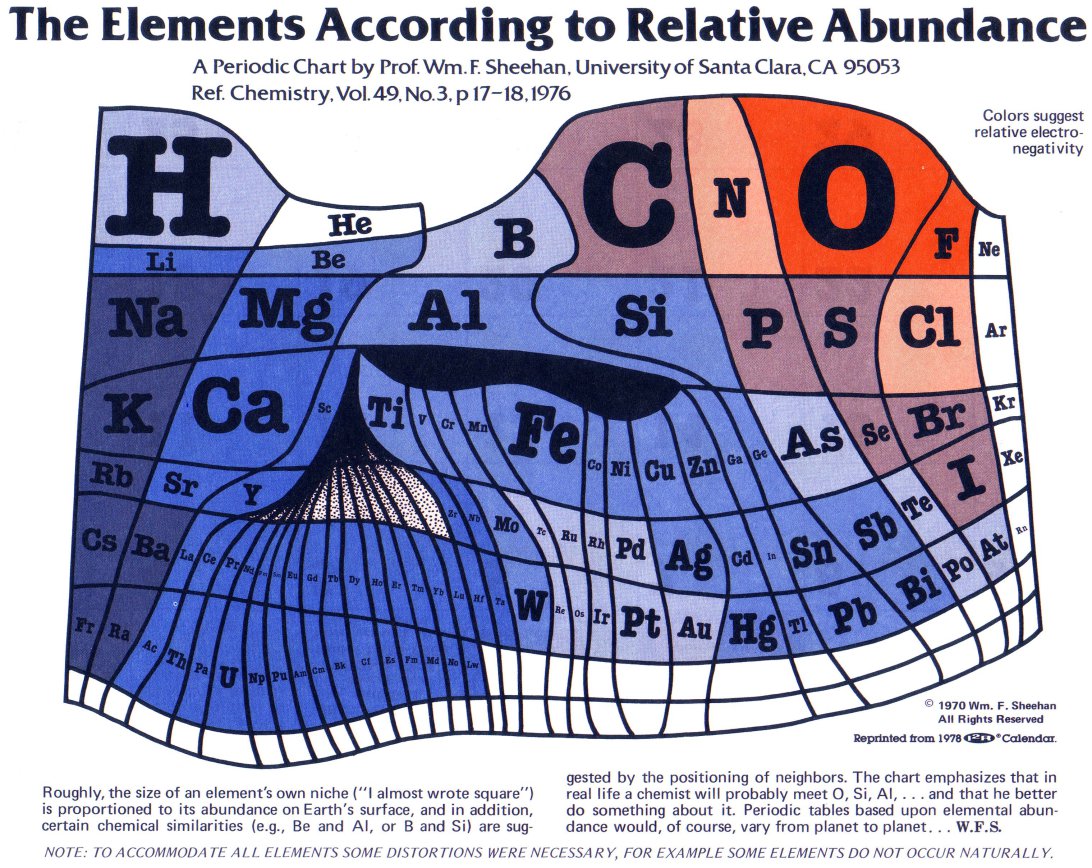
When you learned about The Periodic Table of Elements in high school, it probably didn’t look like this. Above, we have a different way of visualizing the elements. Created by Professor William F. Sheehan at Santa Clara University in 1970, this chart takes the elements (usually shown like this) and scales them relative to their abundance on the Earth’s surface. In the small print beneath the chart, Sheehan notes “The chart emphasizes that in real life a chemist will probably meet O, Si, Al [Oxygen, Silicon and Aluminum] and that he better do something about it.” Click here to see the chart — and the less abundant elements — in a larger format. Below we have a few more creative takes on the Periodic Table.
Follow Open Culture on Facebook and Twitter and share intelligent media with your friends. Or better yet, sign up for our daily email and get a daily dose of Open Culture in your inbox.
We're hoping to rely on loyal readers, rather than erratic ads. Please click the Donate button and support Open Culture. You can use Paypal, Venmo, Patreon, even Crypto! We thank you!
Open Culture scours the web for the best educational media. We find the free courses and audio books you need, the language lessons & educational videos you want, and plenty of enlightenment in between.