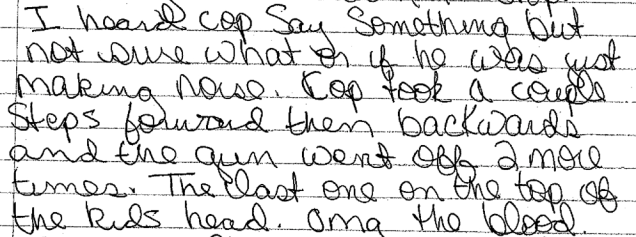
 Tonight, a St. Louis County grand jury decided not to bring criminal charges against Darren Wilson, the white police officer who shot to death Michael Brown, an unarmed African-American teenager, in Ferguson, Missouri this past summer. Following the controversial decision, St. Louis Public Radio started to upload key documents from the grand jury proceedings to its website. The documents include grand jury testimony, forensic evidence, medical reports, and law enforcement interviews. View it all here and be sure to check back for updates.
Read Online Key Documents from the Ferguson Grand Jury: Witness Testimony, Forensic Evidence & More
The Crazy, Iconic Life of Nico; Andy Warhol Muse, Velvet Underground Vocalist, Enigma in Amber
There’s no denying that train wrecks make great documentary subjects.
Not that Abraham Lincoln doesn’t, but watching someone come unglued is a whole ‘nother sort of compelling. Upsetting, even.
Docs in this genre usually require the subject to have left the building in order to reach a satisfying conclusion. The final word belongs to an assortment of friends, colleagues, admirers, enemies…some of whom may be harboring ulterior motives.
Surely German chanteuse Nico’s appearance factored into Andy Warhol’s decision to elevate her to Factory superstar status. (See his video of her immediately above.) She was a model after all, arresting enough to have appeared as herself in La Dolce Vita. She romanced rock gods, film directors, and movie stars, many of whom have their say in Susanne Ofteringer’s documentary Nico-Icon, viewable in its entirety up top.
It’s a fascinating, cautionary portrait, but as the backseat psychoanalysis mounted, I found myself wanting to hear from the subject more. With apologies to Neil Diamond fans, we decided it was only fitting to show you Nico having her own say.
Maybe she was a nightmare. Former keyboardist, James Young, wrote a book about his time on tour with her. He’s in the documentary, of course. Aspiring icons, you’ve been forewarned:
When I worked with her her looks were gone and she wasn’t this Chelsea Girl creature, this peroxide blonde Marlene Dietrich moon goddess vamp. She was a middle aged junkie.
Nice. You reckon he might have gone easier on her, had she been one of John Waters’ superstars, the late Edith Massey or the still-thriving Mink Stole?
Forget sticks and stones. It takes a lot more heroin and hard living to kill the looks of anyone with her bone structure.
Did Nico really have such little use for anyone’s approval but her own? The art she made after her iconic work with the Velvet Underground convinces me that her embrace of ugly–what Chelsea Girls director referred to as her “stupid German perversity”–was sincere.
She’s still an enigma trapped in amber. She’ll be your mirror.
Find 200 free documentaries in our collection, 4,000+ Free Movies Online: Great Classics, Indies, Noir, Westerns, Documentaries & More.
Related Content:
Andy Warhol Shoots “Screen Tests” of Nico, Bob Dylan & Salvador Dalí
Nico Sings “Chelsea Girls” in the Famous Chelsea Hotel
Lou Reed, John Cale & Nico Reunite, Play Acoustic Velvet Underground Songs on French TV, 1972
Ayun Halliday is an author, homeschooler, and Chief Primatologist of the East Village Inky zine. Follow her @AyunHalliday
Literary Remains of Gabriel García Márquez Will Rest in Texas
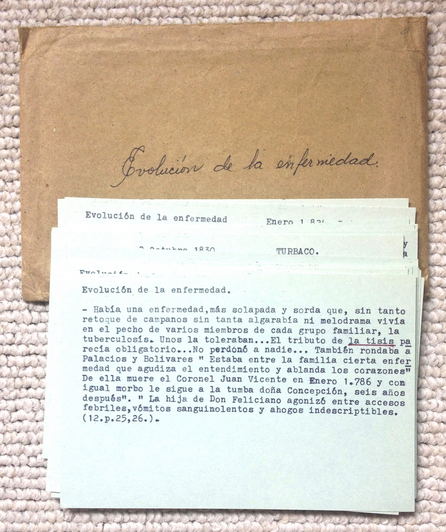
Gabriel García Márquez’s notes for The General in His Labyrinth (1989) via The Ransom Center & The New York Times
Quick note: The Harry Ransom Center, a humanities research library at UT-Austin, announced this morning that it has acquired the archive of Gabriel García Márquez, the Nobel Prize-winning, Colombian novelist who passed away earlier this year. His literary remains include “original manuscript materials for 10 books …; more than 2,000 pieces of correspondence, including letters from Carlos Fuentes and Graham Greene; drafts of his 1982 Nobel Prize acceptance speech; more than 40 photograph albums documenting all aspects of his life over nearly nine decades; the Smith Corona typewriters and computers on which he wrote some of the 20th century’s most beloved works; and scrapbooks meticulously documenting his career via news clippings from Latin America and around the world.”
All of this material, The Harry Ransom Center goes on to say, will conveniently site alongside archives of others authors who inspired García Márquez — most notably, Jorge Luis Borges, William Faulkner and James Joyce.
The New York Times has a small gallery of images showcasing photos in the newly acquired collection. Take a quick spin through it here.
Related Content:
Read 10 Short Stories by Gabriel García Márquez Free Online (Plus More Essays & Interviews)
Jorge Luis Borges’ 1967–8 Norton Lectures On Poetry (And Everything Else Literary)
Carlos Fuentes: “You Have to See the Face of Death in Order to Start Writing Seriously”
Shelf Life: American Museum of Natural History Creates New Video Series on Its 33 Million Artifacts
I once spent a summer as a security guard at the Children’s Museum of Indianapolis. A wonderful place to visit, but my workday experience proved dreadfully dull. By far the highlight was being pulled off whatever exhibit I happened to be guarding to assist in collections, a cavernous backstage area where untold treasures were shelved without ceremony. The head conservator confided that many of these items would never be singled out for display. The thrift store egalitarianism that reigned here was far more appealing than the eye-catching, educational signage in the public area. From the oblivion of deep storage springs the potential for discovery.
How gratifying to learn that the 200 plus scientists employed by the American Museum of Natural History feel the same. As palentologist Mike Novacek, puts it in Shelf Life, the museum’s just launched monthly video series:
You can make new discoveries in Collections just like you can out in the field. You can walk around the corner and see something that no one’s quite observed that way before, describe a new species or a new feature that’s important to science.
The institution can choose from among more than 33,430,000 goodies, from ancient objects they’ve been carefully tending for more than two centuries to the samples of frozen tissue and DNA comprising the barely 13-year-old Ambrose Monell Cryo Collection for Molecular and Microbial Research.
Gems and meteorites!
Arrowheads and gourds!
Vertebrates and invertebrates!
There’s truly something here for…

Wasp enthusiasts (you know who you are) can thrill to the seven and a half million specimens in sex researcher Alfred Kinsey’s Cynipidae collection. (They’re ready for their close up, Mr. DeMille. Famous as they are, the first episode passed them over in favor of a more photogenic mock bee from the genus Criorhina.)
Future episodes will call upon in-house ichthyologists, paleontologists, anthropologists, astrophysicists, and herpetologists to discuss such topics as specimen preparation, taxonomy, and curation. Stay abreast (and — bonus!- celebrate Nero’s birthday with turtles) by subscribing to the museum’s youtube channel.
Related Content:
A Panoramic Virtual Tour of the Smithsonian National Museum of Natural History
Download the Universe: A Discerning Curator for Science eBooks
How to Make a Mummy — Demonstrated by The Getty Museum
Ayun Halliday is an author, homeschooler, and Chief Primatologist of the East Village Inky zine. She goes into more detail about her short-lived stint as a museum security guard in her third book, Job Hopper. Follow her @AyunHalliday
Hear 130 Minutes of Charles Bukowski’s First-Ever Recorded Readings (1968)
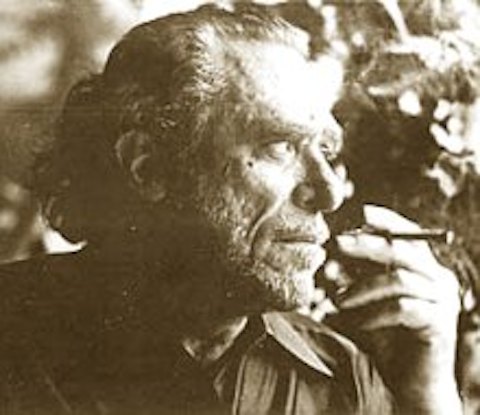
Image via Wikimedia Commons
We enjoy the work of Charles Bukowski here at Open Culture, but recently we’ve weighted our attention toward his late work. And I mean his very late work, like the last poem he ever faxed. So today we turn to the very back of Bukowski’s back pages, for 130 minutes of the cantankerous yet oddly hope-filled poet and novelist’s first-ever recorded readings, all available at Ubuweb. They come, as the site says, “culled from tapes made by Bukowski at his Los Angeles home in 1968 for biographer and rock critic Barry Miles, long before the author had begun regular public readings.” Few would expect the behavior of a shrinking violet from the likes of Bukowski, but this occasion found him “so shy he insisted that he record alone. He reads both poetry and prose, gets thoroughly drunk during the recording, and bitches about his life, his landlord, and his neighbors.”
This material all comes the album At Terror Street and Agony Way, commercially issued in 2000 but now out of print. Now that it has made its way to the internet, you can enjoy such vintage, lean Bukowski cuts as “The State of World Affairs” (“The Hollywood hills stand there, stand there, full of drunks and insane people and much kissing and automobiles”), “I Cannot Stand Tears” (“There were several hundred fools around the goose who broke his leg, trying to decide what to do, when the guard walked up and pulled out his cannon”), and “I Wanted to Overthrow the Government” (“The weakness was not Government but Man, one at a time, that men were never as strong as their ideas, and that ideas were governments turned into men; and so it began on a couch with a spilled martini and it ended in the bedroom”).
You can hear the whole thing, in all its spirited (in both senses of the word) glory on Ubuweb’s Bukowski page, which also offers such choice recordings as 1969’s 70 Minutes in Hell, 1973’s Poems and Insults, and 1980’s Hostage.
Find more of Bukowskis’s 1968 recordings at Ubuweb.
Related Content:
Listen to Charles Bukowski Poems Being Read by Bukowski Himself & the Great Tom Waits
So You Want to Be a Writer?: Charles Bukowski Explains the Dos & Don’ts
The Last (Faxed) Poem of Charles Bukowski
1,000 Free Audio Books: Download Great Books for FreeColin Marshall hosts and produces Notebook on Cities and Culture and writes essays on cities, language, Asia, and men’s style. He’s at work on a book about Los Angeles, A Los Angeles Primer. Follow him on Twitter at @colinmarshall or on Facebook.
A Cabinet of Curiosities: Discover The Public Domain Review’s New Book of Essays

Many of the regulars to the glorious pages of Open Culture might be familiar with The Public Domain Review project, having been featured on OC a fair few times. From sixteenth-century woodcuts on how to swim to hand-colored photographs of nineteenth-century Japan, you will have seen links to all sorts of historical oddities and delights that we’ve gathered from various archives and highlighted on The Public Domain Review. In addition to these shorter collection posts, since we started in 2011, we’ve also published a steady stream of long-form essays on similar wonders from the historical record. It is with great pleasure this week to announce that The Public Domain Review has compiled a selection of these essays into a brand-new beautiful book!
Spread across six themed chapters – Animals, Bodies, Words, Worlds, Encounters and Networks – the collection includes a total of thirty-four essays from a stellar line up of contributors, including Jack Zipes, Frank Delaney, Colin Dickey, George Prochnik, Noga Arikha, and Julian Barnes.
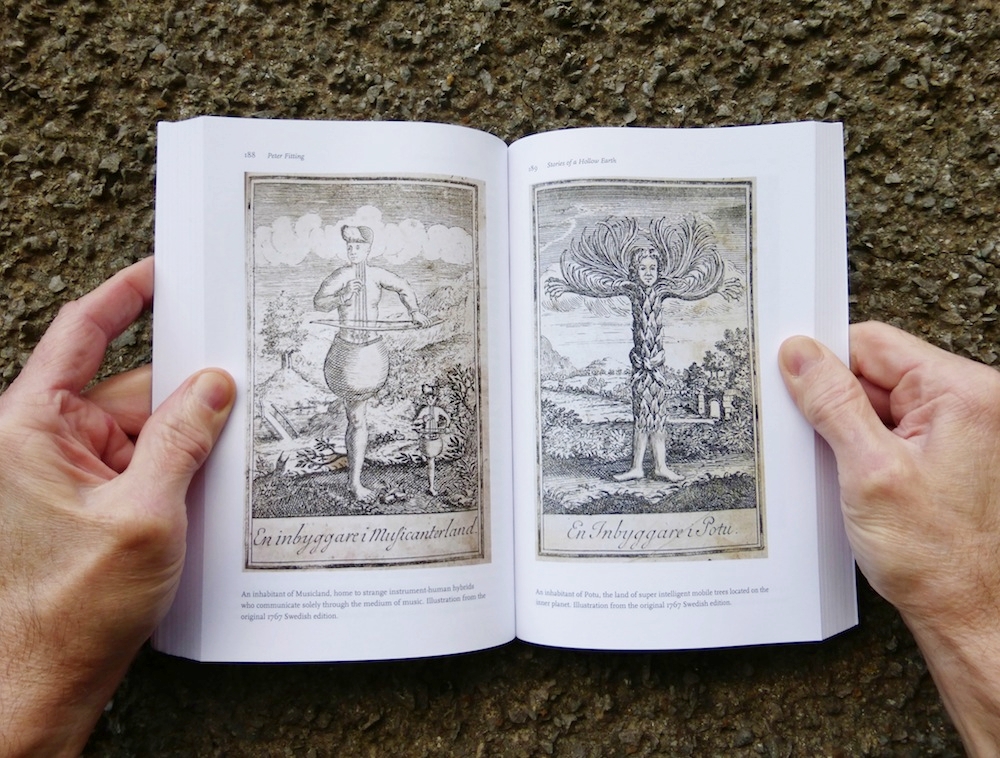
There’s a whole host of weird and wonderful topics explored: from the case of Mary Toft, the woman who claimed to give birth to rabbits, to William Warren’s search for the coordinates of Eden; from Thomas Browne’s odd litany of imagined artefacts, to the phrasebooks of the invented language Volapük; from the strange literary fruits of the “it-narrative” fad, to epic verse in praise of a cat named Jeoffry; from a history of the painted smile, to the bizarre world of medieval animals trials.
The collection is not all obscurities and unknown tales. We have some big hitters in there too. Great essays on figures you will no doubt have heard of — the Brothers Grimm, Proust , Flaubert, Joyce — but all approached from new angles and illuminated by unfamiliar lights.
With 146 illustrations, more than half of which have been newly sourced especially for the book, this is very far from simply the website in print form. It is a beautiful object in and of itself, lovingly designed by writer and designer Nicholas Jeeves.
Anyhow, I hope I’ve enticed you all sufficiently to check out the page on the site for more details, and perhaps even to place an order or two! If you would like to grab yourself a copy then do make sure to put your order in before midnight on November 26th as up until then we’ll be offering the book for a special discounted rate and also ensuring delivery by Christmas.
Adam Green is the co-founder and editor of The Public Domain Review.
French Couple Sings an Achingly Charming Version of VU’s “Femme Fatale”
Day in, day out, we rummage around the internet, looking for new material to bring your way. I start searching, and I never quite know where the search will take me. Some paths lead to dead ends, others to interesting side streets. Speaking of interesting side streets.… Yesterday a trip through some old Velvet Underground material (more on that tomorrow) led me to this small, unexpected delight. Above, we have Mathieu and Pauline, two young French musicians, singing an achingly charming version of VU’s “Femme Fatale”. There’s so much beauty and youth in it, it kinda hurts. Below, see them sing a cover of Serge Gainsbourg’s “Elisa.”
Follow us on Facebook, Twitter and Google Plus and share intelligent media with your friends. Or better yet, sign up for our daily email and get a daily dose of Open Culture in your inbox.
Related Content:
Andy Warhol Shoots the Only Color Film of The Velvet Underground Playing Live in Concert (1967)
David Lynch Takes Aspiring Filmmakers Inside the Art & Craft of Making Indie Films
As a couple of generations of film students have shown us, you shouldn’t try to imitate David Lynch. You should, however, learn from David Lynch. At his best, the director of Eraserhead, Blue Velvet, and Mulholland Drive has managed, in the words of David Foster Wallace, to “single-handedly broker a new marriage between art and commerce in U.S. movies, opening formula-frozen Hollywood to some of the eccentricity and vigor of art film.” How has Lynch brought his enduringly strange and richly evocative visions to the screen, and to a surprising extent into the mainstream, without much apparent compromise?
You can get an idea of his method in Room to Dream: David Lynch and the Independent Filmmaker, the twenty-minute documentary above. Since Lynch hasn’t released a feature film since 2006’s Inland Empire — an especially uncompromising work, admittedly — some fans have wondered whether he’s put the movies, per se, behind him.
But Room to Dream shows the director in recent years, very much engaged in both the theory and process of filmmaking — or rather, his distinctive interpretations of the theory and process of filmmaking.
This touches on his childhood obsession with drawing weapons, his discovery of “moving paintings,” his endorsement of learning by doing, how he uses digital video, his enjoyment of 40-minute takes, why people fear the “very dark,” conveying meaning without explaining meaning (especially to actors), the process of “rehearsing-and-talking, rehearsing-and-talking,” how Avid (the short’s sponsor, as it would happen) facilitates the “heavy lifting” of editing his footage, how he finesses “happy accidents,” how he composes differently for different screens, and the way that “sometimes things take strange routes that end up being correct.” Take Lynch’s words to heart, and you, too, can enjoy his experience of crafting what he calls “sound and picture moving along in time” — with or without an Avid of your own.
Room to Dream will be added to our collection, 285 Free Documentaries Online.
Related Content:
Akira Kurosawa’s 80-Minute Master Class on Making “Beautiful Movies” (2000)
David Lynch Presents the History of Surrealist Film (1987)
10 Tips From Billy Wilder on How to Write a Good Screenplay
Tarkovsky’s Advice to Young Filmmakers: Sacrifice Yourself for Cinema
Filmmaking Advice from Quentin Tarantino and Sam Raimi (NSFW)
Colin Marshall hosts and produces Notebook on Cities and Culture and writes essays on cities, language, Asia, and men’s style. He’s at work on a book about Los Angeles, A Los Angeles Primer. Follow him on Twitter at @colinmarshall or on Facebook.
The Jimi Hendrix Experience Plays “Hey Joe” & “Wild Thing” on The Band’s Very First Tour: Paris, 1966
Jimi Hendrix lived fast, and I don’t just mean to evoke a rock star cliché, but to get at the speed at which his career moved. He arrived in England near the end of September, 1966, at the tender age of 23. In less than a month, he and his manager Chas Chandler had recruited Noel Redding and Mitch Mitchell into the Experience and booked the band’s first gig on October 13 across the channel in Évreux, France, one of four French bookings as a supporting act for The Blackbirds and Johnny Hallyday. They played mostly covers, including Howlin’ Wolf’s “Killing Floor,” Otis Redding’s “Respect,” Don Covay’s “Mercy, Mercy,” and Chris Kenner’s “Land of a Thousand Dances,” and traditional song “Hey Joe,” soon to become the band’s first single. It’s unclear whether anyone recorded that first gig, but we do have some audio of the fourth, on October 18 at the Olympia in Paris. Just above hear them play “Hey Joe” from that night, and below, they do The Troggs’ “Wild Thing.”
Hendrix was already a highly seasoned performer by this time, having blown minds all over the South while touring with, among others, the Isley Brothers, Little Richard, and King Curtis in the early sixties. He had been highly in demand as a backing and session player, but he grew tired of standing in the back and wanted to go solo. He met manager Chandler, then bassist for the Animals, while fronting his own band in New York. Chandler, writes PRI, “knew just what to do with the young guitarist” upon their arrival in England.
Six days after the short tour through France, the band played its first official show in the UK, at the Scotch of St. James, where the Beatles had a private booth. Hendrix proceeded to blow minds all over England, including, of course, those of all the British guitar greats: “Everyone’s eyes were glued to him,” remembers then girlfriend Kathy Etchingham, “He looked different. His guitar playing was superb. People in England hadn’t seen anything like it before. It was quite… out of this world.”
People in the U.S. hadn’t seen anything like it either. While Hendrix had honed many of his signature stage tricks on the soul circuit, by the time he appeared at the Monterey Pop Festival in 1967, he had fully come into his own as a charismatic singer as well as a “near miraculous” guitarist. But in his move from R&B to rock and roll, he never lost his blues roots. “Hendrix wasn’t a typical pop or rock musician,” says Hendrix scholar and English professor Joel Brattin. He “was an improviser. So, if there are 100 different recorded versions of Purple Haze, it’s really worth listening to all 100 because he does something different each time.” The same can be said of the songs he covered, and made his own. Just above, see them play “Hey Joe” at The Marquee for German TV show Beat Club just months before the release of their 1967 debut album. And below, Hendrix exhorts the crowd to sing along before launching into “Wild Thing,” in a Paris appearance one full year after the recording above at the Olympia. Compare, contrast, get your mind blown.
Related Content:
See Jimi Hendrix’s First TV Appearance, and His Last as a Backing Musician (1965)
Jimi Hendrix at Woodstock: The Complete Performance in Video & Audio (1969)
Jimi Hendrix’s Final Interview Animated (1970)
Josh Jones is a writer and musician based in Durham, NC. Follow him at @jdmagness
Stephen Fry Reads You Have To F**king Eat, the New Mock Children’s Book by Adam Mansbach
The sequel to Adam Mansbach’s best-selling mock children’s book, Go the F**k to Sleep is out. Say hello to You Have to F**king Eat.
As mentioned last week, you can download a free audio version read by Breaking Bad star Bryan Cranston over at Audible.com through December 12th. This week, we present a slightly more posh version read by Stephen Fry — the very same Stephen Fry who narrated the UK version of the Harry Potter series, not to mention an audio version of Oscar Wilde’s children’s story “The Happy Prince.” Find more Fry favorites below.
Related Content:
Stephen Fry: What I Wish I Knew When I Was 18
Shakespeare’s Satirical Sonnet 130, As Read By Stephen Fry
Hear Aldous Huxley Read Brave New World. Plus 84 Classic Radio Dramas from CBS Radio Workshop (1956–57)
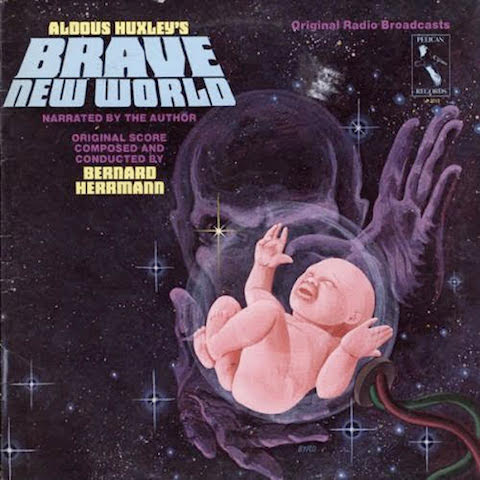
We are, it appears, in the midst of a “podcasting renaissance,” as Colin Marshall has recently pointed out. And yet, like him, I too was unaware that “podcasting had gone into a dark age.” Nevertheless, its current popularity—in an age of ubiquitous screen technology and perpetual visual spectacle—speaks to something deep within us, I think. Oral storytelling, as old as human speech, will never go out of style. Only the medium changes, and even then, seemingly not all that much.
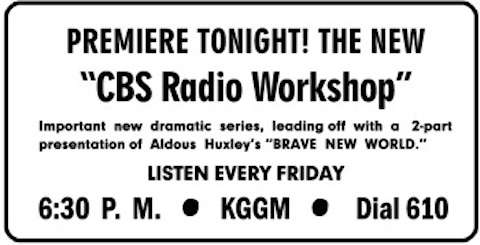
But the differences between this golden age of podcasting and the golden age of radio are still significant. Where the podcast is often off-the-cuff, and often very intimate and personal—sometimes seen as “too personal,” as Colin writes—radio programs were almost always carefully scripted and featured professional talent. Even those programs with man-on-the street features or interviews with ordinary folks were carefully orchestrated and mediated by producers, actors, and presenters. And the business of scoring music and sound effects for radio programs was a very serious one indeed. All of these formalities—in addition to the limited frequency range of old analog recording technology—contribute to what we immediately recognize as the sound of “old time radio.” It is a quaint sound, but also one with a certain gravitas, an echo of a bygone age.
That golden age waned as television came into its own in the mid-fifties, but near its end, some broadcast companies made every effort to put together the highest quality radio programming they could in order to retain their audience. One such program, the CBS Radio Workshop, which ran from January, 1956 to September, 1957, may have been “too little too late”—as radio preservationist site Digital Deli writes—but it nonetheless was “every bit as innovative and cutting edge” as the programs that came before it. The first two episodes, right below, were dramatizations of Aldous Huxley’s Brave New World, read by the author himself. (Find it also on Spotify here.) The series’ remaining 84 programs drew from the work of Antoine de Saint-Exupéry, James Thurber, H.L. Mencken, Mark Twain, Robert Heinlein, Eugene O’Neil, Balzac, Carl Sandburg, and so many more. It also featured original comedy, drama, music, and This American Life-style profiles and storytelling.
Huxley returned in program #12, with a story called “Jacob’s Hands,” written in collaboration with and read by Christopher Isherwood. The great Ray Bradbury made an appearance, in program #4, introducing his stories “Season of Disbelief” and “Hail and Farewell,” read by John Dehner and Stacy Harris, and scored by future film and TV composer Jerry Goldsmith. Other programs, like #10, “The Exurbanites,” narrated by famous war correspondent Eric Sevareid, conducted probing investigations of modern life—in this case the growth of suburbia and its relationship to the advertising industry. The above is but a tiny sampling of the wealth of quality programming the CBS Radio Workshop produced, and you can hear all of it—all 86 episodes—courtesy of the Internet Archive.
Sample streaming episodes in the player above, or download individual programs as MP3s and enjoy them at your leisure, almost like, well, a podcast. See Digital Deli for a complete rundown of each program’s content and cast, as well as an extensive history of the series. This is the swan song of golden age radio, which, it seems, maybe never really left, given the incredible number of listening experiences we still have at our disposal. Yes, someday our podcasts will sound quaint and curious to the ears of more advanced listeners, but even then, I’d bet, people will still be telling and recording stories, and the sound of human voices will continue to captivate us as it always has.
Related Content:
Free: Listen to 298 Episodes of the Vintage Crime Radio Series, Dragnet
How to Listen to the Radio: The BBC’s 1930 Manual for Using a New Technology
Josh Jones is a writer and musician based in Durham, NC. Follow him at @jdmagness
Support Us
We're hoping to rely on loyal readers, rather than erratic ads. Please click the Donate button and support Open Culture. You can use Paypal, Venmo, Patreon, even Crypto! We thank you!

Great Lectures
About Us

Open Culture scours the web for the best educational media. We find the free courses and audio books you need, the language lessons & educational videos you want, and plenty of enlightenment in between.
Advertise With Us
Archives
- June 2026
- May 2026
- April 2026
- March 2026
- February 2026
- January 2026
- December 2025
- November 2025
- October 2025
- September 2025
- August 2025
- July 2025
- June 2025
- May 2025
- April 2025
- March 2025
- February 2025
- January 2025
- December 2024
- November 2024
- October 2024
- September 2024
- August 2024
- July 2024
- June 2024
- May 2024
- April 2024
- March 2024
- February 2024
- January 2024
- December 2023
- November 2023
- October 2023
- September 2023
- August 2023
- July 2023
- June 2023
- May 2023
- April 2023
- March 2023
- February 2023
- January 2023
- December 2022
- November 2022
- October 2022
- September 2022
- August 2022
- July 2022
- June 2022
- May 2022
- April 2022
- March 2022
- February 2022
- January 2022
- December 2021
- November 2021
- October 2021
- September 2021
- August 2021
- July 2021
- June 2021
- May 2021
- April 2021
- March 2021
- February 2021
- January 2021
- December 2020
- November 2020
- October 2020
- September 2020
- August 2020
- July 2020
- June 2020
- May 2020
- April 2020
- March 2020
- February 2020
- January 2020
- December 2019
- November 2019
- October 2019
- September 2019
- August 2019
- July 2019
- June 2019
- May 2019
- April 2019
- March 2019
- February 2019
- January 2019
- December 2018
- November 2018
- October 2018
- September 2018
- August 2018
- July 2018
- June 2018
- May 2018
- April 2018
- March 2018
- February 2018
- January 2018
- December 2017
- November 2017
- October 2017
- September 2017
- August 2017
- July 2017
- June 2017
- May 2017
- April 2017
- March 2017
- February 2017
- January 2017
- December 2016
- November 2016
- October 2016
- September 2016
- August 2016
- July 2016
- June 2016
- May 2016
- April 2016
- March 2016
- February 2016
- January 2016
- December 2015
- November 2015
- October 2015
- September 2015
- August 2015
- July 2015
- June 2015
- May 2015
- April 2015
- March 2015
- February 2015
- January 2015
- December 2014
- November 2014
- October 2014
- September 2014
- August 2014
- July 2014
- June 2014
- May 2014
- April 2014
- March 2014
- February 2014
- January 2014
- December 2013
- November 2013
- October 2013
- September 2013
- August 2013
- July 2013
- June 2013
- May 2013
- April 2013
- March 2013
- February 2013
- January 2013
- December 2012
- November 2012
- October 2012
- September 2012
- August 2012
- July 2012
- June 2012
- May 2012
- April 2012
- March 2012
- February 2012
- January 2012
- December 2011
- November 2011
- October 2011
- September 2011
- August 2011
- July 2011
- June 2011
- May 2011
- April 2011
- March 2011
- February 2011
- January 2011
- December 2010
- November 2010
- October 2010
- September 2010
- August 2010
- July 2010
- June 2010
- May 2010
- April 2010
- March 2010
- February 2010
- January 2010
- December 2009
- November 2009
- October 2009
- September 2009
- August 2009
- July 2009
- June 2009
- May 2009
- April 2009
- March 2009
- February 2009
- January 2009
- December 2008
- November 2008
- October 2008
- September 2008
- August 2008
- July 2008
- June 2008
- May 2008
- April 2008
- March 2008
- February 2008
- January 2008
- December 2007
- November 2007
- October 2007
- September 2007
- August 2007
- July 2007
- June 2007
- May 2007
- April 2007
- March 2007
- February 2007
- January 2007
- December 2006
- November 2006
- October 2006
- September 2006


