Back in 2012, we told you about how the Library of Congress launched the Joe Smith Collection, an audio archive featuring 200+ interviews with legendary music artists, all recorded during the 1980s by Joe Smith while researching and writing his book Off the Record. The audio collection, still available on the web, has now been brought to iTunesU. And the iTunes collection has a virtue that the web archive doesn’t — it lets you download instead of stream the audio files.
If you’re a music junkie, you won’t want to miss the longform interviews with legendary figures like Dave Brubeck, Lou Reed, Paul McCartney, Joan Baez, Herbie Hancock, David Bowie, George Harrison, Yoko Ono, James Brown, Bo Diddley, Jerry Garcia, Christine McVie, Mick Jagger, Linda Ronstadt and more. Each interview runs 30–60 good minutes. You can enter the archive here.
Back in 1977, San Francisco filmmaker Ernie Fosselius had the brainwave to make a spoof of a movie that had just come out. It was a risky move. Nobody had any sense that Star Wars would become the worldwide cultural phenomenon that it did. And just as George Lucas’s space opera earned staggering amounts of money, so did Fosselius’s parody, Hardware Wars. You can watch it above. Made for a mere eight grand, the 13-minute movie became a pre-internet viral hit and a staple on the festival circuit, ultimately earning over $1,000,000 – an unheard of haul for a short film. In fact, in terms of money spent versus money earned, Hardware Wars ended up being far more profitable than Star Wars. And it’s considered the most profitable short film ever made.
“I think a lot of the charm of that movie is the fact that we didn’t really know what we were doing,” said Scott Mathews, who donned a blonde wig to play the movie’s lead, Fluke Starbucker. The movie’s production is so gleefully cheap and half-assed that you can’t help but be charmed by it. Irons, toasters, and tape players are used in place of spaceships.
A canister vacuum cleaner stands in for R2D2, and Chewbacca appears to be a Cookie Monster puppet dyed brown. At one point, while on a desert planet of Tatooine, you see a beach-goer sauntering in the background. And Star Wars’s famous cantina scene is in this movie simply a stroll through a crowded tavern. If you know anything about the bar scene in 1970s San Francisco, you know that it was at least as weird as anything George Lucas managed to put up on the screen.
The often litigious Lucas reportedly really liked the movie, called it “cute.” He even invited Fosselius to voice the inconsolable sobs of Jabba the Hutt’s animal trainer after his beloved Rancor gets killed by Luke Skywalker in Return of the Jedi.
Hardware Wars ended up launching an entire subgenre of movie – the Star Wars fan film. And with the advent of Youtube and digital filmmaking technology, the ability of nerds and mavens to make increasingly sophisticated takes on Lucas’s universe became easier and easier. One of the better, and older, ones is Troops. A mash up of Star Wars and the reality TV series Cops, the short shows the challenges and the struggles of being an Imperial Stormtrooper. Check it out below.
Jonathan Crow is a Los Angeles-based writer and filmmaker whose work has appeared in Yahoo!, The Hollywood Reporter, and other publications. You can follow him at @jonccrow.
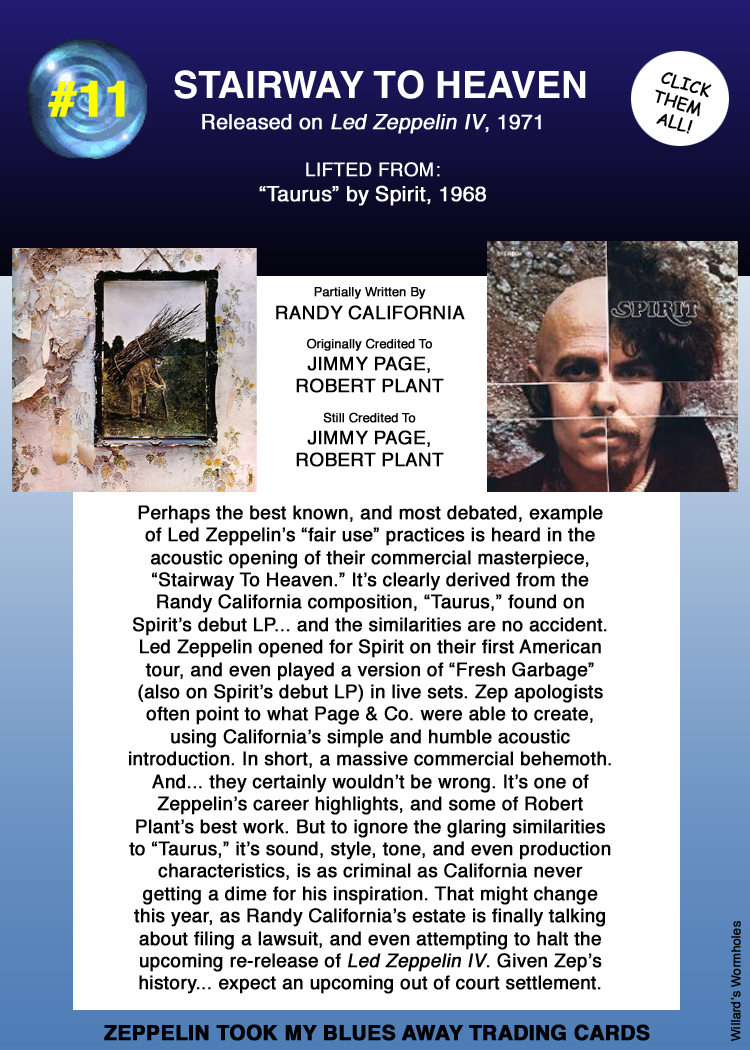
Few have gone broke working in copyright law. Some, however, have gone broke breaking it. Others have built up enough of a reputation and fortune by bending the rules just far enough, though they still run the risk of, if not going financially bankrupt, then looking creatively bankrupt. The English rock band Led Zeppelin seems to have artfully walked just this line for decades, though their usage of the blues and folk songs that inspired them has more recently undergone some seriously high-profile examination in court. Even their signature “Stairway to Heaven” had a suit filed against it in May, “brought by the estate of the late musician Randy California against the surviving members of Led Zeppelin and their record label. The copyright infringement case alleges that the Zeppelin song was taken from the single ‘Taurus’ by the 1960s band Spirit, for whom California served as lead guitarist.”
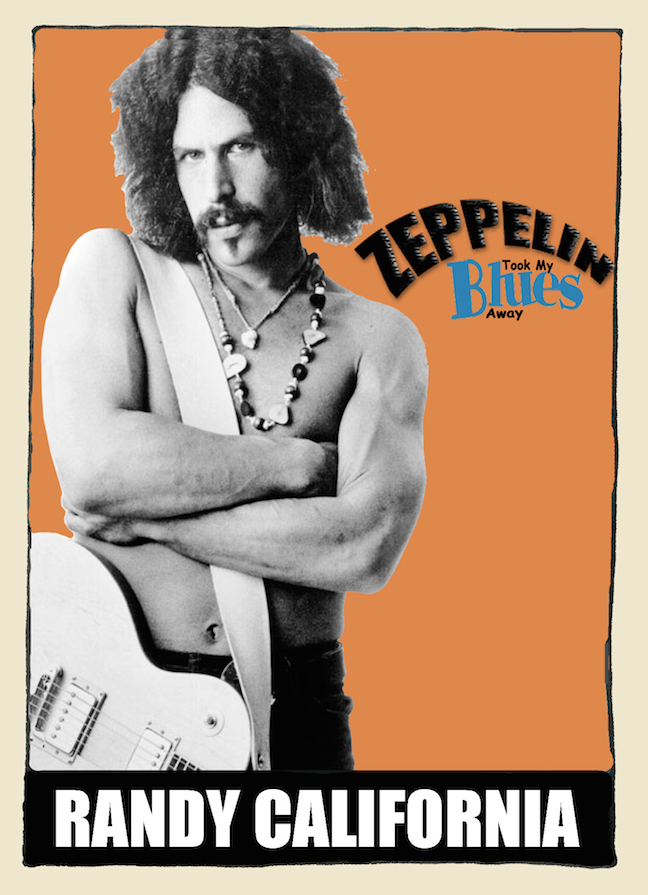
Those looking to make up their own minds about the relevant issues of musical authorship here can look to Zeppelin Took My Blues Away, an “illustrated history of copyright indiscretions,” created in trading card format, and featuring clips for the purposes of comparison and contrast. In this post, we have the card and clips documenting the resemblances between “Stairway to Heaven” and “Taurus,” Randy California’s 1968 song. The series comes to 19 cards in total, including such perhaps excessively Zeppelin-borrowed tunes as Bert Jansch’s “Blackwaterside,” Ritchie Valens’ “Ohh, My Head,” Willie Dixon’s “You Need Love,” and Jake Holmes’ “Dazed and Confused.” The question of whether we can call Jimmy Page and Robert Plant reckless music thieves or simply artists making use of what came before — as all artists must — has no easy answer. I, for my part, can’t even imagine the legal drudgery required for a verdict in cases like this. Something tells me that nothing as fun as trading cards ever gets admitted as evidence.
The CIA fought most of the Cold War on the cultural front, recruiting operatives and placing agents in every possible sphere of influence, not only abroad but at home as well. As Francis Stoner Saunders’ book The Cultural Cold War: the CIA and the World of Arts and Letters details, the agency funded intellectuals across the political spectrum as well as producers of radio, TV, and film. A well-financed propaganda campaign aimed at the American public attempted to persuade the populace that their country looked exactly like its leaders wished to see it, a well-run capitalist machine with equal opportunity for all. In addition to the agency’s various forays into jazz and modern art, the CIA also helped finance and consulted on the production of animated films, like the 1954 adaptation of George Orwell’s Animal Farm we recently featured. We’ve also posted on other animated propaganda films made by government agencies, such as A is for Atom, a PR film for nuclear energy, and Duck and Cover, a short suggesting that cleanliness may help citizens survive a nuclear war.
Today we bring you three short animations funded and commissioned by private interests. These films were made for Arkansas’ Harding College (now Harding University) and financed by longtime General Motors CEO Alfred P. Sloan. The name probably sounds familiar. Today the Alfred P. Sloan Foundation generously supports public radio and television, as well as medical research and other altruistic projects. In the post-war years, Sloan, widely considered “the father of the modern corporation,” writes Karl Cohen in a two-part essay for Animation World Network, supposedly took a shine to the bootstrapping president of Harding, George S. Benson, a Christian missionary and crusading anti-Communist who used his position to promote God, family, and country. According to Cohen, Sloan donated several hundred thousand dollars to Harding as funding for “educational anti-Communist, pro-free enterprise system films.” Contracted by the college, producer John Sutherland, former Disney writer, made nine films in all. As you’ll see in the title card that opens each short, these were ostensibly made “to create a deeper understanding of what has made America the finest place in the world to live.” At the top, watch 1949’s “Why Play Leap Frog?” and just above, see another of the Harding films, “Meet King Joe,” also from 1949.
Just above, watch a third of the Harding propaganda films, “Make Mine Freedom,” from 1948. Each of these films, calling themselves “Fun and Facts about America,” present simplistic patriotic stories with an authoritative narrator who patiently explains the ins and outs of American exceptionalism. “Why Play Leapfrog?” tells the story of Joe, a disgruntled doll-factory worker who learns some important lessons about the supply chain, wages, and prices. He also learns that he’d better work harder to increase his productivity (and cooperate with management) if he wants to keep up with the rising cost of living. “Meet King Joe” introduces us to the “king of the workers of the world,” so called because he can buy more stuff than the poor schlubs in other countries. Joe, “no smarter” and “no stronger than workers in other lands” has such advantages only because of, you guessed it, the wonders of capitalism. “Make Mine Freedom” reminds viewers of their Constitutional rights before introducing us to a snake oil charlatan selling “ism,” a Commie-like tonic, to a group of U.S. labor disputants—if only they’ll sign over their rights and property. The assembled crowd jumps at the chance, but then along comes John Q. Public, who won’t give up his freedom for “some imported double-talk.”
You can read much more about the relationship between Sloan and Benson and the other films Sutherland produced with Sloan’s money, in Cohen’s essay, which also includes information on Cold War animated propaganda films made by Warner Brothers and Disney.
Many a singer-songwriter who first rose to prominence in the 1960s has taken the label of “poet,” usually applied by adoring fans, no doubt to the objection of a fair few serious poetry enthusiasts. But who among them could deny Leonard Cohen’s status as a poet? Though best known as a musician, Cohen has also racked up indisputable writerly credentials, having published not just the novels Beautiful Losers and The Favorite Game but many books of poetry including Death of a Lady’s Man, Let Us Compare Mythologies, and Flowers for Hitler. Some of them include not just poems written as poems but song lyrics — or perhaps works that began as songs but became poems. Surely his albums contain songs that began as poems. Those interested in figuring out Cohen’s simultaneous development as a poet and songwriter would do well to listen to his early poetry readings, like that of “Prayer for Messiah” at the top of the post.
Just above, you can hear Cohen reading several more poems in the hallowed halls of New York’s 92nd Street Y in February 1966. Below, you can watch a television clip from that same year in which the famously Canadian Cohen appears (naturally) on the CBC in a segment “considering the poetic mind.”
He reads more of his verse and offers a bit of insight into his attitude toward the legacy of his own art — specifically, that he pays no attention to its legacy at all. Perhaps that more than anything allows him the freedom to move as necessary between fields of creative textual endeavor, retaining his inimitable sensibility no matter what shape his work takes at the end of the day. And, in any case, at least for my money, if pieces of his more mature work like “First We Take Manhattan” don’t transcend their form, what does?
I will admit it: I’m one of those oft-maligned non-sports people who becomes a football (okay, soccer) enthusiast every four years, seduced by the colorful pageantry, cosmopolitan air, nostalgia for a game I played as a kid, and an embarrassingly sentimental pride in my home country’s team. I don’t lose all my critical faculties, but I can’t help but love the World Cup even while recognizing the corruption, deepening poverty and exploitation, and host of other serious sociopolitical issues surrounding it. And as an American, it’s simply much easier to put some distance between the sport itself and the jingoistic bigotry and violence—“sentimental hooliganism,” to use Franklin Foer’s phrase—that very often attend the game in various parts of the world.
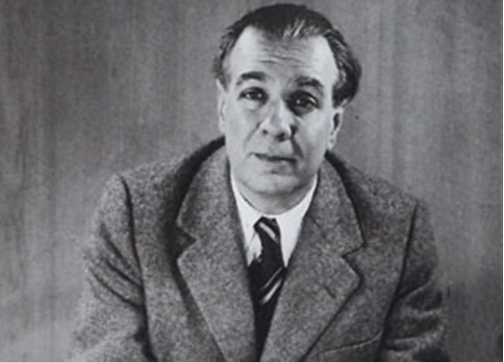
In Argentina, as in many soccer-mad countries with deep social divides, gang violence is a routine part of futbol, part of what Argentine writer Jorge Luis Borges termed a horrible “idea of supremacy.” Borges found it impossible to separate the fan culture from the game itself, once declaring, “soccer is popular because stupidity is popular.” As Shaj Mathew writes in TheNew Republic, the author associated the mass mania of soccer fandom with the mass fervor of fascism or dogmatic nationalism. “Nationalism,” he wrote, “only allows for affirmations, and every doctrine that discards doubt, negation, is a form of fanaticism and stupidity.” As Mathews points out, national soccer teams and stars do often become the tools of authoritarian regimes that “take advantage of the bond that fans share with their national teams to drum up popular support [….] This is what Borges feared—and resented—about the sport.”
There is certainly a sense in which Borges’ hatred of soccer is also indicative of his well-known cultural elitism (despite his romanticizing of lower-class gaucho life and the once-demimonde tango). Outside of the hugely expensive World Cup, the class dynamics of soccer fandom in most every country but the U.S. are fairly uncomplicated. New Republic editor Foer summed it up succinctly in How Soccer Explains the World: “In every other part of the world, soccer’s sociology varies little: it is the province of the working class.” (The inversion of this soccer class divide in the U.S., Foer writes, explains Americans’ disdain for the game in general and for elitist soccer dilettantes in particular, though those attitudes are rapidly changing). If Borges had been a North, rather than South, American, I imagine he would have had similar things to say about the NFL, NBA, NHL, or NASCAR.
Nonetheless, being Jorge Luis Borges, the writer did not simply lodge cranky complaints, however politically astute, about the game. He wrote a speculative story about it with his close friend and sometime writing partner Adolfo Bioy Casares. In “Esse Est Percipi” (“to be is to be perceived”), we learn that soccer has “ceased to be a sport and entered the realm of spectacle,” writes Mathews: “representation of sport has replaced actual sport.” The physical stadiums crumble, while the games are performed by “a single man in a booth or by actors in jerseys before the TV cameras.” An easily duped populace follows “nonexistent games on TV and the radio without questioning a thing.”
The story effectively illustrates Borges’ critique of soccer as an intrinsic part of a mass culture that, Mathews says, “leaves itself open to demagoguery and manipulation.” Borges’ own snobberies aside, his resolute suspicion of mass media spectacle and the coopting of popular culture by political forces seems to me still, as it was in his day, a healthy attitude. You can read the full story here, and an excellent critical essay on Borges’ political philosophy here.
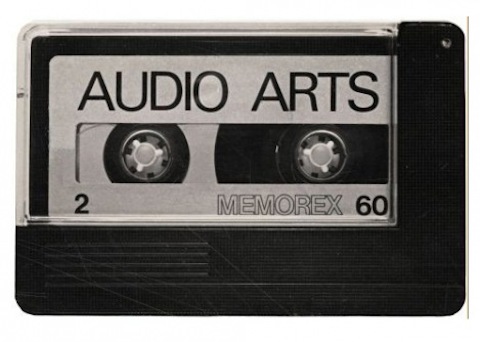
As a podcaster, I’ve long since grown used to the idea of periodically issuing audio content. But the convenient recording, internet, and computer, and mobile listening technologies that made such a medium possible only really converged in the early 2000s. How would I have gone about it had I wanted to put out a “podcast,” say, 40 years earlier? We have one such example in Audio Arts, a British contemporary art “sound magazine” distributed through the mail on audio cassettes. “The seventies were the years of conceptual art with text adding value to the actual works,” co-creator William Furlong once said in an interview. “As an artist I was more interested in ‘discussion,’ the idea of language and the people that already worked in conceptual fields in Great Britain. Soon I realised there weren’t magazines capable of reporting such material inspired by conversation, sounds and discussions. The evocative force of a voice is lost with the written word as it will only ever be a written voice.”
Furlong, a sculptor, and Barry Barker, a gallerist, began publishing Audio Arts in 1973. Its run lasted until, astonishingly, 2006, by which time its archives had come to 25 volumes of four issues each. Its list of subscribers included the formidable Tate, such fans that they actually acquired the magazine’s master tapes, digitized them, and made them all publicly available on their web site. No longer must you seek out nth-generation duplicated analog cassettes and dig out your Walkman; now you can simply stream on your media player of choice every issue from January 1973, “four cassettes with contributions from Caroline Tisdall, Noam Chomsky, James Joyce and W.B. Yeats,” to January 2006, which caps everything off with contributions by Gilbert & George and Jake and Dinos Chapman. Other notable artistic presences include Marcel Duchamp in Volume 2, Philip Glass in Volume 6, and Andy Warhol in Volume 8. Helpfully, Tate has also put together a section with tools to explore Audio Arts’ highlights — something more than a few modern-day podcasts could no doubt use.
The tag line for Stanley Kubrick’s sixth feature was “How did they ever make a movie of Lolita?” And it’s a good question. Vladimir Nabokov’s infamous novel, first published in 1955, is a delirious account of a middle-aged sophisticate’s obsession with a 12 year-old “nymphet.” The book was both praised and pilloried when it came out. Graham Greene called it one of the best books of the year while an English newspaper called it “sheer unrestrained pornography.” With press like that, Lolita quickly became a best-seller.
So when Kubrick, along with his producing partner James B. Harris, bought the rights to the book in 1958, they first had to prove that it could be filmed in a way that could get past the censors. The Hays code was still in effect in Hollywood, which suppressed any hint of sex between two adults. A love story between a prepubescent girl and a middle-aged pervert was going to be a tall order. “If I realized how severe the [censorship] limitations were going to be,” Kubrick stated later, “I wouldn’t have made the film.”
Eventually, Kubrick had to bow to reality; they changed Lolita’s age from 12 to 14, casting the teenaged Sue Lyon for the part. As Richard Corliss noted in his study on Lolita, “The book is about child abuse; the movie is about the wiles a teenage girl might have learned in those two years: an awareness of her power over men.”
The other challenge of adapting Lolita was the book itself. There’s an old truism in Hollywood that mediocre books make great movies and great books make for lousy films. After all, a novel like Mario Puzo’s The Godfather is all about story, characters and suspense – the same stuff as a good script. Authors like James Joyce, William Faulkner and Nabokov, on the other hand, foreground elements that are particular to literature — interior monologues, unreliable narrators, and a musicality of language – elements that are damned tricky to reproduce on the silver screen. If you don’t believe me, compare The Great Gatsby with its numerous dreadful movie adaptations.
Doubtless aware of such pitfalls, Kubrick approached Nabokov, the author himself, to write the script. After their first meeting, Nabokov turned the offer down. “The idea of tampering with my own novel caused me only revulsion,” Nabokov later wrote in the foreword to the published version of his Lolita script. Kubrick, however, is not a person to be dissuaded easily. He sent Nabokov a telegram renewing the offer a few months later, just as the author was beginning to regret passing on the offer and its generous paycheck.
So Nabokov traveled back to Los Angeles to meet with Kubrick, beginning what he would characterize as “an amiable battle of suggestion and countersuggestion on how to cinemize the novel.” By the end of the summer of 1960, Nabokov delivered his first draft – a 400-page behemoth. The script would require some serious editing. After that, Nabokov’s meetings with the director became more and more sporadic.
True to form, Kubrick was secretive about the film. The author had little idea what shape the final movie was going to take until he saw it a couple of days before the premiere in 1962. “I had discovered that Kubrick was a great director, that his Lolita was a first-rate film with magnificent actors, and that only ragged odds and ends of my script had been used.” Kubrick took the script and stripped out all the backstory and most of the narration. He expanded the character of Quilty to give Peter Sellers more to do. While Nabokov was generally complimentary about the film, he still had some complaints. “Most of the sequences were not really better than those I had so carefully composed for Kubrick, and I keenly regretted the waste of my time while admiring Kubrick’s fortitude in enduring for six months the evolution and infliction of a useless product.”
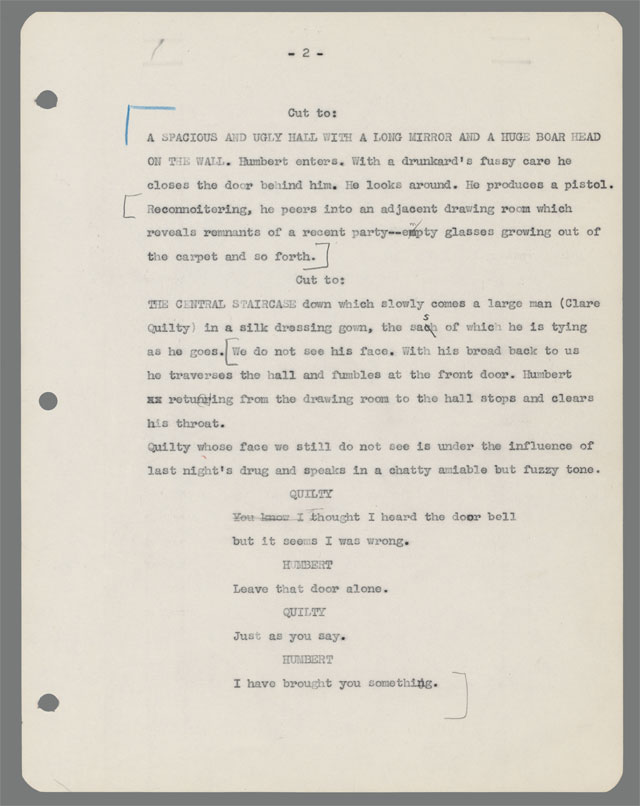
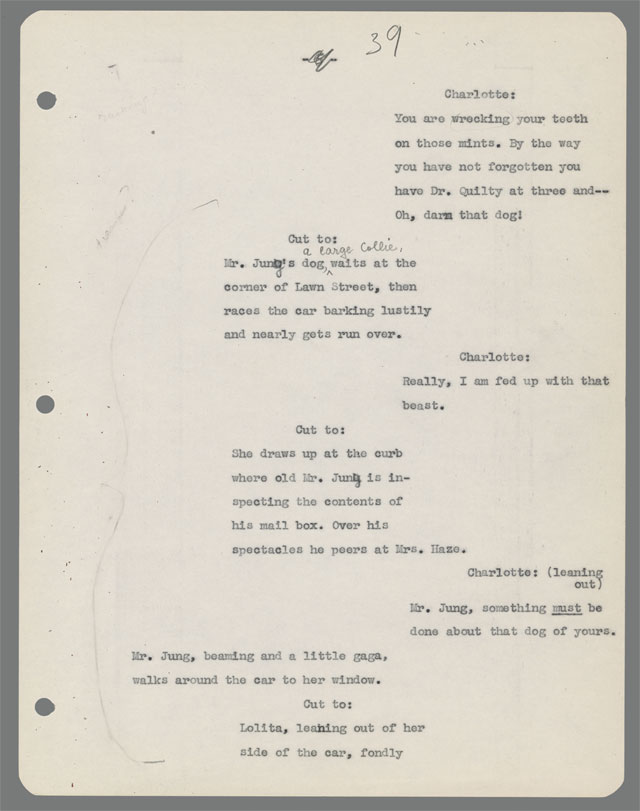
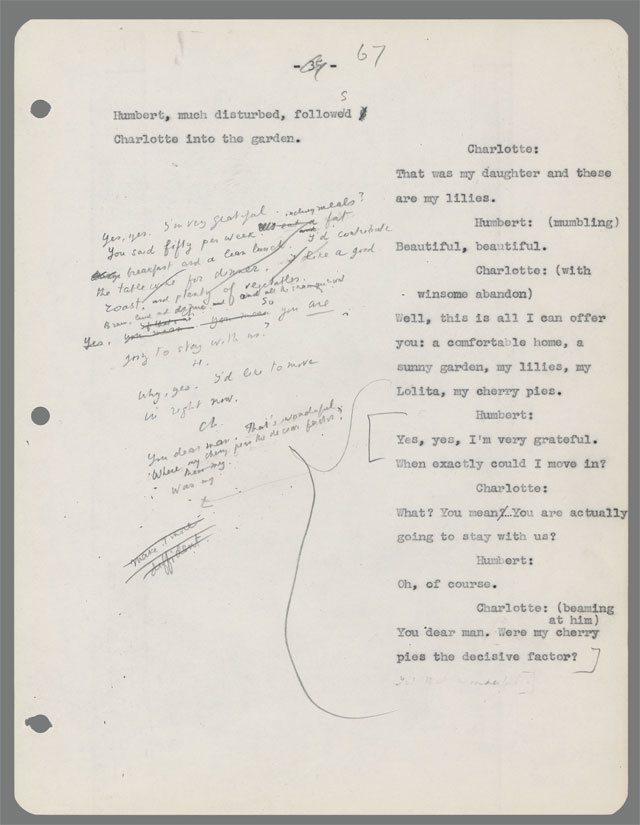
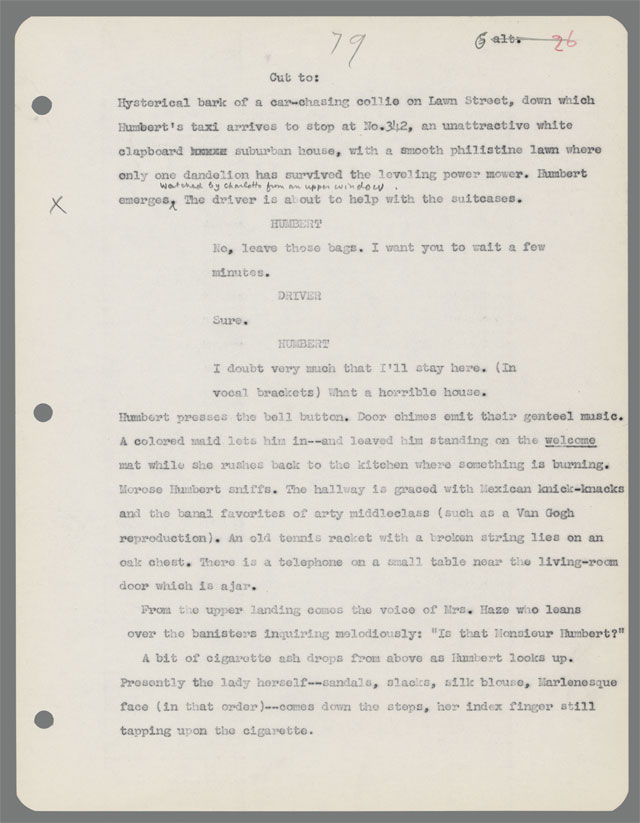
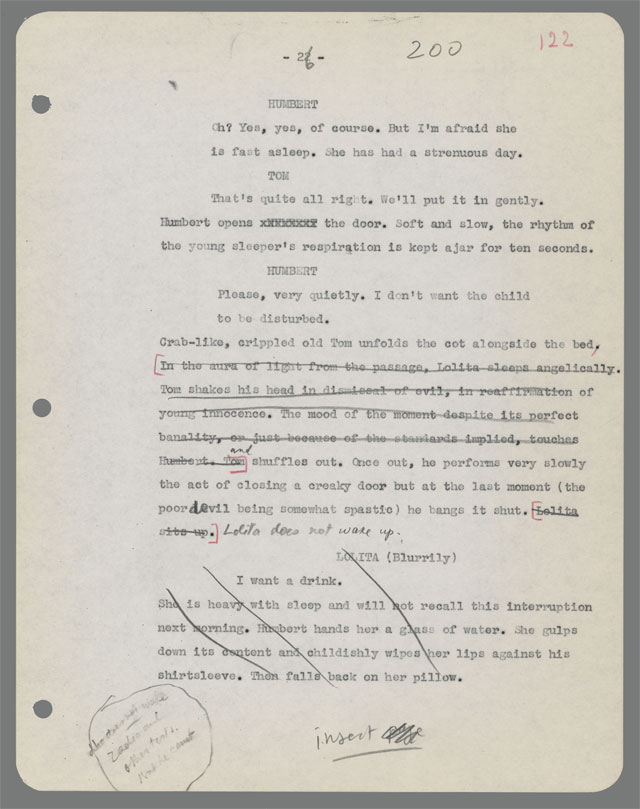
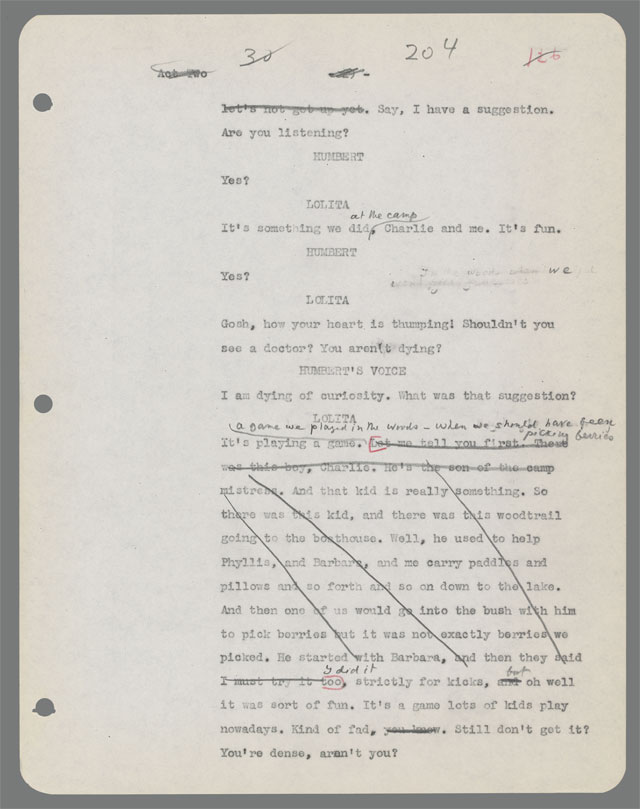
Nonetheless, Nabokov got a single screenwriter credit for the movie and he ended up getting an Oscar nomination for Best Adapted Screenplay. You can see some of Nabokov’s script of Lolita, complete with margin notes, below. (The margin notes apparently don’t appear in the published version.) You can click on each image to view them in a larger format. They come to us via Vice.
Jonathan Crow is a Los Angeles-based writer and filmmaker whose work has appeared in Yahoo!, The Hollywood Reporter, and other publications. You can follow him at @jonccrow.
If you dream of becoming the next Disney Channel star, you’d do well to heed the advice of casting director Judy Taylor, who uses “read” and “talent” according to their industry definitions, and seems unlikely to cut anyone slack for youth or inexperience.
If, however, you’ve got the soul of a poet, a painter, a musical adventurer, all three, or none of the above, I suggest falling to your knees and thanking Denmark’s Louisiana Museum of Modern Art for providing you with an alternative. The weekly videos on art, literature, design and architecture for its Louisiana Channel are a goldmine of inspiration for non-mainstream types both young and old, but certain segments speak explicitly to those just embarking on the journey.
As any number of us geezers can attest, Patti Smith and David Byrne speak with authority. It’s okay if you’ve never heard of them. If you were three or four decades further along, you would have.
(As to Marina Abramović, go easy on your parents if they need to spend a moment or two dialing her up on Wikipedia. I’ll bet Patti or David wouldn’t peer down their noses at someone for not recognizing one of the world’s greatest living performance artists. Excuse the dangling preposition, but she’s definitely someone worth finding out about.)
I realize I don’t speak for most of America, but for me, these guys loom larger than Jay‑Z and Beyonce combined. I also realize that in terms of both wealth and name recognition, there’s a stable full of teen celebrities who leave them in the dust.
Interesting how all three resist the notion of talent as something to be commodified.
Abramović, above, speaks of artistic exploration in literal terms. In her view difficult work should be pursued with the bravery of 17th-century sailors who sallied forth, believing that the world was flat. I suspect she’s a tougher cookie than casting director Taylor. Witness her differentiation between garden variety artists and great artists, the month long rubbish basket task she assigned her students, and the rigorousness of her own practice.
Her fellow trailblazer Smith has a more maternal touch. The path she promotes is similarly twisty, low-paying, and hard, but counterbalanced with “the most beautiful experiences.”
Byrne tackles some of the more practical aspects of committing to the artistic way. To wit, there’s no shame in day jobs, even if it’s been eons since he was in a position to need one. He also makes some very valid points about technology, below, with nary a peep as to the impossibility of concentrating on one’s studies when one is checking Twitter every two seconds. We all stand to benefit.
- Ayun Halliday is the author of seven books, including No Touch Monkey! And Other Travel Lessons Learned Too Late. Follow her @AyunHalliday
We’ve featured a fair few early Talking Heads performances, from Dortmund and Rome in 1980 to Syracuse in 1978 all the way back to CBGB in 1975. But you haven’t really heard early Talking Heads until you’ve heard the earliest Talking Heads. The same year of that CBGB show (one of many they played after their debut there opening for the Ramones), the trio of David Byrne, Chris Frantz, and Tina Weymouth recorded a series of demos at CBS studios. Still unsigned and in their early twenties, this first configuration of the Heads (after the band, newly arrived in New York, shed their identity as “The Artistics” from their days together at the Rhode Island School of Design) laid down the very first known recorded versions of such notable tracks as “Psycho Killer” above, “Thank You for Sending Me an Angel” below, and “I’m Not in Love” below.
You can find a fuller playlist, which includes more songs from these CBS sessions like “I Wish You Wouldn’t Say That,” “Tentative Decisions,” and “Stay Hungry,” here. We often hear these songs described as the defining material of a pioneering “post-punk” band like Talking Heads, so the fact that all these tracks come from 1975 make them perhaps the first examples of the genre ever recorded. This way of playing slightly ahead of their time may actually have kept the group from finding a label to sign them until 1977, when Sire picked up the now-quartet (with the addition of multi-instrumentalist Jerry Harrison) and put out the immortal pair of LPs Talking Heads: 77 and More Songs About Buildings and Food. Yes, even though they’d recorded these demos at CBS studios, CBS Records passed up the chance to take them on. Surely they lived it down more quickly than did Decca Records after having rejected The Beatles, but still, nobody every stayed atop the zeitgeist by turning their back to the Talking Heads.
We're hoping to rely on loyal readers, rather than erratic ads. Please click the Donate button and support Open Culture. You can use Paypal, Venmo, Patreon, even Crypto! We thank you!
Open Culture scours the web for the best educational media. We find the free courses and audio books you need, the language lessons & educational videos you want, and plenty of enlightenment in between.