What Is Apocalypse Now Really About? An Hour-Long Video Analysis of Francis Ford Coppola’s Vietnam Masterpiece

The dis­tort­ed sounds of heli­copter blades. The drunk­en punch that shat­ters the mir­ror. The “Ride of the Valkyries” attack. “I love the smell of napalm in the morn­ing.” The slaugh­ter­ing of the water buf­fa­lo. “The hor­ror… the hor­ror.” In the near­ly three-hour run­time of its orig­i­nal cut, Apoc­a­lypse Now deliv­ers these and many more of the most vivid cin­e­mat­ic moments of the 1970s, the era of “New Hollywood”—when young auteurs like its direc­tor Fran­cis Ford Cop­po­la swept in and demol­ished the bound­aries of main­stream Amer­i­can cinema—and that of the Viet­nam War the film depicts as well.

Yet for all its artis­tic and cul­tur­al impact, the film has­n’t received quite as much scruti­ny as you might imag­ine. Or at least that’s how it looked to pro­fes­sion­al cinephile Lewis Bond, known for his work on Chan­nel Criswell, when he first took stock of Apoc­a­lypse Now’s ana­lyt­i­cal video essay land­scape.

Dis­cus­sions of Cop­po­la’s Viet­nam mas­ter­piece tend to focus on its leg­en­dar­i­ly ardu­ous pro­duc­tion and the one mil­lion feet of film famous­ly shot dur­ing it, a prece­dent per­haps set by the 1991 behind-the-scenes doc­u­men­tary Hearts of Dark­ness: A Film­mak­er’s Apoc­a­lypse.

These appraisals shy away from one seem­ing­ly impor­tant ques­tion in par­tic­u­lar: what is the movie about? On one lev­el, the answer to that ques­tion comes eas­i­ly: a mod­ern adap­ta­tion of Joseph Con­rad’s 1899 nov­el Heart of Dark­ness, Apoc­a­lypse Now trans­plants and trans­forms Con­rad’s sto­ry of a jour­ney up the Con­go Riv­er to the strong­hold of an ivory trad­er into the con­text of 1969 Viet­nam. The riv­er jour­ney remains, now led by a Unit­ed States Army cap­tain charged with the “ter­mi­na­tion with extreme prej­u­dice” of an Army Spe­cial Forces colonel gone rogue, and prob­a­bly insane, in Cam­bo­dia, sur­round­ed by ex-sol­diers and natives who report­ed­ly wor­ship him as a “demigod.”

Bond ref­er­ences the stan­dard inter­pre­ta­tion of Apoc­a­lypse Now’s riv­er jour­ney as “a metaphor for descent into mad­ness,” but in his two-part, hour-long video essay ana­lyz­ing the themes of the film, he posits “a more appro­pri­ate descrip­tion of the riv­er” as “a reflec­tion of the char­ac­ters’ inner jour­ney, show­ing us the indoc­tri­na­tion of evil.” Along the way, Cop­po­la and his col­lab­o­ra­tors offer a sin­gu­lar cin­e­mat­ic expe­ri­ence about not one thing but many: “It’s about the destruc­tion of peo­ple’s morals. It’s about the way Amer­i­ca oper­at­ed dur­ing Viet­nam as well as the con­fused val­ues that Amer­i­ca pushed upon the world. It’s about war. It’s about peo­ple” — and every­thing else before which our inter­pre­tive instincts ulti­mate­ly fall pow­er­less.

Relat­ed Con­tent:

Apoc­a­lypse Now’s “Ride of the Valkyries” Attack: The Anato­my of a Clas­sic Scene

The Mak­ing of Apoc­a­lypse Now Remixed/Revisited

How Aki­ra Kurosawa’s Sev­en Samu­rai Per­fect­ed the Cin­e­mat­ic Action Scene: A New Video Essay

How Stan­ley Kubrick Made His Mas­ter­pieces: An Intro­duc­tion to His Obses­sive Approach to Film­mak­ing

Based in Seoul, Col­in Mar­shall writes and broad­casts on cities and cul­ture. He’s at work on a book about Los Ange­les, A Los Ange­les Primer, the video series The City in Cin­e­ma, the crowd­fund­ed jour­nal­ism project Where Is the City of the Future?, and the Los Ange­les Review of Books’ Korea Blog. Fol­low him on Twit­ter at @colinmarshall or on Face­book.

Arthur C. Clarke Creates a List of His 12 Favorite Science-Fiction Movies (1984)

Many thinkers enjoy sci­ence fic­tion, and some even cre­ate it, but Arthur C. Clarke seemed to pos­sess a mind pre­ci­sion-engi­neered for every aspect of it. When not writ­ing such now-clas­sics of the tra­di­tion as Child­hood’s End, Ren­dezvous with Rama, and 2001: a Space Odyssey, he pre­dict­ed such actu­al ele­ments of human­i­ty’s future as 3D print­ers and the inter­net. He must also have pos­sessed quite a dis­cern­ing ear and eye for oth­er works of sci­ence fic­tion — an abil­i­ty, in oth­er words, to sep­a­rate the art and the insight from the non­sense. (A use­ful abil­i­ty indeed, giv­en that, in the words of sci-fi author Theodore Stur­geon, “nine­ty per­cent of every­thing,” his and Clarke’s field not except­ed, “is crap.”)

Asked in 1984 to name his favorite sci­ence-fic­tion films, Clarke came up with this top-twelve:

  1. Metrop­o­lis (1927, watch it above)
  2. Things to Come (1936)
  3. Franken­stein (1931)
  4. King Kong (orig­i­nal ver­sion) (1933)
  5. For­bid­den Plan­et (1956)
  6. The Thing from Anoth­er World (orig­i­nal ver­sion) (1951)
  7. The Day the Earth Stood Still (1951)
  8. 2001: A Space Odyssey (1968)
  9. Star Wars (1977)
  10. Close Encoun­ters of the Third Kind (1980)
  11. Alien (1979)
  12. Blade Run­ner (1982)

The request came to him on the set of 2010: The Year We Make Con­tact, Peter Hyams’ sequel to Stan­ley Kubrick­’s 2001: A Space Odyssey, which appears on Clarke’s list. This selec­tion may at first seem self-serv­ing, giv­en his own involve­ment in the film’s gen­e­sis, but Clarke’s 2001 and Kubrick­’s 2001, par­al­lel projects derived from a col­lab­o­ra­tive idea, end­ed up as very dif­fer­ent works of sci­ence fic­tion.

Clarke’s choic­es, “which include some obvi­ous titles, clas­sics and mod­ern sen­sa­tions, are a well-round­ed group that would serve any neo­phyte well in study­ing and expe­ri­enc­ing the best that Hol­ly­wood has to offer in that cor­ner of cin­e­ma,” writes Syfy­Wire’s Jeff Spry. He adds that Clarke could­n’t quite decide whether to include Star Trek II: the Wrath of Khan, the pic­ture cred­it­ed with turn­ing Star Trek movies into much more than a one-off propo­si­tion; and, in addi­tion to Star Wars, which had already made his list, he con­sid­ered Return of the Jedi — though not, intrigu­ing­ly, The Empire Strikes Back, now per­haps the most respect­ed Star Wars movie of them all.

This top-twelve list, in any case, shows that Clarke knew a clas­sic when he saw one, and that he must have had a fair­ly expan­sive def­i­n­i­tion of sci­ence fic­tion, one that encom­pass­es even “mon­ster movies” like Franken­stein and King Kong. (Some purists even insist that Star Wars belongs in the fan­ta­sy col­umn.) But he also showed, as always, a cer­tain pre­science, as evi­denced by his selec­tion of Rid­ley Scot­t’s Blade Run­ner, now rec­og­nized as one of the most influ­en­tial films of all time, sci-fi or oth­er­wise, but then still a fresh vic­tim of com­mer­cial and crit­i­cal dis­as­ter. Only Philip K. Dick him­self, author of the nov­el that pro­vid­ed Blade Run­ner its source mate­r­i­al, could see its future more clear­ly. Dick and Clarke’s work may have had lit­tle in com­mon, but great sci­ence-fic­tion­al minds, it seems, think alike.

Relat­ed Con­tent:

In 1964, Arthur C. Clarke Pre­dicts the Inter­net, 3D Print­ers and Trained Mon­key Ser­vants

Arthur C. Clarke Pre­dicts the Inter­net & PC in 1974

Isaac Asi­mov Pre­dicts in 1964 What the World Will Look Like Today — in 2014

The Let­ter Between Stan­ley Kubrick & Arthur C. Clarke That Sparked the Great­est Sci­Fi Film Ever Made (1964)

Philip K. Dick Pre­views Blade Run­ner: “The Impact of the Film is Going to be Over­whelm­ing” (1981)

Metrop­o­lis: Watch Fritz Lang’s 1927 Mas­ter­piece

Based in Seoul, Col­in Mar­shall writes and broad­casts on cities and cul­ture. He’s at work on a book about Los Ange­les, A Los Ange­les Primer, the video series The City in Cin­e­ma, the crowd­fund­ed jour­nal­ism project Where Is the City of the Future?, and the Los Ange­les Review of Books’ Korea Blog. Fol­low him on Twit­ter at @colinmarshall or on Face­book.

W.B. Yeats’ Classic Poem “When You Are Old” Gets Adapted Into a Beautiful Short Film

W.B. Yeats’ 1891 poem “When You Are Old” is wide­ly con­sid­ered a com­men­tary on his unre­quit­ed life­long pas­sion for actress, Irish Repub­li­can and suf­fragette Maud Gonne.

Yeats first met Gonne in 1889 (a meet­ing which Yeats was lat­er to describe in his mem­oirs as the day ‘the trou­bling of my life began’) and he remained in love with her for much of his life, propos­ing mar­riage at least four times. Gonne became his muse, and he drew on his tor­tured love for her, albeit unnamed, as the inspi­ra­tion for many of his works, includ­ing most notably the poem, “When You Are Old.”

Freely based on a son­net by Pierre de Ron­sard, which first appeared in Le Sec­ond Livre Des Son­nets Pour Hélène in 1578, “When You Are Old” enjoins the object of an unre­turned love to reflect–in years to come–on a love reject­ed, to remem­ber one who ‘loved your moments of glad grace’, and who ‘loved the pil­grim soul in you, And loved the sor­rows of your chang­ing face.’

Although Yeats’s poet­ry is often very dense and rich in allu­sion to mythol­o­gy, the occult and his­to­ry, in “When You Are Old” the pain and bit­ter­sweet nature of a spurned love is all too appar­ent.

Aus­tralian play­wright Jes­si­ca Bel­lamy drew on the poem and her love of W.B. Yeats’ work when writ­ing the the­atre mono­logue “Lit­tle Love,” which she then adapt­ed with direc­tor Damien Pow­er to cre­ate the short film Bat Eyes. Watch it above.

In Bat Eyes, Adam and Jen­ny (‘Bat Eyes’) Bar­rett are brought togeth­er through an inci­dent of class­room bul­ly­ing. Through the metaphor of visu­al impair­ment and an eye exam­i­na­tion under­gone by an adult Adam, Bel­lamy and Pow­er explore the poem’s themes of long­ing, insight, rev­e­la­tion and regret, and poet­ry’s capac­i­ty to pro­vide solace and awak­en empa­thy in every­day life. The script of this beau­ti­ful short film con­sists prin­ci­pal­ly of the text of the poem, with the film’s two young leads repeat­ing Yeats’ words back and forth to each oth­er, as the sto­ry flips back and forth in time, the mean­ing of the lines becom­ing more tan­gi­ble and res­o­nant with each recita­tion.

Says Jes­si­ca Bel­lamy:

‘Yeats writes about ancient mythol­o­gy and the his­to­ry of his time, but you don’t have to under­stand all that to get the feel­ing of what he has to say. There are lines, there are moments that, as a read­er, you just get and you think: I’m not alone in this world and that some­one else has felt these things as well. I hope view­ers will hear the truth of what this poem is say­ing, and that they’ll see the film as an ode to love, rela­tion­ships and to poet­ry itself.

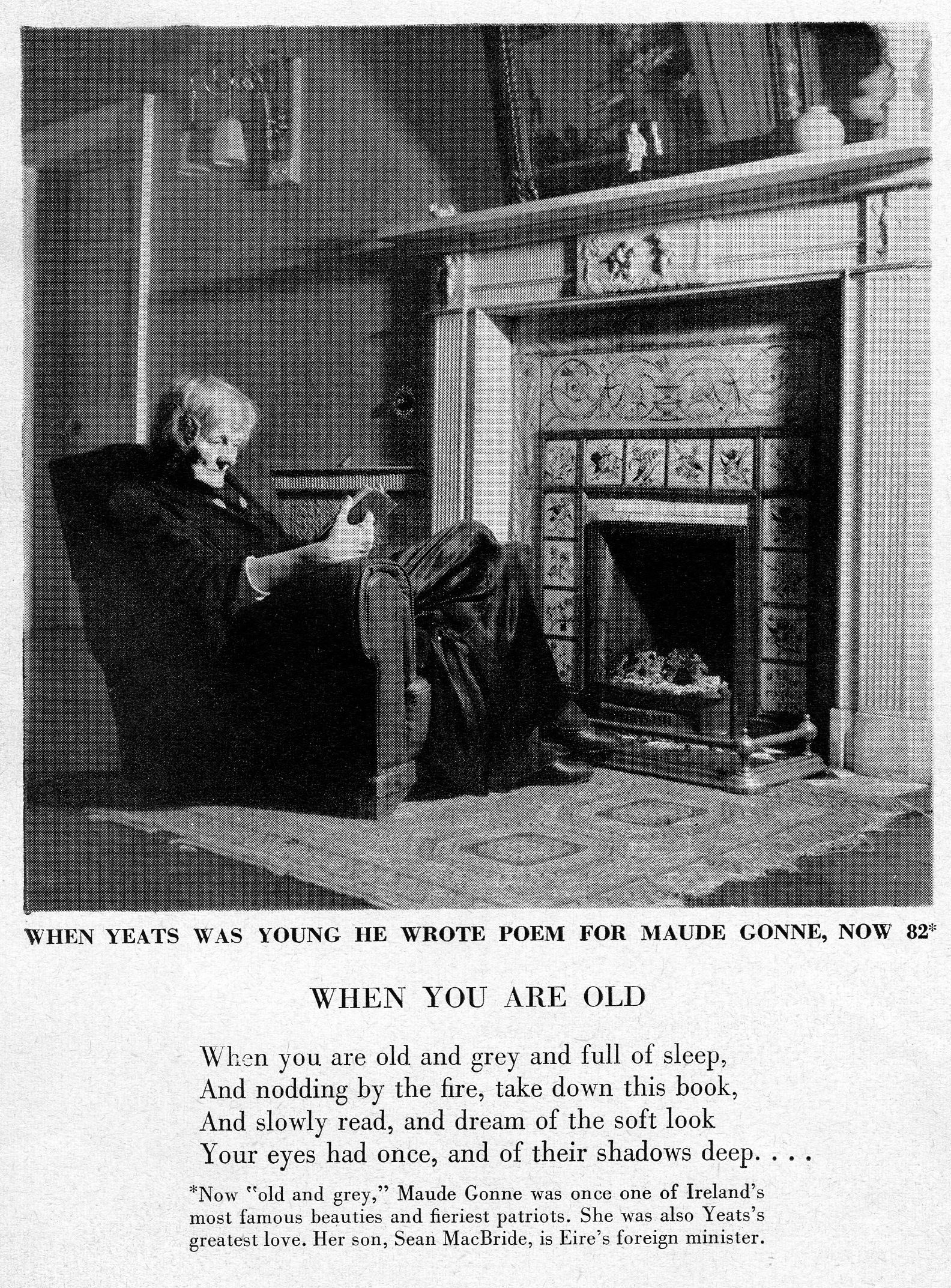
Gonne, who died in 1953, out­lived Yeats by 14 years. She was pho­tographed by Life mag­a­zine in Octo­ber 1948, old and grey, sit­ting by a fire and read­ing Yeats poet­ry.

You can watch the orig­i­nal mono­logue, “Lit­tle Love,” here:

And read and lis­ten to the text of “When You Are Old” here. There’s also a ver­sion read by Col­in Far­rell. Find it below.

Dan Prichard is an online film and web­series pro­duc­er, based in Syd­ney, whose work explores iden­ti­ty, place, and the space between film and per­for­mance in the dig­i­tal are­na. Vis­it his web­site here.

Relat­ed Con­tent:

Rare 1930s Audio: W.B. Yeats Reads Four of His Poems

Aleis­ter Crow­ley & William But­ler Yeats Get into an Occult Bat­tle, Pit­ting White Mag­ic Against Black Mag­ic (1900)

T.S. Eliot’s Clas­sic Poem “The Love Song of J. Alfred Prufrock” Gets Adapt­ed into a Hip Mod­ern Film

by | Permalink | Make a Comment ( 1 ) |

A Free Short Course on How Pixar Uses Physics to Make Its Effects

A new com­put­er-ani­mat­ed spec­ta­cle that makes us rethink the rela­tion­ship between imag­i­na­tion and tech­nol­o­gy seems, now, to come out every few months. Audi­ences have grown used to var­i­ous com­put­er ani­ma­tion stu­dios all com­pet­ing to wow them, but not so long ago the very notion of enter­tain­ing ani­ma­tion made with com­put­ers sound­ed like sci­ence fic­tion. All that changed in the mid-1980s when a young ani­ma­tor named John Las­seter breathed life into the CGI stars of such now sim­ple-look­ing but then rev­o­lu­tion­ary shorts as The Adven­tures of André and Wal­ly B. and Luxo Jr., the lat­ter being the first inde­pen­dent pro­duc­tion by a cer­tain Pixar Ani­ma­tion Stu­dios.

We know Pixar today as the out­fit respon­si­ble for Toy Sto­ry, The Incred­i­bles, WALL‑E, and oth­er ground­break­ing com­put­er-ani­mat­ed fea­tures, each one more impres­sive than the last. How do they do it? Why, with ever-larg­er and more high­ly skilled cre­ative and tech­no­log­i­cal teams, of course, all of whom work atop a basic foun­da­tion laid by Las­seter and his pre­de­ces­sors in the art of com­put­er ani­ma­tion, in the search for answers to one ques­tion: how can we get these dig­i­tal machines to con­vinc­ing­ly sim­u­late our world?

After all, even imag­i­nary char­ac­ters must emote, move around, and bump into one anoth­er with con­vic­tion, and do it in a medi­um of light, wind, water, and much else at that, all ulti­mate­ly under­gird­ed by the laws of physics.

Thanks to Pixar and their com­pe­ti­tion, not a few mem­bers of the past cou­ple gen­er­a­tions have grown up dream­ing of mas­ter­ing com­put­er ani­ma­tion them­selves. Now, in part­ner­ship with online edu­ca­tion­al orga­ni­za­tion Khan Acad­e­my, they have a place to start: Pixar in a Box, a series of short inter­ac­tive cours­es on how to “ani­mate bounc­ing balls, build a swarm of robots, and make vir­tu­al fire­works explode,” which vivid­ly demon­strates that “the sub­jects you learn in school — math, sci­ence, com­put­er sci­ence, and human­i­ties — are used every day to cre­ate amaz­ing movies.” The effects course gets deep­er into the nit­ty-grit­ty of just how com­put­er ani­ma­tors have found ways of tak­ing real phys­i­cal phe­nom­e­na and “break­ing them down into mil­lions of tiny par­ti­cles and con­trol­ling them using com­put­er pro­gram­ming.”

It all comes down to devel­op­ing and using par­ti­cle sys­tems, pro­grams designed to repli­cate the motion of the real par­ti­cles that make up the phys­i­cal world. “Using par­ti­cles is a sim­pli­fi­ca­tion of real physics,” says Pixar Effects Tech­ni­cal Direc­tor Matt Wong, “but it’s an effec­tive tool for artists. The more par­ti­cles you use, the clos­er you get to real physics. Most of our sim­u­la­tions require mil­lions and mil­lions of par­ti­cles to cre­ate believ­able water,” for instance, which requires a lev­el of com­put­ing pow­er scarce­ly imag­in­able in 1982, when Pixar’s own effects artist Bill Reeves (who appears in the one of these videos) first used a par­ti­cle sys­tem for a visu­al effect in Star Trek II. These effects have indeed come a long way, but as any­one who takes this course will sus­pect, com­put­er ani­ma­tion has only begun to show us the worlds it can real­ize.

For more Pixar/Khan Acad­e­my cours­es, please see the items in the Relat­eds below.

Relat­ed Con­tent:

Pixar & Khan Acad­e­my Offer a Free Online Course on Sto­ry­telling

Take a Free Online Course on Mak­ing Ani­ma­tions from Pixar & Khan Acad­e­my

Pixar’s 22 Rules of Sto­ry­telling … Makes for an Addic­tive Par­lor Game

Free Online Physics Cours­es

A Rare Look Inside Pixar Stu­dios

The Beau­ty of Pixar

The First 3D Dig­i­tal Film Cre­at­ed by Ed Cat­mull, Co-Founder of Pixar (1970)

Based in Seoul, Col­in Mar­shall writes and broad­casts on cities and cul­ture. He’s at work on a book about Los Ange­les, A Los Ange­les Primer, the video series The City in Cin­e­ma, the crowd­fund­ed jour­nal­ism project Where Is the City of the Future?, and the Los Ange­les Review of Books’ Korea Blog. Fol­low him on Twit­ter at @colinmarshall or on Face­book.

Watch Earth, a Landmark of Soviet Cinema (1930)

Today we’re adding to our list of Free Movies a 1930 Sovi­et silent film by direc­tor Alexan­der Dovzhenko. It’s called Earth, and it’s the third install­ment in Dovzhenko’s “Ukraine Tril­o­gy.”

When The Guardian cre­at­ed its list of the Top 10 Silent Movies of all time, it put Earth in the #9 slot. About the film writer Pamela Hutchin­son said:

Earth, capped by that avowed­ly sec­u­lar title, is a lyri­cal, car­nal movie about birth, death, sex and rebel­lion. Offi­cial­ly, this Sovi­et-era Ukrain­ian silent is a paean to col­lec­tive farm­ing, craft­ed around a fam­i­ly dra­ma, but its direc­tor, Alexan­der Dovzhenko, was a born rene­gade, for whom plots were far less impor­tant than poet­ry…

Earth is the final part of Dovzhenko’s silent tril­o­gy (fol­low­ing the nation­al­ist fan­ta­sy Zvenig­o­ra (1928) and the avant-garde anti-war film Arse­nal (1929), and is brim­ming with exu­ber­ant youth, but haunt­ed by the shad­ow of death.…

Sketched as trib­ute to the boons of col­lec­tivi­sa­tion, but released as those schemes were falling out of favour, Earth was con­demned on its home turf on polit­i­cal grounds. It was also snipped by cen­sors who object­ed to the nudi­ty, and the infa­mous scene in which farm­ers uri­nate into their trac­tor’s radi­a­tor. But while there was dis­may and cen­sure in the Sovi­et Union, crit­ics else­where were over­awed…

It’s the lat­ter impres­sion that endures. Dovzhenko’s sym­bol­ism is both rich and auda­cious. His scope com­pris­es vast pas­toral land­scapes, and inti­mate fleshy naked­ness. Per­haps its most cel­e­brat­ed sequence is the mag­nif­i­cent open­ing scene: the painful coun­ter­point between a dying man, his infant grand­chil­dren and the burst­ing fruit of his orchard. This is liv­ing cin­e­ma, as refresh­ing and vital as the film’s own cli­mac­tic down­pour.

You can watch Earth above, and find it list­ed in our col­lec­tion of Free Silent Films, a sub­set of our meta col­lec­tion, 4,000+ Free Movies Online: Great Clas­sics, Indies, Noir, West­erns, Doc­u­men­taries & More.

If you would like to sup­port the mis­sion of Open Cul­ture, con­sid­er mak­ing a dona­tion to our site. It’s hard to rely 100% on ads, and your con­tri­bu­tions will help us con­tin­ue pro­vid­ing the best free cul­tur­al and edu­ca­tion­al mate­ri­als to learn­ers every­where. You can con­tribute through Pay­Pal, Patre­on, and Ven­mo (@openculture). Thanks!

Relat­ed Con­tent:

Watch Inter­plan­e­tary Rev­o­lu­tion (1924): The Most Bizarre Sovi­et Ani­mat­ed Pro­pa­gan­da Film You’ll Ever See

Watch Dzi­ga Vertov’s A Man with a Movie Cam­era, Named the 8th Best Film Ever Made

Watch Sovi­et Avant-Garde Com­posers Cre­ate Syn­the­sized Music with Hand-Drawn Ani­ma­tions (1934)

Eight Free Films by Dzi­ga Ver­tov, Cre­ator of Sovi­et Avant-Garde Doc­u­men­taries

by | Permalink | Make a Comment ( 1 ) |

Pixar & Khan Academy Offer a Free Online Course on Storytelling

It doesn’t take much to spark a good sto­ry.

A tall man, a short woman, a set­ting that’s ster­ile to the point of soul­less, and a cou­ple dozen bananas…

It prac­ti­cal­ly writes itself!

If you’re slow to rec­og­nize the poten­tial in these extreme­ly potent ele­ments (culled from the above video’s open­ing shot), this free online course on sto­ry­telling, part of Khan Acad­e­my’s pop­u­lar Pixar In A Box series, might help strength­en those slack sto­ry­telling mus­cles.

The lessons will hold immense appeal for young Pixar fans, but adults stu­dents stand to gain too. Chil­dren are nat­u­ral­ly con­fi­dent sto­ry­tellers. Unfor­tu­nate­ly, time can do a num­ber on both flu­en­cy and one’s belief in one’s own abil­i­ty to string togeth­er nar­ra­tives that oth­ers will enjoy.

The Pixar direc­tors and sto­ry artists draft­ed to serve as instruc­tors for this course are as deft at encour­age­ment as they are at their craft. They’ll help you move that rub­ber tree plant… for free.

Each short, exam­ple-packed video les­son is fol­lowed with an activ­i­ty in which the view­er is asked to parse his or her favorite sto­ries.

One of the most com­pelling aspects of the series is hear­ing about the sto­ries that mat­ter deeply to the teach­ers.

Mark Andrews, who wrote and direct­ed Brave, recalls his vis­cer­al response to the injus­tice of Rudolph the Red Nosed Reindeer’s Island of Mis­fit Toys.

Domee Shi who sto­ry­board­ed Inside Out had to bail on The Lion King, she was so effect­ed by Simba’s dis­cov­ery of his dead father.

Rata­touille ani­ma­tor San­jay Patel, whose obser­va­tions con­sis­tent­ly struck me as the most pro­found and out of the box, went with The Killing Fields, a title that’s prob­a­bly not on the radar of those most square­ly in Pixar’s demo­graph­ic.

The first install­ment stress­es the impor­tance of pro­vid­ing a rich set­ting for well-devel­oped char­ac­ters to explore, though the teach­ers are divid­ed on which should come first.

Direc­tor Pete Doc­ter, whose daughter’s tweenage pas­sage into the Reviv­ing Ophe­lia-land inspired Inside Out, stress­es “writ­ing what you know” need not pin you to the nar­row con­fines of your own back­yard. He was well into pro­duc­tion on Mon­sters, Inc. when he real­ized it wasn’t so much a tale of a mon­ster whose job is scar­ing lit­tle kids as a sto­ry of his own jour­ney to father­hood.

As you may have guessed, exam­ples from the Pixar canon abound.

Khan Acad­e­my will be tak­ing the whole of 2017 to roll out Pixar in a Box’s five remain­ing Sto­ry­telling units

You can com­plete the first unit here, then revis­it their pre­vi­ous course on mak­ing ani­ma­tions, while wait­ing for the rest of the cur­ricu­lum to drop.

Find more free cours­es in our col­lec­tion, 1,700 Free Online Cours­es from Top Uni­ver­si­ties.

Relat­ed Con­tent:

Take a Free Online Course on Mak­ing Ani­ma­tions from Pixar & Khan Acad­e­my

Pixar’s 22 Rules of Sto­ry­telling … Makes for an Addic­tive Par­lor Game

George Saun­ders Demys­ti­fies the Art of Sto­ry­telling in a Short Ani­mat­ed Doc­u­men­tary

John Berg­er (RIP) and Susan Son­tag Take Us Inside the Art of Sto­ry­telling (1983)

Ayun Hal­l­i­day is an author, illus­tra­tor, and the­ater mak­er, whose new play Zam­boni Godot is open­ing in New York City in less than two weeks. Fol­low her @AyunHalliday.

Rarely Seen, Very Early Godard Film Surfaces on YouTube

Jean-Luc Godard, that liv­ing embod­i­ment of the nou­velle vague who did so much to tear down and rebuild the rela­tion­ship between cin­e­ma and its view­ers, has kept push­ing the bound­aries of his art form well into his eight­ies. But even he had to start some­where, and up until very recent­ly indeed, Godard enthu­si­asts looked to his first film Opéra­tion béton, a short 1955 doc­u­men­tary on the con­struc­tion of a Swiss dam that we fea­tured a few years ago, as the start­ing point of his career as a film­mak­er. But most of them sure­ly had more inter­est in Un Femme coquette, Godard­’s sec­ond and no doubt more for­ma­tive first fic­tion film, a nine-minute adap­ta­tion of a Mau­pas­sant sto­ry hard­ly ever seen until just last week.

“Une Femme coquette is the most elu­sive rar­i­ty of the French New Wave, and pos­si­bly the most dif­fi­cult-to-see film by a name film­mak­er that isn’t believed to be irre­triev­ably lost,” wrote A.V. Club crit­ic Ignatiy Vish­n­evet­sky in a 2014 piece on his search for it. And so, for decades, near­ly every­one who want­ed to see Un Femme coquette had to make do with mere descrip­tions. In his Godard biog­ra­phy Every­thing Is Cin­e­ma, New York­er crit­ic Richard Brody high­lights not only how the film­mak­er, in adapt­ing this “tale about a woman who, see­ing a pros­ti­tute beck­on to pass­ing men, decides to try the ges­ture her­self [ … ] turns the neces­si­ty of film­ing cheap­ly and rapid­ly, with­out movie lights, into an aes­thet­ic virtue,” but also how this “film about watch­ing, about try­ing to live with what one has watched, and about the inher­ent dan­gers of doing so” evokes “the per­ilous path [Godard] was tak­ing as he sought to enter the cin­e­ma and antic­i­pates the moral dan­gers that await­ed him there.”

The sud­den appear­ance of Un Femme coquette on “the dig­i­tal back chan­nels fre­quent­ed by obscure movie enthu­si­asts,” as Vish­n­evet­sky puts it, and com­plete with Eng­lish sub­ti­tles at that, would thrill even a casu­al Godard fan. As for the Breath­less, Alphav­ille, and Week­end direc­tor’s die-hard exegetes, one can only imag­ine the feel­ings they, or at least the ones who’ve yet brought them­selves to cast eyes upon this sacred text, have expe­ri­enced while watch­ing it. No mat­ter our lev­el of famil­iar­i­ty with Godard and his work, we can all feel the charge cin­e­ma his­to­ry has giv­en his shoe­string-bud­get­ed and at times rough-look­ing black-and-white short. But who, watch­ing it at one of its sparse ear­ly screen­ings, could have imag­ined what an aes­thet­ic rev­o­lu­tion­ary its direc­tor, screen­writer, and one-man crew would short­ly become — who, that is, besides Jean-Luc Godard?

via AV Club

Relat­ed Con­tent:

An Intro­duc­tion to Jean-Luc Godard’s Inno­v­a­tive Film­mak­ing Through Five Video Essays

Jean-Luc Godard Takes Cannes’ Rejec­tion of Breath­less in Stride in 1960 Inter­view

The Entire­ty of Jean-Luc Godard’s Breath­less Art­ful­ly Com­pressed Into a 3 Minute Film

Jean-Luc Godard’s Debut, Opéra­tion béton (1955) — a Con­struc­tion Doc­u­men­tary

Based in Seoul, Col­in Mar­shall writes and broad­casts on cities and cul­ture. He’s at work on a book about Los Ange­les, A Los Ange­les Primer, the video series The City in Cin­e­ma, the crowd­fund­ed jour­nal­ism project Where Is the City of the Future?, and the Los Ange­les Review of Books’ Korea Blog. Fol­low him on Twit­ter at @colinmarshall or on Face­book.

New Animated Film About Vincent Van Gogh Will Be Made Out of 65,000 Van Gogh-Style Paintings: Watch the Trailer and Making-Of Video

One of Aki­ra Kurosawa’s last films, 1990’s Dreams, saw the Japan­ese mas­ter stretch­ing out into more per­son­al ter­ri­to­ry. A col­lec­tion of short pieces based on the director’s dreams, one of these episodes, “Crows,” shows us a young Kuro­sawa sur­ro­gate who wan­ders from a gallery of Van Gogh’s paint­ings and into the French coun­try­side Van Gogh paint­ed. The addi­tion of Mar­tin Scors­ese as a vol­u­ble, Brook­lyn-accent­ed Van Gogh adds a quirky touch, but there’s some­thing a lit­tle dis­ap­point­ing about the move from the paint­ings to their ref­er­ent. When peo­ple ask, after all, “what must it have been like to have seen the world through Vin­cent van Gogh’s eyes?” they seem to assume the painter saw real­i­ty in same the swirling, writhing, riotous­ly-col­ored motion as his paint­ings.

It’s true the belea­guered Dutch artist had prob­lems with his vision, due to lead poi­son­ing and tem­po­ral lobe epilep­sy. But what we real­ly want to expe­ri­ence is see­ing the world not as Van Gogh saw it but as he paint­ed it. And as we shared last year, we’ll soon have a chance thanks to an incred­i­ble ani­mat­ed fea­ture film project called Lov­ing Vin­cent by Doro­ta Kobiela and High Welch­man. “Every frame of Lov­ing Vin­cent will be an oil paint­ing on can­vas, cre­at­ed with the same tech­niques Van Gogh used over a cen­tu­ry ago.” The film­mak­ers have since released an offi­cial trail­er for the film, which you can see at the top of the post, and a mak­ing-of short, which you can watch just above. The artists we see hard at work in stu­dios in Greece made a total of 65,000 indi­vid­ual oil paint­ings for the film, in col­or and black-and-white, many of which you can see—and purchase—at the Lov­ing Vin­cent web­site.

The painters drew their inspi­ra­tion from live action per­for­mances by actors like Dou­glas Booth, Saoirse Ronan, and Aidan Turn­er, which were then dig­i­tal­ly enhanced with com­put­er ani­mat­ed “ele­ments such as birds, hors­es, clouds and blow­ing leaves.” The 125 “paint­ing ani­ma­tors,” as the film’s site calls them, trans­formed “this ref­er­ence mate­r­i­al into Vin­cent van Gogh’s paint­ing style,” then re-cre­at­ed “the move­ment of the shot through ani­mat­ing each brush­stroke.” It’s a phe­nom­e­nal achieve­ment that painter Piotr Domini­ak above says gave him “goose­bumps” when he saw it. The hand­ful of painters inter­viewed above—from all over Europe—are pas­sion­ate about Van Gogh. Few of them are pro­fes­sion­al artists. Domini­ak worked as a cook before join­ing the project. Sarah Cam­pos worked as a Span­ish teacher, and Waldek Wesolows­ki restored old cars.

From start to fin­ish, Lov­ing Vin­cent has—like its subject’s body of work—been a labor of love (watch a behind-the-scenes short above). But this one came togeth­er on the inter­net. The film­mak­ers began fund­ing with a Kick­starter cam­paign sev­er­al years ago, and most of the artists were recruit­ed through their web­site. Giv­en the incred­i­ble results in what we’ve seen so far, we can expect to enter Van Gogh’s cre­ative vision in a way we could only dream about before. Learn much more about the project at the impres­sive Lov­ing Vin­cent web­site.

Relat­ed Con­tent:

Watch the Trail­er for a “Ful­ly Paint­ed” Van Gogh Film: Fea­tures 12 Oil Paint­ings Per Sec­ond by 100+ Painters

Mar­tin Scors­ese Plays Vin­cent Van Gogh in a Short, Sur­re­al Film by Aki­ra Kuro­sawa

Vin­cent van Gogh Vis­its a Mod­ern Muse­um & Gets to See His Artis­tic Lega­cy: A Touch­ing Scene from Doc­tor Who

Down­load Hun­dreds of Van Gogh Paint­ings, Sketch­es & Let­ters in High Res­o­lu­tion

Josh Jones is a writer and musi­cian based in Durham, NC. Fol­low him at @jdmagness

« Go Back — More in this category... »
Quantcast