Everyone remembers their first kung-fu movie — or everyone remembers their first wave of kung-fu movies, anyway. For some, they came late at night on the less-explored frequencies of the television broadcasting spectrum; for others, they came on sparsely attended double- and triple-bills at the local discount theater. They looked faded and muddy, but somehow still vivid; they felt cheaply produced, yet full of life and energy; and as for how they sounded, time has turned their both hollow and theatrical English-language dubbing into an art form with connoisseurs of its own. They came from faraway lands, which rendered them exotic, but we experienced them almost as dreams, products of another reality altogether. And some of them you can experience again as public domain films.
We still call them “kung fu movies” even though, having grown older and wiser — or at least more culturally aware — we now know their heroes didn’t always defeat their enemies with the Chinese martial arts covered by that umbrella term. But the label applies well enough to 1977’s Legend of Shaolin, the Hong Kong-made epic at the top of the post set in the 13th-century Yuan Dynasty and dealing with that most kung-fu of all themes, revenge. But such historical “kung fu” pictures could also come from countries like Japan, an example of which you can thrill to just above: 1983’s Legend of the Eight Samurai features Sonny Chiba, living embodiment of the 1970s martial-arts film, under the direction of the prolific and respected provocateur Kinji Fukasaku, best known today as the maker of the controversial Battle Royale.
Next in this public-domain martial-arts marathon, we have another Hong Kong movie, Guy with the Secret Kung Fufrom 1981, whose title alone strikes me as recommendation enough. And for our final selection, we move to a more contemporary setting with 1987’s Four Robbers, wherein the titular quartet—pursued by both the police and a malevolent crime syndicate that at first wants to recruit them and later wants revenge against them—have to flee from Hong Kong to Thailand without gambling away the fruits of their labor or compromising their principles. This movie, and many others of its kind, give the lie to the notion that there’s no honor among thieves. Most all of the wanderers, samurai, rebels, aristocrats, cops, and robbers you see in them have one kind of honor or another — but when they come into conflict, it tends to take some old-fashioned kung-fu fighting to settle things. You can find these films added to our collection, 4,000+ Free Movies Online: Great Classics, Indies, Noir, Westerns, Documentaries & More, which includes more 23 Free Kung Fu and Martial Arts Movies Online.
William S. Burroughs, like Christopher Walken, has one of those voices that casts anything he reads in a new light. No matter who the author, if Burroughs reads it, the text sounds like one more missive from the Interzone. In 1995, Burroughs took on the master of the macabre, Edgar Allan Poe, reading “The Masque of the Red Death” and the poem Annabel Lee for a little known PC game called The Dark Eye.
Ignored during its release, the game has since gained cult status, and playthroughs can be found on YouTube (see below). Similar in style to Myst, players point and clicked their way through three narratives based on Poe stories, with little interaction. In the end it was more about mood and design, and the creep of Burroughs’ drawl. (He also voiced the old man character in the game.)
Accompanying Burroughs’ reading was a slideshow that popped up in the middle of the game, with art directed (and possibly drawn) by Bruce Heavin, best known these days as the co-founder of Lynda.com. Thomas Dolby composed the gloomy soundtrack. The Dark Eye was the second game from Inscape, which debuted with the equally ambitious Bad Day on the Midway, a game featuring weird music giants The Residents. Two years after The Dark Eye, the sort of CD-ROM games the company made fell behind due to advances in technology, and the fall of the house of Inscape came inevitably in 1997.
The Internet continues to excavate what’s left of these boundary pushing games, and for those who want an audio version of “Masque”, an mp3 can be enjoyed here.
Ted Mills is a freelance writer on the arts who currently hosts the FunkZone Podcast. You can also follow him on Twitter at @tedmills, read his other arts writing at tedmills.com and/or watch his films here.
Some of the U.S.‘s greatest secular sages also happen to be some of its greatest cranks, contrarians, and critics. I refer to a category that includes Ambrose Bierce, H.L. Mencken, and Hunter S. Thompson. The many differences between these characters don’t eclipse a fundamental similarity: not a one embraced any of the usual pieties about the inherent, infallible greatness of Western Civilization, though each one in his own way made a significant contribution to the Western canon. We would be greatly remiss if we did not include among them perhaps the greatest American satirist of all, Mark Twain.
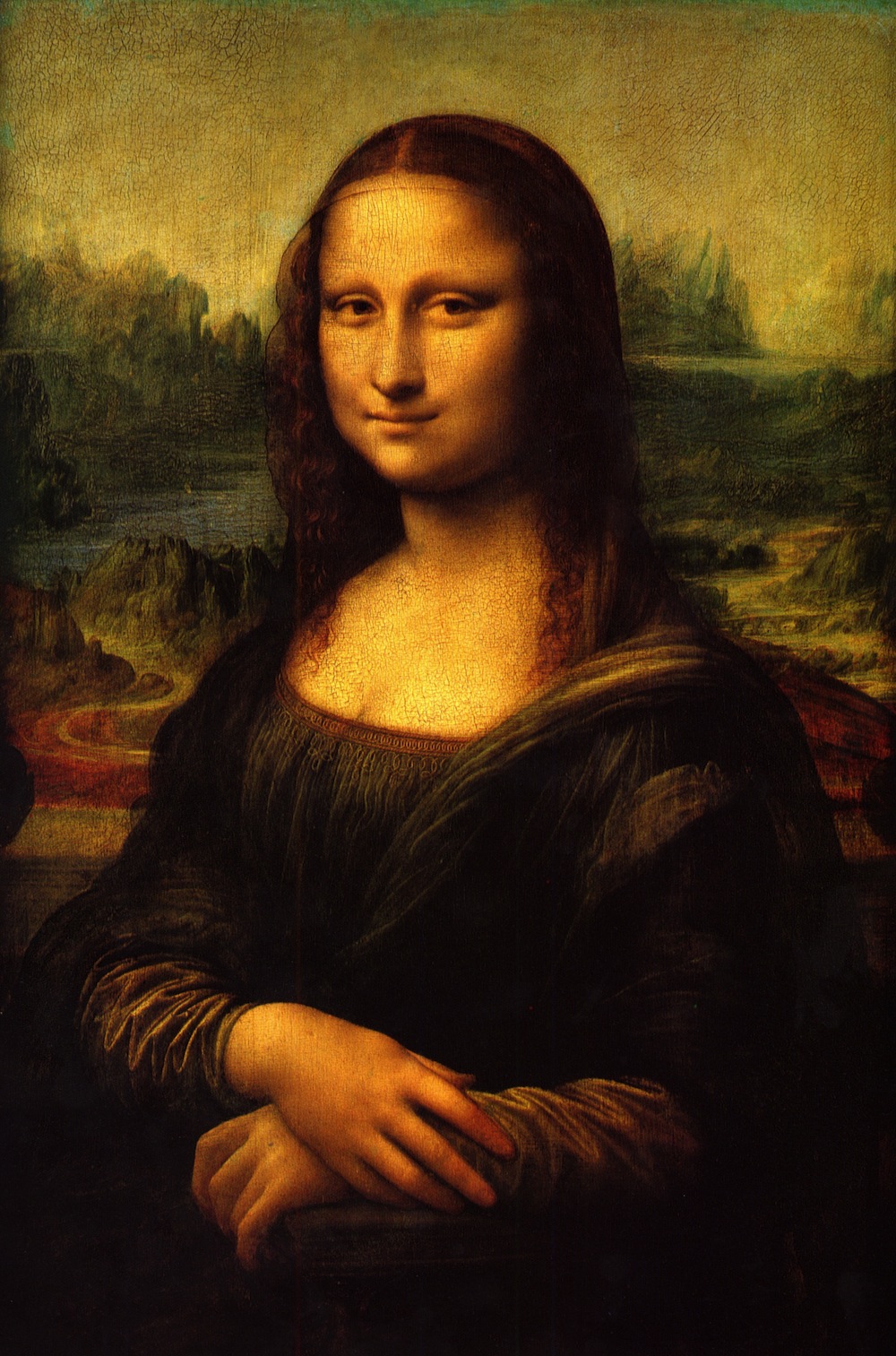
Twain skewered all comers, usually with such wit and invention that we smile and nod even when we feel the sting ourselves. Such was his talent, to deflate puffery in Western literature, politics, religion, and… as we will see, in art. “Throughout his career”—writes UC Berkeley’s Bancroft Library—“Twain expressed his strong reactions to Western painting and sculpture, particularly the Old Masters, both in his published works and in private.” He offered up some hilariously irreverent takes on some of the most revered works of art in history: “his opinions are often passionate, sometimes eccentric, and always lively.” Take for example Twain’s tepid assessment of that most recognizable of Renaissance masterpieces, the Mona Lisa. In an unpublished draft called “The Innocents Adrift,” an account of an 1891 boat trip down the Rhone River, Twain “admitted to being puzzled by the adulation accorded” the painting.
To Twain, the Mona Lisa seemed “merely a good representation of a serene & subdued face… The complexion was bad; in fact it was not even human; there are no people of that color.” The painting’s greenish hue prompted one of Twain’s companions, possibly an invention of the author’s, to exclaim in response, “that smoked haddock!” “After some discussion,” write the UC Berkeley librarians, “the travelers concede that it requires a ‘trained eye’ to appreciate certain aspects of art.” Such training in art appreciation seemed to Twain as much genuine education as instruction in studied, insincere poses.
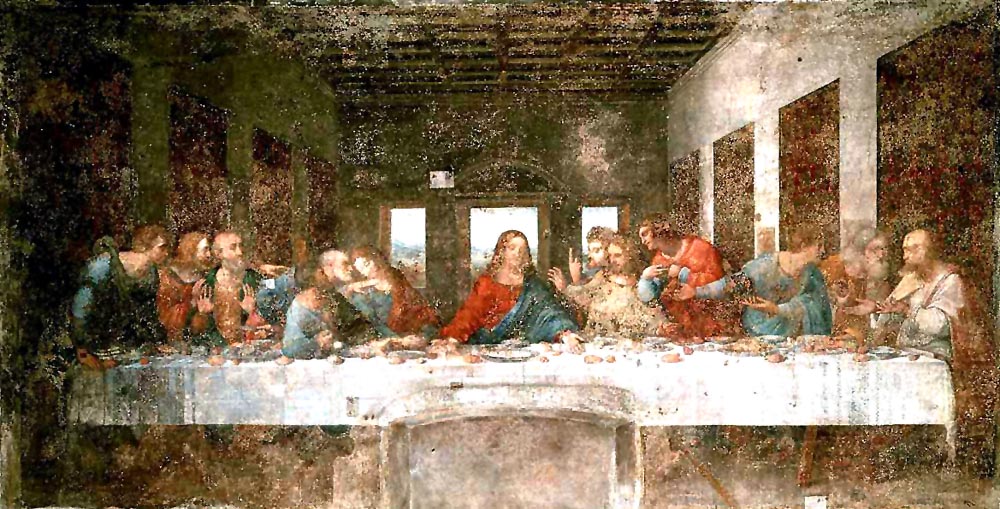
The author took his first “grand tour” in 1867—travelling through Europe and the Levant on the cruise ship Quaker City in the company of many “prosperous—and very proper—passengers.” Unlike these bourgeois travelling companions’ “conventional appreciation for all that they saw,” Twain—writing as a correspondent for the San Francisco Alta California—confessed himself underwhelmed. In particular, he described another Da Vinci, The Last Supper—“the most celebrated painting in the world”—as a “mournful wreck.” (The work was then unrestored; see it above as it looked 100 years later in the 1970s.) Twain later revised his observations for his first full-length book, 1869’s Innocents Abroad, a caricature of ugly American tourists filled with what William Dean Howells called “delicious impudence.” While the others marveled at Da Vinci’s crumbling fresco, Twain, in the current parlance, expressed a great big “meh.”
The world seems to have become settled in the belief, long ago, that it is not possible for human genius to outdo this creation of Da Vinci’s.… The colors are dimmed with age; the countenances are scaled and marred, and nearly all expression is gone from them; the hair is a dead blur upon the wall, and there is no life in the eyes.… I am satisfied that the Last Supper was a very miracle of art once. But it was three hundred years ago.
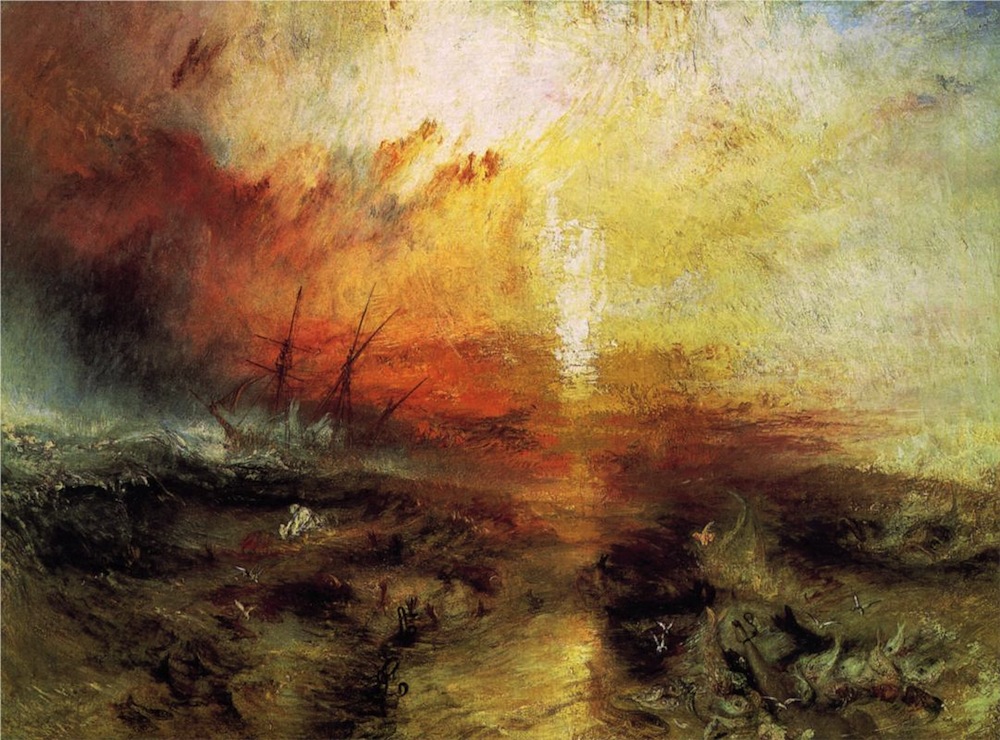
Twain and the professional critics did not always disagree. Take J.M.W. Turner’s famously riotous canvas Slave Ship (or Slavers Overthrowing the Dead and Dying: Typhoon Coming On), above. John Ruskin may have praised the work as the “noblest sea… ever painted by man” and it has come down to us as a violent representation of the horrors of the slave trade, occasioned in part, writes Stephen J. May, by Turner’s sense of “shared guilt about his own role and England’s role in condoning and perpetuating slavery’s malevolent legacy.” The anti-slavery, anti-imperialist Twain would surely have appreciated the sentiment; the painting, however, not so much. Other critics felt similarly, one calling Slave Ship a “gross outrage on nature.” Twain’s summation in an 1878 notebook is much more colorful, a piece of vintage Samuel Clemens undercutting: “Slave Ship—Cat having a fit in a platter of tomatoes.”
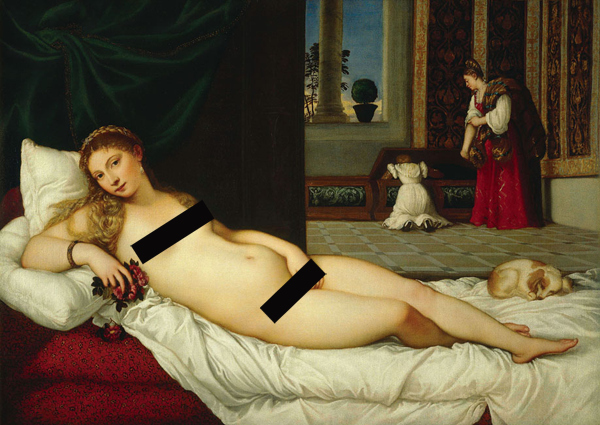
For all his snide portraits of conventional middle-class attitudes toward art, Twain could also be a bit of a prig, as we see in his response to Titian’s Venus of Urbino. In this, he was not so far removed from our own cultural attitudes (or Facebook and Google’s attitudes) about nudity. The censored version of the painting above (see the original here) comes to us via Buzzfeed, who write “Remember kids, blood and gore are fine but boobs will make you blind.” Twain seemed to have unironically agreed, railing in his 1880 travel book A Tramp Abroad against the “indecent license” afforded artists and calling Titian’s suggestive reclining nude “the foulest, the vilest, the obscenest picture the world possesses.” (Ah, if only he had lived to see the internet’s foulest depths.)
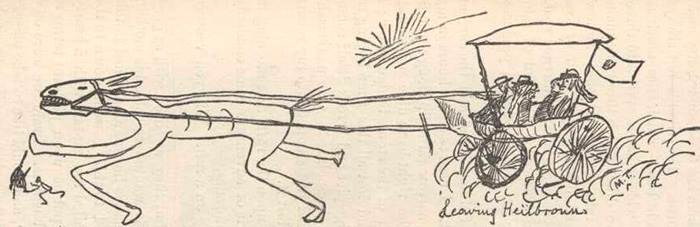
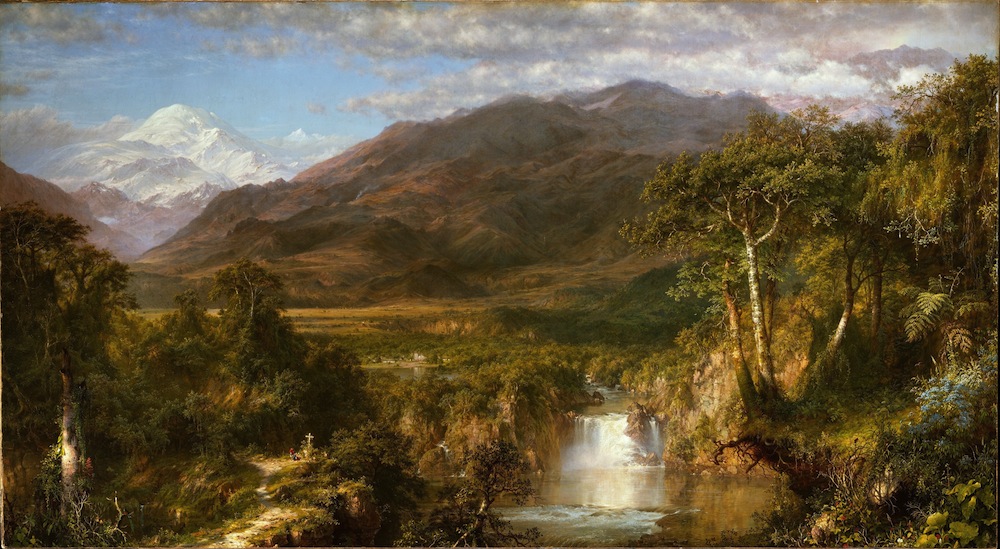
Twain’s own meager contributions to the visual arts—consisting of a dozen sketches, like that above, made for A Tramp Abroad—fall somewhat short of the standards he set for other artists. Nevertheless, he recalled in The Innocents Abroad his dismay at the “acres of very bad drawing, very bad perspective, and very incorrect proportions” in the museums and churches across Europe. What, we might wonder, could possibly move such a harsh, unsparing critic? In art, it seems, Twain valued “strict realism, grandeur of theme and scale, and propriety”—all on display in abundance in American artist Frederic Edwin Church’s The Heart of the Andes, below.
After viewing this idealized South American landscape in St. Louis, Twain called the enormous (over five feet high by ten feet wide) canvas a “most wonderfully beautiful painting.” “We took the opera glasses,” he wrote to his brother, “and examined its beauties minutely…. There is no slurring of perspective about it.” He recommended multiple viewings: “Your third visit will find your brain gasping and straining with futile efforts to take all the wonder in… and understand how such a miracle could have been conceived and executed by human brain and human hands.”
Twain, won over by this sublime spectacle, seems to have temporarily surrendered his critical faculties. In reading his response, I found myself wanting to egg him on: C’mon, what about this soft, gauzy lighting, those lumpy mountains, and the kitschy, overly-sentimental look of the whole thing? But there was room enough in Twain’s critical arsenal for genuine awe as for amused contempt at what he saw as phony expressions of the same. And that breadth of character is what made Mark Twain, well, Mark Twain.
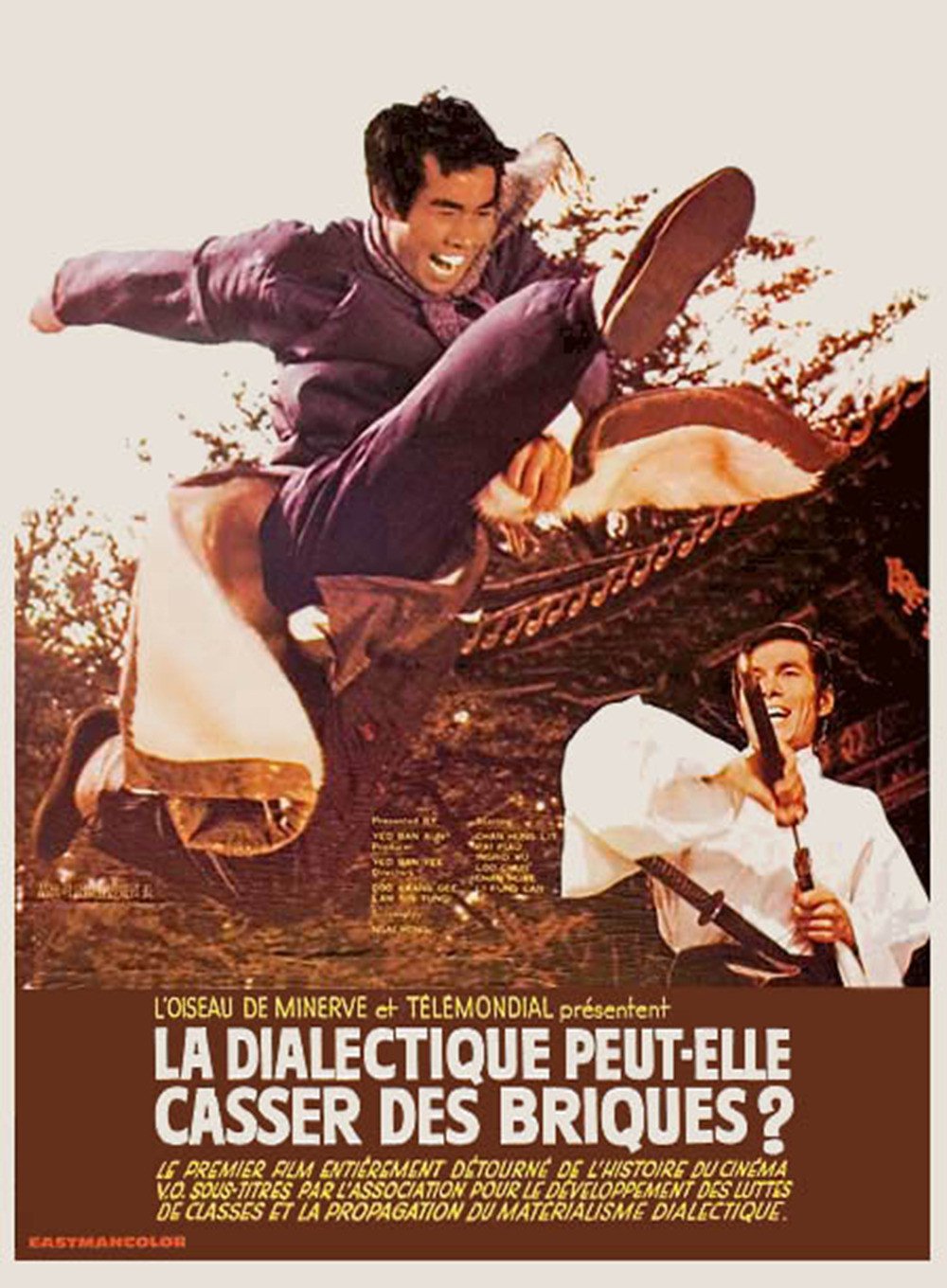
And here I’d always considered La Chinoise the only French-language film that used both borrowed Chinese imagery and lofty theory to mount a critique of capitalism. It turns out that six years after Jean-Luc Godard made that movie, Sinologist, Situationist, and filmmaker René Viénet came out with the next important volume in that fascinating minor tradition, La Dialectique Peut-Elle Casser Des Briques?(Can Dialectics Break Bricks?), an entire Hong Kong martial-arts picture entirely repurposed into, as Dangerous Minds’ Richard Metzger puts it, “a critique of class conflicts, bureaucratic socialism, the failures of the French Communist Party, Maoism, cultural hegemony, sexual equality and the way movies prop up Capitalist ideology.”
Using as its visual material 1972’s Crush, Tu Guangqi’s hand-to-hand-combat-intensive tale of Korean rebellion against Japanese imperialism, the film followed the model of Woody Allen’s What’s Up, Tiger Lily? “which re-dubbed humorous dialogue over a Japanese spy movie to make the plot about a recipe for egg salad […] but here the cinematic Situationist provocateur is less out for laughs (although there are plenty of them) and more about the political subversion.” This intersection of lo-fi chop-socky action with high-flown revolutionary jargon and academic name-dropping (“My Foucaults! My Lacans! And if that’s not enough, I’ll even send my structuralists”) has for decades struck its viewers as sublimely ridiculous. But do the images and the dialogues really clash as totally as they would seem to?
“Like many Hong Kong productions of the early seventies,” writes Luke White at Kung Fu with Braudel, “the scenario of the original film is clearly one in which colonial exploitation and resistance are at issue. Set in Korea under the Japanese occupation that lasted much of the first half of the twentieth century, the heroes (those turned by Viénet into ‘the Proletarians’) are the members of a martial arts school who start to resist the colonial violence of the militaristic Japanese forces. However potentially conservative the nationalistic dimension of its narrative, this is also a work about struggle and liberation from tyranny in some of its most typically modern forms.” In its multiplicity of possible interpretations, La Dialectique Peut-Elle Casser Des Briques? joins the ranks of all the most interesting works of art — and it certainly makes for a refreshing break from actually reading your Foucaults, your Lacans, and your structuralists.
One of our favorite curiosities is the The Charles Mingus CAT-alogue for Toilet Training Your Cat–a pamphlet written by the mercurial jazz musician that offers step-by-step advice on how to get your cat to use the loo. The one thing Mingus didn’t provide is video proof that it could actually be done.
That’s where another musician steps in. Above, we have video of Thomas Dolby’s cat, “Mozart,” in action. Dolby, best known for his 1982 hit “She Blinded Me with Science,” is a teacher at heart. The son of an Oxford and Cambridge don, he’s now the Professor of the Arts at Johns Hopkins University. And, on his Youtube channel, he explains how he pulled off the seemingly impossible:
This is my cat Mozart, a Cornish Rex, peeing on the toilet. Many believed this was not possible, but it’s 100% real. When he was a kitten we tried to teach him to use the toilet, using a DVD. We thought it was a no go. But then aged about 3 he suddenly started to do it. Now sometimes when I get up in the night to pee Mo nips in ahead of me and I have to wait till he’s done. Next we need to teach him to flush! ~TD
If anyone is familiar with the DVD he’s referencing, please identify it in the comments below.
This year we’ve been featuring short animated videos from BBC Radio 4, all covering the big questions: How did everything begin?What makes us human?What is love?How can I know anything at all? They’ve all come scripted by philosopher Nigel Warburton (he of Philosophy Bites podcast fame) and narrated by a host of notables from both sides of the pond like Stephen Fry, Gillian Anderson, Aidan Turner, and Harry Shearer. They’ve illustrated the philosophical concepts at hand not just with elaborate and joke-filled drawings that come to life before your eyes, but with direct reference to the ideas of history’s best-known thinkers: Aristotle, Descartes, Hume, Wittgenstein, de Beauvoir, Sartre, Freud, Chomsky — the list goes on.
If you would like to sign up for Open Culture’s free email newsletter, please find it here. It’s a great way to see our new posts, all bundled in one email, each day.
If you would like to support the mission of Open Culture, consider making a donation to our site. It’s hard to rely 100% on ads, and your contributions will help us continue providing the best free cultural and educational materials to learners everywhere. You can contribute through PayPal, Patreon, and Venmo (@openculture). Thanks!
In 1973, the book Sybil - about a young woman struggling with 16 distinct personalities — became a cultural sensation, spawning a hugely successful made-for-TV movie in 1976 and an utterly unnecessary remake in 2007.
The condition of multiple personality disorder (MPD) was so exotic and strange that it soon became fodder for daytime talk shows like Jerry Springer and campy storylines in soap operas. But the case and the controversial treatment prescribed by Sybil’s doctor Cornelia Wilbur had long-term and serious implications for healthcare in this country. Above, you can watch a video by the New York Times that lays out much of the controversy.
MPD was first diagnosed in the early 1950s with a patient named Eve White (above) who seemed to have three personalities. When Wilbur found that one of her own patients, a troubled graduate student named Shirley Mason (later known to the world as “Sybil”) exhibited some of the same symptoms as Eve, she started an aggressive therapy that included hypnosis and the use of sodium thiopental, truth serum. Wilbur suspected that Mason’s problems were the result of some childhood trauma and her therapy aimed at uncovering them.
Under Wilbur’s care, Mason revealed a host of different personalities from the assertive Peggy, to the emotional Marcia, to Mike, who was not only male but also a carpenter. Through the voice of each personality, Wilbur also uncovered what she believed to be terrifying accounts of childhood rape and abuse.
But as Mason wrote in a 1958 letter to Wilbur, the abuse and the multiple disorders were lies. “I am not going to tell you there isn’t anything wrong,” Mason writes. “But it is not what I have led you to believe.… I do not have any multiple personalities .… I do not even have a ‘double.’ … I am all of them. I have been essentially lying.”
Wilbur dismissed Mason’s claims as an excuse to avoid going deeper in her treatment.
The popularity of Sybil’s story soon turned what was previously a very rare condition into a trendy psychological disorder. The video details the case of Jeanette Bartha who states, “I came in for depression and I left with multiple personalities.” Under treatment with hypnotic drugs, Bartha started to believe not only that she had MPD but also her parents abused her as a part of a satanic cult. Years later, Bartha realized to her grief and horror that these memories were false.
Subsequent research has thoroughly debunked the validity of Wilbur’s methods and even her diagnosis. MPD has been replaced with the broader, and less pulpy sounding, dissociative-identity disorder.
“The problem is fragmentation of identity, not that you really are 12 people,” says Dr. David Siegel, a critic of Wilbur. “You have not more than one but less than one personality.”
Jonathan Crow is a Los Angeles-based writer and filmmaker whose work has appeared in Yahoo!, The Hollywood Reporter, and other publications. You can follow him at @jonccrow. And check out his blog Veeptopus, featuring lots of pictures of badgers and even more pictures of vice presidents with octopuses on their heads. The Veeptopus store is here.
“It is good,” wrote Chilean poet Pablo Neruda, “at certain hours of the day and night, to look closely at the world of objects at rest.” I find myself astonished Neruda himself ever found time to rest, and to compose the hundreds of surrealist poems that made him a national celebrity at 20 years of age and an internationally renowned Nobel Prize winner at age 67. In 1927, Neruda began his long career as a diplomat—“in the Latin American tradition,” writes the American Academy of Poets, “of honoring poets with diplomatic assignments.” Throughout his life, his political commitments were intense and unswerving. His many diplomatic appointments (in civil war-torn Spain and elsewhere), his term in the Chilean senate, his exile, and then his return to diplomatic service in his native land might have constituted a life’s work in its own right.
But Neruda’s loyalty to poetry—“a poetry as impure as the clothing we wear, or our bodies”—defines his life and legacy above all else. “Of all the overlapping and competing facets of his life,” writes Erin Becker, “amidst all the contradictions and the hypocrisies, Neruda was always a poet first… his belief in the beauty of life and words always comes through, even in his most political work.” Neruda himself declared, “I have never thought of my life as divided between poetry and politics.” Instead, he believed that his work spoke not for itself, but for the people. As the Nobel Committee put it, Neruda’s poetry communicated “with the action of an elemental force” that “brings alive a continent’s destiny and dreams.”
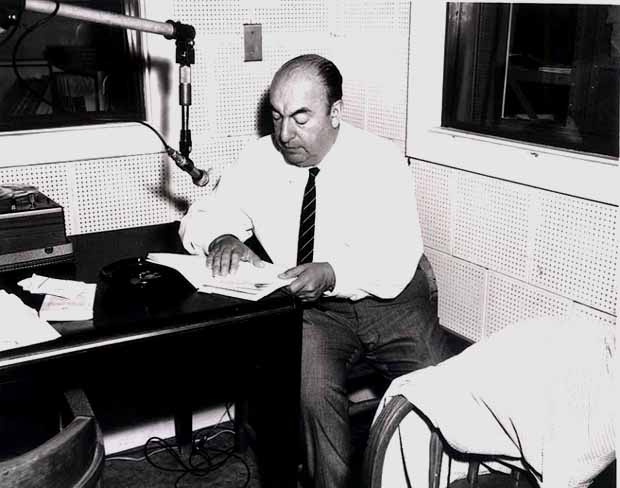
On September 5, 1971, just a few days before he accepted the Nobel, Neruda gave his first public reading in English, on the radio program Comment. You can hear him above introduce and read his very Whitmanesque poem, “Birth.” Neruda had previously addressed English-speaking readers when, after a longtime ban, he visited the states in 1966 and spoke to an audience at New York’s 92nd St. Y. Then, he introduced himself in English but would only read his poetry in Spanish. Here—“having entirely no confidence in my reading”—he nonetheless reads translations of his work by “some of my very best friends,” mainly his primary translator in English, Ben Belitt. While Belitt has been “accused of taking liberties” with Neruda’s verse, the poet himself obviously endorsed his translations.
Belitt’s renderings of Neruda’s learned, yet earthy Spanish have become the standard way most of us encounter the poet in English. The publication of the 1974 dual-language anthology Five Decades: Poems 1925–1970, was to have been “festive,” wrote Belitt in his preface, in honor of the poet’s 70th birthday. Sadly, instead, it was a posthumous celebration of Neruda’s work. The poet died in September of 1973, two years after the reading above and just twelve days after the CIA helped overthrow Salvador Allende and install the brutal dictator Augusto Pinochet. As Oscar Guardiola-Rivera writes colorfully in The Guardian, the details of Neruda’s political life are fodder for activists, “Google-bombs waiting to be set off by a new generation of networked freedom fighters.” His poetic voice, however, speaks to and for the multitudes, with—as Neruda wrote in “Toward an Impure Poetry”—“the mandates of touch, smell, taste, sight, hearing, the passion for justice, sexual desire… [and] the sumptuous appeal of the tactile.”
Our veteran readers will perhaps remember Kirby Ferguson’s four-part video series Everything is a Remix. Created between 2010 and 2014, the series explored the idea that (to quote from one of my earlier posts) “great art doesn’t come out of nowhere. Artists inevitably borrow from one another, drawing on past ideas and conventions, and then turn these materials into something beautiful and new.” That applies to musicians, filmmakers, technologists, and really anyone in a creative space.
This week, to mark the 5th anniversary of the series’ launch, Ferguson has remastered and re-released Everything is a Remix as a single video in HD. “For the first time now, the whole series is available as a single video with proper transitions all the way through, unified styling, and remixed and remastered audio.” Find it featured above, and added to our collection of Free Online Documentaries, a subset of our collection, 4,000+ Free Movies Online: Great Classics, Indies, Noir, Westerns, Documentaries & More.
If you would like to sign up for Open Culture’s free email newsletter, please find it here. It’s a great way to see our new posts, all bundled in one email, each day.
If you would like to support the mission of Open Culture, consider making a donation to our site. It’s hard to rely 100% on ads, and your contributions will help us continue providing the best free cultural and educational materials to learners everywhere. You can contribute through PayPal, Patreon, and Venmo (@openculture). Thanks!
History’s most respected painters all gave their lives to their art. We can almost call that a requirement of the artist who wishes their work to attain immortality, but as for the mortal artists themselves — well, they’ve all got to get out of the house sometime or another. That rule held even for Edgar Degas, 19th- and early 20th-century painter, sculptor, and reluctant impressionist whose body of work commands many dedicated exhibitions even in the 21st century. In the clip above, you can see one of his excursions onto the streets of Paris, captured in 1915 with the then-new invention known as the motion picture camera.
Degas, who would die in 1917, had by the time of this walk reached his eighties, having put his artistic work behind him at least three years before. With his longtime residence on rue Victor-Massé just about to go under the wrecking ball, he moved over to Boulevard de Clichy, where he lived out his days walking the streets in the very manner we see in this snippet of film.
But even as Degas roamed Paris so restlessly and aimlessly, other French painters and sculptors did the work that would put their own names into the art-history pantheon. In the video just above, you can see a 74-year-old Claude Monet — also at quite an advanced age for the time — doing a bit of outdoor painting in his garden at Giverny in 1915, the very year we saw Degas strolling past us with his hat and umbrella.
Here, you can see several shots of the sculptor Auguste Rodin in action, also in 1915, two years before his death, as Mike Springer previously wrote here. The clip’s first sequence “shows the artist at the columned entrance to an unidentified structure, followed by a brief shot of him posing in a garden somewhere. The rest of the film, beginning at the 53-second mark, was clearly shot at the palatial, but dilapidated, Hôtel Biron, which Rodin was using as a studio and second home.”
Mike also covered the fourth French-artist film from 1915 we have here, three minutes of footage of Auguste Renoir in which “we see the 74-year-old master seated at his easel, applying paint to a canvas while his youngest son Claude, 14, stands by to arrange the palette and place the brush in his father’s permanently clenched hand.” Though in several ways debilitated by age, Renoir continued to create, and you can read more about his struggle, as well as the project of the young filmmaker who shot several of these now-invaluable pieces of film, at the original post. And if you want to see more of these artists you may know only as names from art-history textbooks brought to life, if only for a few moments, have a look at our roundup of iconic artists at work.
If you would like to sign up for Open Culture’s free email newsletter, please find it here. It’s a great way to see our new posts, all bundled in one email, each day.
If you would like to support the mission of Open Culture, consider making a donation to our site. It’s hard to rely 100% on ads, and your contributions will help us continue providing the best free cultural and educational materials to learners everywhere. You can contribute through PayPal, Patreon, and Venmo (@openculture). Thanks!
Apart from from writing here on Open Culture, I write about cities. Having mentioned my city-related projects here from time to time (the podcast Notebook on Cities and Culture, the City in Cinema video essays), I’d like to submit for your approval my newest and most ambitious one yet: Where Is the City of the Future?, an in-depth search across the Pacific Rim for the best city to lead us into the urban century ahead — using a brand new model of journalism.
Not long after the turn of the 21st century, the world’s urban population surpassed its non-urban population for the first time ever. And the deeper humanity gets into the this century, the more urbanized our world becomes: developing cities develop, neglected cities revitalize themselves, and the long-standing great cities of the world continue to find (or struggle to find) new ways of accommodating all those who’ve never stopped coming to live in them. How can the ever-growing urban world prepare itself for things to come?
This series of reports, combining both text and photographs, and informed by both extensive on-the-ground exploration and in-depth conversations with those who know these fascinating urban places best, aims to find out by taking as close as possible a look at cities all across the Pacific Rim. These include 20th-century metropolises looking toward the future like Los Angeles, Seattle and Vancouver, compact city-states like Singapore and Hong Kong, fast-developing capitals like Jakarta and Bangkok, lower-profile but nevertheless inventive “sleeper” cities like Wellington and Santiago, and east Asian megacities like Seoul, Tokyo, and Shanghai.
I’ve launched “Where Is the City of the Future?” as one of the flagship projects on Byline, a new platform for crowdfunded journalism. For every $2000 raised there, I’ll go report on one Pacific Rim city, seeking out the important lessons it has to teach every other, from the urbanistic to the architectural to the cultural and beyond. This will begin with reports on Los Angeles and Seoul, and will continue on indefinitely to potential cities of the future in an order voted on the backers. (Theoretically, you could keep me at this for quite a long time!) If you like, you can get involved at the project’s Byline page. Thanks very much indeed — and I look forward to finding the city of the future together.
We're hoping to rely on loyal readers, rather than erratic ads. Please click the Donate button and support Open Culture. You can use Paypal, Venmo, Patreon, even Crypto! We thank you!
Open Culture scours the web for the best educational media. We find the free courses and audio books you need, the language lessons & educational videos you want, and plenty of enlightenment in between.





.jpg)