Courtesy of Legion Magazine, you can hear Canada’s iconic singer-songwriter Leonard Cohen reading “In Flanders Fields” by Lieutenant-Colonel John McCrae. The clip was recently recorded to commemorate the 100th anniversary of the poem.
World War I inspired many poems. But this one, straight from the beginning, became one of the most popular ones. Poets.org recounts the origins of “In Flanders Fields” thusly:
As the first shots of World War I were fired in the summer of 1914, Canada, as a member of the British Empire, became involved in the fight as well. [John] McCrae was appointed brigade-surgeon to the First Brigade of the Canadian Field Artillery.
In April 1915, McCrae was stationed in the trenches near Ypres, Belgium, in an area known as Flanders, during the bloody Second Battle of Ypres. In the midst of the tragic warfare, McCrae’s friend, twenty-two-year-old Lieutenant Alexis Helmer, was killed by artillery fire and buried in a makeshift grave. The following day, McCrae, after seeing the field of makeshift graves blooming with wild poppies, wrote his famous poem “In Flanders Field,” which would be the second to last poem he would ever write. It was published in England’s Punch magazine in December 1915 and was later included in the posthumous collection In Flanders Fields and Other Poems (G. P. Putnam’s Sons, 1919).
As a sad postscript, McCrae started suffering from asthma attacks and bronchitis in the summer of 1917, then died of pneumonia and meningitis in January of 1918. It’s fitting that Leonard Cohen (an accomplished poet before he became a musician) would recite “In Flanders Fields,” the text of which you can read below. The second reading was recorded live in Los Angeles earlier this year.
In Flanders fields the poppies blow
Between the crosses, row on row,
That mark our place; and in the sky
The larks, still bravely singing, fly
Scarce heard amid the guns below.
We are the Dead. Short days ago
We lived, felt dawn, saw sunset glow,
Loved and were loved, and now we lie
In Flanders fields.
Take up our quarrel with the foe:
To you from failing hands we throw
The torch; be yours to hold it high.
If ye break faith with us who die
We shall not sleep, though poppies grow
In Flanders fields.
Follow Open Culture on Facebook and Twitter and share intelligent media with your friends. Or better yet, sign up for our daily email and get a daily dose of Open Culture in your inbox. And if you want to make sure that our posts definitely appear in your Facebook newsfeed, just follow these simple steps.
I once read a book by Larry King called How to Talk to Anyone, Anytime, Anywhere. Slavoj Zizek might well consider writing a book of his own called How to Make Intellectual Pronouncements About Anything, Anytime, Anywhere. From Beethoven’s “Ode to Joy” to political correctness to the Criterion Collection to Starbucks (and those just among the topics we’ve featured here on Open Culture) the Slovenian philosopher-provocateur has for decades demonstrated a willingness to expound on the widest possible variety of subjects, to the point where his career has begun to look like one continuous, free-associative analytical monologue, which in the Big Think video above reaches the inevitable subject: your love life.
Perhaps you’ve tried online dating — a practice that, given the increasingly thorough integration of the internet and daily life, we’ll probably soon just call “dating.” Perhaps you’ve had positive experiences with it, perhaps you’ve had negative ones, and most probably you’ve had a mixture of both, but how often can you take your mind off the awkward fact that you have to first “meet” the other person through an electronic medium, creating a version of yourself to suit that medium? Zizek calls this online dating’s problematic “aspect of self-commodification or self-manipulation.”
“When you date online,” he says, “you have to present yourself there in a certain way, putting forward certain qualities. You focus on your idea of how other people should perceive you. But I think that’s not how love functions, even at the very simple level. I think the English term is ‘endearing foibles’ — an elementary ingredient in love. You cannot ever fall in love with the perfect person. There must be some tiny small disturbing element, and it is only through noticing this element that you say, ‘But in spite of that imperfection, I love him or her.’ ”
Fair enough. But what to do about it? Zizek thinks that the way forward for romantic technologies lies not in a less technological approach, but a more technological approach — or at least a stranger technological approach. He imagines a world of “ideal sexual attraction” where “I meet a lady; we are attracted to each other; we say all the usual stuff — your place, my place, whatever, we meet there. What happens then? She comes with her plastic penis, electric dildo. I come with some horrible thing — I saw it, it’s called something like stimulating training unit — it’s basically a plastic vagina, a hole.”
Dare we examine where this scenario goes? The outcome may surprise you. They simply insert her electric dildo into his stimulating training unit, and voilà, “the machines are doing it for us, buzzing in the background, and I’m free to do whatever I want, and she.” With full tribute paid to the superego by their vulgar devices, “we have a nice talk; we have tea; we talk about movies. I talk with a lady because we really like each other. And, you know, when I’m pouring her tea, or she to me, quite by chance our hands touch. We go on touching. Maybe we even end up in bed. But it’s not the usual oppressive sex where you worry about performance. No, all that is taken care of by the stupid machines. That would be ideal sex for me today.”
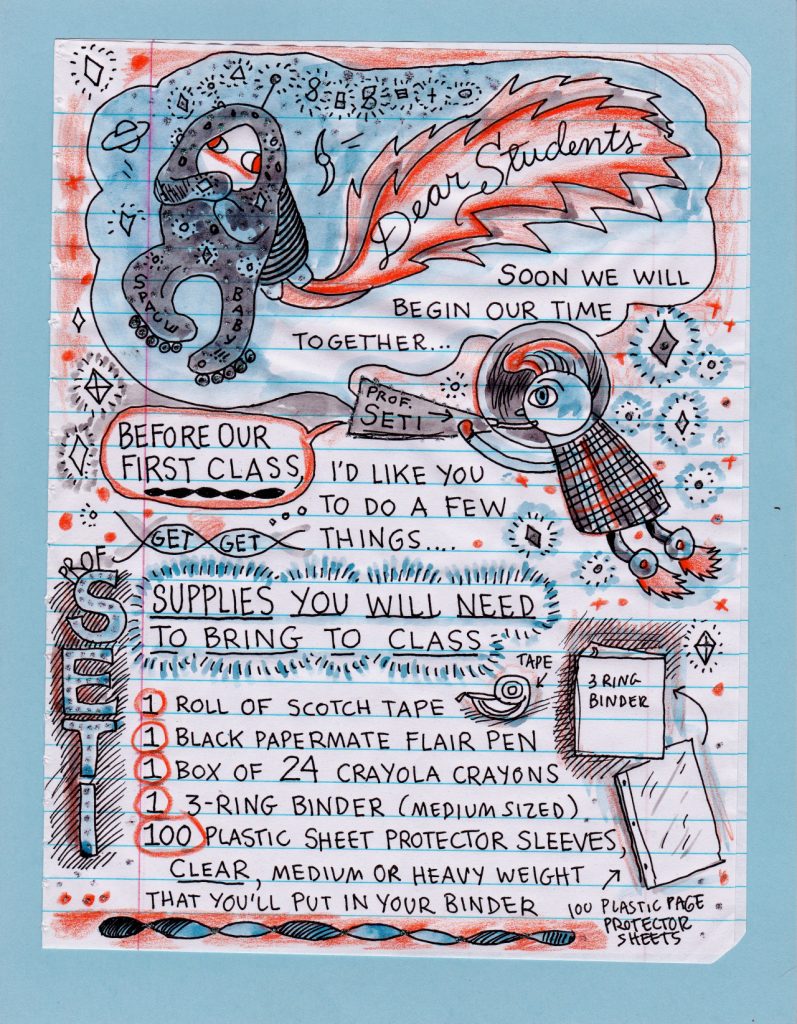
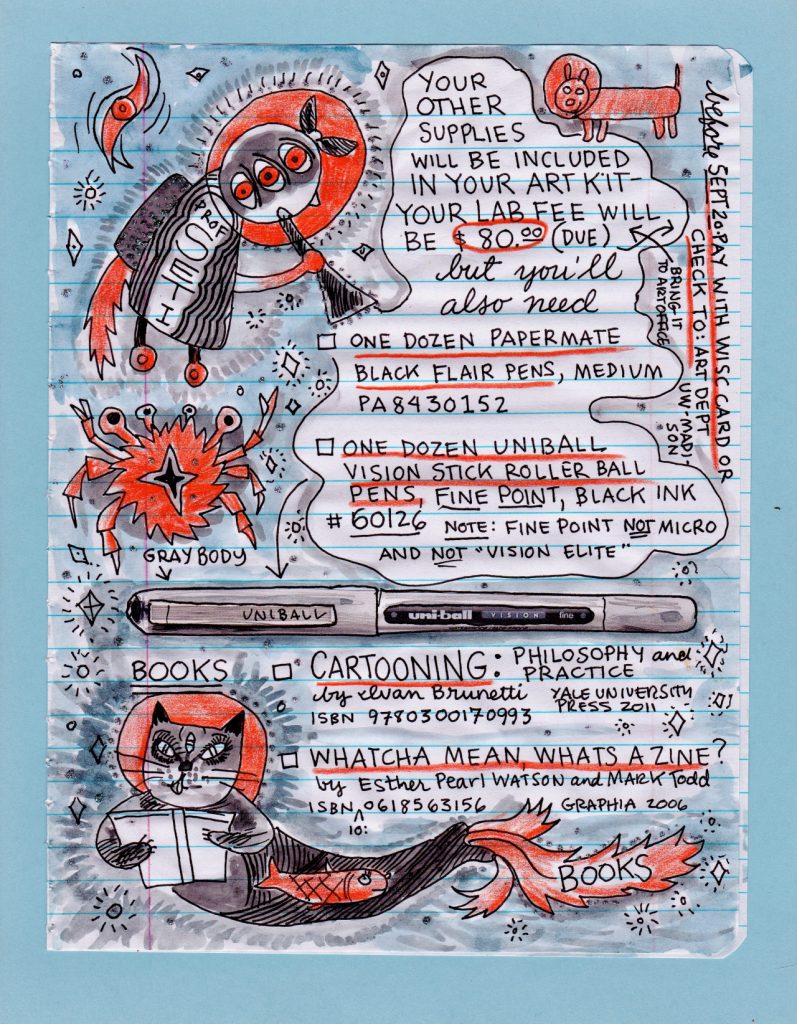
Cartoonist turned educator Lynda Barry is again permitting the world at large to freely audit one of her fascinating University of Wisconsin-Madison classes via her Tumblr. (To get to the start of the class, click here and then scroll down the page until you reach the syllabus, then start working your way backwards.)
As in previous classes, the syllabus, above, spells out a highly specialized set of required supplies, including a number of items rarely called for at the college level.
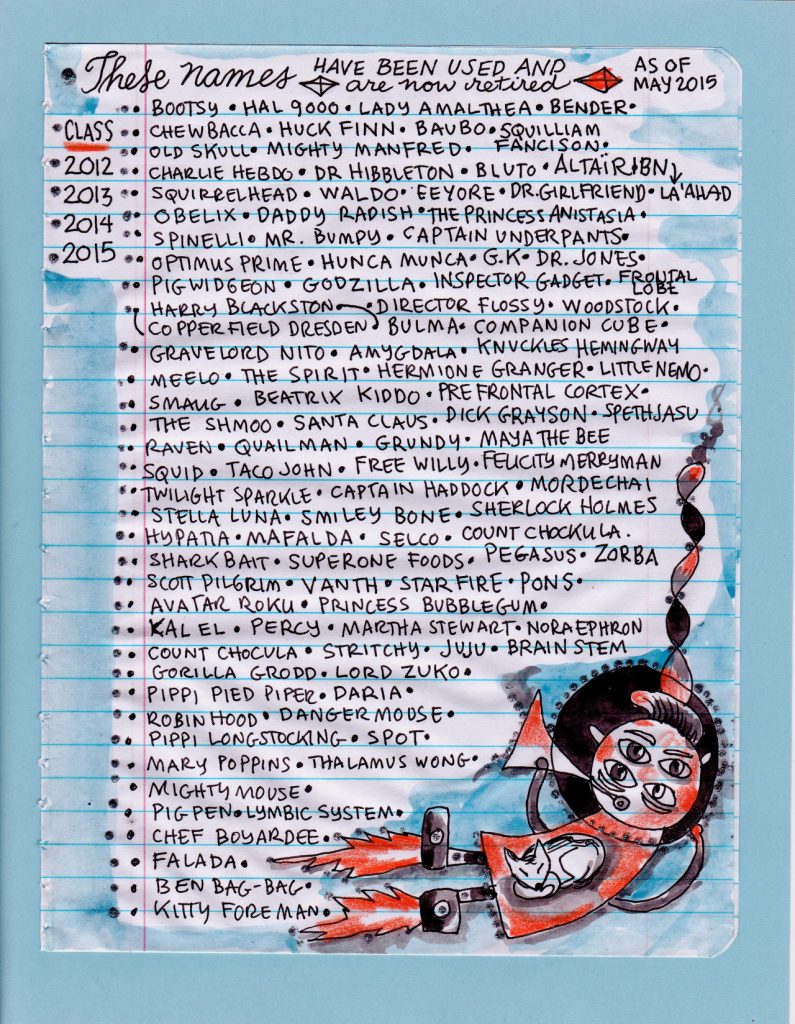
It’s become a time honored tradition for Barry’s students to adopt new names by which to refer to each other in-class, something they’ll enjoy hearing spoken aloud. For “Making Comics,” Barry is flying under the handle Professor SETI (as in “search for extraterrestrial intelligence”), telling the class that “images are the ETI in SETI.”
The students have responded with the following handles: Chef Boyardee, Ginger, Lois Lane, Rosie the Riveter, Regina Phalange, Arabella, Snoopy, Skeeter, Tigger, Arya Stark, Nala, Nostalgia, Akira, Lapus Lazuli, The Buffalo,Mr. November, The Short Giraffe, Nicki Minaj, Neko, Vincent Brooks, Regular Sized Rudy, and Zef.
(Sounds like a rough and ready crew. What name would you choose, and why?)
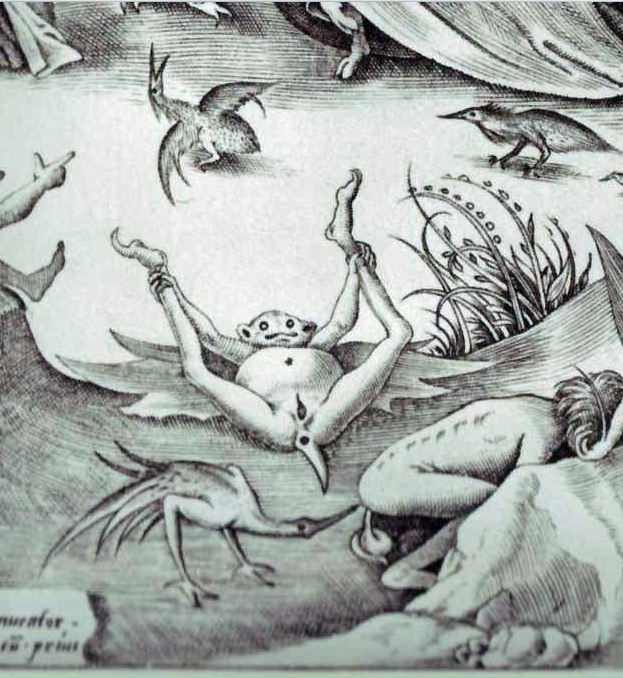
As usual, Barry draws inspiration from the dizzying bounty of images available on the net, bombarding her pupils with findings such as the lobed teeth of the crab-eater seal, above.
What to do with all of these images? Draw them, of course! As Barry tells her students:
Drawing is a language. It’s hard to understand what that really means until you’ve ‘spoken’ and ‘listened’ to it enough in a reliable regular way like the reliable regular way we will have together this semester.
That’s an important definition for those lacking confidence in their drawing abilities to keep in mind. Barry may revere the inky blacks of comics legend Jaime Hernandez, but she’s also a devotee of the wild, unbridled line that may be a beginner’s truest expression. (Stick figures, however, “don’t cut it.”) To her way of thinking, everyone is capable of communicating fluently in visual language. The current crop of student work reveals a range of training and natural talent, but all are worthy when viewed through Barry’s lens.
The teacher’s philosophy is the binding element here, but don’t fret if you are unable to take the class in person:
We rarely speak directly about the work we do in our class though we look at it together. We stare at it and sometimes it makes us laugh or we silently point out some part of it to the classmate beside us. To be able to speak this unspoken language we need to practice seeing (hearing) the way it talks.
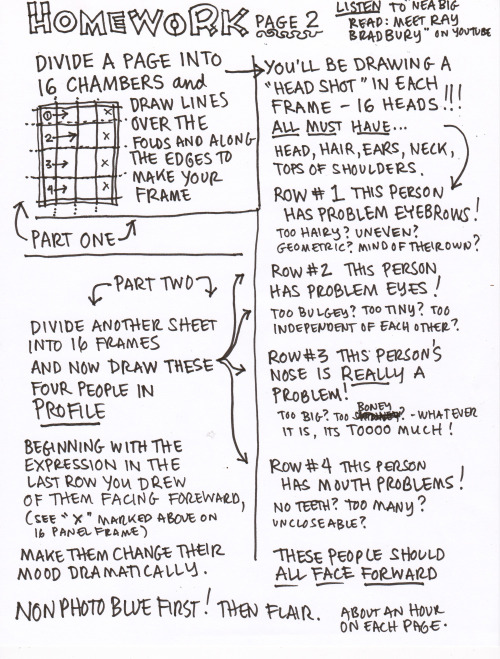
That earlier-alluded-to rigor is no joke. Daily diary comics, 3 minute self portraits on index cards, pages folded to yield 16 frames in need of filling, and found images copied while listening to prescribed music, lectures, and readingsare a constant, non-negotiable expectation of all participants. Her methodology may sound goose‑y but it’s far from loose‑y.
In other words, if you want to play along, prepare to set aside a large chunk of time to complete her weekly assignments with the vigor demanded of non-virtual students.
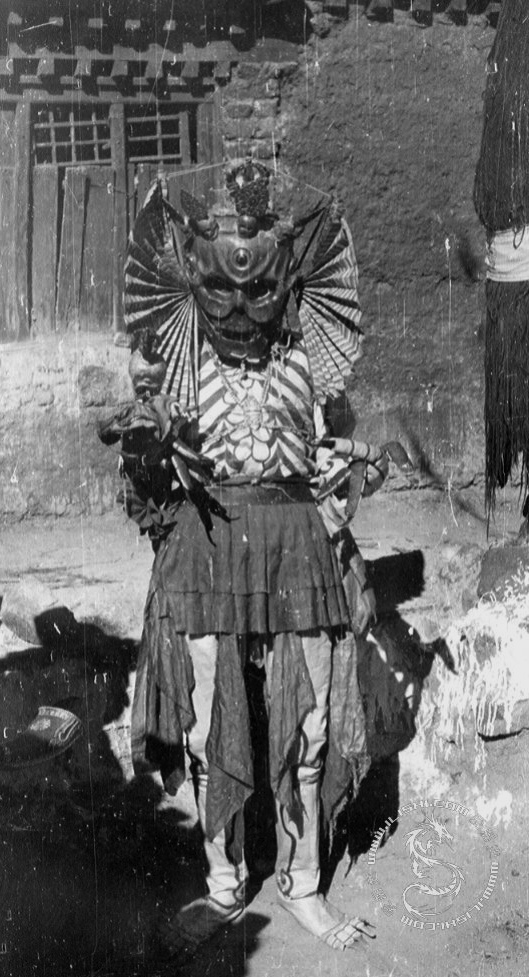
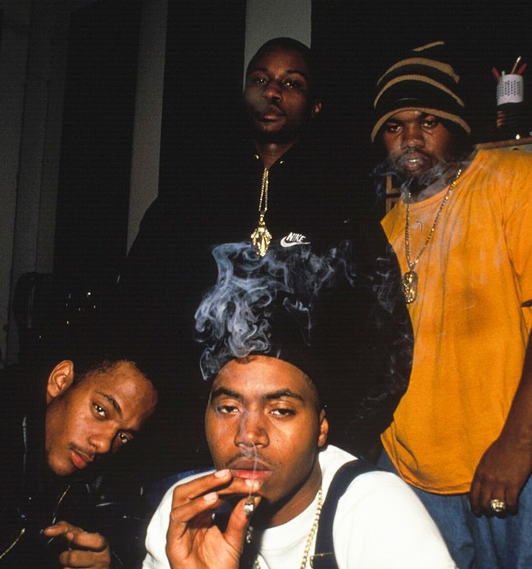
Those who aren’t able to commit to going the distance at this time can reconstruct the class later. Barry leaves both the assignments and examples of student work on her Tumblr for perpetuity. (You can see an example here.) For now, try completing the 20 minute exercise using the assigned image above, or by choosing from one of her “extra credit” images, below:
Set timer for three minutes and begin this drawing using a yellow color pencil. Try to draw as much of the drawing as you can in three minutes. You can draw fast, and in a messy way, The important thing is to get as much covered as you can in three minutes. You can color things in if you like. Look for the darkest areas of the photo and color those in.
Set a timer for another three minutes and using your non-dominant hand, draw with orange or color pencil to draw the entire drawing again, drawing right on top of the first drawing layer. The lines don’t have to match or be right on top of each other, you can change your mind as you add this layer. You can move a bit to the right rather than try to draw directly onto the first set of lines.
Set a timer for another 3 minutes and use a red pencil and draw it again, using you dominant hand, adding another layer to the drawing. Again, you don’t have to follow your original lines. Just draw on top of them.
Set a timer for another 3 minutes and use a dark green pencil to draw the entire drawing one more time on top of all the others.
Set a timer for 8 minutes and use a dark blue pencil to draw it one more time.
Spend the last 8 minutes inking the image in with your uniball pen. Remember that solid black is the very last thing you’d do given your time limit. You want to make sure to draw all the parts of the picture first.
To say that most political discussions on social media lack nuance seems tantamount to pointing out that most pornography lacks romance. The thrusts, parries, and asides of the Facebook comment skirmish and the Twitterfight generally constitute performative acts rather than thoughtful interpersonal engagement. It’s more the nature of the medium than the fault of the participants; ever-churning controversy keeps the machines running. One controversial subject now trending on a network near you is the issue of Cultural Appropriation—broadly defined as the use of the symbols, language, dress, hairstyles, music, art, and other signifiers of one culture by another.
A problem arises when we leave the subject broadly defined. Power dynamics are key, but to condemn all acts of cultural appropriation as theft leaves us in a bind. How do we generate culture without it? Not all acts of borrowing are equally respectful, but without them, we could not have had the musical revolutions of rock and roll—with its appropriation of the blues—or of hip-hop, with its appropriation of disco, pop, Kung Fu movies, and everything else in a DJ’s record and video collection. Negative and positive examples can easily get jumbled together under these rubrics. To avoid getting tangled in analytical brambles, why don’t we turn instead to what I would consider a positive example of cultural appropriation: the pieces you hear in the videos here, interpretations of blues songs performed by musician Luna Lee on a Gayageum, a traditional Korean zither-like instrument.
We’ve featured Luna’s Gayageum covers before—of Jimi Hendrix’s “Voodoo Chile” and Stevie Ray Vaughan’s take on Hendrix’s “Little Wing.” Both Hendrix songs demonstrate the degree to which the rock guitarist borrowed heavily from blues idioms. Traditional blues artists themselves, of course, created and innovated through borrowing from each other and from myriad traditional sources. Are Luna’s blues performances any different? She clearly demonstrates a love and respect for the source material, and she plays it with deftness and skill, taking pleasure in musicianship, not salesmanship. Her blues covers don’t seem to have much commercial appeal, but they greatly appeal to listeners judging by the number of people her videos reach.
At the top of the post, you can hear her play John Lee Hooker’s “Boom Boom.” Below it, we have Albert King’s “Born Under a Bad Sign,” and above, B.B. King’s “The Thrill is Gone.” Lower down, hear Muddy Waters “Rollin’ and Tumblin’” (first recorded by Hambone Willie Newborn) and Elmore James’ “Dust My Broom.” Each interpretation relies on multitrack recording—Luna is either accompanied by a generic backing track or accompanies herself with a rhythm track that she plays over. Her covers of American blues classics on a traditional Korean instrument bring to the fore the intercultural accessibility of the songs and their adaptability to an instrumental context we might also consider “roots.” But as you can see from Luna’s Youtube channel, she doesn’t only adapt “roots” music. She also covers Radiohead, Frank Sinatra, Led Zeppelin, and AC/DC.
It’s likely my own bias for the blues—and for more traditional blues in particular—that makes me say so, but I think the covers represented here are her most successful. (Whether Messrs Hooker, King, King, Waters, and James would approve, I cannot say.) There’s something about hearing the Gayageum in dialogue with these songs that feels… well, if not exactly authentic at least less gimmicky than than a cover of One Republic. But ultimately, whatever your preference, if you can appreciate Luna’s instrumental skill and devotion to her source material, you’ll find something to love on her page.
She’s not in it for the money, but like every struggling artist, Luna has dreams and bills to pay. To support her work, visit her Patreon page and help contribute to her goal of playing music full time and hiring additional collaborators. In the pitch video below, Luna gives us some of her musical background and explains how she adapted the traditionally acoustic Gayageum for more rocking contemporary tunes.
We might as well get the self-writing joke about a 65-hour John Cage playlist out of the way up front: that’s a whole lot of silence! But of course, such a joke about the work of John Cage inevitably ends up as a joke about how little so many of us know about the work of John Cage. Most of us learn, at one time or another, of “4’33”,” his famous 1952 composition — or perhaps anti-composition — which instructs its players to, for the length of time reflected by its title, play nothing at all. But dig a little deeper into Cage’s motivations, and you find that he wanted the audience of “4’33”” to listen not to the silence, but to whatever sounds happen to remain in the absence of music — so that those incidental noises, in effect, become the music.
If you find yourself still in need of more of Cage’s salutary effect on your perception of not just music and art but of the world itself, you can hear Ulysses Classical’s playlist of only Cage’s “Number Pieces” below, which “has a cleansing effect on the mind, as if it paints the walls of the room I’m sitting in with soothing colors.”
Ulysses Classical’s background post on the big chronological playlist opens with a quote from Cage that neatly incapsulates what we might call his philosophy of composition, or maybe of life itself: “What I’m proposing, to myself and other people, is what I often call the tourist attitude — that you act as though you’ve never been there before. So that you’re not supposed to know anything about it. If you really get down to brass tacks, we have never been anywhere before.” This playlist, which spans Cage’s six-decade career from 1932 to 1992, showcases just what rich musical places Cage found when he acted as though he’d never been there before. Listening to it will certainly take you to musical places you’ve never been before — and, assuming you’ve been to “4’33”,” it doesn’t take you there, but I suppose you can go to that particular patch of musical territory any time you like.
“The propagandist’s purpose is to make one set of people forget that certain other sets of people are human.” –Aldous Huxley (1936)
Lior Sperandeo, who has previously directed short films called People of Mumbai, People of Nepal, and People of Senegal, returns with a film that resists focusing on a sense of place. People of Nowhere captures the plight of Syrian refugees, fleeing their worn-torn country for a safer life in Europe. Explaining how he came to make the dramatic film, Sperandeo writes:
I have heard and read different opinions about the wave of Syrian refugees who try to make their way in to the EU. Then I went to Lesvos. 7 days on the Greek Island gave me a healthier, human perspective on the situation. Seeing the people behind the headlines with my own eyes, and feeling their deep struggle, broke my heart. Are they the ‘threat’ people talk about? All I saw were courageous people in a time of crisis, looking for hope. I also got to meet brave volunteers from all over the world who reach out to help all people regardless of their religion, race or background. That inspired me. My hope is that this video might tear down some of the walls of bad ideas and opinions we have built around ourselves.
You can watch Lior’s film, a reminder that real lives are stake in the slow-moving genocide in Syria, on Vimeo here. And visit his Vimeo Channel here.
Follow Open Culture on Facebook and Twitter and share intelligent media with your friends. Or better yet, sign up for our daily email and get a daily dose of Open Culture in your inbox. And if you want to make sure that our posts definitely appear in your Facebook newsfeed, just follow these simple steps.
I will never forget my first hearing of singer-songwriter Kate Bush’s “ Wuthering Heights.” My college boyfriend was a fan, but nothing he told me in advance prepared me for the shocking lunatic squeak of that voice.
It’s an acquired taste, but a lasting one. Bush’s debut single, written on a full moon night at the tender age of 18, has become a classic in its own right. (SPOILER: its life span has proved longer than Heathcliff’s).
It’s also perennially ripe for parody. Not just because of the voice. Two music videos Bush released seal that deal.
The UK version, above, features the sort of over-the-top theatrics rarely displayed outside the privacy of bedroom mirrors, as Bush pirouettes, cartwheels, and emotes in a gauzy white frock.
When it came time for the American release, below, Bush painted her nails, rouged her lips, and took to the great outdoors in a bright red gown and tights, below.
More than 300 participants heeded the call, allowing Shambush! to achieve its goal of setting the world’s record for the most number of people dressed as Kate Bush. (As one of the organizers pointed out, they would’ve set the world’s record even if it had only been the three of them.)
What a wonderful, ridiculous moment in music history to be a part of!
For those inspired to recreate the madness with their own crew, Shambush! breaks down (and names) some of the most iconic moves in an instructional video, below.
Code.org, a non-profit dedicated to expanding access to computer science, has created a fun way for students to learn the basics of coding. Teaming up with Disney and Lucasfilm, they’ve launched Star Wars: Building a Galaxy with Code, a tutorial designed to teach students to write JavaScript as they guide Star Wars characters through a fun mission. The module is designed for kids 11 and up. (Adults, that could definitely apply to you.) There’s also a separate beginner’s tutorial for kids between the ages of 6 and 10.
More Code.org tutorials can be found here. And you’ll find other introductory coding courses (some designed with an older demographic in mind) in the Relateds below.
With dependable frequency, the religious views of Albert Einstein get revised and re-revised according to some re-discovered or re-interpreted quotation from his scientific work or personal correspondence. It’s not especially surprising that Einstein had a few things to say on the subject. As the pre-eminent theoretical physicist of his age, he spent his days pondering the mysteries of the universe. As one of the most famous public intellectuals in history, and an immigrant to a country as highly religious as the United States, Einstein was often called on to voice his religious opinions. Like any one of us over the course of a lifetime, those statements do not harmonize into a neat and tidy confession of belief, or unbelief. Instead, at times, Einstein explicitly aligns himself with the pantheism of Baruch Spinoza; at other times, he expresses a much more skeptical attitude. Often he seems to stand in awe of a vague deist notion of God; Often, he seems maximally agnostic.
Einstein rejected the atheist label, it’s true. At no point in his adult life, however, did he express anything at all like a belief in traditional religion. On the contrary, he made a particular point of distancing himself from the theologies of Judaism and Christianity especially. Though he did admit to a brief period of “deep religiousness” as a child, this phase, he wrote “reached an abrupt end at the age of twelve.” As he writes in his Autobiographical Notes, after a “fanatic orgy of freethinking,” brought on by his exposure to scientific literature, he developed a “mistrust of every kind of authority… a skeptical attitude toward the convictions that were alive in any specific social environment—an attitude that has never left me, even though, later on, it has been tempered by a better insight into the causal connections.” In contrast to the “religious paradise” of his youth, Einstein wrote that he had come to find another kind of faith—in the “huge world… out yonder… which stands before us like a great riddle.”
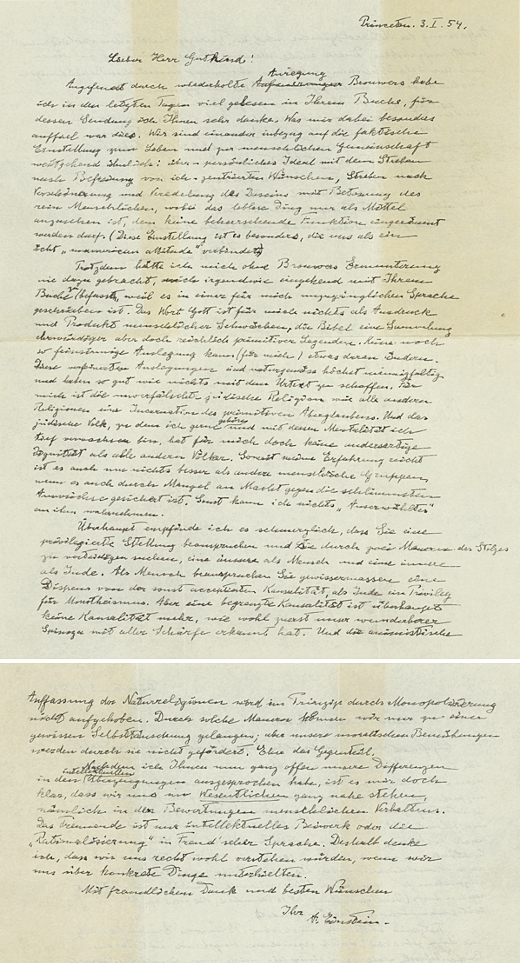
Einstein’s rejection of a personal God was undeniably final, such that in 1954, a year before his death, he would write the letter above to philosopher Erik Gutkind after reading Gutkind’s book Choose Life: The Biblical Call to Revolt on the recommendation of a mutual friend. The book, Einstein tells its author, is “written in a language inaccessible to me.” He goes on to disparage all religion as “the most childish superstition”:
The word God is for me nothing more than the expression and product of human weakness, the Bible a collection of honorable, but still purely primitive, legends which are nevertheless pretty childish. No interpretation, no matter how subtle, can change this for me. For me the Jewish religion like all other religions is an incarnation of the most childish superstition. And the Jewish people to whom I gladly belong, and whose thinking I have a deep affinity for, have no different quality for me than all other people. As far as my experience goes, they are also no better than other human groups, although they are protected from the worst cancers by a lack of power…
You can read a full transcript at Letters of Note, who include the letter in their second volume of fascinating correspondence from famous figures, More Letters of Note. The letter went up for auction in May of 2008, and a much more dogmatically anti-religious scientist had a keen interest in acquiring it: “Unsurprisingly,” Letters of Note point out, “one of the unsuccessful bidders was Richard Dawkins.”
Last year, I posted about The City in Cinema, my series of video essays exploring cities as revealed and re-imagined by the films set in them — or rather, at that time, about one city in particular: Los Angeles, birthplace of Hollywood cinema and endlessly fascinating urban phenomenon in its own right. But ever since I first began the project, I knew I’d want to extend it to other cities. When first I stepped beyond Los Angeles with The City in Cinema, I stepped into the city I’ve long considered my favorite to visit in America.
And what city, exactly, would that be? “Portland, Oregon: one of the nation’s most beautiful cities, with Mount Hood rising in the distance, majestic, serene, white with eternal snow,” a “city of wide streets, modern buildings” whose citizens “attend many fine churches” and live in “beautiful homes,” a city where “in the soft climate, gardens grow lush and green throughout the year” with roses “everywhere in profusion,” a “family town, a good place to bring up children.” Or so, in any case, goes the opening of Portland Exposé, a 1957 true-crime morality play, one of the very first films to use Portland as a setting, and the one that opens my latest long-form video essay, Portland, the City in Cinema.
At that time not much more than a small-to-medium-sized town in the woods, Portland claims only a scant cinematic history up through the 1970s. But every Portland movie that came out then, such as the CBS nuclear-strike dramatization A Day Called X and the bohemian land-use satire Property, boasts its own sort of interest. And then, in the 1980s, emerges Gus Van Sant, unquestionably the foremost Portland auteur of his generation. His black-and-white debut feature Mala Noche, which deals humorously with themes of homosexuality on Portland’s former Skid Row (now the thoroughly gentrified Pearl District) drew the Hollywood attention that would ultimately get him making mainstream features like Good Will Hunting and Milk.
But Van Sant has, in parallel, led another career as a thoroughly independent filmmaker, and one who shoots most of those thoroughly independent films in Portland. That track of Van Sant’s work has led to such formidable Portland movies, central to a project like this, as Drugstore Cowboy, My Own Private Idaho, and Paranoid Park. During the 1990s, the time of the “Indiewood” boom in America, other filmmakers discovered Portland’s potential as a rich and underused urban setting: Annette Haywood-Carter for her adaptation of Joyce Carol Oates’ novel Foxfire, for instance, or Jake Kasdan for his unconventional detective story and black romantic comedy Zero Effect.
Albert Pyun, perhaps the last great B‑movie auteur, also came to Portland of the 1990s for his Andrew Dice Clay vehicle Brain Smasher… a Love Story. And not much later, the city hosted the likes of Body of Evidence, a highly unerotic erotic thriller starring Willem Dafoe and Madonna. But it, too, reveals the the city’s potential (or potential for misuse) as a setting, as does the more recent Untraceable, a bland compromise between techno-thriller and torture horror that at least had the money to shoot Portland from some impressive angles.
As the city of Portland has developed in a way appreciated by urbanists for its compact downtown, useful transit system, mostly well-executed architectural preservation, and overall “smart” growth (by American standards, anyway), the cinema of Portland has developed in a way appreciated by critics. The 21st century has so far seen such well-crafted, thoughtful Portland pictures as Kelly Reichardt’s Old Joy and Wendy and Lucy, Aaron Katz’s Dance Party USA and Cold Weather, and Matt McCormick’s Some Days Are Better than Others. But if Portland, the City in Cinema remains, in its current version, the definitive examination of the cinema of Portland, I’ll be terribly disappointed. I intend it in part as an appreciation of the Portland movies already made, certainly, but in larger part as a call for more Portland movies in the future.
These days, I’m feeling pretty good about my last remaining vice. But, as always, too much of anything is not a good thing. And that includes coffee too. Just ask Honoré de Balzac, who, according to legend, met an untimely death by drinking 50 cups per day. Or ask the fellow featured in the French animation called Le café–or simply Coffee in English. Up top, you can find a subtitled version of the riotous film directed by Stephanie Marguerite and Emilie Tarascou. Beneath, we have a non-subtitled but higher resolution version. Enjoy, and remember to drink coffee responsibly.
We're hoping to rely on loyal readers, rather than erratic ads. Please click the Donate button and support Open Culture. You can use Paypal, Venmo, Patreon, even Crypto! We thank you!
Open Culture scours the web for the best educational media. We find the free courses and audio books you need, the language lessons & educational videos you want, and plenty of enlightenment in between.