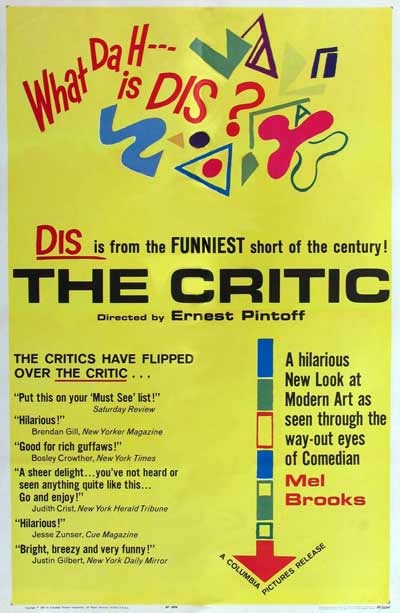
Watch The Critic: The Oscar-Winning, Animated Film Narrated by Mel Brooks (1963)

One day in ear­ly 1962, Mel Brooks was sit­ting in a New York City the­ater watch­ing an avant-garde film by the Scot­tish-born Cana­di­an ani­ma­tor Nor­man McLaren when he heard some­one in the audi­ence express­ing bewil­der­ment. “Three rows behind me,” Brooks told Ken­neth Tynan for a 1979 New York­er pro­file, “there was an old immi­grant man mum­bling to him­self. He was very unhap­py because he was wait­ing for a sto­ry line and he was­n’t get­ting one.”

Brooks had made a study of old cur­mud­geons ever since he was a boy grow­ing up in a Jew­ish neigh­bor­hood of Brook­lyn. In a 1975 Play­boy inter­view he described his eccen­tric Uncle Joe, who would say to him when he was five years old, “Don’t invest. Put da mon­ey inna bank. Even the land could sink.”

Lat­er, as a young come­di­an learn­ing his craft on the borscht belt cir­cuit, Brooks paid close atten­tion to the elo­cu­tion and tim­ing of the old Yid­dish come­di­ans. After work­ing as a writer for Sid Cae­sar’s ear­ly tele­vi­sion pro­gram, Your Show of Shows, Brooks and fel­low writer Carl Rein­er hit it big as per­form­ers in 1961, with their “2000-Year-Old Man” rou­tine. Rein­er was the straight man inter­view­ing an old man played by Brooks. In one famous scene Rein­er asked, “You knew Jesus?” Brooks replied, “Yeah. He was a thin man, always wore san­dals. Came into the store but nev­er bought any­thing.”

So when he over­heard the old kvetch in the movie the­ater giv­ing a run­ning com­men­tary on his own bewil­der­ment, Brooks rec­og­nized the comedic pos­si­bil­i­ties. He approached direc­tor Ernest Pintoff, whose Oscar-nom­i­nat­ed 1959 short The Vio­lin­ist had been nar­rat­ed by Rein­er, about mak­ing a movie. Pintoff hired artist Bob Heath to cre­ate the ani­ma­tion, and chose Bach to set the high­brow tone. Brooks was 36 years old when he cre­at­ed the voice of the 71-year-old man. As he told Tynan, the com­men­tary was ad-libbed:

I asked my pal Ernie Pintoff to do the visu­als for a McLaren-type car­toon. I told him, ‘Don’t let me see the images in advance. Just give me a mike and let them assault me.’ And that’s what he did…I sat in a view­ing the­atre look­ing at what Ernie showed me, and I mum­bled what­ev­er I felt that old guy would have mum­bled, try­ing to find a plot in this maze of abstrac­tions. We cut it down to three and a half min­utes and called it The Crit­ic.

The film was a crit­i­cal as well as a pop­u­lar suc­cess, win­ning the Acad­e­my Award for best ani­mat­ed short film of 1963. Putting The Crit­ic into per­spec­tive, Samuel Raphael Fran­co of J, the Jew­ish news week­ly, wrote in 2009:

The film is a rel­ic of quin­tes­sen­tial borscht belt humor.…It is also a valu­able soci­o­log­ic por­trait of the pre­dom­i­nant cul­tur­al atti­tudes of Brook­lyn’s first gen­er­a­tion of Russ­ian-Jew­ish immi­grants. The influ­ence of Brooks’ devel­op­ment as a com­ic as a tumm­ler for the crowds in the Catskills sur­faces right away in the first line, “Vat the hell is dis?”

The Crit­ic has been added to the Ani­ma­tion sec­tion of our Free Movies col­lec­tion, and also to our list of 30 Free Oscar Win­ning Films.

My Best Friend’s Birthday, Quentin Tarantino’s 1987 Debut Film

Few­er than 40 min­utes sur­vive of My Best Friend’s Birth­day, the first film direct­ed by Quentin Taran­ti­no. But its brief screen time runs dense with ref­er­ences to Elvis Pres­ley, the Par­tridge Fam­i­ly, A Count­ess from Hong Kong, Rod Stew­art, Deputy Dawg, and That Darn Cat. In between the rapid-fire gab ses­sions, we also wit­ness a slap­stick kung-fu bat­tle and even hear a bit of repur­posed ear­ly-sev­en­ties pop music. Though a fire claimed the sec­ond half of what was pre­sum­ably the pic­ture’s only print, the first half, which you can watch free on YouTube, leaves no doubt as to the iden­ti­ty of its auteur. In some sense, it bears an even deep­er imprint of Taran­ti­no’s per­son­al­i­ty than his sub­se­quent films, since he stars in it as well. To behold the ear­ly-twen­tysome­thing Taran­ti­no por­tray­ing the good-heart­ed and aggres­sive­ly enthu­si­as­tic but jit­tery and dis­tractible rock­a­bil­ly DJ Clarence Poole is to behold the Quentin Taran­ti­no pub­lic per­sona in an embry­on­ic form, a dis­tilled form — or both.

The plot of My Best Friend’s Birth­day, such as it remains, finds Clarence look­ing to give a birth­day present to his pal Mick­ey, who’s been fresh­ly, and harsh­ly, re-reject­ed by an ex-girl­friend. None of Clarence’s ideas — not the cake, not the call girl — work out quite as intend­ed, though now I sup­pose we’ll nev­er know how wrong things real­ly went, or if they man­aged to right them­selves in the end. Yet the trun­cat­ed ver­sion of the film feels some­how more fas­ci­nat­ing — more sat­is­fy­ing, even — than any com­ple­tion I can imag­ine. Both the movie’s hope­less­ly unre­solved sto­ry and its dreamy visu­al qual­i­ty, cour­tesy of a beat­en-up 16-mil­lime­ter print trans­ferred onto what looks like a VHS tape, turn it into the most exper­i­men­tal art Taran­ti­no has ever cre­at­ed. It casts adrift even the direc­tor’s hardi­est fans in a stark south­ern Cal­i­for­nia real­i­ty: long-run­ning argu­ments about mean­ing­less cul­ture, cease­less ele­va­tion of the dis­pos­able, and a vague, loom­ing, but nev­er­the­less con­stant sense of threat. And amid all this, it can still serve up a line like, “What made you inter­est­ed in tack­ling pros­ti­tu­tion as a career goal?”

My Best Friend’s Birth­day appears in our col­lec­tion of Free Movies Online.

Relat­ed con­tent:

Crack­ing Taran­ti­no

Film­mak­ing Advice from Quentin Taran­ti­no and Sam Rai­mi (NSFW)

Quentin Taran­ti­no Gives Sneak Peek of Pulp Fic­tion to Jon Stew­art (1994)

Col­in Mar­shall hosts and pro­duces Note­book on Cities and Cul­ture. Fol­low him on Twit­ter at @colinmarshall.

Henri Matisse Illustrates 1935 Edition of James Joyce’s Ulysses

matisse ulysses front page

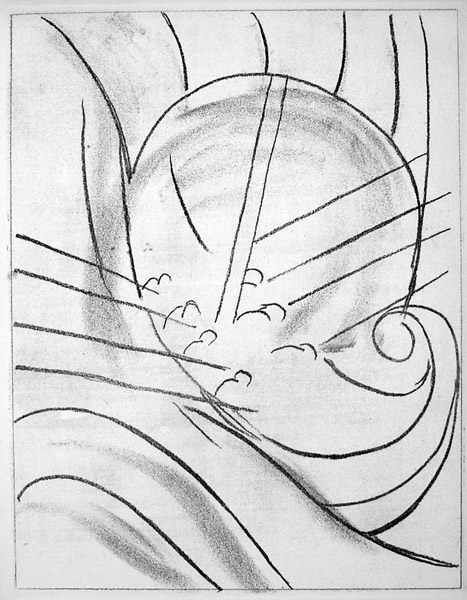
A cou­ple weeks back, we men­tioned that you can down­load a fine­ly-read audio ver­sion of James Joyce’s Ulysses for free. What that ver­sion does­n’t include — and could­n’t include — are etch­ings by Hen­ri Matisse. Back in the mid-1930s, George Macey, an Amer­i­can pub­lish­er, approached the cel­e­brat­ed painter and asked him how many etch­ings he could pro­vide for $5,000. Although it’s wide­ly believed that Matisse nev­er read Joyce’s sprawl­ing clas­sic (despite being giv­en a French trans­la­tion of the text), he did come back with 26 full-page illus­tra­tions, all of them based on six themes from Home­r’s Odyssey, the epic poem that Ulysses con­scious­ly plays upon. In 1935, an illus­trat­ed edi­tion of Ulysses was print­ed. Matisse signed 1500 copies; Joyce only 250. And today a copy signed by both artists will run you a cool $37k. Buy, hey, the ship­ping is only $6.

Odysseus Blind­ing Polyphe­mus

henri-matisse-ulysses1935

Odysseus and Nau­si­caa

ulysses matisse drawing

Odysseus’ Ship

Matisse_Ulysses_Barque

by | Permalink | Make a Comment ( 6 ) |

The Invention (and Demonstration) of the First Football Helmet, 1932

British Pathe con­tin­ues to dust off and dig­i­tize some amaz­ing clips from its archive. First came The World’s First Mobile Phone (1922) and footage of The King’s Speech in 1938 — you know, the real King George VI work­ing his way through a pub­lic speech in Scot­land. Now British Pathe returns with some 1932 footage of an inven­tor show­ing off the first foot­ball hel­met, his mod­est “attempt to pre­vent fatal injuries” in the sport. You won’t want to miss the demo of this new fan­gled piece of sports equip­ment. H/T Devour

If you would like to sup­port the mis­sion of Open Cul­ture, con­sid­er mak­ing a dona­tion to our site. It’s hard to rely 100% on ads, and your con­tri­bu­tions will help us con­tin­ue pro­vid­ing the best free cul­tur­al and edu­ca­tion­al mate­ri­als to learn­ers every­where. You can con­tribute through Pay­Pal, Patre­on, and Ven­mo (@openculture). Thanks!

Purdue Sets World Record with Largest Rube Goldberg Machine

Hats off to the Pur­due Soci­ety of Pro­fes­sion­al Engi­neers team. This week­end, the team broke its own world record for the Largest Func­tion­al Rube Gold­berg Machine. The con­trap­tion only took 300 steps to do some­thing quite sim­ple — blow up and pop a bal­loon. If you’re a fan of Rube Gold­berg machines and books, then you won’t want to miss one of my favorites — The Page Turn­er cre­at­ed by Joseph Her­sch­er, a New Zealand kinet­ic artist who now resides in Brook­lyn. via i09

Fol­low us on Face­bookTwit­ter and now Google Plus and share intel­li­gent media with your friends! They’ll thank you for it.

Richard Feynman Presents Quantum Electrodynamics for the NonScientist

In 1979, the charis­mat­ic physi­cist Richard Feyn­man jour­neyed to the Uni­ver­si­ty of Auck­land (New Zealand) and deliv­ered a series of four lec­tures on Quan­tum Elec­tro­dy­nam­ics (QED), the the­o­ry for which he won his Nobel Prize. It’s some heady mate­r­i­al, but Feyn­man made a point of mak­ing dif­fi­cult con­cepts intel­li­gi­ble to a crowd not nec­es­sar­i­ly trained in sci­en­tif­ic think­ing. If you’ve nev­er seen Feyn­man lec­ture before, then you won’t want to miss these lec­tures avail­able in four parts (find Part 1 above, and the remain­ing parts below), or his longer lec­ture series, The Char­ac­ter of Phys­i­cal Law, deliv­ered at Cor­nell in 1964. (Find it here, or in the Physics sec­tion of our col­lec­tion, 1,700 Free Online Cours­es from Top Uni­ver­si­ties.)

As for the Auck­lund lec­tures on QED, they lat­er became the basis for Feyn­man’s pop­u­lar 1988 book, QED: The Strange The­o­ry of Light and Mat­ter

If you would like to sup­port the mis­sion of Open Cul­ture, con­sid­er mak­ing a dona­tion to our site. It’s hard to rely 100% on ads, and your con­tri­bu­tions will help us con­tin­ue pro­vid­ing the best free cul­tur­al and edu­ca­tion­al mate­ri­als to learn­ers every­where. You can con­tribute through Pay­Pal, Patre­on, and Ven­mo (@openculture). Thanks!

Relat­ed Con­tent

Richard Feyn­man: The Like­li­hood of Fly­ing Saucers

Free Online Physics Cours­es

How the Titanic Sank: James Cameron’s New CGI Animation

It was 100 years ago next Sun­day that the lux­u­ry lin­er Titan­ic struck an ice­berg and sank in the North Atlantic Ocean with 1,514 souls aboard. It was one of the dead­liest mar­itime dis­as­ters in his­to­ry.

Last night, the Nation­al Geo­graph­ic Chan­nel broad­cast the pre­mier of The Titan­ic: The Final Word With James Cameron, in which the famed under­sea explor­er and direc­tor of the 1997 block­buster movie about the dis­as­ter presents the lat­est foren­sic evi­dence of what hap­pened that night a cen­tu­ry ago. At one point in the show, Cameron, fresh off of his dive to the bot­tom of the Mar­i­ana Trench, gives a sort of “play-by-play” analy­sis of the mechan­ics of the dis­as­ter (see above) using Com­put­er Graph­ic Imag­ing (CGI) soft­ware. The trag­ic ele­ment is com­plete­ly abstract­ed out of the pic­ture.

For more on the Titan­ic cen­te­nary, includ­ing inter­ac­tive fea­tures and a 46-minute doc­u­men­tary film on the dis­as­ter, vis­it the Nation­al Geo­graph­ic “Adven­ture on the Titan­ic” Web page.

Salvador Dali Gets Surreal with Mike Wallace (RIP) in 1958

This week­end, Mike Wal­lace died at the age of 93. As The New York Times observes in its obit, Wal­lace was “a pio­neer of Amer­i­can broad­cast­ing who con­front­ed lead­ers and liars for 60 Min­utes over four decades.” But before he became a fix­ture on 60 Min­utes, Mike Wal­lace host­ed his own short-lived TV show in the late 1950s, The Mike Wal­lace Inter­view, which let Amer­i­cans get an up-close and per­son­al view of some leg­endary fig­ures — Frank Lloyd WrightEleanor Roo­seveltRein­hold NiebuhrAldous Hux­leyErich FrommAyn Rand and Glo­ria Swan­son.

Above, we’re bring­ing back Mike Wal­lace’s mem­o­rable inter­view with Sal­vador Dali in 1958. For the bet­ter part of a half hour, Wal­lace tried to demys­ti­fy “the enig­ma that is Sal­vador Dali,” and it did­n’t go ter­ri­bly well. It turns out that sur­re­al­ist painters give sur­re­al answers to con­ven­tion­al inter­view ques­tions too. Pret­ty quick­ly, Wal­lace capit­u­lates and says, “I must con­fess, you lost me halfway through.” Hap­pi­ly for us, the video makes for some good view­ing more than 50 years lat­er.

Relat­ed Con­tent:

Des­ti­no: The Sal­vador Dalí – Dis­ney Col­lab­o­ra­tion 57 Years in the Mak­ing

Sal­vador Dali Appears on “What’s My Line? in 1952

Alfred Hitch­cock Recalls Work­ing with Sal­vador Dali on Spell­bound

by | Permalink | Make a Comment ( 1 ) |

« Go BackMore in this category... »
Quantcast