From April 4 through September 9, the Tate Modern will stage the first serious UK exhibition of major works by Damien Hirst, one of Britain’s most influential, controversial and wealthy artists. Many of his famous sculptures — including, of course, the famous/infamous shark suspended in formaldehyde — will be on display. It’s our job to get you better acquainted with the exhibit. So let’s have Damien Hirst, the artist himself, take you on a tour of the big affair. The program above, Damien Hirst — The First Look, originally aired on Channel 4 in the UK. You can also watch Hirst wander through the exhibition with curator Ann Gallagher right here. Finally, you might want to spend a few minutes with a review by Oliver Wallington, an artist who wonders whether the emperor of art “has no clothes.” Or scan the review at The Guardian, which quietly raises eyebrows of its own.
Martin Scorsese’s Very First Films: Three Imaginative Short Works
?si=ILR3sREkYPwPDwsP
Last week we featured the first three films of Stanley Kubrick. Today we focus on the first three by Martin Scorsese. Although the two men were about the same age when they ventured into filmmaking, and faced similar constraints, their earliest films are strikingly different.
Kubrick and Scorsese had both grown up in New York City and gone to high school in the Bronx, but their circumstances were worlds apart. Kubrick failed to get into college after high school because of bad grades but, as he put it, “backed into a fantastically good job at the age of seventeen” working as a staff photographer for Look magazine. Scorsese went to college and studied the history and aesthetics of cinema. When Kubrick decided to try his hand at motion pictures he was driven by a sense of economic urgency. His strategy was to get a foothold in the marketplace by beating the newsreel industry at its own game. Scorsese, on the other hand, was sheltered from economic worries. He was moved instead by the vivacity and inventiveness of French New Wave cinema, among other influences, and wanted to assert himself as the next great auteur.
As a severely asthmatic child, Scorsese went to the movies often. When high school graduation was approaching he thought about becoming a priest, and briefly considered studying literature. But then something caught his eye: a catalog for the New York University film school. He went to an NYU orientation session, where the various department heads took turns describing their programs to a room filled with prospective students. When the head of the Department of Television, Motion Pictures and Radio stood up–a man named Haig Manoogian–the young Scorsese was instantly impressed. “He had such energy, such passion,” Scorsese tells Richard Schickel in Conversations with Scorsese. “I said to myself, That’s where I want to be, with this person.”
Manoogian took the art of film very seriously. When Scorsese was a freshman in 1960 he attended Manoogian’s once-a-week class on the history of film. Each session included a lecture and the screening of a film. In Conversations with Scorsese the filmmaker remembers Manoogian’s ruthlessness in dealing with students who attended only to watch movies. “He’d say, okay, you don’t come back, you don’t come back,” says Scorsese, “ ‘because some of you must think because we’re showing movies, it’s fun. Get out.’ ”
As Scorsese moved through the program, he gradually began learning a few basic skills in the mechanics of making a movie. By junior year, each student was expected to collaborate in the making of a short film. So in 1963 Scorsese took Manoogian’s summer workshop, where he found that not every student got to direct. “He’d say, Okay, you’re director, you’re grip, you’re camera, whatever,” Scorsese tells Schickel. “So there were a lot of people who were very unhappy.” He quickly figured out that Manoogian was assigning the role of director to students who had their own screenplay. “What I did was write a script and get it to him as soon as possible, and he okayed it, so I was given a crew, and they all knew that they had to do what I wanted.”
Scorsese and his crew took one of the school’s old 16mm Bell & Howell Filmo cameras and shot a one-reel comedy in a week. He would later describe the film as “nine minutes of visual nonsense.” What’s a Nice Girl Like You Doing in a Place Like This?, as it is called, (see above) adopts the surreal comic sensibility Scorsese admired in the work of Mel Brooks and Ernie Kovaks, along with narrative technique he picked up watching French New Wave films, particularly those of François Truffaut. As he tells Schickel:
My little film had all the tricks and fun of just putting pictures together in slow motion and fast motion and stills, and intercutting with mattes the way Truffaut would do in Jules and Jim. It had no depth at all, but it was a lot of fun. And it won me a scholarship, so my father was able to use it for the tuition for the next year. And then that led me to doing another short film in my junior year, the second semester, and that became It’s Not Just You, Murray!
It’s Not Just You, Murray! part one:
It’s Not Just You, Murray! part two:
It’s Not Just You, Murray! (above), completed in 1964, is a much more ambitious film. It tells the story of a pair of Italian-American gansters. “The two characters, Murray and Joe,” Scorsese tells Michael Henry Wilson in Scorsese on Scorsese, “are close friends, but the sort who are constantly stealing from each other, pinching their whisky and their girls. They live the way I myself was living with my buddies–relationships that contain as much hate as love.”
Scorsese chose not to present Murray as a gangster at the beginning of the film, because he wanted to make a wider statement about American life. “I grew up in Little Italy,” he tells Wilson, “I’ve seen corruption up close, I’ve seen it operating every day. After that you can’t take the Establishment seriously. It’s all a fraud.” The two-reel film is like a preliminary sketch for some of Scorsese’s most famous later films. When Schickel tells Scorsese he had never seen It’s Not Just You, Murray!, he is surprised by the filmmaker’s description. “It was basically Goodfellas,” Scorsese says. “Huh,” says Schickel?
It’s Goodfellas. I did it in 1964. Murray was a big epic, as much as I could manage, of two guys who were friends in the underworld, from my old neighborhood. but I did it with very New Wave techniques. It was also a cross with The Roaring Twenties, an attempt at that sort of scale which led eventually to Mean Streets, which led ultimately to Goodfellas, and to Casino and Gangs of New York–the scale of it, the excessive nature of it. I mean, in Murray there’s just a hint of it. We didn’t have the money.
The Big Shave:
After Scorsese received his bachelor’s degree from NYU in 1964, he began work on his first feature film, Who’s That Knocking at My Door? It took him over two years to make, and in 1967 he still hadn’t found a distributor. At that time he received a grant from the Cinémathèque de Belgique to make a short film. The result was the third film by Scorsese to be released, and his first in color: The Big Shave (above). “In a bathroom that may represent the American Psyche haunted by the Vietnam war,” writes Wilson in a synopsis of the film, “the daily ritual of shaving turns into a scene of horror.”
As Scorsese tells Mary Pat Kelly in Martin Scorsese: The First Decade, “It grew out of my feelings about Vietnam. But in reality something else was going on inside of me, I think, which really had nothing to do with the war.” Scorsese was experiencing a number of professional and personal setbacks, and was deeply depressed at the time. “After separating from my wife,” he tells Wilson, “I was camping out in empty, creepy apartments.” He continues:
When I wrote the script, I was very serious, but while we were shooting it we never stopped laughing. Watching the rushes, we were doubled up. It was only afterwards that I tried to rationalize what I had done. I almost convinced myself that it was a film against the Vietnam war, that this guy who shaves so meticulously and ends up cutting his throat represented the average American of his day. It was because of these political implications that I used Bunny Berigan’s original 1939 version of “I Can’t Get Started” for the soundtrack. I even wanted to end with archival images of Vietnam, but I didn’t need them. The Big Shave was really a fantasy, a strictly personal vision of death.
You can find the Scorsese films mentioned above in our collection of Free Movies Online.
Philosophy Bites: Podcasting Ideas From Plato to Singularity Since 2007

I’ve spent four years writing Podthoughts, a podcast review column, for Maximumfun.org. At one podcast a week, this means I’ve listened to and written up well over 200 different podcasts. At this point, each and every one that doesn’t consist of two guys volleying shapeless complaints about their least favorite bands, movies, television shows, and sports teams comes as a drop of water in the desert. Yes, I exaggerate, but the vast creative territory offered by a form of media as fresh and open as podcasting nevertheless remains mostly unexplored. None of the blame, however, falls upon Open University lecturer Nigel Warburton and BBC producer David Edmonds, whose podcast Philosophy Bites (iTunes — Libsyn — Web) pushed the medium forward very early in its lifetime. Alas, my predecessor in Podthinking beat me to reviewing Philosophy Bites, but I later interviewed Edmonds on my own show about what it takes to craft a podcast with so many top philosophers talking about so many philosophical topics in such short spans of time, so we’ll call it even.
The Philosophy Bites canon now forms a wider-ranging, more accessible philosophy curriculum than you’ll find in any university — and notably, in these trying economic times, an infinitely cheaper one. You can pick from a variety of possible points of entry, including clear explanations of well-known concepts like Plato’s Cave and free will; philosophical perspectives on such issues of the day as the singularity and genetic enhancement in sports; discussions of Adam Smith, David Hume, and philosophy’s other luminaries of old; and conversations with modern-day philosophical luminaries like Alain de Botton and A.C. Grayling. When you’d like to move on to longer-form roundtable discussions of famous works of philosophy, start downloading The Partially Examined Life, a podcast I did get the chance to Podthink about. For the earbud-equipped and philosophically inclined, these are fruitful times indeed.
Note: Philosophy Bites recently published a book based on its podcast. And it starts by trying to answer the question. What is Philosophy? BrainPickings has more on their answers.
Related content:
55 Free Philosophy Courses
The History of Philosophy… Without Any Gaps
Colin Marshall hosts and produces Notebook on Cities and Culture. Follow him on Twitter at @colinmarshall.
Orson Whales!: Welles Meets Led Zeppelin Meets Melville in Mashup Animation
Last week we gave you “ein Stop-Motion” animation of Ernest Hemingway’s little classic, The Old Man and the Sea, set to “Sail” by AWOLNATION. How can we possibly connect the dots and give you another maritime mashup this week? Easy-peasy. Today, we’re serving up Alex Itin’s animation of Orson Welles reading Moby Dick, with images being drawn in the pages of Herman Melville’s classic, and with Led Zep providing the soundtrack and playing their version of “Moby Dick.” Mission accomplished!
Free copies of Moby Dick can be found in our Free Audio Books and Free eBooks collections. And you can watch original footage of the great Orson Welles reading Moby Dick right here.
If you would like to support the mission of Open Culture, consider making a donation to our site. It’s hard to rely 100% on ads, and your contributions will help us continue providing the best free cultural and educational materials to learners everywhere. You can contribute through PayPal, Patreon, and Venmo (@openculture). Thanks!
John Cleese, Monty Python Icon, on How to Be Creative
A couple of years ago, Maria Popova highlighted for us a 2009 talk by John Cleese that offered a handbook for creating the right conditions for creativity. Of course, John Cleese knows something about creativity, being one of the leading forces behind Monty Python, the beloved British comedy group.
Now, we have another talk, recorded circa 1991, where Cleese uses scientific research to describe what creativity is … and what creativity isn’t. He starts by telling us, creativity is not a talent. It has nothing to do with IQ. It is a way of doing things, a way of being — which means that creativity can be learned. The rest he explains in 37 thought-filled minutes.
Related Content:
Malcolm McLaren: The Quest for Authentic Creativity
Amy Tan: The Sources of Creativity
The Universal Mind of Bill Evans: Advice on Learning to Play Jazz & The Creative Process
Follow us on Facebook, Twitter and now Google Plus and share intelligent media with your friends! They’ll thank you for it.
Yale Introduces Another Seven Free Online Courses, Bringing Total to 42
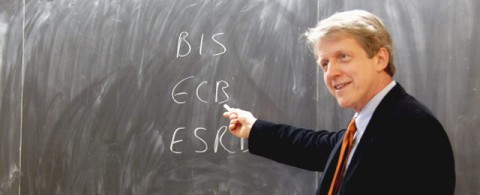
It’s April, which means it’s time for a new batch of Open Courses from Yale University. The latest release adds another six courses to the mix, bringing Yale’s total to 42. We have listed the new additions below, and also added them to our ever-growing list of Free Online Courses. As always, Yale gives you access to their courses in multiple formats. You can generally download their lectures via YouTube, iTunes or Yale’s Open Course web site.
- African American History: From Emancipation to the Present — Web Site — Jonathan Holloway
- Financial Markets 2011 — YouTube — Robert Shiller
- Freshman Organic Chemistry II — YouTube — iTunes — Web Site — J. Michael McBride
- Hemingway, Fitzgerald, Faulkner — YouTube — Wai Chee Dimock
- Philosophy and the Science of Human Nature — YouTube — iTunes Audio — Web Site — Tamar Gendler
- The Atmosphere, the Ocean, and Environmental Change — YouTube — iTunes — Web Site — Ronald B. Smith
- The Early Middle Ages, 284‑1000 — YouTube — iTunes — Web Site — Paul H. Freedman
Note: Earlier this week, my local NPR station featured a big conversation about Disruptive Innovation in Higher Education. Guests included Salman Khan (Khan Academy), Sebastian Thrun (Udacity), Anant Agarwal (MITx) and Ben Nelson (The Minerva Project). You can listen to their wide-ranging conversation here.
‘The Sound of Miles Davis’: Classic 1959 Performance with John Coltrane
Here’s an amazing time capsule from the golden age of jazz: Miles Davis and his group–including John Coltrane–performing with the Gil Evans Orchestra on the CBS program, The Robert Herridge Theater.
The show was recorded on April 2, 1959 at Studio 61 in New York. It was a bold departure for The Robert Herridge Theater, a program normally devoted to the dramatic story-telling arts. Davis was slated to appear with his full sextet, but alto saxophonist Julian “Cannonball” Adderley had a migraine headache that day, according to the Miles Ahead Web site, so the group was pared down to a quintet, with Davis on trumpet and flugelhorn, Coltrane on tenor and alto saxophone, Wynton Kelly on piano, Paul Chambers on bass and Jimmy Cobb on drums.
The broadcast took place halfway through the recording of Davis’s landmark album, Kind of Blue. The 26-minute show (see above) opens with the classic “So What,” recorded only a month earlier. Davis solos twice on the song to fill in for Adderley. The group is then joined by Gil Evans and his orchestra. Together they play three numbers from Davis’s 1957 album, Miles Ahead. Here’s the set list:
- So What
- The Duke
- Blues for Pablo
- New Rhumba
- So What (reprise)
“There are many ways of telling a story,” says host and producer Robert Herridge. “What you’re listening to now, the music of Miles Davis, is one of those ways.”
Related Content:
Thelonious Monk, Bill Evans and More on the Classic Jazz 625 Show
1959: The Year that Changed Jazz
Classic Jazz Album Covers Animated, or the Re-Birth of Cool
The Universal Mind of Bill Evans: Advice on Learning to Play Jazz & The Creative Process
Reading David Foster Wallace’s The Pale King Live on Stage; Paperback Coming Soon
“David Foster Wallace’s writing sort of lends itself to being read aloud,” says actor Brian Elerding. He understates the case; at times, Wallace seems to have crafted his prose specifically to reflect and embody spoken language. He listened to the English actually used today, including all its tics, hitches, solecisms, and deliberate inarticulacies, with an observatory precision and rigor approaching the scientific. Actor-writer-director John Krasinski first put this quality of Wallace’s writing to a high-profile test with his 2009 film adaptation of Brief Interviews with Hideous Men. In the above clip, we see the making of a similar project in a very different form: last April in Beverly Hills, the PEN (Poets, Essayists, and Novelists) Center USA put on a live reading where “eleven talented actors” performed David Foster Wallace monologues “to an enthusiastic crowd of 300.”
These monologues came adapted from The Pale King, Wallace’s famously posthumous novel about what, if anything, lays beyond the crushing veil of tedium at a Peoria IRS branch office. As we enter the throes of United States tax time, the book gears up for a paperback release featuring additional material, some of which appeared last month at The Millions. PEN’s reading, introduced by Los Angeles Times book critic David L. Ulin, showcased interpretations of The Pale King’s characters through the voices of actors like Nick Offerman and Josh Radnor, comedians like Rob Delaney and June Diane Raphael, and even former Black Flag frontman Henry Rollins. Now best known as a spoken-word artist, Rollins understands well the power and depth of human speech. “It’s trying to reach you on every page,” he says of Wallace’s writing. “He’s trying to make a connection.” Struggling to pin down the exact nature of Wallace’s resonance, so strong with so many readers, literary scholars have used hundreds of thousands of their own words to draw the very same conclusion.
Related content:
David Foster Wallace: The Big, Uncut Interview
‘This Is Water’: Complete Audio of David Foster Wallace’s Kenyon Graduation Speech (2005)
Colin Marshall hosts and produces Notebook on Cities and Culture. Follow him on Twitter at @colinmarshall.
Support Us
We're hoping to rely on loyal readers, rather than erratic ads. Please click the Donate button and support Open Culture. You can use Paypal, Venmo, Patreon, even Crypto! We thank you!

About Us

Open Culture scours the web for the best educational media. We find the free courses and audio books you need, the language lessons & educational videos you want, and plenty of enlightenment in between.
Advertise With Us

