“You know,” says Ray Charles in this new animated interview from Blank on Blank, “what I got to live up to is being myself. If I do that the rest will take care of itself.”
Charles always sounded like no one else. When he played or sang just a few notes, you would immediately recognize his distinctive sound, that unique blending of gospel and blues. As he explains in the interview, his style was a direct reflection of who he was. “I can’t help what I sound like,” he says. “What I sound like is what I am, you know? I cannot be anything other than what I am.”
Blank on Blank is a project that brings lost interviews with famous cultural figures back to life. The Charles video is the 12th episode in Blank on Blank’s ongoing series with PBS Digital Studios. The audio of Charles is from the Joe Smith Collection at the Library of Congress. Smith is a former record company executive who recorded over 200 interviews with music industry icons for his book Off the Record: An Oral History of Popular Music. He talked with Charles on June 3, 1987, when the musician was 56 years old. You can hear the complete, unedited interview at the Library of Congress Web site.
In the interview, Charles says that being true to himself was a night-by-night thing. “I don’t sing ‘Georgia’ like the record. I sing it true,” he says. “I sing what I sing true. Each night I sing it the way I feel that night.” For an example of Charles being true to himself, here he is performing “Georgia On My Mind” on the Dick Cavett Show on September 18, 1972:
“It is a truth universally acknowledged, that a single man in possession of a good fortune, must be in want of a wife.”
Translation:
The heterogeneity of assumed intentions may incur a conclusory stereotype regarding gender selections in marriage-based societies, especially in those where the masculine hegemony of capital resources presupposes the feminization of property and uxorial acquisition.
I vividly recall my first opera. It was The Marriage of Figaro at the Metropolitan Opera in New York. A friend bought two family circle tickets—nosebleed seats—and insisted that I come along. She was a trained opera singer and aficionado. I was an unlearned neophyte. Most of my expectations were fulfilled: the enormously impressive space, plenty of bombast, intricately designed sets and costuming. And it was long. Very long. But not, as I had feared, boring. Not at all. I had not expected, in fact, to be so physically moved by the performances, and not only moved to basic emotions—I was moved deep in my gut. There’s no way I could adequately explain it.
But the medical scientists in the video above can. In “The Science of Opera,” actor Stephen Fry and comedian Alan Davies convene a panel of researchers from University College London to discuss what happened physiologically when the pair were hooked up to various sensors as they attended Verdi’s Simon Boccanegraat the Royal Opera House. Like the pairing at my first opera, Fry is a knowledgeable lover of the art and Davies is almost an opera virgin (the story of his actual first opera gets a good laugh). The gadgets attached to Fry and Davies measured their heart rates, breathing, sweat, and “various other emotional responses.” What do we learn from the experiment? For one thing, as neurobiologist Michael Trimble informs us, “music is different from all the other arts.” For example, ninety percent of people surveyed admit to being moved to tears by a piece of music. Only five to ten percent say the same about painting or sculpture. Fry and Davies’ autonomic nervous system responses confirm the power of music (and story) to move us beyond our conscious control and awareness.
And why is this? You’ll have to watch the discussion to learn more—I won’t summarize it here. Just know that we get insights not only into the science of opera, but the art as well—Verdi’s art in particular—and the various disciplines represented here do much to expand our appreciation of music, whether we specifically love opera or not. This is not the first talk on opera Fry has been a part of. He previously hosted another Royal Opera Company event called “Verdi vs. Wagner: the 200th birthday debate” (above). Though I favor the Germans, I’d say it’s a draw, but partisans of either one will likely come away with their opinions intact, having learned a thing or two along the way.
Amanda Palmer and Neil Gaiman strike me as a very happily married couple, an impression their live cover of Makin’ Whoopee supports.
What’s their secret? As anyone with an interest in romance or Earth Science will tell you, opposites attract. On the surface of things, the exhibitionistic, highly theatrical, always controversial Palmer is quite different from her unfailingly discreet husband of the last two-and-a-half years. (Watch him mine his reticence to great comic effect at the 2.52 mark.)
That’s not to say they don’t have things in common.
And while he has three children from a previous marriage, the Gaiman-Palmer union has yet to produce any little Neil or Amandas. Which brings us back to Makin’ Whoopee. Whether or not the lyrics jibe with one’s personal outlook, the song’s enduring popularity (85 years and counting) might suggest its central dilemma is evergreen. Its biological observations are certainly above reproach: sex often leads to babies, who lead to the sort of responsibilities that signal the end of the honeymoon, if not the marriage.
Perhaps an open relationship in the whoopee department will continue to keep things playful between the Gaiman-Palmers, regardless of what their future holds. It’s really none of our business, is it?
Ayun Halliday must tender her regrets as she is directing a cast of 15 home schooled teens in her husband’s musical, Yeast Nation, that night. Follow her @AyunHalliday
You’ve heard it in shopping malls. You’ve heard it in elevators. No doubt you’ve even heard it on the telephone, while waiting on hold. But you’ve never heard Antonio Vivaldi’s The Four Seasons like this before.
On August 8, the flamboyant British violinist Nigel Kennedy and members of his Poland-based Orchestra of Life joined with the Palestine Strings ensemble at the Royal Albert Hall in London for a very unorthodox performance of the Baroque classic for a BBC Proms broadcast. With musicians drawn mostly from the West Bank and East Jerusalem, the Palestine Strings is an orchestra of the Edward Said National Conservatory of Music, a school founded in the Israeli-occupied territories in 1993 and named in 2004 for Said, the influential Palestinian-born writer, theorist and music aficionado who died the previous year.
The 17 members of the Palestine Strings who traveled to London ranged from 13 to 23 years old. They wore black-and-white checkered keffiyehs over their suits and dresses as a show of national pride. In the performance (shown above in its entirety), Kennedy and his collaborators followed the basic outline of Vivaldi’s four-concerto suite, but made frequent excursions into jazz and Arabic music. As Helen Wallace writes at BBC Music Magazine:
Into a basic rhythm section set-up — the irresistible bassist Yaron Stavi and Krzysztof Dziedzic on subtle percussion without drum kit, the gently agile pianist Gwilym Simcock providing a perfect continuo foil to Kennedy’s manic sawing — he wove spaces into which the young Palestinian soloists could stand and improvise in mesmerising Arabic style. These were especially successful in the apprehensive slow movement of Summer, where the shepherd boy fears the imminent storm: sinuous, silky-toned melismas from violin, viola and voice rang out, projecting like melancholy muezzin calls into the hall, and suiting perfectly Vivaldi’s open structure.
It wasn’t all good: “It Don’t Mean a Thing” cropped up in Summer apropos of nothing, while Spring opened with infuriating, Shirley Bassey-style crescendos on the final notes of every phrase. Kennedy’s own solos were pretty rough at times. At one point in Autumn he lost the thread completely and had to stop and ask the leader where they were. But he led the concertante episodes with such charm and wit, adding in birds at spring time, and delivering Winter’s aria like the purest folk air, you had to forgive the excesses.
The Quentin Tarantino Archives, which bills itself, perhaps not hyperbolically, as the “web’s biggest and most popular website about Quentin Tarantino and his movies,” has posted an exclusive — a list of the filmmaker’s favorite movies of 2013, through the month of September.
1. Afternoon Delight (Jill Soloway)
2. Before Midnight (Richard Linklater)
3. Blue Jasmine (Woody Allen)
4. The Conjuring (James Wan)
5. Drinking Buddies (Joe Swanberg)
6. Frances Ha (Noah Baumbach)
7. Gravity (Alfonso Cuarón)
8. Kick Ass 2 (Jeff Wadlow)
9. The Lone Ranger (Gore Verbinski)
10. This Is The End (Seth Rogen, Evan Goldberg)
There you have the films that touched Tarantino over the past nine months. But are you wondering about the longer term? The past 25 years? The entire history of cinema? If so, see:
“Is there anything sadder than an Esperantist?” a friend once jokingly asked me. “Two Esperantists” might seem the natural response, but hey, at least they could talk to each other. Speakers of Esperanto, the best-known constructed language, have wound up as the butt of more than a few jokes since the tongue’s inventor Ludwig Lazarus Zamenhof first made his utopian linguistic creation public in 1887, intending it as a tool to unite a fractious, nationalistic mankind. (A noble origin, balanced by such less-noble uses such as that William Shatner horror movie.) Yet Esperanto has actually enjoyed singular success, by the standards of constructed languages. In the five-minute TED Ed lesson above (and the expanded one at TED Ed’s own site), linguist John McWhorter tells us about the invention of other, lesser-known “conlangs,” including Elvish, Klingon, Dothraki, and Na’vi. If you’ve never heard any of those spoken, don’t feel unworthy; maybe you just haven’t sufficiently explored constructed worlds like those in which Game of Thrones, Avatar, Star Trek, and The Lord of the Ringstake place.
McWhorter makes a special point of Elvish since, in constructing it for use in The Lord of theRings’ Middle-Earth, J.R.R. Tolkien made a linguistic effort with little precedent in modern literature. He took the pains, in fact, to construct not just a plausible Elvish language but a plausible set of Elvish languages. “Tolkien charted out ancient and newer versions of Elvish. When the first Elves awoke at Cuiviénen, in their new language the word for people was kwendi, but in the language of one of the groups that moved away, Teleri, over time kwendi became pendi. Just like real languages, conlangs like Elvish split off into many. When the Romans transplanted Latin across Europe, French, Spanish, and Italian were born.” Hence, in our reality, a variety of words for hand like main, manus, and mano, and in Tolkien’s reality, a variety of words for people like kwendi, pendi, and kindi. But Elvish now finds itself surpassed in grammatical complexity and breadth of vocabulary by the likes of Klingon, Dothraki, and Na’vi, whose fans have put as much energy into expanding them as their creators. And those interested in similarly robust “real” conlangs — i.e., those not built for a fictional realm, but for ours — might take a look at Ithkuil, whose creator John Quijada was recently profiled in the New Yorker by Joshua Foer. You’ll also not want to miss this past post on Open Culture where Tolkien Reads Poems from The Fellowship of the Ring, in Elvish and English (1952). Or just listen to the reading below.
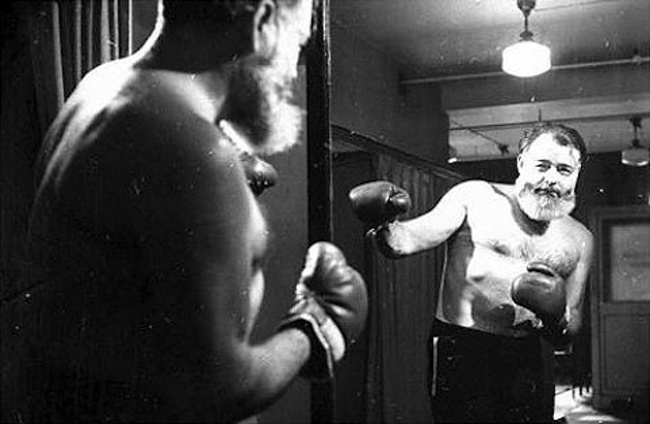
In a 1954 interview in the Paris Review, Ralph Ellison said of one of his literary heroes: “When [Ernest Hemingway] describes something in print, believe him; believe him even when he describes the process of art in terms of baseball or boxing; he’s been there.” I read this thinking that Ellison might be a bit too credulous. Hemingway, after all, has provoked no end of eye-rolling for his legendary machismo, bravado, and maybe several dozen other Latin descriptors for masculine foolhardiness and bluster. As for his “boxing,” we would be wise not to believe him. He may have “been there,” but the real boxers he encountered, and tried to spar with, would never testify he knew what he was doing
Ernest Hemingway wasn’t a boxer so much as he was a “boxer”… a legend in his own mind, a romantic. Hemingway’s friend and sometime sparring partner, novelist Morley Callaghan tells it this way: “we were two amateur boxers. The difference between us was that he had given time and imagination to boxing; I had actually worked out a lot with good fast college boxers.” Or, as the author of an article on the Fine Books & Collections site has it, “Hemingway was lost in the romance of a sport that has no romance to those seriously pursuing it; the romance strictly belongs to spectators.”
As a spectator with pretentions to greatness in the sport, Papa was prone to overestimating his abilities, at the expense of his actual skill as a writer. As he would tell Josephine Herbst, without a hint of irony, “my writing is nothing, my boxing is everything.”
Click for larger image
How did the pros evaluate his self-professed ability? Jack Dempsey, who spent time in Paris in the ‘20s being feted and fawned over, had this to say of Hemingway’s aspirations:
There were a lot of Americans in Paris and I sparred with a couple, just to be obliging…. But there was one fellow I wouldn’t mix it with. That was Ernest Hemingway. He was about twenty-five or so and in good shape, and I was getting so I could read people, or anyway men, pretty well. I had this sense that Hemingway, who really thought he could box, would come out of the corner like a madman. To stop him, I would have to hurt him badly, I didn’t want to do that to Hemingway. That’s why I never sparred with him.
Given Hemingway’s penchant for self-delusion in this matter, he may have interpreted this as Dempsey’s capitulation to his obvious prowess. An even more scathing critique of Hemingway’s bullying… I mean boxing skill … comes to us via Booktryst’s Stephen J. Gertz, who proffers an amusing dissection of the letter above, an unpublished correspondence Hemingway sent in 1943 to George Brown, the writer’s “trainer, coach, friend, and factotum.” Brown, it seems, was kindly, or prudent, enough to encourage his employer in his delusions. However, Gertz writes, “the reality was that anyone who had even the slightest idea of what they were doing in the ring could take Hemingway, who was notorious for foolishly trying to actually fight trained boxers.” He’s lucky, then, that Dempsey practiced such judicious restraint. If not, we may never have seen any fiction from Hemingway after he tried to go a round or two with the champ.
We're hoping to rely on loyal readers, rather than erratic ads. Please click the Donate button and support Open Culture. You can use Paypal, Venmo, Patreon, even Crypto! We thank you!
Open Culture scours the web for the best educational media. We find the free courses and audio books you need, the language lessons & educational videos you want, and plenty of enlightenment in between.