F. Scott Fitzgerald was right. The rich really are different from you or me. They’re more likely to behave unethically.
That’s the finding of a group of studies by researchers at the University of California, Berkeley. The research shows that people of higher socioeconomic status are more likely to break traffic laws, lie in negotiations, take valued goods from others, and cheat to increase chances of winning a prize. The resulting paper, “Higher Social Class Predicts Increased Unethical Behavior,” [PDF] was published last year in the Proceedings of the National Academy of Sciences.
Perhaps most surprising, as this story by PBS NewsHour economics reporter Paul Solman shows, is that the tendency for unethical behavior appears not only in people who are actually rich, but in those who are manipulated into feeling that they are rich. As UC Berkeley social psychologist Paul Piff says, the results are statistical in nature but the trend is clear. “While having money doesn’t necessarily make anybody anything,” Piff told New Yorkmagazine,“the rich are way more likely to exhibit characteristics that we would stereotypically associate with, say, assholes.”
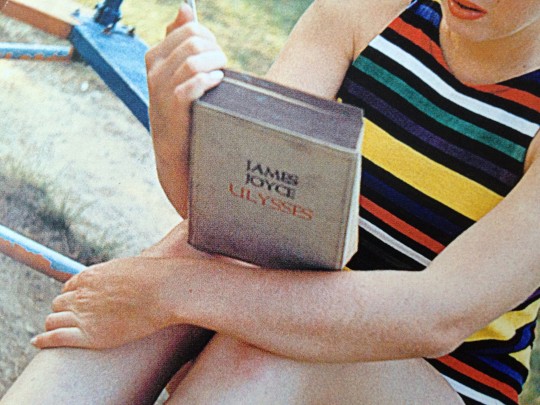
The good folks at Book Riot conducted a survey of 828 readers, hoping to find out what books they’ve faked reading. The top five books (all available in our Free eBooks and Free Audio Books collections) may not come as a surprise:
Pride and Prejudice by Jane Austen
Ulysses by James Joyce
Moby-Dick by Herman Melville
War and Peace by Leo Tolstoy
The Bible
Nor will the remaining 15 astound you (give or take a couple). But we’ll let you head over to Book Riot for the complete list. Wait! Stop! Before you leave, let us know what books you’ve fudged before. It’s anonymous and all in good fun. Look forward to your confessions.
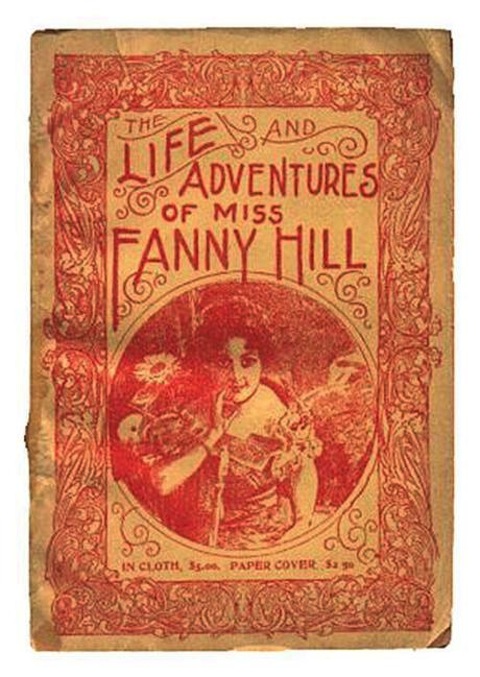
In a recent interview with literary historian Loren Glass about the achievements of taboo-busting publisher Grove Press, I wondered whether anyone growing up today could conceive of a book causing a public scandal, let alone a trial that reaches the Supreme Court. Grove had the highest-profile of its several legal skirmishes after publishing Henry Miller’s Tropic of Cancer in 1961. Two years later, G.P. Putnam Sons would drop their own literary bombshell in the form of Memoirs of a Woman of Pleasure, better known by the name of the protagonist there referenced, Fanny Hill, who, orphaned at fifteen, throws herself into a career in “profit by pleasing.” Originally written in 1748 by John Cleland, a former British East India Company employee locked up in debtors’ prison, the book broke new ground by offering almost nothing but a string of elaborately crafted (and, technically, “vulgar” language-free) sex scenes.
“A partial list of the book’s adventures includes an orgy, sex between women, masturbation, masochism, cross-dressing, and a detailed sodomy scene that is one of only two known explicit depictions of male same-sex ardor in the language before the end of the 19th century,” writes the Boston Globe’s Ruth Graham in an article on the 50th anniversary of the Fanny Hill-vindicating verdict. “The book still has the capacity to shock. As [assistant attorney general William I.] Cowin noted in front of the Supreme Court, after the first 10 pages of the novel, ‘all but 32 have sexual themes.’ But Fanny Hill would not have survived so long if it were merely scandalous in 18th-century terms: It remains revolutionary today because, as English critic Peter Quennell wrote in the introduction to the 1963 edition, “It treats of pleasure as the aim and end of existence.” You can find out just what this means by downloading the book free from Project Gutenberg or iTunes, or listening to a free audio version here. Whether these text-only editions count as worksafe all depends, of course, on the size of your screen and the literacy of your co-workers. You can see bawdy illustrations that appeared in historical editions here. Note that they are very definitively NSFW.
The story of Oskar Schindler, savior of thousands of Polish Jews, produced an epic novel, Schindler’s Ark, which in turn produced Steven Spielberg’s epic Schindler’s List. Like that of Anne Frank, Schindler’s story contains actions both unimaginably courageous and relatably human, and so his drama moves us past the stupefyingly brutal machinery of the Nazi death camps and into the lives of the real people under threat and those who helped them. But when we step out of the memoirs and fictionalizations and back into the dry history of documents, memos, and orders, the inhuman bureaucratic cast of Nazi efficiency returns, even in the case of Oskar Schindler.
Take the actual list (page one above). A featureless business ledger, the list is indistinguishable from the many concentration camp registers and death records Schindler’s fellow Nazis kept assiduously as they went about the business of eradicating a whole population. We know, of course, that Schindler played the part of a party believer to save lives instead of take them, but it’s still quite eerie to look over this faceless list of names and contemplate how close these men and women came to the horrors of the camps that took so many of their neighbors, friends, and relatives.
The list above is now on sale through an Ebay auction, starting bid 3 million dollars. It is certified authentic as the actual list typed up by Shindler’s accountant Itzhak Stern (played by Ben Kingsley in the film). The auction page provides the following information:
Itzhak Stern typed up the 14 page list on onion skin paper. Up for auction is not a copy of that list, but the actual one. It was sold by Itzhak Stern’s nephew to the current owner. It is dated in pencil on the first page, April 18, 1945. The auction will also include a copy of the affidavit from Stern’s nephew, recounting more details and provenance on The List. There’s a complete history of the composition of the list in David Crowe’s brilliant bio, Oskar Schindler: The Untold Account of His Life, Wartime Activities, and the True Story Behind the List.
We’ve already featured former Black Flag frontman and current spoken-word artist Henry Rollins explaining why, to his mind, only education can restore democracy. He also believes it can cure something he calls “disaster capitalism,” and you can hear more from him about it in the Big Think video above. He addresses, in his characteristically straightforward manner, the questions of what exactly ails the American economy, how that ailment might have come about, and how the country can educate itself back to health. We may individually get our educations now, he grants, but “how long will it be until America fiscally turns itself around” to the point of repaying “the risk of the investment on that student loan to get a person through four years of college? Will that person get a job where paying off that loan and getting a house and affording a family, will that be a possibility? In the present America, it doesn’t look like it is.”
Seeing a dire national situation, Rollins recommends doing like China, but not in the way you might assume. He suggests looking “500 years at a time,” much farther up the road than we have of late. “I’d be looking up the road so far my eyes would fall out of my head.” He wants the country to become “like Europe, where they’ll educate your kid until his head explodes,” producing “three doctors per floor of every apartment building” and doing so by making “college tuition either free or really low.” Generally thought of as liberal, Rollins sums this up in a way that might appeal to his ideological opponents: “If you have a country full of whip-crack smart people, you have a country the rest of the world will fear. They will not invade a country of educated people because we are so smart we’ll build a laser that will burn you, the enemy, in your sleep before you can even mobilize your air force to kill us. We will kill you so fast because we are so smart and we will have foreign policy that will not piss you off to the point to where you have to attack us.”
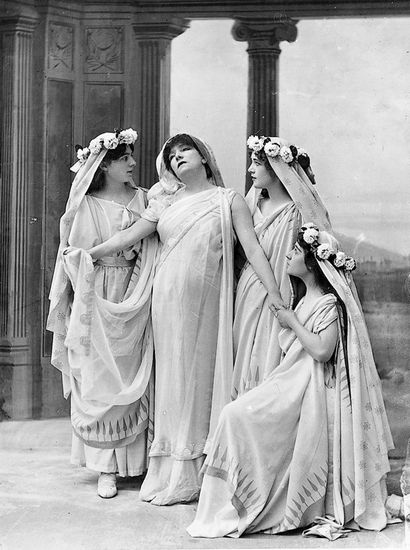
The French actress Sarah Bernhardt is often remembered as the first international superstar. Her hypnotic presence and flamboyant personality are legendary. “She could contrive thrill after thrill,” wrote Lytton Strachey of Bernhardt’s acting ability, “she could seize and tear the nerves of her audience, she could touch, she could terrify, to the top of her astonishing bent.” Bernhardt died before the age of talking movies, notes her biographer Robert Gottlieb, “yet she remains the most famous actress the world has ever known.”
How good was she? Listen below, and you can begin to form your own opinion. The recording was made in February of 1910, when Bernhardt and her troupe were touring America. To tap into the emerging phonographic record market, Bernhardt stopped by Thomas Edison’s laboratory in West Orange, New Jersey, to cut some wax cylinders. For one recording, she chose a scene from Jean Racine’s 1677 tragedy Phèdre, which is based on Euripides’ Hippolytus and Seneca’s Phaedra. Bernhardt plays the title role opposite an unknown actor in the highly dramatic Act II Scene V, in which Phèdre declares her love for Hypolyte, her stepson:
Unfortunately, the video image moves in a distracting way. So perhaps the best way to enjoy the audio is to forget the image and read along with Bernhardt. A full transcript follows the jump:
The history of religion(s) is a fascinating subject, one that should be covered, in my humble opinion, as an integral part of every liberal arts education. But the history of atheism—of disbelief—is a subject that only emerges piecemeal, in oppositional contexts, especially in the wake of recent fundamentalist uprisings in the past decade or so. We covered one such history recently, the 2004 BBC series Atheism: A Rough History of Disbelief, made by director Jonathan Miller and featuring such high-profile thinkers as Richard Dawkins, Daniel Dennett, Arthur Miller, and physicist Steven Weinberg.
Miller’s series originally included much more material than he could air, and so the BBC agreed to let him produce the outtake interviews as a separate program called The Atheism Tapes. It’s a series in six parts, featuring interviews with English philosopher Colin McGinn, Weinberg, Miller, Dawkins, Dennett, and British theologian Denys Turner. At the top, watch Miller’s intro to The Atheism Tapes and his interview with Colin McGinn. It’s an interesting angle—Miller gets to quiz McGinn on “what it means to be a skeptical English philosopher in such a seemingly religious country as the United States.” Many readers may sympathize with McGinn’s difficulty in communicating his unbelief to those who find the concept totally alien.
Directly above, watch Daniel Dennett (after the intro) discuss the relationship between atheism and Darwin’s revolutionary theory. Miller is a wonderful interviewer—sympathetic, probing, informed, humorous, humanist. He is the perfect person to bring all these figures together and get their various takes on modern unbelief, because despite his own professions, Miller really cares about these big metaphysical questions, and his passion and curiosity are shared by all of his interviewees. In the introduction to his interview with playwright Arthur Miller (below), Jonathan Miller makes the provocative claim that Christianity believes “there’s something peculiar about the Jews that makes them peculiarly susceptible to profane disbelief.” Watch Arthur Miller’s response below.
One would hope that all manner of people—believers, atheists, and the non-committal—would come away from The Atheism Tapes with at least a healthy respect for the integrity of philosophical and scientific inquiry and doubt. See the full series on YouTube here. Or purchase your copy on Amazon here.
“Football is a whole skill to itself. A whole world. A whole universe to itself. Me love it because you have to be skillful to play it! Freedom! Football is freedom.”
Bob Marley spoke those lines in 1979, two years before his life was cut short by melanoma, revealing his passion for the world’s game, or what we call “soccer” here in America. Casual fans might not know this, but Marley followed Brazilian football closely, revered Pele, made the sport part of his daily routine, and when he traveled to Rio de Janeiro in 1980, he took part in a now legendary match on musician Chico Buarque’s private pitch. Team A consisted of Marley, Junior Marvin (member of the Wailers), Paulo César Caju (member of the Brazil 1970 squad), Toquinho (Brazilian musician), Chico Buarque and Jacob Miller (lead singer of Inner Circle). Team B featured Alceu Valença (Brazilian musician), Chicão (member of Jorge Ben’s band) and four staff members from Island Records, recalls Russ Slater in Sounds and Colours. The short clip above shows Marley scoring a goal, despite being well into his battle with melanoma.
If you would like to support the mission of Open Culture, consider making a donation to our site. It’s hard to rely 100% on ads, and your contributions will help us continue providing the best free cultural and educational materials to learners everywhere. You can contribute through PayPal, Patreon, and Venmo (@openculture). Thanks!
We're hoping to rely on loyal readers, rather than erratic ads. Please click the Donate button and support Open Culture. You can use Paypal, Venmo, Patreon, even Crypto! We thank you!
Open Culture scours the web for the best educational media. We find the free courses and audio books you need, the language lessons & educational videos you want, and plenty of enlightenment in between.