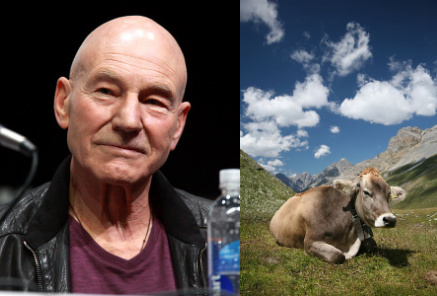
Her question? What do English cows sound like when they moo.
The knighted star does not skimp on his answer, even if, as he repeatedly suggests, one cannot do the subject justice in less than an entire afternoon. The dialects of British cows, like those of their human counterparts, underscore that theirs is a society “dominated by class, social status and location.”
The moo of a cow from West Oxfordshire, home to Prime Minister David Cameron, is quite conservative compared to the lusty bellow of a specimen from West Yorkshire, where Stewart grew up. (The latter is so astonishing, he immediately offers to produce it twice.)
Cockney cows, a breed whose ranks have thinned considerably since Shakespeare’s day, sound like sheep.
As an extra treat, Stewart generously agrees to the host’s request for an American cow, impersonating a Nevada-dweller, a geographic homage to the original questioner as well as his bride, jazz singer Sunny Ozell.
Is there anything this man can’t — or won’t — do?
After reaching the rank of Sergeant during World War I, Alexander Woollcott returned to New York to become a drama critic for the New York Times. Woollcott was a man of large bulk and outsized personality, whose sharp, acerbic wit made him popular with his readers. According to The Ten-Year Lunch, an Oscar-winning documentary about the New York group of writers and journalists known as the Algonquin Round Table, Woollcott’s quick tongue made his bombastic presence nearly unbearable to his friends:
When he returned from the war, Woollcott boasted of his military adventures so often and so loudly that his friends grew tired of listening. He began every sentence with “When I was in the theatre of war…” Irritated by his pomposity, press agent Murdoch Pemberton lured Woollcott [to the Algonquin Hotel] with the promise of an ace pastry chef. The idea was to hold a sort of roast, at which a number of critics and journalists from around town would come and poke fun at him.
For better or worse, the attempt to puncture Woollcott’s ego at the Algonquin Hotel was unsuccessful. Rather than take offence, Woollcott was flattered by the attention, and the various figures in attendance also thoroughly enjoyed themselves. Serendipitously, the legendary luncheons of the Algonquin Round Table were born.
Most of the Table’s members had taken part in the war, to one degree or another: journalist Ruth Hale and her syndicated-columnist husband Heywood Broun had been war correspondents; New Yorker founder Harold Ross had edited the military newspaper Stars & Stripes; acclaimed columnist Franklin Pierce Adams had made Captain. Other members included poet and critic Dorothy Parker, a tragic romantic who had become the city’s most quotable woman. (Parker’s inexhaustible supply of witticisms still feels fresh today: when asked to use the word horticulture in a sentence, Parker replied, “You can lead a whore to culture, but you can’t make her think.”) Parker’s best friend was humorist and essayist Robert Benchley, who had once written an essay exploring Newfoundland fishing rights for his International Law class at Harvard from the unorthodox perspective of the fish. Frequently joining them was Neysa McNein, a sought-after illustrator who hosted the Table’s afternoon gatherings in her studio, where Irving Berlin could occasionally be found playing the piano.
The near-daily meetings at the Algonquin Hotel fostered a close-knit cultural fraternity of New York’s best writers, illustrators, and artists. The group vacationed together at their jointly-owned Vermont island, played games of poker wagering houses and honeymoons, and criticized each other’s work. Whenever a member of the Round Table would make a conceited remark, everyone would immediately rise and bow, honoring their friend’s regal affectations. The only exception to the rule was Woollcott, whose bread and butter pomposity was tolerated by virtue of its regularity.
With its interviews of original Table members, the documentary is a tantalizing look at the lives of the men and women who ruled New York’s cultural milieu during the heyday of the printed word. Equal parts wish for the idyllic past and history of New York’s biggest cultural players, The Ten-Year Lunch leaves one with a pang of oddly potent nostalgia. We can’t recommend it enough.
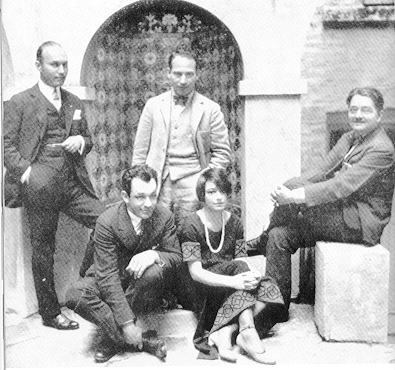
In the image above, see Art Samuels, Charlie MacArthur, Harpo Marx, Dorothy Parker and Alexander Woollcott
Ilia Blinderman is a Montreal-based culture and science writer. Follow him at @iliablinderman.
Before Brian Epstein discovered The Beatles in 1961, they looked nothing like the British mop-top mods of their early sixties pop phase. As the Quarrymen, they aped the looks of American fifties rockers (see a slideshow in this fan-made video of “In Spite of All the Danger”): Sometimes they dressed like folk revivalists in checkered shirts and jeans, sometimes like a Carl Perkins rockabilly band in matching suits and skinny ties, and sometimes like pompadoured greasers straight out of West Side Story.
But even after the band acquired its distinctive look and wrote a cache of original songs, they were still “competing for increased exposure just like everybody else.” This meant numerous goofy publicity stunts, every one of which they seemed to thoroughly love. In one such affair, the foursome taped a television special called “Around the Beatles,” a reference to the theater-in-the-round studio setup. In the first part of the program, they donned yet another costume, Shakespearean dress, and staged a spoof of Act V, Scene I of A Midsummer Night’s Dream in honor of Shakespeare’s 400th anniversary. (See the original black-and-white BBC broadcast from April 28, 1964 above. The show was broadcast in America on ABC that November, in color.)
After some fanfare, “Around the Beatles” opens on Ringo, in hose and doublet, firing a cannon. Then we get the obligatory hoard of screaming teenage fans singing the praises of each Beatle and marching into the studio with signs and banners. After another trumpet fanfare, the play begins, and we’re off into slapstick British comedy, with a mugging Paul as Pyramus, sneering John as Thisbe, smirking George as Moonshine, and a scene-chewing Ringo as Lion. The hecklers in the box seats were scripted, mostly (one yells “go back to Liverpool!”—probably not a plant). Overall the silly skit confirms what I’ve always maintained: if the Beatles’ hadn’t made it as musicians, they’d have done well to stay together as a comedy troupe.
The second part of the special featured musical performances from several other acts and, of course, from the Beatles themselves. See the band bop along to a medley of “Love Me Do”/ “Please Please Me”/ “From Me to You”/ “She Loves You”/ “I Want to Hold Your Hand” above. They prerecorded the music on April 19th and mimed the performances, as you can surely tell from the total lack of amplifiers onstage. This was, as it is again, the way of things in pop music on television. But if you are one of those who think The Beatles didn’t put on a good live show, Colin Fleming at The Atlantic begs to differ, with a thorough explication of rare recordings from an October 1963 performance in Stockholm.
In October, 1973, David Bowie made his last live appearance as Ziggy Stardust. (Watch it here.) Pretty soon, Bowie would morph into a new persona Aladdin Sane and later The Thin White Duke. But, for a moment there, he almost went with another unlikely character, “Cobbler Bob.” Or so that’s the playful scenario that English comedian and actor Adam Buxton imagines in this short lego video. Enjoy.
When you’re done having a laugh and ready for something more serious, we’d encourage you to see these related posts:
At the stroke of midnight, millions of New Year’s resolutions went into effect, with the most common ones being lose weight, get fit, quit drinking and smoking, save money, and learn something new. Unfortunately, 33% of these resolutions will be abandoned by January’s end. And upwards of 80% will eventually fall by the wayside. Making resolutions stick is tricky business. But it’s possible, and Stanford psychologist Kelly McGonigal has a few scientifically-proven suggestions for you.
For years, McGonigal has taught a very popular course called The Science of Willpower in Stanford’s Continuing Studies program, where she introduces students to the idea that willpower is not an innate trait. Rather it’s a “complex mind-body response that can be compromised by stress, sleep deprivation and nutrition and that can be strengthened through certain practices.” For those of you who don’t live in the San Francisco Bay Area, you can also find McGonigal’s ideas presented in a recent book, The Willpower Instinct: How Self-Control Works, Why It Matters, and What You Can Do to Get More of It, which just came out in paperback yesterday. Below, we have highlighted 15 of Dr. McGonigal’s strategies for increasing your willpower reserves and making your New Year’s resolution endure.
Will power is like a muscle. The more you work on developing it, the more you can incorporate it into your life. It helps, McGonigal says in this podcast, to start with small feats of willpower before trying to tackle more difficult feats. Ideally, find the smallest change that’s consistent with your larger goal, and start there.
Choose a goal or resolution that you really want, not a goal that someone else desires for you, or a goal that you think you should want. Choose a positive goal that truly comes from within and that contributes to something important in life.
Willpower is contagious. Find a willpower role model — someone who has accomplished what you want to do. Also try to surround yourself with family members, friends or groups who can support you. Change is often not made alone.
Know that people have more willpower when they wake up, and then willpower steadily declines throughout the day as people fatigue. So try to accomplish what you need to — for example, exercise — earlier in the day. Then watch out for the evenings, when bad habits can return.
Understand that stress and willpower are incompatible. Any time we’re under stress it’s harder to find our willpower. According to McGonigal, “the fight-or-flight response floods the body with energy to act instinctively and steals it from the areas of the brain needed for wise decision-making. Stress also encourages you to focus on immediate, short-term goals and outcomes, but self-control requires keeping the big picture in mind.” The upshot? “Learning how to better manage your stress is one of the most important things you can do to improve your willpower.” When you get stressed out, go for a walk. Even a five minute walk outside can reduce your stress levels, boost your mood, and help you replenish your willpower reserves.
Sleep deprivation (less than six hours a night) makes it so that the prefrontal cortex loses control over the regions of the brain that create cravings. Science shows that getting just one more hour of sleep each night (eight hours is ideal) helps recovering drug addicts avoid a relapse. So it can certainly help you resist a doughnut or a cigarette.
Also remember that nutrition plays a key role. “Eating a more plant-based, less-processed diet makes energy more available to the brain and can improve every aspect of willpower from overcoming procrastination to sticking to a New Year’s resolution,” McGonigal says.
Don’t think it will be different tomorrow. McGonigal notes that we have a tendency to think that we will have more willpower, energy, time, and motivation tomorrow. The problem is that “if we think we have the opportunity to make a different choice tomorrow, we almost always ‘give in’ to temptation or habit today.”
Acknowledge and understand your cravings rather than denying them. That will take you further in the end. The video above has more on that.
Imagine the things that could get in the way of achieving your goal. Understand the tendencies you have that could lead you to break your resolution. Don’t be overly optimistic and assume the road will be easy.
Know your limits, and plan for them. Says McGonigal, “People who think they have the most self-control are the most likely to fail at their resolutions; they put themselves in tempting situations, don’t get help, give up at setbacks. You need to know how you fail; how you are tempted; how you procrastinate.”
Pay attention to small choices that add up. “One study found that the average person thinks they make 14 food choices a day; they actually make over 200. When you aren’t aware that you’re making a choice, you’ll almost always default to habit/temptation.” It’s important to figure out when you have opportunities to make a choice consistent with your goals.
Be specific but flexible. It’s good to know your goal and how you’ll get there. But, she cautions, “you should leave room to revise these steps if they turn out to be unsustainable or don’t lead to the benefits you expected.”
Give yourself small, healthy rewards along the way. Research shows that the mind responds well to it. (If you’re trying to quite smoking, the reward shouldn’t be a cigarette, by the way.)
Finally, if you experience a setback, don’t be hard on yourself. Although it seems counter-intuitive, studies show that people who experience shame/guilt are much more likely to break their resolutions than ones who cut themselves some slack. In a nutshell, you should “Give up guilt.”
If you live in the SF Bay Area, you can take Kelly’s The Science of Willpowercourse that begins on January 13. (Anyone can enroll, and yes, I know that because I help run the Continuing Studies program at Stanford.)
Take Laurence Olivier. Who else could have made the phrase “Polaroid SX-70 Land Camera” sound like Shakespeare? Seriously. He could’ve tacked the string of superlatives he unleashes against a black background above onto the end of Henry V’s St. Crispin’s Day speech and I would have been none the wiser.
(And gentlemen in England now a‑bed
Shall think themselves accursed they were not here,
And hold their manhoods cheap whiles any speaks
That fought with us upon Saint Crispin’s day -
Pocket sized, folding, electronically controlled, motor driven…)
Sir Larry was followed in 1979 by actress Liv Ullmann, solemnly praising the SX70 Sonar OneStep’s moment-capturing abilities. Is there a Polaroid somewhere in the Ingmar Bergman Archive of his and Ullmann’s 12-year-old daughter Linn, standing at the sink, washing dishes? Or has YouTube become the sole reliquary for these precious moments?
Christopher Plummer’s 1980 spot seems downright loose by contrast, as he kicks back on a beach, aiming his SX70 Sonar OneStep at a Golden Retriever and a canoe’s worth of kids. (Sir Larry’s subject was a rather fussy porcelain clock.)
When young artists, be they writers, painters, or musicians, aim to strike it big, they invariably choose to move to New York. Brooklyn lofts, hopes of finding a likeminded smart set, and the promise of good times beckon countless young men and women to develop their creative careers in a city whose history teems with outsized aspirations and even larger personalities. New York has, after all, been a hub for artistic luminaries since the early 20th century.
In the 1961 documentary entitled New York In The Twenties, above,Walter Cronkite gives a snapshot of the talented crowd that was once drawn in by the city’s cultural riptide during the 1920s. The short video consists of interviews with the publisher Alfred Knopf; New York Herald Tribune editor Stanley Walker; and Pulitzer prize-winning author of The Green Pastures, Marc Connelly. Walker plays the part of the consummate New York newspaperman, pining for the days when decent citizens weren’t forced to rub shoulders with the boors now infesting the Westchester and Connecticut trains. Connelly, in more affable fashion, describes the fabled 1920s group of creative minds known as the Algonquin Round Table:
Alexander Woollcott was searing, acid, rude; I used to feel sometimes his only exercise was rancour. But, he was engaging, was compelling, and amusing… Edna Ferber, young, industrious, she used to scare us all to death by her habit of industry. George Kaufman was certainly one of the wittiest of that group. George’s wit… had the sharpness of a silver point etching… There was… Harold Ross, founder of the New Yorker. There was speculation about Ross, his curious head of hair; it was very high, very thick. Somebody once said that that jungle picture Chang had been filmed in it. I think it was George Kaufmann that once said he looked like a dishonest Lincoln.
A lot of people who knew nothing about the personal lives or the attitudes … of the people at the round table… thought that it was a mutual admiration society and a logrolling organization. It was anything but that because I promise you, the worst pannings ever received for our books or our plays came from the critical friends who were members of that group.
Alfred Knopf, in turn, discusses the glory days of publishers and writers, as well as the genius of H. L. Mencken, whom he describes as “the greatest editor… that I’ve ever known.”
Viewing the halcyon days of New York’s creative scene, with its jazz clubs and speakeasies, it’s no wonder that Knopf, Walker, and Connelly’s accounts leave one with an ineluctable sense of nostalgia. Of course, with its unceasing influx of artists, the city’s substance remains the same today. It’s just that its Bloomberg-era sterility has led to a change in style.
Ilia Blinderman is a Montreal-based culture and science writer. Follow him at @iliablinderman.
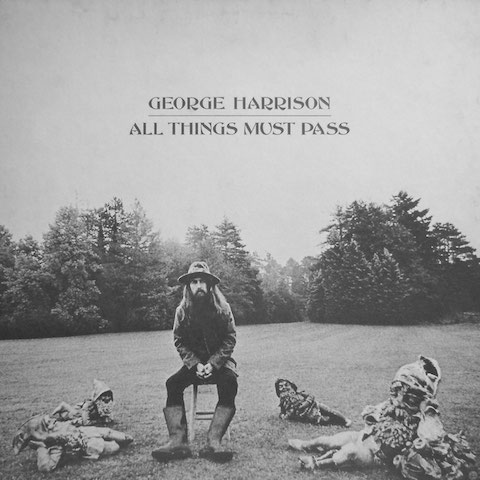
It’s pretty well established by this point that Phil Spector is dangerously insane. But once upon a time, he was also insane in the best possible way, willing to use methods no other record producer would to create his signature sixties “wall of sound” with huge ensembles and off-the-wall effects that turned the studio into an instrument. And for all his documented violence, Spector was also once a surprisingly gentle writer, as you can see in his notes to George Harrison, made during the recording of Harrison’s Spector-produced triple-album All Things Must Pass. In his comments, Spector coaxes Harrison to work harder on his vocal performances and make his voice more prominent throughout the album’s eighteen studio tracks.
Although he’d made significant contributions to The Beatles as a songwriter, Harrison was eager to do his own thing during the band’s demise in the late sixties. All Things Must Pass is generally thought of as his first solo album, but he had actually released two previous records under his name, the 1968 film soundtrack Wonderwall Music and the experimental 1969 Electronic Sound. Both of these, however, are largely instrumental, and Harrison had yet to step out of the The Beatles as a singer in his own right until All Things Must Pass in 1970. Spector’s notes make it clear that Harrison was less than confident in his vocal abilities. In the midst of his technical comments, Spector frequently refers to Harrison’s voice as “buried” in the mix. The letter as a whole is an intriguing glimpse into Spector’s process and, I think, a glimpse of Harrison working to overcome his natural reticence. After his list of notes on each track—some a sentence or two, some paragraph-length—Spector ends with a diplomatic summation that reiterates his desire to put Harrison’s voice front-and-center.
George, on all the 18 numbers I just mentioned, this is what I feel are the most important items on each. Naturally, wherever possible, of main importance is to get a good vocal performance by yourself. Also, if you do any of the background voices, you should spend considerable time on them to make sure they are good…. I think you should spend whatever time you are going to on performances so that they are the very best you can do and that will make the remixing of the album that much easier. I really feel that your voice has got to be heard throughout the album so that the greatness of the songs can really come through. We can’t cover you up too much (and there really is no need to) although as I said, I’m sure excellent mixes can be obtained with just the proper amount of time spent on each one.
The letter finishes on a very warm note:
George, thank you for all your understanding about what we discussed, I appreciate your concern very much and hope to see you as soon as it is possible.
We're hoping to rely on loyal readers, rather than erratic ads. Please click the Donate button and support Open Culture. You can use Paypal, Venmo, Patreon, even Crypto! We thank you!
Open Culture scours the web for the best educational media. We find the free courses and audio books you need, the language lessons & educational videos you want, and plenty of enlightenment in between.