He has a wild look in his eyes, but a beautiful idea in his mind. Meet Raul Lemesoff, an eccentric character from Buenos Aires, who takes old cars and turns them into “militaristic bibliothecas” that drive the streets of Argentina, giving free books to those who want them. This is an ongoing project for Lemesoff, but the weaponized 1979 Ford Falcon you see above was specially created to celebrate World Book Day on March 5th. You can thank 7UP for commissioning that project.
Follow us on Facebook, Twitter and Google Plus and share intelligent media with your friends. And if you see any great items we should feature on our site, send them our way. We’d love to get your ideas.
Ludwig Wittgenstein’sTractatus Logico-Philosophicus (available in our collection of 130 Free Philosophy eBooks has surely set a fair few of its readers on the path to philosophy. But how much music has it inspired? Improbable as it may sound, the German-Austrian philosopher of mathematics, language, and mind’s ultra-terse 1922 masterpiece has brought about at least two pieces. We’ve previously featured Finnish composer M.A. Numminen adapting the Tractatus into an avant-garde comic opera. Today, we have Tibor Szemző’s Tractatus.
You can download the whole piece as a single MP3 on Ubuweb, or hear it above. According to UBU’s page about it, the work, first composed for Szemző and Péter Forgács’ video Wittgenstein Tractatus, “took six months of hard work in the studio to produce, yet it is only 30 minutes and 30 seconds long.”
And not only has Szemző set to music Wittgenstein’s statement after statement on the relationship of language to reality, he’s done so in seven different languages, combining readings recorded in English, Spanish, and Hungarian in Budapest, Japanese in Tokyo, Czech in Prague, the original German in Vienna, and Slovak in Bratislava.
Though I can only really follow three of those (assuming I really grasp Wittgenstein in the first place), Szemző’s Tractatus makes me appreciate how well Wittgenstein’s Tractatus — with its simple yet complex lines like “Everything we see could also be otherwise” and “The light that work sheds is a beautiful light, which, however, only shines with real beauty if it is illuminated by yet another light” — functions not just as a set of lyrics, but as an exercise in foreign-language comprehension. And didn’t Wittgenstein want to get us thinking about language in the first place?
In 1931, Caltech invited Albert Einstein to spend some time on their campus, with the hopes that he might eventually join their faculty. While in Southern California, he met Charlie Chaplin, took a photo with an Einstein puppet, enjoyed the mild winter, ruffled a few conservative feathers, then eventually left town. On the train ride back across the country, he visited the Hopi House, near the Grand Canyon, where he posed for a picture with members of the Hopi tribe. The website Hanksville.org revisits the classic photograph (apparently taken by Eugene O. Goldbeck) that documented his short visit:
There are several striking things about this photograph that deserve mention. It is clear that the headdress that has been placed on Professor Einstein’s head and the pipe he has been given to hold have no relationship to the Indians in this photograph. These Indians are Hopis from the relatively nearby Hopi pueblos while the headdress and pipe belong to the Plains Indian culture.… The Hopis in this picture were employees of the Fred Harvey Company who demonstrated their arts there and, no doubt, posed for many other pictures with tourists.
Besides Albert Einstein and his wife, there are 3 adult Hopis and one Hopi child in the photograph. Einstein is holding the hand of a young Hopi girl in a very natural manner; she is clutching something tightly in her other hand and is quite intent upon something outside the frame. Prof. Einstein’s attraction to children is seen in several other unofficial photographs. He loved children and felt quite comfortable with them. The two men on the left side of the photograph were there to facilitate the Einsteins’ trip. The man on the left is J. B. Duffy, General Passenger Agent of the ATSF (the famous Atichson, Tokepa and Santa Fe Railroad); the other man is Herman Schweizer, Head of Fred Harvey Curio, normally stationed in Albuquerque. He may have spoken German and was therefore present because Prof. Einstein was not completely comfortable yet with English.
According to the Einstein Almanac, the Hopi “gave Einstein a peace pipe, recognizing his pacifism, and dubbed him the ‘Great Relative.’ ” You can see the pipe on display in the photo.
As one website observed, what’s perhaps most notable about the historic image is this: It captures layers of commodification/fetishization. Here stands the most fetishized intellectual of the 20th century posing with one of the most fetishized peoples. Or maybe that’s just overthinking things.
Google the keywords “art” and “limits” (or “boundaries”) and you will find thousands of results with titles like “art without limits” or “art without boundaries.” Without dissecting any of them in particular, the general idea strikes me as a fantasy. Art cannot exist without limits: the limitations of particular media, the limitations of the artist’s vision, the limitations of space and time. We always work within limits, and often those creators who are most deliberate about setting limitations for themselves produce some of the most profound and unusual works. One could name minimalists like Samuel Beckett, or Lars Van Trier, or Erik Satie. Or Chuck Jones, American animator of such classic Warner Brother’s characters as Bugs Bunny, Daffy Duck, Porky Pig, and, of course, the Road Runner and Wile E. Coyote. Hey, why not? He’s a genius.
Jones had a keen ear for wisecracks, a satirical bent, and perfect comic timing; his verbal humor is as deft as his slapstick; and perhaps most importantly, he recognized the importance of setting strict limits on his cartoon universe, so as to make its rapid-fire jokes physically intelligible and wring from them the maximum amount of tension and irony. Take the list of rules above for the Road Runner/Wile E. Coyote cartoons. These have been circulating widely on the internet, and I’d guess people find them intriguing not only because they pull back the curtain on the inner workings of a fictive world as familiar as the back of our hands, but also because they reveal how Jones’ cartoon series functions as a minimalist thought experiment. What happens when you restrict two cartoon characters to the barest of expressions, movements, and setting, and to the oddball consumer products of one megacorporation?
We all know the answer: A perpetual motion machine of physical comedy, with loads of near-mythic subtext underlying Wile E.‘s tragicomic folly. The list of rules is on display at New York’s Museum of the Moving Image in an exhibit called What’s Up Doc? The Animation Art of Chuck Jones. The story has a twist. Apparently, writes Kottke—who shared a slightly different version of the rules—“long-time Jones collaborator Michael Maltese said he’d never heard of the rules.” Whether this means that Jones kept them secret and never shared them with his team, or whether he formulated them after the fact, we may never know. In any case, I imagine that if we sat down and watched all of the Road Runner cartoons with a copy of the rules in front of us, we’d find that they apply in almost every case.
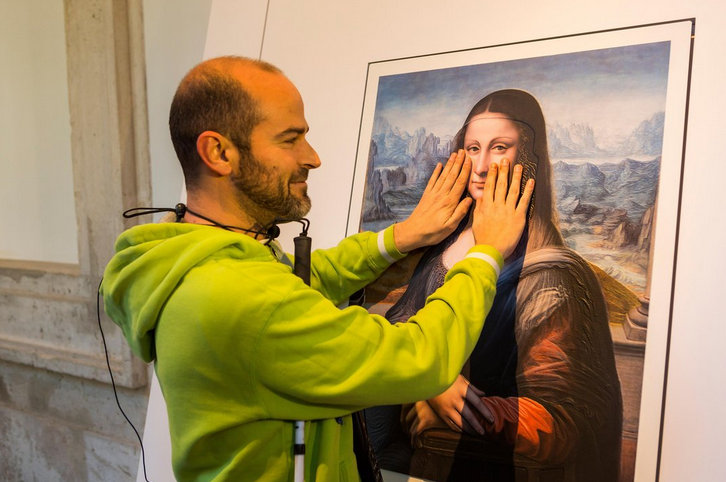
Are you one of the millions of sighted visitors who’ll visit a world class institution this year only to find yourself suffering from museum fatigue a couple of hours in? You know, that moment when all the paintings start to look alike, still lifes, crucifixions, and teenage noblewomen swimming before your eyes?
If so, may we recommend closing your eyes and limiting yourself to an in-depth study of a half dozen paintings? That’s the number of works on display in Hoy toca el Prado, Madrid’s Museo del Prado’s landmark exhibition aimed at people with visual disabilities.
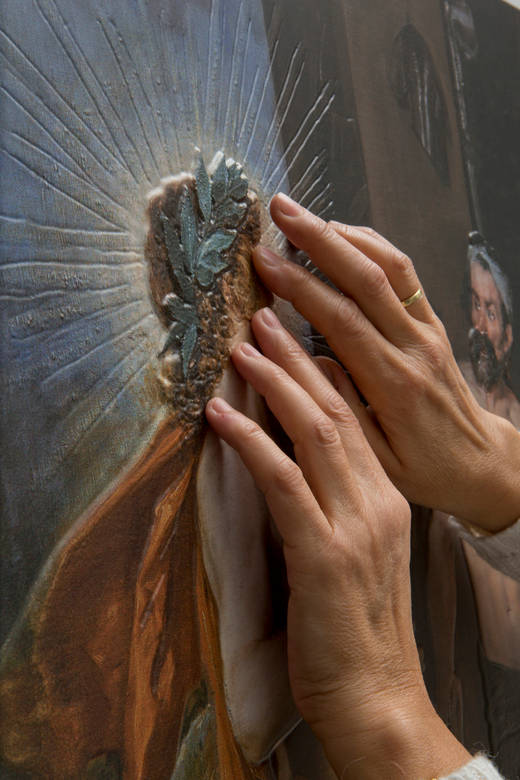
The Louvre, New York’s Metropolitan Museum of Art, and London’s National Gallery all have touch-friendly programming that allows blind visitors to experience sculptural works with their hands. The Prado’s initiative is unique in that it applies 3D printing techniques to reproductions of painted—i.e. flat—work.
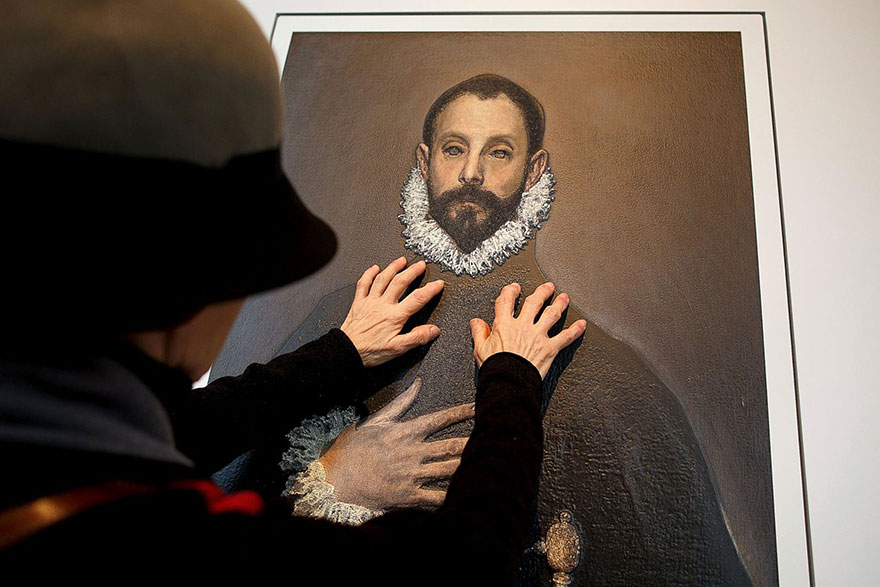
Certain aspects of each painting, including textures, were selected for showcasing in the 3D reproductions. A chemical process involving ultraviolet light and special ink resulted in a few millimeters of added volume. The reproductions retained the originals’ color, for visually impaired visitors with the ability to perceive it.
Image courtesy of The Prado
Sighted patrons can try their hands at experiencing such works as The Parasol by Goya and Velazquez’s Vulcan’s Forge in a non-visual way by donning opaque glasses. Texts are in braille. Audioguides are accessible to all.
According to the original’s record in the museum’s catalog, El Greco’s The Nobleman with His Hand on His Chestis notable for the “expressive gaze its sitter directs at the viewer.” The exhibit’s curator reported that one of the first blind visitors to come through wanted to know the subject’s eye color. He found that he could not confidently respond without double checking.
Some YouTuber posted online a pretty nice clip of an espresso shot being pulled from a La Marzocco FB80 espresso machine at 120 frames per second. They recommend muting the sound, then putting on your own music. I gave it a quick shot with the famous soundtrack for Kubrick’s 2001: A Space Odyssey. And I’ll be damned, it syncs up pretty well. Have a better soundtrack to recommend? Feel free to let us know in the comments section below.
In 2001 or 2002, guitarist and singer David Gilmour of Pink Floyd recorded a musical interpretation of William Shakespeare’s “Sonnet 18” at his home studio aboard the historic, 90-foot houseboat the Astoria. This video of Gilmour singing the sonnet was released as an extra on the 2002 DVD David Gilmour in Concert, but the song itself is connected with When Love Speaks, a 2002 benefit album for London’s Royal Academy for the Dramatic Arts.
The project was organized by the composer and conductor Michael Kamen, who died a little more than a year after the album was released. When Love Speaks features a mixture of dramatic and musical performances of Shakespeare’s Sonnets and other works, with artists ranging from John Gielgud to Ladysmith Black Mambazo.
Kamen wrote much of the music for the project, including the arrangement for Sonnet 18, which is sung on the album by Bryan Ferry. A special benefit concert to celebrate the release of the album was held on February 10, 2002 at the Old Vic Theatre in London, but Ferry did not attend. Gilmour appeared and sang the sonnet in his place. It was apparently around that time that Gilmour recorded his own vocal track for Kamen’s song.
“Sonnet 18” is perhaps the most famous of Shakespeare’s 154 sonnets. It was written in about 1595, and most scholars now agree the poem is addressed to a man. The sonnet is composed in iambic pentameter, with three rhymed quatrains followed by a concluding couplet:
Shall I compare thee to a summer’s day? Thou art more lovely and more temperate: Rough winds do shake the darling buds of May, And summer’s lease hath all too short a date; Sometime too hot the eye of heaven shines, And often is his gold complexion dimm’d; And every fair from fair sometime declines, By chance or nature’s changing course untrimm’d But thy eternal summer shall not fade, Nor lose possession of that fair thou ow’st; Nor shall death brag thou wander’st in his shade, When in eternal lines to time thou grow’st: So long as men can breathe or eyes can see, So long lives this, and this gives life to thee.
This post was originally published on Open Culture on April 5, 2013. We’re bringing it back today for Gilmour’s 69th birthday.
I think I speak for many of us when I say that coffee fuels our greatest intellectual efforts. And even as we get the jitters and leave brown rings on our desks, we can take comfort in the fact that so it also went with some of the most notable philosophers in the history of the discipline. As far back as the 18th century, no less a writer, thinker, and agitator than François-Marie Arouet, better known as Voltaire, “reportedly consumed somewhere between 40 and 50 cups of joe a day, apparently of a chocolate-coffee mixture. He lived into his eighties, though his doctor warned him that his beloved coffee would kill him.”
That comes from Amanda Scherker at The Huffington Post writing up “9 Famous Geniuses Who Were Also Huge Coffee Addicts.” Voltaire’s java habit also comes up on “10 Odd Obsessions of Famous Philosophers” by Virginia Muir at Listverse, who names his drinking venue of choice (the Café Procope in Paris) and indicates the extent of his enthusiasm by noting that “he even regularly paid exorbitant fees to have luxury coffee imported for his personal use” — which certainly doesn’t seem so eccentric today.
Later that century, Immanuel Kant took up coffee in his last days. Writing first-hand on the subject in the aptly titled The Last Days of Immanuel Kant, Thomas De Quincey (no stranger to life-changing habits himself) describes the philosopher’s “custom of taking, immediately after dinner, a cup of coffee,” a ritual he so came to relish that, whenever he sensed he may not get his new favorite beverage, there “commenced a scene of some interest. Coffee must be brought ‘upon the spot’ (a word he had constantly on his mouth during his latter days) ‘in a moment.’ ” Knowing this would happen, De Quincey made sure “the coffee was ground; the water was boiling; and the very moment the word was given, [Kant’s] servant shot in like an arrow and plunged the coffee into the water.… But this trifling delay seemed unendurable to Kant.”
In the 19th century, Søren Kierkegaard would also get into a coffee ritual. He “had his own quite peculiar way of having coffee,” writes biographer Joakim Garff. “Delightedly he seized hold of the bag containing the sugar and poured sugar into the coffee cup until it was piled up above the rim. Next came the incredibly strong, black coffee, which slowly dissolved the white pyramid.” I always drink it black myself, but who among us dares think ourselves too good for the teeth-aching preferred by the author of Fear and Trembling?
We must always bear in mind, too, that while coffee may constitute a necessary condition for our intellectual achievements, it never constitutes a sufficient one. Before pouring your next cup, whether your first of the day or your fiftieth, whether before or after dinner, and whether into a pyramid of sugar or not, ask yourself how much progress you’ve made on your own Candideor Critique of Pure Reason. A sobering question, to be sure — but after enough caffeine, you feel pretty sober anyway.
We're hoping to rely on loyal readers, rather than erratic ads. Please click the Donate button and support Open Culture. You can use Paypal, Venmo, Patreon, even Crypto! We thank you!
Open Culture scours the web for the best educational media. We find the free courses and audio books you need, the language lessons & educational videos you want, and plenty of enlightenment in between.