The concept is pretty self explanatory. Go to Radiooooo.com, pick a country, pick a decade (from 1900 to Now), and then Radiooooo.com will rev up its time machine and serve up songs from that time and place. Instantly you can hear the radio music of 1930s Sudan, 1970s Russia, and 1990s Brazil.
To learn more about Radiooooo.com, read the Indiegogo page that helped fund the original project. And one word of caution, Radiooooo.com can take a little time to load and process things. So if you make your selections and nothing happens, give things a few moments, and all should work out.
If you would like to support the mission of Open Culture, consider making a donation to our site. It’s hard to rely 100% on ads, and your contributions will help us continue providing the best free cultural and educational materials to learners everywhere. You can contribute through PayPal, Patreon, and Venmo (@openculture). Thanks!
For those who love to explore the minutia of song writing and production, Hrishikesh Hirway’s Song Exploder podcast is a godsend, and shows off the potential and power of this new media. Where else could one song get a 15 minute exploration of its meaning, writing, and recording, and from–as per this episode–Iggy Pop and Josh Homme themselves?
Iggy Pop, now 68 years old and with a voice more sepulchral than ever, has returned with Post Pop Depression, his 23rd album, his 17th as a solo artist. And according to this interview, it might just be his last. Homme, Queens of the Stone Age’s frontman, co-wrote and produced the album with Pop, and it is fair to say the collaboration is similar to those between David Bowie and Pop during the ‘70s. The instrument choice is odd and creative, with rock clichés avoided by two musicians who know them well.
In this episode, the two walk through the creation of the album’s centerpiece track “American Valhalla,” starting with Homme’s “Shitty Demo” (literally the title of the instrumental he sent to Pop) and delving into the lyric writing, Pop’s thoughts about veterans, mortality, the afterlife, and that final line, “I’ve nothing but my name.” Sure, Pop says it’s a character speaking, but it sounds a bit like an epitaph.
There’s many more surprises in this mini doc that we won’t spoil. Be sure to check out Song Exploder’s other episodes as well. Even if you’ve never heard of the song at the beginning, you’ll know it inside out by the end.
Ted Mills is a freelance writer on the arts who currently hosts the artist interview-based FunkZone Podcast. You can also follow him on Twitter at @tedmills, read his other arts writing at tedmills.com and/or watch his films here.
Many of us today think of Vincent Price as the face, and an even more so the voice, of modestly budgeted midcentury horror movies. But over his long and prolific career, he showed just what multitudes he could contain. Price could elevate schlock, of course, but he could also rise to the challenge of masterpieces: here on Open Culture, we’ve previously featured his readings, on record and on camera, of the work of Edgar Allan Poe, the original master of the psychologically troubling tale. Today, we have for you a set of recitations well outside the realm of the scary: Price reading the poetry of Percy Bysshe Shelley, free on Spotify (whose software you can download here).
Shelley, as anyone interested in 19th-century English poetry knows, didn’t have a long career, but the candle that burns quickly, as they say, burns bright. Before his death at the age of 29 in a storm on the Gulf of Spezia, he managed to write such immortal works as Music, When Soft Voices Die, Ozymandias, To a Skylark, Ode to the West Wind, and the drama Prometheus Unbound, all of which we hear Price read whole, or in part, in this playlist. And for its final four tracks, we hear famed English stage actor Ralph Richardson deliver four poems from the equally enduring legacy of Shelley’s rough contemporary Samuel Taylor Coleridge, including Kubla Khanand The Rime of theAncient Mariner.
The vividness of the imagery and the timeless resonance of the themes in both poets’ work hold up well on the page, but no matter how many times you’ve read it, hearing it interpreted by performers like Price and Richardson can let you experience it in a new way. Their dramatic backgrounds empower them to bring out levels of emotion you might never have felt in your own reading; certainly Price’s world-weary yet faintly arch tone does well with Ozymandias’ gaze-into-the-abyss evocation of hubris, impermanence, and the ultimate fate in oblivion of all things great and small. Maybe the man who starred in The Pit and the Pendulum never really strayed far from horror after all.
At its best, architecture can show us a way out of the rigid, routinized thinking that keeps us pacing the same social and cultural mazes decade after decade. A radical redesign of the way we use space can herald a re-imagining of our interrelations, hierarchies, and political dynamics. Consider the inspiring work, for example, of visionary futurist Buckminster Fuller. (Or consider the very different career of recently departed Zaha Hadid, who “built the unbuildable,” writes one former student, and “defied gravity.”) At its worst, architecture imprisons us, literally and otherwise, mindlessly populating the built environment with drab, prefabricated boxes, and reproducing conditions of repression, poverty, and mediocrity. The way we build determines in great degree the way we live.
But the influence of an individual architect or school will always exceed the designers’ intentions. Perhaps the most famous of 20th century modern architecture and design movements, Walter Gropius’ Bauhaus school, contributed a vocabulary of simplified geometrical designs and primary color schemes that pushed European aesthetics out of a stifling traditionalism.
And yet, their modernist insistence on boxiness, on materials like steel, concrete, and glass, and on a near total lack of ornament, helped bring into being the strip mall and the office park. Likewise, the urban utopian architect Le Corbusier deliberately sought to engineer social improvement through building design, and also helped birth a depressingly bleak landscape of housing projects and “structures that reinforce deteriorating social effects.”
So what distinguishes good architecture from bad? And where did the postmodern mélange of styles that make up the typical urban environment come from? Ask 100 architects the first question, and you might get 100 different answers. But you can go a long way toward answering the second question by learning the history of the many great buildings that have directly or indirectly inspired millions of imitators worldwide. And you can do that for free at the Youtube channel ACB (Art and Culture Bureau), which features over 50 documentaries, writes Arch Daily, “devoted to the most significant achievements of architecture, its beginnings, and the latest creations of the great architects of today.”
Maybe begin with the Bauhaus film, at the top of the post, an almost thirty-minute history of the fascinating post-WWI movement, school, and building in Dessau, Germany. Be sure to also catch films on Paris’ Georges Pompidou Centre, the 17th century Tomb of Itimad-ud-Daulah (called the “baby Taj Mahal”), Le Corbusier’s Brutalist Convent of La Tourette, and Zaha Hadid’s Phaeno science center, among many, many more. All of the films are directed by Richard Copans and some of them have interviews with the architects themselves. See the full list of documentaries here.
Talk to nearly any veteran of sixties counterculture, and you’re bound to hear a story or three about an acid trip. Some of those trips were bad, man, full of nightmare hallucinations and severe anxiety. In other accounts, however, LSD gets credit for opening up the mind, releasing old patterns of thought, and freeing up latent creative energy. From Ken Kesey to R. Crumb, these stories abound. Are they credible? Now that scientists have once again begun to study the drug—first synthesized in 1938 and used in experiments in the 50s and 60s until it was banned nearly everywhere—they are finding concrete answers using the latest in brain imaging technology.
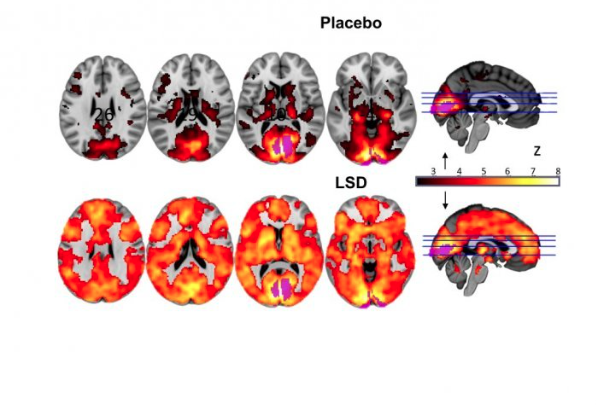
And it appears that LSD—-in a controlled laboratory setting at least—“can be seen as reversing the more restricted thinking we develop from infancy to adulthood.” So reports The Guardian in regard to experiments recently conducted by neuropharmacologist David Nutt, former “drugs advisor” for the British government. Nutt gave volunteer subjects an injection of LSD, then captured the first images ever recorded of the brain on acid. You can see dramatic animations of those scans in the video at the top of the post, comparing the brains of test subjects on the drug and those on placebo, and see some static images above. The study, says Nutt, “is to neuroscience what the Higgs boson was to particle physics.” In an interview with Nature, he describes LSD research as a “way to study the biological phenomenon that is consciousness.”
What the subjects experienced won’t necessarily surprise anyone who has been on one of those legendary, mind-altering trips: researchers found, writes The Guardian, that “under the drug, regions [of the brain] once segregated spoke to one another,” producing hallucinations, “feelings of oneness with the world,” and “a loss of personal identity called ‘ego dissolution.’” However, prior to this study, Nutt says, “we didn’t know how these profound effects were produced.” There has been precious little data, because “scientists were either scared or couldn’t be bothered to overcome the enormous hurdles to get this done.”
Working with the Beckley Foundation, which studies psychoactive drugs and promotes policy reform, Nutt and his colleague Robert Carhart-Harris crowdfunded their study; in the video above, you can hear them both describe the goals and rationale of their research. What they eventually found, The Guardian reports, was that “under the influence, brain networks that deal with vision, attention, movement and hearing became far more connected, leading to what looked like a ‘more unified brain.’”
But at the same time, other networks broke down. Scans revealed a loss of connections between part of the brain called the parahippocampus and another region known as the retrosplenial cortex.
Nutt and his colleagues have more specific experiments planned, he tells Nature, “to look at how LSD can influence creativity, and how the LSD state mimics the dream state.” And just as the drug was tested decades ago as a therapy for addictions and psychiatric disorders, Nutt hopes he can conduct similar trials. But his research has an even larger scope: As Amanda Feilding, director of the Beckley Foundation, puts it, “We are finally unveiling the brain mechanisms underlying the potential of LSD, not only to heal, but also to deepen our understanding of consciousness itself.” We look forward to Nutt’s further research findings. Perhaps someday, LSD will be available with a prescription. Until then, it’s probably wise not to try these experiments at home.
“Jam” Handy (1886–1983) was known for two things: 1.) participating in the 1904 and 1924 Olympics (quite a feat if you think about the gap in time), and 2.) making thousands of educational training films for American corporations, schools and the US armed forces. A guru of cinematic advertising, he shot films for General Motors, DuPont, Chevrolet, Coca-Cola and U.S. Steel, from the 1930s through the 1960s.
Above you can watch Back of the Mike, a film shot for Chevrolet in 1938. Like other films in this genre, this piece of cinematic advertising offers us an entertaining, if not educational, look at how old-time radio shows created their sound effects–all while helping market a product, the Chevrolet that helps the good guys win in the end. If the film makes you want to buy a Chevy, we can’t help you there. But if Back of the Mikegives you a hankering to listen to old time radio plays, then you’ve come to the right place. We’ve got a few good items listed for you in the Relateds below.
If you would like to support the mission of Open Culture, consider making a donation to our site. It’s hard to rely 100% on ads, and your contributions will help us continue providing the best free cultural and educational materials to learners everywhere. You can contribute through PayPal, Patreon, and Venmo (@openculture). Thanks!
By their color palettes, by their dramatic structures, by their shot lengths, by the frequency and variety of their characters’ swearing: film enthusiasts have found ways to analyze just about every aspect of film. But only recently has the world of film analysis seen a large-scale study of dialogue by gender and age — in fact, the largest-scale study of dialogue by gender and age yet — undertaken by a new site called Polygraph, “a publication that explores popular culture with data and visual storytelling.” They wanted to put to the data test part of the notion, widely expressed in opinion pieces, that “white men dominate movie roles.”
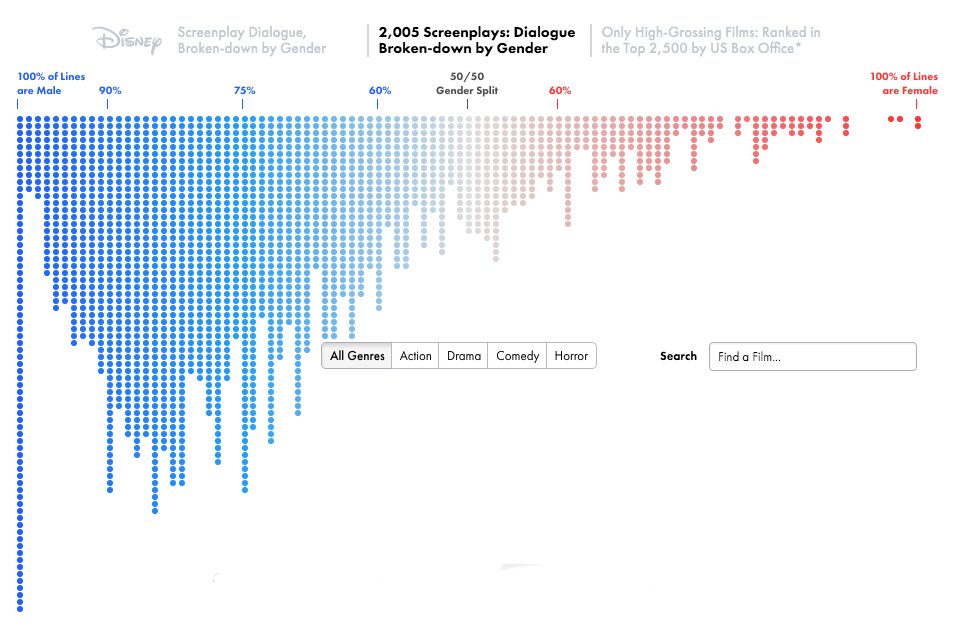
“We Googled our way to 8,000 screenplays and matched each character’s lines to an actor,” write Polygraph’s Hannah Anderson and Matt Daniels. “From there, we compiled the number of words spoken by male and female characters across roughly 2,000 films, arguably the largest undertaking of script analysis, ever.” They present their quantitative results with great visual clarity, and you can view them for three distinct areas of cinema territory: just the 2,000 screenplays the study focused on; only high-grossing films at the American box office; and only Disney movies (known, of course, for their abundance of princesses, with or without many lines).
“Across thousands of films in our dataset,” they write, “it was hard to find a subset that didn’t over-index male. Even romantic comedies have dialogue that is, on average, 58% male. For example, Pretty Woman and 10 Things I Hate About You both have lead women (i.e., characters with the most amount of dialogue). But the overall dialogue for both films is 52% male, due to the number of male supporting characters.” And as far as age, “dialogue available to women who are over 40 years old decrease substantially. For men, it’s the exact opposite: there are more roles available to older actors.”
Depending on what kind of films you watch, this may well jibe with your viewing experience: mainstream stories have long tended to favor macho and often mature protagonists, and the antagonists they defeat in man-to-man combat have sometimes reached advanced ages indeed (all the more time, presumably, in which to have mastered the art of villainy, especially of the one-last-grand-speech-before-I-destroy-the-world variety). The women, and usually young women, featured in such pictures, when they appear at all, have to do much of their communication nonverbally.
This all supports a complaint I’ve long had about the movies, mainstream or otherwise: over a century in existence, and they’ve hardly touched the vast creative space available to them. The all-female Ghostbusters coming this summer will surely do its small part to rectify the lack of woman-delivered dialogue on the silver screen, but the depth of the deficiency, as revealed by Polygraph, suggests we could do with a few all-female Glengarry Glen Rosses as well.
On an ordinary afternoon, a group of friends sit around listening to records. Someone puts on a Willie Nelson album, and there is a knock at the door. It’s an older man, making a delivery. He pauses behind his clipboard, hearing the music from inside the house. “Is that Red Headed Stranger,” he asks? Yes. He asks if he can come in and listen. And for the next thirty minutes, no one says a word as the album tells its mournful tale of betrayal and bloody revenge, a story, writes Allmusic “about a preacher on the run after murdering his departed wife and her new lover.” It’s an album that remains—with its “brief song-poems and utterly minimal backing”—perhaps “the strangest blockbuster country produced.”
That 1975 album of tear-jerkers and murder ballads, which established Nelson as a “superstar recording artist,” is so “old-fashioned” it sounds “like a tale told around a cowboy campfire.” And it is for that reason millions of fans can’t tear themselves away from its compelling narrative and achingly sad, homespun laments—including myself, a few friends, and a stranger on a schedule who came to the door. And if Red Headed Stranger is an unlikely blockbuster, Nelson is an unlikely superstar, full of contradictions. He’s a gentle outlaw; an old-fashioned country troubadour who has remained on the progressive activist edge; and an unassuming, traditional artist who happens to be loved across the spectrum of generations, political persuasions, and musical styles.
But before Nelson became an international superstar he appeared on the country music circuit clean-shaven, short-haired, and in the natty suit and tie you see him wear in the clip above from a televised 1962 Grand Ole Opry performance. Close your eyes and you’ll hear that it’s undoubtedly Nelson’s familiar warble—though not so weathered with age as we’ve grown used to. But when you look, it’s hard to see the grizzled tax-evading, pot-smoking outlaw hippie hero we know and love in this fresh-faced gent. Nelson had only just moved to Nashville two years prior, and he struggled to make an impression at first. But when country singer Faron Young heard him sing his “Hello Walls” at a bar next to the Opry, his fortunes changed. Young sent the song into the top 40, and Nelson became, as the host above calls him, “the Mickey Mantle of country music,” writing hit after hit.
By ’62, he had recorded his first LP, And Then I Wrote, singing many songs he’d given to other artists. He opens above with “Hello Walls,” and he closes with his other massive hit from the period, “Crazy,” Patsy Cline’s signature tune. In-between, Nelson sings another song from his debut album, Billy Walker’s “Funny How Time Slips Away,” and works in “Night Life,” a blues song he wrote for Ray Price. Only eight years after this TV appearance, Nelson decided to retire from music and pack it in, feeling like his career had run its course. It wasn’t until a couple years later—after he’d become part of Austin’s eclectic music scene and re-invented himself musically with 1973’s Shotgun Willie—that the outlaw balladeer we know and love was born.
We're hoping to rely on loyal readers, rather than erratic ads. Please click the Donate button and support Open Culture. You can use Paypal, Venmo, Patreon, even Crypto! We thank you!
Open Culture scours the web for the best educational media. We find the free courses and audio books you need, the language lessons & educational videos you want, and plenty of enlightenment in between.