
FYI: This special deal is now over…
You can see their standard 0ffer–an all-access pass to their catalogue of 70+ courses–here.
FYI: This special deal is now over…
You can see their standard 0ffer–an all-access pass to their catalogue of 70+ courses–here.
When David Lynch and Mark Frost’s Twin Peaks premiered on ABC in 1990, viewers across America were treated to a televisual experience like none they’d ever had before. Four years earlier, something similar had happened to the unsuspecting moviegoers who went to see Lynch’s breakout feature Blue Velvet, an experience described as eye-opening by even David Foster Wallace. A dedicated meditator with an interest in plunging into unexplored realms of consciousness, Lynch tends to bring his audience right along with him in his work, whether that work be cinema, television, visual art, music, or comic strips. Only natural, then, that Lynch would take an interest in the artistic and experiential possibilities of virtual reality.
Last year we featured the first glimpse of a Twin Peaks virtual reality experience in development, revealed at Lynch’s Festival of Disruption in Los Angeles. “The best news is that the company developing the game, Collider Games, is giving creative control to Lynch,” wrote Ted Mills, and now, with the release of Twin Peaks VR’s official trailer, we can get a clearer idea of what Lynch has planned for players. As Laura Snoad writes at It’s Nice That, Lynch has used the opportunity to revisit “well-known environments featured in the series, such as the iconic Red Room (the stripy-floored, velvet curtain-clad parallel universe where Agent Cooper meets murdered teen Laura Palmer), the Twin Peaks’ Sheriff’s Department and the pine-filled forest around the fictional Washington town.”
This will come as good news indeed to those of us Twin Peaks enthusiasts who’ve made the pilgrimage to Snoqualmie, North Bend, and Fall City, the real-life Washington towns where Lynch and his collaborators shot the series. But Twin Peak VR will offer a greater variety of challenges than snapping photos of the series’ locations and chatting with bemused locals: Snoad writes that each environment is constructed like an escape room. “Solving puzzles to help Agent Cooper and Gordon Cole (the FBI agent played by Lynch himself), players will also meet some of the show’s weird and terrifying characters, from the backwards-speaking inhabitants of the Black Lodge to the terrifying Bob himself.”
Available via Steam on Oculus Rift, Vive, and Valve Index this month, with Oculus Quest and PlayStation VR versions scheduled, Twin Peaks VR should give a fair few virtual-reality holdouts a compelling reason to put on the goggles — much as Twin Peaks the show caused the cinéastes of the 1990s to break down and watch evening TV. Enjoying Lynch’s work, whatever its medium, has always felt like plunging into a dream: not like watching his dream, but experiencing a dream he’s made for us. If virtual-reality technology has finally come anywhere close to the vividness of Lynch’s imagination, Twin Peaks VR will mark the next step in his artistic evolution. But for now, to paraphrase no less a Lynch fan than Wallace, the one thing we can say with total confidence is that it will be… Lynchian.
via It’s Nice That
Related Content:
Watch an Epic, 4‑Hour Video Essay on the Making & Mythology of David Lynch’s Twin Peaks
Twin Peaks Actually Explained: A Four-Hour Video Essay Demystifies It All
David Lynch Is Creating a Virtual Reality Experience for Twin Peaks
Twin Peaks Tarot Cards Now Available as 78-Card Deck
David Lynch Directs a Mini-Season of Twin Peaks in the Form of Japanese Coffee Commercials
Play the Twin Peaks Video Game: Retro Fun for David Lynch Fans
Based in Seoul, Colin Marshall writes and broadcasts on cities, language, and culture. His projects include the book The Stateless City: a Walk through 21st-Century Los Angeles and the video series The City in Cinema. Follow him on Twitter at @colinmarshall or on Facebook.
Meditation and art have an ancient, intertwined history in China, where the beginnings of Chan Buddhism are inseparable from landscape painting. In Japan, Zen art has constituted “a practice in appreciating simplicity,” of disappearing into the creative act, cultivating degrees of egolessness that allow an artist’s movements to become spontaneous and unhampered by second guesses. The “first Japanese artists to work in [ink],” notes the Metropolitan Museum of Art, “were Zen monks who painted in a quick and evocative manner.” They passed their techniques, and their wisdom, on to their students.
Perhaps the closest analogue to this tradition in the west is comic art. Artist Ted Gula has worked with comics legends Frank Frazetta and Moebius and drawn for Disney, Marvel, and DC. As a child, he watched Jack Kirby work. “He wouldn’t speak,” says Gula. “He’d be in a trance…. The pencil would hit the paper and it wouldn’t stop until the page was complete, like it poured out.” How is that possible? Gula asked himself, astonished. Kirby had disappeared into the work. There were no preliminary sketches or rough indicators. He would draw an entire book like that, Gula says in the video above from Proko.
Say what you will about the content of Kirby’s work—superhero comics aren’t to everyone’s liking. But no distaste for the nature of his storytelling diminishes Kirby’s attainment of a purely extemporaneous method he seems never to have explained to Gula in words. Later, however, while working with Moebius, Gula says, he learned the technique of “automatic drawing.” Demonstrating it for us above, Gula describes a way of drawing that shares much in common with other meditative visual art traditions.
“It’s all doing very organic shapes,” he says, showing us how to “draw your mind’s eye. This takes your mind, and your mind’s eye, to a place that normally is unexplored, and it can’t help but enhance your whole view of your ability.” The ego must step aside, executive functioning isn’t needed here. “I have no idea,” Gula says, “it’s all just happening on its own.” Moebius explained it as “just letting my mind relax” and Gula has observed similar practices among all the artists he’s worked with.
Gula describes automatic drawing as a natural process for the artist’s mind and hands. The interviewer, artist and teacher Sam Prokopenko, also mentions Korean artist Kim Jung Gi in their interview, who does “amazingly accurate drawings from his memory without any construction lines,” as Prokopenko says above, in a video from his “12 Days of Proko” series, which interviews well-known artists about their techniques. What’s Kim Jung Gi’s secret? Is he possessed of a superhuman, photographic memory? No, he tells Prokopenko.
The secret to becoming fully immersed in the work—one that surely goes for so many pursuits, both creative and athletic—is just to do it: over and over and over and over and over again. (To many people’s disappointment, this also seems to be the secret of meditation.) In Kim Jung Gi’s case, “of course, some part of it is a talent he was born with, but we can’t overlook how much that talent was developed.” We need no expert talent, either innate or developed, to get started. Automatic drawing seems to require a beginner’s mind.
Related Content:
Moebius Gives 18 Wisdom-Filled Tips to Aspiring Artists
Watch Moebius and Miyazaki, Two of the Most Imaginative Artists, in Conversation (2004)
Moebius’ Storyboards & Concept Art for Jodorowsky’s Dune
Josh Jones is a writer and musician based in Durham, NC. Follow him at @jdmagness
The world of tomorrow, today, has been the promise of so much futurism of the modern industrial age, in times that now seem quaint to us from our digital perches. Today’s self-appointed visionaries can’t seem to imagine life on Earth a hundred years from now. They pour their resources into interplanetary ventures. But even if some contingent of humanity goes on to colonize the solar system and beyond, there will always be a role for fashion, even in the austere environs of deep space.
Still, if predicting the future of humanity is a risky proposition, given the number of unpredictable variables at play, predicting future fashions may be even more fraught with peril. Trends don’t come out of nowhere—they draw, self-consciously or otherwise, from the past. But which pasts end up in the latest season’s collections might be anyone’s guess. Unlike technology, in other words, fashion doesn’t appear to follow any sort of linear trajectory from invention to invention.
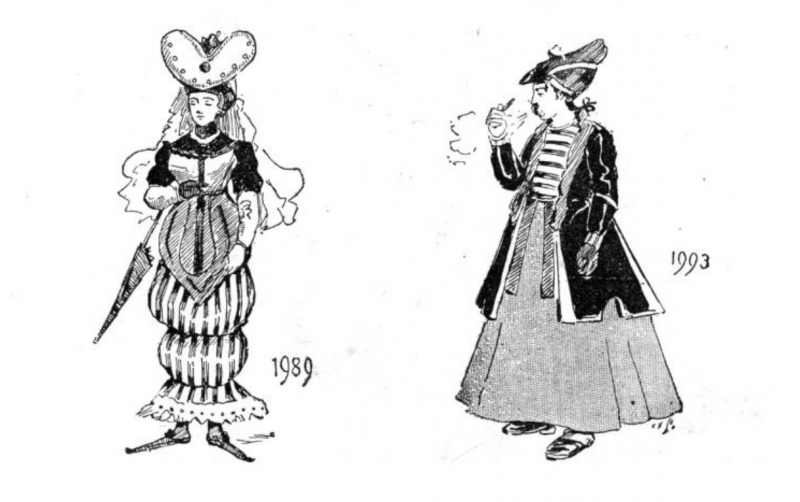
“Fashion,” writes W. Cade-Gall in an 1893 article in the Strand Magazine, “is thought a whim, a sort of shuttlecock for the weak-minded of both sexes to make rise and fall, bound and rebound with the battledore called—social influence.” All of this will be remedied almost fifty years in the future, the author assures their readers. “It will interest a great many people to learn that Fashion assumed the dignity of a science in 1940.” Cade-Gall’s sci-fi satire is not, perhaps, the most serious attempt at predicting future fashions, but it may rank as one of the most amusingly literary.
The article, “Future Dictates Fashion” (read online here and at the Internet Archive) purports to describe the contents of a book, discovered by “an elderly gentleman of our acquaintance,” from one hundred years in the future, or 1993, a time, as you can see in the drawing at the top, in which the 18th century has come roaring back, with what appears to be a tricorner hat perched on what appears to be the head of a man smoking a pipe and wearing an ankle-length skirt. Cade-Gall describes the scientific system of fashion in detail, with each historical period acquiring both a “Type” and a “Tendency.”
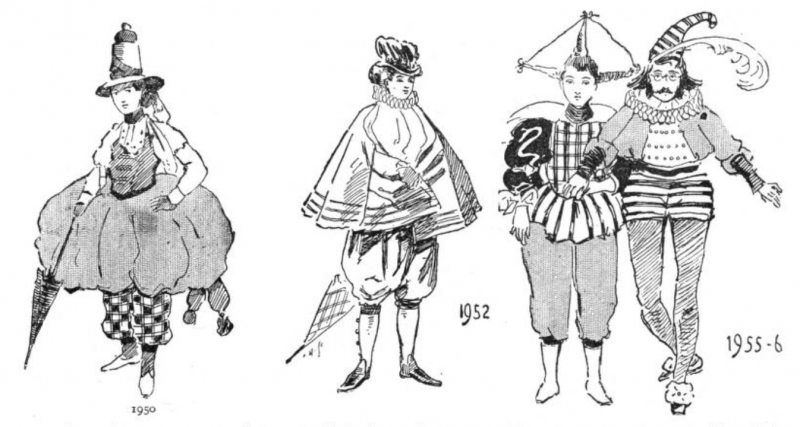
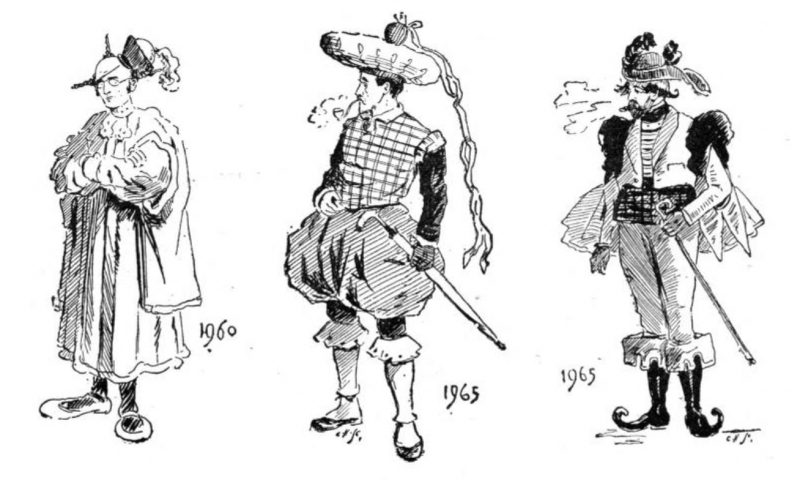
The period between 1915 and 1940, for example, the last one listed in the future fashion history book’s table, is said to be of the type “Hysterical” and the tendency “Angustorial.” Cade-Gall not only invented the word “angustorial” and this clever story within a story (which turns out to be a dream) but also illustrated the fashions of the imagined 20th century, with the conceit that these are printed plates from the future. Readers familiar with the costume designs of the Bauhaus school might see the 1929 illustrations as somewhat uncanny.
Other fashions look like the kind of thing David Bowie might have worn onstage in the early 70s, and some are clearly portmanteaus of different eras and their qualities—from the “bizarre,” “ebullient,” and “hysterical” to the “severe,” “opaque,” and “latorial,” a word, like “angustorial,” that Cade-Gall made up for this occasion. The descriptions of these fashions are as detailed and ridiculous as the illustrations. “Taught by the Darwinian theory” in 1930 we learn, “society discovered whence its tendency to baldness originated. They had recourse by degrees to flexible tiles of extraordinary cut.”
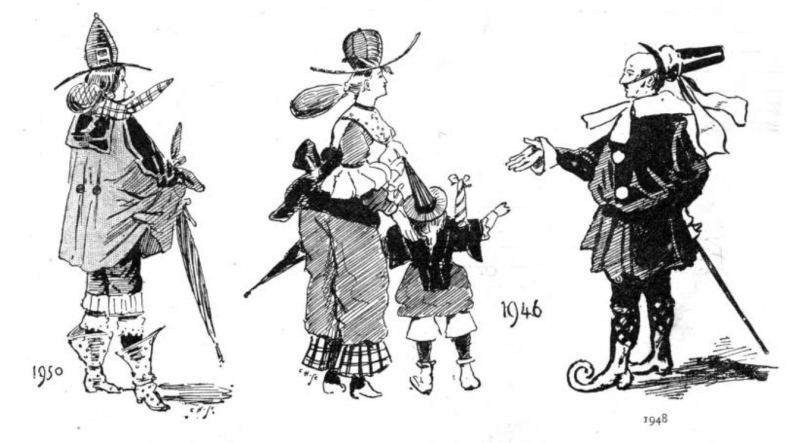
The hairpiece innovation followed some indecision over mens’ pants ten years earlier, which led to a period of knee-breeches. “Trousers, which had been wavering between nautical buttons and gallooned knees—or, in the vernacular of the period, a sail three sheets in the wind—and a flag at half-mast—were the items sacrificed.” It’s all in good fun—more a send-up of the overly-serious meaning attached to clothing than an attempt to look into fashion’s future. But imagining a 20th century dressed the way Cade-Gall imagines it might make us pine for a more ostentatiously (if impractically) dressed past—or a more ebullient and latorial future, whether on Earth or gallooned amongst the stars.
via JF Ptak Science Books/Public Domain Review
Related Content:
Josh Jones is a writer and musician based in Durham, NC. Follow him at @jdmagness

Time-travel rules in The Terminator franchise are notoriously inconsistent. Is it possible for someone from the future to travel backwards to change events, given the paradox that with a changed future, the traveler wouldn’t then have had the problem to try to come back and fix? Neither the closed-loop series of events in the first Terminator film nor the changed (postponed) future in the second make sense, and matters just get worse through the subsequent films.
Mark Linsenmayer, Erica Spyres, and Brian Hirt are joined by Brian’s brother and co-author Ken Gerber to talk through the various time travel rulesets and plot scenarios (a good starter list is at tvtropes.org), covering Dr. Who, Back to the Future, Looper, Dark (the German TV show), time loop films a la Groundhog Day (Edge of Tomorrow, Happy Death Day), time-travel comedies (Future Man), historical tourism (Mr. Peabody and Sherman), Timecop’s “The same matter cannot occupy the same space,” using time-travel to sentimentalize (About Time) or clone yourself (see that Brak Show episode about avoiding homework), and freezing time (like in the old Twilight Zone).
Some articles we looked at included:
You can find the Brian and Ken short stories we talk about at gerberbrothers.net. Listen to them podcast together and read the science fiction stories they publish at constellary.com. The Partially Examined Life podcast episode Mark hosted where the dangers of AI are discussed is #108 with Nick Bostrom.
This episode includes bonus discussion that you can only hear by supporting the podcast at patreon.com/prettymuchpop. This podcast is part of the Partially Examined Life podcast network.
Pretty Much Pop: A Culture Podcast is the first podcast curated by Open Culture. Browse all Pretty Much Pop posts or start with the first episode.

Image via Wikimedia Commons
Are plants sentient? We know they sense their environments to a significant degree; like animals, they can “see” light, as a New Scientist feature explains. They “live in a very tactile world,” have a sense of smell, respond to sound, and use taste to “sense danger and drought and even to recognize relatives.” We’ve previously highlighted research here on how trees talk to each other with chemical signals and form social bonds and families. The idea sets the imagination running and might even cause a little paranoia. What are they saying? Are they talking about us?
Maybe we deserve to feel a little uneasy around plant life, given how ruthlessly our consumer economies exploit the natural world. Now imagine we could hear the sounds plants make when they’re stressed out. In addition to releasing volatile chemicals and showing “altered phenotypes, including changes in color, smell, and shape,” write the authors of a new study published at bioRxiv, it’s possible that plants “emit airborne sounds [their emphasis] when stressed—similarly to many animals.”
The researchers who tested this hypothesis at Tel Aviv University “found that tomato and tobacco plants made sounds at frequencies humans cannot hear,” New Scientist reports. “Microphones placed 10 centimetres from the plants picked up sounds in the ultrasonic range of 20 to 100 kilohertz, which the team say insects and some mammals would be capable of hearing and responding to from as far as 5 metres away.”
The plants made these sounds when stressed by lack of water or when their stems were cut. Tomato plants stressed by drought made an average of 35 sounds per hour. Tobacco plants, on average, made 11. Unstressed plants, by contrast, “produced fewer than one sound per hour.” The scientists used machine learning to distinguish between different kinds of distress calls, as it were, and different kinds of plants, “correctly identifying in most cases whether the stress was caused by dryness or a cut,” and they conducted the experiments in both closed acoustic chambers and a greenhouse.
Plants do not, of course, have vocal cords or auditory systems. But they do experience a process known as “cavitation,” in which “air bubbles form, expand and explode in the xylem, causing vibrations,” the paper explains. These vibrations have been recorded in the past by direct, contact-based methods. This new study, which has yet to pass peer review, might be the first to show how plants might use sound to communicate with each other and with other living organisms, suggesting “a new modality of signaling.”
The possibilities for future research are fascinating. We might learn, for example, that “if plants emit sounds in response to a caterpillar attack, predators such as bats could use these sounds to detect attacked plants and prey on the herbivores, thus assisting the plant.” And just as trees are able to respond to each other’s distress when they’re connected in a forest, “plants could potentially hear their drought stressed or injured neighbors and react accordingly”—however that might be.
Much remains to be learned about the sensory lives of plants. Whether their active calls and responses to the stimuli around them are indicative of a kind of consciousness seems like a philosophical as much as a biological question. But “even if the emission of the sounds is entirely involuntary,” the researchers write (seeming to leave room for plant volition), it’s a phenomenon that counts as a form of communication: maybe even what we might someday call plant language, different from species to species and, perhaps, between individual plants themselves.
Related Content:
Josh Jones is a writer and musician based in Durham, NC. Follow him at @jdmagness
With the holidays fast approaching, two interns at the Sallie Bingham Center for Women’s History and Culture at Duke University’s Rubenstein Library turned to the center’s collection of vintage advertising cookbooks for inspiration.
Their labors, and the fruits thereof—a queasy-looking Crown Jewel Dessert and a savory fish-shaped “salad” as per the Joys of Jell‑O Gelatin Dessert cookbook—are showcased above.
While the library has yet to digitize that particular early-60’s gem, there are plenty of other options from the Nicole Di Bona Peterson Advertising Cookbook Collection available for free download, including several that are gelatin based.
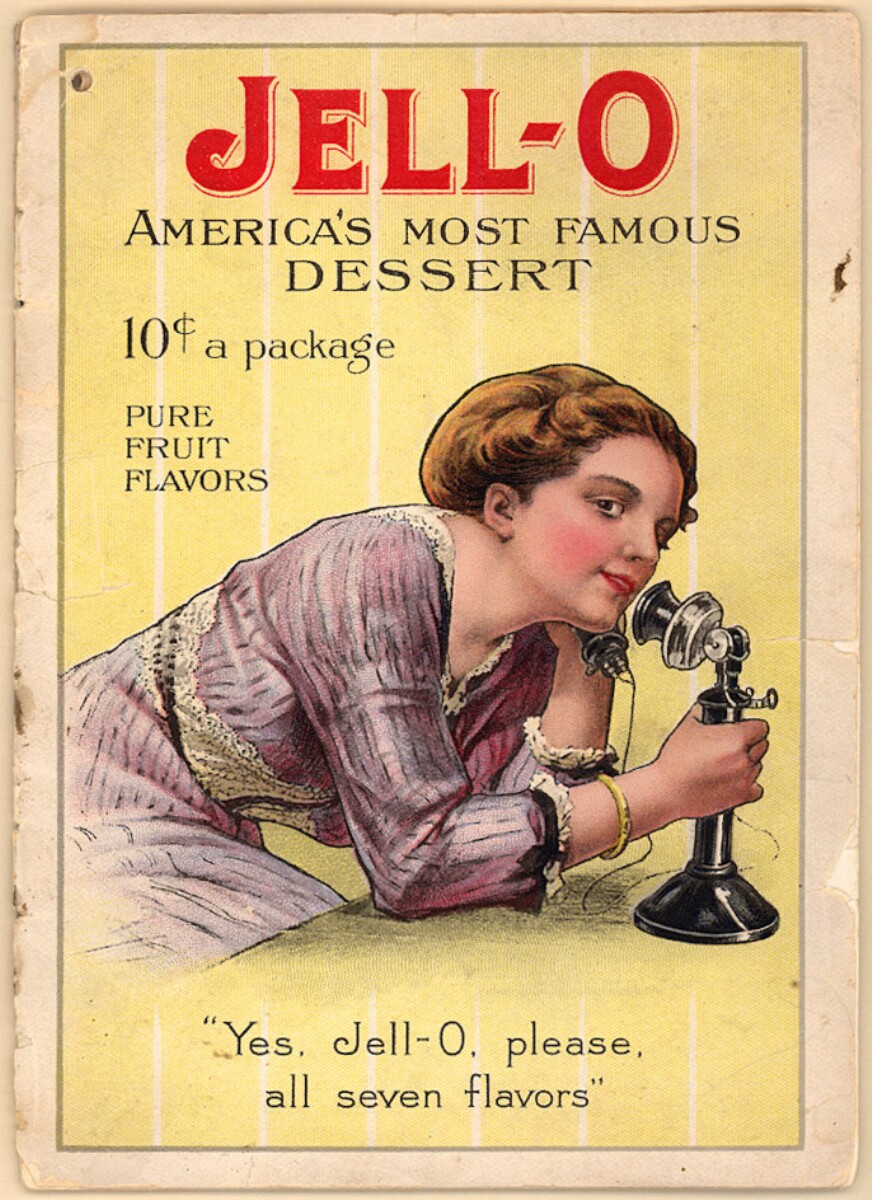
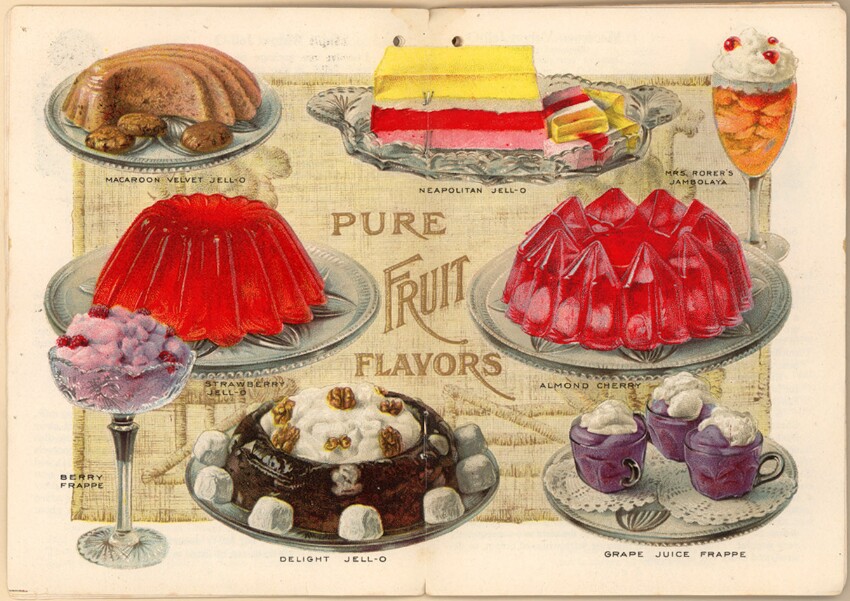
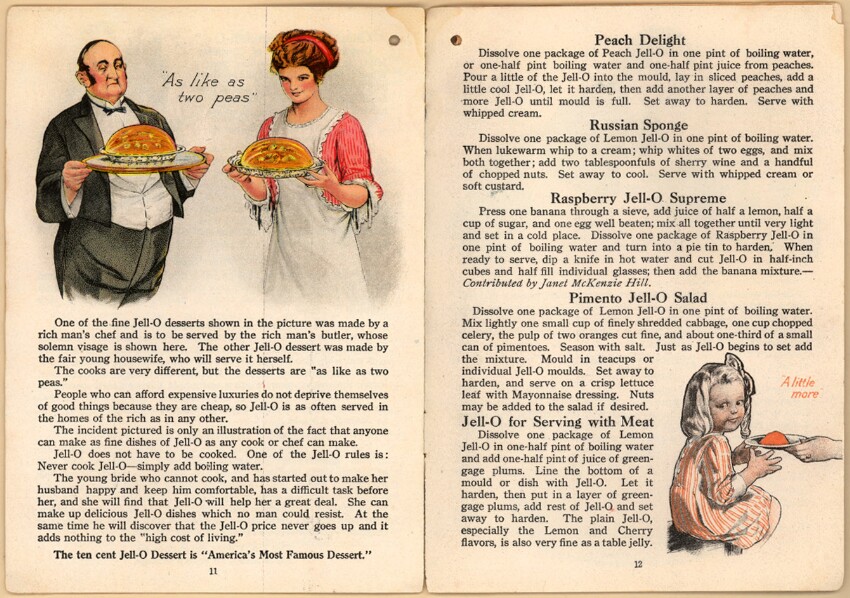
The authors of the pre-Women’s‑Suffrage Jell‑O: America’s Most Famous Dessert, would have boggled at our 21st-century abundance of flavors (and our godlike telephones), just as our eyes widen at their lush full-color illustrations and hundred-year-old social norms.
As one might expect, given the Sallie Bingham Center’s mission of preserving printed materials that reflect the public and private lives of women, past and present, these vintage cookbooks speak to far more than just culinary trends.

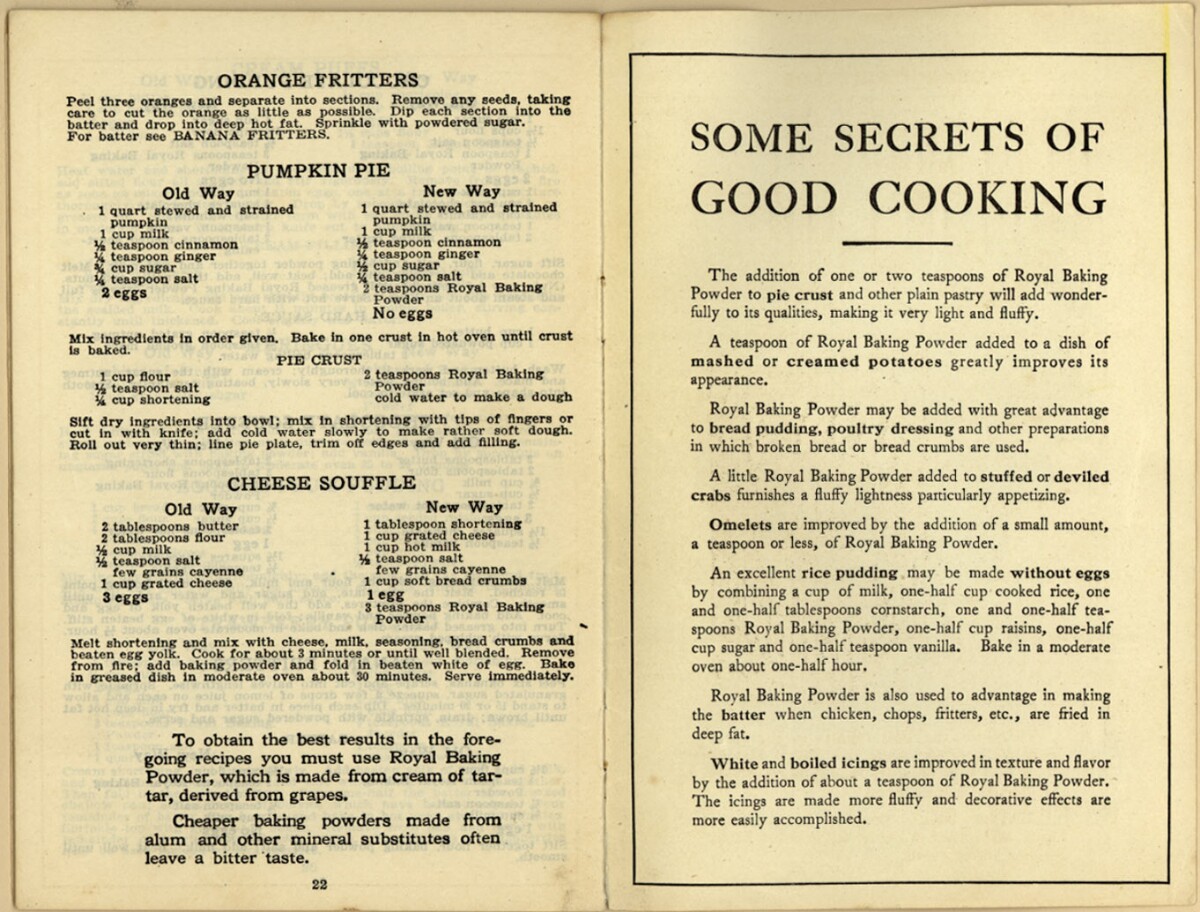
Royal Baking Powder’s 55 Ways to Save Eggs puts a positive spin on wartime economies by framing cheap ingredient substitutions as something clever and modern, attributes the young housewife depicted on the cover would surely wish to embody.
(Shout out to any home bakers who were aware that cream of tartar is derived from grapes…)
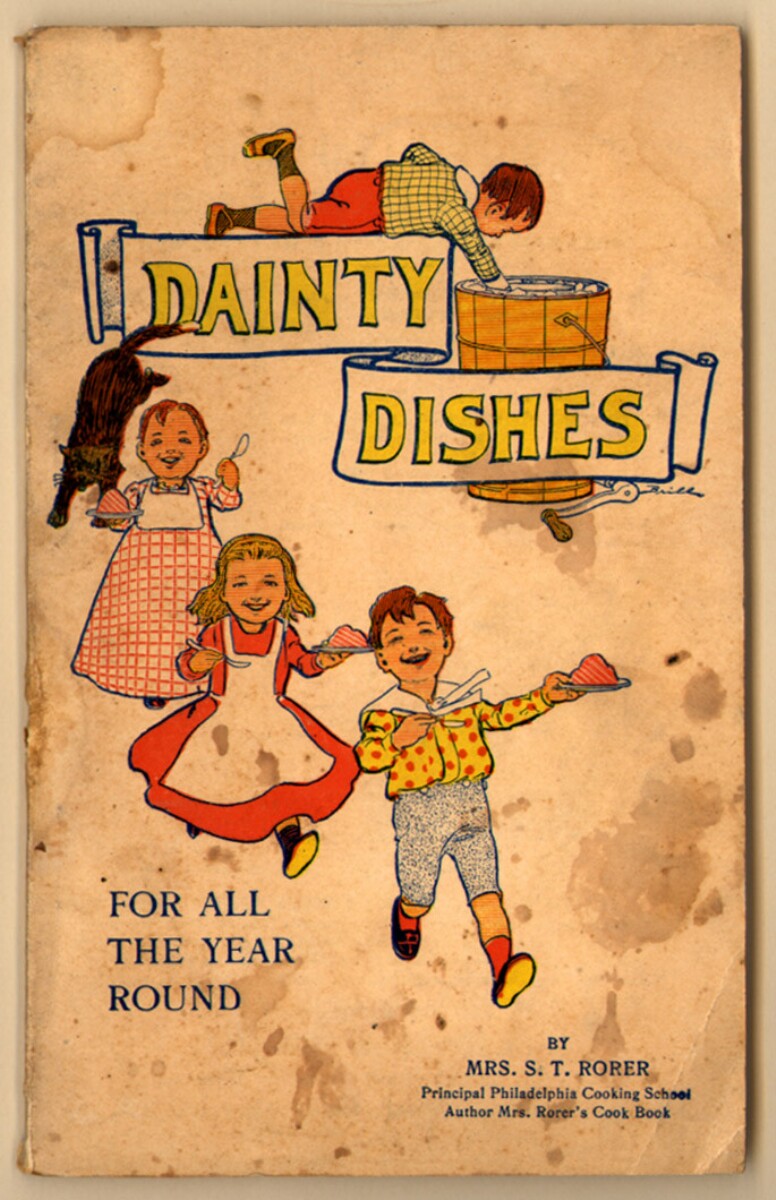
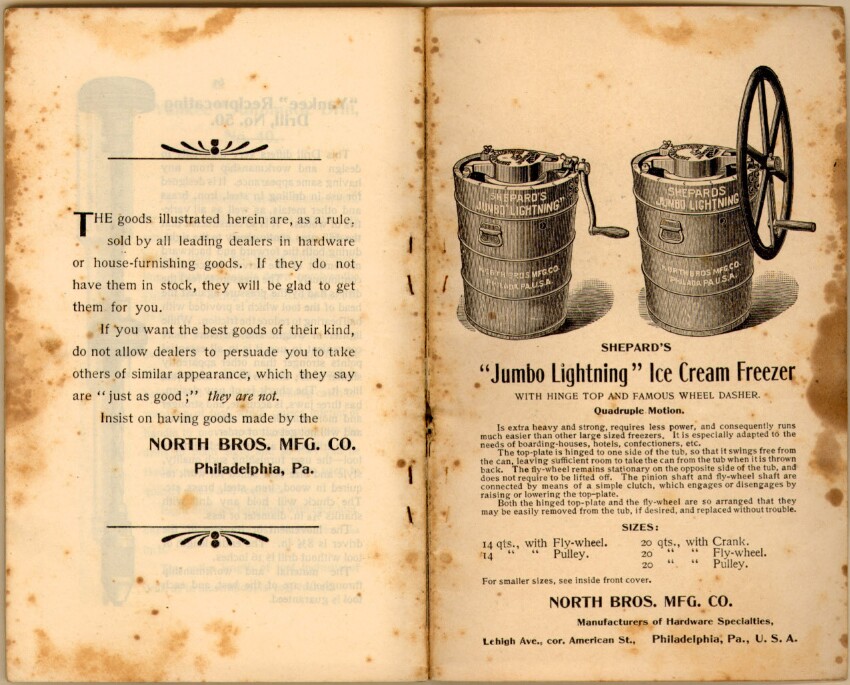
Dainty Dishes for All the Year Round (1900) finds its publisher, North Brothers Manufacturing Co., sitting pretty, unable to imagine a future some twenty years hence, in which technological advances would result in the commercial mass production of ice cream, thus damning their star item, Shephard’s “Lightning” Ice Cream Freezer, to the category of inessential countertop clutter.
Sadly, not all of the delicious-sounding ice cream recipes by Mrs. S. T. Rorer, a leading culinary author and educator and America’s first dietician, are included, but you can browse many illustrated ads for North Brothers’ built-to-last goods, including a meat cutter, a number of screwdrivers, and a magnificently steampunk Christmas tree stand.

Would it surprise you to learn that our current preoccupation with ancient grains is far from a new thing?
1929’s Modern Ways with an Ancient Food was aimed squarely at mothers anxious, then as now, that their children were properly nourished.
The grain in question was not quinoa or freekeh, but rather farina, referred to by most Americans by its most popular brand name Cream of Wheat, a fact not lost on this volume’s publisher, Cream of Wheat competitor Hecker H‑O Company.
History shows that Cream of Wheat trounced Hecker’s Cream-Farina.
Given the blandness of the grain in question, chalk it up to Cream of Wheat’s muscular advertising approach, and robust licensing of products featuring the iconic image of Rastus, a smiling black spokeschef whose palpably offensive, dialect-heavy endorsements are one pitfall Hecker seems to have skirted.

Begin your explorations of the Sallie Bingham Center’s Nicole Di Bona Peterson Advertising Cookbook Collection here, and let us know in the comments if there’s a recipe you’re intending to try.
Related Content:
An Archive of 3,000 Vintage Cookbooks Lets You Travel Back Through Culinary Time
400 Ways to Make a Sandwich: A 1909 Cookbook Full of Creative Recipes
The Futurist Cookbook (1930) Tried to Turn Italian Cuisine into Modern Art
Ayun Halliday is an author, illustrator, theater maker and Chief Primatologist of the East Village Inky zine. Join her in NYC tonight, Monday, December 9, as her monthly book-based variety show, Necromancers of the Public Domain celebrates another vintage advertising pamphlet, Dennison’s Christmas Book (1921). Follow her @AyunHalliday
How does Martin Scorsese direct a movie? Younger filmmakers have been studying at his feet trying to figure that out for more than four decades. Now in his late 70s and boasting a name that has long since become a byword for the American auteur, Scorsese continues to direct a major feature (alongside almost equally numerous documentaries and shorts) at a much younger filmmaker’s pace. This year saw the release of The Irishman, the latest chapter in Scorsese’s collaboration with Robert De Niro that began back in 1973 with Mean Streets. This ambitious new film has prompted Scorsese fans to look back at the director’s career, tracing the lines that run through his both vigorously entertaining and highly idiosyncratic body of work.
Studio Binder, whose primers on the directing styles of Quentin Tarantino and Wes Anderson we’ve previously featured here on Open Culture, has produced a thorough breakdown of what makes a Martin Scorsese Picture — as their opening titles have announced since Raging Bull — a Martin Scorsese Picture.
In a breakdown of Scorsese’s techniques, filmmaker SC Lannom highlights how he builds flawed characters, links camera movement to emotion, makes energetic editing decisions (in collaboration with his longtime editor Thelma Schoonmaker), uses character-driven camera placement, builds “authentic and educational worlds,” composes movies to the music he has in mind, pairs montages with voiceovers, and makes use of “extreme sound design.”
Of course, none of these descriptions convey the visceral impact of Scorsese’s films at their best. You can get a taste of that in the Studio Binder “Director’s Chair” video on Scorsese at the top of the post, which assembles examples of how he uses his roots in Italian New York, creates characters on the edge (Taxi Driver’s Travis Bickle being perhaps the prototype), builds “authentic worlds,” and keeps both the music and the edit in mind while directing. These methods are most clearly apparent in his hit “gangster movies” like GoodFellas, Casino, and The Departed, but other milieux — the time and place of professional boxing, of Jesuit priests in 17th-century Japan, of crooked 1990s stockbrokers, of Jesus Christ — have also proven amenable to the Scorsese treatment.
Scorsese’s faithfulness to the real world, or at least the real world as he sees and feels it, is exceeded only by his faithfulness to the world of cinema. While he usually deals with realistic subject matter, he does so with every trick in the stylistic book: not just musical montages but sequences of slow and fast motion, freeze-frames, and zooms all meant to bring you, the viewer, into the emotional experience of his characters. “Scorsese knows how he wants you to feel, and he is a ‘dirty fighter’ of cinema who will pull out all the tricks to get you feeling that way,” writes Lannom. “The difference between him and say, Michael Bay, is that Scorsese’s stories, messages, and general approach is much more mature.” Indeed, Scorsese can sometimes seem to be one of the last grown-ups in Hollywood, but one whose love of cinema burns as intensely as it did in childhood. For that reason, a new Scorsese movie — rather, a new Martin Scorsese Picture — will always be an event.
Related Content:
The Filmmaking of Martin Scorsese Demystified in 6 Video Essays
Martin Scorsese Explains the Difference Between Cinema and Movies
Martin Scorsese’s Very First Films: Three Imaginative Short Works
Martin Scorsese Reveals His 12 Favorite Movies
Based in Seoul, Colin Marshall writes and broadcasts on cities and culture. He’s at work on a book about Los Angeles, A Los Angeles Primer, the video series The City in Cinema, and the crowdfunded journalism project Where Is the City of the Future? Follow him on Twitter at @colinmarshall or on Facebook.


Open Culture scours the web for the best educational media. We find the free courses and audio books you need, the language lessons & educational videos you want, and plenty of enlightenment in between.

©2006-2026 Open Culture, LLC.
All rights reserved.

