While one is still comparatively young, one has many more thoughts & certainly sentiments than one is able to make use of. It seems as if these might be stored up so that in old age or when one became less prolific one could find matter to use. Every thought or suggestion could be of use.
There are very few moral defenses for rummaging inside another’s private diary or sketchbook, until that person shuffles off this mortal coil … and even then snoopers may get burned by what they read.
Or not.
Boredom is another strong possibility.
Best to stick with figures of historical import.
With all due respect to Frida Kahlo, I prefer those whom history hasn’t turned into mega-celebs.
It’s fun to discover a fascinating person via her own words and doodles, rather than seek them out as a bedazzled fan girl.
The Women’s History Project at the Archives of American Art is scanning a trove of handwritten papers as part of a year long mission to preserve and pass along the creative processes and daily doings of various women artists, art historians, critics, dealers, and gallery owners. Fascinating reading awaits those who can get past the enigmatic antique scrawl. More on that below.
A sample:
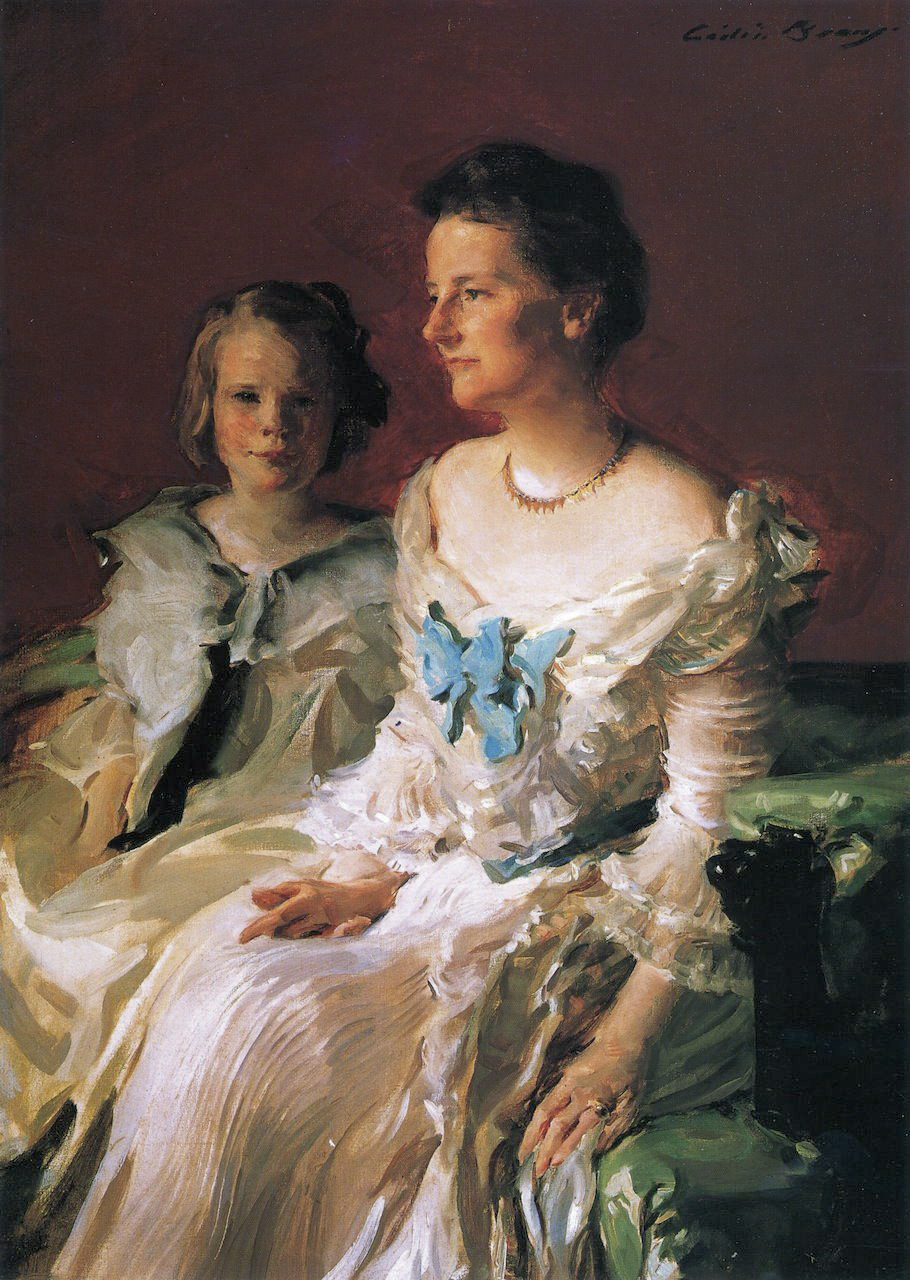
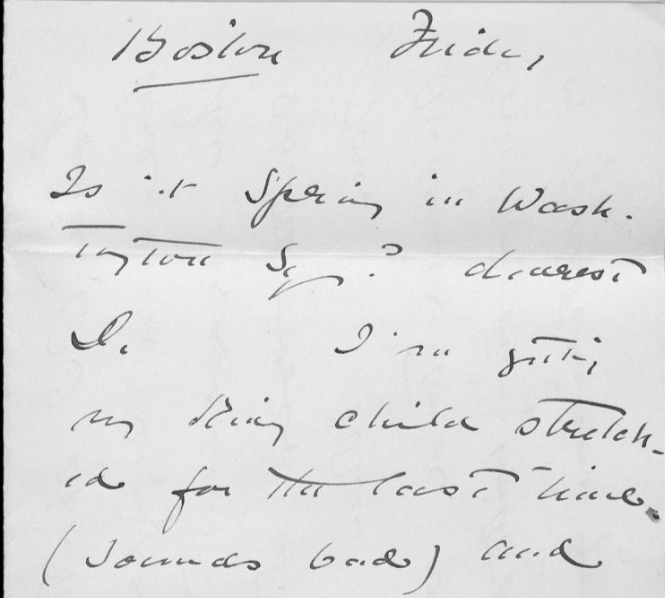
Portraitist Cecilia Beaux’s letters to her friend, frequent sitter, and possible lover, actress Dorothea Gilder. (See Beaux’s painting of “Mrs. Theodore Roosevelt and daughter Ethel” from 1902 up top.)
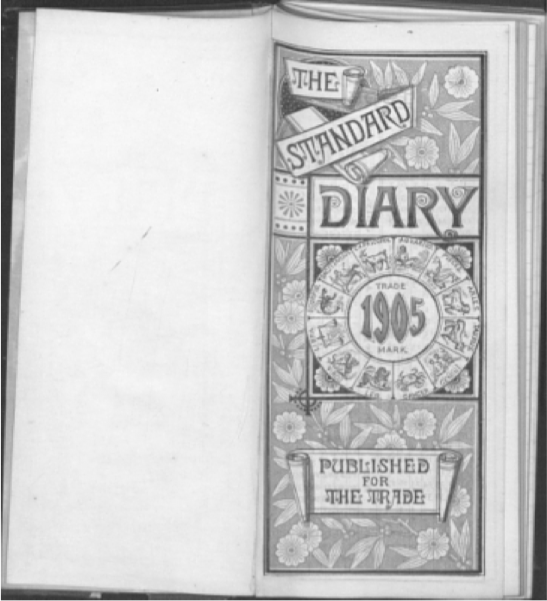
The above mentioned Whitney’s 1914 travel diary, when she made several trips to France in the name of establishing and supporting a hospital in north-central France.
Ready to explore?
You can do more than that.
The project is a part of the Smithsonian Transcription Center, which depends upon the public to take a crack at deciphering the obscure cursive of these handwritten pages, strike-throughs, marginalia, and all. You can try your hand at a single sentence or tackle an entire collection or diary. No worries if you have no transcription experience. The Center has easy to follow instructions here.
Your efforts will make the digitized documents keyword searchable, while preserving the original creators’ memories for future generations. New content will be added monthly through March 2020.
Readers of Open Culture no doubt have more pronounced polyglot tendencies than average web-surfers, and perhaps even toward relatively unlikely languages, but let us ask this: how many Etruscan speakers do you know? You’ve probably heard that name, which refers to the civilization that existed in ancient Italy between roughly the eleventh and third century BC and in roughly the era of modern-day Tuscany. The Etruscans had their own language, but it didn’t survive their civilization’s assimilation into the Roman Republic in complete enough shape for us to understand it today. But even if we can’t understand texts composed in Etruscan, we’ve at least determined what spoken Etruscan sounded like.
The animated NativLang video above tells the story of the Etruscan language’s rediscovery, from its appearance on the linen wrappings of a mummy in a sarcophagus purchased by a European in the mid-1800s; to the determination that many of the letters European languages use descended from it (first passed down from the Phoenicians and then to the Greeks); to the frustrated search for an “Etruscan Rosetta Stone.”
It also breaks down several Etruscan words : creice, meaning “Greece”; ruma, meaning “Rome”; and phersu, meaning “mask,” but which “lives on right at the heart of our English vocabulary as person.” Along the way, the video’s narrator provides examples of quite a few Etruscan sounds and how we now know they were pronounced.
Linguists have figured all this out with a relative paucity of sources, making each and every artifact inscribed with Etruscan writing invaluable to their quest for full comprehension: the Cippus Perusinus, for example, a legal contract literally etched in stone, or the aforementioned mummy wrappings, the meaning of which remains obscure. “We don’t know how this text got to Egypt. But thanks to all this work, we can tell it’s a kind of ritual calendar, and sometimes we can follow whole threads of text.” The narrator pronounces a few of them, and “it’s almost like, if you close your eyes, I could take you right back to the days of fluent Etruscan. But ask how to say a simple yes or no, and we’re lost again.”
Based in Seoul, Colin Marshall writes and broadcasts on cities, language, and culture. His projects include the book The Stateless City: a Walk through 21st-Century Los Angeles and the video series The City in Cinema. Follow him on Twitter at @colinmarshall, on Facebook, or on Instagram.
What if everything you thought you knew about grunge was a lie? Maybe you’ve suspected all along! But even if you were there, or somewhere, in that time of abysmally low internet literacy and connectivity, when every traditional media outlet was flannel, floppy hair, mopey half-protests, festivals, Seattle.… When you could save $6-$13 on “women’s grunge” and “$5 on kids’ grunge too!” at major department store chains…
But we may still remember grunge as a movement—with charismatic leaders and tragic heroes. A movement to reclaim serious, heavy, emotional hair rock from the profoundly unserious hair bands of the 80s. The first wave of Pacific Northwest bands to emerge with Nirvana, Soundgarden, and Pearl Jam were earnest and well-meaning and “primal,” says Bruce Pavitt, co-founder of the legendary Seattle record label Sub Pop.
Sub Pop midwifed the scene by signing so many of the bands that made it big, cultivating the sound and look of dirty, angry backwoodsmen with guitars. “Grunge Made Blue-Collar Culture Cool,” wrote Steven Kurutz in The New York Times Style Section just a few days ago, an implicit acknowledgment that the mostly-white and largely male scene sold a particular image of blue-collar that resonated, says Pavitt, because it represented an “ ‘American archetype.”
Pavitt and co-founder Jonathan Poneman were diehard fans of the music but they were no starry-eyed idealists—they understood exactly how to sell the region’s quirks to a national and international media. “It could have happened anywhere,” Poneman has said, “but there was a lucky set of coincidences. [Photographer] Charles Peterson was here to document the scene, [producer] Jack Endino was here to record the scene. Bruce and I were here to exploit the scene.”
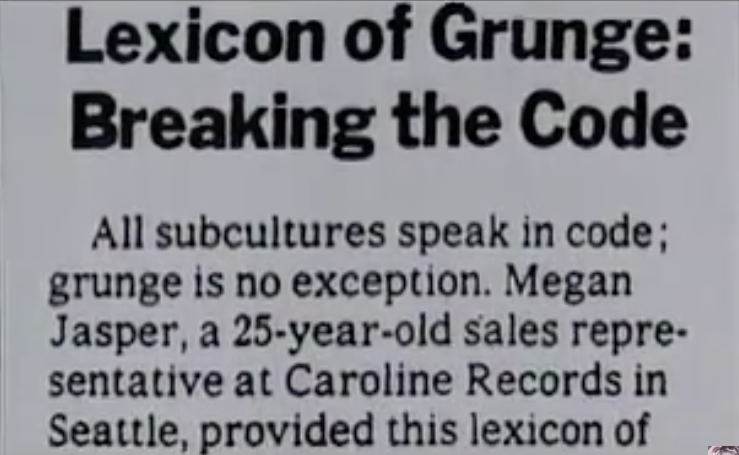
But what was the scene? Was it “Grunge”? What is “Grunge”? How do you pronounce “Grunge”? What do “Grunge” people eat? After being peppered with one too many questions when the shockwave of Nirvana’s major label debut Nevermindhit in 1992, Poneman referred a reporter to a former Sub Pop employee, Megan Jasper, then working as a sales rep for Caroline records. The reporter, Rick Marin, was calling from The New York Times’ Style Section, asking for help compiling a grunge lexicon. What kinds of things do “Grunge” people say?
“By then,” writes Alan Siegel at The Ringer, “only outsiders earnestly used the term ‘grunge’ as a noun.” It was, says Charles Cross, former editor of alternative paper The Rocket, “an overhyped, inflated word that doesn’t have actual meaning in Seattle.” As for grunge slang, such a thing “didn’t exist.” The only thing to do, Jasper decided, was “react by trying to make fun of it,” she says. She had done the very same thing months earlier, when British magazine Sky made the same request. “I gave them a bunch of fake shit.”
As she says in the interview clip at the top, she asked Marin to toss out normal words and she would give him “grunge” equivalents. “I kept escalating the craziness of the translations because anyone in their right mind would go, ‘Oh, come on, this is bullshit.’… but it never happened because he was concentrating so hard on getting the information right.” Thus, the grunge lexicon below, published in The New York Times in 1992. (“All subcultures speak in code,” goes the caption. This one would be appearing in malls nationwide.)
bloated, big bag of bloatation – drunk
bound-and-hagged – staying home on Friday or Saturday night
cob nobbler – loser
dish – desirable guy
fuzz – heavy wool sweaters
harsh realm – bummer
kickers – heavy boots
lamestain – uncool person
plats – platform shoes
rock on – a happy goodbye
score – great
swingin’ on the flippity-flop – hanging out
tom-tom club – uncool outsiders
wack slacks – old ripped jeans
It’s unlikely Marin ever traveled to Seattle and tried to bond with fellow kids, or he would not have published Jasper’s hoax glossary in an article otherwise critical of the mainstreaming of grunge. Marin compared the phenomenon to “the mass-marketing of disco, punk and hip-hop. Now with the grunging of America, it’s happening again. Pop will eat itself, the axiom goes.” It’s a thorough, well-sourced piece that quotes many of the scene’s founders, including Poneman, never suspecting they might be having a laugh.
The fake news grunge lexicon was a huge hit in Seattle, where Jasper was celebrated by her friends and family. “I got a very nice pat on the back,” she says. People clipped the lexicon to their shirts at shows. Indie label C/Z records then printed t‑shirts. “Lamestain” appeared on one. “Harsh Realm” on another. Mudhoney spread around Jasper’s slang in a Melody Maker interview with straight faces. It should have been debunked immediately “but this was 1992,” writes Siegel, “Snopes wasn’t around yet. Hell, The New York Times was still four years away from launching a website.”
Then, writer and reporter Thomas Frank called Jasper and asked, “there’s no way this is real, right?” Immediately, she responded, “Of course it’s not real.” Frank published the scoop in 1993; the Times smeared him as a hoaxer to discredit the revelation. The Baffler faxed the Times this note: “When The Newspaper of Record goes searching for the Next Big Thing and the Next Big Thing piddles on its leg, we think that’s funny.” These days, we might expect a Twitter war.
No one Siegel interviews seems to have been particularly upset about the whole thing. Marin’s “eyebrow is totally raised” throughout his piece, says his former editor Penelope Green. (Marin himself declined to be interviewed.) But the story has far less to do with one credulous reporter working a deadline and more to do with his argument—grunge had been rapidly packaged and sold, and by The Times, no less! But maybe its image was sort of a joke to begin with, one that now gets such straight-faced, reverent, sealed-behind-glass-cases treatment that you have to laugh.
In the playlist above, Gregory Sadler presents a 24-lecture course on “Critical Thinking”–something the world could always use more of. Presented at Fayetteville State University, the course features lectures on topics like Deductive and Inductive Arguments, Fallacies, Rhetorical Devices, Appeals to Authority and much more. The textbook used (and referenced) in the course was Moore and Parker’s Critical Thinking. The individual lectures are as follows:
If you would like to sign up for Open Culture’s free email newsletter, please find it here. It’s a great way to see our new posts, all bundled in one email, each day.
If you would like to support the mission of Open Culture, consider making a donation to our site. It’s hard to rely 100% on ads, and your contributions will help us continue providing the best free cultural and educational materials to learners everywhere. You can contribute through PayPal, Patreon, and Venmo (@openculture). Thanks!
In 1958, Hunter S. Thompson applied for a job with the Vancouver Sun. He was fresh out of the Air Force and struggling to make a living in New York City, though from the tone of the letter you wouldn’t know it.
People who are experts in such things say that good cover letters should match the employer’s needs with the applicant’s abilities, should be tailored specifically to the job in question and should show some personality. By those yardsticks, Thompson’s letter to the Vancouver Sun is a model to be followed. He lays out his eagerness to work: “I can work 25 hours a day if necessary, live on any reasonable salary.” Any HR manager would be tickled with lines like that. He succinctly describes his work experience: “most of my experience has been in sports writing, but I can write everything from warmongering propaganda to learned book reviews.” And for any other fault you might find with the letter, it definitely doesn’t lack in personality.
Yet the letter somehow failed to charm his would-be employer; Thompson never moved to Vancouver. Perhaps they were given pause by Thompson’s steady stream of insults directed towards his former editor — “It was as if the Marquis De Sade had suddenly found himself working for Billy Graham” — and towards journalism in general: “It’s a damned shame that a field as potentially dynamic and vital as journalism should be overrun with dullards, bums, and hacks, hag-ridden with myopia, apathy, and complacence, and generally stuck in a bog of stagnant mediocrity.” Or perhaps it was his intentionally off-putting arrogance, “I’d rather offend you now than after I started working for you.” In any case, it’s a hoot to read. More people should write job application letters like this.
Read the full letter below.
Vancouver Sun
TO JACK SCOTT, VANCOUVER SUN
October 1, 1958 57 Perry Street New York City
Sir,
I got a hell of a kick reading the piece Time magazine did this week on The Sun. In addition to wishing you the best of luck, I’d also like to offer my services.
Since I haven’t seen a copy of the “new” Sun yet, I’ll have to make this a tentative offer. I stepped into a dung-hole the last time I took a job with a paper I didn’t know anything about (see enclosed clippings) and I’m not quite ready to go charging up another blind alley.
By the time you get this letter, I’ll have gotten hold of some of the recent issues of The Sun. Unless it looks totally worthless, I’ll let my offer stand. And don’t think that my arrogance is unintentional: it’s just that I’d rather offend you now than after I started working for you.
I didn’t make myself clear to the last man I worked for until after I took the job. It was as if the Marquis de Sade had suddenly found himself working for Billy Graham. The man despised me, of course, and I had nothing but contempt for him and everything he stood for. If you asked him, he’d tell you that I’m “not very likable, (that I) hate people, (that I) just want to be left alone, and (that I) feel too superior to mingle with the average person.” (That’s a direct quote from a memo he sent to the publisher.)
Nothing beats having good references.
Of course if you asked some of the other people I’ve worked for, you’d get a different set of answers. If you’re interested enough to answer this letter, I’ll be glad to furnish you with a list of references — including the lad I work for now.
The enclosed clippings should give you a rough idea of who I am. It’s a year old, however, and I’ve changed a bit since it was written. I’ve taken some writing courses from Columbia in my spare time, learned a hell of a lot about the newspaper business, and developed a healthy contempt for journalism as a profession.
As far as I’m concerned, it’s a damned shame that a field as potentially dynamic and vital as journalism should be overrun with dullards, bums, and hacks, hag-ridden with myopia, apathy, and complacence, and generally stuck in a bog of stagnant mediocrity. If this is what you’re trying to get The Sun away from, then I think I’d like to work for you.
Most of my experience has been in sports writing, but I can write everything from warmongering propaganda to learned book reviews.
I can work 25 hours a day if necessary, live on any reasonable salary, and don’t give a black damn for job security, office politics, or adverse public relations.
I would rather be on the dole than work for a paper I was ashamed of.
It’s a long way from here to British Columbia, but I think I’d enjoy the trip.
If you think you can use me, drop me a line.
If not, good luck anyway.
Sincerely,
Hunter S. Thompson
Note: An earlier version of this post appeared on our site in April 2015.
Jonathan Crow is a Los Angeles-based writer and filmmaker whose work has appeared in Yahoo!, The Hollywood Reporter, and other publications. You can follow him at @jonccrow. And check out his blog Veeptopus, featuring lots of pictures of badgers and even more pictures of vice presidents with octopuses on their heads. The Veeptopus store is here.
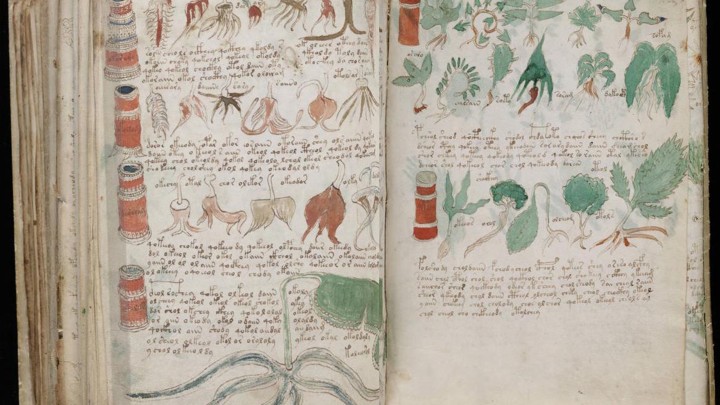
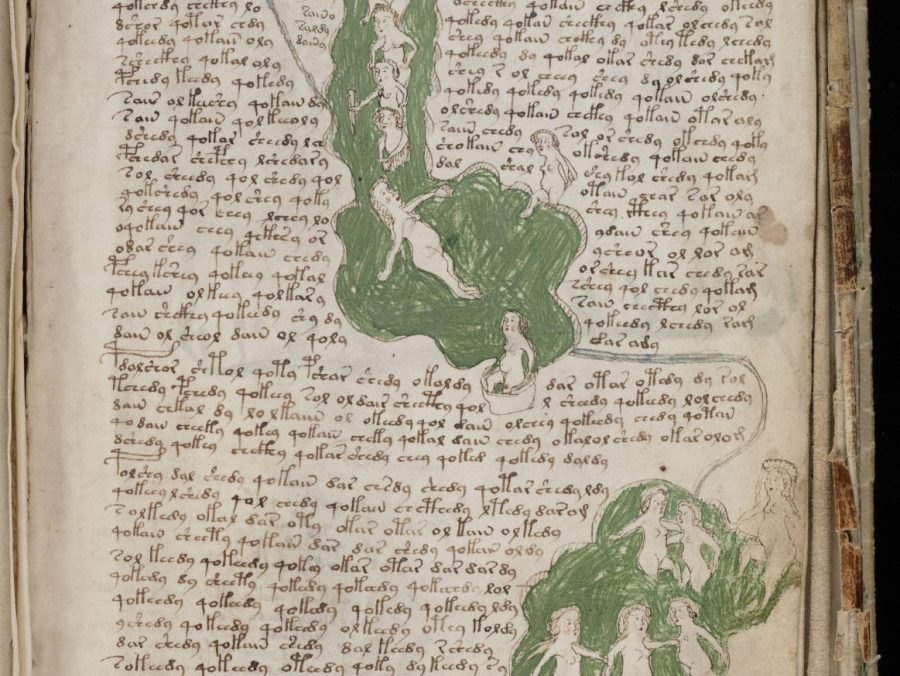
Humanity will remember the name of James Joyce for generations to come, not least because, as he once wrote about his best-known novel Ulysses, “I’ve put in so many enigmas and puzzles that it will keep the professors busy for centuries arguing over what I meant, and that’s the only way of insuring one’s immortality.” If Joyce was right, then the author of the mysterious Voynich manuscript (about which you can see an animated introduction here) has set a kind of standard for immortality. Filled with odd, not especially explanatory illustrations and written in a script not seen anywhere else, the early 15th-century text has perplexed scholars for at least 400 or so years of its existence.
But recent years have seen a few claims of having cracked the Voynich manuscript’s code: one effort made use of artificial intelligence, another concludes that the text was written in phonetic Old Turkish, and the latest declares the Voynich manuscript to have been composed in “the only known example of proto-Romance language.” University of Bristol Research Associate Gerard Cheshire, the man behind this new decoding, describes that language as “ancestral to today’s Romance languages including Portuguese, Spanish, French, Italian, Romanian, Catalan and Galician. The language used was ubiquitous in the Mediterranean during the Medieval period, but it was seldom written in official or important documents because Latin was the language of royalty, church and government.”
And what, pray tell, is the Voynich manuscript actually about? Cheshire has revealed little about its content thus far, though he has described the text as “compiled by Dominican nuns as a source of reference for Maria of Castile, Queen of Aragon.” Though he has claimed to determine the nature of its unusual language — one without punctuation but with “diphthong, triphthongs, quadriphthongs and even quintiphthongs for the abbreviation of phonetic components” — deciphering its more than 200 pages of content stands as another task altogether. In the meantime, you can read his paper “The Language and Writing System of MS408 (Voynich) Explained,” originally published in the journal Romance Studies.
Although Cheshire’s discovery has produced headlines like the Express’ “Voynich Manuscript SOLVED: World’s Most Mysterious Book Deciphered After 600 Years,” others include Ars Techhnica’s “No, Someone Hasn’t Cracked the Code of the Mysterious Voynich Manuscript.” That article quotes Lisa Fagin Davis, executive director of the Medieval Academy of America (and vocal Voynich-translation skeptic), criticizing the foundation of Cheshire’s claim: “He starts with a theory about what a particular series of glyphs might mean, usually because of the word’s proximity to an image that he believes he can interpret. He then investigates any number of medieval Romance-language dictionaries until he finds a word that seems to suit his theory. Then he argues that because he has found a Romance-language word that fits his hypothesis, his hypothesis must be right.”
Fagin Davis adds that Cheshire’s “ ‘translations’ from what is essentially gibberish, an amalgam of multiple languages, are themselves aspirational rather than being actual translations,” and that “the fundamental underlying argument — that there is such a thing as one ‘proto-Romance language’ — is completely unsubstantiated and at odds with paleolinguistics.” Fagin Davis’ criticism doesn’t even stop there, and if she’s right, Cheshire’s approach will be unlikely to produce a coherent translation of the entire text. And so, at least for the moment, the Voynich manuscript’s life as a mystery continues, keeping busy not just professors but enthusiasts, technologists, Research Associates, and many others besides.
Based in Seoul, Colin Marshall writes and broadcasts on cities, language, and culture. His projects include the book The Stateless City: a Walk through 21st-Century Los Angeles and the video series The City in Cinema. Follow him on Twitter at @colinmarshall, on Facebook, or on Instagram.
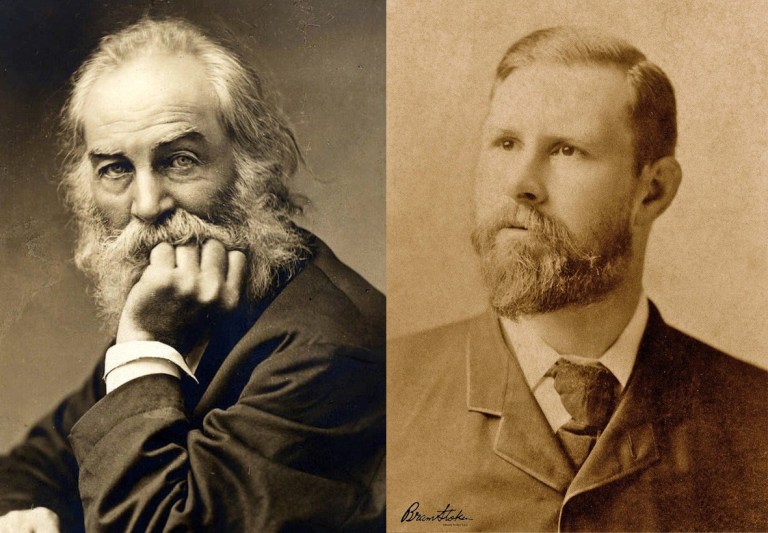
Every artist starts out as a fan, and in general we see the marks of early fandom on their mature work. The best, after all—as figures from Igor Stravinsky to William Faulkner have remarked—steal without compunction, taking what they like from their heroes and making it their own. But what exactly, we might wonder, did Draculaauthor Bram Stoker steal from his literary hero, Walt Whitman? I leave it to you to read the 1897 Gothic novel that spawned innumerable undead franchises and fandoms next to Whitman’s Leaves of Grass, the book that most inspired Stoker when it made its British debut in 1868.
First published in 1855, then rewritten over the rest of Whitman’s life, the book of poetry boldly celebrated the same pleasure and sensuality that Stoker’s novel made so dangerous. But Draculawas the work of a 50-year old writer. When Stoker first read Whitman, he was only 22, wide-eyed and romantic, and “grown from a sickly boy into a brawny athlete,” writes Meredith Hindley at the National Endowment for the Humanities magazine.
Whitman—himself a champion of robust masculine health (he once penned a manual called “Manly Health & Training”)—so appealed to the young Irish writer’s deep sensibilities that he wrote the older poet a gushing letter two years later in 1870.
Stoker’s fan letter certainly shows the Whitmanian influence, “a long stream of sentiment cascading through various emotions,” as Brain Pickings’ Maria Popova describes it, including “surging confidence bordering on hubris, delicate self-doubt, absolute artist-to-artist adoration.” Whitman, flattered and charmed, wrote a reply, but only after four years, during which Stoker sat on his letter, ashamed to mail it. “For four years, it haunted his desk, part muse and part goblin.” When he finally gathered the courage in 1876 to rewrite the emotional letter and put it in the mail, he was rewarded with the kind of praise that must have absolutely thrilled him.
“You did so well to write to me,” Whitman replied, “so unconventionally, so fresh, so manly, and affectionately too.” Thus began a literary friendship that lasted until Whitman’s death in 1892 and seems to have been as welcome to Whitman as to his biggest fan. A stroke had nearly incapacitated the poet in 1873 and sapped his health and strength for the last two decades of his life, leaving him, as he wrote, with a physique “entirely shatter’d—doubtless permanently—from paralysis and other ailments.” But “I am up and dress’d,” he added, “and get out every day a little, live here quite lonesome, but hearty, and good spirits.”
One also wonders if Stoker would have received such a warm response if he had mailed his original letter unchanged. The “previously unsent effusion,” notes Popova, “opens with an abrupt directness unguarded even by a form of address.” Put another way, it’s blunt, melodramatic, and overly familiar to the point of rudeness: “If you are the man I take you to be,” he begins, “you will like to get this letter. If you are not I don’t care whether you like it or not and only ask that you put it in to the fire without reading any farther.” Contrast this with the revised communication, which begins with the respectful salutation, “My dear Mr. Whitman,” and continues in relatively formal, though still highly spirited, vein.
Stoker had mellowed and matured, but he never left behind his adoration for Whitman and Leaves of Grass. When he eloquently sums up the effect reading the book and its original 1855 preface had on him—he echoes the feelings of millions of fans throughout the ages who have found a voice that speaks to them from far away of feelings they know intimately but cannot express at home:
Be assured of this Walt Whitman—that a man of less than half your own age, reared a conservative in a conservative country, and who has always heard your name cried down by the great mass of people who mention it, here felt his heat leap towards you across the Atlantic and his soul swelling at the words or rather the thoughts.
Read Stoker’s original and revised letters and Whitman’s brief, touching response at Brain Pickings.
We're hoping to rely on loyal readers, rather than erratic ads. Please click the Donate button and support Open Culture. You can use Paypal, Venmo, Patreon, even Crypto! We thank you!
Open Culture scours the web for the best educational media. We find the free courses and audio books you need, the language lessons & educational videos you want, and plenty of enlightenment in between.