Watch Hannah Arendt’s Final Interview (1973)

Even before the elec­tion of Don­ald Trump, as some crit­ics began to see the pos­si­bil­i­ty of a win, talk turned to his­tor­i­cal names of anti-fas­cism: George Orwell, Sin­clair Lewis, and, espe­cial­ly, Han­nah Arendt, author of The Ori­gins of Total­i­tar­i­an­ism, On Rev­o­lu­tion, and Eich­mann in Jerusalem, her series of arti­cles for The New York­er about the tri­al of the Naz­i’s chief bureau­crat. Arendt close­ly observed author­i­tar­i­an regimes and their after­math, detail­ing the way ide­ol­o­gy seeps in through banal polit­i­cal careerism.

Since 2016, her warn­ings have seemed all-too-pre­scient, espe­cial­ly after a coup attempt last Jan­u­ary that has been all-but hand-waved out of polit­i­cal mem­o­ry by the GOP and its media appa­ra­tus, while can­di­dates who deny the legit­i­ma­cy of elec­tion out­comes they don’t like increas­ing­ly get their names on bal­lots. The degree to which Arendt saw the polit­i­cal con­di­tions of her time, and maybe ours, with clar­i­ty has less to do with fore­knowl­edge and more with a deep knowl­edge of the past. Cor­rup­tion, tyran­ny, deceit, in all their many forms, have not changed much in their essen­tial char­ac­ter since the records of antiq­ui­ty were set down.

“Dark times,” she wrote in the 1968 pref­ace to her col­lec­tion of essays Men in Dark Times, “are not only not new, they are no rar­i­ty in his­to­ry, although,” she adds, “they were per­haps unknown in Amer­i­can his­to­ry, which oth­er­wise has its fair share, past and present, of crime and dis­as­ter.” Had her assess­ment changed a few years lat­er, in what would be her final inter­view, above, in 1973 (aired on French TV in 1974)? Had dark times come for the U.S.? The Yom Kip­pur War had just begun, the seem­ing­ly-end­less Viet­nam War dragged on, and the Water­gate scan­dal had hit its crescen­do.

Still, Arendt con­tin­ued to feel a cer­tain guard­ed opti­mism about her adopt­ed coun­try, which, she says, is “not a nation-state” like Ger­many or France:

This coun­try is unit­ed nei­ther by her­itage, nor by mem­o­ry, nor by soil, nor by lan­guage, nor by ori­gin from the same. There are no natives here. The natives were the Indi­ans. Every­one else are cit­i­zens. And these cit­i­zens are unit­ed only by one thing and this is true: That is, you become a cit­i­zen in the Unit­ed States by a sim­ple con­sent to the Con­sti­tu­tion. The con­sti­tu­tion – that is a scrap of paper accord­ing to the French as well as the Ger­man com­mon opin­ion, & you can change it. No, here it is a sacred doc­u­ment. It is the con­stant remem­brance of one sacred act. And that is the act of foun­da­tion. And the foun­da­tion is to make a union out of whol­ly dis­parate eth­nic minori­ties and reli­gions, and (a) still have a union, and (b) do not assim­i­late or lev­el down these dif­fer­ences. And all of this is very dif­fi­cult to under­stand for a for­eign­er. It’s what a for­eign­er nev­er under­stands.

Whether or not Amer­i­cans under­stood them­selves that way in 1973, or under­stand our­selves this way today, Arendt points to an ide­al that makes the demo­c­ra­t­ic process in the U.S. unique; when, that is, it is allowed to func­tion as osten­si­bly designed, by the con­sent of the gov­erned rather than the tyran­ny of an oli­garchy. Arendt died two years lat­er, as the war in Viet­nam final­ly came to an inglo­ri­ous end. You can watched her full tele­vised inter­view — with Eng­lish trans­la­tions by the uploader, Phi­los­o­phy Over­dose — above, or find it pub­lished in the book, Han­nah Arendt: The Last Inter­view and Oth­er Con­ver­sa­tions.

What would Arendt have had to say to our time of MAGA, COVID-19 and elec­tion denial­ism, mass polit­i­cal racism, misog­y­ny, homo­pho­bia, and xeno­pho­bia? Per­haps her most suc­cinct state­ment on how to rec­og­nize the dark times comes from that same 1968 pref­ace:

I bor­row the term from Brecht’s famous poem ‘To Pos­ter­i­ty,’ which men­tions the dis­or­der and the hunger, the mas­sacres and the slaugh­ter­ers, the out­rage over injus­tice and the despair ‘when there was only wrong and no out­rage,’ the legit­i­mate hatred that makes you ugly nev­er­the­less, the well-found­ed wrath that makes the voice grow hoarse. All this was real enough as it took place in pub­lic; there was noth­ing secret or mys­te­ri­ous about it. And still, it was by no means vis­i­ble to all, nor was it at all easy to per­ceive it; for, until the very moment when cat­a­stro­phe over­took every­thing and every­body, it was cov­ered up not by real­i­ties but by the high­ly effi­cient talk and dou­ble-talk of near­ly all offi­cial rep­re­sen­ta­tives who, with­out inter­rup­tion and in many inge­nious vari­a­tions, explained away unpleas­ant facts and jus­ti­fied con­cerns. When we think of dark times and of peo­ple liv­ing and mov­ing in them, we have to take this cam­ou­flage, ema­nat­ing from and spread by ‘the estab­lish­ment’ – or ‘the sys­tem,’ as it was then called – also into account. If it is the func­tion of the pub­lic realm to throw light on the affairs of men by pro­vid­ing a space of appear­ances in which they can show in deed and word, for bet­ter or worse, who they are and what they can do, then dark­ness has come when this light is extin­guished by ‘cred­i­bil­i­ty gaps’ and ‘invis­i­ble gov­ern­ment,’ by speech that does not dis­close what is but sweeps it under the car­pet, by exhor­ta­tions, moral and oth­er­wise, that, under the pre­text of uphold­ing old truths, degrade all truth to mean­ing­less triv­i­al­i­ty.

Relat­ed Con­tent:

Han­nah Arendt Explains How Pro­pa­gan­da Uses Lies to Erode All Truth & Moral­i­ty: Insights from The Ori­gins of Total­i­tar­i­an­ism

Large Archive of Han­nah Arendt’s Papers Dig­i­tized by the Library of Con­gress: Read Her Lec­tures, Drafts of Arti­cles, Notes & Cor­re­spon­dence

Han­nah Arendt Explains Why Democ­ra­cies Need to Safe­guard the Free Press & Truth … to Defend Them­selves Against Dic­ta­tors and Their Lies

Josh Jones is a writer and musi­cian based in Durham, NC. Fol­low him at @jdmagness

R.I.P. Vangelis: The Composer Who Created the Future Noir Soundtrack for Blade Runner Dies at 79

It would be dif­fi­cult to over­state the promi­nence, in the late twen­ti­eth cen­tu­ry, of the theme from Hugh Hud­son’s Char­i­ots of Fire. Most any­one under the age of 60 will have heard it many times as par­o­dy before ever see­ing it in its orig­i­nal, Acad­e­my Award-win­ning con­text. Unfor­tu­nate­ly, encoun­ter­ing the piece in near­ly every humor­ous slow-motion run­ning scene for two or three decades straight has a way of damp­en­ing its impact. But back in 1981, to score a nine­teen-twen­ties peri­od dra­ma with brand-new dig­i­tal syn­the­siz­ers marked a brazen depar­ture from con­ven­tion, as well as the begin­ning of a trend of musi­cal anachro­nism in cin­e­ma (which would man­i­fest even in the likes of Dirty Danc­ing).

The Char­i­ots of Fire theme has sure­ly returned to many of our playlists after the death this week of its com­pos­er, Van­ge­lis. Even before that film, he’d col­lab­o­rat­ed with Hud­son on doc­u­men­taries and com­mer­cials; imme­di­ate­ly there­after, he found him­self in great demand as a com­pos­er for fea­tures.

The very next year, in fact, saw Van­ge­lis craft­ing a score that has, per­haps, remained even more respect­ed over time than the one he did for Char­i­ots of Fire. Set in the far-flung year of 2019, Rid­ley Scot­t’s Blade Run­ner need­ed a high-tech sound that also reflect­ed its “future noir” sen­si­bil­i­ty. This neat­ly suit­ed Van­ge­lis’ proven abil­i­ty to com­bine cut­ting-edge elec­tron­ic instru­ments with tra­di­tion­al acoustic ones in a high­ly evoca­tive fash­ion.

Blade Run­ner’s for­mi­da­ble influ­ence owes pri­mar­i­ly to its visu­als, to the “look and feel” of its imag­ined future. But I defy fans of the film to remem­ber any of its most strik­ing images — the infer­nal sky­line of 2019 Los Ange­les, the cars fly­ing between video-illu­mi­nat­ed sky­scrap­ers, Deckard’s first meet­ing with Rachael — with­out also hear­ing Van­ge­lis’ music in their heads. Though it took audi­ences decades to catch up with Blade Run­ner, it’s now more or less set­tled that each ele­ment of the film com­ple­ments all the oth­ers in cre­at­ing a dystopi­an vision still, in many ways, unsur­pass­able. Van­ge­lis’ own expe­ri­ences across gen­res and tech­nolo­gies, which you can learn more about in the doc­u­men­tary Van­ge­lis and the Jour­ney to Itha­ka, placed him ide­al­ly to imbue that vision with musi­cal life.

Relat­ed con­tent:

Expe­ri­ence Blade Run­ner Like You Nev­er Have Before Through a Fea­ture-Length Remas­tered Sound­track

How Blade Run­ner Cap­tured the Imag­i­na­tion of a Gen­er­a­tion of Elec­tron­ic Musi­cians

The Sounds of Blade Run­ner: How Music & Sound Effects Became Part of the DNA of Rid­ley Scott’s Futur­is­tic World

Stream 72 Hours of Ambi­ent Sounds from Blade Run­ner: Relax, Go to Sleep in a Dystopi­an Future

Sean Con­nery (RIP) Reads C.P. Cavafy’s Epic Poem “Itha­ca,” Set to the Music of Van­ge­lis

Based in Seoul, Col­in Mar­shall writes and broad­casts on cities, lan­guage, and cul­ture. His projects include the Sub­stack newslet­ter Books on Cities, the book The State­less City: a Walk through 21st-Cen­tu­ry Los Ange­les and the video series The City in Cin­e­ma. Fol­low him on Twit­ter at @colinmarshall, on Face­book, or on Insta­gram.

Jean-Paul Sartre & Albert Camus: Their Friendship and the Bitter Feud That Ended It

At the end of World War II, as Europe lay in ruins, so too did its “intel­lec­tu­al land­scape,” notes the Liv­ing Phi­los­o­phy video above. In the midst of this “intel­lec­tu­al crater” a num­ber of great thinkers debat­ed “the blue­print for the future.” Fem­i­nist philoso­pher and nov­el­ist Simone de Beau­voir put it blunt­ly: “We were to pro­vide the post­war era with its ide­ol­o­gy.” Two names — De Beau­voir’s part­ner Jean-Paul Sartre and his friend Albert Camus — came to define that ide­ol­o­gy in the phi­los­o­phy broad­ly known as Exis­ten­tial­ism.

The two first met in Paris in 1943 dur­ing the Nazi occu­pa­tion. They were already “deeply acquaint­ed” with one another’s work and shared a mutu­al respect and admi­ra­tion as crit­ics and review­ers of each oth­er and as fel­low resis­tance mem­bers. Both “intel­lec­tu­al giants” were tar­get­ed by the FBI, and both would go on to win the Nobel Prize in Lit­er­a­ture (though Sartre reject­ed his). Their fame would con­tin­ue into the post­war years, despite Camus’ retreat from philo­soph­i­cal writ­ing after the pub­li­ca­tion of The Rebel.

While we’ve pre­vi­ous­ly brought you sto­ries of their friend­ship, and its bit­ter end, the video above digs deep­er into the Sartre-Camus rival­ry, with crit­i­cal his­tor­i­cal con­text for their think­ing. Their ini­tial falling out took place over The Rebel, which cham­pi­oned an eth­i­cal indi­vid­u­al­ism and cri­tiqued the moral­i­ty of rev­o­lu­tion­ary vio­lence. Instead of explor­ing sui­cide, as he had done in The Myth of Sisy­phus, here Camus explores the prob­lem of mur­der, con­clud­ing that — out­side of extreme cir­cum­stances like a Nazi inva­sion — vio­lent polit­i­cal means do not jus­ti­fy their ends.

The book pro­voked Sartre, a doc­tri­naire Marx­ist, who had issued what Camus con­sid­ered fee­ble defens­es for Joseph Stal­in’s purges and gulags. A series of scathing reviews and angry ripostes fol­lowed. The per­son­al tone of these attacks chilled what lit­tle warmth remained between them. When the Alger­ian war for inde­pen­dence erupt­ed a few years lat­er, the staunch­ly anti-colo­nial­ist Sartre took the side of Alge­ri­a’s Nation­al Lib­er­a­tion Front (FLN), excus­ing acts of vio­lence against civil­ians and rival fac­tions as jus­ti­fied by French oppres­sion. Such events “were beyond jus­ti­fi­ca­tion in the mind of Camus.”

While Sartre belit­tled Camus as “a crook,” the “acute­ness of the sit­u­a­tion was all the stronger for Camus since Alge­ria was his home­land. He could not see it in the ide­o­log­i­cal warped black and white of Sartre’s cir­cle or the con­ser­v­a­tive French gov­ern­ment.” The state­ment might sum up all of Camus’ thought. As Sartre final­ly con­ced­ed in a posthu­mous trib­ute; he “rep­re­sent­ed in our time the lat­est exam­ple of that long line of moral­istes whose works con­sti­tute per­haps the most orig­i­nal ele­ment in French let­ters.… he reaf­firmed… against the Machi­avel­lians and against the Idol of real­ism, the exis­tence of the moral issue,” in all its com­plex ambi­gu­i­ty and uncer­tain­ty.

Relat­ed Con­tent:

Sartre Writes a Trib­ute to Camus After His Friend-Turned-Rival Dies in a Trag­ic Car Crash: “There Is an Unbear­able Absur­di­ty in His Death”

The Exis­ten­tial­ism Files: How the FBI Tar­get­ed Camus, and Then Sartre After the JFK Assas­si­na­tion

Albert Camus Writes a Friend­ly Let­ter to Jean-Paul Sartre Before Their Per­son­al and Philo­soph­i­cal Rift

Josh Jones is a writer and musi­cian based in Durham, NC. Fol­low him at @jdmagness

William Blake: The Remarkable Printing Process of the English Poet, Artist & Visionary

Few artists have antic­i­pat­ed, or pre­cip­i­tat­ed, the frag­ment­ed, hero­ical­ly indi­vid­u­al­ist, and pur­pose­ful­ly oppo­si­tion­al art of moder­ni­ty like William Blake, a man to whom the cliché ahead of his time can be applied with per­fect accu­ra­cy. Blake stren­u­ous­ly opposed the ratio­nal­ist Deism and Neo­clas­si­cal artis­tic val­ues of his con­tem­po­raries, not only in prin­ci­ple, but in near­ly every part of his artis­tic prac­tice. His pol­i­tics were cor­re­spond­ing­ly rad­i­cal: in oppo­si­tion to empire, racism, pover­ty, patri­archy, Chris­t­ian dog­ma, and the emerg­ing glob­al cap­i­tal­ism of his time.

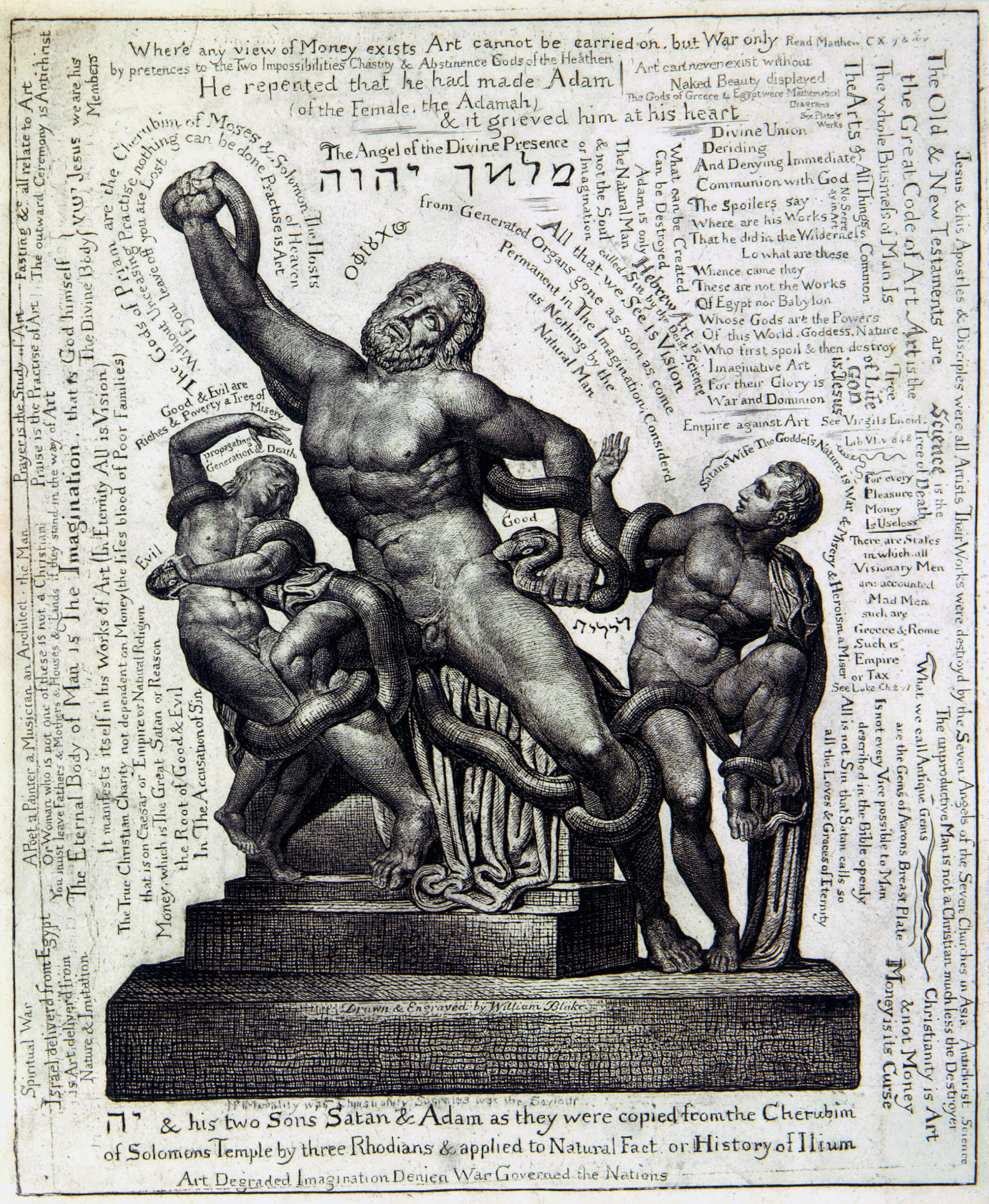
Nowhere do we see Blake’s visu­al rad­i­cal­ism more in evi­dence, argues Julia M. Wright in a 2000 essay for the jour­nal Mosa­ic, than in his Laocoön, a work that not only seems to presage the mod­ernist col­lag­ing of text and image, from Braque to Rauschen­berg, but also looks toward hyper­text with its non­lin­ear­i­ty, frag­men­ta­tion, and inter­tex­tu­al­i­ty: “By com­bin­ing as many as four dif­fer­ent media in Laocoön — draw­ing, writ­ing, engrav­ing, and sculp­ture [in his depic­tion of the clas­si­cal orig­i­nal] — Blake puts into play their dif­fer­ent prop­er­ties, engag­ing the debate in the­o­ry as well as prac­tice.”

Through an art of visu­al pas­tiche, Blake resists the Neo­clas­si­cal idea that visu­al art and poet­ry were mutu­al­ly exclu­sive for­mal pur­suits that could not coex­ist. (View a larg­er image here to read the poems and slo­gans that sur­round the image.)

We can see the influ­ence of Blake’s rad­i­cal­ism every­where, from zine art to the Blakes repro­duced on the skin of spe­cial edi­tion Doc Martens (the artist was also an enthu­si­as­tic defend­er of the Goth­ic over the Clas­si­cal, Wright points out). An art like Blake’s demand­ed a rad­i­cal process, and he con­ceived one through his pro­fes­sion­al skills as an engraver, an art he began learn­ing at the age of twelve. “Right from his ear­li­est child­hood,” notes the British Library video at the top, “Blake was dri­ven by two extra­or­di­nary and pow­er­ful aspi­ra­tions. On the one hand as a poet, on the oth­er as a painter… so how was he going to bring these two togeth­er in a form that would enable him to pub­lish his own images in illus­tra­tion of his own poems?”

The video demon­strates “Blake’s inno­va­tion” as an engraver and print­er. The print­ing process at that point involved a num­ber of dif­fer­ent spe­cial­ized work­ers, some respon­si­ble for set­ting text, and oth­ers for sep­a­rate­ly print­ing images in blank spaces left on the pages. Blake’s process “enabled him, with the excep­tion of the paper, to be respon­si­ble for every stage in the pro­duc­tion process, from writ­ing the poems, mak­ing the draw­ings, using the stop-out var­nish to write his text, etch­ing and print­ing the impres­sions.”

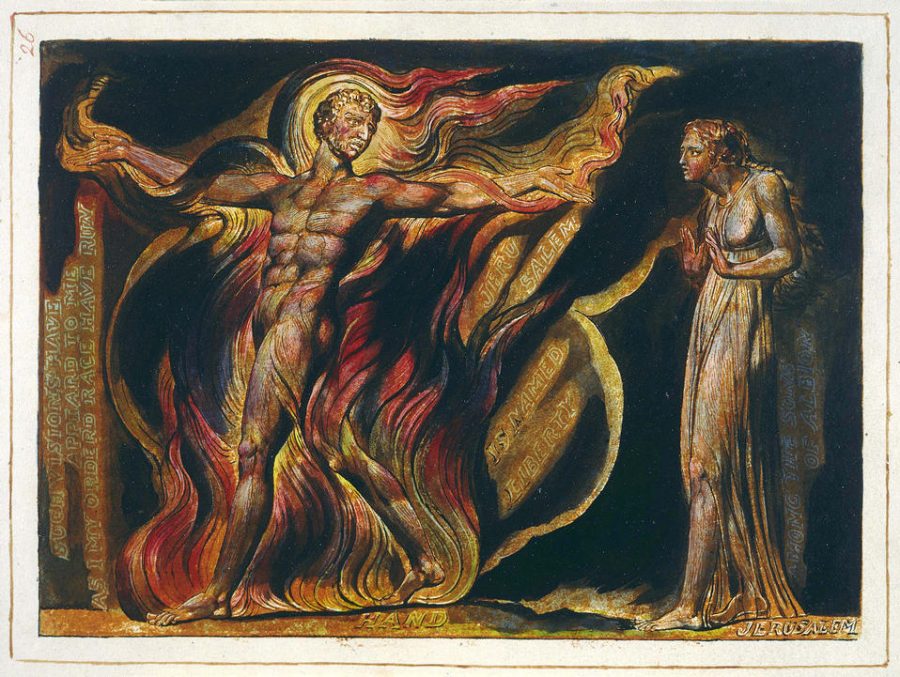
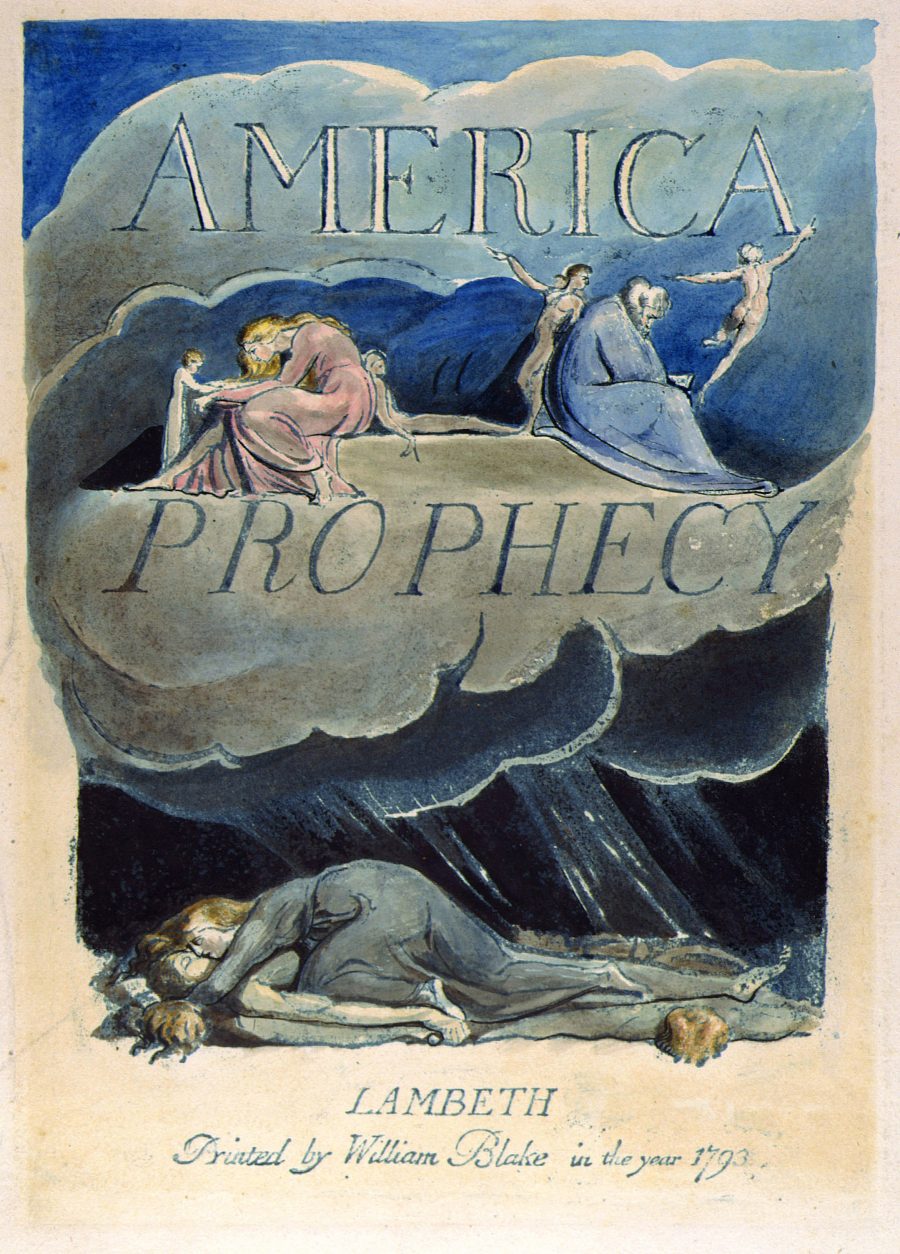
He began work­ing out his meth­ods as a teenag­er, and they allowed tremen­dous cre­ative free­dom through­out his life to cre­ate per­son­al works of art like the “Illu­mi­nat­ed Books” (from which the oth­er two images here come): con­tain­ers of his com­plex mythol­o­gy and some of his most pas­sion­ate engrav­ings. You can learn even more about Blake’s DIY print­ing process in the video fur­ther up from Ash­molean Muse­um. Blake’s futur­is­tic art drew heav­i­ly from the past — from Renais­sance mas­ters like Michelan­ge­lo, for exam­ple — as a means of cre­at­ing an alter­nate art his­to­ry, one that opposed the val­ues of dom­i­na­tion and oppres­sive sys­tems of order.

His for­mal and polit­i­cal rad­i­cal­ism is per­haps one rea­son Blake became one of the first artists to pop­u­late an online archive, with the launch of the Blake Archive all the way back in 1996, “con­ceived as an inter­na­tion­al [free] pub­lic resource that would pro­vide uni­fied access to major works of visu­al and lit­er­ary art that are high­ly dis­parate, wide­ly dis­persed, and more and more often severe­ly restrict­ed as a result of their val­ue, rar­i­ty, and extreme fragili­ty.” Vis­it the Blake Archive here to see high res­o­lu­tion scans of hun­dreds of Blake’s prophet­ic works, all cre­at­ed from start to fin­ish by his own hand, and learn more about his per­son­al and com­mer­cial illus­tra­tions at the links below.

Relat­ed Con­tent:

William Blake’s 102 Illus­tra­tions of The Divine Com­e­dy Col­lect­ed in a Beau­ti­ful Book from Taschen

Enter an Archive of William Blake’s Fan­tas­ti­cal “Illu­mi­nat­ed Books”: The Images Are Sub­lime, and in High Res­o­lu­tion

William Blake’s Hal­lu­ci­na­to­ry Illus­tra­tions of John Milton’s Par­adise Lost

Josh Jones is a writer and musi­cian based in Durham, NC. Fol­low him at @jdmagness

Meet the Variophone, the Early Soviet Synthesizer that Made Music with a Film Projector (1932)

The ear­ly days of elec­tron­ic instru­ments lacked com­mon­ly accept­ed ideas about what an elec­tron­ic instru­ment was, much less how it should be used. No one asso­ci­at­ed elec­tron­ics with tech­no or new wave or hip hop or pop, giv­en that none of these exist­ed. Every sound made by exper­i­ments in syn­the­sis in the ear­ly 20th cen­tu­ry was by its nature exper­i­men­tal, and most elec­tron­ic instru­ments were one of a kind. It did not even seem obvi­ous that elec­tron­ic instru­ments had to be machines that were pur­pose built for sound.

In 1930, at the very dawn of sound on film, Evge­ny Sholpo invent­ed the Var­io­phone — or “Auto­mat­ed Paper Sound with sound­tracks in both trans­ver­sal and inten­sive form.” It was, in sim­pler terms, a pho­to­elec­tric audio syn­the­siz­er that made use of a film pro­jec­tor and spin­ning card­board discs with sound waves cut into them in var­i­ous pat­terns. When ampli­fied, the device could turn the pat­terns into sounds. It also cre­at­ed “abstract spi­ral ani­ma­tion,” notes Boing Boing. Both “were way ahead of their time.”

If you’re think­ing such a machine might be used to make film sound­tracks, it was. But it was also “a con­tin­u­a­tion of research that Sholpo had been con­duct­ing since the 1910s,” the blog Beyond the Coda writes, “when he was work­ing on per­former­less music.”

Sholpo want­ed a device that would replace musi­cians and allow com­posers to turn com­plex musi­cal ideas into record­ed sounds them­selves. He was aid­ed in the endeav­or by Geor­gy Rim­sky-Kor­sakov (grand­son of Russ­ian com­pos­er Niko­lai Rim­sky-Kor­sakov), who helped him build the pro­to­type at Lenfilm Stu­dios in 1931.

The two pro­duced their first film sound­track for the pro­pa­gan­da film The Year 1905 in Bour­geoisie Satire, in 1931, and then the fol­low­ing year cre­at­ed “a syn­the­sized sound­track for A Sym­pho­ny of Peace and many oth­er sound­tracks for films and car­toons through­out the thir­ties,” notes 120 Years of Elec­tron­ic Music. The Var­io­phone was destroyed dur­ing the Siege of Leningrad, but Sholpo built two more, con­tin­u­ing to record sound­tracks through the for­ties. Unlike the first mono­phon­ic ana­logue syn­the­siz­ers built a cou­ple of decades lat­er, the Var­io­phone could cre­ate and repli­cate poly­phon­ic com­po­si­tions, since tones could be lay­ered atop each oth­er, as in mul­ti­track record­ing.

You can hear sev­er­al exam­ples of the Var­io­phone here, and see it synched to ani­ma­tion — both from its own sound waves and from hand-drawn films like “The Dance of the Crow,” below. What does it sound like? The tones and tim­bres vary some­what among record­ings. There’s clear­ly been some degra­da­tion in qual­i­ty over time, and the tech­nol­o­gy of record­ing sound on film was only in its infan­cy at the time, in any case. But, in cer­tain moments, the Var­io­phone can sound like the ear­ly Moog that Wendy Car­los used to syn­the­size clas­si­cal music and record film scores almost 40 years after Sholpo patent­ed his machine.

via Boing Boing

Relat­ed Con­tent:

How an 18th-Cen­tu­ry Monk Invent­ed the First Elec­tron­ic Instru­ment

Leon Theremin Adver­tis­es the First Com­mer­cial Pro­duc­tion Run of His Rev­o­lu­tion­ary Elec­tron­ic Instru­ment (1930)

The His­to­ry of Elec­tron­ic Music, 1800–2015: Free Web Project Cat­a­logues the Theremin, Fairlight & Oth­er Instru­ments That Rev­o­lu­tion­ized Music

Josh Jones is a writer and musi­cian based in Durham, NC. Fol­low him at @jdmagness

David Cronenberg Visits a Video Store & Talks About His Favorite Movies

The excite­ment over Crimes of the Future, set to pre­miere next week at the Cannes Film Fes­ti­val, sug­gests that David Cro­nen­berg retains a strong fan base more than half a cen­tu­ry into his film­mak­ing career. But many of us who con­sid­er our­selves part of that fan base did­n’t dis­cov­er his work in the the­ater, much less at Cannes. Rather, we found it at the video store, ide­al­ly one that devot­ed a sec­tion specif­i­cal­ly to his work — or at least to his sig­na­ture genre of “body hor­ror,” which his films would in any case have dom­i­nat­ed. Fit­ting, then, that the new Cro­nen­berg inter­view above takes place among shelves packed with, if not the VHS tapes and Laserdiscs we grew up with, then at least DVDs and Blu-Rays.

This video comes from Kon­bi­ni, a French Youtube chan­nel whose Video Club series has brought such auteurs as Claire Denis, Hirokazu Kore-eda, and Ter­ry Gilliam into the hal­lowed halls of Paris’ JM Vidéo.

“They have 50,000 movies, I think,” says the inter­view­er. “That’s too many,” replies Cro­nen­berg, “so you need to give me a few.” The direc­tor of Video­dromeThe Fly, and Crash turns out to have no trou­ble spot­ting and dis­cussing movies of inter­est, and the list of his picks from the stock at JM Vidéo is as fol­lows:

  • Fed­eri­co Felli­ni, La Stra­da (“the begin­ning of my entrance­ment with moviemak­ing”)
  • Ing­mar Bergman, The Hour of the Wolf  (“a beau­ti­ful movie; very much a night­mare”)
  • Roger Vadim, And God Cre­at­ed Woman (Brigitte Bar­dot “was incred­i­bly sex­u­al, beau­ti­ful — I was total­ly in love with her”)
  • Jean-Pierre and Luc Dar­d­enne, Roset­ta (which the Cro­nen­berg-led 1999 Cannes jury select­ed in “the fastest vote for the Palme d’Or ever in the his­to­ry of Cannes”)
  • Rid­ley Scott, Alien (some of whose ele­ments “are exact­ly like my very low-bud­get film Shiv­ers”)
  • Paul Ver­ho­even, Total Recall (a project for which he wrote twelve screen­play drafts, reject­ed for being “the Philip K. Dick ver­sion” rather than “Raiders of the Lost Ark go to Mars”)
  • Ken Rus­sell, Altered States (which “com­bined a strange group of peo­ple who, nor­mal­ly, you would­n’t think would make a sci­ence-fic­tion movie”)
  • Abdel­latif Kechiche, Blue Is the Warmest Col­or (“a beau­ti­ful, sexy, inter­est­ing, intense movie with young actress­es who are real­ly very good, and giv­ing every­thing,” includ­ing Crimes of the Future’s own Léa Sey­doux)
  • Olivi­er Assayas, Per­son­al Shop­per (“one of the movies that con­vinced me to ask Kris­ten Stew­art to be in Crimes of the Future”)
  • Matthieu Kasso­vitz, La Haine (his intro­duc­tion to the “fan­tas­tic emo­tion­al depth” and “intel­lect” of Vin­cent Cas­sel)
  • Julia Ducour­nau, Titane (a “very dan­ger­ous” genre pic­ture that nev­er­the­less won a Palme d’Or)
  • Richard Mar­quand, Return of the Jedi (when asked to direct it, he said, “ ‘Well, I don’t usu­al­ly direct oth­er peo­ple’s mate­r­i­al,’ and they said, ‘Good­bye‘”)
  • Bran­don Cro­nen­berg, Pos­ses­sor (“my son’s movie,” the prod­uct of “a strug­gle that remind­ed me of all the dif­fi­cul­ties I ever had mak­ing a movie”)
  • Ed Emsh­willer, Rel­a­tiv­i­ty (the kind of film that showed him “you did­n’t have to go to film school, which I nev­er did, you did­n’t have to work in the film indus­try, you could make a movie your­self just because you want­ed to make a movie”)
  • Kathryn Bigelow, Strange Days (“one of the movies that con­vinced me I should work with Ralph Fiennes”)
  • Nico­las Roeg, Don’t Look Now (“a very, very strong movie, very strange, very much about death, but at first you’re not aware that that’s real­ly the sub­ject mat­ter”)

As not just a film fan but a film­mak­er, Cro­nen­berg has plen­ty of relat­ed sto­ries to tell about his own pro­fes­sion­al expe­ri­ences in cin­e­ma. Not all of them have to do with the pic­tures that inspired him when he was com­ing of age in the nine­teen-fifties and nine­teen-six­ties. In fact, even as he approach­es his ninth decade, he clear­ly con­tin­ues to find new ideas and col­lab­o­ra­tors in the work of emerg­ing direc­tors. Per­haps that’s one rea­son he seems uncan­ni­ly undi­min­ished here, much like this sur­vivor of a video store whose shelves he brows­es. Vive JM Vidéo, et vive Cro­nen­berg.

via Metafil­ter

Relat­ed con­tent:

The Last Video Store: A Short Doc­u­men­tary on How the World’s Old­est Video Store Still Sur­vives Today

Time Out Lon­don Presents The 100 Best Hor­ror Films: Start by Watch­ing Four Hor­ror Clas­sics Free Online

Quentin Taran­ti­no Gives a Tour of Video Archives, the Store Where He Worked Before Becom­ing a Film­mak­er

A Cel­e­bra­tion of Type­writ­ers in Film & Tele­vi­sion: A Super­cut

John Lan­dis Decon­structs Trail­ers of Great 20th Cen­tu­ry Films: Cit­i­zen Kane, Sun­set Boule­vard, 2001 & More

Based in Seoul, Col­in Mar­shall writes and broad­casts on cities, lan­guage, and cul­ture. His projects include the Sub­stack newslet­ter Books on Cities, the book The State­less City: a Walk through 21st-Cen­tu­ry Los Ange­les and the video series The City in Cin­e­ma. Fol­low him on Twit­ter at @colinmarshall, on Face­book, or on Insta­gram.

Hans Zimmer Was in the First-Ever Video Aired on MTV, The Buggles’ “Video Killed the Radio Star”

More than four decades after its release, The Bug­gles’ “Video Killed the Radio Star” is usu­al­ly cred­it­ed with more pop-cul­tur­al impor­tance than musi­cal influ­ence. Per­haps that befits the song whose video was the first-ever aired on MTV. But if you lis­ten close­ly to the song itself in The Bug­gles’ record­ing (as opposed to the con­cur­rent­ly pro­duced ver­sion by Bruce Wool­ley and the Cam­era Club, which also has its cham­pi­ons), you’ll hear an unex­pect­ed degree of both com­po­si­tion­al and instru­men­tal com­plex­i­ty. You’ll also have a sense of a fair­ly wide vari­ety of inspi­ra­tions, one that Bug­gles co-founder Trevor Horn has since described as includ­ing not just oth­er music but lit­er­a­ture as well.

“I’d read J. G. Bal­lard and had this vision of the future where record com­pa­nies would have com­put­ers in the base­ment and man­u­fac­ture artists,” said Horn in a 2018 Guardian inter­view. “I’d heard Kraftwerk’s The Man-Machine and video was com­ing. You could feel things chang­ing.” The Bug­gles, Horn and col­lab­o­ra­tor Geoff Downes employed all the tech­nol­o­gy they could mar­shal. And by his reck­on­ing, “Video Killed the Radio Star” would take 26 play­ers to re-cre­ate live. Pay­ing prop­er homage to Kraftwerk requires not just using machin­ery, but get­ting at least a lit­tle Teu­ton­ic; hence, per­haps, the brief appear­ance of Hans Zim­mer at 2:50 in the song’s video.

“‘Hey, I like this idea of com­bin­ing visu­als and music,” Zim­mer recent­ly recalled hav­ing thought at the time. “This is going to be where I want to go.” And so he did: today, of course, we know Zim­mer as per­haps the most famous film com­pos­er alive, sought after by some of the pre­em­i­nent film­mak­ers of our time. He and Horn would actu­al­ly col­lab­o­rate again in the ear­ly nine­teen-nineties on the sound­track to Bar­ry Levin­son’s Toys (whose oth­er con­trib­u­tors includ­ed no less an eight­ies video icon than Thomas Dol­by, who’d played key­boards on the Bruce Wool­ley “Video Killed the Radio Star”). By that time Horn had put per­form­ing behind him and turned super-pro­duc­er for artists like Yes, Seal, and the Pet Shop Boys. The Bug­gles burnt out quick­ly, but one doubts that Horn or Zim­mer lose much sleep over it today.

Relat­ed con­tent:

Watch the First Two Hours of MTV’s Inau­gur­al Broad­cast (August 1, 1981)

How Hans Zim­mer Cre­at­ed the Oth­er­world­ly Sound­track for Dune

The 120 Min­utes Archive Com­piles Clips & Playlists from 956 Episodes of MTV’s Alter­na­tive Music Show (1986–2013)

Hear 9 Hours of Hans Zim­mer Sound­tracks: Dunkirk, Inter­stel­lar, Incep­tion, The Dark Knight & Much More

Based in Seoul, Col­in Mar­shall writes and broad­casts on cities, lan­guage, and cul­ture. His projects include the Sub­stack newslet­ter Books on Cities, the book The State­less City: a Walk through 21st-Cen­tu­ry Los Ange­les and the video series The City in Cin­e­ma. Fol­low him on Twit­ter at @colinmarshall, on Face­book, or on Insta­gram.

What’s It Like Drumming For Prince?: Drummer Hannah Welton Describes the Genius of His Musicianship

Tes­ti­mo­ni­als to Prince’s mind-blow­ing musi­cian­ship flood­ed the media after his death, from cel­e­brat­ed stars and not-so-famous musi­cians who played in the artist’s back­ing bands over the decades. In the for­mer cat­e­go­ry, we have Prince’s own musi­cal hero, Ste­vie Won­der — no slouch as a mul­ti-instru­men­tal­ist — whose Songs in the Key of Life stood as a “per­fect album” for the Pur­ple One. Won­der describes their jam ses­sions as “amaz­ing” for the vari­ety of peo­ple and cul­tures Prince could bring togeth­er, and for the incred­i­ble range of his tal­ent.

“He could play clas­si­cal music if he want­ed to,” said Won­der, in tears after Prince’s death. “He could play jazz if he want­ed to, he could play coun­try if he want­ed to. He played rock, you know, he played blues. He played pop. He played every­thing.…” He played all 27 instru­ments on his debut album, from elec­tric gui­tar, bass, and piano to “mini-Moog, poly-Moog, Arp string ensem­ble, Arp Pro Soloist, Ober­heim four-voice, clavinet, drums, syn­drums, water drums, slap­sticks, bon­gos, con­gas, fin­ger cym­bals, wind chimes, orches­tral bells, wood­blocks, brush trap, tree bell, hand claps and fin­ger snaps.”

He did all of this with lit­tle to no for­mal train­ing, teach­ing him­self to com­pose in near­ly any idiom and to switch up gen­res and styles with ease. In short, Prince was a “genius,” says drum­mer Han­nah Wel­ton in the Drumeo video above. Wel­ton joined the New Pow­er Gen­er­a­tion in 2012, then helped form his new back­ing band, 3rdeyegirl. In the video above, the hard-work­ing drum­mer makes it clear that she does not use this word friv­o­lous­ly. “I don’t know that I ever heard an off note,” she says. “Piano, gui­tar, drums, nobody touched any of those instru­ments the way that he did.”

Wel­ton also talks about what she learned from Prince — after their first meet­ing when he asked her to play ping pong. “One thing,” she says, is that “the space between the notes is just a funky as the notes them­selves.” In the hour-long les­son, Wel­ton shows off her own drum skills in songs like “Wom­en’s Intu­ition” (which she wrote with her hus­band Joshua Wel­ton, one of Prince’s pro­duc­ers) and talks more about her time with the untouch­able musi­cian, includ­ing how he recruit­ed her after see­ing her on YouTube and what it’s like to have a “drum-off/bass-off” with him. As for whether she ever beat Prince in ping pong, you’ll have to watch to find out.…

Relat­ed Con­tent:

Prince’s First Tele­vi­sion Inter­view (1985)

Watch a New Director’s Cut of Prince’s Blis­ter­ing “While My Gui­tar Gen­tly Weeps” Gui­tar Solo (2004)

The Lit­tle Prince: Footage Gets Unearthed Of the Pop Star at Age 11

Josh Jones is a writer and musi­cian based in Durham, NC. Fol­low him at @jdmagness

« Go BackMore in this category... »
Quantcast