The Birth of Venus, we often hear, depicts the ideal woman. Yet half a millennium after Sandro Botticelli painted it, how many of us whose tastes run to the female form really see it that way? “I’ve always been struck by how Venus is strangely asexual, and her nudity is clinical,” says gallerist James Payne, creator of the Youtube channel Great Art Explained. “Maybe that’s because she represents sex as a necessary function: sex for procreation, the ultimate goal in a dynastic marriage.” This, safe to say, isn’t the sort of thing that gets most of us going in the 21st century. But this famous painting does something more important than to show us a naked woman: it reveals, as Payne puts it in a new video essay, “a dramatic shift in western art.”
If you accept the definition of the Renaissance that has it start in the 15th century, The Birth of Venus’ completion in the 1480s makes it quite an early Renaissance artwork indeed. In that period, “a renewed interest in ancient Greco-Roman culture led to an intellectual and artistic rebirth, a rise in humanist philosophy, and radical changes in ideas about religion, politics, and science.”
In art, Botticelli bridged “the gap between medieval Gothic art and the emerging humanism.” In the Middle Ages, Christianity’s dominance had been total, but “the Renaissance gave artists like Botticelli freedom to explore new subject matter, albeit within a Christian framework.” At the time, “the idea that art could be for pleasure, and not just to serve God, was new and radical.”
Botticelli’s “inclusion of a near-life-sized female nude was unprecedented in Western art,” and underscored her origin in not Christian scripture but Greek myth. With her “statue-like pose” and alabaster skin, Venus “is unreal, an idealized figure not bound by actual laws,” but her shy self-covering “makes voyeurs of us all.” Botticelli, in his religiousness, could have been “depicting Venus as an emblem of sacred or divine love,” but his genius lay in his ability “to take a pagan story, a nude female, and make them acceptable to contemporary Christian thinking.” Chaste and untouchable though the goddess may look in his rendering, knowledge of the painting’s daring, almost subversive conception makes it more exciting to behold. A bit of context, as Payne well knows, always gives art a charge.
Based in Seoul, Colin Marshall writes and broadcasts on cities, language, and culture. His projects include the Substack newsletterBooks on Cities, the book The Stateless City: a Walk through 21st-Century Los Angeles and the video series The City in Cinema. Follow him on Twitter at @colinmarshall or on Facebook.
The 1960s moved very fast. The Beatles started 1963 as four freshly scrubbed moptops from Liverpool. By 1968 they were hairy hippies dabbling in drugs and mysticism. (And writing some of the best music of all time, don’t get me wrong!). Then there were the Monkees. Created by Bob Rafelson and Bert Schneider in 1966 as a loving homage to the Beatles 1964–65 Richard Lester films, it too quickly changed. By 1968, the show and the band had run its course. There was already no cultural space for four lovable…anythings. And while many elements killed the optimism and radical hope of the 1960s–Vietnam, bad acid, Manson, Altamont–hats off to Head, the cult movie that annihilated The Monkees as a band, the band movie as a concept, and the concept of light entertainment as being on the side of the viewer. Obscenity, who really cares? asked Dylan a few years before. Propaganda, all is phony. That’s Head.
What’s interesting about the Head story is trying to figure out the motivations of several of the players. The Monkees themselves were tired of being seen as an ersatz band, although by all accounts they were. Rafelson and company auditioned young actors and musicians and assembled the top four into the band/TV show. Most of the songs were written by Tin Pan Alley stalwarts like Neil Diamond or Carole King, or up and coming artists like Harry Nilsson. By being a fake band for two seasons of their show, however, the Monkees had turned into a real band. But what they were turning into was not the Monkees that the teens loved. Who had the appetite for destruction first? The monster? Or the mad scientists?
Having conquered television and the radio—-the Monkees had kept the Beatles and the Stones out of the Number One position in 1966-—Rafelson sought to conquer film, and by doing so, offer up a mea culpa of sorts: yes, this group was a prefabrication. Yes, we’re going to tear it all down. Inspired by experimental filmmakers like Stan Brakhage and Kenneth Anger, Rafelson, the band, and up-and-coming actor Jack Nicholson decamped in early 1968 to a resort motel in Ojai, CA. There they smoked a lot of weed, and recorded hours of conversations. Nicholson and Rafelson later dosed LSD and fashioned the tapes into a script.
Head is constructed in vignettes, jumping thru genres like a person with an itchy remote control finger. Vintage movie clips and crass commercials interrupt the action. The television—-which both sold happy propaganda alongside harrowing clips from Vietnam to Americans every night—-is not to be trusted.
“The band is constantly being chased, attacked, torn apart, caged, sucked up in a giant vacuum and imprisoned in a big black box that reappears throughout the movie,” critic Petra Mayer wrote in 2018, looking back at the cult film. “They can’t escape — not with philosophy, not with force. They never escape.”
A year earlier the Beatles had realized their own trap, and escaped thru the positive magic of Sgt. Pepper’s Lonely Hearts Club Band. In 1968, the Monkees didn’t get the luxury. Self-awareness and self-destruction continues as an occasional career move by unhappy pop artists-—Pink Floyd, Prince, Garth Brooks, David Bowie-—but the Monkees destroyed themselves first, and most spectacularly. Head cost $750,000 to make, and made $16,000 back.
“Most of our fans couldn’t get in because there was an age restriction and the intelligentsia wouldn’t go to see it anyway because they hated the Monkees,” said Dolenz. Rafelson and Nicholson made out okay. They would go on to Easy Rider and establish their film careers. The Monkees? Not as much.
Surprisingly, the one Monkee who spoke well of the film’s cult legacy was their most critical member, Michael Nesmith.
“It has a life that comes from literature,” he told interviewer Doug Gordon. “It has a life that comes from fiction. It has a life that comes from fantasy and the deep troves of making up stories and narrative. But it was telling a narrative, but the narrative that it was telling was very, very different than the one the television show was.”
Ted Mills is a freelance writer on the arts who currently hosts the Notes from the Shed podcast and is the producer of KCRW’s Curious Coast. You can also follow him on Twitter at @tedmills, and/or watch his films here.
From Playing for Change comes this: “When The Levee Breaks is a powerful, thought-provoking and emotionally-charged classic by Led Zeppelin, from their Led Zeppelin IV album. The song is a rework of the 1929 release by Kansas Joe McCoy and Memphis Minnie about the Great Mississippi Flood of 1927; the most destructive river flooding in U.S. history.” In the accompanying video above, we can see powerful scenes from the Katrina Flood of 2005–and Jones getting accompanied by “Stephen Perkins of Jane’s Addiction, Susan Tedeschi, Derek Trucks and over 20 musicians and dancers from seven different countries.”
Find more Playing for Change performances in the Relateds below.
If you would like to sign up for Open Culture’s free email newsletter, please find it here. It’s a great way to see our new posts, all bundled in one email, each day.
If you would like to support the mission of Open Culture, consider making a donation to our site. It’s hard to rely 100% on ads, and your contributions will help us continue providing the best free cultural and educational materials to learners everywhere. You can contribute through PayPal, Patreon, and Venmo (@openculture). Thanks!
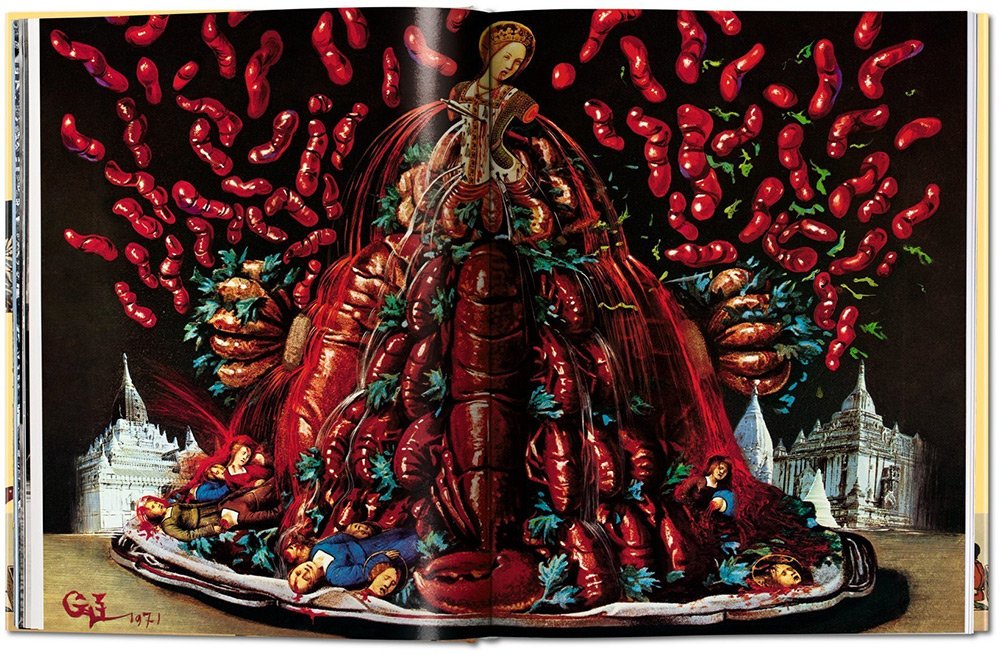
It’s presentation may be Surreal, but it’s not an entirely unrealistic thing to prepare as The Art Assignment’s Sarah Urist Green discovers, above.
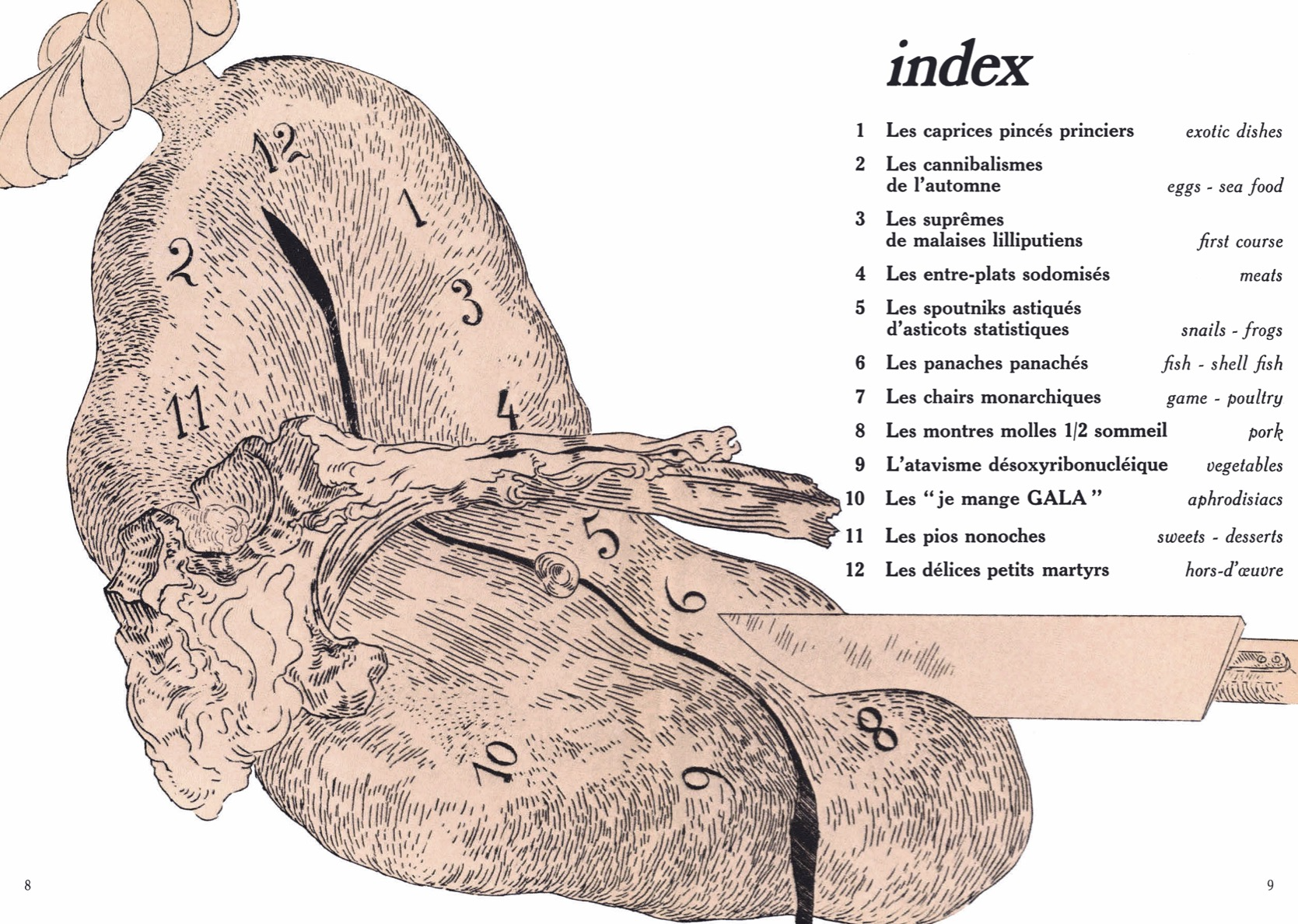
The recipe, published in Les Diners de Gala, Dali’s over-the-top cult cookery book from 1973, has pedigree.
Dali got it off a chef at Paris’ fabled Tour d’Argent, who later had second thoughts about giving away trade secrets, and balked at sharing exact measurements for the dish:
Bush of Crawfish in Viking Herbs
In order to realize this dish, it is necessary to have crawfish of 2 ounces each. Prepare the following ingredients for a broth: ‘fumet’ (scented reduced bullion) of fish, of consommé, of white wine, Vermouth, Cognac, salt, pepper, sugar and dill (aromatic herb). Poach the crawfish in this broth for 20 minutes. Let it cool for 24 hours and arrange the crawfish in a dome. Strain the broth and serve in cups.
Green may seek repentance for the sin of poaching lobsters’ freshwater cousins, but Dali, who blamed his sex-related guilt on his Catholic upbringing, was unconflicted about enjoying the “delicious little martyrs”:
If I hate that detestable degrading vegetable called spinach, it is because it is shapeless, like Liberty. I attribute capital esthetic and moral values to food in general, and to spinach in particular. The opposite of shapeless spinach, is armor. I love eating suits of arms, in fact I love all shell fish… food that only a battle to peel makes it vulnerable to the conquest of our palate.
If your scruples, schedule or savings keep you from attempting Dali’s Surreal shellfish tower, you might try enlivening a less aspirational dish with Green’s wholesome, homemade fish stock:
Devin Lytle and Jared Nunn, test driving Dali’s Cassanova cocktail and Eggs on a Spit for History Bites on Buzzfeed’s Tasty channel, seem less surefooted than Green in both the kitchen and the realm of art history, but they’re totally down to speculate as to whether or not Dali and his wife, Gala, had a “healthy relationship.”
If you can stomach their snarky, self-referential asides, you might get a bang out of hearing them dish on Dali’s revulsion at being touched, Gala’s alleged penchant for bedding younger artists, and their highly unconventional marriage.
Despite some squeamishness about the eggs’ viscousness and some reservations about the surreal amount of butter required, Lytle and Nunn’s reaction upon tasting their Dali recreation suggest that it was worth the effort:
Cassanova cocktail
• The juice of 1 orange
• 1 tablespoon bitters (Campari)
• 1 teaspoon ginger
• 4 tablespoons brandy
• 2 tablespoons old brandy (Vielle Cure)
• 1 pinch Cayenne pepper
This is quite appropriate when circumstances such as exhaustion, overwork or simply excess of sobriety are calling for a pick-me-up.
Here is a well-tested recipe to fit the bill.
Let us stress another advantage of this particular pep-up concoction is that one doesn’t have to make the sour face that usually accompanies the absorption of a remedy.
At the bottom of a glass, combine pepper and ginger. Pour the bitters on top, then brandy and “Vielle Cure.” Refrigerate or even put in the freezer.
Thirty minutes later, remove from the freezer and stir the juice of the orange into the chilled glass.
Drink… and wait for the effect.
It is rather speedy.
Your best bet for preparing Eggs on a Spit, which Lytle compares to “an herby, scrambled frittata that looks like a brain”, are contained in artist Rosanna Shalloe’s modern adaption.
What would you do if you discovered an original, autographed copy of Les Diners de Gala in the attic of your new home?
A young man named Brandon takes it to Rick Harrison’s Gold & Silver Pawn Shop, hoping it will fetch $2500.
Harrison, star of the History Channel’s Pawn Stars, gives Brandon a quick primer on the Persistence of Memory, Dali’s famous “melting clocks” painting (failing to mention that the artist insisted the clocks should be interpreted as “the Camembert of time.”)
Brandon walks with something less than the hoped for sum, and Harrison takes the book home to attempt some of the dishes. (Not, however, Bush of Crayfish in Viking Herb, which he declares, “a little creepy, even for Dali.”)
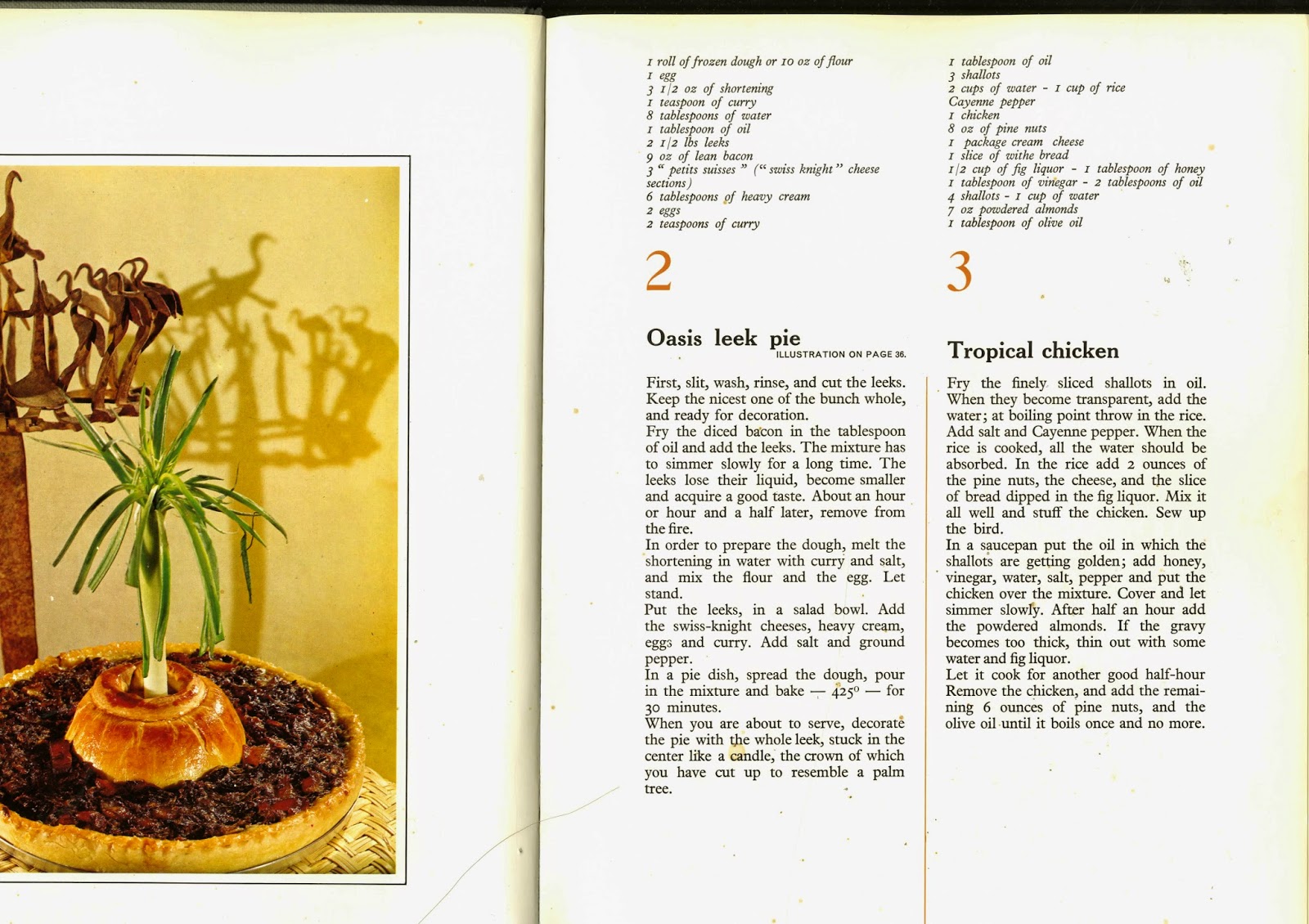
Alas, his younger relatives are wary of Oasis Leek Pie’s star ingredient and refuse to entertain a single mouthful of whole fish, baked with guts and eyes.
They’re not alone. The below newsreel suggests that comedian Bob Hope had some reservations about Dalinian Gastro Esthetics, too.
We intend to ignore those charts and tables in which chemistry takes the place of gastronomy. If you are a disciple of one of those calorie-counters who turn the joys of eating into a form of punishment, close this book at once; it is too lively, too aggressive, and far too impertinent for you. — Salvador Dali
For more than two hours, Quentin Tarantino’s Once Upon a Time… in Hollywood builds up to the Manson murders. Or rather, it seems to be building up to the Manson murders, but then takes a sharp turn on Cielo Drive; when the credits roll, the real-life killers are dead and the real-life victims alive. Such revisionist revenge is of a piece with other recent Tarantino pictures like Inglourious Basterds, which ends with the massacre of Hitler and Goebbels, among other Nazis, and Django Unchained, wherein the titular slave lays waste to the house of the master. Long well known for borrowing from othermovies, Tarantino seems to have found just as rich a source of material in history books.
Once Upon a Time… in Hollywood “creates a new story using existing characters and situations, and many of them just happen to be real.” So says Kirby Ferguson in the video essay above, “Tarantino’s Copying: Then Vs. Now.” The film’s large cast of secondary characters includes such 1960s celebrities as Steve McQueen and Bruce Lee, as well as countless other figures recognizable mainly to the director’s fellow pop-culture obsessives.
Also portrayed is Charles Manson and the ragged young members of the “Manson Family” recruited to do his bidding, as well as are their intended victims of the night of August 8, 1969, most prominently the actress Sharon Tate. It is she, Ferguson argues, who ties together Once Upon a Time… inHollywood’s various threads of fact and fiction.
Leonardo DiCaprio’s washed-up actor Rick Dalton and Brad Pitt’s blacklisted stuntman Cliff Booth, the film’s main characters, are wholly Tarantinian creations. 26 years old and pregnant with the child of her husband Roman Polanski (a version of whom also shows up in one scene), the rising Tate shares a métier with Dalton, and when the Manson family come for her in the film, they end up face-to-face with Booth (much to their misfortune), “but unlike both of them, she is a real person, and what is depicted of her is, broadly speaking, true.” Using these characters real and imagined, Tarantino “takes a dark, frightening, and just crushingly sad reality and gives it a happy ending with brutal retribution.” For all the postmodern borrowing and shuffled storytelling that launched him into Hollywood, the man knows how to give audiences just what they want — and somehow to surprise them even as he does it.
Based in Seoul, Colin Marshall writes and broadcasts on cities, language, and culture. His projects include the Substack newsletterBooks on Cities, the book The Stateless City: a Walk through 21st-Century Los Angeles and the video series The City in Cinema. Follow him on Twitter at @colinmarshall or on Facebook.
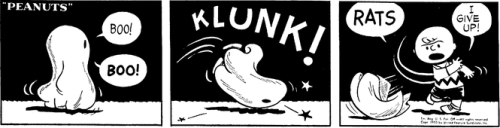
Animator/musician David Heatley, comedian Daniel Lobell, and academic/3anuts author Daniel Leonard join your Pretty Much Pop host Mark Linsenmayer to discuss Charlie Brown and his author Charles Schulz from Peanuts’ 1950 inception through the classic TV specials through to the various post-mortem products still emerging.
What’s the enduring appeal, and is it strictly for kids? We talk about the challenges of the strip format, the characters as archetypes, Schulz as depressed existentialist, religion in Peanuts, and whether the strip is actually supposed to be funny.
Some articles we used for the discussion include:
We marvel today at what we consider the wonders of ancient Egypt, but at some point, they all had to have been built by people more or less like ourselves. (This presumes, of course, that you’ve ruled out all the myriad theories involving supernatural beings or aliens from outer space.) Safe to say that, whenever in human history work has been done, work has been skipped, especially when that work is performed by large groups. It would’ve taken great numbers indeed to build the pyramids, but even less colossally scaled tombs couldn’t have been built alone. And when a tomb-builder took the day off, he needed an excuse suitable to be written in stone — on at any rate, on stone.
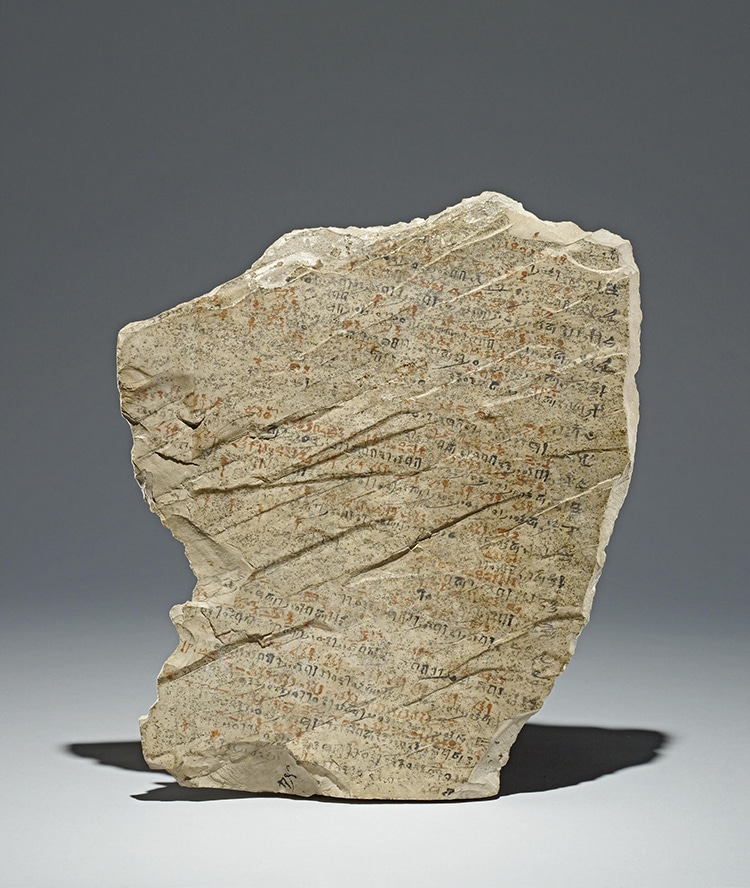
“Ancient Egyptian employers kept track of employee days off in registers written on tablets,” writes Madeleine Muzdakis at My Modern Met. One such artifact “held by the British Museum and dating to 1250 BCE is an incredible window into ancient work-life balance.” Called ostraca, these tablets were made of “flakes of limestone that were used as ‘notepads’ for private letters, laundry lists, records of purchases, and copies of literary works,” according to Egyptologist Jennifer Babcock.
Discovered along with thousands of others in the tomb builder’s village of Deir el-Medina, this particular ostracon, on view at the British Museum’s web site, offers a rich glimpse into the lives of that trade’s practitioners. Over the 280-day period covered by this 3,200-year-old ostracon, common excuses for absence include “brewing beer” and “his wife was bleeding.”
Beer, Muzdakis explains, “was a daily fortifying drink in Egypt and was even associated with gods such as Hathor. As such, brewing beer was a very important activity.” And alarming though that “bleeding” may sound, the reference is to menstruation: “Clearly men were needed on the home front to pick up some slack during this time. While one’s wife menstruating is not an excuse one hears nowadays, certainly the ancients seem to have had a similar work-life juggling act to perform.” Most of us today presumably have it easier than did the average ancient Egyptian laborer, or even artisan. Depending on where you live, maybe you, too, could call in sick to work with the excuse of having been bitten by a scorpion. But how well would it fly if you were to plead the need to feast, to embalm your brother, or to make an offering to a god?
Based in Seoul, Colin Marshall writes and broadcasts on cities, language, and culture. His projects include the Substack newsletterBooks on Cities, the book The Stateless City: a Walk through 21st-Century Los Angeles and the video series The City in Cinema. Follow him on Twitter at @colinmarshall or on Facebook.
Over 40 months, 40 animators contributed to making a short animation. The process went something like this: An animator created a three second segment, then passed it to another animator in a different country. Then, that next animator made a new contribution, inching things forward.
Above you can watch the final product. It’s the brainchild of Nathan Boey. Enjoy.
If you would like to sign up for Open Culture’s free email newsletter, please find it here. It’s a great way to see our new posts, all bundled in one email, each day.
If you would like to support the mission of Open Culture, consider making a donation to our site. It’s hard to rely 100% on ads, and your contributions will help us continue providing the best free cultural and educational materials to learners everywhere. You can contribute through PayPal, Patreon, and Venmo (@openculture). Thanks!
We're hoping to rely on loyal readers, rather than erratic ads. Please click the Donate button and support Open Culture. You can use Paypal, Venmo, Patreon, even Crypto! We thank you!
Open Culture scours the web for the best educational media. We find the free courses and audio books you need, the language lessons & educational videos you want, and plenty of enlightenment in between.