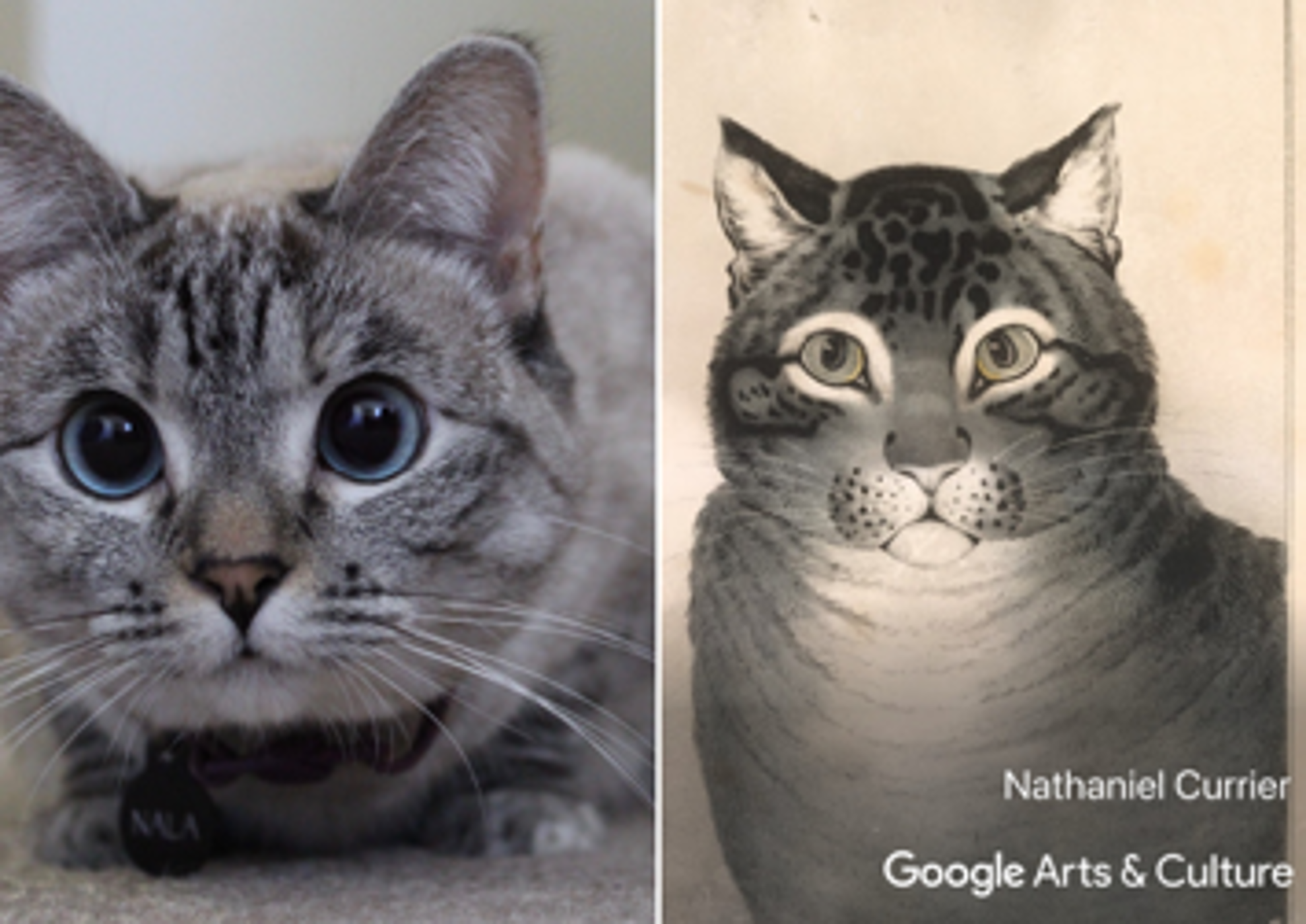
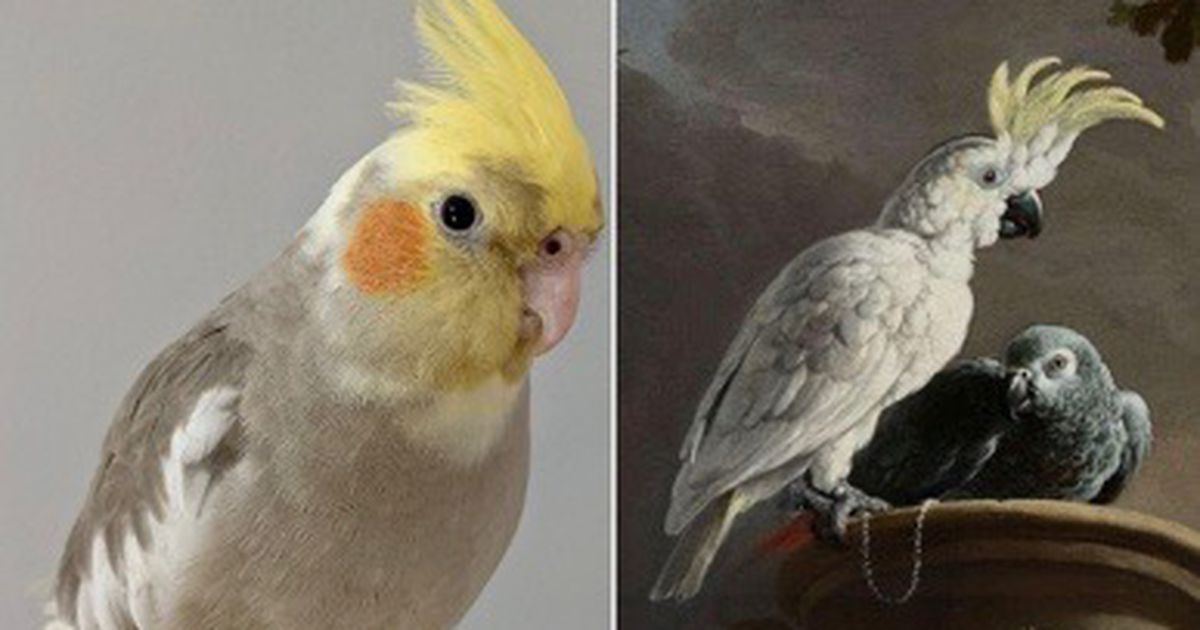
If so, you should definitely permit her to download the Google Arts & Culture app on your phone to take a selfie using the Pet Portraits feature.
Surely your pet will be just as excited to let a machine-learning algorithm trawl tens of thousands of artworks from Google Arts & Culture’s partnering museums’ collections, looking for doppelgängers.
Or maybe it’ll just view it as one more example of human folly, if a far lesser evil than our predilection for pet costumes.
Should your pet wish to know more about the artworks it resembles, you can tap the results to explore them in depth.
Dogs, fish, birds, reptiles, horses, and rabbits can play along too, though anyone hailing from the rodent family will find themselves shut out.
Mashable reports that “uploading a stock image of a mouse returned drawings of wolves.”
Last night, we sadly learned of the passing of Ivan Reitman, director of many beloved comedies–Meatballs (1979), Stripes (1981), Ghostbusters (1984), and beyond.
Born in Czechoslovakia in 1946–his mother an Auschwitz survivor and his father an underground resistance fighter–Reitman moved to Canada as a young child, where he eventually attended McMaster University. And there he “produced and directed Orientation [in 1968], the most successful student film ever made in Canada,” writes Macleans. “Produced at a cost of $1,800 while Reitman was president of the McMaster University Film Board, Orientation — the story of a freshman during his first week at university — was acquired by Twentieth CenturyFox of Canada as a “featurette” to accompany John And Mary in first-run engagements across the country.” “It earned $15,000 in rentals and continues to be in demand…” You can watch it above, or on McMaster’s website.
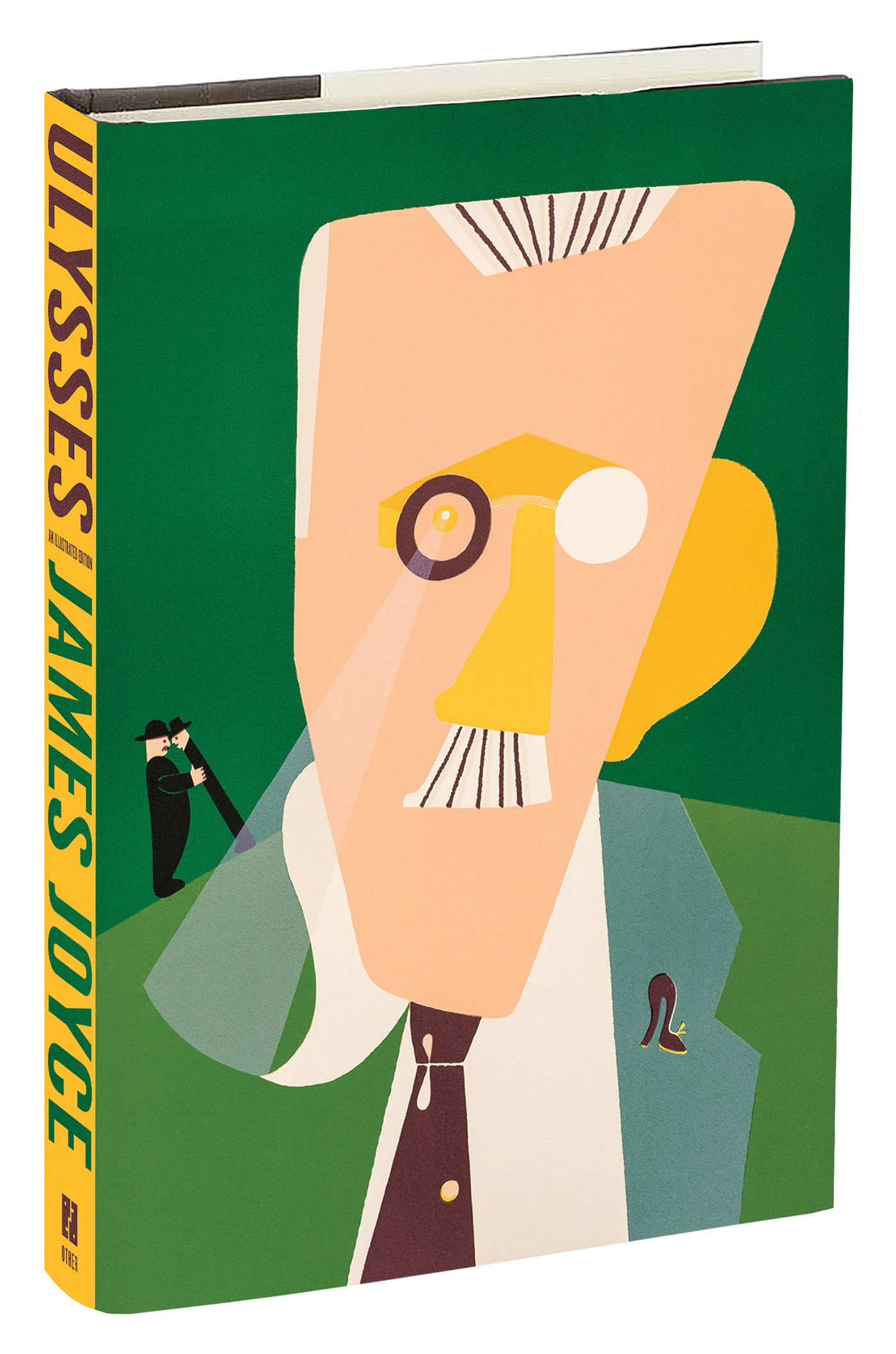
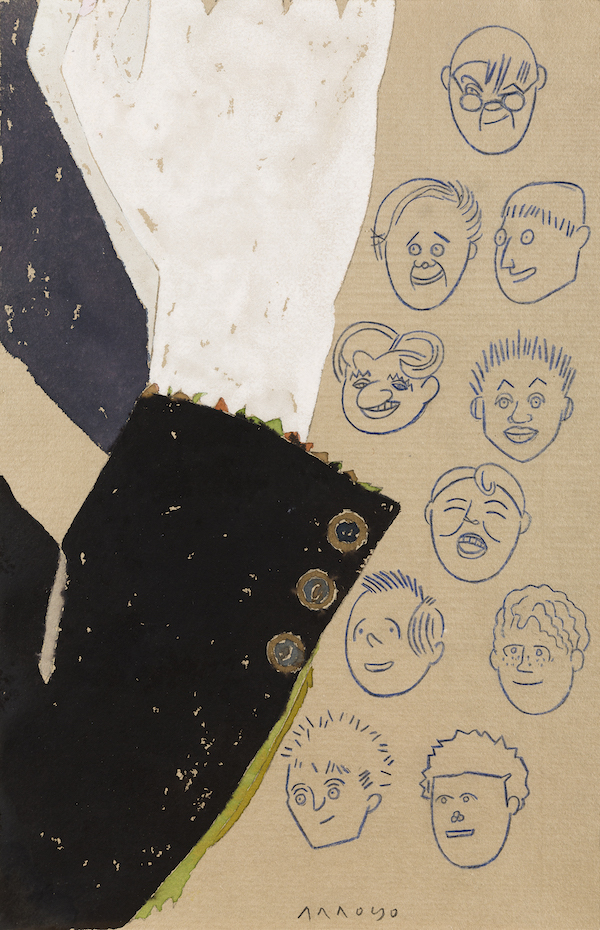
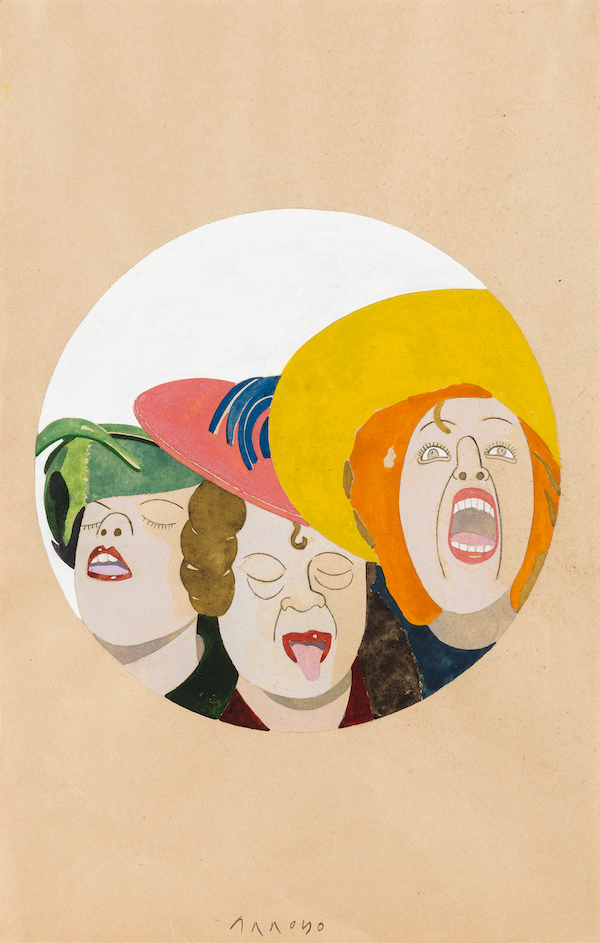
This year will see the long-delayed publication of a version of Ulysses that Joyce didn’t want you to read — not James Joyce, mind you, but the author’s grandson Stephen Joyce. Up until his death in 2020, Stephen Joyce opposed the publication of his grandfather’s best-known book in an illustrated edition. But he only retained the power actually to prevent it until Ulysses’ 2012 entry into the public domain, which made the work freely usable to everyone who wanted to. In this case, “everyone” includes such notables as neo-figurative artist Eduardo Arroyo, described by the New York Times’ Raphael Minder as “as one of the greatest Spanish painters of his generation.”
At the time of Ulysses’ copyright expiration, Arroyo had long since finished his own set of more than 300 illustrations for Joyce’s celebrated and famously intimidating novel. Arroyo noted in a 1991 essay, writes Minder, that “imagining the illustrations kept him alive when he was hospitalized in the late 1980s for peritonitis, an inflammation of the abdominal lining.”
The initial hope was for an Arroyo-illustrated edition to mark the 50th anniversary of Joyce’s death in 1991, but without the permission of the author’s estate, the project had to be put on hold for a couple of decades. When that time came, it was taken up again by two publishers, Barcelona’s Galaxia Gutenberg and New York’s Other Press.
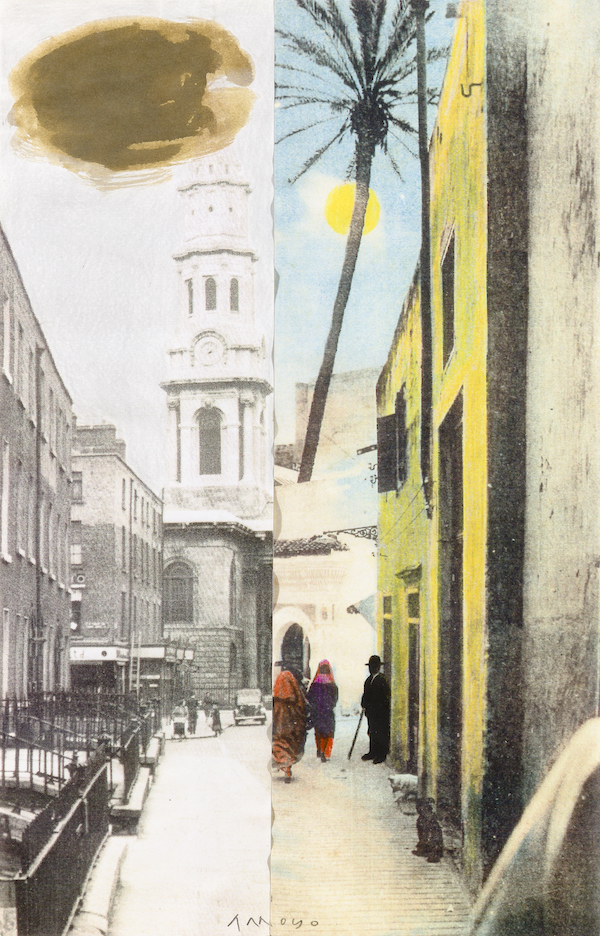
“Some of Arroyo’s black-and-white illustrations are printed in the margins of the book’s pages, while others are double-page paintings whose vivid colors are reminiscent of the Pop Art that inspired him.” His drawings, watercolors and collages include “eclectic images of shoes and hats, bulls and bats, as well as some sexually explicit representations of scenes that drew the wrath of censors a century ago.” For Ulysses’ “710 pages of inner monologue and dialogue, stream of consciousness, blank verse, Greek classics, and the venues and byways of Dublin, 1904,” as the Los Angeles Times’ Jordan Riefe puts it, are as well known for their formidable complexity as it is for the power they once had to scandalize polite society.
Arroyo, who died in 2018, stayed faithful to Ulysses’ content. (“Of course there are graphic nudes,” Riefe adds, “especially in later chapters.”) He also succeeded in completing an arduous project that the most notable artists of Joyce’s day refused even to attempt. “Joyce himself had asked Picasso and Matisse to illustrate it,” writes Galaxia Gutenberg’s Joan Tarrida, “but neither took on the task. Matisse preferred to illustrateThe Odyssey,” Ulysses’ own structural inspiration, “which deeply offended Joyce.” What Joyce would make of Arroyo’s vital and multifarious illustrations, more of which you can sample at Literary Hub, is any scholar’s guess — but then, didn’t he say something about wanting to keep the scholars guessing for centuries?
Based in Seoul, Colin Marshall writes and broadcasts on cities, language, and culture. His projects include the Substack newsletterBooks on Cities, the book The Stateless City: a Walk through 21st-Century Los Angeles and the video series The City in Cinema. Follow him on Twitter at @colinmarshall or on Facebook.
The Riot Grrrl movement feels like one of the last real revolutions in rock and punk, and not just because of its feminist, anti-capitalist politics. As Polyphonic outlines in his short music history video, Riot Grrrl was one of the last times anything major happened in rock music before the internet. And it’s especially thrilling because it all started with *zines*.
Women in the punk scene had a right to complain. Bands and their fans were very male, and sexual harassment was chronic at shows, leaving most women standing at the back of the crowd. Some zines even spelled it out: “Punks Are Not Girls,” says one.
Alienated from the scene but still fans at heart, Tobi Vail and Kathleen Hanna, already producing their own feminist zines, joined forces to release “Bikini Kill” a gathering of lyrics, essays, confessionals, appropriated quotes, plugs for Vail’s other zine “Jigsaw”, and a sense that something was happening. Something was changing in rock culture. Kim Deal of the Pixies and Kim Gordon of Sonic Youth were heroes, Poly Styrene of X‑Ray Spex was a legend, and Yoko Ono “paved the way in more ways than one for us angry grrl rockers.” Another zine, “Girl Germs,” was created by Allison Wolfe and Molly Neuman.
Bikini Kill the zine led to Bikini Kill the band in 1990, and their song “Rebel Girl” became an anthem of a new feminist rock movement focused mainly in the Pacific Northwest, around the same time as grunge.
Wolfe and Neuman, joined by Erin Smith, formed Bratmobile in 1991. K Records founder Calvin Johnson had asked them to play support for Bikini Kill, and out of necessity—Wolfe first admitted they were a “fake band”—they grabbed rehearsal space and became a “real” band on the spot. “Something in me clicked,” Wolfe said. “Like, okay, if most boy punk rock bands just listen to the Ramones and that’s how they write their songs, then we’ll do the opposite and I won’t listen to any Ramones and that way we’ll sound different.”
The burgeoning scene needed a manifesto, and it got one in “Bikini Kill” issue #2. The Riot Grrrl Manifesto staked out a space that was against “racism, able-bodieism, ageism, speciesism, classism, thinism, sexism, anti-semitism and heterosexism” as well as “capitalism in all its forms.” It ends with: “BECAUSE I believe with my wholeheartmindbody that girls constitute a revolutionary soul force that can, and will change the world for real.”
The manifesto (and the very healthy Pacific Northwest live scene) spawned a movement, even bringing with it bands that had been around previously, like L7. Riot Grrrl set out to elevate women’s voices and music, without capitulating to male standards, and return to the DIY and collective energy of the early punk scene. It also brought feminist theory out of the colleges and onto the stage, and with it queer theory and dialog about trauma, rape, and abuse—everything mainstream culture would rather not talk about. Like the original punk scene in the 1970s, it burned brightly and flamed out. But it inspired generations of bands, from Sleater-Kinney to White Lung, as well as non-rock music like the Electroclash movement.
Read a zine from the time, or listen to the lyrics of Riot Grrrl bands and you will hear the same discourse, and recognize the same tactics, as today. In some ways it feels even more radical now-—that humble, photocopied zines could affect a whole scene and not be atomized by social media.
Ted Mills is a freelance writer on the arts who currently hosts the Notes from the Shed podcast and is the producer of KCRW’s Curious Coast. You can also follow him on Twitter at @tedmills, and/or watch his films here.
FYI: The Great Courses (formerly The Teaching Company) is running its Spring Warehouse Clearance Sale, offering a steep discount on a good number of its courses. If you’re not familiar with it, the Great Courses provides a very nice service. They travel across the U.S., recording great professors lecturing on great topics that will appeal to any lifelong learner. They then make the courses available to customers in different formats (DVD, Video & Audio Downloads, etc.). The courses are very polished and complete, and they can be quite reasonably priced, especially when they’re on sale, as they are today. Click here to explore the offer. The Spring Warehouse Clearance Sale ends on March 10.
Note: The Great Courses is a partner with Open Culture. So if you purchase a course, it benefits not just you and Great Courses. It benefits Open Culture too. So consider it win-win-win.
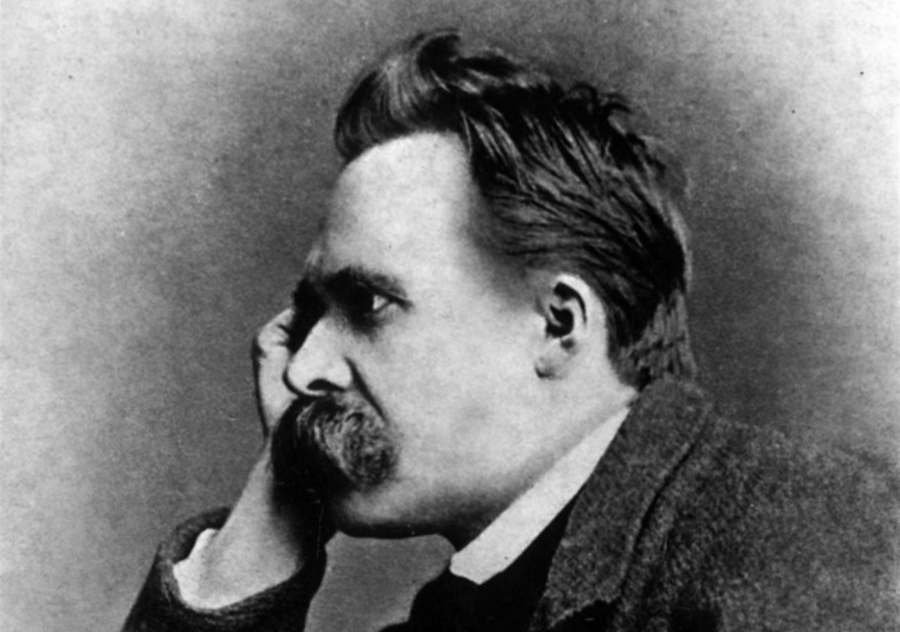
The life of Russian-born poet, novelist, critic, and first female psychologist Lou Andreas-Salomé has provided fodder for both salacious speculation and intellectual drama in film and on the page for the amount of romantic attention she attracted from European intellectuals like philosopher Paul Rée, poet Ranier Maria Rilke, and Friedrich Nietzsche. Emotionally intense Nietzsche became infatuated with Salomé, proposed marriage, and, when she declined, broke off their relationship in abrupt Nietzschean fashion.
For her part, Salomé so valued these friendships she made a proposal of her own: that she, Nietzsche and Rée, writes D.A. Barry at 3:AM Magazine, “live together in a celibate household where they might discuss philosophy, literature and art.” The idea scandalized Nietzsche’s sister and his social circle and may have contributed to the “passionate criticism” Salomé’s 1894 biographical study, Friedrich Nietzsche: The Man and His Works, received. The “much maligned” work deserves a reappraisal, Barry argues, as “a psychological portrait.”
In Nietzsche, Salomé wrote, we see “sorrowful ailing and triumphal recovery, incandescent intoxication and cool consciousness. One senses here the close entwining of mutual contradictions; one senses the overflowing and voluntary plunge of over-stimulated and tensed energies into chaos, darkness and terror, and then an ascending urge toward the light and most tender moments.” We might see this passage as charged by the remembrance of a friend, with whom she once “climbed Monte Sacro,” she claimed, in 1882, “where he told her of the concept of the Eternal Recurrence ‘in a quiet voice with all the signs of deepest horror.’”
We should also, perhaps primarily, see Salomé’s impressions as an effect of Nietzsche’s turbulent prose, reaching its apotheosis in his experimentally philosophical novel, Thus Spake Zarathustra. As a theorist of the embodiment of ideas, of their inextricable relation to the physical and the social, Nietzsche had some very specific ideas about literary style, which he communicated to Salomé in an 1882 note titled “Toward the Teaching of Style.” Well before writers began issuing “similar sets of commandments,” writes Maria Popova at Brain Pickings, Nietzsche “set down ten stylistic rules of writing,” which you can find, in their original list form, below.
1. Of prime necessity is life: a style should live.
2. Style should be suited to the specific person with whom you wish to communicate. (The law of mutual relation.)
3. First, one must determine precisely “what-and-what do I wish to say and present,” before you may write. Writing must be mimicry.
4. Since the writer lacks many of the speaker’s means, he must in general have for his model a very expressive kind of presentation of necessity, the written copy will appear much paler.
5. The richness of life reveals itself through a richness of gestures. One must learn to feel everything — the length and retarding of sentences, interpunctuations, the choice of words, the pausing, the sequence of arguments — like gestures.
6. Be careful with periods! Only those people who also have long duration of breath while speaking are entitled to periods. With most people, the period is a matter of affectation.
7. Style ought to prove that one believes in an idea; not only that one thinks it but also feels it.
8. The more abstract a truth which one wishes to teach, the more one must first entice the senses.
9. Strategy on the part of the good writer of prose consists of choosing his means for stepping close to poetry but never stepping into it.
10. It is not good manners or clever to deprive one’s reader of the most obvious objections. It is very good manners and very clever to leave it to one’s reader alone to pronounce the ultimate quintessence of our wisdom.
As with all such prescriptions, we are free to take or leave these rules as we see fit. But we should not ignore them. While Nietzsche’s perspectivism has been (mis)interpreted as wanton subjectivity, his veneration for antiquity places a high value on formal constraints. His prose, we might say, resides in that tension between Dionysian abandon and Apollonian cool, and his rules address what liberal arts professors once called the Trivium: grammar, rhetoric, and logic: the three supports of moving, expressive, persuasive writing.
Salomé was so impressed with these aphoristic rules that she included them in her biography, remarking, “to examine Nietzsche’s style for causes and conditions means far more than examining the mere form in which his ideas are expressed; rather, it means that we can listen to his inner soundings.” Isn’t this what great writing should feel like?
Salomé wrote in her study that “Nietzsche not only mastered language but also transcended its inadequacies.” (As Nietzsche himself commented in 1886, notes Hugo Drochon, he needed to invent “a language of my very own.”) Nietzsche’s bold-yet-disciplined writing found a complement in Salomé’s boldly keen analysis. From her we can also perhaps glean another principle: “No matter how calumnious the public attacks on her,” writes Barry, “particularly from [his sister] Elisabeth Förster-Nietzsche during the Nazi period in Germany, Salomé did not respond to them.”
Note: An earlier version of this post appeared on our site in December 2016.
If you would like to sign up for Open Culture’s free email newsletter, please find it here. It’s a great way to see our new posts, all bundled in one email, each day.
If you would like to support the mission of Open Culture, consider making a donation to our site. It’s hard to rely 100% on ads, and your contributions will help us continue providing the best free cultural and educational materials to learners everywhere. You can contribute through PayPal, Patreon, and Venmo (@openculture). Thanks!
When we think of a “midcentury modern” home, we think of glass walls. In part, this has to do with the post-World War II decades’ promotion of the southern California-style indoor-outdoor suburban lifestyle. But business and culture are downstream of technology, and, in this specific case, the technology known as insulated glass. Its development solved the problem of glass windows that had dogged architecture since at least the second century: they let in light, but even more so cold and heat. Only in the 1930s did a refrigeration engineer figure out how to make windows with not one but two panes of glass and an insulating layer of air between them. Its trade name: Thermopane.
First manufactured by the Libbey-Owens-Ford glass company, “Thermopane changed the possibilities for architects,” says Vox’s Phil Edwards in the video above, “How Insulated Glass Changed Architecture.” In it he speaks with architectural historian Thomas Leslie, who says that “by the 1960s, if you’re putting a big window into any residential or office building” in all but the most temperate climates, you were using insulated glass “almost by default.”
Competing glass manufacturers introduced a host of variations on and innovations in not just the technology but the marketing as well: “No home is truly modern without TWINDOW,” declared one brand’s magazine advertisement.
The associated imagery, says Leslie, was “always a sliding glass door looking out onto a very verdant landscape,” which promised “a way of connecting your inside world and your outside world” (as well as “being able to see all of your stuff”). But the new possibility of “walls of glass” made for an even more visible change in commercial architecture, being the sine qua non of the smoothly reflective skyscrapers that rise from every American downtown. Today, of course, we can see 80, 900, 100 floors of sheer glass stacked up in cities all over the world, shimmering declarations of membership among the developed nations. Those sliding glass doors, by the same token, once announced an American family’s arrival into the prosperous middle class — and now, more than half a century later, still look like the height of modernity.
Based in Seoul, Colin Marshall writes and broadcasts on cities, language, and culture. His projects include the Substack newsletterBooks on Cities, the book The Stateless City: a Walk through 21st-Century Los Angeles and the video series The City in Cinema. Follow him on Twitter at @colinmarshall or on Facebook.
We hear a great deal today about the potential causes of rising sea levels. At a certain point, natural curiosity brings out the opposite question: what causes sea levels to fall? And for that matter, can a body of water so large simply vanish entirely? Such a thing did happen once, according to the PBS Eons video above. The story begins, from our perspective, with the discovery about a decade ago of a giant rabbit — or rather of the bones of a giant rabbit, one “up to six times heavier than your average cottontail” that “almost certainly couldn’t hop.” This odd, long-gone specimen was dubbed Nuralagus rex: “the rabbit king of Minorca,” the modern-day island it ruled from about five million to three million years ago.
After living for long periods of time on islands without natural predators, certain species take on unusual proportions. “But how did the normal-size ancestor of Nuralagus make it onto a Mediterranean island in the first place?” The answer is that Minorca wasn’t always an island. In fact, “mega-deposits” of salt under the floor of the Mediterranean suggest that, “at one point in history, the Mediterranean Sea must have evaporated.” As often in our investigation of the natural world, one strange big question leads to another even stranger and bigger one. Geologists’ long and complex project of addressing it has led them to posit a forbidding-sounding event called the Messinian Salinity Crisis, or MSC.
MSC-explaining theories include a “global cooling event” six million years ago whose creation of glaciers would have reduced the flow of water into the Mediterranean, and “tectonic events” that could have blocked off what we now know as the Strait of Gibraltar. But the cause now best supported by evidence involves a combination of shifts in the Earth’s crust and changes in its climate — sixteen full cycles of them. “During periods of decreasing sea level, the position and angle of the Earth changed with respect to the Sun, so there were periods of lower solar energy, and others of higher solar energy, which increased evaporation rates in the Mediterranean. At the same time, an actively folding and uplifting tectonic belt caused water input to decrease.”
The MSC seems to have lasted for over 600,000 years. At its driest point, 5.6 million years ago, “external water sources were completely cut off, and most of the water left behind in the Mediterranean basin was evaporating.” For sea creatures, the Mediterranean became uninhabitable, but those that lived on dry land had a bit of a field day. These relatively dry conditions “allowed hippos, elephants, and other megafauna from Africa to walk and swim across the Mediterranean,” constituting a great migration that would have included the ancestor of Nuralagus rex. But when the sea later filled back up — possibly due to a flood, as animated above — the rabbit king of Minorca learned that, even on a geological timescale, you can’t go home again.
Based in Seoul, Colin Marshall writes and broadcasts on cities, language, and culture. His projects include the Substack newsletterBooks on Cities, the book The Stateless City: a Walk through 21st-Century Los Angeles and the video series The City in Cinema. Follow him on Twitter at @colinmarshall or on Facebook.
We're hoping to rely on loyal readers, rather than erratic ads. Please click the Donate button and support Open Culture. You can use Paypal, Venmo, Patreon, even Crypto! We thank you!
Open Culture scours the web for the best educational media. We find the free courses and audio books you need, the language lessons & educational videos you want, and plenty of enlightenment in between.