Grab a cup of coffee, put on your thinking cap, and start working through this video from Minute Physics, which explains why guitars, violins and other instruments can be tuned to a tee. But when it comes to pianos, it’s an entirely different story, a mathematical impossibility. Pianos are slightly but necessarily out of tune.
If you would like to sign up for Open Culture’s free email newsletter, please find it here. It’s a great way to see our new posts, all bundled in one email, each day.
If you would like to support the mission of Open Culture, consider making a donation to our site. It’s hard to rely 100% on ads, and your contributions will help us continue providing the best free cultural and educational materials to learners everywhere. You can contribute through PayPal, Patreon, and Venmo (@openculture). Thanks!
If you enjoy modern Japanese animation, you can no doubt name several masterpieces of the form off the top of your head, whether acclaimed series like Neon Genesis Evangelion and Cowboy Bebop to the work of cinema auteurs like Satoshi Kon and Hayao Miyazaki. What may cross your mind less readily is how much these and other anime productions owe to Astro Boy, or as it was known in Japan, Tetsuwan Atomu (“Mighty Atom”). First conceived on the page by artist Osamu Tezuka, remembered today as “the Godfather of Manga” (i.e., Japanese comics), it became an animated television series in 1962, a production overseen — and fatefully under-budgeted — by Tezuka himself.
“It was a stupidly low number,” Tezuka later wrote in his autobiography of the per-episode figure he quoted to his reluctant sponsors. Yet despite the manifold production stresses it caused, it forced — like any severe limitation — a good deal of creativity.
In time, writes Matt Alt in Pure Invention: How Japan Made the Modern World, “the beloved hallmarks of Japanese animated fare — the striking of theatrical poses, the lingering freeze-frames, the limited ranges of motion — evolved from desperate cost-saving workarounds into factors that distinguish anime from content produced in other lands.”
When they were first publicly screened in November of 1962, the first episodes of Astro Boy were accompanied by a lesser-known Tezuka project: Tales from a Certain Street Corner (ある街角の物語), a 40-minute film crafted with an “anti-Disney” aesthetic. At Nishikata Film Review, Cathy Munroe Hotes describes this as “the first of Tezuka’s jikken animation – or experimental works – which Tezuka made for artistic rather than commercial purposes. Although the animation does employ some unusual techniques such as a POV shot of a plane tree seed flying to the ground, it is not ‘experimental’ in the usual sense of the word.”
The term better suits some of the other works included in the playlist at the top of the post, which collects clips of a variety of Tezuka’s experimental and quasi-experimental animations produced between the mid-nineteen-sixties and the late eighties (many of which can easily be seen in full on Youtube), which collectively exhibit both imaginative power and a sense of humor. “Memory” (めもりい), from 1964, mixes traditional animation with Monty Python-style cutouts to depict the yearnings of a postwar salaryman. The omnibus Pictures at an Exhibition (展覧会の絵), made a couple of years later, satirizes modern society in ten different ways, each scored with a movement of the eponymous Mussorgsky piece.
By the last years of Tezuka’s life, the style of his animation seems to have evolved in several directions at once. “Jumping” (ジャンピング) from 1984, imagines what it would be like to jump ever-more-superhuman heights from a first-person perspective; “Push” (プッシュ), from 1987, uses a more conventionally cartoonish aesthetic to render a post-apocalyptic world dominated by vending machines. That same year, Tezuka — a descendant of famed samurai Hanzō Hattori — also released “Muramasa” (村正), a nuclear-annihilation allegory about a haunted sword. The threat posed to Earth by man was also the major theme of Legend of the Forest (森の伝説), left unfinished by the time of Tezuka’s death in 1989 but later picked up by his son Makoto: just one of the countless animators, Japanese and otherwise, working under the Godfather’s influence today.
Based in Seoul, Colin Marshall writes and broadcasts on cities, language, and culture. His projects include the Substack newsletterBooks on Cities and the book The Stateless City: a Walk through 21st-Century Los Angeles. Follow him on Twitter at @colinmarshall or on Facebook.
It pays to think intelligently about the inevitable. And this course taught by Yale professor Shelly Kagan does just that, taking a rich, philosophical look at death. Here’s how the course description reads:
There is one thing I can be sure of: I am going to die. But what am I to make of that fact? This course will examine a number of issues that arise once we begin to reflect on our mortality. The possibility that death may not actually be the end is considered. Are we, in some sense, immortal? Would immortality be desirable? Also a clearer notion of what it is to die is examined. What does it mean to say that a person has died? What kind of fact is that? And, finally, different attitudes to death are evaluated. Is death an evil? How? Why? Is suicide morally permissible? Is it rational? How should the knowledge that I am going to die affect the way I live my life?
You can watch the 26 lectures above. Or find them on YouTube and iTunes in video and audio formats. For more information on this course, including the syllabus, please visit this Yale site.
If you would like to sign up for Open Culture’s free email newsletter, please find it here. It’s a great way to see our new posts, all bundled in one email, each day.
If you would like to support the mission of Open Culture, consider making a donation to our site. It’s hard to rely 100% on ads, and your contributions will help us continue providing the best free cultural and educational materials to learners everywhere. You can contribute through PayPal, Patreon, and Venmo (@openculture). Thanks!
Note: With the sad passing of James Earl Jones, at age 93, we’re bringing back a post from our archive–one featuring Jones reading two great American poets, Edgar Allan Poe and Walt Whitman. These readings first appeared on our site in 2014.
For all its many flaws the original Star Wars trilogy never strayed too far afield because of the deep well of gravitas in James Earl Jones’ voice. The ominous breathing, the echo effect, and that arresting baritone—no amount of dancing Ewoks could take away from his vocal performance. And though Jones’ expressive face has also carried many a film, his unmistakable voice can give even the silliest of material the weight of an oil tanker’s anchor. So then imagine the effect when Jones reads from already weighty literature by Edgar Allan Poe and Walt Whitman? “Chills” only begins to describe it. Just above, hear him read Poe’s “The Raven,” a poem whose rhymes and sing-song cadences conjure up the mad obsession that materializes as that most portentous and intelligent of all the winged creatures.
While Vader and Poe seem like natural companions, the reading by Jones above of selections from Whitman’s “Song of Myself” also makes perfect sense. As comfortable on the stage as he is before the cameras, Jones has an excellent ear for the Shakespearean line, clearly good preparation for the Whitmanian, an “operatic line,” writes The Broken Tower, “due to its brea(d)th.” In the truth Whitman sings in his expansive transcendental poem, “the body, the body politic, and the nation’s body, are all literally the stuff of the universe, stardust smattered and strewn from the unifying explosion of our shared origin.” There are few readers, I aver, who could hold such “stuff” together with the strength and depth of voice as James Earl Jones. The recording above, of sections 6–7 and 17–19, comes from a reading Jones gave in October of 1973 at the 92nd St. Y. Below, hear the complete recording, with several more stanzas. Jones begins at the beginning, rumbling and bellowing out those lines that transmute egotism into magisterial, selfless inclusivity:
It speaks to the importance of discoveries in physics over the past few generations that even the disinterested layman has heard of the field’s central challenge. In brief, there exist two separate systems: general relativity, which describes the physics of space, time, and gravity, and quantum mechanics which describes the physics of fundamental particles like electrons and photons. Each being applicable only at its own scale, one would seem to be incompatible with the other. What the field needs to bring them together is kind of a “grand unified theory,” a concept that has long since worked its way into popular culture.
In the Big Think video above, physicist Michio Kaku explains this scientific quest for what he calls “the God equation” in about five minutes. Such an equation “should unify the basic concepts of physics.” But general relativity as conceived by Albert Einstein is “based on smooth surfaces,” while quantum mechanics is “based on chopping things up into particles.”
The challenge of bringing the two into concert has attracted “the greatest minds of the entire human race,” but to no definitive avail. At this point, Kaku says, only one conception “has survived every challenge: string theory, which is what I do for a living” — and which has attained a rather high level of public awareness, if not necessarily public understanding.
Kaku breaks it down as follows: “If you can peer into the heart of an electron, you would see that it’s a rubber band: a tiny, tiny vibrating string, very similar to a guitar string. There’s an infinite number of vibrations, and that is why we have subatomic particles,” each variety of which corresponds to a different vibration. “A simple idea that encapsulates the entire universe” — and, crucially, a mathematically consistent one — string theory has attracted astute proponents and detractors alike, the latter objecting to its untestabillity. But one day, technology may well advance sufficiently to falsify it or not, and if not, the door opens to the possibility of time machines, wormholes, parallel universes, “things out of The Twilight Zone.” A physicist can dream, can’t he?
Based in Seoul, Colin Marshall writes and broadcasts on cities, language, and culture. His projects include the Substack newsletterBooks on Cities and the book The Stateless City: a Walk through 21st-Century Los Angeles. Follow him on Twitter at @colinmarshall or on Facebook.
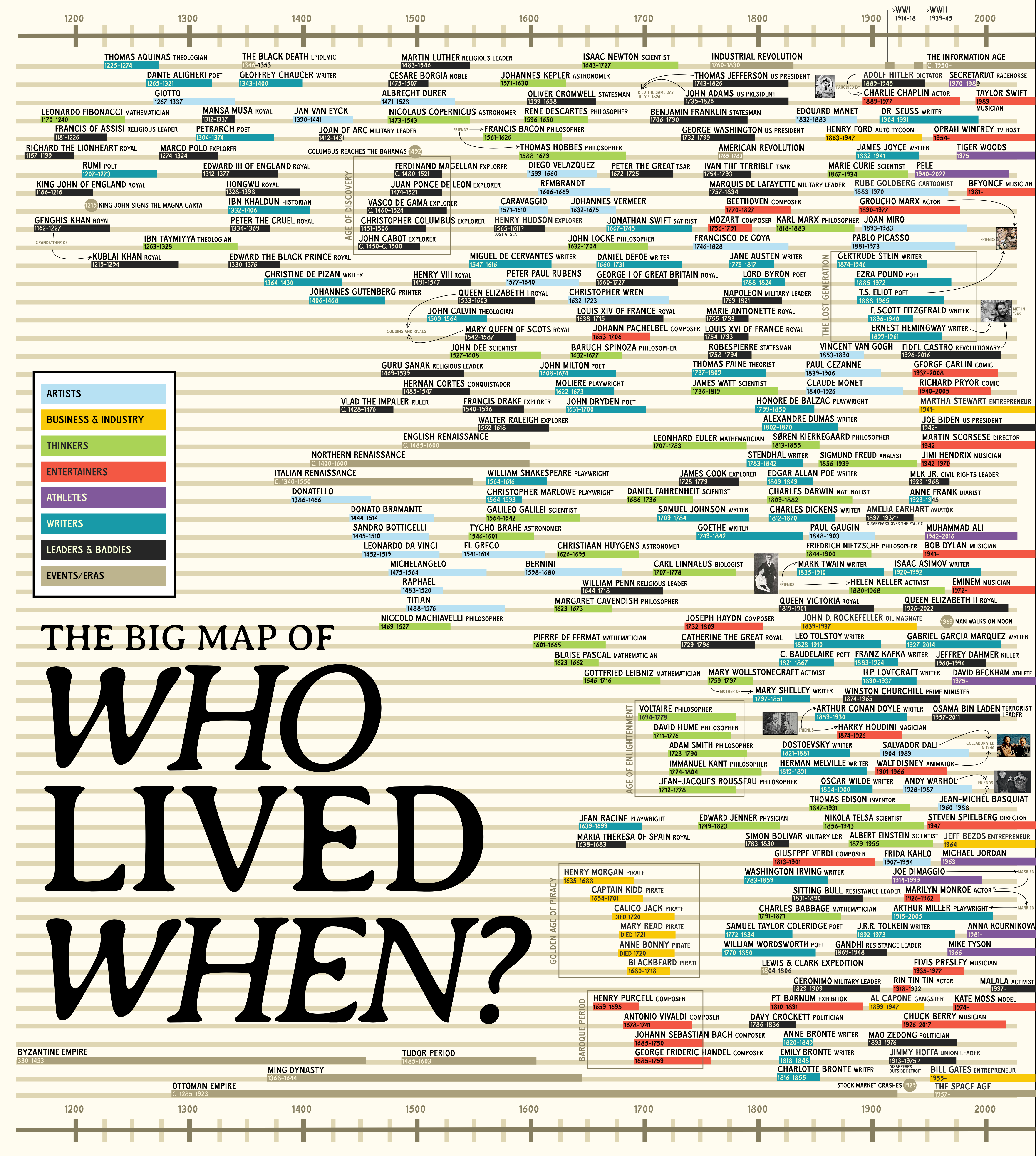
We could call the time in which we live the “Information Age.” Or we could describe it more vividly as the era of Bill Gates and Jeff Bezos, Martin Scorsese and Steven Spielberg, Oprah Winfrey and Martha Stewart, Beyoncé and Bob Dylan. Whatever you think of the work of any of these figures in particular, you can hardly deny the impact they’ve had on our culture. Were we living a century ago, we might have said the same of Henry Ford and John D. Rockefeller, James Joyce and F. Scott Fitzgerald (though he hadn’t quite published The Great Gatsby yet), Pablo Picasso and Charlie Chaplin, Marie Curie and Sigmund Freud.
Were we living in the year 1225, our lives would’ve overlapped with those of Leonardo Fibonacci, Francis of Assisi, Rumi, and Thomas Aquinas, as well as both Genghis Khan and his grandson Kublai Khan.
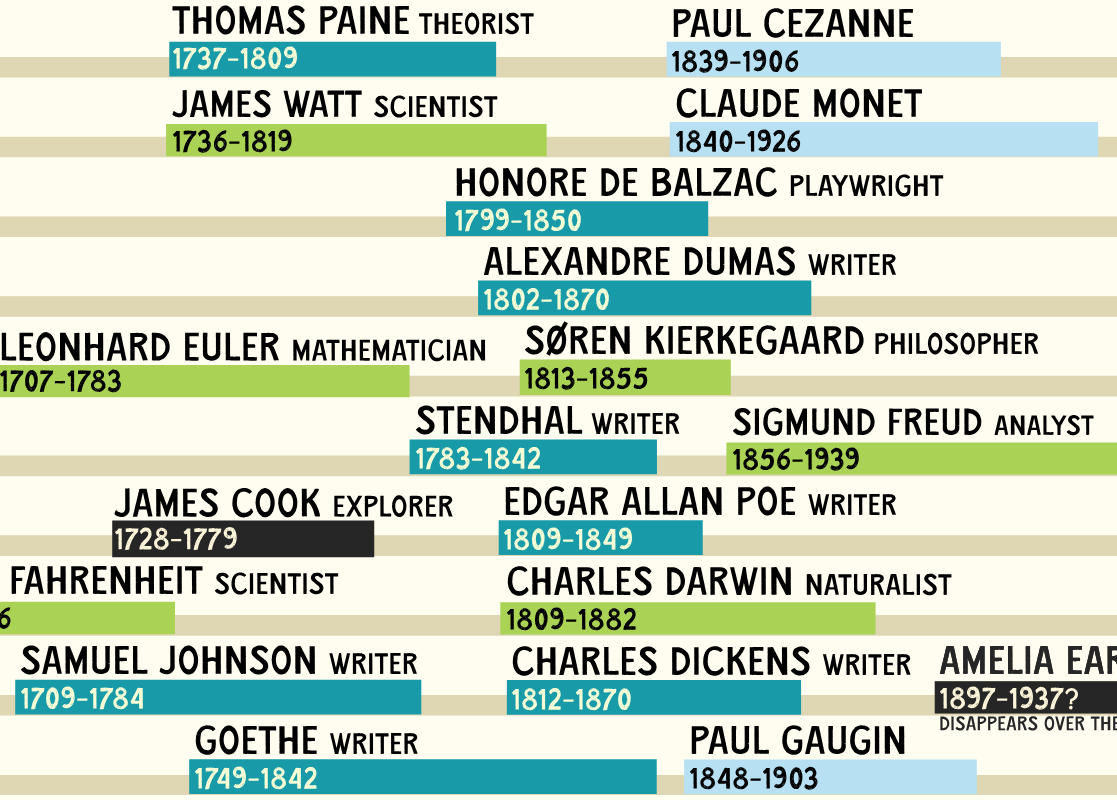
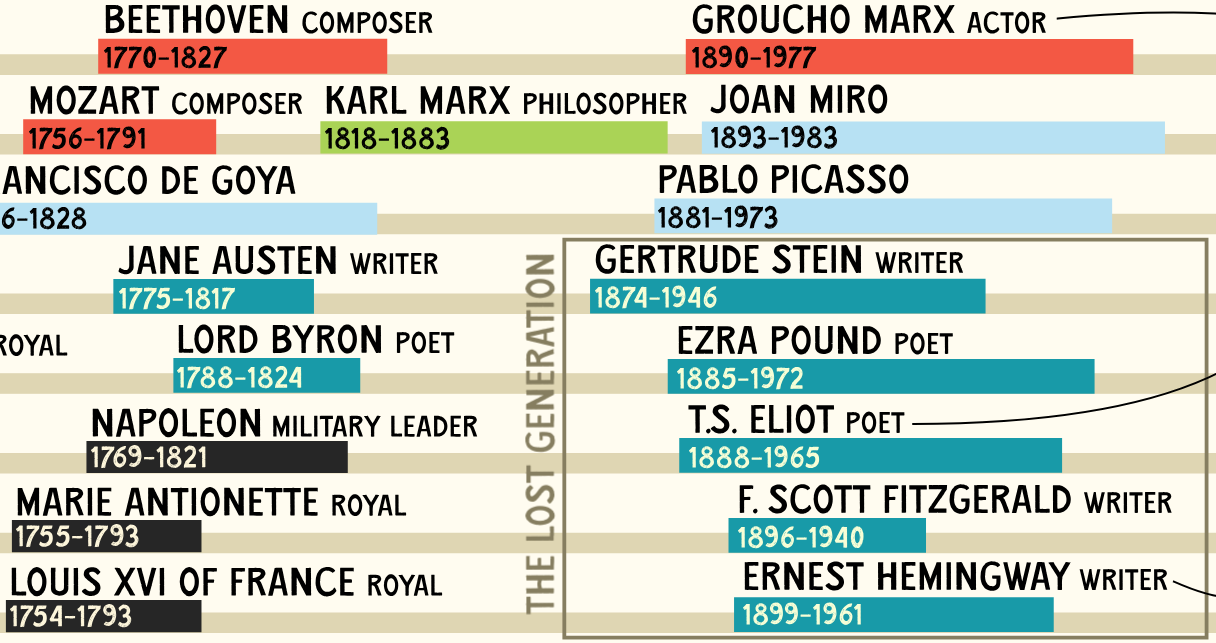
All this is laid out visually in The Big Map of Who Lived When, created earlier this year by a Reddit user called Profound_Whatever. As Big Think’s Frank Jacobswrites, the map reveals surprising instances of contemporaneousness, such as that current U.S. President Joe Biden “for about a year was alive at the same time as Nikola Tesla (1854–1943), the Serbian-American inventor who developed the alternating current (AC) system that is used for distributing electricity.”
For “another, more recent (and more baffling) overlap: The life of J.R.R. Tolkien (1892–1973), who wrote The Lord of the Rings, coincided ever so slightly with that of Eminem.” Going farther into the past, how many of us were fully aware that “Christopher Columbus (1451–1506), Leonardo da Vinci (1452–1519), and Martin Luther (1483–1546) were contemporaries of each other”? Or that “the lives of Oliver Cromwell (1599–1658) and René Descartes (1596–1650) synced almost perfectly with each other, despite the one being the dogmatically Puritan figurehead of the English Civil War, and the other the father of modern, rationalist philosophy by giving doubt to a central role in the pursuit of truth”?
The Big Map of Who Lived When uses a color-coding system to divide the figures whose lifespans it charts into eight categories, including artists (Leonardo da Vinci, Rube Goldberg), thinkers (John Locke, Charles Darwin), “business & industry” (including famed pirates from Henry Morgan to Blackbeard), and “leaders & baddies” (Napoleon, Adolf Hitler). It all reminds us that we’d give anything for a chance to meet some of them, or to stay out of the path of others. Of course, the individuals we think of as having defined a particular historical era weren’t always regarded that way by everyone else who lived at the same time: something it wouldn’t hurt to bear in mind when considering our own place in history.
Based in Seoul, Colin Marshall writes and broadcasts on cities, language, and culture. His projects include the Substack newsletterBooks on Cities and the book The Stateless City: a Walk through 21st-Century Los Angeles. Follow him on Twitter at @colinmarshall or on Facebook.
A vague sense of disquiet settled over Europe in the period between World War I and World War II. As the slow burn of militant ultranationalism mingled with jingoist populism, authoritarian leaders and fascist factions found mounting support among a citizenry hungry for certainty. Europe’s growing trepidation fostered some of the 20th century’s most striking painterly, literary, and cinematic depictions of the totalitarianism that would soon follow. It was almost inevitable that this period would see the birth of the first deeply philosophical animated film, known as The Idea.
The Idea first emerged as a wordless novel in 1920, drawn by Frans Masereel. Masereel, a close friend of Dadaist and New Objectivist artist George Grosz, had created a stark, black-and-white story about the indomitable nature of ideas. Employing thick, aggressive lines obtained through woodcut printing, Masereel depicted a conservative political order’s fight against the birth of a new idea, which eventually flourished in spite of the establishment’s relentless attempts to suppress it.
Setting to work in 1930, a Czech filmmaker named Berthold Bartosch spent two years animating The Idea. Bartosch’s visual style remained true to Masereel’s harsh, vivid lines. His version of the story, however, took a decidedly bleaker turn—one that was more reminiscent of the writings of his compatriot, Franz Kafka. Whereas Masereel believed that the purity of good ideas would overwhelm their opposition, Bartosch, working a decade closer to the Nazis’ ascendancy, was wary of such idealism.
Above, you can watch what film historian William Moritz has called “the first animated film created as an artwork with serious, even tragic, social and philosophical themes.” Paired with a haunting score composed by Arthur Honegger, the 25-minute animation is a powerfully moving meditation on art, struggle, purity of thought, and populist savagery that remains untarnished after eight decades.
Stanley Kubrick’s 2001: A Space Odyssey has been praised in all manner of terms since it came out more than half a century ago. An early advertising campaign, tapping into the enthusiasm of the contemporary counterculture, called it “the ultimate trip”; in the equivalently trendy parlance of the twenty-twenties, one could say that it “goes hard,” in that it takes no few bold, even unprecedented aesthetic and dramatic turns. The new video essay from Just One More Thing even describes 2001 as “the hardest film Kubrick ever made” — which, given Kubrick’s uncompromising ambitions as a filmmaker, is certainly saying something.
In one of the many interview clips that constitute the video’s 23 minutes, Steven Spielberg recalls his conversations with Kubrick in the last years of the master’s life. “I want to make a movie that changes the form,” Kubrick would often say to Spielberg. Arguably, he’d already done so with 2001, which continues to launch its first-time viewers into an experience unlike any they’ve had with a movie before. Unlike the more substance-inclined members of his generation, Spielberg went into the theater “clean as a whistle,” but “came out of there altered” nevertheless. It didn’t require drugs to appreciate after all; “that film was the drug.”
This isn’t to say that 2001 is purely or even primarily an abstract work of cinema. In collaboration with Arthur C. Clarke, Kubrick put a great deal of technical thought into the film’s vision of the future, with its well-appointed space stations, its artificially intelligent computers, its video calls, and its tablet-like mobile devices. Working in the years before the moon landing, says Stanley Kubrick: The Complete Films author Paul Duncan, they “had to completely visualize, and make real, things that had never occurred.” Such was the realism of their speculative work (up to and including imagining how Earth would look from space) that, as Roger Ebert notes, the real Apollo 11 astronauts could describe their experience simply: “It was like 2001.”
Conceived in the heat of the Space Race, the film envisions a great deal that didn’t come to pass by the eponymous year — and indeed, has yet to materialize still today. “We haven’t quite gotten to artificial intelligence as portrayed,” says star Keir Dullea in a 50th-anniversary interview. “Almost, but not quite.” Still, even since then, the technology has come far enough along that few of us can ponder the current state of AI without sooner or later hearing the ominously polite voice of HAL somewhere in the back of our minds. The saga of astronauts currently stranded on the International Space Station does contrast harshly with 2001’s visions of stable and well-functioning life in outer space — but as a story, it might well have appealed to Kubrick in his Dr. Strangelove mode.
Based in Seoul, Colin Marshall writes and broadcasts on cities, language, and culture. His projects include the Substack newsletterBooks on Cities and the book The Stateless City: a Walk through 21st-Century Los Angeles. Follow him on Twitter at @colinmarshall or on Facebook.
We're hoping to rely on loyal readers, rather than erratic ads. Please click the Donate button and support Open Culture. You can use Paypal, Venmo, Patreon, even Crypto! We thank you!
Open Culture scours the web for the best educational media. We find the free courses and audio books you need, the language lessons & educational videos you want, and plenty of enlightenment in between.