For those looking to boost their skills or explore new fields without breaking the bank, Class Central has done the heavy lifting. Known as a search engine for online courses, Class Central has compiled what might be the largest collection of free online certificates and badges available anywhere. From tech giants like Google and Microsoft to elite universities like Harvard and Stanford, this list covers a diverse range of subjects and skill sets.
There was a time when the world’s top universities used to offer free certificates for completing online courses. While most of those certificates are no longer free, many of the courses themselves remain open to learners, covering topics like Computer Science, Literature, and Business.
Certificates can serve as both motivation and proof of achievement for completing online courses. While platforms like Coursera and edX have moved toward paid certifications, a surprising number of free options remain — if you know where to look. Thankfully, Class Central’s guide makes it easy to find these opportunities.
What’s Included in the Guide?
The article organizes free certificate offerings by providers, including:
Google: Over 1,000 free certificates and badges in topics like digital marketing, Android development, and AI.
Harvard: Free certificates for their popular CS50 series and other online courses.
Stanford Medicine: Medical courses offering free certificates and CME credit.
LinkedIn Learning: 110+ hours of free certifications in business, technology, and design.
Semrush Academy: 90+ courses with free certificates focused on marketing and SEO.
CodeSignal: 700+ free skill certifications to validate coding, technical abilities, and soft skills.
If you’re ready to explore the full list of free courses and certifications, head over to Class Central’s detailed guide: Massive List of Thousands of Free Certificates and Badges. It’s a treasure trove for anyone looking to learn something new, enhance their resume, or simply satisfy their curiosity — all for free!
Bob Ross the man died nearly thirty years ago, but Bob Ross the archetypal TV painter has never been more widely known. “With his distinctive hair, gentle voice, and signature expressions such as ‘happy little trees,’ he’s an enduring icon,” writes Michael J. Mooney in an Atlantic piece from 2020. “His likeness appears on a wide assortment of objects: paints and brushes, toasters, socks, calendars, dolls, ornaments, and even a Chia Pet.” Here in Korea, where I live, he’s universally called Bob Ajeossi, ajeossi being a kind of colloquial title for middle-aged men. It’s quite an afterlife for a soft-spoken public-television host from the eighties.
Ross quickly became a pop-cultural figure in that era, starring in semi-ironic MTVspots by the early nineties. But over the decades, writes Mooney, “the appreciation of Bob Ross has morphed into something nearly universally earnest.” It helps that he has “the ultimate calming presence,” which has drawn special appreciation here in the twenty-first century: “More than a decade before most therapists were telling clients to be mindful and present, Ross was telling his viewers to appreciate their every breath.” This meditative, positive mood pervades all of The Joy of Painting’s more than 400 recorded broadcasts, and they even deliver the soothing effects of what YouTube-viewing generations know as “unintentional ASMR.”
Now you can watch almost all those broadcasts on a single YouTube playlist, which includes all of The Joy of Painting’s 31 seasons, originally aired between 1983 and 1994. (The videos come from the official YouTube channel of The Joy of Painting and Bob Ross.) Despite having ended its run well before any of us had ever imagined watching video online, the show now feels practically made for the internet, what with not just its ASMR qualities, but also the parasocial friendliness of Ross’ personality, the instructional value and sheer quantity of its content, and the highly consistent format. Every time, Ross paints a complete picture from start to finish: usually a landscape featuring mighty mountains, freedom-loving clouds, and happy little trees, but occasionally something just different enough to keep it interesting. And so the man Mooney describes as “probably America’s most famous painter” lives on as a beloved YouTuber.
Based in Seoul, Colin Marshall writes and broadcasts on cities, language, and culture. His projects include the Substack newsletterBooks on Cities and the book The Stateless City: a Walk through 21st-Century Los Angeles. Follow him on the social network formerly known as Twitter at @colinmarshall.
We are regularly urged to take 10,000 steps a day. However, it turns out 10,000 isn’t exactly a number anchored in science. Rather, it’s a product of marketing. According to a Harvard medical website, that figure goes back to “1965, when a Japanese company made a device named Manpo-kei, which translates to ’10,000 steps meter.’ ” 10,000 likely sounded better than a more precise number. And so it began.
So this raises the question: what’s the ideal number of steps according to science? Dr. I‑Min Lee, a professor of medicine at Harvard Medical School, focused on that question and determined that mortality rates decline when women increase their steps from lower levels (e.g., 2,000 steps) to 4,400 steps per day, with gains increasing until they reach 7,500 steps. From there, the gains level out. (Read the JAMA study here.) Meanwhile, a European study, which monitored 226,000 participants, found that people who walked more than 2,337 steps daily could start lowering their risk of dying from heart disease. And people who walked more than 3,867 steps daily could start reducing their risk of dying from any cause overall. However, unlike the Harvard study, the European study found that adding more steps continues to lower mortality rates, with gains accruing past 7,500 steps, and perhaps beyond 20,000 steps. What’s the exact sweet spot? We’ll need more research to figure that out. Until then, the existing research suggests that it pays to spend time with your walking shoes.
The new video above come from TED-Ed.
If you would like to support the mission of Open Culture, consider making a donation to our site. It’s hard to rely 100% on ads, and your contributions will help us continue providing the best free cultural and educational materials to learners everywhere. You can contribute through PayPal, Patreon, and Venmo (@openculture). Thanks!
“Considering that, in a cartoon, anything can happen that the mind can imagine, the comics have generally depicted pretty mundane worlds,” writes Calvin and Hobbes creator Bill Watterson. “Sure, there have been talking animals, a few spaceships and whatnot, but the comics have rarely shown us anything truly bizarre. Little Nemo’s dream imagery, however, is as mind-bending today as ever, and Winsor McCay remains one of the greatest innovators and manipulators of the comic strip medium.” And Little Nemo, which sprawled across entire newspaper pages in the early decades of the twentieth century, pushed artistic boundaries not just as a comic, but also as a film.
When first seen in 1911, the twelve-minute short Little Nemo was titled Winsor McCay, the Famous Cartoonist of the N.Y. Herald and His Moving Comics. A mixture of live action and animation, it dramatizes McCay making a gentleman’s wager with his colleagues that he can draw figures that move — an idea that might have come with a certain plausibility, given that speed-drawing was already a successful part of his vaudeville act. Meeting this challenge entails drawing 4,000 pictures, a task as demanding for McCay the character as it was for McCay the real artist. This labor adds up to the four minutes that end the film, which contains moments of still-impressive fluidity, technique, and humor.
Clearly possessed of a sense of animation’s potential as an art form, McCay went on to make nine more films, and ultimately considered them his proudest work. Like the Little Nemo movie, he used his second such effort, Gertie the Dinosaur, in his vaudeville act, performing alongside the projection to create the effect of his giving the titular prehistoric creature commands. “In some ways, McCay was the forerunner of Walt Disney in terms of American animation,” writes Lucas O. Seastrom at The Walt Disney Family Museum. “In order to create a lovable dinosaur and accomplish these seemingly magical feats, McCay used mathematical precision and groundbreaking techniques, such as the process of inbetweening, which later became a Disney standard.”
More than once, McCay the animator drew inspiration from the work of McCay the newspaper artist: in 1921, he made a couple of motion pictures out of his pre-Little Nemo sleep-themed comic strip Dream of the Rarebit Fiend. But for his most ambitious animated work, he turned toward history — and, at the time, rather recent history — to re-create the sinking of the RMSLusitania, an event that his employer, the newspaper magnate William Randolph Hearst, had insisted on downplaying at the time due to his stance against the U.S.’ joining the Great War. Decades thereafter, Looney Tunes animator Chuck Jones said that “the two most important people in animation are Winsor McCay and Walt Disney, and I’m not sure which should go first.” Watch these and McCay’s other surviving films on this Youtube playlist, and you can decide for yourself.
Based in Seoul, Colin Marshall writes and broadcasts on cities, language, and culture. His projects include the Substack newsletterBooks on Cities and the book The Stateless City: a Walk through 21st-Century Los Angeles. Follow him on the social network formerly known as Twitter at @colinmarshall.
Charles Darwin’s work on heredity was partly driven by tragic losses in his own family. Darwin had married his first cousin, Emma, and “wondered if his close genetic relation to his wife had had an ill impact on his children’s health, three (of 10) of whom died before the age of 11,” Katherine Harmon writes at Scientific American. (His suspicions, researchers surmise, may have been correct.) He was so concerned about the issue that, in 1870, he pressured the government to include questions about inbreeding on the census (they refused).
Darwin’s children would serve as subjects of scientific observation. His notebooks, says Alison Pearn of the Darwin Correspondence Project at Cambridge University Library, show a curious father “prodding and poking his young infant,” Charles Erasmus, his first child, “like he’s another ape.” Comparisons of his children’s development with that of orangutans helped him refine ideas in On the Origin of Species, which he completed as he raised his family at their house in rural Kent, and inspired later ideas in Descent of Man.
But as they grew, the Darwin children became far more than scientific curiosities. They became their father’s assistants and apprentices. “It’s really an enviable family life,” Pearn tells the BBC. “The science was everywhere. Darwin just used anything that came to hand, all the way from his children right through to anything in his household, the plants in the kitchen garden.” Steeped in scientific investigation from birth, it’s little wonder so many of the Darwins became accomplished scientists themselves.
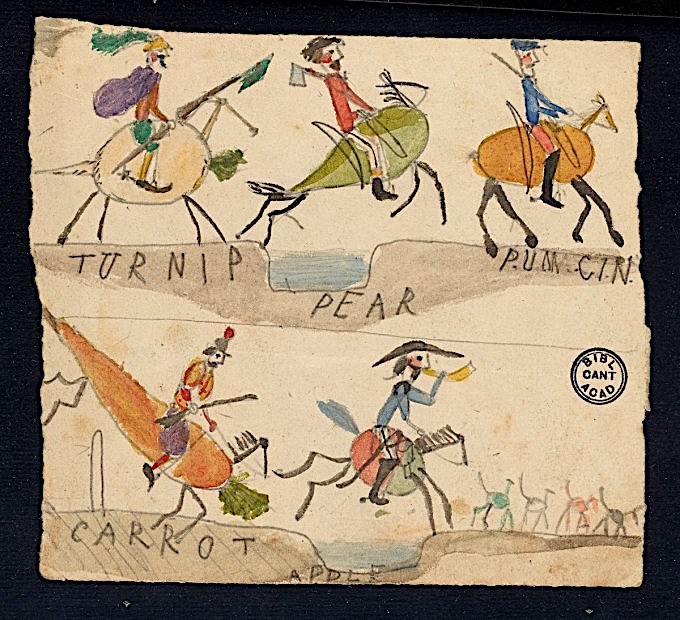
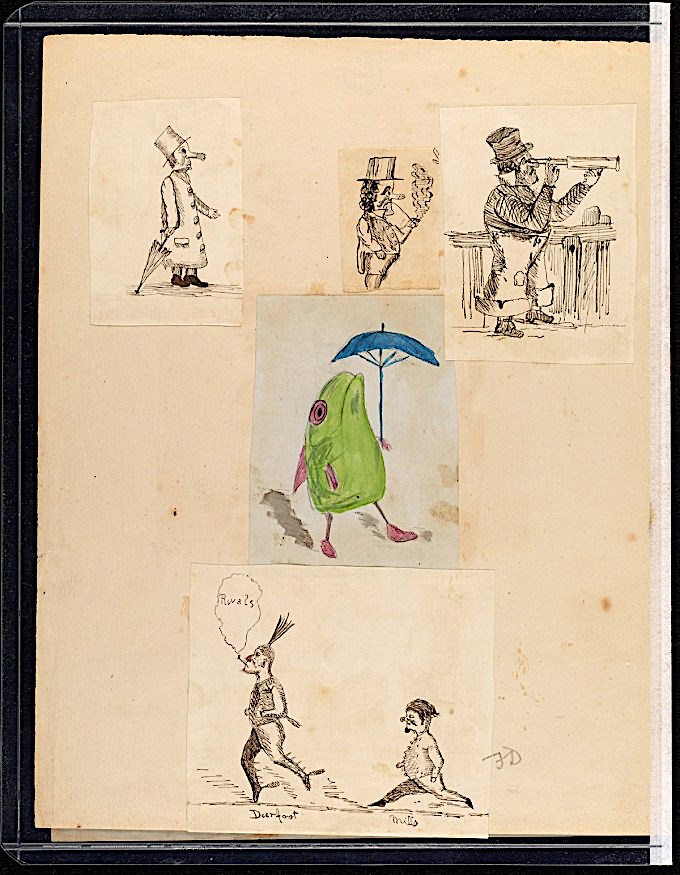
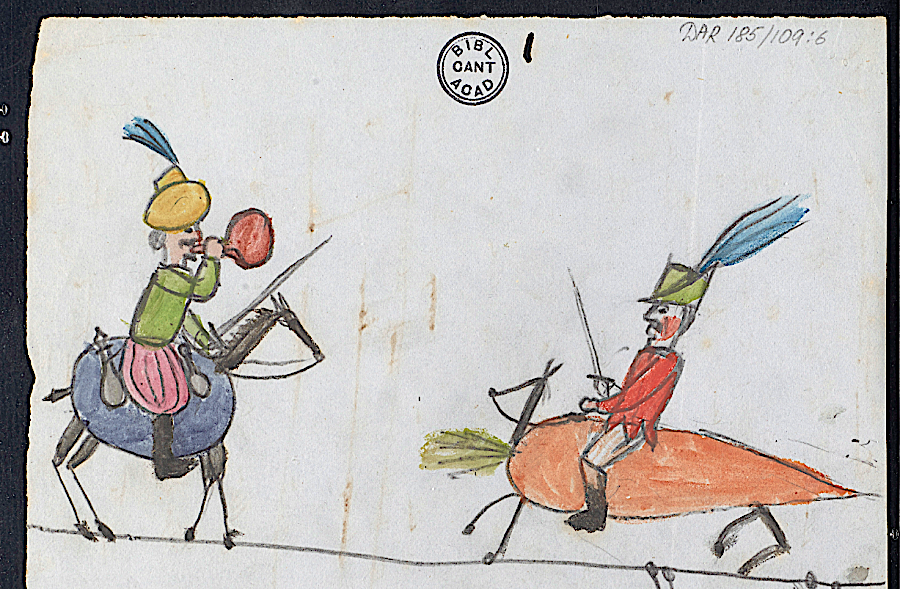
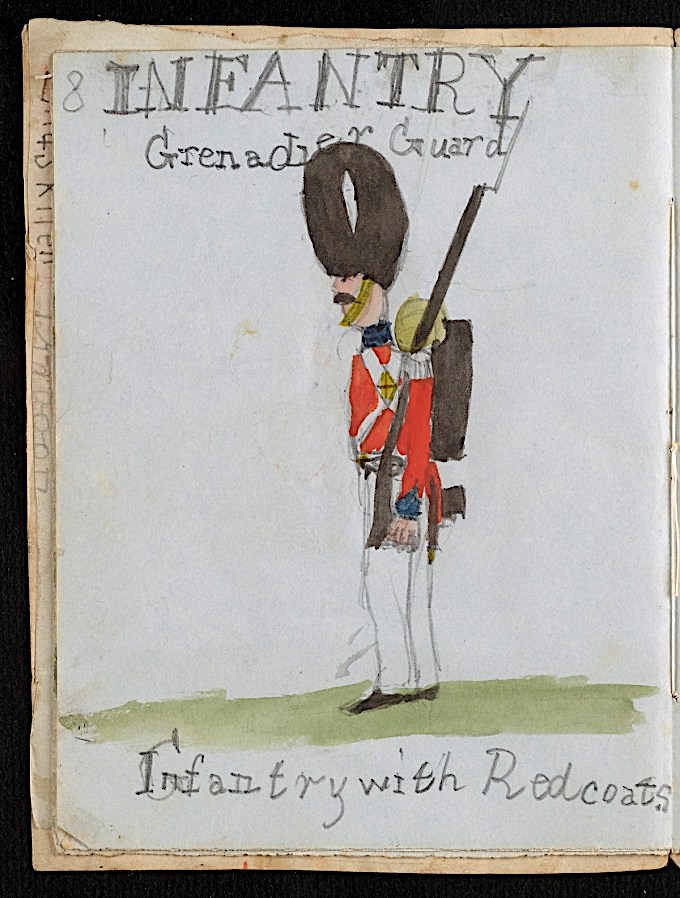
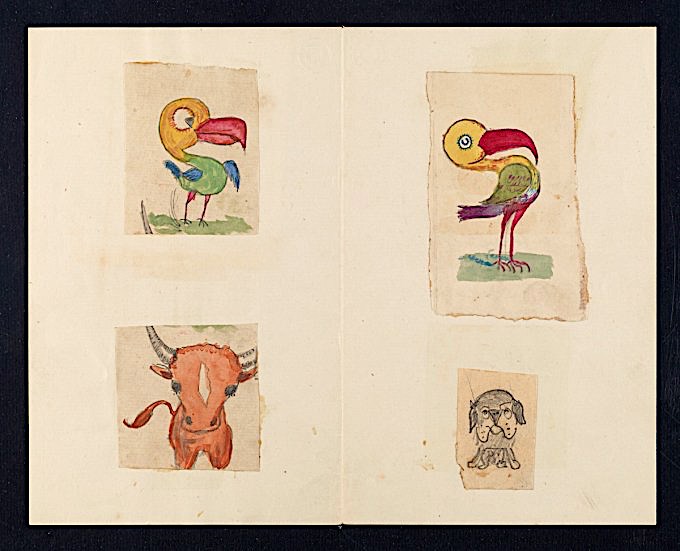
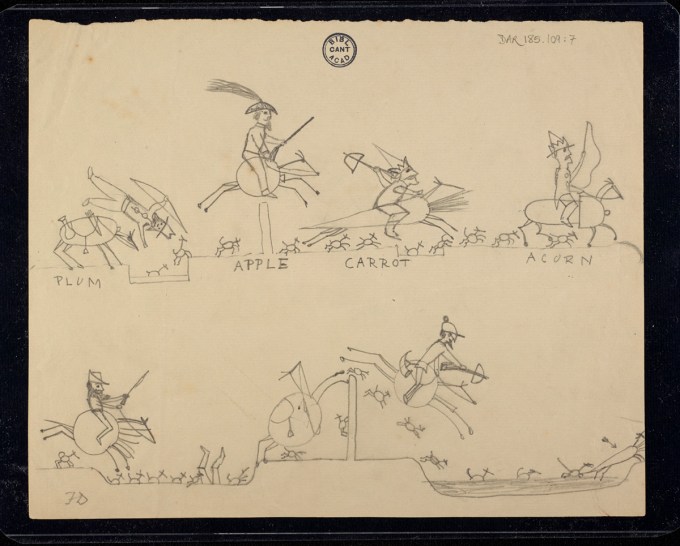
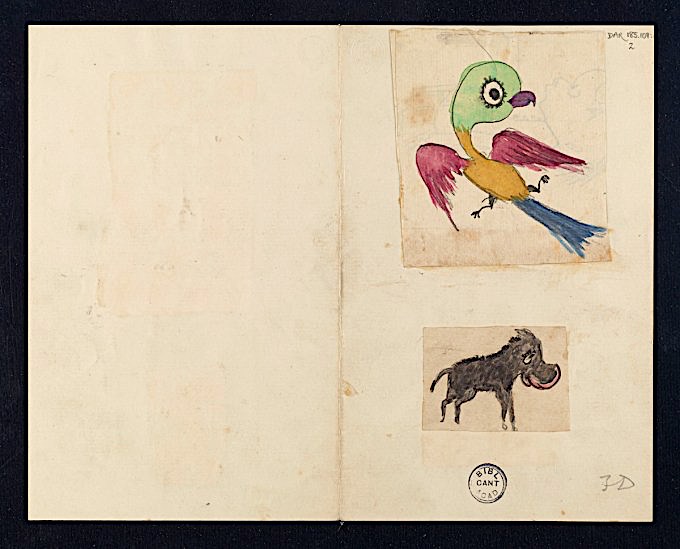
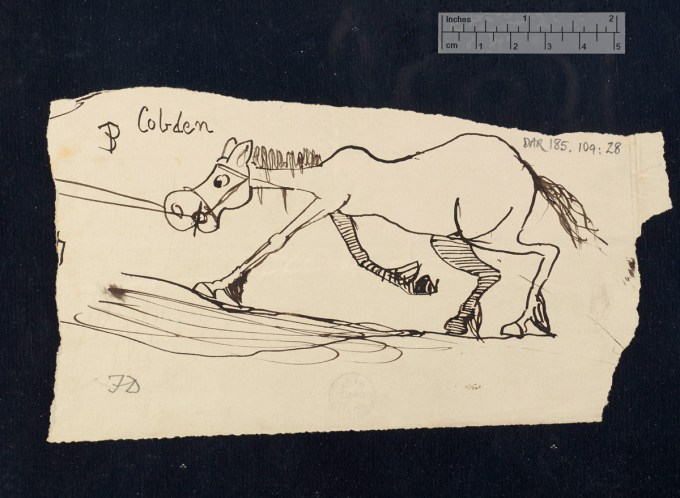
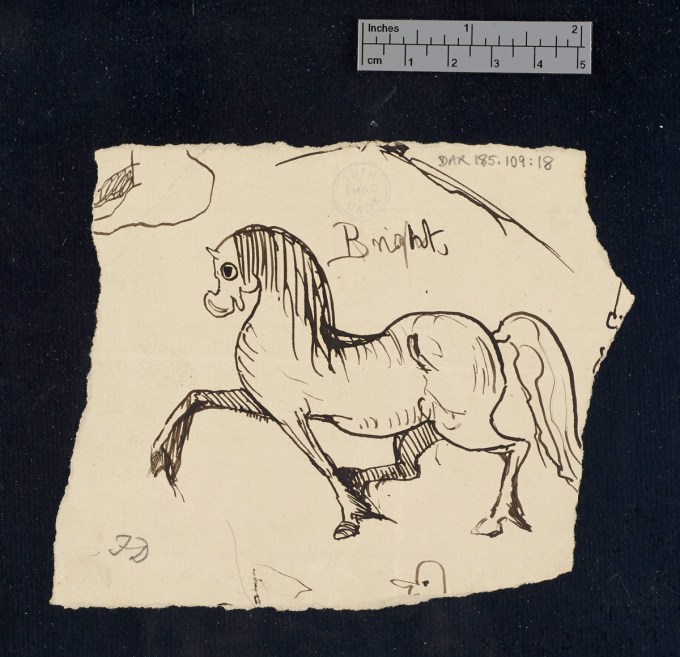
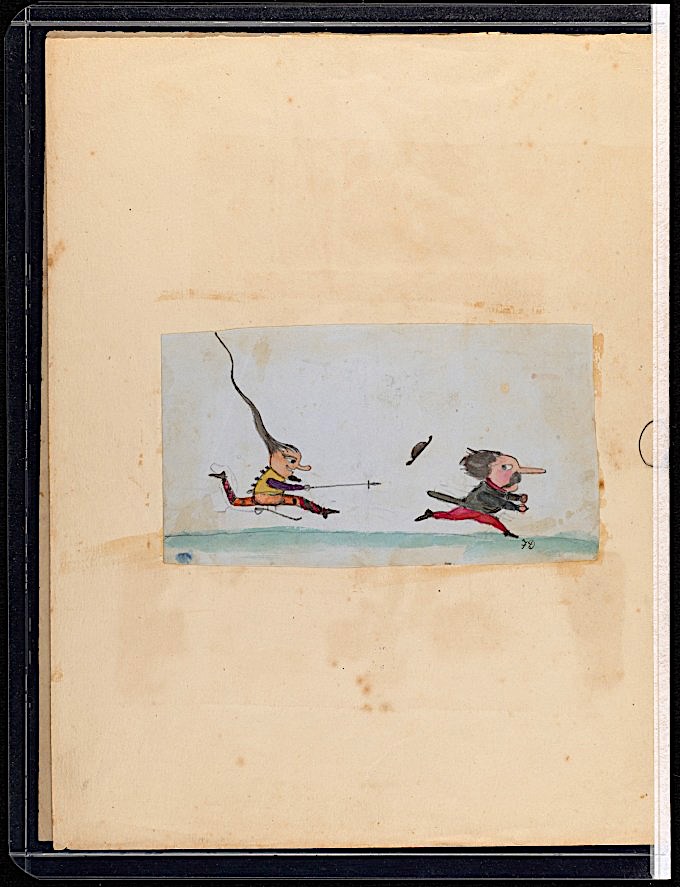
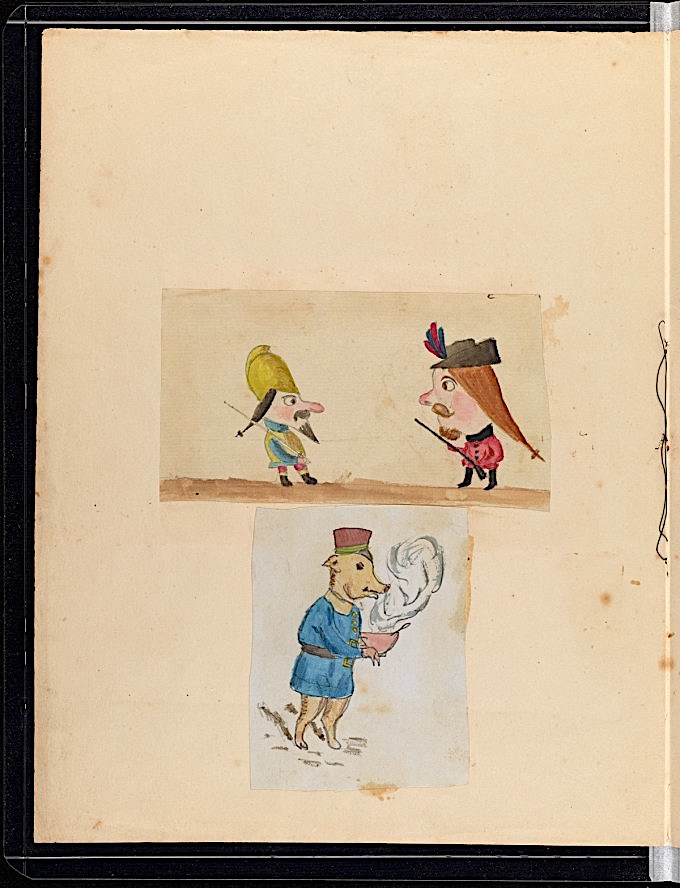
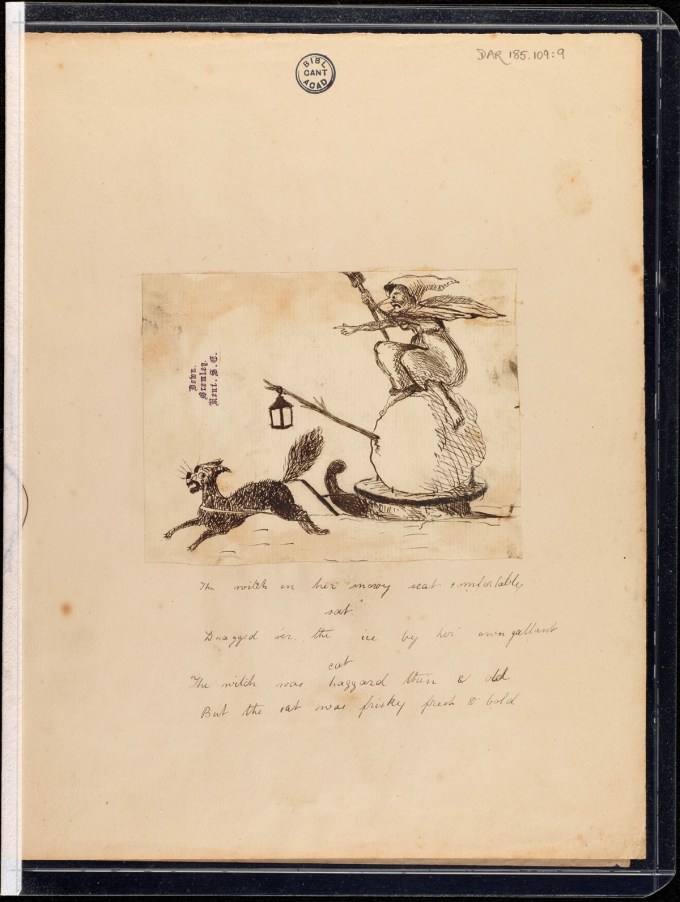
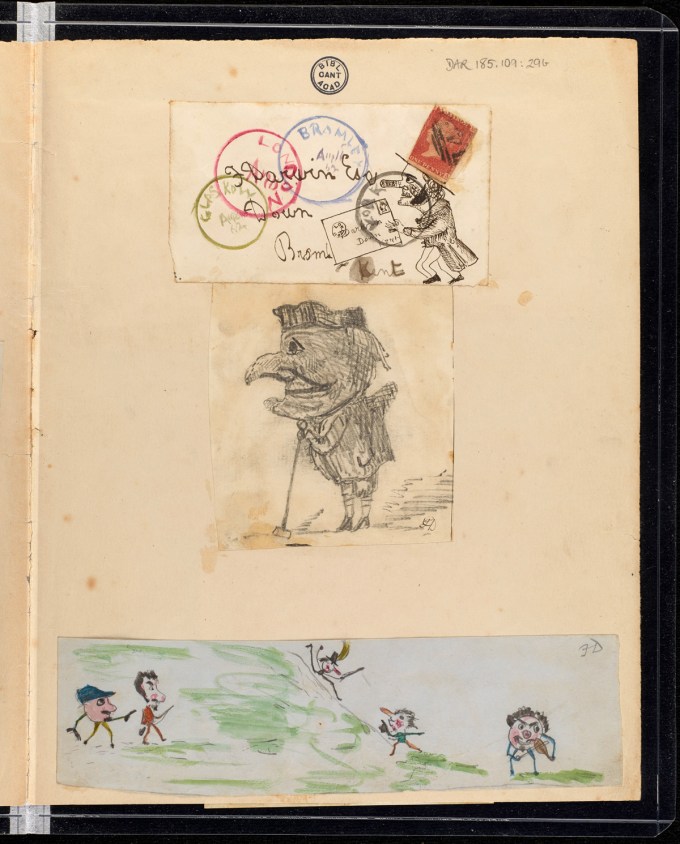
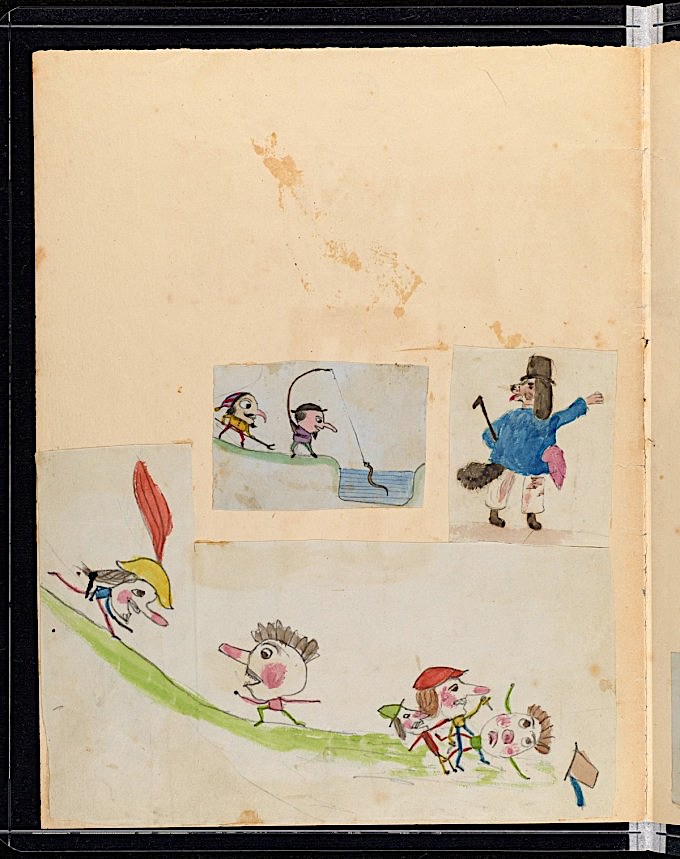
Down House was “by all accounts a boisterous place,” writes McKenna Staynor at The New Yorker, “with a wooden slide on the stairs and a rope swing on the first-floor landing.” Another archive of Darwin’s prodigious writing, Cambridge’s Darwin Manuscripts Project, gives us even more insight into his family life, with graphic evidence of the Darwin brood’s curiosity in the dozens of doodles and drawings they made in their father’s notebooks, including the original manuscript copy of his magnum opus.
The project’s director, David Kohn, “doesn’t know for certain which kids were the artists,” notes Staynor, “but he guesses that at least three were involved: Francis, who became a botanist; George, who became an astronomer and mathematician; and Horace, who became an engineer.” One imagines competition among the Darwin children must have been fierce, but the drawings, “though exacting, are also playful.” One depicts “The Battle of Fruits and Vegetables.” Others show anthropomorphic animals and illustrate military figures.
There are short stories, like “The Fairies of the Mountain,” which “tells the tale of Polytax and Short Shanks, whose wings have been cut off by a ‘naughty fairy.’” Imagination and creativity clearly had a place in the Darwin home. The man himself, Maria Popova notes, felt significant ambivalence about fatherhood. “Children are one’s greatest happiness,” he once wrote, “but often & often a still greater misery. A man of science ought to have none.”
It was an attitude born of grief, but one, it seems, that did not breed aloofness. The Darwin kids “were used as volunteers,” says Kohn, “to collect butterflies, insects, and moths, and to make observations on plants in the fields around town.” Francis followed his father’s path and was the only Darwin to co-author a book with his father. Darwin’s daughter Henrietta became his editor, and he relied on her, he wrote, for “deep criticism” and “corrections of style.”
Despite his early fears for their genetic fitness, Darwin’s professional life became intimately bound to the successes of his children. The Darwin Manuscripts Project, which aims to digitize and make public around 90,000 pages from the Cambridge University Library’s Darwin collection will have a profound effect on how historians of science understand his impact. “The scope of the enterprise, of what we call evolutionary biology,” says Kohn, “is defined in these papers. He’s got his foot in the twentieth century.”
The archive also shows the development of Darwin’s equally important legacy as a parent who inspired a boundless scientific curiosity in his kids. See many more of the digitized Darwin children’s drawings at The Marginalian.
Note: An earlier version of this post appeared on our site in 2020.
Saturday Night Live began its 50th season last fall, around the same time as the premiere of Jason Reitman’s film Saturday Night, which dramatizes the program’s 1975 debut. All of this has put fans into something of a retrospective mood, especially if they happen to have been tuning in since the very beginning. For others, SNL is a show they haven’t been watching all that long, used to watch, or watched at one time and have started watching again. With its ever-changing cast, writers, sketch concepts, and overall comedic sensibility, it’s never remained the same for too long at a stretch, and though many viewers have their favorite seasons, few grasp the full sweep of its history as a television institution.
Now, anyone can get a sense of SNL in its entirety with Everything You NEED to Know About Saturday Night Live, a YouTube series that, true to its title, recounts the show’s most notable performers, characters, innovations, troubles, and moments planned or otherwise (often the latter, given the nature of the broadcast). Each season gets its own episode, starting with the first, whose Not Ready for Prime Time Players included such young up-and-comers as Dan Aykroyd, John Belushi, Chevy Chase, and Gilda Radner.
As that list of names would imply, this “hip comedy variety program for baby boomers that dared to stay up late” soon became a veritable force of era-defining funnymen and funnywomen. Then as now, SNL tends to send its breakout stars to Hollywood, albeit with varying results.
That contributes to the constant churn that has brought onto the show’s roster such household-names-to-be as Bill Murray, Eddie Murphy, Billy Crystal, Adam Sandler, and Tina Fey, while also featuring non-cast-members like Penn and Teller or guest hosts like Steve Martin, whose appearances greatly raised their own profiles. To watch through these encapsulations, which as of this writing have reached season nineteen (1993–94), is to take a journey through American popular culture itself. Creator Lorne Michaels’ recently declared lack of intent to step down any time soon bolsters SNL’s aura of unstoppabilty, built up over five decades of influential personalities, still-quoted gags, and instantly recognizable characters — if also the occasional uncooperative host, chemistry-free cast, or accidentally uttered bit of profanity. But what’s the fun of doing half a century of live TV if it goes without a hitch?
Based in Seoul, Colin Marshall writes and broadcasts on cities, language, and culture. His projects include the Substack newsletterBooks on Cities and the book The Stateless City: a Walk through 21st-Century Los Angeles. Follow him on the social network formerly known as Twitter at @colinmarshall.
Here’s a strange home video of Nirvana when they were unknown, playing inside a Radio Shack in the band’s hometown of Aberdeen, Washington. The video was recorded on the evening of January 24, 1988, after the store had closed. In those days the group went by the name of Ted Ed Fred.
Only the day before, the band had recorded its first demo tape at a studio in Seattle. Guitarist and singer Kurt Cobain asked his new friend Eric Harter, who managed the Radio Shack, to videotape the band playing “Paper Cuts,” one of 10 songs from the demo. Along with Cobain, the video features Nirvana co-founder Krist Novoselic on bass and Dale Crover of the Melvins on drums.
The video below includes footage of Harter talking about the Radio Shack video and giving a copy of the tape to Cobain’s grieving widow Courtney Love, who is shown with her friend Kat Bjelland of Babes in Toyland. At one point, Harter mentions a “Ted Ed Fred” concert at the Community World Theater in Tacoma. To see a full video of that show, which was staged the night before the Radio Shack taping (and only hours after the demo session), click here.
Note: An earlier version of this post appeared on our site in 2013.
If you would like to support the mission of Open Culture, consider making a donation to our site. It’s hard to rely 100% on ads, and your contributions will help us continue providing the best free cultural and educational materials to learners everywhere. You can contribute through PayPal, Patreon, and Venmo (@openculture). Thanks!
The end of the nineteenth century is still widely referred to as the fin de siècle, a French term that evokes great, looming cultural, social, and technological changes. According to at least one French mind active at the time, among those changes would be a fin deslivres as humanity then knew them. “I do not believe (and the progress of electricity and modern mechanism forbids me to believe) that Gutenberg’s invention can do otherwise than sooner or later fall into desuetude,” says the character at the center of the 1894 story “The End of Books.” “Printing, which since 1436 has reigned despotically over the mind of man, is, in my opinion, threatened with death by the various devices for registering sound which have lately been invented, and which little by little will go on to perfection.”
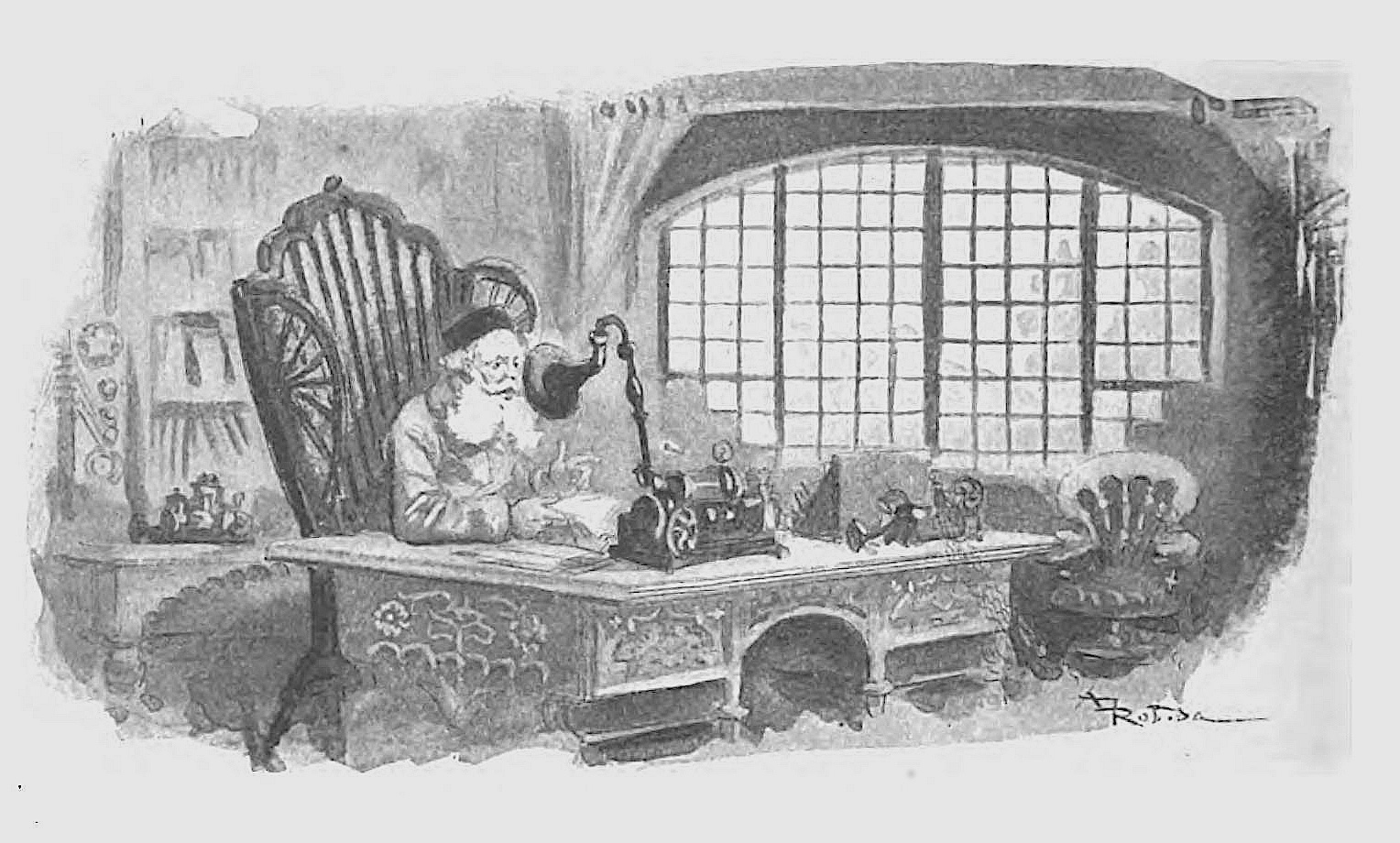
First published in an issue of Scribner’s Magazine (viewable at the Internet Archive or this web page), “The End of Books” relates a conversation among a group of men belonging to various disciplines, all of them fired up to speculate on the future after hearing it proclaimed at London’s Royal Institute that the end of the world was “mathematically certain to occur in precisely ten million years.” The participant foretelling the end of books is, somewhat ironically, called the Bibliophile; but then, the story’s author Octave Uzanne was famous for just such enthusiasms himself. Believing that “the success of everything which will favor and encourage the indolence and selfishness of men,” the Bibliophile asserts that sound recording will put an end to print just as “the elevator has done away with the toilsome climbing of stairs.”
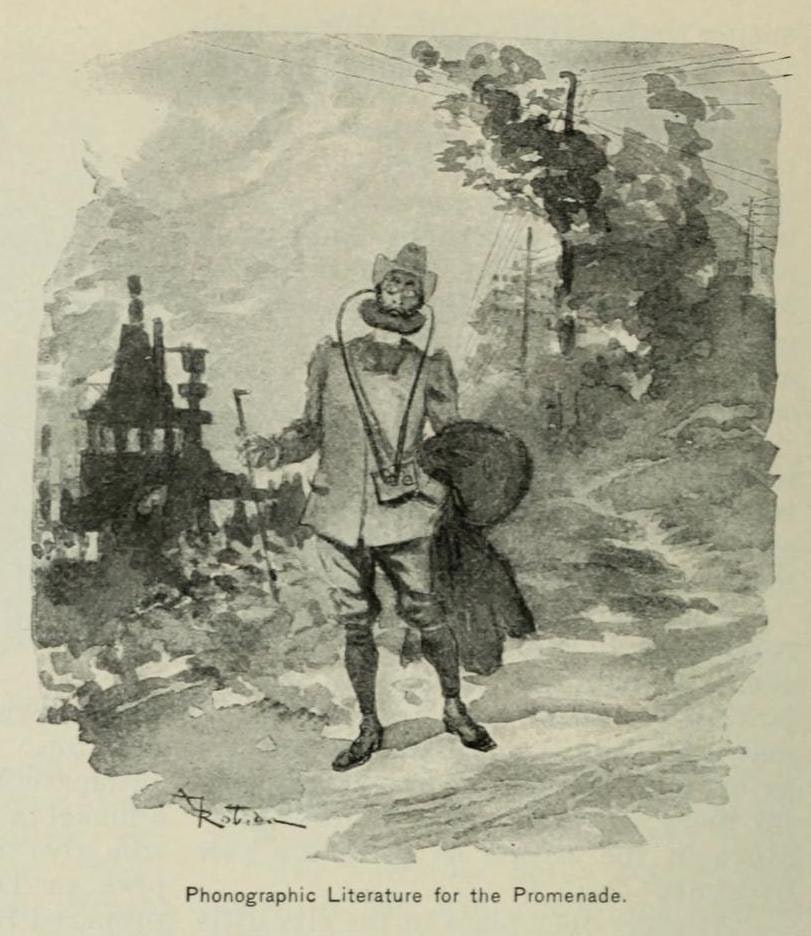
These 130 or so years later, anyone who’s been to Paris knows that the elevator has yet to finish that job, but much of what the Bibliophile predicts has indeed come true in the form of audiobooks. “Certain Narrators will be sought out for their fine address, their contagious sympathy, their thrilling warmth, and the perfect accuracy, the fine punctuation of their voice,” he says. “Authors who are not sensitive to vocal harmonies, or who lack the flexibility of voice necessary to a fine utterance, will avail themselves of the services of hired actors or singers to warehouse their work in the accommodating cylinder.” We may no longer use cylinders, but Uzanne’s description of a “pocket apparatus” that can be “kept in a simple opera-glass case” will surely remind us of the Walkman, the iPod, or any other portable audio device we’ve used.
All this should also bring to mind another twenty-first century phenomenon: podcasts. “At home, walking, sightseeing,” says the Bibliophile, “fortunate hearers will experience the ineffable delight of reconciling hygiene with instruction; of nourishing their minds while exercising their muscles.” This will also transform journalism, for “in all newspaper offices there will be Speaking Halls where the editors will record in a clear voice the news received by telephonic despatch.” But how to satisfy man’s addiction to the image, well in evidence even then? “Upon large white screens in our own homes,” a “kinetograph” (which we today would call a television) will project scenes fictional and factual involving “famous men, criminals, beautiful women. It will not be art, it is true, but at least it will be life.” Yet however striking his prescience in other respects, the Bibliophile didn’t know – though Uzanne may have — that books would persist through it all.
Based in Seoul, Colin Marshall writes and broadcasts on cities, language, and culture. His projects include the Substack newsletterBooks on Cities and the book The Stateless City: a Walk through 21st-Century Los Angeles. Follow him on the social network formerly known as Twitter at @colinmarshall.
We're hoping to rely on loyal readers, rather than erratic ads. Please click the Donate button and support Open Culture. You can use Paypal, Venmo, Patreon, even Crypto! We thank you!
Open Culture scours the web for the best educational media. We find the free courses and audio books you need, the language lessons & educational videos you want, and plenty of enlightenment in between.