Behold an Anatomically Correct Replica of the Human Brain, Knitted by a Psychiatrist

Our brains dic­tate our every move.

They’re the ones who spur us to study hard, so we can make some­thing of our­selves, in order to bet­ter our com­mu­ni­ties.

They name our babies, choose our clothes, decide what we’re hun­gry for.

They make and break laws, orga­nize protests, frit­ter away hours on social media, and give us the green light to binge watch a bunch of dumb shows when we could be read­ing War and Peace.

They also plant the seeds for Fitz­car­ral­do-like cre­ative endeav­ors that take over our lives and gen­er­ate lit­tle to no income.

We may describe such endeav­ors as a labor of love, into which we’ve poured our entire heart and soul, but think for a sec­ond.

Who’s real­ly respon­si­ble here?

The heart, that mus­cu­lar fist-sized Valen­tine, con­tent to just pump-pump-pump its way through life, lub-dub, lub-dub, from cra­dle to grave?

Or the brain, a crafty Iago of an organ, pos­ses­sor of bil­lions of neu­rons, com­plex, con­tra­dic­to­ry, a mys­tery we’re far from unrav­el­ing?

Psy­chi­a­trist Dr. Karen Nor­berg’s brain has steered her to study such heavy duty sub­jects as the day­care effect, the rise in youth sui­cide, and the risk of pre­scrib­ing selec­tive sero­tonin reup­take inhibitors as a treat­ment for depres­sion.

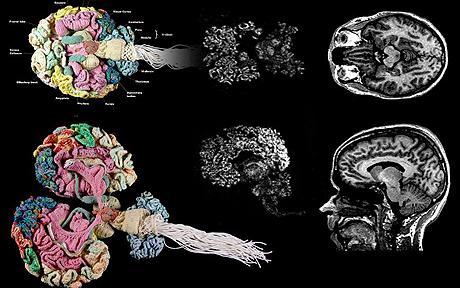
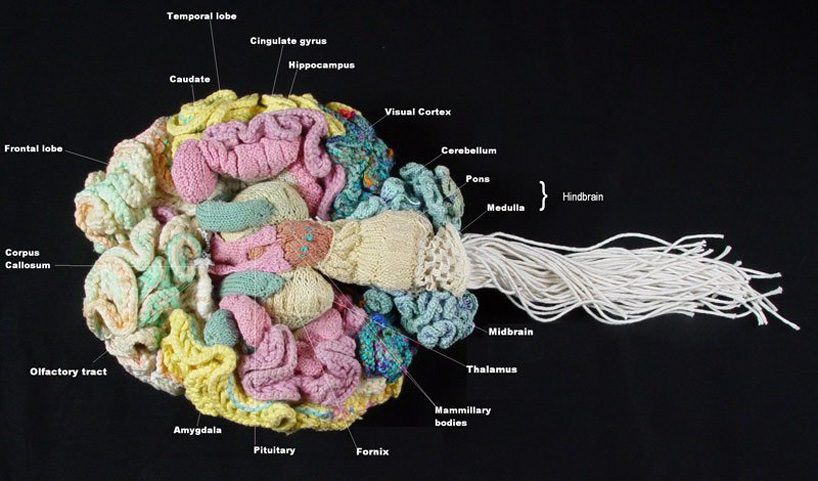
On a lighter note, it also told her to devote nine months to knit­ting an anatom­i­cal­ly cor­rect repli­ca of the human brain.

(Twelve, if you count three months of research before cast­ing on.)

How did her brain con­vince her to embark on this mad­cap assign­ment?

Easy. It arranged for her to be in the mid­dle of a more pro­sa­ic knit­ting project, then goosed her into notic­ing how the ruf­fles of that project resem­bled the wrin­kles of the cere­bral cor­tex.

Coin­ci­dence?

Not like­ly. Espe­cial­ly when one of the cere­bral cor­tex’s most impor­tant duties is deci­sion mak­ing.

As she explained in an inter­view with The Tele­graph, brain devel­op­ment is not unlike the growth of a knit­ted piece:

You can see very nat­u­ral­ly how the ‘rip­pling’ effect of the cere­bral cor­tex emerges from prop­er­ties that prob­a­bly have to do with nerve cell growth. In the case of knit­ting, the effect is cre­at­ed by increas­ing the num­ber of stitch­es in each row.

Dr. Norberg—who, yes, has on occa­sion referred to her project as a labor of love—told Sci­en­tif­ic Amer­i­can that such a mas­sive crafty under­tak­ing appealed to her sense of humor because “it seemed so ridicu­lous and would be an enor­mous­ly com­pli­cat­ed, absurd­ly ambi­tious thing to do.”

That’s the point at which many people’s brains would give them per­mis­sion to stop, but Dr. Nor­berg and her brain per­sist­ed, push­ing past the hypo­thet­i­cal, cre­at­ing col­or­ful indi­vid­ual struc­tures that were even­tu­al­ly sewn into two cud­dly hemi­spheres that can be joined with a zip­per.

(She also let slip that her brain—by which she means the knit­ted one, though the obser­va­tion cer­tain­ly holds true for the one in her head—is female, due to its robust cor­pus cal­lo­sum, the “tough body” whose mil­lions of fibers pro­mote com­mu­ni­ca­tion and con­nec­tion.)

Note: An ear­li­er ver­sion of this post appeared on our site in 2019.

Relat­ed Con­tent:

How to Rewire Your Brain in 6 Weeks: A BBC Reporter Explores How Every­day Life Changes Can Alter Our Brains

The Human Brain: A Free Online Course from MIT

The “Brain Dic­tio­nary”: Beau­ti­ful 3D Map Shows How Dif­fer­ent Brain Areas Respond to Hear­ing Dif­fer­ent Words

A Mas­sive, Knit­ted Tapes­try of the Galaxy: Soft­ware Engi­neer Hacks a Knit­ting Machine & Cre­ates a Star Map Fea­tur­ing 88 Con­stel­la­tions

Ayun Hal­l­i­day is an author, illus­tra­tor, the­ater mak­er.

by | Permalink | Make a Comment ( 8 ) |

Hear the First Masterpiece of Electronic Music, Karlheinz Stockhausen’s Gesang der Jünglinge

Karl­heinz Stock­hausen appears, among many oth­er cul­tur­al fig­ures, on the cov­er of Sgt. Pep­per’s Lone­ly Hearts Club Band. His inclu­sion was more than a trendy ges­ture toward the Euro­pean avant-garde; any­one who knows that path­break­ing elec­tron­ic com­poser’s work will notice its influ­ence on the album at first lis­ten. Paul McCart­ney him­self went on record with his notion that assum­ing the alter egos of the title would allow him and his fel­low Bea­t­les to branch out both cul­tur­al­ly and intel­lec­tu­al­ly in their music, incor­po­rat­ing pas­tich­es of Ravi Shankar, B. B. King, Albert Ayler, the Doors, the Beach Boys, and indeed Stock­hausen, whose Gesang der Jünglinge had already inspired “Tomor­row Nev­er Knows” on Revolver.

Lit­er­al­ly “Song of the Youths,” Gesang der Jünglinge was an ear­ly work for Stock­hausen, who com­posed it in 1954, when he was still a PhD stu­dent in com­mu­ni­ca­tions at the Uni­ver­si­ty of Bonn. Inspired by not just his tech­no­log­i­cal inter­ests but also his devout Catholi­cism, he decid­ed to cre­ate a mass for elec­tron­ic sounds and voic­es, with the intent to debut it at Cologne Cathe­dral. (Leg­end has it that he was rebuffed by reli­gious author­i­ties, who insist­ed that loud­speak­ers had no place in a house of wor­ship, but sources dis­agreed on whether he actu­al­ly sought their per­mis­sion in the first place.)

He drew its words from a pas­sage of the Old Tes­ta­ment sto­ry of three boys cast into the fire by King Neb­uchad­nez­zar for their refusal to wor­ship a gold­en idol and kept unharmed by the praise to God they sang amid the flames.

In Stock­hausen’s high-tech ren­der­ing, the boys are rep­re­sent­ed by the voice of twelve-year-old Josef Protsch­ka (who would grow up to become an acclaimed vocal­ist in his own right), and the fire by a col­lage of elec­tron­ic sounds. Though the com­poser’s manip­u­la­tions, part design and part chance, the human and mechan­i­cal halves of the piece become one: Protschka’s vocals break apart and reform into frag­ments of lan­guage nev­er before heard, and the arti­fi­cial­ly gen­er­at­ed tones bend uncan­ni­ly toward the sound of sung vow­els. All this, to say noth­ing of its play­back in five-chan­nel sound in a time when stereo was still a nov­el­ty, would have sound­ed deeply, even dis­turbing­ly unfa­mil­iar to the audi­ence at Gesang der Jünglinge’s pre­miere — and its impact prob­a­bly had­n’t been much dimin­ished by the time of the 2001 per­for­mance above. Stock­house­n’s music may have been after the shock of the new, but it also faced the eter­nal.

Relat­ed con­tent:

Watch Karl­heinz Stockhausen’s Great Heli­copter String Quar­tet, Star­ring 4 Musi­cians, 4 Cam­eras & 4 Copters

Pio­neer­ing Elec­tron­ic Com­pos­er Karl­heinz Stock­hausen Presents “Four Cri­te­ria of Elec­tron­ic Music” & Oth­er Lec­tures in Eng­lish (1972)

Hear Karl­heinz Stockhausen’s Pio­neer­ing Com­po­si­tions for Music Box­es

A Karl­heinz Stock­hausen Brand­ed Car: A Play­ful Trib­ute to the Ground­break­ing Elec­tron­ic Com­pos­er

“Tomor­row Nev­er Knows”: How The Bea­t­les Invent­ed the Future With Stu­dio Mag­ic, Tape Loops & LSD

The His­to­ry of Elec­tron­ic Music in 476 Tracks (1937–2001)

Based in Seoul, Col­in Marshall writes and broad­casts on cities, lan­guage, and cul­ture. His projects include the Sub­stack newslet­ter Books on Cities and the book The State­less City: a Walk through 21st-Cen­tu­ry Los Ange­les. Fol­low him on the social net­work for­mer­ly known as Twit­ter at @colinmarshall.

The World’s Most Famous Organ Piece Played on the World’s Largest Fully Operational Pipe Organ

The world’s most famous organ piece, played on the world’s largest ful­ly func­tion­ing pipe organ. That’s what you have above. Here, organ­ist Dylan David Shaw per­forms Bach’s Toc­ca­ta and Fugue in D minor on the famous Wana­mak­er organ.

Orig­i­nal­ly built for the St. Louis World’s Fair in 1904, the organ end­ed up in Philadel­phi­a’s Wana­mak­er’s depart­ment store in 1911. More than a cen­tu­ry lat­er, the organ still resides in the same store. But Macy’s even­tu­al­ly took over Wanamaker’s, and Macy’s now plans to close the store, leav­ing the fate of the organ unknown. Where will the 28,000-pipe organ find a new home? That’s still TBD, some­thing that’s like­ly to get resolved in the months to come.

Relat­ed Con­tent 

Down­load the Com­plete Organ Works of J.S. Bach for Free

Bohemi­an Rhap­sody Played on the Pipe Organ

The “All of Bach” Project Is Mak­ing Per­for­mances of Every Bach Piece Avail­able Online: Watch 346 High-Qual­i­ty Record­ings

Bach’s Most Famous Organ Piece Played on Wine Glass­es

by | Permalink | Make a Comment ( 5 ) |

How Raphael Became A Master: Watch the Evolution of the Artist Through His Madonna Paintings

No artist became a Renais­sance mas­ter through a sin­gle piece of work, though now, half a mil­len­ni­um lat­er, that may be how most of us iden­ti­fy them. Leonar­do? Painter of the Mona Lisa. Michelan­ge­lo? Painter of the Sis­tine Chapel ceil­ing (or, per­haps, the sculp­tor of the most famous David, depend­ing on your medi­um of choice). Raphael? Painter of The School of Athens, as recent­ly fea­tured here on Open Cul­ture. Raphael paint­ed that mas­ter­work in Vat­i­can City’s Apos­tolic Palace between the years 1509 and 1511, when he was in his mid-twen­ties. Under­stand­ing how he could have attained that lev­el of skill by that age requires exam­in­ing his oth­er work, as Evan Puschak, bet­ter known as the Nerd­writer, does in the new video above.

Specif­i­cal­ly, Puschak exam­ines Raphael’s Madon­nas, a sub­ject to which he returned over and over again through­out the course of his short but pro­duc­tive career. In what seems to have been his first ren­di­tion of Mary and her holy son, Puschak says, “you can see that Raphael has a bet­ter sense of three-dimen­sion­al bod­ies and how to make them feel like they’re part of the space that they’re in” than his father, who’d been a well-regard­ed painter him­self, or even than Piero del­la Francesca, from whom his father learned.

“Yet the paint­ing also suf­fers from “an awk­ward­ness in the arrange­ment of the fig­ures,” as well as a lack of “emo­tion, rela­tion­ships, or any sense of nar­ra­tive” — much like “a thou­sand oth­er Madon­nas that came before.”

Yet Raphael was a quick study, a trait reflect­ed in the devel­op­ment of the many Madon­nas he paint­ed there­after. From Leonar­do he learned tech­niques like sfu­ma­to, the cre­ation of soft tran­si­tions between col­ors; from Michelan­ge­lo, “how to use the human body as an expres­sive tool.” But what most clear­ly emerges is the con­cept con­tem­po­rary the­o­rist Leon Bat­tista Alber­ti called his­to­ria: a nar­ra­tive that plays out even with­in the con­fines of a sta­t­ic image. In Raphael’s cir­cu­lar, abun­dant­ly detailed Alba Madon­na of 1511, Puschak sees the infant Jesus “not so much tak­ing as grab­bing his future and pulling it clos­er” as Mary looks on with emo­tions sub­tly lay­ered into her face. How, exact­ly, Raphael honed his instinct for dra­ma is a ques­tion for art his­to­ri­ans. But would it be too much of a reach to guess that he also learned a thing or two from his time as a stage-set design­er?

Relat­ed con­tent:

Pla­to, Aris­to­tle & Oth­er Greek Philoso­phers in Raphael’s Renais­sance Mas­ter­piece, The School of Athens

Artist Turns Famous Paint­ings, from Raphael to Mon­et to Licht­en­stein, Into Inno­v­a­tive Sound­scapes

Why Leonar­do da Vinci’s Great­est Paint­ing is Not the Mona Lisa

The Evo­lu­tion of The Great Wave off Kana­gawa: See Four Ver­sions That Hoku­sai Paint­ed Over Near­ly 40 Years

14 Self-Por­traits by Pablo Picas­so Show the Evo­lu­tion of His Style: See Self-Por­traits Mov­ing from Ages 15 to 90

The Evo­lu­tion of Kandinsky’s Paint­ing: A Jour­ney from Real­ism to Vibrant Abstrac­tion Over 46 Years

Based in Seoul, Col­in Marshall writes and broad­casts on cities, lan­guage, and cul­ture. His projects include the Sub­stack newslet­ter Books on Cities and the book The State­less City: a Walk through 21st-Cen­tu­ry Los Ange­les. Fol­low him on the social net­work for­mer­ly known as Twit­ter at @colinmarshall.

A Massive Choir Sings “Paranoid” to Honor Ozzy Osbourne

In Toron­to, 7,000 singers par­tic­i­pat­ed in Choir Choir Choir’s trib­ute to Ozzy Osbourne, all tak­ing part in a giant sing-along of “Para­noid.”  The first sin­gle on Black Sab­bath’s sec­ond album (1970), “Para­noid” reached #4 in the UK mar­ket and put Sab­bath on the map. The song also became an ear­ly heavy met­al clas­sic. Watch Sab­bath per­form the song live in 1970 here; or watch them per­form it for the very last time on July 5, 2025 here. Then enjoy the Choir Choir Choir trib­ute above.

If you would like to sign up for Open Culture’s free email newslet­ter, please find it here. It’s a great way to see our new posts, all bun­dled in one email, each day.

If you would like to sup­port the mis­sion of Open Cul­ture, con­sid­er mak­ing a dona­tion to our site. It’s hard to rely 100% on ads, and your con­tri­bu­tions will help us con­tin­ue pro­vid­ing the best free cul­tur­al and edu­ca­tion­al mate­ri­als to learn­ers every­where. You can con­tribute through Pay­Pal, Patre­on, and Ven­mo (@openculture). Thanks!

Relat­ed Con­tent 

Watch David Byrne Lead a Mas­sive Choir in Singing David Bowie’s “Heroes”

Watch The Nine Lives of Ozzy Osbourne: A Free Doc­u­men­tary on the Heavy Met­al Pio­neer (RIP)

Ozzy Osbourne’s Gui­tarist Zakk Wylde Plays Black Sab­bath on a Hel­lo Kit­ty Gui­tar

Kids Orches­tra Plays Ozzy Osbourne’s “Crazy Train” and Zeppelin’s “Kash­mir”

Pat­ti Smith Sings “Peo­ple Have the Pow­er” with a Choir of 250 Fel­low Singers

by | Permalink | Make a Comment ( 3 ) |

Empire Without Limit: Watch Mary Beard’s TV Series on Ancient Rome

As the found­ing myth has it, the city of Rome was estab­lished by a man named Romu­lus, one of two orphaned twin broth­ers raised by a she-wolf on the banks of the Tiber riv­er. The leg­end of Romu­lus and Remus, which involves the for­mer’s frat­ri­ci­dal slay­ing of the lat­ter, lends itself to strik­ing imagery, though it also gives forth more ques­tions than answers. “The Latin for wolf, lupa, also means pros­ti­tute,” for exam­ple, “so was it actu­al­ly a pros­ti­tute who came to the res­cue?” So asks his­to­ri­an Mary Beard in Rome: Empire With­out Lim­it, a four-part series you can watch in its entire­ty above.

In a sense, the sto­ry works either way: the mor­tal clash of broth­er against broth­er makes for a recur­ring metaphor­i­cal theme in the long his­to­ry of Rome, but so does the irre­press­ible pow­er of com­merce. Criss­cross­ing the Euro­pean con­ti­nent, Great Britain, the Mediter­ranean, and Africa by car, boat, bicy­cle, sub­way train, and above all on foot, Beard uses the traces of the might­i­est ancient empire to explain how the whole oper­a­tion actu­al­ly worked, and what its day-to-day expe­ri­ence was like for its sub­jects. When it orig­i­nal­ly aired in 2016, Empire With­out Lim­it fol­lowed up her acclaimed book SPQR: A His­to­ry of Ancient Rome, which cov­ers some of the same themes.

Those who’ve fol­lowed Beard’s work in print, on tele­vi­sion, or in oth­er media know that her ver­sion of Roman his­to­ry is hard­ly anoth­er suc­ces­sion of emper­ors and mil­i­tary cam­paigns. While she does devote time to dis­cussing such sig­nal fig­ures as Julius Cae­sar (who def­i­nite­ly did­n’t say “Et tu, Brute?”), Augus­tus, Hadri­an, and Con­stan­tine, she dis­plays equal or greater inter­est in a four-year-old sil­ver min­er in what’s now Spain, say, or an anony­mous young woman the shape of whose skull sug­gests the extent of migra­tion with­in the empire. And just as wor­thy of con­sid­er­a­tion as any par­tic­u­lar Roman cit­i­zen­ship is the con­cept of Roman cit­i­zen­ship itself, which ulti­mate­ly extend­ed across the vastest empire the world had ever known.

All roads lead to Rome, as the say­ing goes, and in the hey­day of the Roman empire, as Beard points out, it was actu­al­ly true. The ancient Romans were the first to build what she calls “a joined-up world,” where get­ting on a path in Rome and fol­low­ing it could get you all the way to places like Spain or Greece. (And also unprece­dent­ed­ly, you could take a glance at mile mark­ers along that road and imme­di­ate­ly “place your­self in the world.”) Roman dom­i­nance may have end­ed long ago, but the parts of the world have con­tin­ued to join up in much the same way since, and indeed, the broad Roman world­view sur­vives. As Beard puts it, “there’s a lit­tle bit of the Romans in the head of every one of us” — espe­cial­ly those of us who think about their empire every day.

Relat­ed con­tent:

The His­to­ry of Ancient Rome in 20 Quick Min­utes: A Primer Nar­rat­ed by Bri­an Cox

A Map Show­ing How the Ancient Romans Envi­sioned the World in 40 AD

How Rome Began: The His­to­ry As Told by Ancient His­to­ri­ans

Is Amer­i­ca Declin­ing Like Ancient Rome?

Do You Think About Ancient Rome Every Day? Then Browse a Wealth of Videos, Maps & Pho­tos That Explore the Roman Empire

Rick Steves’ Europe: Binge Watch 11 Sea­sons of America’s Favorite Trav­el­er Free Online

Based in Seoul, Col­in Marshall writes and broad­casts on cities, lan­guage, and cul­ture. His projects include the Sub­stack newslet­ter Books on Cities and the book The State­less City: a Walk through 21st-Cen­tu­ry Los Ange­les. Fol­low him on the social net­work for­mer­ly known as Twit­ter at @colinmarshall.

What Makes Picasso’s Guernica a Great Painting?: Explore the Anti-Fascist Mural That Became a Worldwide Anti-War Symbol

A paint­ing is not thought out and set­tled in advance. While it is being done, it changes as one’s thoughts change. And when it’s fin­ished, it goes on chang­ing, accord­ing to the state of mind of who­ev­er is look­ing at it. — Pablo Picas­so

In a famous sto­ry about Guer­ni­ca, Pablo Picasso’s wrench­ing 1937 anti-war mur­al, a gestapo offi­cer barges into the painter’s Paris stu­dio and asks, “did you do that?”, to which Picas­so acer­bical­ly replies, “you did.” The title refers to the 1937 bomb­ing of a Basque town dur­ing the Span­ish Civ­il War, car­ried out by Span­ish Nation­al­ists and the Luft­waffe. Whether or not the anec­dote about Picas­so and the Nazi ever hap­pened is unim­por­tant; it encap­su­lates the artist’s dis­gust and out­rage over the atroc­i­ties of war and the takeover of his coun­try by Fran­co’s Nation­al­ists, unyield­ing sen­ti­ments found not only in the paint­ing but also its path through the world.

“Guer­ni­ca had this real­ly unique rela­tion­ship with Picas­so and his life,” says art his­to­ri­an Patri­cia Fail­ing. “In a way it was his alter ego.” This is a bold claim con­sid­er­ing that dur­ing most of his career, “Picas­so gen­er­al­ly avoids pol­i­tics,” notes PBS, “and dis­dains overt­ly polit­i­cal art.” After the mural’s exhi­bi­tion at the Span­ish Pavil­ion of the 1937 Paris World’s Fair, how­ev­er, the paint­ing was sent on tours of Europe and North Amer­i­ca “to raise con­scious­ness about the threat of fas­cism.”

In 1939, after the fall of Madrid, the artist declared, “The paint­ing will be turned over to the gov­ern­ment of the Span­ish Repub­lic the day the Repub­lic is restored in Spain!”  Then, almost 30 years lat­er,

In a sur­pris­ing­ly iron­ic turn, Fran­co launched a cam­paign in 1968 for repa­tri­a­tion of the paint­ing, assur­ing Picas­so that the Span­ish Gov­ern­ment had no objec­tion to the con­tro­ver­sial sub­ject mat­ter. One can only imag­ine how incred­u­lous Picas­so must have been. Through his lawyers, Picas­so turned the offer down flat, mak­ing it clear that Guer­ni­ca would be turned over only when democ­ra­cy and pub­lic lib­er­ties were restored to Spain.

Picas­so died in 1973 and nev­er saw his coun­try free from fas­cism. Fran­co died two years lat­er. The paint­ing was not exhib­it­ed in Spain until 1981 — not a “return,” but a restora­tion, per­haps, of an inter­na­tion­al icon that had endured 44 years of exile, had become a potent anti-war sym­bol dur­ing the Viet­nam War, and had sur­vived a van­dal attack the year after the artist’s death.

In the Great Art Explained video above, James Payne “looks at some of the more acknowl­edged inter­pre­ta­tions along with tech­niques, com­po­si­tion and artis­tic inspi­ra­tion,” as the video’s descrip­tion notes. “We all know that Art is not truth,” Picas­so said, con­sis­tent­ly dis­cour­ag­ing tidy inter­pre­ta­tions of Guer­ni­ca as a straight­for­ward protest paint­ing. “Art is a lie that makes us real­ize truth.” What do we real­ize when we stand before the mur­al — all 11 by 25 feet of it? It depends upon our state of mind, the artist might say, as he engulfs view­ers in an alle­gor­i­cal night­mare stand­ing in for a very real hor­ror.

Note: An ear­li­er ver­sion of this post appeared on our site in 2021.

Relat­ed Con­tent: 

Watch Pablo Picasso’s Cre­ative Process Unfold in Real-Time: Rare Footage Shows Him Cre­at­ing Draw­ings of Faces, Bulls & Chick­ens

The Gestapo Points to Guer­ni­ca and Asks Picas­so, “Did You Do This?;” Picas­so Replies “No, You Did!”

Guer­ni­ca: Alain Resnais’ Haunt­ing Film on Picasso’s Paint­ing & the Crimes of the Span­ish Civ­il War

The Mys­tery of Picas­so: Land­mark Film of a Leg­endary Artist at Work, by Hen­ri-Georges Clouzot

Josh Jones is a writer and musi­cian based in Durham, NC. Fol­low him at @jdmagness

« Go Back
Quantcast