In the graduate department where I once taught freshmen and sophomores the rudiments of college English, it became common practice to include Shakespeare’s Titus Andronicus on many an Intro to Lit syllabus, along with a viewing of Julie Taymor’s flamboyant film adaptation. The early work is thought to be Shakespeare’s first tragedy, cobbled together from popular Roman histories and Elizabethan revenge plays. And it is a truly bizarre play, swinging wildly in tone from classical tragedy, to satirical dark humor, to comic farce, and back to tragedy again. Critic Harold Bloom called Titus “an exploitative parody” of the very popular revenge tragedies of the time—its murders, maimings, rapes, and mutilations pile up, scene upon scene, and leave characters and readers/audiences reeling in grief and disbelief from the shocking body count.
Part of the fun of teaching Titus is in watching students’ jaws drop as they realize just how bloody-minded the Bard is. While Taymor’s adaptation takes many modern liberties in costuming, music, and set design, its horror-show depiction of Titus’ unrelenting mayhem is faithful to the text. Later, more mature plays rein in the excessive black comedy and shock factor, but the bodies still stack up. As accustomed as we are to thinking of contemporary entertainments like Game of Thrones as especially gratuitous, the whole of Shakespeare’s corpus, writes Alice Vincent at The Telegraph, is “more gory” than even HBO’s squirm-worthy fantasy epic, featuring a total of 74 deaths in 37 plays to Game of Thrones’ 61 in 50 episodes.
All of those various demises came together in a 2016 compendium staged at The Globe (in London) called The Complete Deaths. It included everything “from early rapier thrusts to the more elaborate viper-breast application adopted by Cleopatra.” The only death director Tim Crouch excluded is “that of a fly that meets a sticky end in Titus Andronicus.” In the infographic above, see all of the causes of those deaths, including Antony and Cleopatra’s snakebite and Titus Andronicus’ piece-de-resistance, “baked in a pie.”
Part of the reason so many of my former undergraduate students found Shakespeare’s brutality shocking and unexpected has to do with the way his work was tamed by later 17th and 18th century critics, who “didn’t approve of the on-stage gore.” The Telegraph quotes director of the Shakespeare Institute Michael Dobson, who points out that Elizabethan drama was especially gruesome; “the English drama was notorious for on-stage deaths,” and all of Shakespeare’s contemporaries, including Christopher Marlowe and Ben Jonson, wrote violent scenes that can still turn our stomachs.
More recent productions like a bloody staging of Titus at The Globe have restored the gore in Shakespeare’s work, and The Complete Deaths left audiences with little doubt that Shakespeare’s culture was as permeated with representations of violence as our own—and it was as much, if not more so, plagued by the real thing.
Note: An earlier version of this post appeared on our site in 2016.
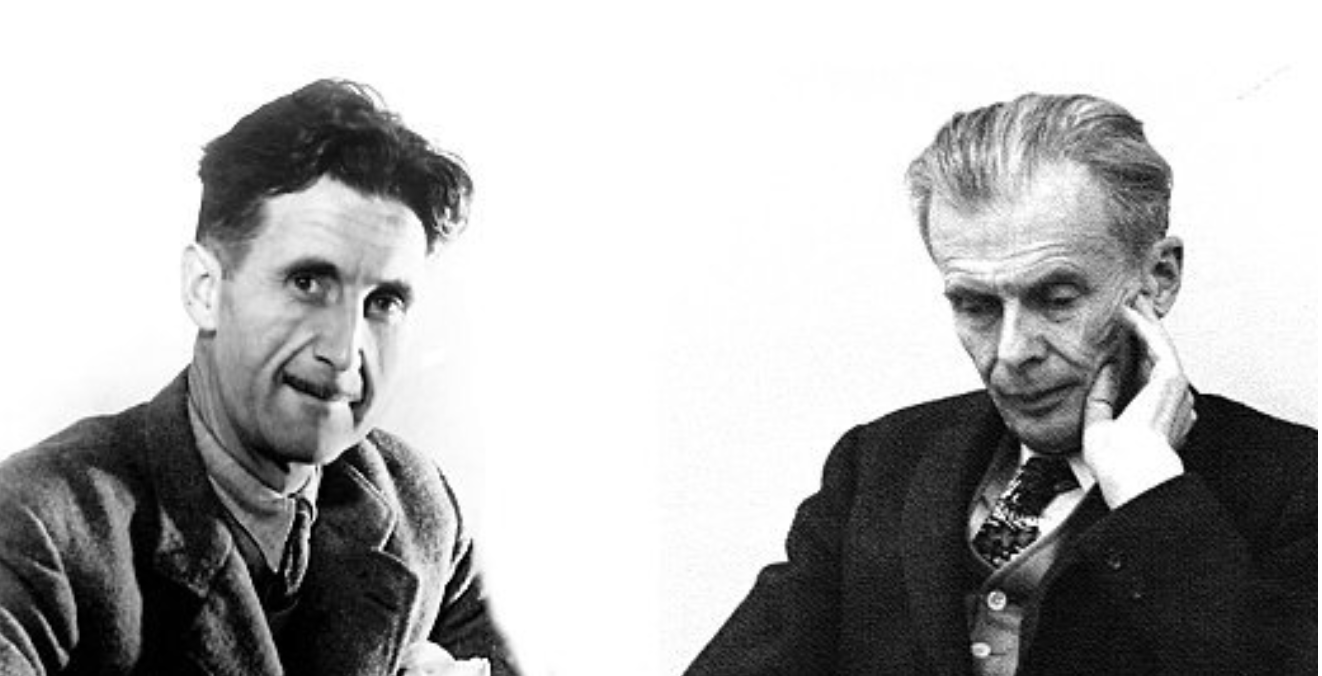
In 1949, George Orwell received a curious letter from his former high school French teacher.
Orwell had just published his groundbreaking book Nineteen Eighty-Four, which received glowing reviews from just about every corner of the English-speaking world. His French teacher, as it happens, was none other than Aldous Huxley, who taught at Eton for a spell before writing Brave New World (1931), the other great 20th-century dystopian novel.
Huxley starts off the letter praising the book, describing it as “profoundly important.” He continues, “The philosophy of the ruling minority in Nineteen Eighty-Four is a sadism which has been carried to its logical conclusion by going beyond sex and denying it.”
Then Huxley switches gears and criticizes the book, writing, “Whether in actual fact the policy of the boot-on-the-face can go on indefinitely seems doubtful. My own belief is that the ruling oligarchy will find less arduous and wasteful ways of governing and of satisfying its lust for power, and these ways will resemble those which I described in Brave New World.” (Listen to him read a dramatized version of the book here.)
Basically, while praising Nineteen Eighty-Four, Huxley argues that his version of the future was more likely to come to pass.
In Huxley’s seemingly dystopian World State, the elite amuse the masses into submission with a mind-numbing drug called Soma and an endless buffet of casual sex. Orwell’s Oceania, on the other hand, keeps the masses in check with fear thanks to an endless war and a hyper-competent surveillance state. At first blush, they might seem like they are diametrically opposed but, in fact, an Orwellian world and a Huxleyan one are simply two different modes of oppression.
While we haven’t quite arrived at either dystopian vision, the power of both books is that they tap into our fears of the state. While Huxley might make you look askance at The Bachelor or Facebook, Orwell makes you recoil in horror at the government throwing around phrases like “enhanced interrogation” and “surgical drone strikes.”
You can read Huxley’s full letter below.
Wrightwood. Cal.
21 October, 1949
Dear Mr. Orwell,
It was very kind of you to tell your publishers to send me a copy of your book. It arrived as I was in the midst of a piece of work that required much reading and consulting of references; and since poor sight makes it necessary for me to ration my reading, I had to wait a long time before being able to embark on Nineteen Eighty-Four.
Agreeing with all that the critics have written of it, I need not tell you, yet once more, how fine and how profoundly important the book is. May I speak instead of the thing with which the book deals — the ultimate revolution? The first hints of a philosophy of the ultimate revolution — the revolution which lies beyond politics and economics, and which aims at total subversion of the individual’s psychology and physiology — are to be found in the Marquis de Sade, who regarded himself as the continuator, the consummator, of Robespierre and Babeuf. The philosophy of the ruling minority in Nineteen Eighty-Four is a sadism which has been carried to its logical conclusion by going beyond sex and denying it. Whether in actual fact the policy of the boot-on-the-face can go on indefinitely seems doubtful. My own belief is that the ruling oligarchy will find less arduous and wasteful ways of governing and of satisfying its lust for power, and these ways will resemble those which I described in Brave New World. I have had occasion recently to look into the history of animal magnetism and hypnotism, and have been greatly struck by the way in which, for a hundred and fifty years, the world has refused to take serious cognizance of the discoveries of Mesmer, Braid, Esdaile, and the rest.
Partly because of the prevailing materialism and partly because of prevailing respectability, nineteenth-century philosophers and men of science were not willing to investigate the odder facts of psychology for practical men, such as politicians, soldiers and policemen, to apply in the field of government. Thanks to the voluntary ignorance of our fathers, the advent of the ultimate revolution was delayed for five or six generations. Another lucky accident was Freud’s inability to hypnotize successfully and his consequent disparagement of hypnotism. This delayed the general application of hypnotism to psychiatry for at least forty years. But now psycho-analysis is being combined with hypnosis; and hypnosis has been made easy and indefinitely extensible through the use of barbiturates, which induce a hypnoid and suggestible state in even the most recalcitrant subjects.
Within the next generation I believe that the world’s rulers will discover that infant conditioning and narco-hypnosis are more efficient, as instruments of government, than clubs and prisons, and that the lust for power can be just as completely satisfied by suggesting people into loving their servitude as by flogging and kicking them into obedience. In other words, I feel that the nightmare of Nineteen Eighty-Four is destined to modulate into the nightmare of a world having more resemblance to that which I imagined in Brave New World. The change will be brought about as a result of a felt need for increased efficiency. Meanwhile, of course, there may be a large scale biological and atomic war — in which case we shall have nightmares of other and scarcely imaginable kinds.
Thank you once again for the book.
Yours sincerely,
Aldous Huxley
Note: An earlier version of this post appeared on our site in 2015.
If you’ve made the journey to Athens, you probably took the time to visit its most popular tourist attraction, the Acropolis. On that monument-rich hill, you more than likely paid special attention to the Parthenon, the ancient temple dedicated to the city’s namesake, the goddess Athena Parthenos. But no matter how much time you spent amid the ruins of the Parthenon, if that visit happens to have taken place in the past 200 years, you may now question whether you’ve truly seen it at all. That’s because only recently has scaffolding been removed that has partially obscured its western façade for the past two decades, resulting in the purer visual state seen in the clips collected above.
The press attention drawn by this event prompted Greece’s Minister of Culture Linda Mendoni to declare this the first time the Parthenon’s exterior has been completely free of scaffolding in about two centuries. Having been originally built in the fifth century BC, and come through most of that span much the worse for wear, it requires intensive and near-constant maintenance.
Its inundation by visitors surely doesn’t help: an estimated 4.5 million people went to the Acropolis in 2024, the kind of figure that makes you believe in the diagnoses of global “overtourism” thrown around these days. The Greek government’s countermeasures include a daily visitor cap of 20,000, implemented in 2023, and a requirement to reserve a timed entry slot.
If you’d like to see the wholly un-scaffolded Parthenon in person, you’d best reserve your own slot as soon as possible: more conservation work is scheduled to begin in November, albeit with temporary infrastructure designed to be “lighter and aesthetically much closer to the logic of the monument,” as Mendoni has explained. But if you miss that window, don’t worry, since that operation should only last until early next summer, and upon its completion, “the Parthenon will be completely freed of this scaffolding too, and people will be able to see it truly free.” Not that they’ll be able to see it for free: even now, a general-admission Acropolis reservation costs €30 (about $35 USD) during the summertime peak season. Athena was the goddess of wisdom, warfare, and handicraft, not wealth, but it clearly lies within her powers to command a decent price.
Based in Seoul, Colin Marshall writes and broadcasts on cities, language, and culture. His projects include the Substack newsletterBooks on Cities and the book The Stateless City: a Walk through 21st-Century Los Angeles. Follow him on the social network formerly known as Twitter at @colinmarshall.
One of my very first acts as a new New Yorker many years ago was to make the journey across three boroughs to Woodlawn Cemetery in the Bronx. My purpose: a pilgrimage to Herman Melville’s grave. I came not to worship a hero, exactly, but—as Fordham University English professor Angela O’Donnell writes—“to see a friend.” Professor O’Donnell goes on: “It might seem presumptuous to regard a celebrated 19th-century novelist so familiarly, but reading a great writer across the decades is a means of conducting conversation with him and, inevitably, leads to intimacy.” I fully share the sentiment.
I promised Melville I would visit regularly but, alas, the pleasures and travails of life in the big city kept me away, and I never returned. No such petty distraction kept away a friend-across-the-ages of another 19th-century American author.
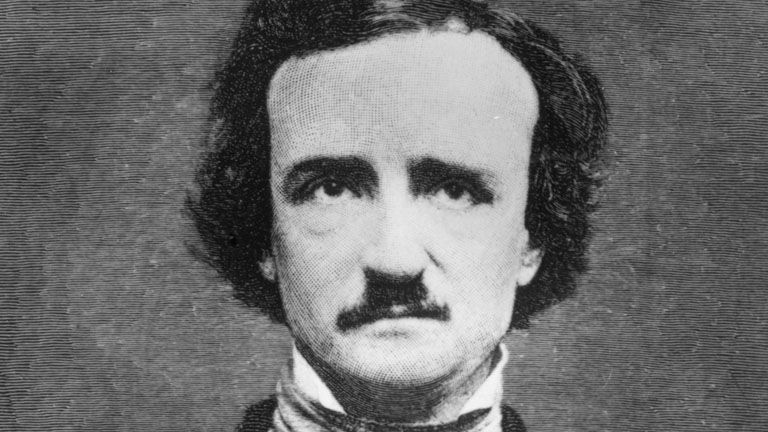
“For decades,” writes the Baltimore Sun, “Edgar Allan Poe’s birthday was marked by a mysterious visitor to his gravesite in Baltimore. Beginning in the 1930s, the ‘Poe Toaster’ placed three roses at the grave every Jan. 19 and opened a bottle of cognac, only to disappear into the night.” The identity of the original “Poe Toaster”—who may have been succeeded by his son—remains a tantalizing mystery. As does the mystery of how Edgar Allan Poe died.
Most of you have probably heard some version of the story. On October 3, 1849, a compositor for the Baltimore Sun, Joseph Walker, found Poe lying in a gutter. The poet had departed Richmond, VA on September 27, bound for Philadelphia “where he was to edit a volume of poetry for Mrs. St. Leon Loud,” the Poe Museum tells us. Instead, he ended up in Baltimore, “semiconscious and dressed in cheap, ill-fitting clothes so unlike Poe’s usual mode of dress that many believe that Poe’s own clothing had been stolen.” He never became lucid enough to explain where he had been or what happened to him: “The father of the detective story has left us with a real-life mystery which Poe scholars, medical professionals, and others have been trying to solve for over 150 years.”
Most people assume that Poe drank himself to death. The rumor was partly spread by Poe’s friend, editor Joseph Snodgrass, whom the poet had asked for in his semi-lucid state. Snodgrass was “a staunch temperance advocate” and had reason to recruit the writer posthumously into his campaign against drink, despite the fact that Poe had been sober for six months prior to his death and had refused alcohol on his deathbed. Poe’s attending physician, John Moran, dismissed the binge drinking theory, but that did not help clear up the mystery. Moran’s “accounts vary so widely,” writes Biography.com, “that they are not generally considered reliable.”
So what happened? Doctors at the University of Maryland Medical Center theorize that Poe may have contracted rabies from one of his own pets—likely a cat. This diagnosis accounts for the delirium and other reported symptoms, though “no one can say conclusively,” admits the Center’s Dr. Michael Benitez, “since there was no autopsy after his death.” As with any mystery, the frustrating lack of evidence has sparked endless speculation. The Poe Museum offers the following list of possible cause of death, with dates and sources, including the rabies and alcohol (both overimbibing and withdrawal) theories:
Beating (1857) The United States Magazine Vol.II (1857): 268.
Murder (1998) Walsh, John E., Midnight Dreary. Rutgers Univ. Press, 1998: 119–120.
Epilepsy (1999) Archives of Neurology June 1999: 646, 740.
Carbon Monoxide Poisoning (1999) Albert Donnay
The Smithsonianadds to this list the possible causes of brain tumor, heavy metal poisoning, and the flu. They also briefly describe the most popular theory: that Poe died as a result of a practice called “cooping.”
A site called The Medical Bag expands on the cooping theory, a favorite of “the vast majority of Poe biographies.” The term refers to “a practice in the United States during the 19th century by which innocent people were coerced into voting, often several times, for a particular candidate in an election.” Oftentimes, these people were snatched unawares off the streets, “kept in a room, called the coop” and “given alcohol or drugs in order for them to follow orders. If they refused to cooperate, they would be beaten or even killed.” One darkly comic detail: victims were often forced to change clothes and were even “forced to wear wigs, fake beards, and mustaches as disguises so voting officials at polling stations wouldn’t recognize them.”
This theory is highly plausible. Poe was, after all, found “on the street on Election Day,” and “the place where he was found, Ryan’s Fourth Ward Polls, was both a bar and a place for voting.” Add to this the notoriously violent and corrupt nature of Baltimore elections at the time, and you have a scenario in which the author may very well have been kidnapped, drugged, and beaten to death in a voter fraud scheme. Ultimately, however, we will likely never know for certain what killed Edgar Allan Poe. Perhaps the “Poe Toaster” was attempting all those years to get the story from the source as he communed with his dead 19th century friend year after year. But if that mysterious stranger knows the truth, he ain’t talking either.
Note: An earlier version of this post appeared on our site in 2015.
More than a few of us might be interested in the opportunity to spend a day in Victorian London. But very few of us indeed who’ve ever read, say, a Charles Dickens novel would ever elect to live there. “London’s little lanes are charming now,” says Sheehan Quirke, the host of the video above, while standing in one of them, “but 150 years ago in places like this, you’d have had whole families crammed into these tiny rooms without running water. There would have been open cesspits spilling down the streets, and the stench of sewage boiling in the midday sun would have been unbearable.” The stinking city, already the biggest in the world and growing every day, “wasn’t only horrible to live in, but genuinely dangerous.”
Much of the tremendous amount of waste produced by Londoners went straight into the River Thames, which eventually grew so foul that the engineer Joseph Bazalgette took on the job of designing not just a sewer system, but also an embankment to “replace what was essentially a stinking swamp filled with rubbish and human waste and eels.” Though eminently, even miraculously functional, Bazalgette’s design wasn’t utilitarian.
After its completion in 1870, the embankment was lined with elaborately decorated lamps (some of the first pieces of electric lighting in the world) that still catch the eye of passersby today, well into the twenty-first century. “We don’t associate decoration with cutting-edge technology, and that’s a major difference between us and the Victorians,” who “saw no contradiction between startling modernity and time-honored tradition.”
Quirke became renowned as The Cultural Tutor a few years ago on the social media platform then called Twitter. His threads have cultivated the understanding of countless many readers about a host of subjects to do with history, art, architecture, music, and design, with an eye toward the ways in which past civilizations may have done them better than ours does. The Victorians, for instance, may have lacked modern amenities that none of us could live without, but they designed even their sewage pumping stations “with the same ornamental exuberance as any church or palace.” Perhaps they thought their sanitation workers deserved beautiful surroundings; they certainly had “a sense of pride, a belief that what they’d done here was worthwhile, that it meant something.” Current infrastructure, large-scale and small, is technologically superior, yet almost none of it is worth regarding, to put it mildly. Whether our own civilization could return to beauty is the question at the heart of Quirke’s enterprise — and one his growing group of followers has begun to ask themselves every time they step outside.
Based in Seoul, Colin Marshall writes and broadcasts on cities, language, and culture. His projects include the Substack newsletterBooks on Cities and the book The Stateless City: a Walk through 21st-Century Los Angeles. Follow him on the social network formerly known as Twitter at @colinmarshall.
If your knowledge of America’s most celebrated female artist is confined to the gift shop’s greatest hits, you might enjoy a leisurely prowl through the 1100+ works in the Georgia O’Keeffe Museum’s digital collection.
A main objective of this collection is to provide a more complete understanding of the life and work of the iconic artist, who died in 1986 at the age of 98.
Her evolution is evident when you search by materials or date.
You can also view works by other artists in the collection, including two very significant men in her life, photographer Alfred Stieglitz and ceramicist Juan Hamilton.
Each item’s listing is enhanced with information on inscriptions and exhibitions, as well as links to other works produced in the same year.
If you wish to become a cinephile worthy of the title, you must first pledge never to refuse to watch a film for any of the following reasons. First, that it is in a different language and subtitled; second, that it is too old; third, that it is too slow; fourth, that it is too long; and fifth, that it has no “story.” These categories of refusal are what Lewis Bond, co-creator of the YouTube channel The House of Tabula, calls “the five cardinal sins of cinema,” and no one who commits them can ever attain an understanding of the art form, its nature, its history, and its potential. Once you’ve made your vow, you’ll be ready to watch through the 135 chronologically ordered motion pictures that constitute The House of Tabula’s “Ultimate Film Studies Watchlist,” fully explained in the video above.
While the movies first emerged in the nineteenth century, and plenty continue to be made here in the twenty-first, they stand unopposed as the defining popular art form of the twentieth. And it is from the span of that century that all the films on this list are drawn, from Georges Méliès’ Le Voyage dans la Luneand D. W. Griffith’s The Birth of a Nation to all the way to Quentin Tarantino’s Pulp Fiction and the Wachowskis’ The Matrix.
What happened to cinema between those periods was, in a sense, a process of technological and artistic evolution, but as Bond’s commentary underscores, older films aren’t superseded by newer ones — or at least, older films of value aren’t. Indeed, the ambition and creativity of these decades, or even century-old movies, puts many a current release to shame.
By no means is the list dominated by obscurities. Gone with the Wind, Fantasia, Singin’ in the Rain, Psycho, Jaws, Alien: even the least cinematically inclined among us have seen a few of these movies, or at least they feel like they have. Maybe they’ve never got around to watching Citizen Kane, but they’ll have a sense that it belongs on any syllabus meant to cultivate an understanding of film as an art form. The presence of Star Wars may come as more of a surprise, but no less than Citizen Kane, it illustrates the benefit of watching your way through cinema history: if you do, you’ll experience just how much of a break they represented with all that came before. Ordinary moviegoers may feel like they’ve seen it all before, but cinephiles — especially those who’ve made the journey through The House of Tabula’s watchlist — know how vast an area of cinematic possibility remains unexplored.
Based in Seoul, Colin Marshall writes and broadcasts on cities, language, and culture. His projects include the Substack newsletterBooks on Cities and the book The Stateless City: a Walk through 21st-Century Los Angeles. Follow him on the social network formerly known as Twitter at @colinmarshall.
The practice of cartomancy, or divination with cards, dates back several hundred years to at least 14th century Europe, perhaps by way of Turkey. But the specific form we know of, the tarot, likely emerged in the 17th century, and the deck we’re all most familiar with—the Rider-Waite Tarot—didn’t appear until 1909. Popular mainly with occultists like Aleister Crowley and Madame Blavatsky in the early 20th century, the tarot exploded into popular culture in the new age 70s with books like Stuart Kaplan’s Tarot Cards for Fun and Fortune Telling, and by way of cult filmmakers like Alejandro Jodorowsky.
Since its relatively recent popularization, “fun” and “fortune telling” have more or less defined most people’s attitude to the tarot, whether they approve or disapprove of either one. But for artists and poets like William Butler Yeats, T.S. Eliot, and surrealist director Jodorowsky—whose film narration is perhaps the most poetic in modern cinema—the tarot has always meant something much more mysterious and inspiring. “The tarot,” says Jodorowsky in the short film above, “will teach you how to create a soul.”
After studying the Major and Minor Arcana and the suits, and puzzling over the symbols on each card, Jodorowsky discovered that “all 78 cards could be joined in a mandala, in just one image.” Learning to see the deck thus, “You must not talk about the future. The future is a con. The tarot is a language that talks about the present. If you use it to see the future, you become a conman.” Like other mystical poets, Jodorowsky’s study of the tarot did not lead him to the supernatural but to the creative act.
And like many a poet before him, Jodorowsky explored the journey of the Fool in his 1973 film The Holy Mountain, a “dazzling, rambling, often incoherent satire,” writes Matt Zoller Seitz, that “unfurls like a hallucinogenic daydream.” Jodorowsky’s cinematic dream logic comes not only from his work as a “shamanic psychotherapist.” He also credits the tarot for his psychomagical realism. “For me,” says Jodorowsky in the video at the top, “the tarot was something more serious. It was a deep psychological search.” The result of that search—Jodorowsky’s singular and totally unforgettable body of work—speaks to us of the value of such an undertaking, whatever means one uses to get there.
Or as Jodorowsky says in one of his mystical pronouncements, “If you set your spirit to something, that phenomenon will happen.” If that sounds like magical thinking, that’s exactly what it is. Jodorowsky shows us how to read the tarot as he does, for psychological insight and creative inspiration, in the video above, addressed to a fan named John Bishop. Spanish speakers will have no trouble understanding his presentation, as he quickly slides almost fully into his native language through lack of confidence in his facility with English. The video belongs to a series on Jodorowsky’s YouTube channel, most of them fully in Spanish without subtitles.
Nevertheless, for English speakers, the subtitled video at the top offers a surprisingly dense lesson on the Chilean mystic’s interpretation of the tarot’s supposed wisdom as a symbolic system, and a way of telling the present.
We're hoping to rely on loyal readers, rather than erratic ads. Please click the Donate button and support Open Culture. You can use Paypal, Venmo, Patreon, even Crypto! We thank you!
Open Culture scours the web for the best educational media. We find the free courses and audio books you need, the language lessons & educational videos you want, and plenty of enlightenment in between.