Back in 2008, Bob Boilen (host of All Songs Considered) and NPR music critic Stephen Thompson attended a noisy concert where they struggled to hear Laura Gibson perform. Jokingly, Thompson suggested that Gibson perform at Boilen’s office desk instead. She did. And, with that, the NPR Tiny Desk Concert was born. Since then, more than 1,300 musical acts have performed their own stripped-down, authentic shows in the cramped confines of NPR’s headquarters in Washington, D.C. That includes everyone from Taylor Swift to Dua Lipa, to the Pixies, the Grateful Dead’s Bob Weir, and Gary Clark Jr. In the video above, Architectural Digest takes you behind the scenes, showing the set where the magic happens. There you can see “a real desk in a real office, surrounded by shelves packed with priceless mementos left by artists–from Adele’s water bottle to Sabrina Carpenter’s martini glass and even Chappell Roan’s wig.” And you can meet the team behind the production, while learning how Tiny Desk became a beloved series. Below watch a complete playlist of all Tiny Desk Concerts. Enjoy!
When we speak English, we might say we’re speaking the language of Samuel Johnson, the man who wrote its first dictionary. Or we could say we’re speaking the language of Shakespeare, who coined more English terms than any other individual in history. It would make just as much sense to describe ourselves as speaking the language of the King James Bible, the mass printing of which did so much to standardize English, steamrolling flat many of the countless local variations that existed in the early seventeenth century. But as many an Englishman (and more than a few Americans) would be loath to admit, when we speak English, we are, much of the time, actually speaking French.
“In 1066, the Normans turn up and seize the English throne from the Anglo-Saxons says YouTuber Robwords in the new video above, describing the single most important event in the entire history of the English language, which he recounts in just 22 minutes. “William the Conqueror becomes king, and Norman French becomes the language of England’s élite.”
Under its new ruler, the country’s earls, thanes, and athelings would be called barons, dukes, and princes. “The now-subdued Anglo-Saxons needed to learn French words if they wanted to get by, so English absorbs a whole host of French terms associated with power, justice, art, government, law, and culture — such as power, justice, art, government, law, and culture,” to name just a few.
This thoroughgoing Frenchification gave rise to what we now call Middle English, as distinct from the Old English spoken before. As noted by RobWords, about 85 percent of Old English vocabulary is no longer in use today, yet we’re still “using Old English in every sentence that we utter,” not least when we break out such irregular-seeming plurals as mice, oxen, and wolves. Tuesday, Wednesday, Thursday, and Friday make reference to “the Anglo-Saxons’ pre-Christian gods.” And even in the fast-changing, slang-ridden, internet-influenced, and — for better or for worse — highly “globalized” English we speak today, we can still hear dim echoes of the ancient ancestor linguists call Proto-Indo-European. Perhaps that’s why, despite being so widely spoken, English is still so tricky to learn: when we speak it, we’re speaking not just a language, but many languages all at once.
Based in Seoul, Colin Marshall writes and broadcasts on cities, language, and culture. His projects include the Substack newsletterBooks on Cities and the book The Stateless City: a Walk through 21st-Century Los Angeles. Follow him on the social network formerly known as Twitter at @colinmarshall.
A few things to know about Charlie Chaplin. He starred in over 80 films, reeling off most during the silent film era. In 1914 alone, he acted in 40 films, then another 15 in 1915. By the 1920s, Chaplin had emerged as the first larger-than-life movie star and director, if not the most recognizable person in the world. Thanks to YouTube, you can watch 50+ Chaplin films on the web. Above, you will find a Chaplin mini-film festival that brings together four movies shot in 1917: The Adventurer, The Cure, Easy Street and The Immigrant. And then below you’ll find 50+ other films arranged in a neat list. Many can be otherwise found in our collection, 4,000+ Free Movies Online: Great Classics, Indies, Noir, Westerns, Documentaries & More.
A Burlesque On Carmen — Free — Original two-reel parody of Bizet’s Carmen by Charlie Chaplin. Also stars Leo White & Edna Purviance. (1915)
A Busy Day — Free — Chaplin plays a wife jealous of her husband’s interest in another woman, played by Phyllis Allen. On her way to attack the couple, the wife interrupts the set of a film, knocking over a film director, played by Mack Sennett, and a policeman, played by Billy Gilbert. (1914)
A Day’s Pleasure — Free — “Chaplin’s fourth film for First National Films. It was created at the Chaplin Studio. It was a quickly made two-reeler to help fill a gap while working on his first feature The Kid. It is about a day outing with his wife and the kids and things don’t go smoothly.” (1919)
A Dog’s Life — Free – This endearing short Chaplin film tells the story of underdogs, human and canine, succeeding despite the odds. (1918)
A Fair Exchange — Free — Originally released as Getting Acquainted, the film’s plot has been summarized as follows: “Charlie and his wife are walking in the park when they encounter Ambrose and his wife. The partners become fond of their counterparts and begin chasing each other around. A policeman looking for a professional Don Juan becomes involved, as does a Turk.” (1914)
A Film Johnnie - Free — Charlie goes to the movie and falls in love with a girl on the screen. (1914)
A Night in the Show — Free — Chaplin played two roles: one as Mr. Pest and one as Mr. Rowdy. The film was created from Chaplin’s stage work from a play called Mumming Birds. (1915)
A Night Out — Free — “After a visit to a pub, Charlie and Ben cause a ruckus at a posh restaurant. Charlie later finds himself in a compromising position at a hotel with the head waiter’s wife.” (1915)
A Woman — Free — This Chaplin film starts with Charlie meeting Edna (Edna Purviance) and her parents in a park; the mother is played by Marta Golden and the father by Charles Insley. (1915)
Behind the Screen – Free – A short film written and directed by Chaplin, the film is long on slapstick, but it also gets into themes dealing with gender bending and homosexuality. (1916)
Between Showers - Free — A short Keystone film from 1914 starring Charlie Chaplin, Ford Sterling, and Emma Bell Clifton.
By the Sea — Free — “It is windy at a bathing resort. After fighting with one of the two husbands, Charlie approaches Edna while the two husbands themselves fight over ice cream. Driven away by her husband, Charlie turns to the other’s wife.” (1915)
Caught in a Cabaret — Free — Charlie is a clumsy waiter in a cheap cabaret, suffering the strict orders from his boss. He’ll meet a pretty girl in the park, pretending to be a fancy ambassador, despite the jealousy of her fiancée. (1914)
Charlie Shanghaied — Free — Charlie Chaplin and his Tramp character gets shanghaied by crooks. (1915)
Charlie’s Recreation — Free — Out of costume, Charlie is a clean-shaven dandy who, somewhat drunk, visits a dance hall. There the wardrobe girl has three rival admirers: the band leader, one of the musicians, and now Charlie. (1914).
Charlotte et Le Mannequin — Free — Also known as Mabel’s Married Life, the film’s plot is summarized as follows: “Accosted by a masher in the park and unable to motivate husband Charlie into taking action, Mabel gets him a boxing mannequin to sharpen his fighting skills.” (1914)
Cruel Cruel Love - Free — Chaplin plays a rich, upper-class gentleman whose romance is endangered when his girlfriend oversees him being embraced by a maid. (1914)
Face on a Barroom Floor — Free — “The plot is a satire derived from Hugh Antoine D’Arcy’s poem of the same title. The painter courts Madeleine but loses to the wealthy client who sits for his portrait. The despairing artist draws the girl’s portrait on the barroom floor and gets tossed out. Years later he sees her, her husband and their horde of children. Unrecognized by her, Charlie shakes off his troubles and walks off into the future.” (1914)
Gentlemen of Nerve — Free — “Mabel and her beau go to an auto race and are joined by Charlie and his friend. As Charlie’s friend is attempting to enter the raceway through a hole, the friend gets stuck and a policeman shows up. Charlie sprays the policeman with soda until [his] friends makes it through the hole. In the grandstand, Mabel abandons her beau for Charlie. Both Charlie’s friend and Mabel’s are arrested and hauled away.” (1914)
His Favorite Pastime — Free — Charlie gets drunk in the bar. He steps outside, meets a pretty woman, tries to flirt with her, only to retreat after the woman’s father returns. (1914)
His New Job — Free — “Charlie is trying to get a job in a movie. After causing difficulty on the set he is told to help the carpenter. When one of the actors doesn’t show, Charlie is given a chance to act but instead enters a dice game. When he does finally act he ruins the scene, wrecks the set and tears the skirt from the star.” (1915)
His Prehistoric Past — Free — “Charlie dreams he is in the stone age. There King Low-Brow rules a harem of wives. Charlie, in skins and a bowler, falls in love with the king’s favorite wife, Sum-Babee. During a hunting trip the king is pushed over a cliff. Charlie proclaims himself king, but Ku-Ku discovers the real king alive. They return to find Charlie and Sum- Babee together.” (1914)
His Trysting Place — Free — “Charlie’s wife sends him to the store for a baby bottle with milk. Elsewhere, Ambrose offers to post a love letter for a woman in his boarding house. The two men meet at a restaurant and each takes the other’s coat by mistake. Charlie’s wife thinks he has a lover; Ambrose’s believes he has an illegitimate child.” (1914)
In the Park — Free — “A tramp steals a girl’s handbag, but when he tries to pick Charlie’s pocket loses his cigarettes and matches. He rescues a hot dog man from a thug, but takes a few with his walking stick. When the thief tries to take some of Charlie’s sausages, Charlie gets the handbag. The handbag makes its way from person to person to its owner, who is angry with her boyfriend who didn’t protect her in the first place. The boyfriend decides to throw himself in the lake in despair, so Charlie helps him out.” (1915)
Kid Auto Races at Venice – Free – It’s the first film in which Charlie Chaplin’s iconic “Little Tramp” character makes his appearance. (1914)
Laughing Gas - Free — Film starring Chaplin is sometimes known as “Busy Little Dentist”, “Down and Out”, “Laffing Gas”, “The Dentist”, and “Tuning His Ivories”.
Mabel’s Busy Day — Free — “A hotdog girl gives one to a policeman who then allows her into a race track. While other customers swipe her hotdogs, Charlie runs off with the whole box, pretending to sell them while actually giving them away. She calls her policeman who battles Charlie.” (1914)
Mabel’s Strange Predicament — Free — Watch lots and lots of high jinks go down in a hotel. (1914)
Making a Living — Free – Premiering on February 2, 1914, Making a Living marks the first film appearance by Charlie Chaplin.
Musical Tramps — Free — “Charlie and his partner are to deliver a piano to 666 Prospect St. and repossess one from 999 Prospect St. They confuse the addresses. The difficulties of delivering the piano by mule cart, and most of the specific gags, appeared later in Laurel and Hardy’s ‘The Music Box’.” (1914)
One A.M. — Free — The first silent film Charlie Chaplin starred in alone. (1916)
Police — Free — “Police was Charlie Chaplin’s 14th released film from Essanay. It was made at the Majestic Studio in Los Angeles. Charlie playing an ex-convict finds life on the outside not to his liking and leads him to breaking into a home with another thief (Wesley Ruggles). Edna Purviance plays the girl living in the home who tries to change him.” (1916)
Shoulder Arms — Free — Charlie is a boot camp private who has a dream of being a hero who goes on a daring mission behind enemy lines. (1918)
Sunnyside — Free — “Charlie works on a farm from 4am to late at night. He gets his food on the run (milking a cow into his coffee, holding an chicken over the frying pan to get fried eggs). He loves the neighbor’s daughter Edna but is disliked by her father. He rides a cow into a stream and is kicked off. Unconscious, he dreams of a nymph dance. Back in reality a city slicker is hurt in a car crash and is being cared for by Edna. When Charlie is rejected after attempting to imitate the slicker, the result is ambiguous–either tragic or a happy ending. Critics have long argued as to whether the final scene is real or a dream.” (1919)
The Bank — Free — “Charlie does everything but an efficient job as janitor. Edna buys her fiance, the cashier, a birthday present. Charlie thinks “To Charles with Love” is for him. He presents her a rose which she throws in the garbage. Depressed, Charlie dreams of a bank robbery and his heroic role in saving the manager and Edna … but it is only a dream.”
The Bond — Free — A propaganda film created and funded by Chaplin for theatrical release to help sell U.S. Liberty Bonds during World War I. (1918)
The Champion — Free — “Walking along with his bulldog, Charlie finds a “good luck” horseshoe just as he passes a training camp advertising for a boxing partner “who can take a beating.” After watching others lose, Charlie puts the horseshoe in his glove and wins. The trainer prepares Charlie to fight the world champion. A gambler wants Charlie to throw the fight. He and the trainer’s daughter fall in love.” (1915)
The Count — Free — The Count was Charlie Chaplin’s 5th film for Mutual Films. Co-starring Eric Campbell and Edna Purviance, it is a story about Charlie and his boss finding an invitation to a party from a real Count. (1916)
The Fatal Mallet — Free — Three men will fight for the love of a charming girl. Charlie will play dirty, throwing bricks to his contender, and using a huge hammer to hurt one of them. But a precocious kid will be the fourth suitor in discord. (1914)
The Fireman — Free — Charlie Chaplin’s second short for Mutual continued his focus on gags and situations—as the title suggests, Chaplin plays the role of an inept firefighter. (1916)
The Floorwalker — Free — “The Floorwalker was Charlie Chaplin’s first Mutual Film Company made in 1916. It starred Chaplin as a customer in a department store who finds out the manager is stealing money from the store. It was noted for the first ‘running staircase’ used in films.” (1916)
The Good for Nothing — Free — Made at the Keystone Studios, the film involves Chaplin taking care of a man in a wheelchair. (1914)
The Immigrant — Free — Chaplin, in the role of the Tramp character, plays an immigrant coming to the United States. He gets accused of theft while on a voyage across the Atlantic Ocean. (1917)
The Kid - Free — The Kid is a 1921 American silent comedy-drama film written, produced, directed and starring Charlie Chaplin, and features Jackie Coogan as his foundling baby, adopted son and sidekick. This was Chaplin’s first full-length film as a director. (1921)
The Knockout — Free — Charlie Chaplin’s seventeenth film for Keystone Studios. Chaplin only has a small role, and Fatty Arbuckle takes up the main role. (1914)
The Landlady’s Pet — Free — Otherwise known as The Star Boarder, the film turns around this theme: A brat’s magic lantern show exposes an indiscreet moment between a landlady and her star boarder. (1914)
The Masquerader — Free — “Charlie is an actor in a film studio. He messes up several scenes and is tossed out. Returning dressed as a lady, he charms the director. Even so, Charlie never makes it into film, winding up at the bottom of a well.” (1914)
The New Janitor — Free — “Charlie is janitor for a firm the manager of which receives a threatening note about his gambling debts. He throws a bucket of water out the window which lands on his boss and costs him his job. The boss, attempting to steal the money heeds from the office safe, is caught by his secretary and Charlie comes to save her and the money. He is briefly accused of being the thief but ultimately triumphs.” (1914)
The Pawnshop – Free – Rich in slapstick, The Pawnshop was one of Chaplin’s more popular movies for Mutual Film, the producer of many fine Chaplin comedies. (1916)
The Property Man — Free — “Charlie has trouble with actors’ luggage and conflicts over who gets the star’s dressing room. There are further difficulties with frequent scene changes, wrong entries and a fireman’s hose. At one point he juggles an athlete’s supposed weights. The humor is still rough: he kicks an older assistant in the face and allows him to be run over by a truck.” (1914)
The Rink – Free – The Rink, Chaplin’s 8th film for Mutual Films, showcases the actor’s roller skating abilities. (1916)
The Rival Mashers — Free — “Charlie and a rival vie for the favors of their landlady. In the park they each fall different girls, though Charlie’s has a male friend already. Charlie considers suicide, is talked out of it by a policeman, and later throws his girl’s friend into the lake. Frightened, the girls go off to a movie. Charlie shows up there and flirts with them. Later both rivals substitute themselves for the girls and attack the unwitting Charlie. In an audience-wide fight, Charlie is tossed from the screen.” (1914)
The Rounders — Free — Writes IMDB: “Two drunks live in the same hotel. One beats his wife, the other is beaten by his. They go off and get drunk together. They try to sleep in a restaurant using tables as beds and are thrown out. They lie down in a row boat which fills with water, drowning them (a fate apparently better than going home to their wives).” (1914)
The Tramp - Free — The film made Chaplin’s great Tramp character famous. (1915)
The Vagabond — Free — A silent film by Charlie Chaplin that co-starred Edna Purviance, Eric Campbell, Leo White and Lloyd Bacon, with Chaplin appearing as The Tramp. The British Film Institute calls it the “pivotal work” of his Mutual period – “and his most touching.” (1916)
Tillie’s Punctured Romance – Free – Among other things, the film is notable for being the last film that Chaplin didn’t write or direct by himself. (1914)
Triple Trouble — Free — “As Colonel Nutt is experimenting with explosives, a new janitor is joining his household. The inept janitor proceeds to make life difficult for the rest of the staff. Meanwhile, a foreign agent arrives at the house in hopes of getting Col. Nutt’s latest invention. The inventor throws him out, so the agent then employs a thug to get the formula. When police head to the Nutt home to start an investigation, a complicated fracas ensues.” (1918)
Twenty Minutes of Love — Free — IMDB summarizes thusly: “Charlie is hanging around in the park, finding problems with a jealous suitor, a man who thinks that Charlie has robbed him of a watch, a policeman and even a little boy, all because our friend can’t stop snooping.” (1914)
Work — Free — “Charlie and his boss have difficulties just getting to the house they are going to wallpaper. The householder is angry because he can’t get breakfast and his wife is screaming at the maid as they arrive. The kitchen gas stove explodes, and Charlie offers to fix it. The wife’s secret lover arrives and is passed off as the workers’ supervisor, but the husband doesn’t buy this and fires shots. The stove explodes violently, destroying the house.” (1915)
Most of the quoted summaries above were written by Ed Stephan on IMDB.
Note: An earlier version of this post appeared on our site in 2011. Some of the links and text have been updated.
Doric, Ionic, Corinthian: these, as practically everyone who went through school in the West somehow remembers, are the three varieties of classical column. We may still recall them, more specifically, as representing the three ancient Greek architectural styles. But as ancient-history YouTuber Garrett Ryan points out in the new Told in Stone video above, only Doric and Ionic columns belong fully to ancient Greece; what we think of when we think of Corinthian columns were developed more in the civilization of ancient Rome. The context is an explanation of how the ancient Greeks built their temples, one of the characteristics of their design process being the use of columns aplenty.
It’s one thing to hear about Greek columns in the classroom, and quite another to walk amid them in person. That, perhaps, is why Ryan delivers the opening of his video perched upon the ruins of what’s known as Temple C. Having once stood proudly in Selinus, a city belonging to Magna Graecia (Greek-speaking areas of Italy), it now constitutes one of the prime tourist attractions for antiquity-minded visitors to modern-day Sicily.
Though his channel may be called Told in Stone, Ryan begins his brief history of the Greek temple before that hardy material had even come into use for these purposes. At first, the Greeks fashioned the homes of their gods out of mud brick, with thatched roofs and wooden porches; only from the seventh century BC, “probably inspired by contact with Egypt,” did they start building them to last.
Or they built them to last as long as could be expected, in any case, given the nature of the materials available in the ancient world and the millennia that have passed since then. Take the Temple of Apollo at the Sanctuary of Didyma in modern-day Turkey, which history-and-architecture YouTuber Manuel Bravo pays a visit in the video just above. It may not look as if the nearly 2400 years since its never-technically-completed construction began have been kind, but it’s nevertheless one of the better-preserved temples from ancient Greek civilization in existence (not to mention the largest). Even in its ruined state, it gives what Bravo describes as the impression of — or at least, in its heyday, having been — “a forest of huge columns,” a built version of “the sacred forests that Greeks used to consecrate to the gods.” They’re Ionic columns, in case you were wondering, but don’t sweat it; there won’t be a quiz.
Based in Seoul, Colin Marshall writes and broadcasts on cities, language, and culture. His projects include the Substack newsletterBooks on Cities and the book The Stateless City: a Walk through 21st-Century Los Angeles. Follow him on the social network formerly known as Twitter at @colinmarshall.
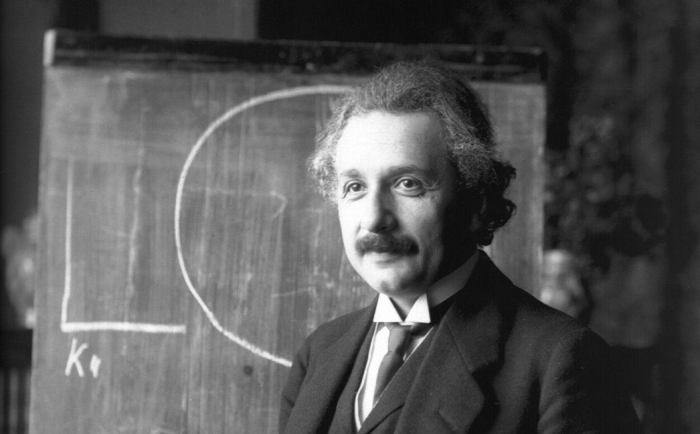
As one particularly astute observer of human emotions might put it, it is a truth universally acknowledged that we can’t all be Albert Einstein. In fact, none of us can. That unique experience was denied even Einstein’s son Hans Albert, though he did go on to his own distinguished career as an engineer and professor of hydraulics. Einstein father and son had a strained relationship, yet the great physicist had a hand in his son’s success, inspiring him to pursue his scientific passion. But Einstein’s paternal encouragement extended further, beyond scientific pursuits and toward a general theory of learning and enjoyment that suggests we can be happiest and most productive when being most ourselves.
While living in Berlin in 1915, Einstein wrote a poignant letter to his son, just two days after finishing his theory of general relativity. His tone swings from buoyant to pained—lamenting his family’s “awkward” separation and proposing to spend more time with Albert, as he calls him. His son can “learn many good and beautiful things from me,” writes Einstein, “These days I have completed one of the most beautiful works of my life.”
Einstein also writes, “I am very pleased that you find joy with the piano. This and carpentry are in my opinion for your age the best pursuits.” An amateur musician himself, Einstein understood the value of developing an informal avocation. “Mainly play the things on the piano which please you,” he tells his son, “even if the teacher does not assign those.” Doing what you love, the way you like to do it, he goes on, “is the way to learn the most, that when you are doing something with such enjoyment that you don’t notice that the time passes.”
This great theme of total immersion in a creative endeavor surfaced several decades later in another scientist’s work, that of Hungarian psychologist Mihaly Csikszentmihalyi, described by Martin Seligman—former President of the American Psychological Association—as “the world’s leading researcher” in the field of positive psychology. Presented in his popular TED talk above, and at more length in his books on the subject, Csikszentmihalyi’s insights into human flourishing mirror Einstein’s: he calls such creative immersion “flow,” or the state of “being completely involved in an activity for its own sake.”
The ego falls away. Time flies. Every action, movement, and thought follows inevitably from the previous one, like playing jazz. Your whole being is involved, and you’re using your skills to the utmost.
Contrary to our usual conceptions of using one’s “skills to the utmost,” Csikszentmihalyi tells us that the reward for entering such a state is not the material benefits it generates, but the positive emotions. These emotions, as Einstein theorized, not only motivate us to become better, but they also provide a source of meaning no amount of financial gain above a minimum level can offer. “The lack of basic material resources contributes to unhappiness,” Csikszentmihalyi’s data demonstrates, “but the increase in material resources does not increase happiness.” While none of us can be Einstein, Csikszentmihalyi tells us we can all benefit from Einstein’s advice, by doing whatever we do to the best of our abilities and without any motive other than sheer pleasure.
Note: An earlier version of this post appeared on our site in 2015.
“The last people anyone expected to come out of that gig as being the memorable ones was Queen,” said Bob Geldof in an interview, looking back at the band’s stunning 24 minute set at Live Aid on July 13, 1985. In front of 72,000 people in Wembley Stadium and millions watching worldwide, Queen resuscitated their career with a selection of hits and new material.
The band, as Roger Taylor says in the mini dochere, was “bored” and “in a bit of a trough.” They also had been criticized for playing Sun City in South Africa during the reign of Apartheid.
Going into Live Aid, a lot of the artists didn’t know what to expect of the entire event. Many, including Bob Geldof himself, wondered if the event would flop. But Queen more than any of them seemed to intuit right from the start the importance of the day, though they were very nervous backstage. But once onstage they completely own it, even more so Freddie Mercury who rises to the occasion as a front man and as a singer, giving one of his best performances.
In that short set, Queen gives a full concert worth of energy and the audience responds. Not all were Queen fans, but by the end everybody had become one, singing along to “We Are the Champions” and “We Will Rock You.” Across the Atlantic, the 90,000 strong Philadelphia audience followed suit, watching the jumbotron simulcast.
“Do you know how hard it is to get someone’s attention who’s on the other side of the room?” asks Dave Grohl of Foo Fighters in this other short doc on the set. “Imagine a stadium and making them sing along with you.”
This hot summer concert would turn out to be the zenith of Queen’s career. There would be more albums and singles, but Freddie Mercury would slowly succumb to AIDS, and disappear from public view, until passing in 1991. The Live Aid set stands as one of the band’s final, iconic, and major achievements. Watch it, in all of its glory, above.
You can watch the full Live Aid broadcast on Internet Archive. You can also watch 10+ hours of the best performances here on the Live Aid YouTube channel. Videos will be added to the playlist below throughout the day.
If asked about your favorite dish, you’d do well to name something exotic. Gone are the days when a taste for the likes of Italian, Mexican, or Chinese cuisine could qualify you as an adventurous eater. Even expeditions to the very edges of the menus at Peruvian, Ethiopian, or Laotian restaurants, say, would be unlikely to draw much respect from serious twenty-first-century eaters. One solution is to take your culinary voyages through not just space but also time, seeking out the meals of centuries and even millennia past. This has lately become somewhat easier to do, thanks to the work of Harvard- and Yale-associated researchers like Gojko Barjamovic, Patricia Jurado Gonzalez, Chelsea A. Graham, Agnete W. Lassen, Nawal Nasrallah, and Pia M. Sörensen.
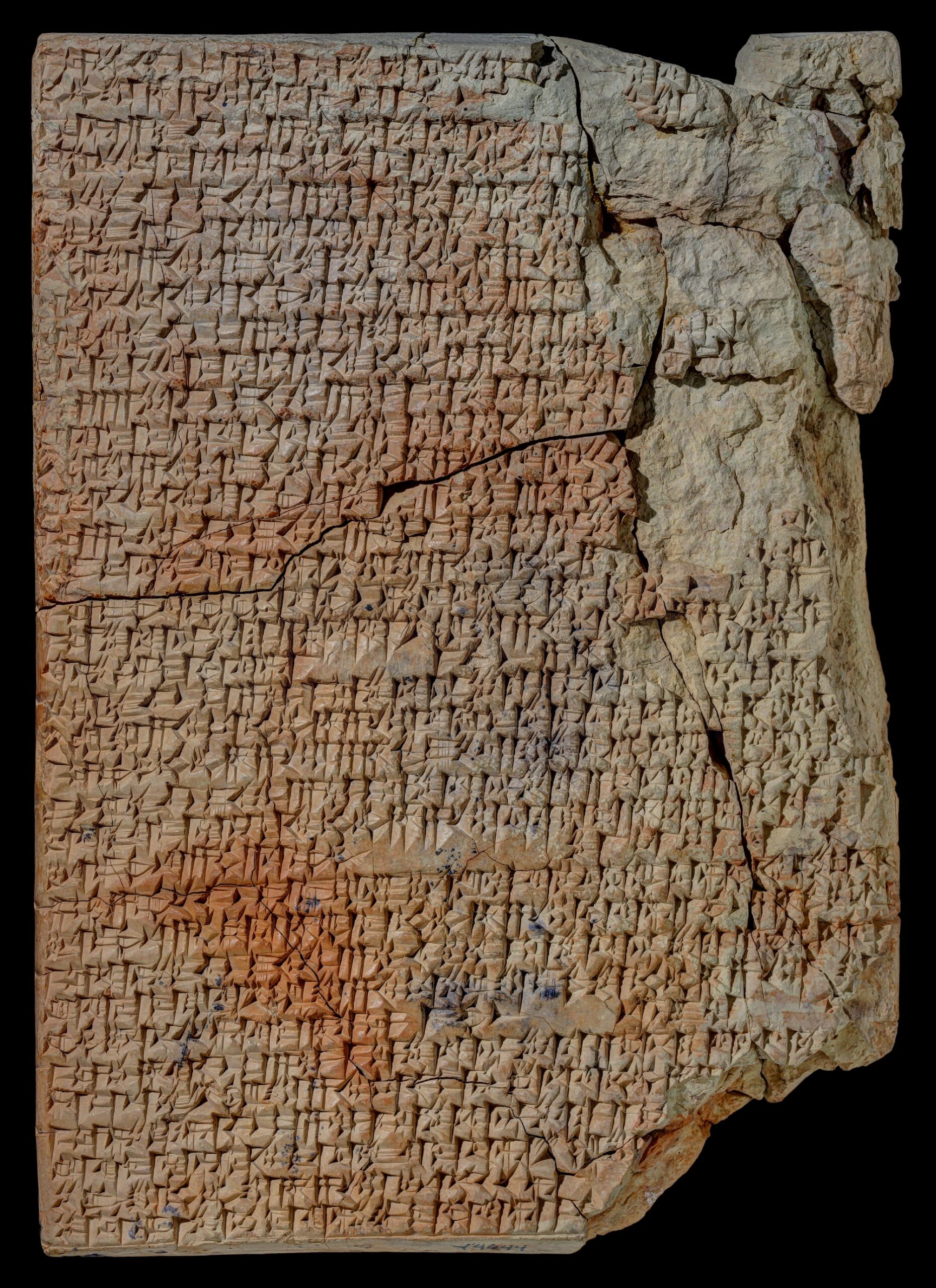
A few years ago, that interdisciplinary research team participated in a Lapham’s Quarterly roundtable on making and eating the ancient Mesopotamian recipes contained on what are known as the “Yale Culinary Tablets.” Dating from between 1730 BC and the sixth or seventh century BC, their Cuneiform inscriptions offer only broad and fragmentary guidance on the preparation of once-common dishes, none of which, luckily, are particularly complex.
The vegetarian soup pašrūtum, or “unwinding,” involves flavors no bolder than those of cilantro, leek, garlic, and dried sourdough. The stew puhādi, which uses lamb as well as milk, turns out to be “delicious when served with the peppery garnish of crushed leek and garlic.”
The Yale Culinary Tablets reveal that the Babylonians, too, enjoyed tucking into the occasional foreign meal — which, four millennia ago, could have meant a bowl of elamūtum, or “Elamite broth,” named for its origin in Elam in modern-day Iran. Another dish made with milk, it also calls for sheep’s blood (“the mixture of sour milk and blood may sound odd,” the roundtable article assures us, “but the combination produces a rich soup with a slight tartness”) and dill, which seems to have been the height of exotic ingredients at the time. Tuh’u, a leg-meat stew, has an identifiable descendant still eaten in Iraq today, but that dish uses white turnip instead of the ancient recipe’s red beet. Given that “Jews of Baghdad before their expulsion used red beet,” it’s “tempting to link the recipe to the continental European borscht.”
Reconstructing these recipes, which tend to lack quantities or procedural details, has involved educated guesswork. But no other texts in existence can get you closer to reconstructing ancient Mesopotamian cuisine in your own kitchen. If you’d like to see how that’s done before giving it a try yourself, watch the videosabove and below from Max Miller, whose Youtube channel Tasting Historyspecializes in preparing dishes from earlier stages of civilization. Not that departure from the recipes as originally dictated by tradition would have any consequences. Most of these recipes may date from an era close to the reign of King Hammurabi, but there’s nothing in his famous Code about what happens to cooks who make the occasional substitution.
Based in Seoul, Colin Marshall writes and broadcasts on cities, language, and culture. His projects include the Substack newsletterBooks on Cities and the book The Stateless City: a Walk through 21st-Century Los Angeles. Follow him on the social network formerly known as Twitter at @colinmarshall.
“Tomorrow Never Knows” couldn’t be made today, and not just because the Beatles already made it in 1966. Marking perhaps the single biggest step in the group’s artistic evolution, that song is in every sense a product of its time. The use of psychedelic drugs like LSD was on the rise in the counterculture, as was the awareness of the religion and music of faraway lands such as India. At the same moment, developments in recording-studio technology were making new approaches possible, involving sounds that musicians never would have imagined trying before — and, when brought together, produced a result that many listeners of just a few years earlier would hardly have recognized as music at all.
In the new You Can’t Unhear This video above, host Raymond Schillinger explains all that went into the recording of “Tomorrow Never Knows,” which he calls “arguably the most pivotal song of the Beatles’ career.” It seems that John had undergone some considerable experiences during the group’s five-month-long break after Rubber Soul, given that he turned up to EMI Studios afterward with a song that “defied pretty much every convention of pop music at the time: the lyrics didn’t rhyme, the chord progression didn’t really progress, and instead of romantic love, the subject matter was expanding one’s psychic consciousness through ego death.” A young Geoff Emerick, who’d just been promoted to the role of the Beatles’ recording engineer, rose to the challenge of facilitating an equally non-standard studio process.
The wholly new sonic texture that resulted owes in large part to the use of multiple tape loops, literal sections of audio tape connected at the beginning and end to allow theoretically infinite repetition of their content. This was a fairly new musical technology at the time, and the Beatles made use of it with gusto, creating loops of all manner of sped-up sounds — an orchestra playing, a Mellotron, a reversed Indian sitar, Paul sounding like a seagull — and orchestrating them “live” during recording. (Ringo’s drum track, despite what sounds like a superhuman regularity in this context, was not, in fact a loop.) Other technologically novel elements included John’s double-tracked vocals run through a revolving Leslie speaker and a backwards guitar solo about whose authorship Beatles enthusiasts still argue.
What John had called “The Void,” was retitled after one of Ringo’s signature askew expressions (“a hard day’s night” being another) in order to avoid drawing too much attention as a “drug song.” But listeners tapped into the LSD scene would have recognized lyrical inspiration drawn from The Tibetan Book of the Dead, the ancient work that also informed The Psychedelic Experience, the guidebook by Timothy Leary and Richard Alpert (later Baba Ram Dass) with which John directed his own first trip. But even for the least turned-on Beatle fan, “Tomorrow Never Knows” was “like stepping from a black-and-white world into full color,” as Schillinger puts it. The Beatles might have gone the way of the Rolling Stones and chosen to record in an American studio rather than their home-away-from-home on Abbey Road, the unconventional use of its less-than-cutting-edge gear resulted in what remains a vividly powerful dispatch from the analog era — even here in the twenty-twenties, when consciousness expansion itself has gone digital.
Based in Seoul, Colin Marshall writes and broadcasts on cities, language, and culture. His projects include the Substack newsletterBooks on Cities and the book The Stateless City: a Walk through 21st-Century Los Angeles. Follow him on the social network formerly known as Twitter at @colinmarshall.
We're hoping to rely on loyal readers, rather than erratic ads. Please click the Donate button and support Open Culture. You can use Paypal, Venmo, Patreon, even Crypto! We thank you!
Open Culture scours the web for the best educational media. We find the free courses and audio books you need, the language lessons & educational videos you want, and plenty of enlightenment in between.