More than a few of us can claim, with some confidence, to know every Beatles song. And indeed it may be true, in that we’ve heard every track of all their studio albums. But as decade after decade of Beatles scholarship has demonstrated, there’s knowing their songs, and then there’s knowing their songs. Musician and YouTuber David Bennett has made it his project to attain the second kind of knowledge, and on his dedicated series UnBeatled, to share it with the public. In each UnBeatled video he analyzes just one song — “Help!,”“Here Comes the Sun,”“Penny Lane,” and so on — at a level of detail fine enough to necessitate not just breaking it down to its component tracks, but also examining the demos and unreleased takes recorded in the studio.
This process can reveal a great deal about the Beatles’ songwriting process, as Bennett explains in the video at the top of the post. In the course of twenty minutes, he covers eleven songs, a selection not necessarily limited to the group’s universally praised compositions.
Take the first, “Yellow Submarine,” whose early recordings differ both lyrically, melodically, and in time signature from the version we know (and may or may not love), beginning with an idea of John’s and being further shaped by Paul through its iterations. Another of John’s musical seeds is “Everybody Had a Hard Year,” whose fingerpicking pattern (originally learned from Donovan in India) is also heard in “Julia” and “Dear Prudence,” and which evolved, with different chords, into the middle section of “I’ve Got a Feeling.”
Such interconnections come as rewards of close and deep listening to the Beatles canon. And certain songs turn out to be worlds of their own: “Strawberry Fields Forever,” for instance, was assembled out of two completely different recordings, then adjusted in tempo and pitch to match in the middle. One of those takes includes the voice of producer George Martin counting in the orchestra, the pitch of which suggests that its members had originally played in a different key than the one we hear. As Bennett notes, using the then relatively novel technology of “vari-speed” had become practically standard in the Beatles’ studio process, as such technological layering and adjustment itself became a key part of their songwriting process. It contributed much to their signature “vibey, psychedelic, uncanny sound”: sought after by many bands over the past six decades, but never truly replicated.
Based in Seoul, Colin Marshall writes and broadcasts on cities, language, and culture. He’s the author of the newsletterBooks on Cities as well as the books 한국 요약 금지 (No Summarizing Korea) and Korean Newtro.Follow him on the social network formerly known as Twitter at @colinmarshall.
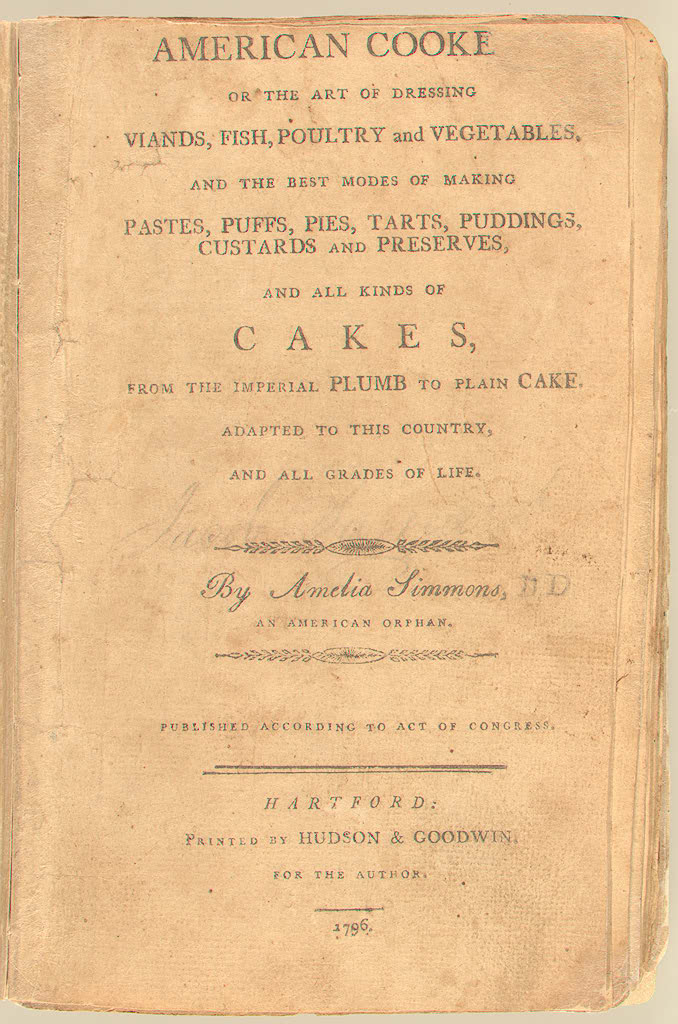
On the off chance Lin-Manuel Miranda is casting around for source material for his next American history-based blockbuster musical, may we suggest American Cookery by “poor solitary orphan” Amelia Simmons?
First published in 1796, at 47 pages (nearly three of them are dedicated to dressing a turtle), it’s a far quicker read than the fateful Ron Chernow Hamilton biography Miranda impulsively selected for a vacation beach read.
Slender as it is, there’s no shortage of meaty material:
Calves Head dressed Turtle Fashion
Soup of Lamb’s Head and Pluck
Fowl Smothered in Oysters
Tongue Pie
Foot Pie
Modern chefs may find some of the first American cookbook’s methods and measurements take some getting used to.
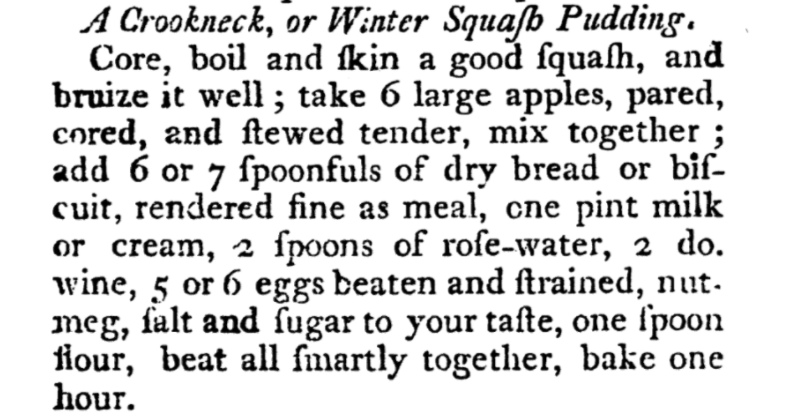
We like to cook, but we’re not sure we possess the wherewithal to tackle a Crookneck or Winter Squash Pudding.
We’ve never been called upon to “perfume” our “whipt cream” with “musk or amber gum tied in a rag.”
And we wouldn’t know a whortleberry if it bit us in the whitpot.
The book’s full title is an indication of its mysterious author’s ambitions for the new country’s culinary future:
American Cookery, or the art of dressing viands, fish, poultry, and vegetables, and the best modes of making pastes, puffs, pies, tarts, puddings, custards, and preserves, and all kinds of cakes, from the imperial plum to plain cake: Adapted to this country, and all grades of life.
As Keith Stavely and Kathleen Fitzgerald write in an essay for What It Means to Be an American, a “national conversation hosted by the Smithsonian and Arizona State University,” American Cookery managed to straddle the refined tastes of Federalist elites and the Jeffersonians who believed “rustic simplicity would inoculate their fledgling country against the corrupting influence of the luxury to which Britain had succumbed”:
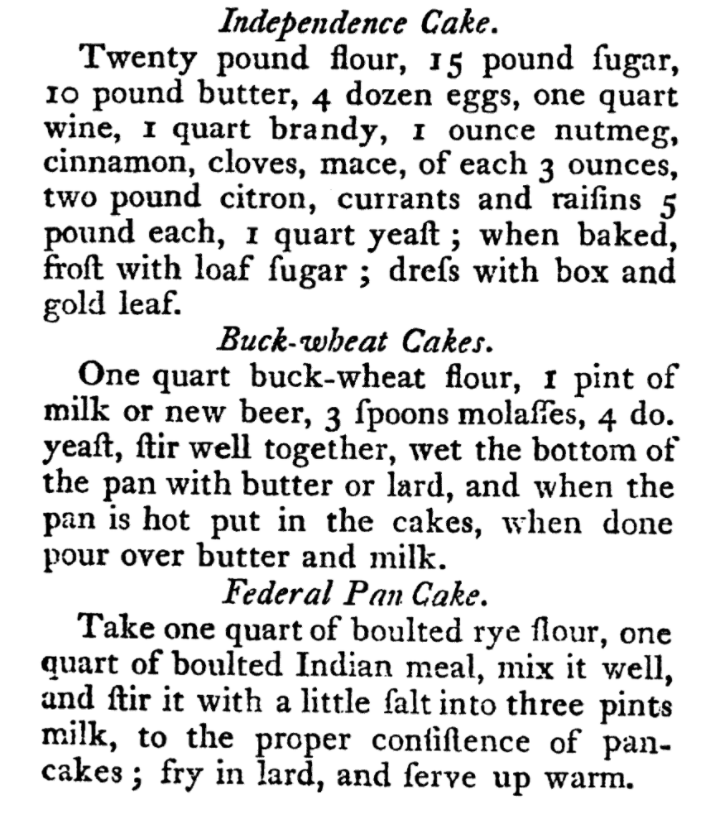
The recipe for “Queen’s Cake” was pure social aspiration, in the British mode, with its butter whipped to a cream, pound of sugar, pound and a quarter of flour, 10 eggs, glass of wine, half-teacup of delicate-flavored rosewater, and spices. And “Plumb Cake” offered the striving housewife a huge 21-egg showstopper, full of expensive dried and candied fruit, nuts, spices, wine, and cream.
Then—mere pages away—sat johnnycake, federal pan cake, buckwheat cake, and Indian slapjack, made of familiar ingredients like cornmeal, flour, milk, water, and a bit of fat, and prepared “before the fire” or on a hot griddle. They symbolized the plain, but well-run and bountiful, American home. A dialogue on how to balance the sumptuous with the simple in American life had begun.
American Cookery is one of nine 18th-century titles to make the Library of Congress’ list of 100 Books That Shaped America:
This cornerstone in American cookery is the first cookbook of American authorship to be printed in the United States. Numerous recipes adapting traditional dishes by substituting native American ingredients, such as corn, squash and pumpkin, are printed here for the first time. Simmons’ “Pompkin Pudding,” baked in a crust, is the basis for the classic American pumpkin pie. Recipes for cake-like gingerbread are the first known to recommend the use of pearl ash, the forerunner of baking powder.
Students of Women’s History will find much to chew on in the second edition of American Cookery as well, though they may find a few spoonfuls of pearl ash dissolved in water necessary to settle upset stomachs after reading Simmons’ introduction.
Stavely and Fitzgerald observe how “she thanks the fashionable ladies,” or “respectable characters,” as she calls them, who have patronized her work, before returning to her main theme: the “egregious blunders” of the first edition, “which were occasioned either by the ignorance, or evil intention of the transcriber for the press.”
Ultimately, all of her problems stem from her unfortunate condition; she is without “an education sufficient to prepare the work for the press.” In an attempt to sidestep any criticism that the second edition might come in for, she writes: “remember, that it is the performance of, and effected under all those disadvantages, which usually attend, an Orphan.”
Last year, we featured here on Open Culture the story of how a samurai ended up in the unlikely setting of seventeenth-century Venice. But as compellingly told as it was in video essay form by Evan Puschak, better known as the Nerdwriter, it ended just as things were getting interesting. We last left Hasekura Rokuemon Tsunenaga as he was setting out on a mission to Europe in order to meet the Pope and facilitate the brokering of a deal for his feudal lord, Date Masamune. Having struck up a friendship with a Japanese-speaking Franciscan friar called Luis Sotelo, whose missionary hospital had saved the life of one of his concubines, Date got it in his head that he should establish a direct relationship with the mighty Spanish empire.
Of course, in 1613, it wasn’t quite as easy as catching a flight from Tokyo (or rather, in those days, Edo) to Rome. Making the long passage by ship were about 180 Japanese, Portuguese, and Spanish men, many of whom had never been out on the open ocean before. After two less-than-smooth months, they landed 200 miles north of what we now call San Francisco, then made their way down the coast to Acapulco, then a city in what was known as the colony of New Spain. From there, Date’s embassy went inland to the power center of Mexico City, then to Veracruz on the east coast, from whose port it could take another ship all the way across the Atlantic from New Spain to old.
The Spanish king Philip had his reservations about opening trade relationships with Japan, as granting that distant land “access to the Pacific would risk turning this exclusive imperial corridor into a shared commercial space.” The prospect of limited integration, controlled by the hand of Spain, had appealed to him, but the disruption caused by the embassy’s arrival soured him on even that idea. To Hasekura’s mind, the way forward lay in bolstering Japanese Catholicism. Though baptized in 1615 in Philip’s presence, the samurai retainer found that he could prevail upon the king no further. Onward, then, to the Eternal City, where, on the night of October 25th, 1615, Hasekura managed to kiss the feet of the Pope.
A few days thereafter, Hasekura was officially made a citizen of Rome. Alas, the Pope proved either unwilling or unable to help establishing the desired trade links, and meanwhile, back in Japan, the new shōgun Tokugawa Ieyasu had expelled all missionaries from Japan and ordered the destruction of all the institutions they’d built. Hasekura, it turns out, never actually made it to Venice; his letters, whose discovery opened part one of this series, had just been sent there in a futile appeal for funds. After the embassy’s return to Japan, Sotelo fulfilled his expectation of achieving martyrdom there. How Hasekura lived out the rest of his unusual life back in his homeland is only sketchily known, but one suspects that, whatever happened, he never imagined himself becoming an object of worldwide fascination four centuries after his death.
Based in Seoul, Colin Marshall writes and broadcasts on cities, language, and culture. He’s the author of the newsletterBooks on Cities as well as the books 한국 요약 금지 (No Summarizing Korea) and Korean Newtro.Follow him on the social network formerly known as Twitter at @colinmarshall.
Like another famous Okie from Muskogee, Woody Guthrie came from a part of Oklahoma that the U.S. government sold during the 1889 land rush away from the Quapaw and Osage nations, as well as the Muscogee, a people who had been forcibly relocated from the Southeast under Andrew Jackson’s Indian Removal Act. By the time of Guthrie’s birth in 1912 in Okfuskee County, next to Muskogee, the region was in the hands of conservative Democrats like Guthrie’s father Charles, a landowner and member of the revived KKK who participated in a brutal lynching the year before Guthrie was born.
Guthrie was deeply embedded in the formative racial politics of the country. While some people may convince themselves that a time in the U.S. past was “great”—unmarred by class conflict and racist violence and exploitation, secure in the hands of a benevolent white majority—Guthrie’s life tells a much more complex story. Many Indigenous people feel with good reason that Guthrie’s most famous song, “The Land is Your Land,” has contributed to nationalist mythology. Others have viewed the song as a Marxist anthem. Like much else about Guthrie, and the country, it’s complicated.
Considered by many, Stephen Petrus writes, “to be the alternative national anthem,” the song “to many people… represents America’s best progressive and democratic traditions.” Guthrie turned the song into a hymn for the struggle against fascism and for the nascent Civil Rights movement. Written in New York in 1940 and first recorded for Moe Asch’s Folkways Records in 1944, “This Land is Your Land” evolved over time, dropping verses protesting private property and poverty after the war in favor of a far more patriotic tone. It was a long evolution from embittered parody of “God Bless America” to “This land was made for you and me.”
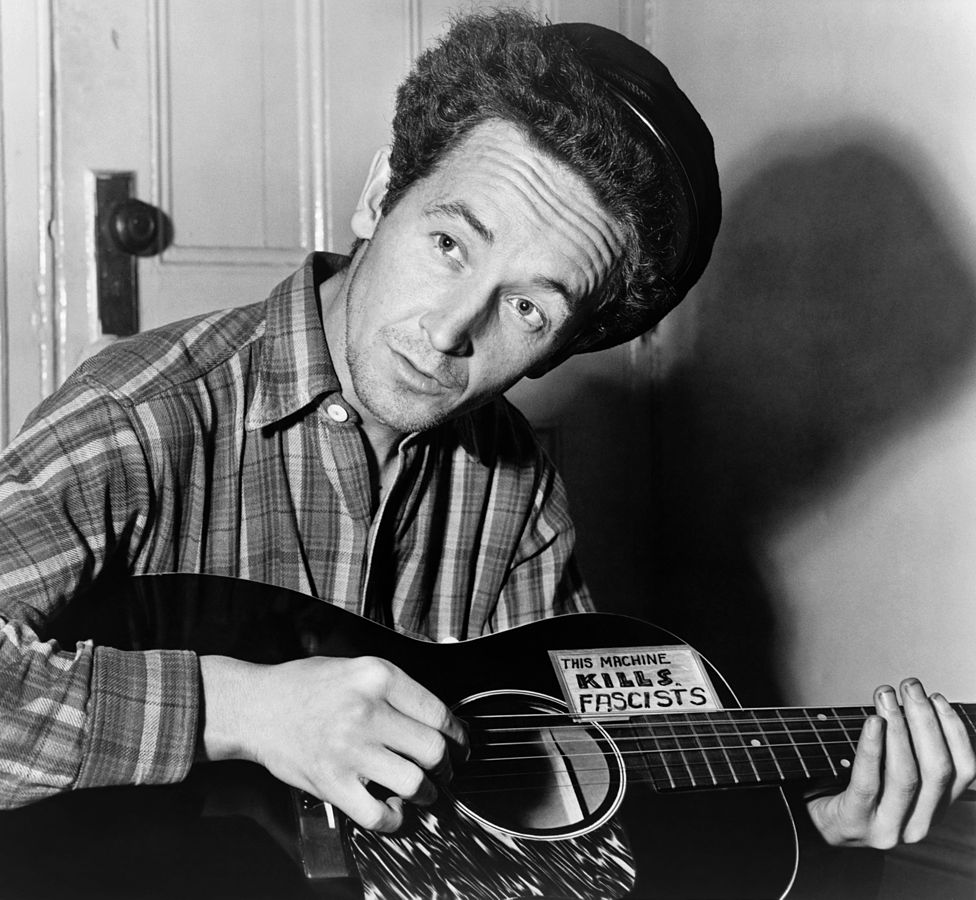
But whether socialist or populist in nature, Guthrie’s patriotism was always subversive. “By 1940,” writes John Pietaro, he had “joined forces with Pete Seeger in the Almanac Singers,” who “as a group, joined the Communist Party. Woody’s guitar had, by then, been adorned with the hand-painted epitaph, THIS MACHINE KILLS FASCISTS.” (Guthrie had at least two guitars with the slogan scrawled on them, one on a sticker and one with ragged hand-lettering.) The phrase, claims music critic Jonny Whiteside, was originally “a morale-boosting WWII government slogan printed on stickers that were handed out to defense plant workers.” Guthrie reclaimed the propaganda for folk music’s role in the culture. As Pietaro tells it:
In this time he also founded an inter-racial quartet with Leadbelly, Sonny Terry and Cisco Houston, a veritable super-group he named the Headline Singers. This group, sadly, never recorded. The material must have stood as the height of protest song—he’d named it in opposition to a producer who advised Woody to “stop trying to sing the headlines.” Woody told us that all you can write is what you see.
You can hear The Headline Singers above, minus Lead Belly and featuring Pete Seeger, in the early 1940’s radio broadcast of “All You Fascists Bound to Lose.” “I’m gonna tell you fascists,” sings Woody, “you may be surprised, people in this world are getting organized.” Upon joining the Merchant Marines, Guthrie fought against segregation in the military. After the war, he “stood shoulder to shoulder with Paul Robeson, Howard Fast, and Pete Seeger” against violent racist mobs in Peekskill, New York. Both of Guthrie’s anti-fascist guitars have seemingly disappeared. As Robert Santelli writes, “Guthrie didn’t care for his instruments with much love.” But during the decade of the 1940’s he was never seen without the slogan on his primary instrument.
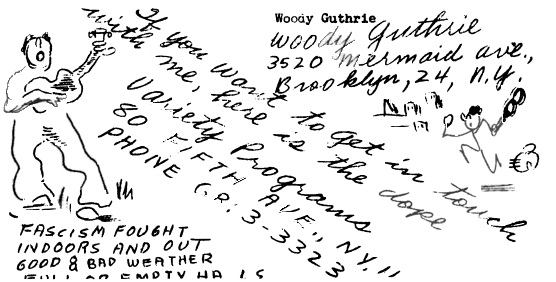
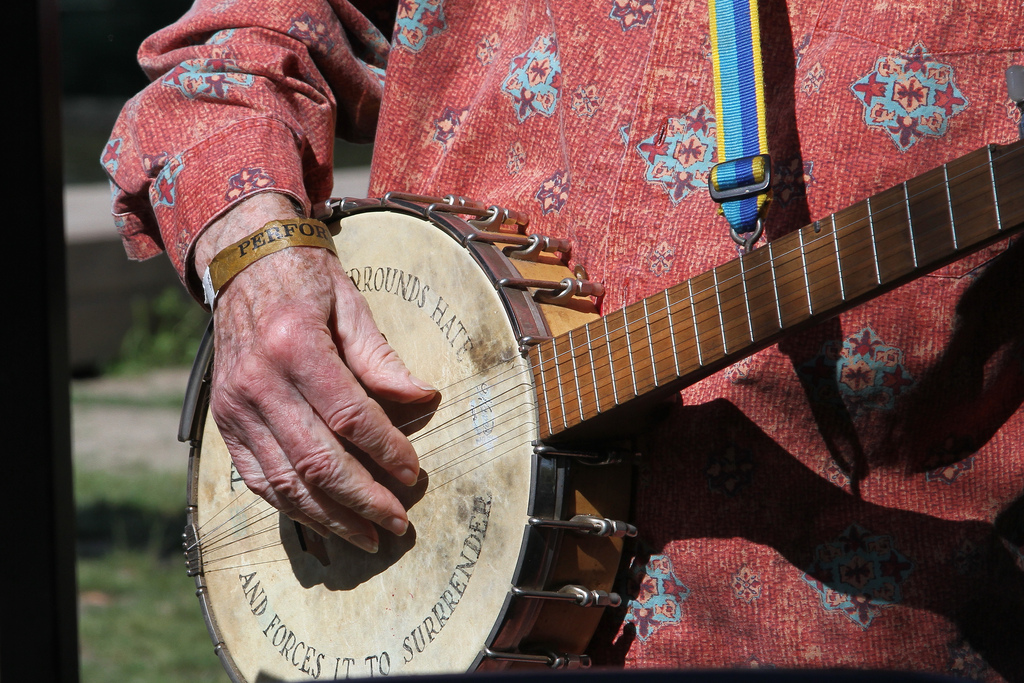
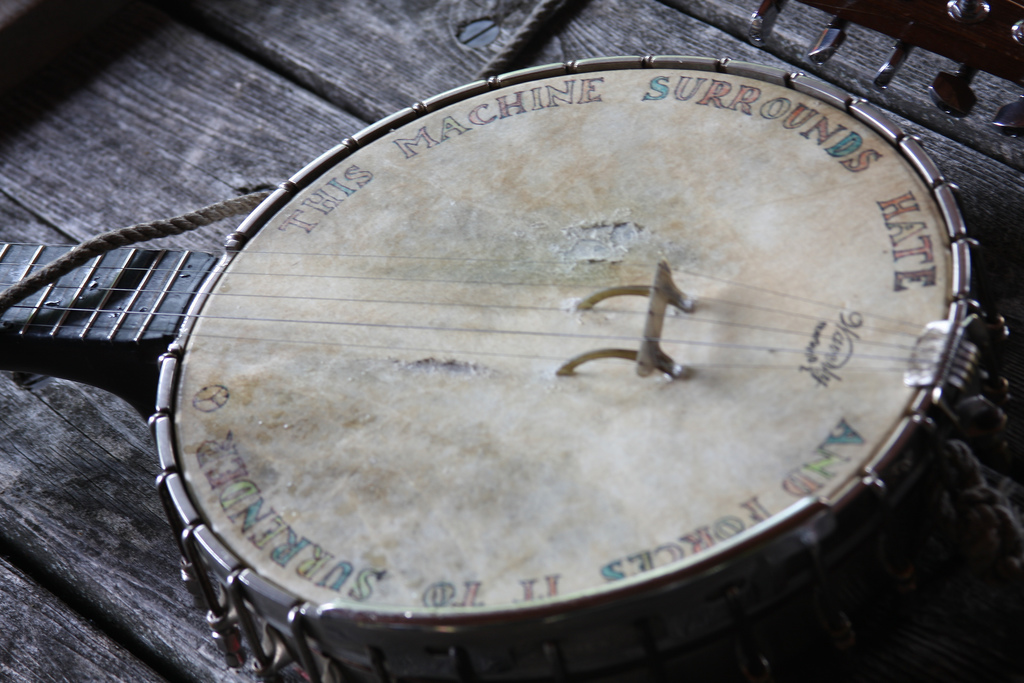
“This Machine Kills Fascists” has since, writes Motherboard, become Guthrie’s “trademark slogan… still referenced in pop culture and beyond” and providing an important point of reference for the anti-fascist punk movement. You can see another of Guthrie’s anti-fascist slogans above, which he scrawled on a collection of his sheet music: “Fascism fought indoors and out, good & bad weather.” Guthrie’s long-lived brother-in-arms Pete Seeger, carried on in the tradition of anti-fascism and anti-racism after Woody succumbed in the last two decades of his life to Huntington’s disease. Like Guthrie, Seeger painted a slogan around the rim of his instrument of choice, the banjo, a message both playful and militant: “This machine surrounds hate and forces it to surrender.”
Seeger carried the message from his days playing and singing with Guthrie, to his Civil Rights and anti-war organizing and protest in the 50s and 60s, and all the way into the 21st century at Occupy Wall Street in Manhattan in 2011. At the 2009 inauguration of Barack Obama, Seeger sang “This Land is Your Land” onstage with Bruce Springsteen and his son, Tao-Rodriquez Singer. In rehearsals, he insisted on singing the two verses Guthrie had omitted from the song after the war. “So it was,” writes John Nichols at The Nation, “that the newly elected president of the United States began his inaugural celebration by singing and clapping along with an old lefty who remembered the Depression-era references of a song that took a class-conscious swipe at those whose ‘Private Property’ signs turned away union organizers, hobos and banjo pickers.”
Both Guthrie and Seeger drew direct connections between the fascism and racism they fought and capitalism’s outsized, destructive obsession with land and money. They felt so strongly about the battle that they wore their messages figuratively on their sleeves and literally on their instruments. Pete Seeger’s famous banjo has outlived its owner, and the colorful legend around it has been mass-produced by Deering Banjos. Where Guthrie’s anti-fascist guitars went off to is anyone’s guess, but if one of them were ever discovered, Robert Santelli writes, “it surely would become one of America’s most valued folk instruments.” Or one of its most valued instruments in general.
Though his movies may have benefited greatly from foreign audiences and backers, David Lynch was one of the most thoroughly American of all filmmakers. “Born Missoula, MT,” declared his Twitter bio, yet one never really associates him with a particular place in the United States (at least no extant one). From Montana, the Lynch family moved to Idaho, then Washington, then North Carolina, then Virginia. The timing of that last stint proved culturally fortuitous indeed: living in the city of Alexandria, the eighteen-year-old Lynch was close enough to the nation’s capital to attend the very first concert the Beatles played in North America, at the Washington Coliseum on February 11, 1964.
“I was into rock and roll music, mainly Elvis Presley.” Lynch recalls this unsurprising fact in the clip above (which would have been among the last interviews he gave before his death a year ago) from Beatles ’64, the Martin Scorsese-produced documentary on the Fab Four’s first U.S. tour.
“I didn’t have any idea how big this event was. And it was in a gigantic place where they had boxing matches. The Beatles were in the boxing ring. It was so loud, you can’t believe. Girls shuddering, crying, screaming their heart out. It was phenomenal.” That deafening crowd noise figures into most every account of the group’s Beatlemania-era shows — and played a decisive role in their permanent retreat into the studio a couple of years later.
Lynch surely would have understood the desire for artistic exploration and control that drove the Beatles’ concentration on making records. Even the sensibilities of his work and theirs had something in common, exhibiting as they both did the unlikely combination of popularity and experimentation. Somehow, David Lynch’s films and the Beatles’ albums could venture into bewildering obscurity and sentimental kitsch without losing coherence or critical respect. And dare one imagine that the experience of witnessing the American debut of what would become the most influential rock band of all time has given Lynch his appreciation — evident in his movies, but also his own recordings — for the power of music, which he calls “one of the most fantastic things”? Even if not, it must have been, well… surreal.
Based in Seoul, Colin Marshall writes and broadcasts on cities, language, and culture. He’s the author of the newsletterBooks on Cities as well as the books 한국 요약 금지 (No Summarizing Korea) and Korean Newtro.Follow him on the social network formerly known as Twitter at @colinmarshall.
When the history books are written, we’ll remember the politicians, law firms, and CEOs who quickly bent the knee to Donald Trump. We’ll also remember the scant few American figures who refused to back down. Bruce Springsteen will be high on that short list.
Touring in Europe last summer, Springsteen warned his audience: “The America that I love, the America I have written about, that has been a beacon of hope and liberty for 250 years, is currently in the hands of a corrupt, incompetent and treasonous administration.” Those words seem particularly prescient given the chaos and violence now unfolding in Minnesota.
Following the shootings of Renee Good and Alex Pretti, Springsteen made his voice heard again—this time through music. Last week, he released the protest song “Streets of Minneapolis” and soon afterward traveled to Minnesota to perform the song live at a benefit concert arranged by Tom Morello. Speaking to the crowd, Springsteen said, “I wrote Streets of Minneapolis and recorded it the next day.” When he wondered if the song sounded too ‘soapboxy,’ he turned to Morello, and the Rage Against the Machine guitarist replied, “Bruce, nuance is wonderful, but sometimes you need to kick them in the teeth.” We’ll say amen to that.
After “Streets of Minneapolis,” Springsteen and Morello performed “The Ghost of Tom Joad.” Watch it above. The start of the show began with “Killing In The Name Of.” Catch it below.
As mentioned here last week, Scott Galloway argued that Americans have one way to reverse the violent overreach of the federal government: launch a one-month economic strike aimed at major tech and AI companies, with the goal of reducing America’s GDP and making the markets wobble. When the markets gyrated after “Liberation Day,” President Trump immediately rolled back many tariffs. Now, if Americans can flex their economic muscles in February, Galloway wagers the administration will rethink whether it wants to keep arresting journalists and letting masked ICE agents shoot civilians in the streets—with impunity.
Today, Galloway has launched a new website, Resist and Unsubscribe, that provides an action plan for a monthlong strike. In the “Ground Zero” section of the site, Galloway lists subscription services from America’s largest technology companies—Amazon, Meta, Google, Apple, Netflix, OpenAI, and Microsoft—and provides links that let users unsubscribe quickly. He also suggests holding off on buying new hardware and products from these companies (e.g. iPhones). If you use February to review your subscriptions and find ones to cut, you’ll clean up your personal finances. You’ll also get the attention of the major technology companies that account for one-third of the S&P 500. When the tech CEOs get “yippy,” so too will Trump.
In the “Blast Zone” section of Resist and Unsubscribe, Galloway lists consumer‑facing companies he has “identified as active enablers of ICE,” naming AT&T, Comcast, Lowe’s, Marriott, and Spotify among others. He explains how these companies support ICE and recommends specific services you can cancel or avoid. Scroll down the page to see these suggestions.
Visit Resist and Unsubscribe, find some services to cancel (it’s not a large sacrifice), and spread the word. You can also find more information about the Resist and Unsubscribe movement on Galloway’s blog, “No Mercy/No Malice.”
We're hoping to rely on loyal readers, rather than erratic ads. Please click the Donate button and support Open Culture. You can use Paypal, Venmo, Patreon, even Crypto! We thank you!
Open Culture scours the web for the best educational media. We find the free courses and audio books you need, the language lessons & educational videos you want, and plenty of enlightenment in between.




.jpg)
